 Скачать презентацию An introduction to Public Lending Right Jim Parker
672e194828403dd7305b8aad78af2d47.ppt
- Количество слайдов: 20



An introduction to Public Lending Right Jim Parker, PLR UK September 2010 Standard Presentation
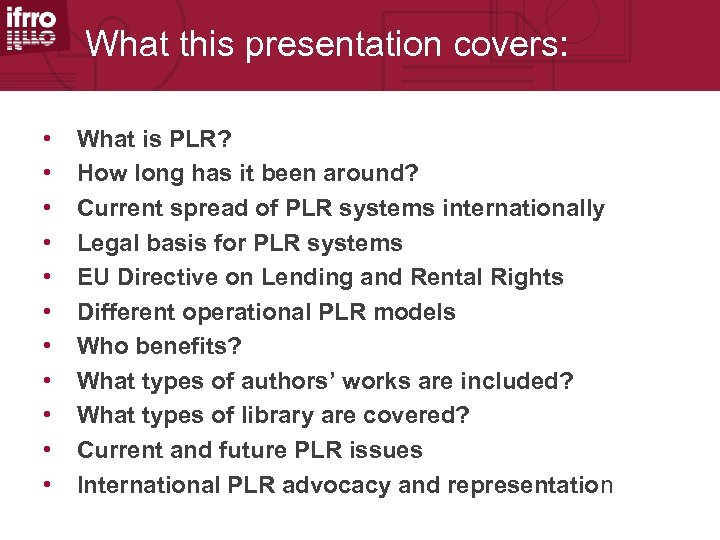
What this presentation covers: • What is PLR? • How long has it been around? • Current spread of PLR systems internationally • Legal basis for PLR systems • EU Directive on Lending and Rental Rights • Different operational PLR models • Who benefits? • What types of authors’ works are included? • What types of library are covered? • Current and future PLR issues • International PLR advocacy and representation
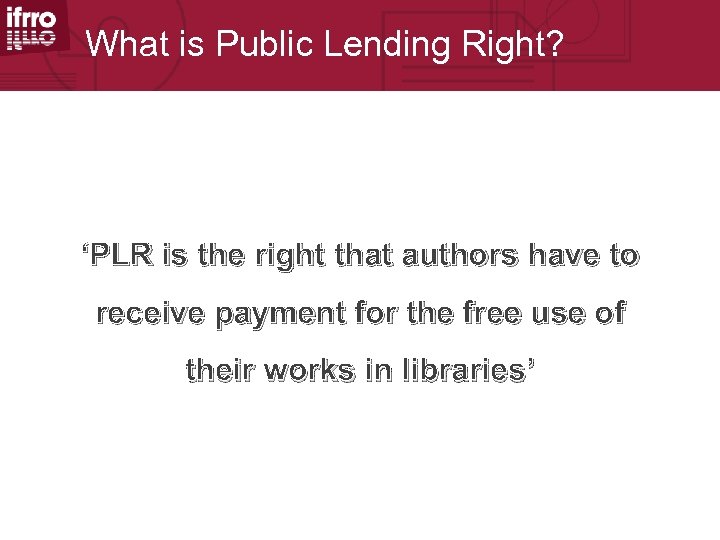
What is Public Lending Right? ‘PLR is the right that authors have to receive payment for the free use of their works in libraries’
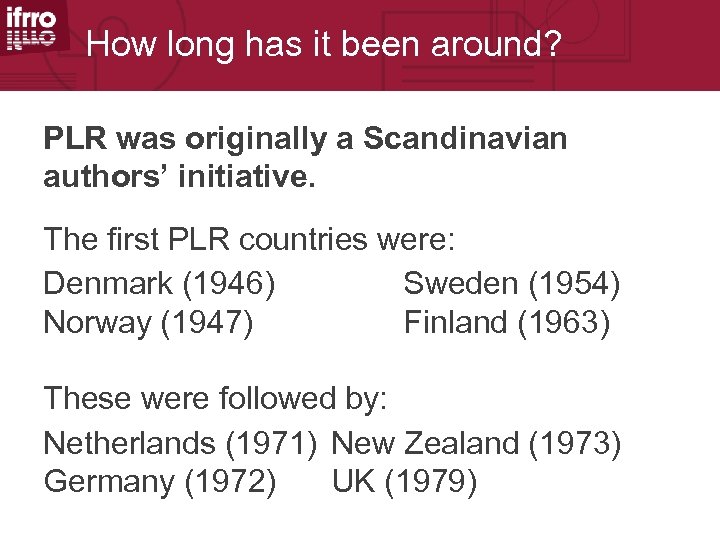
How long has it been around? PLR was originally a Scandinavian authors’ initiative. The first PLR countries were: Denmark (1946) Sweden (1954) Norway (1947) Finland (1963) These were followed by: Netherlands (1971) New Zealand (1973) Germany (1972) UK (1979)
Current spread of PLR systems How many countries have PLR? • Around 44 countries have recognised the PLR principle in their legislation • Of these 44, 29 have taken the next step and established PLR systems to enable payments to be made
Where are they? • Working systems mainly in Europe: 25 countries, including several of the newer EU Member States • Also in Australia, Canada, New Zealand Israel • Legislation (but no working system yet) in Burkina Faso, Mauritius, Ethiopia and Kazakhstan • No working PLR systems in Africa, South America, Asia • Current campaign for PLR in South Africa
Legal basis for PLR systems Copyright-based systems • Lending seen as a copyright exploitation of an author’s works • Licence fees negotiated with libraries or government • Systems administered by collective management organisations (CMOs) • Underpinned by the EU Directive on Lending and Rental
PLR as a remuneration right • 1992 Lending Right Directive allowed derogation from exclusive lending right • EU countries like the UK and Ireland provide for a statutory remuneration right • PLR administered by government body (PLR office in UK, Library Council in Ireland) • Outside Europe, countries like Australia and New Zealand have separate PLR legislation • Canada has a PLR system but not underpinned by legislation
PLR as state support for national culture • Scandinavian model – PLR paid to authors writing in country’s national language(s) • Language eligibility criterion not seen by the Commission as discrimination under EU law • Not copyright-based so national treatment does not apply but payment to authors in other countries if they write in the required languages
EU Directive on Lending Right What the Directive says • Passed 1992, and reconstituted in 2006 • Recognises lending as an exclusive right enabling rightsholders to licence or prohibit lending of their works • All member states and candidate states must implement the Directive in their national legislation • But the Directive includes flexibilities:
§ member states may derogate from an exclusive right provided that authors obtain remuneration for loans of their books § member states are free to determine this remuneration taking account of their cultural promotion objectives § member states may exempt certain categories of (library) establishment from the payment of remuneration
Impact of the Lending Directive on member states • There are now working PLR systems in 20 member states • European courts ruled against Belgium for noncompliance in 2003 • Spain, Italy, Portugal and Ireland found to have ‘improperly’ implemented the Directive by excluding public libraries in 2006 • Still no PLR systems in Portugal, Cyprus, Poland, Malta, Greece, Bulgaria and Romania
Different Operational Models for PLR Loans-based systems • Payments to authors related to how often works are lent out by libraries • This is the system in the UK, Ireland, Germany, Estonia and others • Payment based on a rate-per-loan • Payment therefore reflects public usage of works
Stock-based systems • Payments relate to the number of copies of an author’s works held by libraries • Examples include Australia, Canada, Denmark, New Zealand • Annual or periodic census of book stock for PLR purposes • In the past this system was cheaper to administer than a loans-based approach
Other calculation and payment models • Payment based on book purchases (France) • Payment based on payment per registered library user (Spain, Belgium, France) • Payments made as travel or study grants (Norway, Slovenia) • PLR funds going to authors’ pensions (France, Germany)
Who receives PLR payments? • Every PLR system benefits authors – writers, illustrators, editors, translators, etc. • PLR in UK and Ireland open to authors across the EEA • Germany, France, The Netherlands, etc. , pay authors in other countries under reciprocal agreements • Publishers get PLR payments in at least 9 countries • Germany and France pay publishers in other countries • The surviving family of dead authors have the right to their PLR in some countries for up to 70 years • Non-European PLR systems outside copyright tend to pay only to their own nationals
What works are covered by PLR? • Printed books are included everywhere • Talking books, CDs etc included in some countries • Ebooks now included in the UK since 2010 • Only literary and heritage books included in Canada
What types of library are included? • In the UK and many countries only public libraries are included • Australia covers both public and educational libraries • In Germany public and scientific libraries are included • In Iceland the Faroe Islands books held by public and school libraries and the National Library are included in PLR
Current and future PLR issues • Will ebooks issued by libraries be brought into PLR everywhere? • First steps down this route in the UK with Digital Economy Act Apr 2010 • Government funding for PLR – eg Canada has introduced variable payment rates to cope with expanded numbers; Hungary PLR funding postponed until 2012 • Will the Commission challenge the remaining non-PLR member states to implement the Lending Directive properly?
International PLR advocacy and representation • International PLR network set up in 1995 (www. plrinternational. com); contact its coordinator Jim Parker at jim. parker@plr. uk. com • Network holds two-yearly conferences: next one in Brussels Sept. 2011 • Periodic training seminars supported by the Network and EWC, and funded by Norwegian authors’ organisations Kopinor and NFF • IFRRO members’ sub-group on PLR set up in 2010
Скачать презентацию An introduction to Public Lending Right Jim Parker
672e194828403dd7305b8aad78af2d47.ppt