


 Скачать презентацию An Introduction to Preservation Metadata and the PREMIS
33fae1e29af9ad94d306725068616fa5.ppt
- Количество слайдов: 34
 An Introduction to Preservation Metadata and the PREMIS Data Dictionary Rebecca Guenther, Library of Congress ALA Midwinter 2009 Intellectual Access to Preservation Metadata Interest Group Sat. January 24, 2009
 Overview § What is preservation metadata? § Development of PREMIS § PREMIS data dictionary • Features of the data dictionary • Implementing PREMIS § PREMIS Maintenance Agency § Future directions
 Digital preservation: advances & remaining challenges § Groups around the world and conferences continue to make significant progress in raising awareness about digital preservation imperative § Gradual shift in focus from articulating problem to solving it … • Not so much “Why is digital preservation important” anymore; rather, “What must be done to achieve preservation objectives? ” § Many practical challenges in implementing reliable, sustainable digital preservation programs § One key implementation challenge: preservation metadata
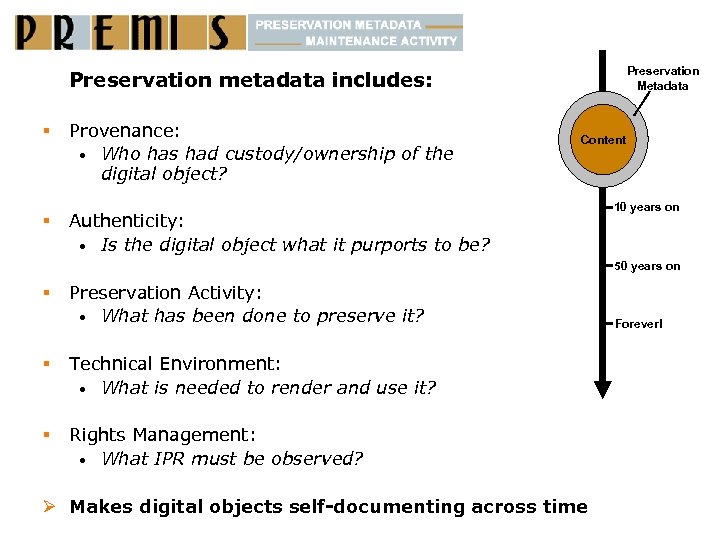 Preservation Metadata Preservation metadata includes: § § Provenance: • Who has had custody/ownership of the digital object? Content Authenticity: • Is the digital object what it purports to be? 10 years on 50 years on § Preservation Activity: • What has been done to preserve it? § Technical Environment: • What is needed to render and use it? § Rights Management: • What IPR must be observed? Ø Makes digital objects self-documenting across time Forever!
 What does PREMIS cover? § Administrative metadata that supports the digital preservation process § Provides information to help manage a resource for preservation purposes Technical characteristics • Information about actions on an object • Relationships (structural and derivative) • Structural: indicates how compound objects are put together • Derivative: results of common preservation actions • • Rights metadata associated with preservation
 Some background … § Pre-2002: various preservation metadata element sets released Different scopes, purposes, underlying models/assumptions • No international standard; little consolidation of expertise/best practice • § June 2002: Preservation Metadata Framework • • • § International working group (jointly sponsored by OCLC, RLG) Comprehensive, high-level description of types of information constituting preservation metadata Used OAIS reference model as starting point Set of “prototype” preservation metadata elements Consensus-based foundation for developing formal preservation metadata specifications … but not an “off-the-shelf, ready to implement” solution Post-2002: Need implementable preservation metadata, with guidelines for application and use, relevant to a wide range of digital preservation systems and contexts • Motivated formation of PREMIS Working Group
 PREMIS Working Group § June 2003: OCLC, RLG sponsored new international working group: • § PREMIS: Preservation Metadata: Implementation Strategies Membership: > 30 experts from 5 countries, representing libraries, museums, archives, government agencies, and the private sector • Co-Chairs: Priscilla Caplan (FCLA), Rebecca Guenther (LC) • § Objective 1: Identify and evaluate alternative strategies for encoding, storing, managing, and exchanging preservation metadata PREMIS Survey Report (September 2004) • Snapshot of current practices/emerging trends related to managing and using preservation metadata in digital archiving systems • http: //www. oclc. org/research/projects/pmwg/surveyreport. pdf • § Objective 2: Define implementable, core preservation metadata, with guidelines/recommendations for management and use
 PREMIS Data Dictionary § May 2005: Data Dictionary for Preservation Metadata: Final Report of the PREMIS Working Group § March 2008: PREMIS Data Dictionary for Preservation Metadata, version 2. 0 § Includes PREMIS Data Dictionary, context/assumptions, data model, usage § XML schema to support implementation § Data Dictionary: examples Comprehensive view of information needed to support digital preservation • Guidelines/recommendations to support creation, use, management • Based on deep pool of institutional experiences in setting up and managing operational capacity for digital preservation • http: //www. loc. gov/standards/premis/v 2/premis-2 -0. pdf
 2005 British Conservation Awards: Digital Preservation Award 2006 Society of American Archivists Preservation Publication Award
 Some guiding principles … § “Implementable, core, preservation metadata”: “Preservation metadata”: maintain viability, renderability, understandability, authenticity, identity in a preservation context • “Core”: What most preservation repositories need to know to preserve digital materials over the long-term • “Implementable”: rigorously defined; supported by usage guidelines/recommendations; emphasis on automated workflows • § “Technical neutrality”: Digital archiving system: no assumptions about specific archiving technology, system/DB architectures, preservation strategy • Metadata management: no assumptions about whether metadata is stored locally or in external registry; recorded explicitly or known implicitly; instantiated in one metadata element or multiple elements • Promotes flexibility, applicability in wide range of contexts •
 Scope of data dictionary § Implementation independent § Descriptive metadata out of scope § Technical metadata applying to all or most format types § Media or hardware details are limited § Business rules are essential for working repositories, but not covered § Rights information for preservation actions, not access
 What PREMIS is and is not § What PREMIS is: Common data model for organizing/thinking about preservation metadata • A checklist for core metadata in a repository • Guidance for local implementations • Standard for exchanging information packages between repositories • § What PREMIS is not: Out-of-the-box solution: need to instantiate as metadata elements in repository system • All needed metadata: excludes business rules, format-specific technical metadata, descriptive metadata for access, non-core preservation metadata • Lifecycle management of objects outside repository • Rights management: limited to permissions regarding actions taken within repository •
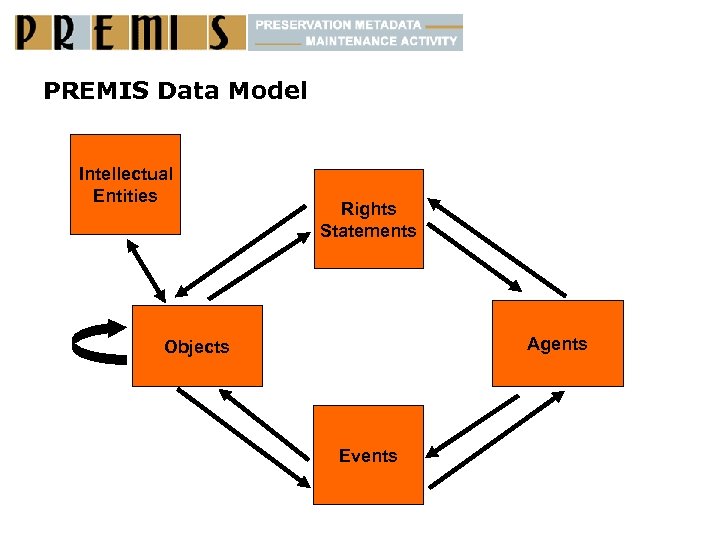 PREMIS Data Model Intellectual Entities Rights Statements Agents Objects Events
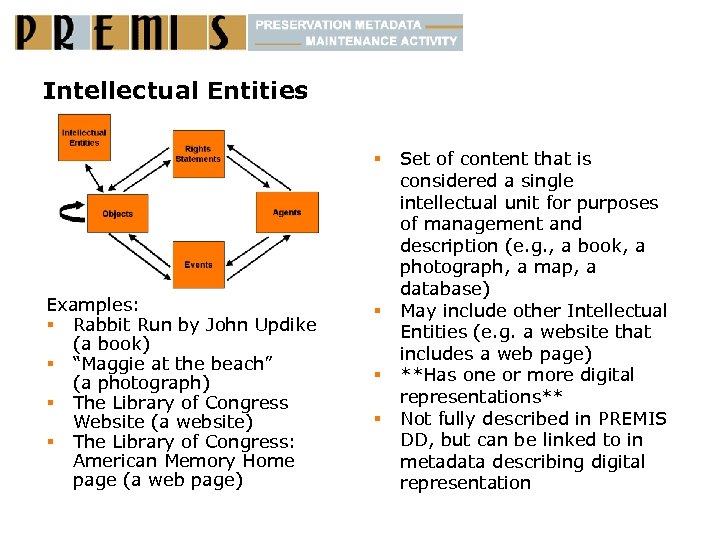 Intellectual Entities § Examples: § Rabbit Run by John Updike (a book) § “Maggie at the beach” (a photograph) § The Library of Congress Website (a website) § The Library of Congress: American Memory Home page (a web page) § § § Set of content that is considered a single intellectual unit for purposes of management and description (e. g. , a book, a photograph, a map, a database) May include other Intellectual Entities (e. g. a website that includes a web page) **Has one or more digital representations** Not fully described in PREMIS DD, but can be linked to in metadata describing digital representation
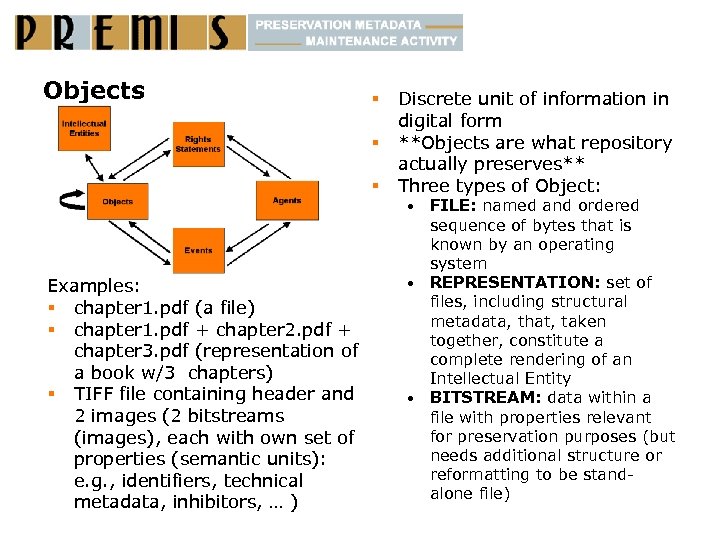 Objects § § § Discrete unit of information in digital form **Objects are what repository actually preserves** Three types of Object: FILE: named and ordered sequence of bytes that is known by an operating system • REPRESENTATION: set of files, including structural metadata, that, taken together, constitute a complete rendering of an Intellectual Entity • BITSTREAM: data within a file with properties relevant for preservation purposes (but needs additional structure or reformatting to be standalone file) • Examples: § chapter 1. pdf (a file) § chapter 1. pdf + chapter 2. pdf + chapter 3. pdf (representation of a book w/3 chapters) § TIFF file containing header and 2 images (2 bitstreams (images), each with own set of properties (semantic units): e. g. , identifiers, technical metadata, inhibitors, … )
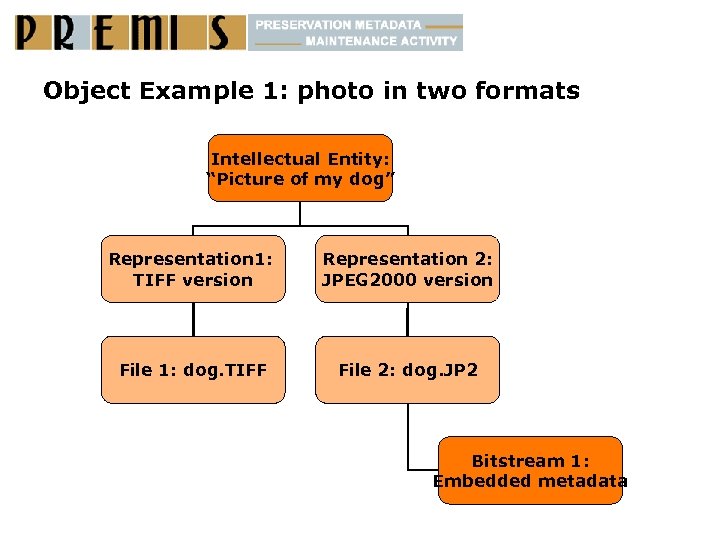 Object Example 1: photo in two formats Intellectual Entity: “Picture of my dog” Representation 1: TIFF version Representation 2: JPEG 2000 version File 1: dog. TIFF File 2: dog. JP 2 Bitstream 1: Embedded metadata
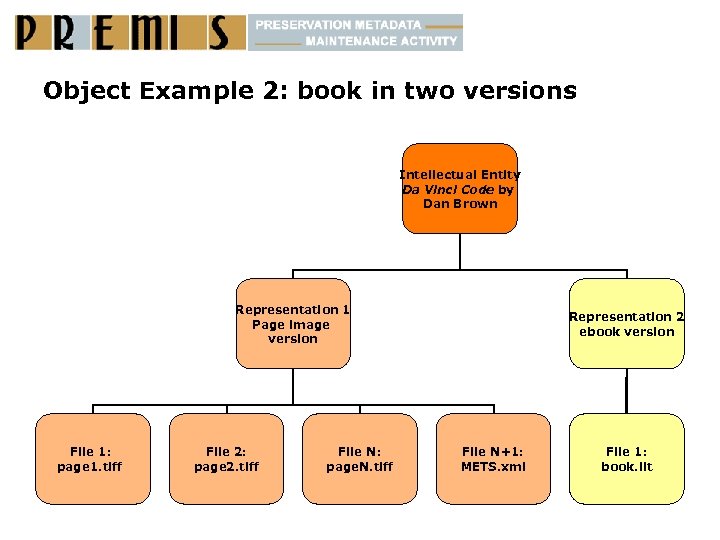 Object Example 2: book in two versions Intellectual Entity Da Vinci Code by Dan Brown Representation 1 Page image version File 1: page 1. tiff File 2: page 2. tiff File N: page. N. tiff Representation 2 ebook version File N+1: METS. xml File 1: book. lit
 An important aside about Objects § Repository does NOT have to control Objects at all levels • E. g. , repository may only manage files, not representations or bit streams. § The PREMIS DD tells you: IF you control at the representation level, these are the semantic units (properties) that pertain to representations; • IF you control at the file level, these are the semantic units (properties) that pertain to files; • IF you control at the bitstream level, these are the semantic units (properties) that pertain to bit streams; • AND IF you control at multiple levels, you need to record relationships between them •
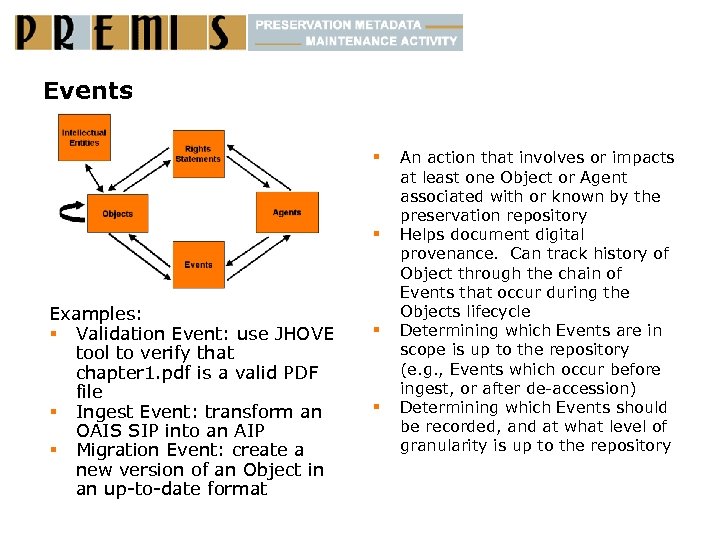 Events § § Examples: § Validation Event: use JHOVE tool to verify that chapter 1. pdf is a valid PDF file § Ingest Event: transform an OAIS SIP into an AIP § Migration Event: create a new version of an Object in an up-to-date format § § An action that involves or impacts at least one Object or Agent associated with or known by the preservation repository Helps document digital provenance. Can track history of Object through the chain of Events that occur during the Objects lifecycle Determining which Events are in scope is up to the repository (e. g. , Events which occur before ingest, or after de-accession) Determining which Events should be recorded, and at what level of granularity is up to the repository
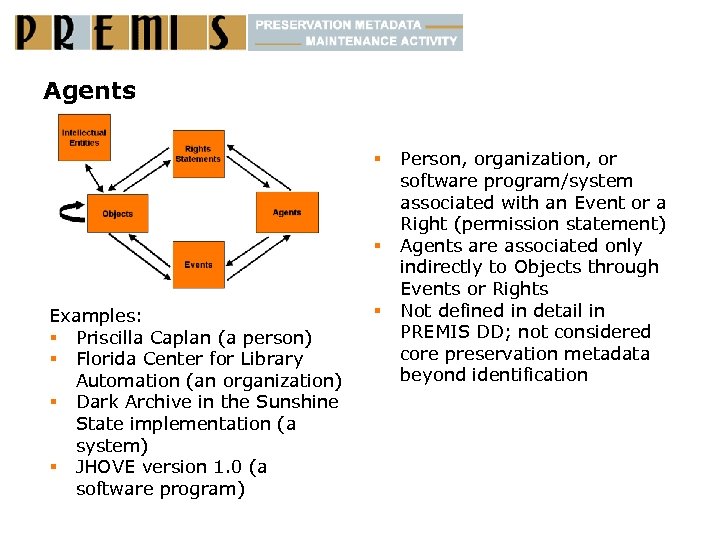 Agents § § Examples: § Priscilla Caplan (a person) § Florida Center for Library Automation (an organization) § Dark Archive in the Sunshine State implementation (a system) § JHOVE version 1. 0 (a software program) § Person, organization, or software program/system associated with an Event or a Right (permission statement) Agents are associated only indirectly to Objects through Events or Rights Not defined in detail in PREMIS DD; not considered core preservation metadata beyond identification
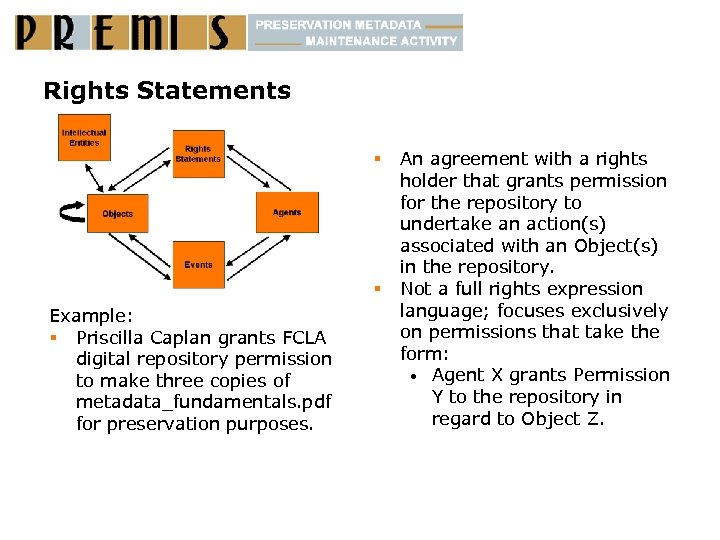 Rights Statements § § Example: § Priscilla Caplan grants FCLA digital repository permission to make three copies of metadata_fundamentals. pdf for preservation purposes. An agreement with a rights holder that grants permission for the repository to undertake an action(s) associated with an Object(s) in the repository. Not a full rights expression language; focuses exclusively on permissions that take the form: • Agent X grants Permission Y to the repository in regard to Object Z.
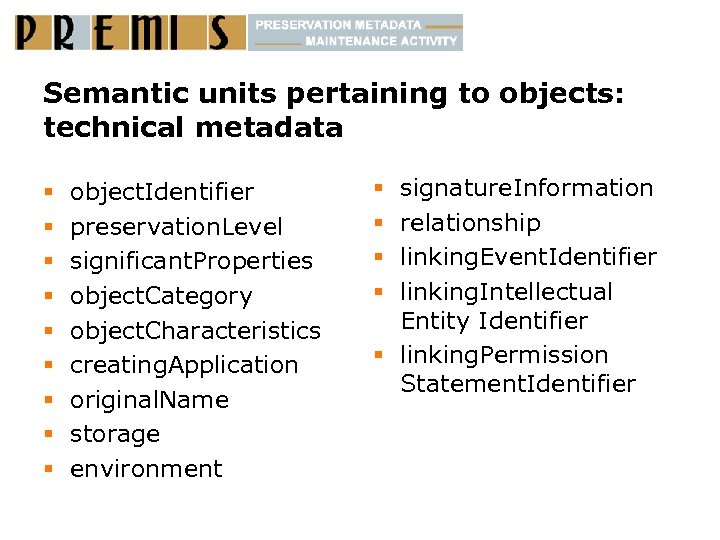 Semantic units pertaining to objects: technical metadata § § § § § object. Identifier preservation. Level significant. Properties object. Category object. Characteristics creating. Application original. Name storage environment signature. Information relationship linking. Event. Identifier linking. Intellectual Entity Identifier § linking. Permission Statement. Identifier § §
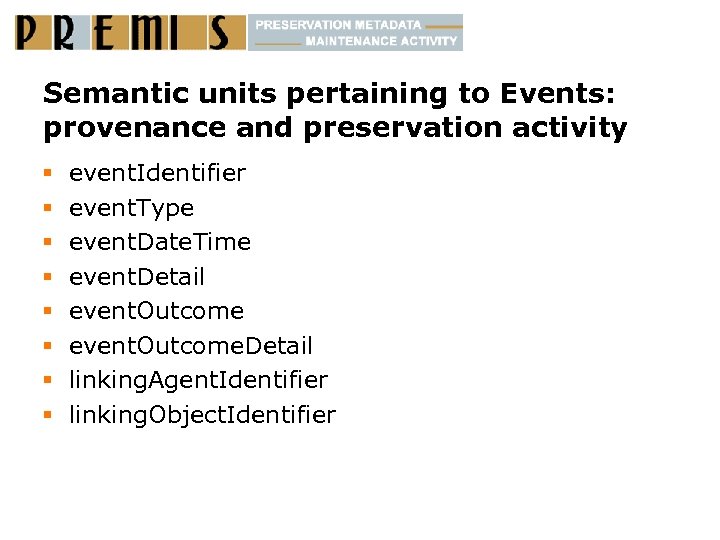 Semantic units pertaining to Events: provenance and preservation activity § § § § event. Identifier event. Type event. Date. Time event. Detail event. Outcome. Detail linking. Agent. Identifier linking. Object. Identifier
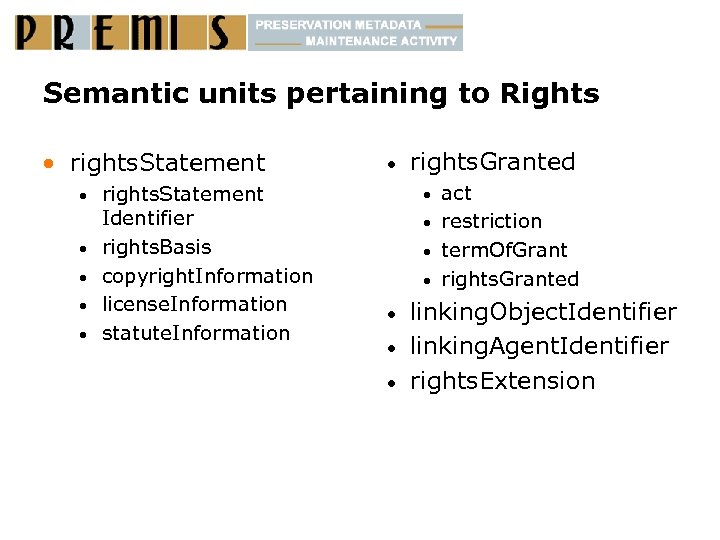 Semantic units pertaining to Rights · rights. Statement · · · rights. Statement Identifier rights. Basis copyright. Information license. Information statute. Information · rights. Granted act · restriction · term. Of. Grant · rights. Granted · linking. Object. Identifier · linking. Agent. Identifier · rights. Extension ·
 Semantic units pertaining to Agents § agent. Identifier § agent. Name § agent. Type
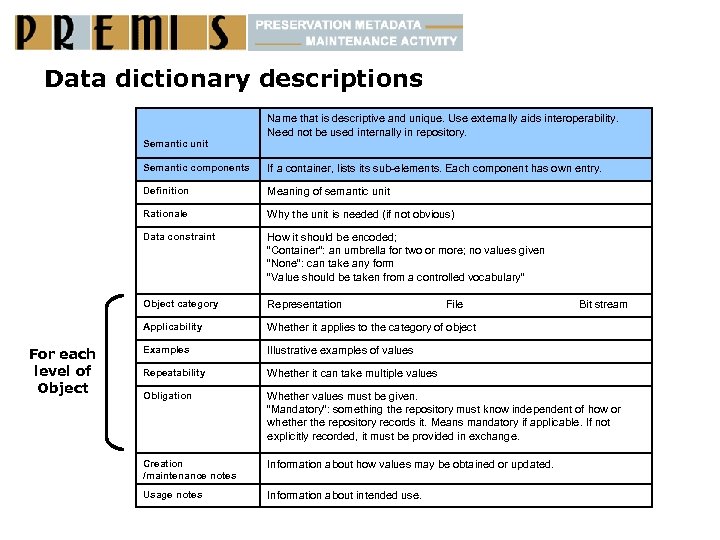 Data dictionary descriptions Semantic unit Name that is descriptive and unique. Use externally aids interoperability. Need not be used internally in repository. Semantic components Definition Meaning of semantic unit Rationale Why the unit is needed (if not obvious) Data constraint How it should be encoded; ”Container”: an umbrella for two or more; no values given ”None”: can take any form ”Value should be taken from a controlled vocabulary” Object category Representation Applicability For each level of Object If a container, lists its sub-elements. Each component has own entry. Whether it applies to the category of object Examples Illustrative examples of values Repeatability Whether it can take multiple values Obligation Whether values must be given. ”Mandatory”: something the repository must know independent of how or whether the repository records it. Means mandatory if applicable. If not explicitly recorded, it must be provided in exchange. Creation /maintenance notes Information about how values may be obtained or updated. Usage notes Information about intended use. File Bit stream
 Sample Data Dictionary entry
 Community interest § PREMIS Data Dictionary product of collaboration and consensus PREMIS membership reflects variety of institutions, domains, countries • Multiplicity of perspectives promotes applicability in multiplicity of contexts • Digital preservation is a shared problem; this invites shared solutions • § Data Dictionary useful to any institution or organization committed to the long-term preservation of digital materials
 PREMIS Maintenance Activity § Web site: Permanent Web presence, hosted by Library of Congress • Central destination for PREMIS-related info, announcements, resources • Home of the PREMIS Implementers’ Group (PIG) discussion list • § PREMIS Editorial Committee: Set directions/priorities for PREMIS development • Coordinate future revisions of Data Dictionary and XML schema • Promote implementation • Membership: Library of Congress, OCLC, FCLA, British Library, Library and Archives Canada, BSt. U (Germany), MIT/DSpace • http: //www. loc. gov/standards/premis/
 Activities § First revision of Data Dictionary (PREMIS 2. 0) Revised by EC and released in late March • Changes based on extensive discussions with implementers and on Editorial Committee • § Guidelines for using PREMIS with METS (draft available at: ) • http: //www. loc. gov/premis/guidelines-premismets. html § PREMIS Implementers’ Registry • http: //www. loc. gov/premis-registry. html § Developing controlled vocabularies in LC registry § PREMIS Tutorials: Previous: Glasgow, Boston, Stockholm, Albuquerque, Washington, San Diego • Upcoming: Rome in Feb. • § Current consultancies: Understanding PREMIS • Tool for converting PREMIS to METS/PREMIS and vice versa •
 Some implementers … § DAITTSS (Florida): a preservation repository for the use of the libraries of the public universities of Florida. Uses a locallydeveloped software application (DAITSS), which implements most of the PREMIS data elements. § Ex Libris (Digi. Tool): an enterprise solution for the management of digital assets in libraries and academic environments consisting of a number of modules, each designed to address different needs, functions, and workflows pertaining to the life cycle of a digital object • British Library electronic journal archiving project: uses METS, MODS, PREMIS for information packages § For more information see: • http: //www. loc. gov/premis-registry. html
 Why is PREMIS important to catalogers? § § § As we take responsibility for more digital materials, we need to ensure that they can be used in the future Most preservation metadata will be generated from the object, but catalogers may need to verify its accuracy Catalogers may need to play a role in assessing and organizing digital materials • Understanding the structure of complex digital objects • Determining significant properties that need to be preserved
 Conclusions § PREMIS Data Dictionary provides critical piece of reliable digital preservation infrastructure comprised of technology, standards, and best practice § PREMIS was produced from an international, cross-domain, consensus-building process and is applicable to any preservation effort § PREMIS Data Dictionary is a building block with which effective, sustainable digital preservation strategies can be implemented § PREMIS Data Dictionary tightly focused on implementation: • Practical implementation was guiding principle in all discussions • Developed tools (XML schema) to support implementation; released with Data Dictionary • Further work with encouragement for international participation and tools development is ongoing Ø Unglamorous but necessary infrastructure!
 URLs, etc. § PREMIS Maintenance Activity: http: //www. loc. gov/standards/premis/ § PREMIS Data Dictionary for Preservation Metadata: http: //www. loc. gov/standards/premis/v 2/premis-2 -0. pdf § PREMIS Implementation Registry http: //www. loc. gov/standards/premis-registry. php § PREMIS Implementers Group list http: //listserv. loc. gov/listarch/pig. html