


 Скачать презентацию An Introduction to Persuasion and Argument Moving people
d915f0bcd507121acafbd15a48988565.ppt
- Количество слайдов: 15
 An Introduction to Persuasion and Argument Moving people to a belief, position, or course of action Adapted from Mike Mc. Guire’s Com 101 class notes, MV Community College
 Persuasion vs. Argument • Persuasion and argument are often used interchangeably • Persuasion is a broad term, which includes many tactics designed to move people to a position, a belief, or a course of action • Argument is a specific kind of persuasion based on the principles of logic and reasoning
 The Importance of Argument and Persuasion • In everyday life… Appealing a grade, asking for a raise, applying for a job, negotiating the price of a new car, arguing in traffic court • In academic life… Defending your ideas, engaging intellectual debate • On the job… Getting people to listen to your ideas, winning buy-in, getting your boss to notice, getting cooperation, moving people to action • In writing… Irrefutably making your point, writing to be read • In reading and listening… Critically evaluating other’s arguments, protecting yourself from unethical persuasive tactics, recognizing faulty reasoning when you see it.
 What exactly is an Argument? • An argument involves the process of establishing a claim and then proving it with the use of logical reasoning, examples, and research.
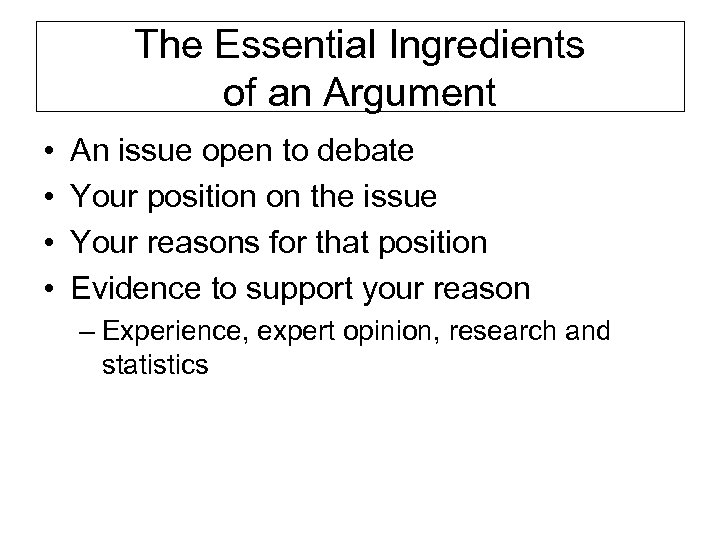 The Essential Ingredients of an Argument • • An issue open to debate Your position on the issue Your reasons for that position Evidence to support your reason – Experience, expert opinion, research and statistics
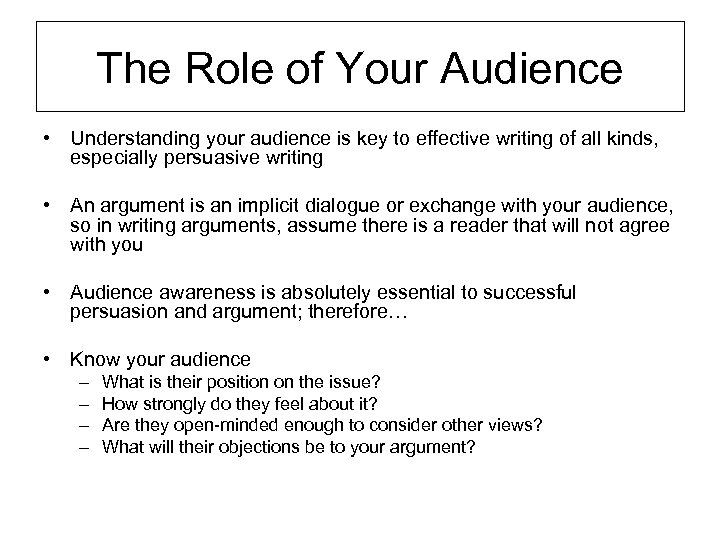 The Role of Your Audience • Understanding your audience is key to effective writing of all kinds, especially persuasive writing • An argument is an implicit dialogue or exchange with your audience, so in writing arguments, assume there is a reader that will not agree with you • Audience awareness is absolutely essential to successful persuasion and argument; therefore… • Know your audience – – What is their position on the issue? How strongly do they feel about it? Are they open-minded enough to consider other views? What will their objections be to your argument?
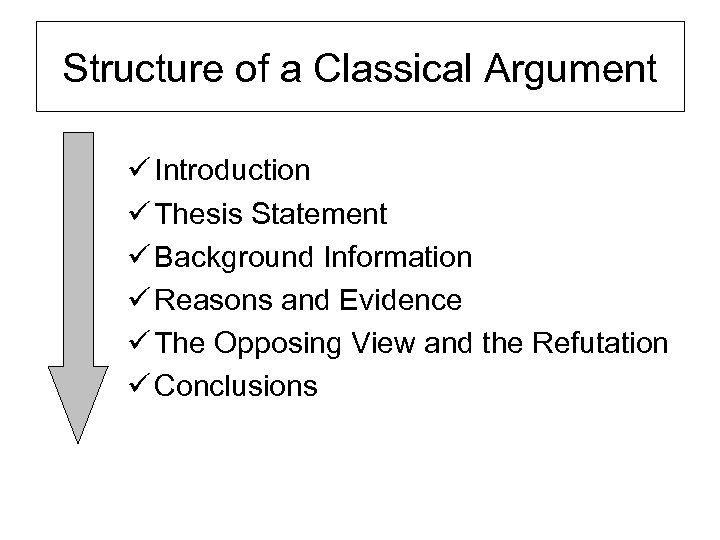 Structure of a Classical Argument ü Introduction ü Thesis Statement ü Background Information ü Reasons and Evidence ü The Opposing View and the Refutation ü Conclusions
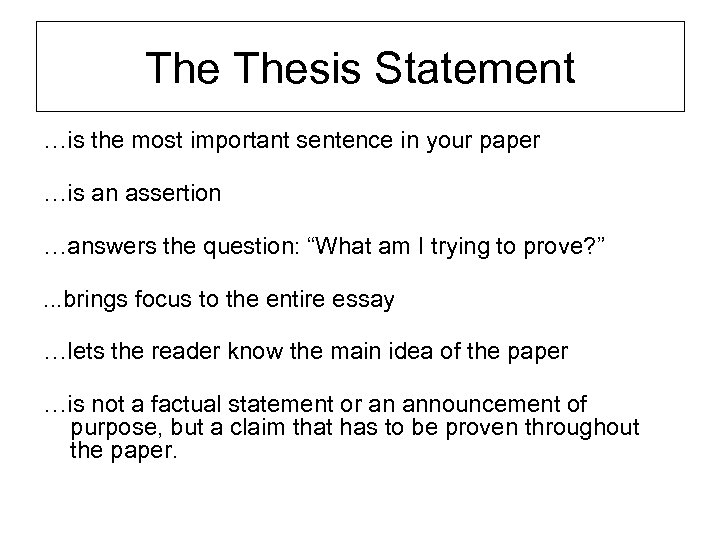 The Thesis Statement …is the most important sentence in your paper …is an assertion …answers the question: “What am I trying to prove? ”. . . brings focus to the entire essay …lets the reader know the main idea of the paper …is not a factual statement or an announcement of purpose, but a claim that has to be proven throughout the paper.
 Example: Which thesis statement • Parents, often too busy to watch television shows with their families, can monitor their children’s viewing habits with the aid of the V-chip. • To help parents monitor their children’s viewing habits, the V-chip should be a required feature for television sets sold in the U. S. • This paper will describe a V-chip and examine the uses of the V-chip in American-made television sets.
 Using a Reasonable Tone • Shows you are fair-minded and therefore adds to your credibility • When you acknowledge the opposition with balanced language, it shows that your respect the opposing views • No matter how passionate you are about the issue, don’t resort to careless, harsh words; this would show more about your than the issue
 Offering a Counterargument • Addressing the opposition demonstrates your credibility as a writer • It shows that you have researched multiple sides of the argument and have come to an informed decision • Remember, keep a balanced tone when attempting to debunk the opposition
 Counter-arguing Effectively • Conceding to some of your opposition’s concerns can demonstrate respect for their opinions • Remain tactful yet firm – using rude or deprecating language can cause your audience to reject your position without carefully considering your claims
 The Big 3 • Ethos: If people believe and trust in you, which helps your persuasion. • Pathos: Getting people to feel happy, sad, or angry to help your argument. • Logos: Facts, numbers, and information appealing to the audience
 A Different Perspective • Media Clip
 “Selling it!” • Your teacher does not want to accept your late work. • Your parents do not want to let you go to the movies. • You really want those expensive shoes, but don’t have enough money. • Your brother is watching the game, and your favorite show is about to come on.