


 Скачать презентацию An Introduction to Peer-to-Peer Networks Presentation for MIE
e43e01b8337d35da3f5aa42cd1a362a4.ppt
- Количество слайдов: 35
 An Introduction to Peer-to-Peer Networks Presentation for MIE 456 - Information Systems Infrastructure II Vinod Muthusamy October 30, 2003
 Agenda n Overview of P 2 P n n n Unstructured P 2 P systems n n Napster (Centralized) Gnutella (Distributed) Kazaa/Fasttrack (Super-peers) Structured P 2 P systems (DHTs) n n Characteristics Benefits Chord Pastry CAN Conclusions
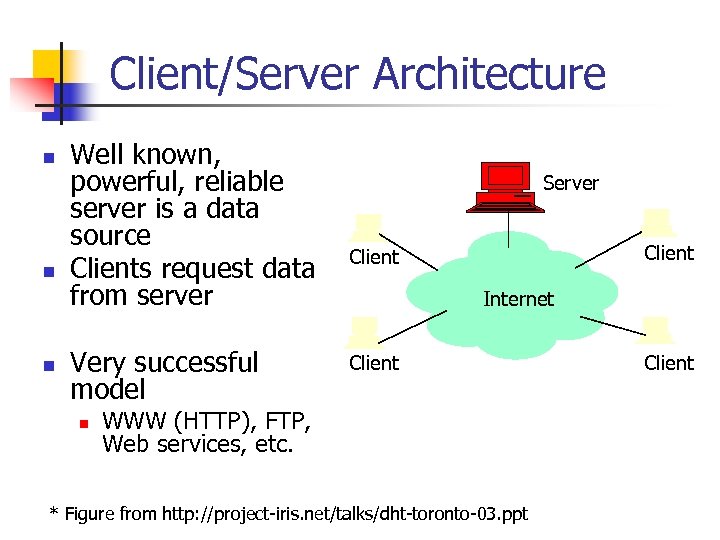 Client/Server Architecture n n n Well known, powerful, reliable server is a data source Clients request data from server Very successful model n Server Client Internet Client WWW (HTTP), FTP, Web services, etc. * Figure from http: //project-iris. net/talks/dht-toronto-03. ppt Client
 Client/Server Limitations n Scalability is hard to achieve Presents a single point of failure Requires administration Unused resources at the network edge n P 2 P systems try to address these limitations n n n
 P 2 P Computing* n n n P 2 P computing is the sharing of computer resources and services by direct exchange between systems. These resources and services include the exchange of information, processing cycles, cache storage, and disk storage for files. P 2 P computing takes advantage of existing computing power, computer storage and networking connectivity, allowing users to leverage their collective power to the ‘benefit’ of all. * From http: //www-sop. inria. fr/mistral/personnel/Robin. Groenevelt/ Publications/Peer-to-Peer_Introduction_Feb. ppt
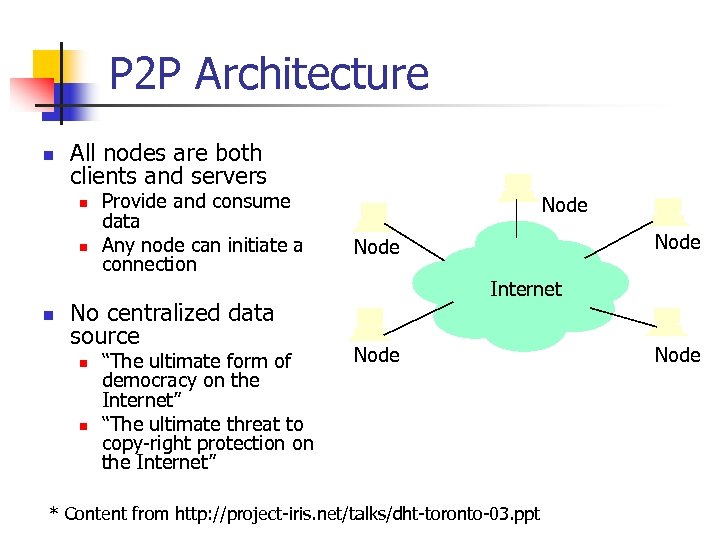 P 2 P Architecture n All nodes are both clients and servers n n n Provide and consume data Any node can initiate a connection No centralized data source n n “The ultimate form of democracy on the Internet” “The ultimate threat to copy-right protection on the Internet” Node Internet Node * Content from http: //project-iris. net/talks/dht-toronto-03. ppt Node
 P 2 P Network Characteristics n Clients are also servers and routers n n n Nodes contribute content, storage, memory, CPU Nodes are autonomous (no administrative authority) Network is dynamic: nodes enter and leave the network “frequently” Nodes collaborate directly with each other (not through well-known servers) Nodes have widely varying capabilities
 P 2 P Benefits n Efficient use of resources n n Scalability n n n Consumers of resources also donate resources Aggregate resources grow naturally with utilization Reliability n n Unused bandwidth, storage, processing power at the edge of the network Replicas Geographic distribution No single point of failure Ease of administration n Nodes self organize No need to deploy servers to satisfy demand (c. f. scalability) Built-in fault tolerance, replication, and load balancing
 P 2 P Applications n Are these P 2 P systems? n File sharing (Napster, Gnutella, Kazaa) n Multiplayer games (Unreal Tournament, DOOM) n Collaborative applications (ICQ, shared whiteboard) n Distributed computation (Seti@home) n Ad-hoc networks
 Popular P 2 P Systems n Napster, Gnutella, Kazaa, Freenet n Large scale sharing of files. n n n User A makes files (music, video, etc. ) on their computer available to others User B connects to the network, searches for files and downloads files directly from user A Issues of copyright infringement
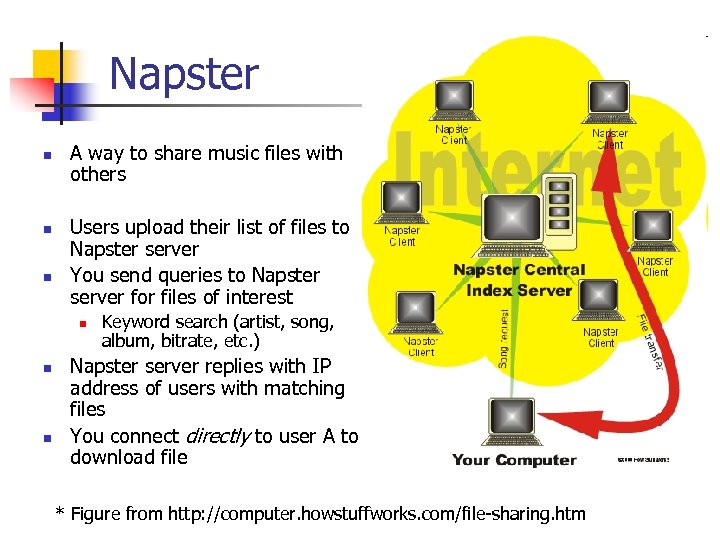 Napster n n n A way to share music files with others Users upload their list of files to Napster server You send queries to Napster server for files of interest n n n Keyword search (artist, song, album, bitrate, etc. ) Napster server replies with IP address of users with matching files You connect directly to user A to download file * Figure from http: //computer. howstuffworks. com/file-sharing. htm
 Napster n Central Napster server n n Can ensure correct results Bottleneck for scalability Single point of failure Susceptible to denial of service n n Malicious users Lawsuits, legislation Search is centralized File transfer is direct (peer-to-peer)
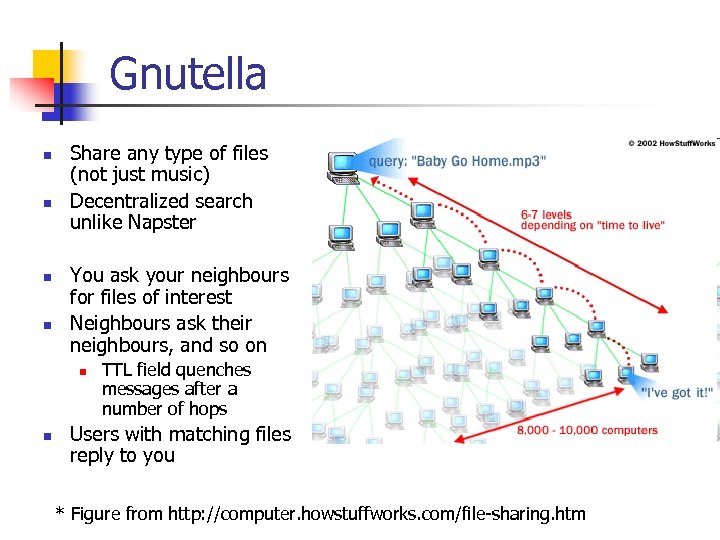 Gnutella n n Share any type of files (not just music) Decentralized search unlike Napster You ask your neighbours for files of interest Neighbours ask their neighbours, and so on n n TTL field quenches messages after a number of hops Users with matching files reply to you * Figure from http: //computer. howstuffworks. com/file-sharing. htm
 Gnutella n Decentralized n n No single point of failure Not as susceptible to denial of service Cannot ensure correct results Flooding queries n Search is now distributed but still not scalable
 Kazaa (Fasttrack network) n Hybrid of centralized Napster and decentralized Gnutella n Super-peers act as local search hubs n n n Each super-peer is similar to a Napster server for a small portion of the network Super-peers are automatically chosen by the system based on their capacities (storage, bandwidth, etc. ) and availability (connection time) Users upload their list of files to a super-peer Super-peers periodically exchange file lists You send queries to a super-peer for files of interest
 Free riding* n File sharing networks rely on users sharing data n Two types of free riding n n n Downloading but not sharing any data Not sharing any interesting data On Gnutella n n 15% of users contribute 94% of content 63% of users never responded to a query n Didn’t have “interesting” data * Data from E. Adar and B. A. Huberman (2000), “Free Riding on Gnutella”
 Anonymity n Napster, Gnutella, Kazaa don’t provide anonymity n n n Users know who they are downloading from Others know who sent a query Freenet n Designed to provide anonymity among other features
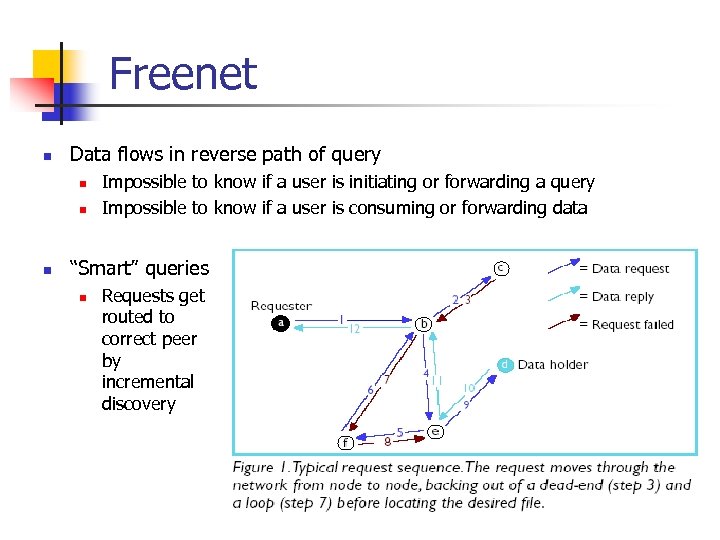 Freenet n Data flows in reverse path of query n n n Impossible to know if a user is initiating or forwarding a query Impossible to know if a user is consuming or forwarding data “Smart” queries n Requests get routed to correct peer by incremental discovery
 Structured P 2 P n n n Second generation P 2 P overlay networks Self-organizing Load balanced Fault-tolerant Scalable guarantees on numbers of hops to answer a query n n Major difference with unstructured P 2 P systems Based on a distributed hash table interface
 Distributed Hash Tables (DHT) n n Distributed version of a hash table data structure Stores (key, value) pairs n n n The key is like a filename The value can be file contents Goal: Efficiently insert/lookup/delete (key, value) pairs Each peer stores a subset of (key, value) pairs in the system Core operation: Find node responsible for a key n n Map key to node Efficiently route insert/lookup/delete request to this node
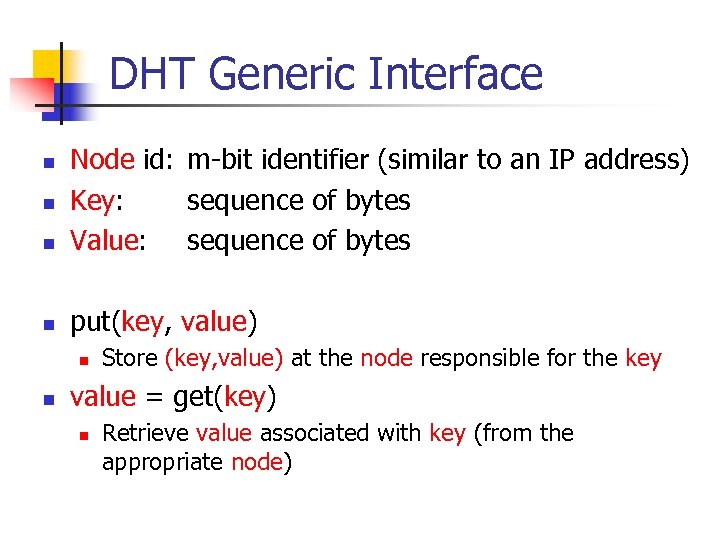 DHT Generic Interface n Node id: m-bit identifier (similar to an IP address) Key: sequence of bytes Value: sequence of bytes n put(key, value) n n Store (key, value) at the node responsible for the key value = get(key) n Retrieve value associated with key (from the appropriate node)
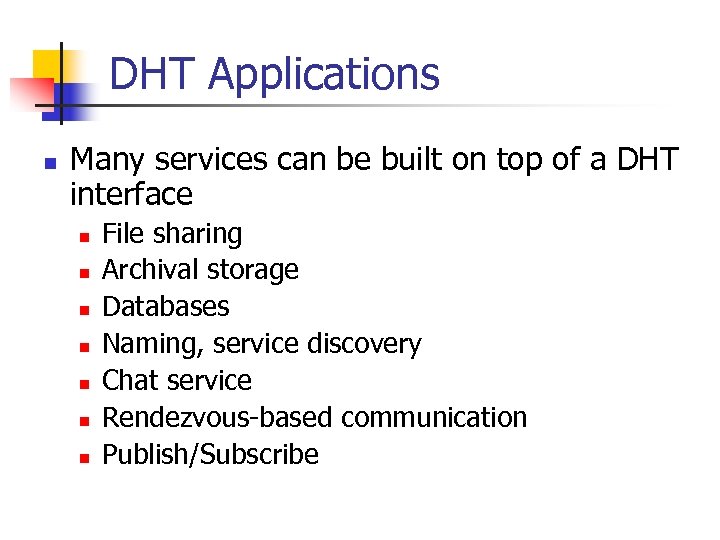 DHT Applications n Many services can be built on top of a DHT interface n n n n File sharing Archival storage Databases Naming, service discovery Chat service Rendezvous-based communication Publish/Subscribe
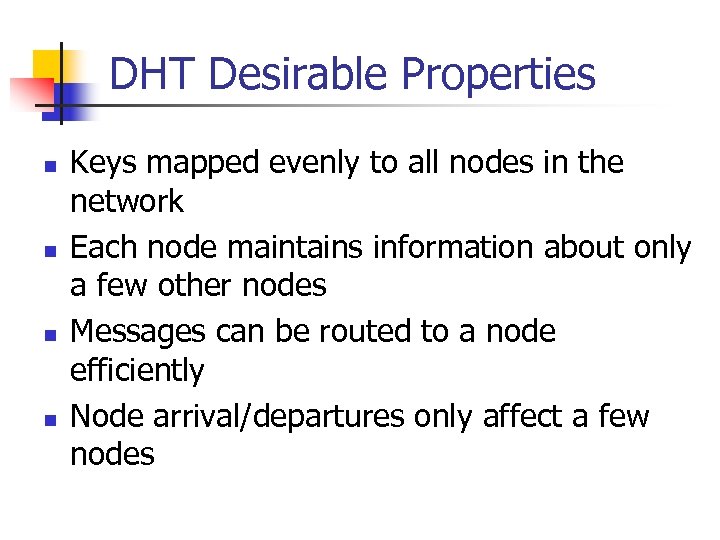 DHT Desirable Properties n n Keys mapped evenly to all nodes in the network Each node maintains information about only a few other nodes Messages can be routed to a node efficiently Node arrival/departures only affect a few nodes
 DHT Routing Protocols n DHT is a generic interface n There are several implementations of this interface n n n n n Chord [MIT] Pastry [Microsoft Research UK, Rice University] Tapestry [UC Berkeley] Content Addressable Network (CAN) [UC Berkeley] Skip. Net [Microsoft Research US, Univ. of Washington] Kademlia [New York University] Viceroy [Israel, UC Berkeley] P-Grid [EPFL Switzerland] Freenet [Ian Clarke] These systems are often referred to as P 2 P routing substrates or P 2 P overlay networks
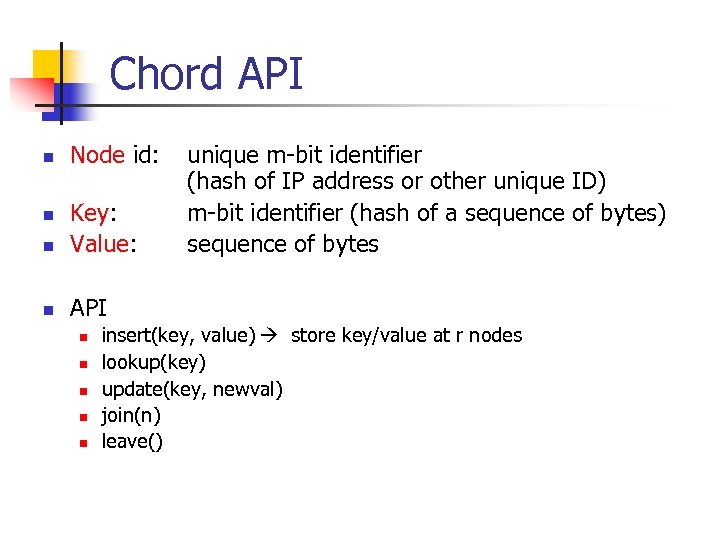 Chord API n Node id: n Key: Value: n unique m-bit identifier (hash of IP address or other unique ID) m-bit identifier (hash of a sequence of bytes) sequence of bytes API n n n insert(key, value) store key/value at r nodes lookup(key) update(key, newval) join(n) leave()
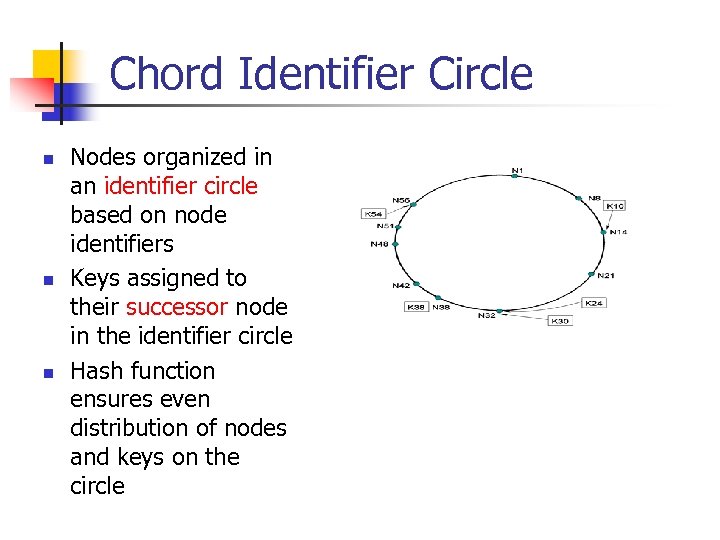 Chord Identifier Circle n n n Nodes organized in an identifier circle based on node identifiers Keys assigned to their successor node in the identifier circle Hash function ensures even distribution of nodes and keys on the circle
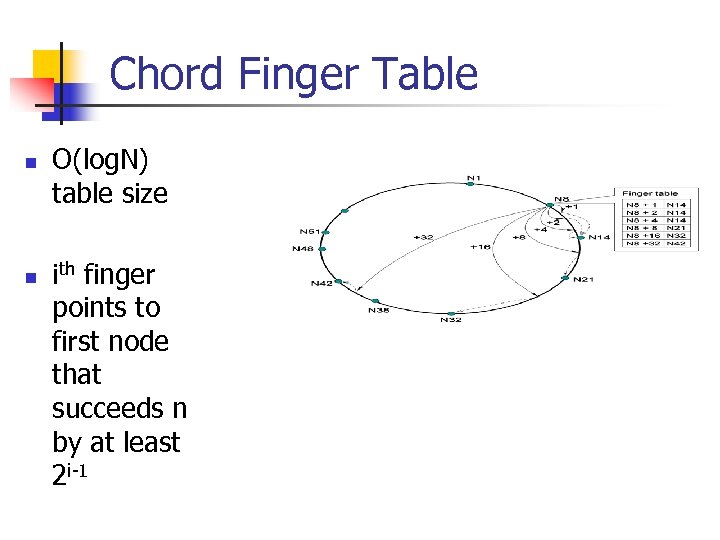 Chord Finger Table n n O(log. N) table size ith finger points to first node that succeeds n by at least 2 i-1
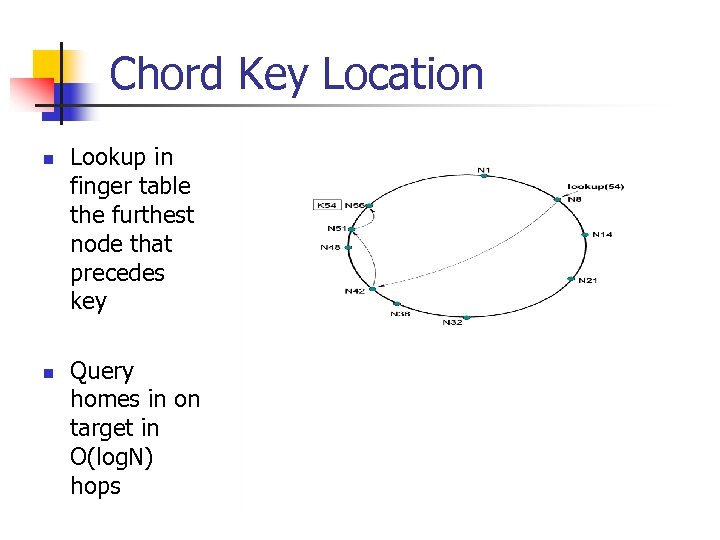 Chord Key Location n n Lookup in finger table the furthest node that precedes key Query homes in on target in O(log. N) hops
 Chord Properties n In a system with N nodes and K keys, with high probability… n n n each node receives at most K/N keys each node maintains info. about O(log. N) other nodes lookups resolved with O(log. N) hops No delivery guarantees No consistency among replicas Hops have poor network locality
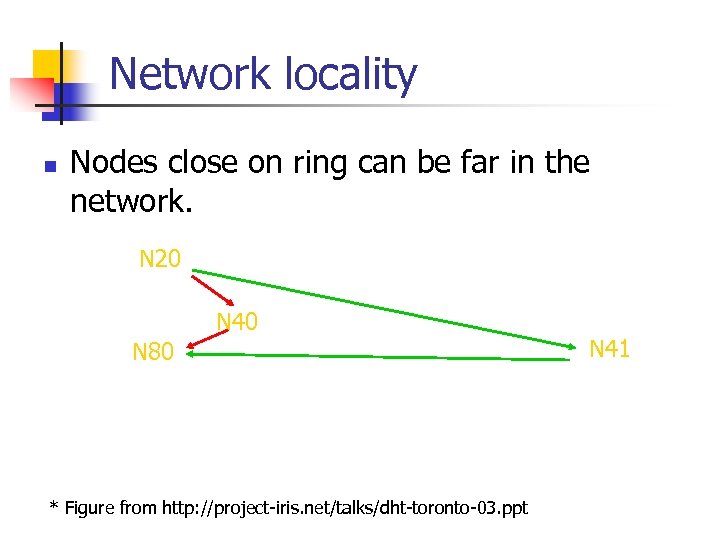 Network locality n Nodes close on ring can be far in the network. N 20 N 40 N 80 * Figure from http: //project-iris. net/talks/dht-toronto-03. ppt N 41
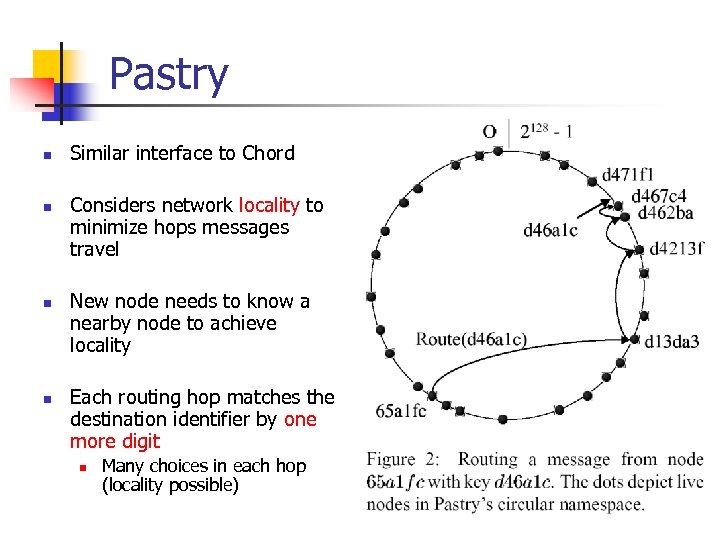 Pastry n n Similar interface to Chord Considers network locality to minimize hops messages travel New node needs to know a nearby node to achieve locality Each routing hop matches the destination identifier by one more digit n Many choices in each hop (locality possible)
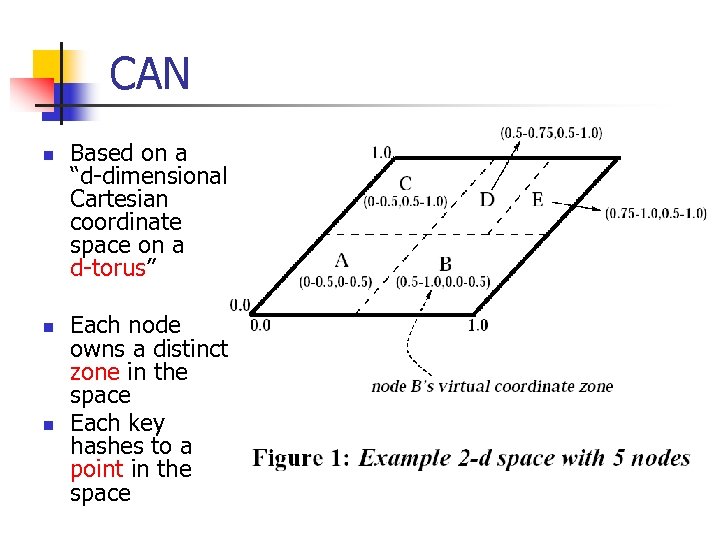 CAN n n n Based on a “d-dimensional Cartesian coordinate space on a d-torus” Each node owns a distinct zone in the space Each key hashes to a point in the space
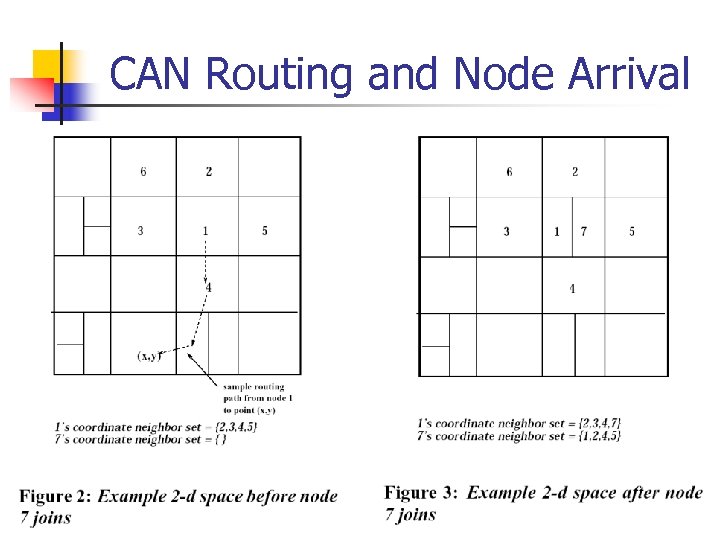 CAN Routing and Node Arrival
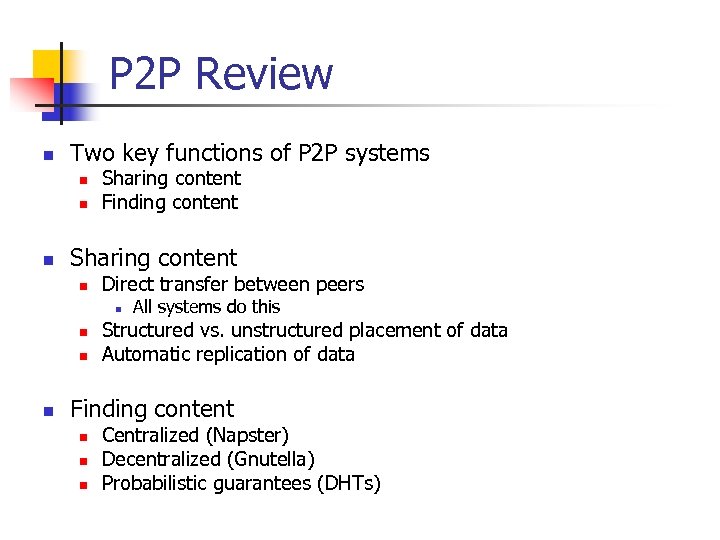 P 2 P Review n Two key functions of P 2 P systems n n n Sharing content Finding content Sharing content n Direct transfer between peers n n All systems do this Structured vs. unstructured placement of data Automatic replication of data Finding content n n n Centralized (Napster) Decentralized (Gnutella) Probabilistic guarantees (DHTs)
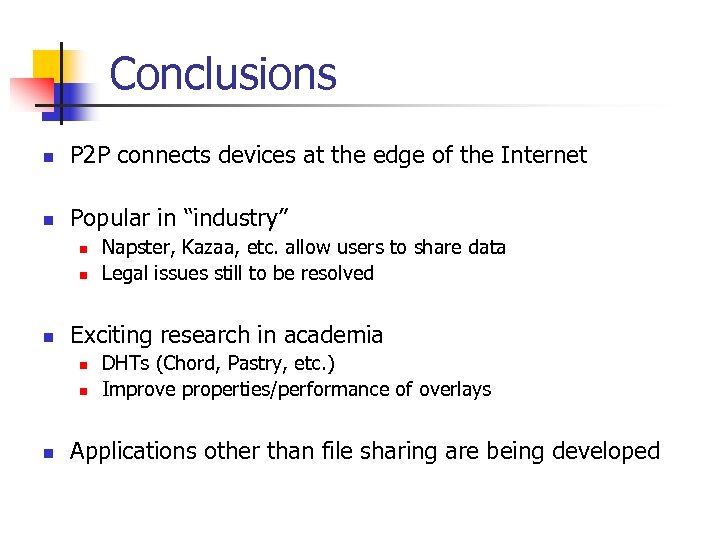 Conclusions n P 2 P connects devices at the edge of the Internet n Popular in “industry” n n n Exciting research in academia n n n Napster, Kazaa, etc. allow users to share data Legal issues still to be resolved DHTs (Chord, Pastry, etc. ) Improve properties/performance of overlays Applications other than file sharing are being developed