


 Скачать презентацию An Introduction to Ion-Optics Series of Five Lectures
950928991e28298cf8cbf31f42ced027.ppt
- Количество слайдов: 32
 An Introduction to Ion-Optics Series of Five Lectures JINA, University of Notre Dame Sept. 30 – Dec. 9, 2005 Georg P. Berg
 The Lecture Series 1 st Lecture: 9/30/05, 2: 00 pm: Definitions, Formalism, Examples 2 nd Lecture: 10/7/05, 2: 00 pm: Ion-optical elements, properties & design 3 rd Lecture: 10/14/05, 2: 00 pm: Real World Ion-optical Systems 4 th Lecture: 12/2/05, 2: 00 pm: Separator Systems 5 th Lecture: 12/9/05, 2: 00 pm: Demonstration of Codes (TRANSPORT, COSY, Mag. Net)
 1 st Lecture: 9/30/05, 2: 00 – 3: 30 pm: Definitions, Formalism, Examples • Motivation, references, remarks (4 - 8) • The driving forces (9) • Definitions & first order formalism (10 - 16) • Phase space ellipse, emittance, examples (17 - 25) • Taylor expansion, higher orders (26 - 27) • The power of diagnostics (28 - 30) • Q&A
 Motivation • Manipulate charged particles (b+/-, ions, like p, d, a, …) • Beam lines systems • Magnetic & electric analysis/ separation (e. g. St. George) • Acceleration of ions
 Who needs ion-optics anyway? • Over 6*109 people have - I hope so - happy lives without! • A group of accelerator physicists are using it to build machines that enables physicists to explore the unkown! • Many physicists using accelerators, beam lines and magnet system (or their data) needs some knowledge of ion-optics. • This lecture series is an introduction to the last group and I will do my best to let you in on the basics first and than we will discuss some of the applications of ion-optics and related topics.
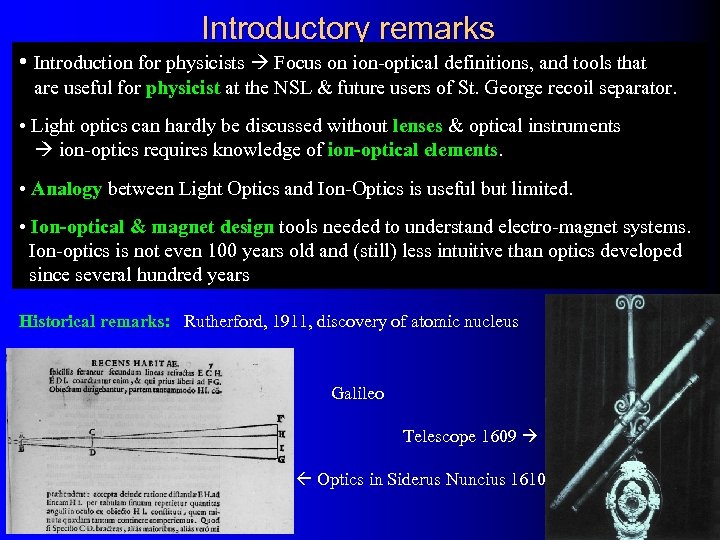 Introductory remarks • Introduction for physicists Focus on ion-optical definitions, and tools that are useful for physicist at the NSL & future users of St. George recoil separator. • Light optics can hardly be discussed without lenses & optical instruments ion-optics requires knowledge of ion-optical elements. • Analogy between Light Optics and Ion-Optics is useful but limited. • Ion-optical & magnet design tools needed to understand electro-magnet systems. Ion-optics is not even 100 years old and (still) less intuitive than optics developed since several hundred years Historical remarks: Rutherford, 1911, discovery of atomic nucleus Galileo Telescope 1609 Optics in Siderus Nuncius 1610
 Basic tools of the trade • Geometry, drawing tools, CAD drafting program (e. g. Auto. Cad) • Linear Algebra (Matrix calculations), first order ion-optics (e. g. TRANSPORT) • Higher order ion-optics code to solve equation of motion, (e. g. COSY Infinity, GIOS, RAYTRACE (historic) • Electro-magnetic field program (solution of Maxwell’s Equations), (e. g. finite element (FE) codes, 2 d & 3 d: POISSON, TOSCA, Mag. Net) • Properties of incoming charged particles and design function of electro-magnetic facility, beam, reaction products (e. g. kinematic codes, charge distributions of heavy ions, energy losses in targets) • Many other specialized programs, e. g for accelerator design (e. g. synchrotrons, cyclotrons) not covered in this lecure series.
 Literature • Optics of Charged Particles, Hermann Wollnik, Academic Press, Orlando, 1987 • The Optics of Charged Particle Beams, David. C Carey, Harwood Academic Publishers, New York 1987 • Accelerator Physics, S. Y. Lee, World Scientific Publishing, Singapore, 1999 • TRANSPORT, A Computer Program for Designing Charged Particle Beam Transport Systems, K. L. Brown, D. C. Carey, Ch. Iselin, F. Rotacker, Report CERN 80 -04, Geneva, 1980 • Computer-Aided Design in Magnetics, D. A. Lowther, P. Silvester, Springer 1985
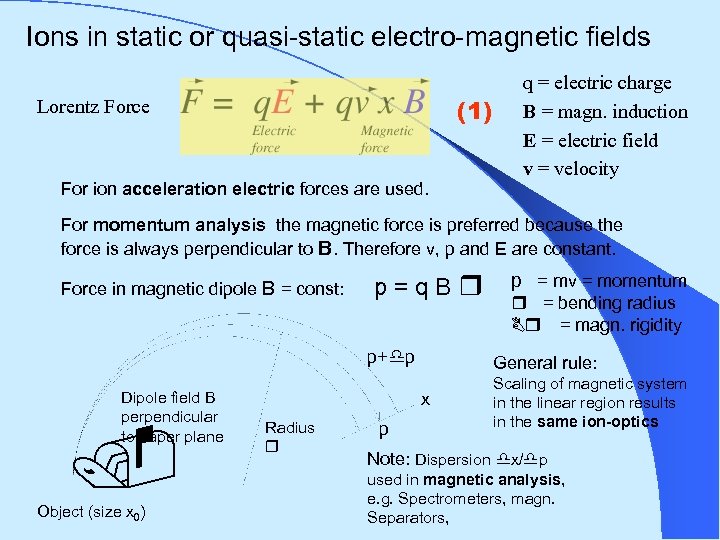 Ions in static or quasi-static electro-magnetic fields (1) Lorentz Force For ion acceleration electric forces are used. q = electric charge B = magn. induction E = electric field v = velocity For momentum analysis the magnetic force is preferred because the force is always perpendicular to B. Therefore v, p and E are constant. Force in magnetic dipole B = const: p=q. Br p+dp Dipole field B perpendicular to paper plane . Object (size x 0) p r = bending radius Br = magn. rigidity General rule: x Radius r p = mv = momentum Scaling of magnetic system in the linear region results in the same ion-optics Note: Dispersion dx/dp used in magnetic analysis, e. g. Spectrometers, magn. Separators,
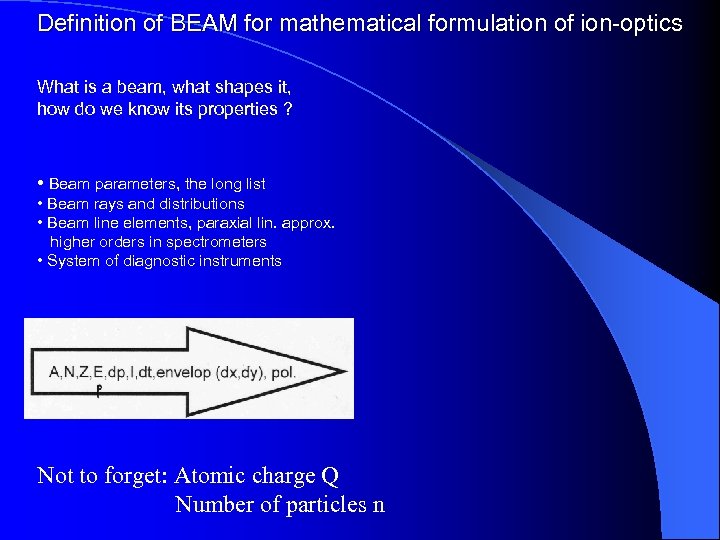 Definition of BEAM for mathematical formulation of ion-optics What is a beam, what shapes it, how do we know its properties ? • Beam parameters, the long list • Beam rays and distributions • Beam line elements, paraxial lin. approx. higher orders in spectrometers • System of diagnostic instruments Not to forget: Atomic charge Q Number of particles n
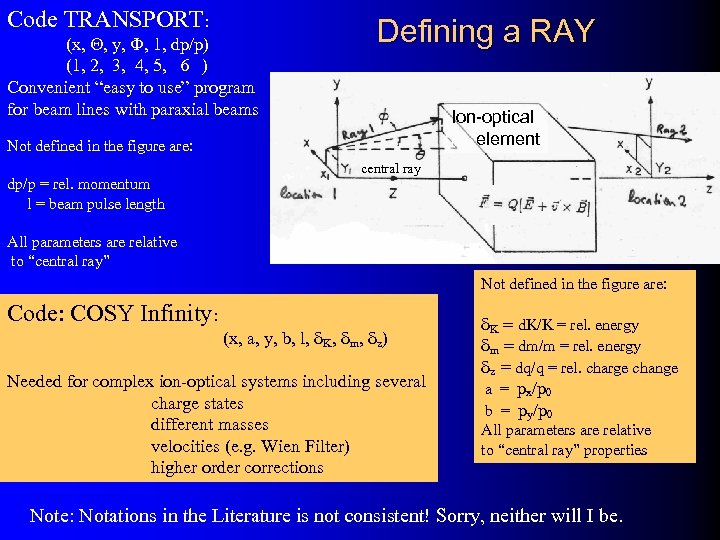 Code TRANSPORT: (x, Q, y, F, 1, dp/p) (1, 2, 3, 4, 5, 6 ) Convenient “easy to use” program for beam lines with paraxial beams Defining a RAY Ion-optical element Not defined in the figure are: dp/p = rel. momentum l = beam pulse length central ray All parameters are relative to “central ray” Not defined in the figure are: Code: COSY Infinity: (x, a, y, b, l, d. K, dm, dz) Needed for complex ion-optical systems including several charge states different masses velocities (e. g. Wien Filter) higher order corrections d. K = d. K/K = rel. energy dm = dm/m = rel. energy dz = dq/q = rel. charge change a = px/p 0 b = py/p 0 All parameters are relative to “central ray” properties Note: Notations in the Literature is not consistent! Sorry, neither will I be.
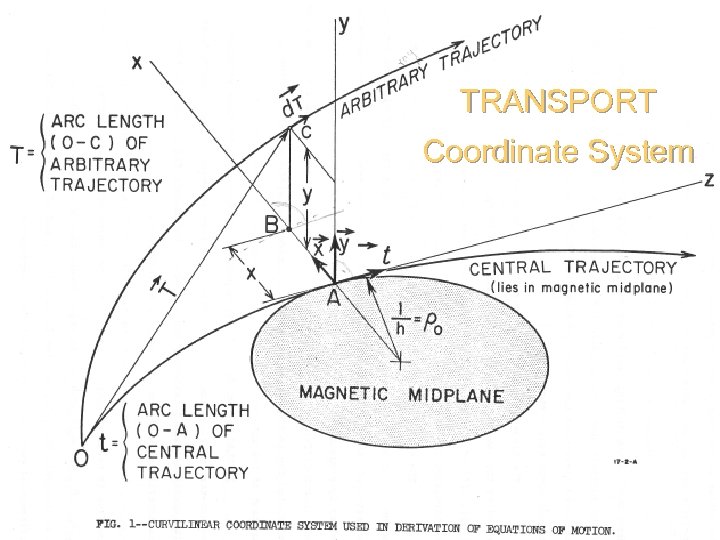 TRANSPORT Coordinate System Ray at initial Location 1
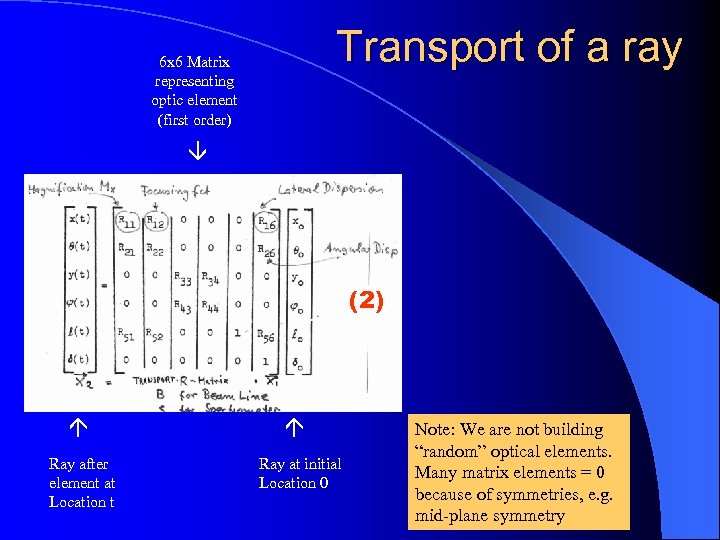 Transport of a ray 6 x 6 Matrix representing optic element (first order) Ray after element at Location t (2) Ray at initial Location 0 Note: We are not building “random” optical elements. Many matrix elements = 0 because of symmetries, e. g. mid-plane symmetry
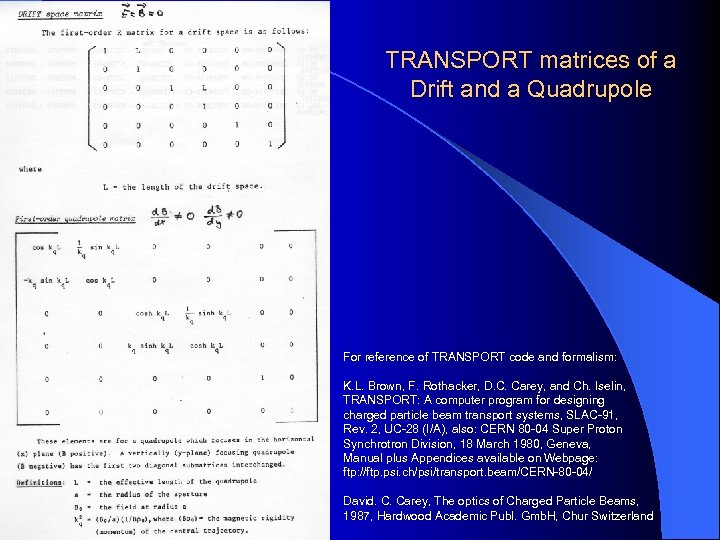 TRANSPORT matrices of a Drift and a Quadrupole For reference of TRANSPORT code and formalism: K. L. Brown, F. Rothacker, D. C. Carey, and Ch. Iselin, TRANSPORT: A computer program for designing charged particle beam transport systems, SLAC-91, Rev. 2, UC-28 (I/A), also: CERN 80 -04 Super Proton Synchrotron Division, 18 March 1980, Geneva, Manual plus Appendices available on Webpage: ftp: //ftp. psi. ch/psi/transport. beam/CERN-80 -04/ David. C. Carey, The optics of Charged Particle Beams, 1987, Hardwood Academic Publ. Gmb. H, Chur Switzerland
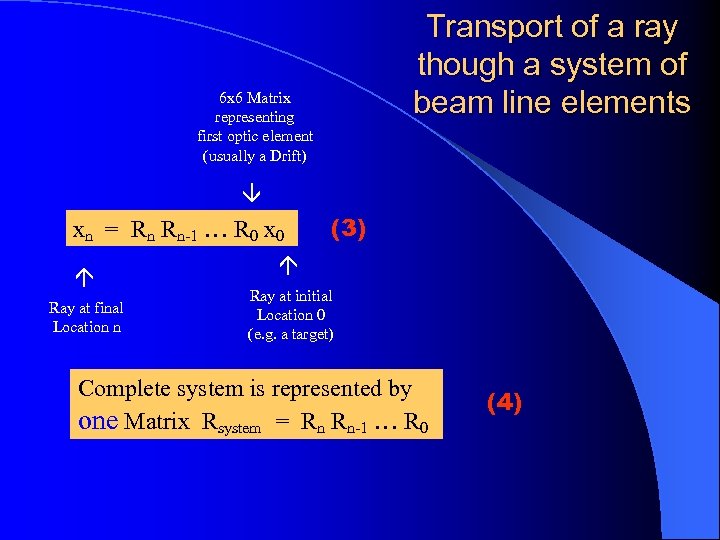 Transport of a ray though a system of beam line elements 6 x 6 Matrix representing first optic element (usually a Drift) Ray at final Location n (3) xn = Rn Rn-1 … R 0 x 0 Ray at initial Location 0 (e. g. a target) Complete system is represented by one Matrix Rsystem = Rn Rn-1 … R 0 (4)
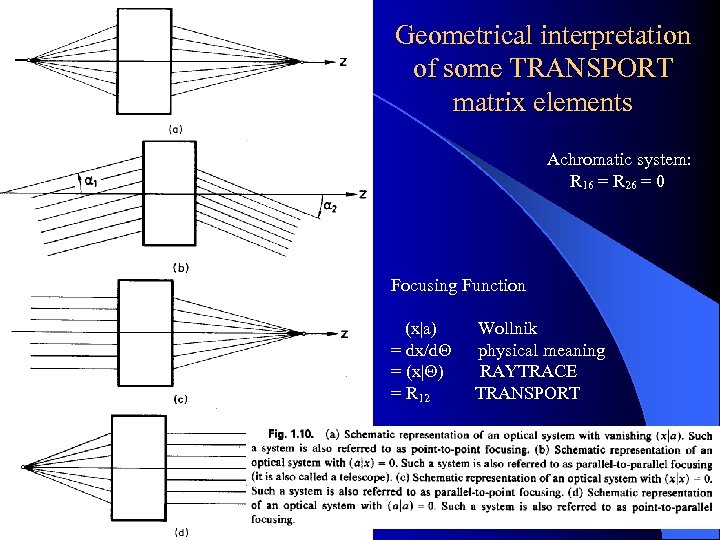 Geometrical interpretation of some TRANSPORT matrix elements Wollnik, p. 16 Achromatic system: R 16 = R 26 = 0 Focusing Function (x|a) = dx/d. Q = (x|Q) = R 12 Wollnik physical meaning RAYTRACE TRANSPORT
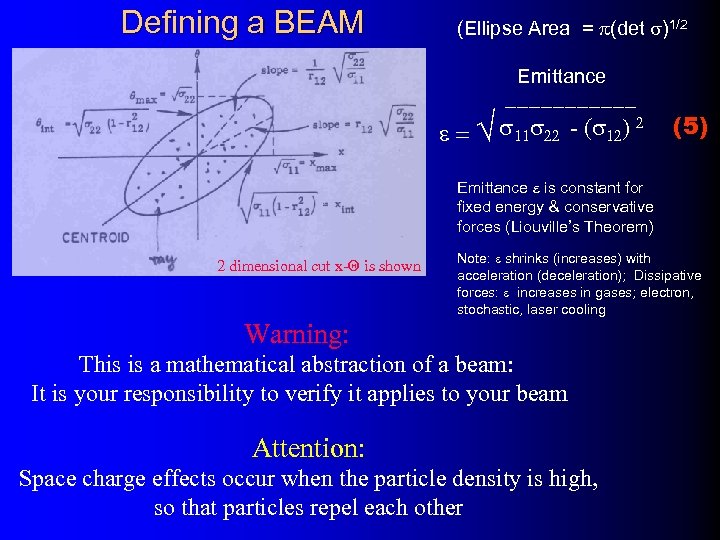 Defining a BEAM (Ellipse Area = p(det s)1/2 Emittance ``````) 2 e = Ö s 11 s 22 - (s 12 (5) Emittance e is constant for fixed energy & conservative forces (Liouville’s Theorem) 2 dimensional cut x-Q is shown Note: e shrinks (increases) with acceleration (deceleration); Dissipative forces: e increases in gases; electron, stochastic, laser cooling Warning: This is a mathematical abstraction of a beam: It is your responsibility to verify it applies to your beam Attention: Space charge effects occur when the particle density is high, so that particles repel each other
 Equivalence of Transport of ONE Ray Û Ellipse Defining the s Matrix representing a Beam
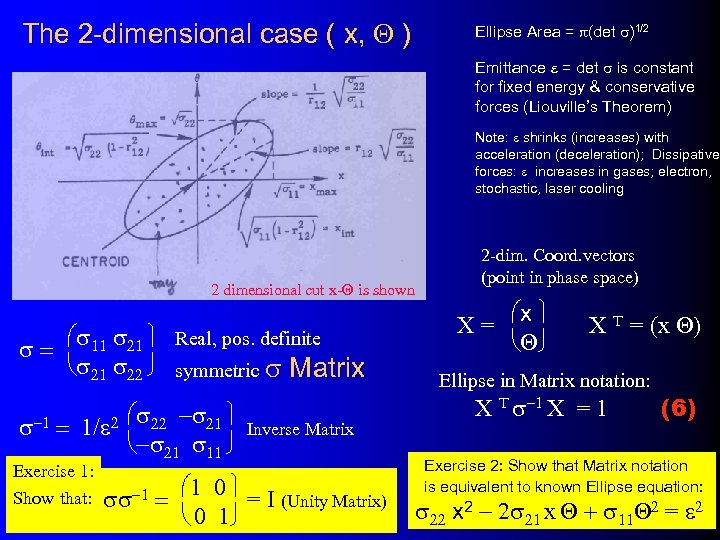 The 2 -dimensional case ( x, Q ) Ellipse Area = p(det s)1/2 Emittance e = det s is constant for fixed energy & conservative forces (Liouville’s Theorem) Note: e shrinks (increases) with acceleration (deceleration); Dissipative forces: e increases in gases; electron, stochastic, laser cooling 2 dimensional cut x-Q is shown Real, pos. definite s = æs 11 s 21 ü ès 21 s 22 þ symmetric s Matrix s-1 = 1/e 2 æs 22 -s 21 ü è-s 21 s 11 þ Exercise 1: Show that: Inverse Matrix ss-1 = æ 1 0 ü = I (Unity Matrix) è 0 1þ 2 -dim. Coord. vectors (point in phase space) X = æx ü èQþ X T = (x Q) Ellipse in Matrix notation: X T s-1 X = 1 (6) Exercise 2: Show that Matrix notation is equivalent to known Ellipse equation: s 22 x 2 - 2 s 21 x Q + s 11 Q 2 = e 2
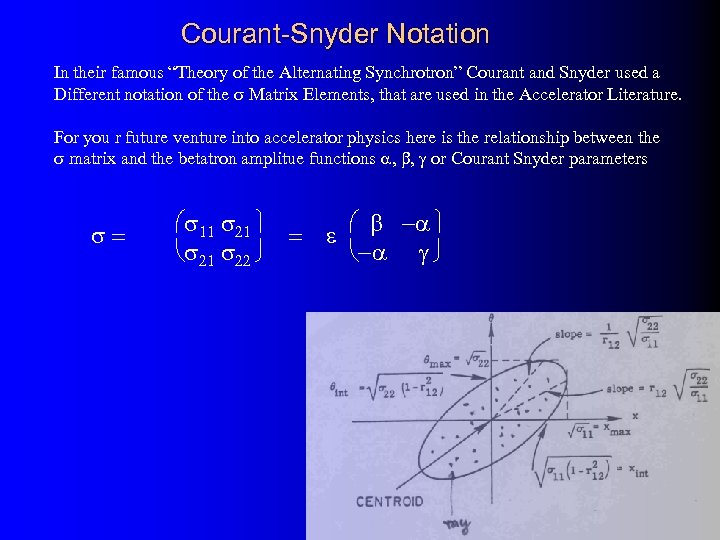 Courant-Snyder Notation In their famous “Theory of the Alternating Synchrotron” Courant and Snyder used a Different notation of the s Matrix Elements, that are used in the Accelerator Literature. For you r future venture into accelerator physics here is the relationship between the s matrix and the betatron amplitue functions a, b, g or Courant Snyder parameters s= æs 11 s 21 ü = ès 21 s 22 þ e æ b -a ü è-a g þ
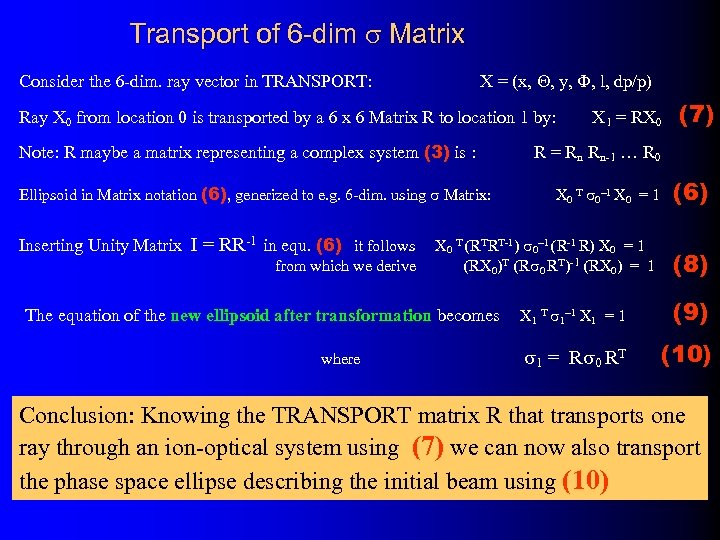 Transport of 6 -dim s Matrix X = (x, Q, y, F, l, dp/p) Consider the 6 -dim. ray vector in TRANSPORT: Ray X 0 from location 0 is transported by a 6 x 6 Matrix R to location 1 by: Note: R maybe a matrix representing a complex system (3) is : Ellipsoid in Matrix notation (6), generized to e. g. 6 -dim. using s Matrix: Inserting Unity Matrix I = RR-1 in equ. (6) it follows from which we derive (7) R = Rn Rn-1 … R 0 X 0 T s 0 -1 X 0 = 1 X 0 T (RTRT-1) s 0 -1 (R-1 R) X 0 = 1 (RX 0)T (Rs 0 RT)-1 (RX 0) = 1 The equation of the new ellipsoid after transformation becomes where X 1 = RX 0 (6) (8) X 1 T s 1 -1 X 1 = 1 (9) s 1 = Rs 0 RT (10) Conclusion: Knowing the TRANSPORT matrix R that transports one ray through an ion-optical system using (7) we can now also transport the phase space ellipse describing the initial beam using (10)
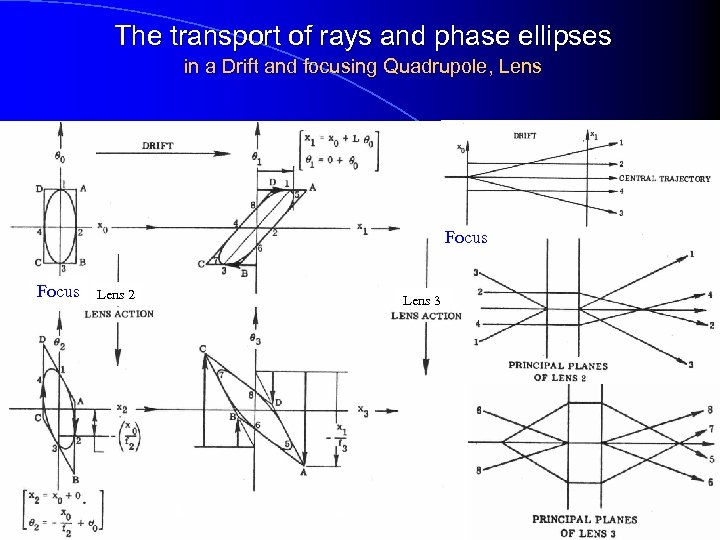 The transport of rays and phase ellipses in a Drift and focusing Quadrupole, Lens Focus 2. Lens 2 3. Lens 3 Matching of emittance and acceptance
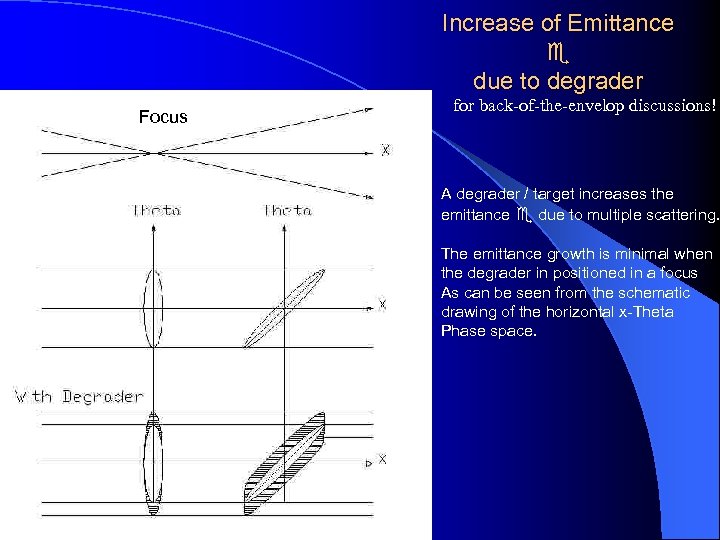 Increase of Emittance e due to degrader Focus for back-of-the-envelop discussions! A degrader / target increases the emittance e due to multiple scattering. The emittance growth is minimal when the degrader in positioned in a focus As can be seen from the schematic drawing of the horizontal x-Theta Phase space.
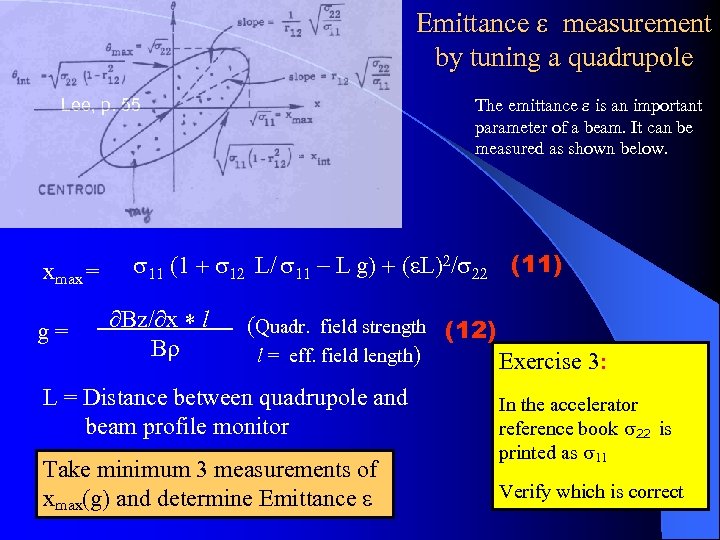 Emittance e measurement by tuning a quadrupole Lee, p. 55 xmax = The emittance e is an important parameter of a beam. It can be measured as shown below. s 11 (1 + s 12 L/ s 11 - L g) + (e. L)2/s 22 (11) ¶Bz/¶x * l Br (Quadr. field strength (12) l = eff. field length) Exercise 3: L = Distance between quadrupole and In the accelerator beam profile monitor reference book s 22 is g= Take minimum 3 measurements of xmax(g) and determine Emittance e printed as s 11 Verify which is correct
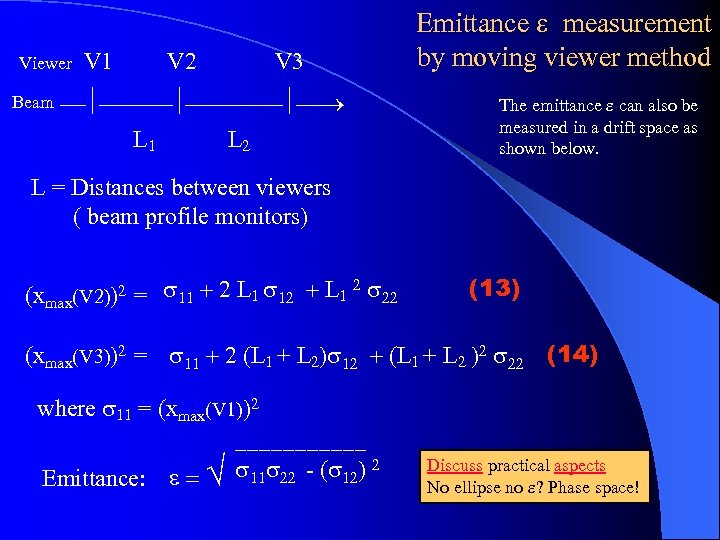 Viewer Beam V 1 V 2 V 3 ¾½¾¾¾¾½¾® L 1 L 2 Emittance e measurement by moving viewer method The emittance e can also be measured in a drift space as shown below. L = Distances between viewers ( beam profile monitors) 2 (xmax(V 2))2 = s 11 + 2 L 1 s 12 + L 1 s 22 (13) (xmax(V 3))2 = s 11 + 2 (L 1 + L 2)s 12 + (L 1 + L 2 )2 s 22 (14) where s 11 = (xmax(V 1))2 `````` ) 2 Emittance: e = Ö s 11 s 22 - (s 12 Discuss practical aspects No ellipse no e? Phase space!
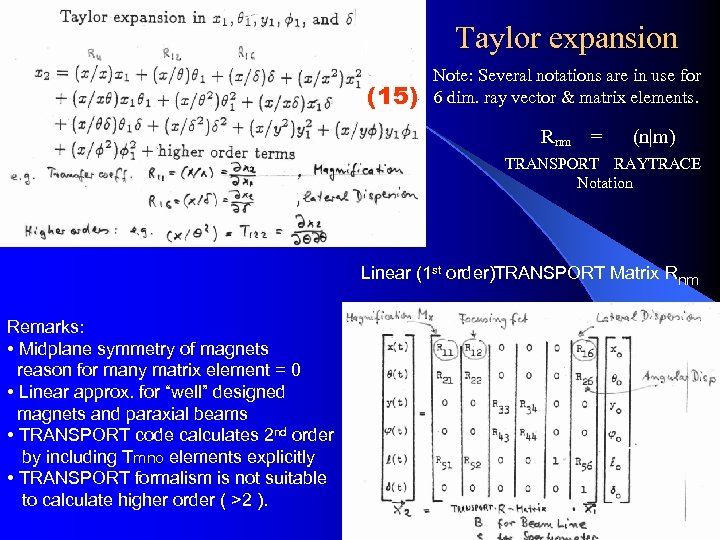 , l (15) Taylor expansion Note: Several notations are in use for 6 dim. ray vector & matrix elements. Rnm = (n|m) TRANSPORT RAYTRACE Notation Linear (1 st order)TRANSPORT Matrix Rnm Remarks: • Midplane symmetry of magnets reason for many matrix element = 0 • Linear approx. for “well” designed magnets and paraxial beams • TRANSPORT code calculates 2 nd order by including Tmno elements explicitly • TRANSPORT formalism is not suitable to calculate higher order ( >2 ).
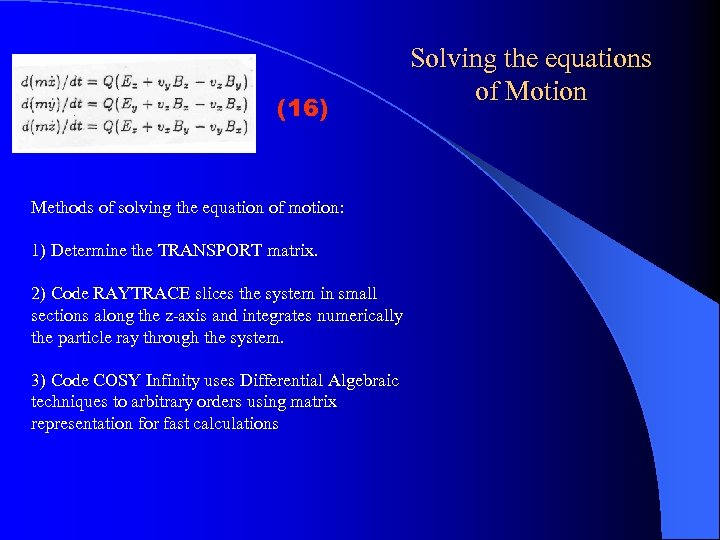 (16) Methods of solving the equation of motion: 1) Determine the TRANSPORT matrix. 2) Code RAYTRACE slices the system in small sections along the z-axis and integrates numerically the particle ray through the system. 3) Code COSY Infinity uses Differential Algebraic techniques to arbitrary orders using matrix representation for fast calculations Solving the equations of Motion
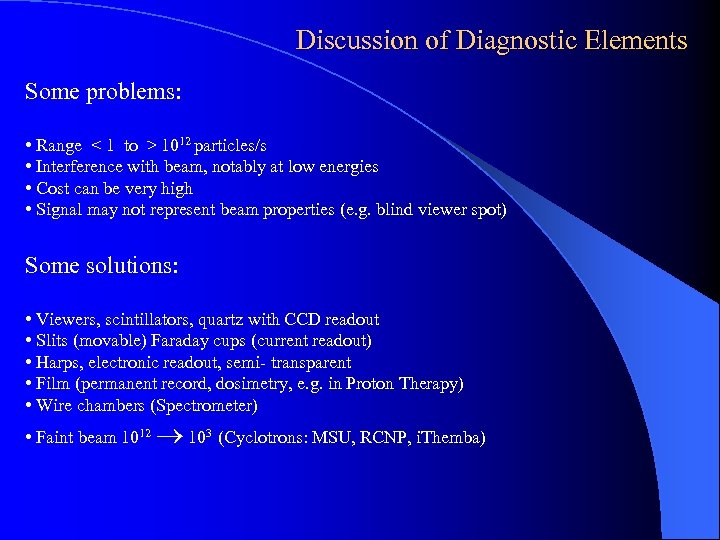 Discussion of Diagnostic Elements Some problems: • Range < 1 to > 1012 particles/s • Interference with beam, notably at low energies • Cost can be very high • Signal may not represent beam properties (e. g. blind viewer spot) Some solutions: • Viewers, scintillators, quartz with CCD readout • Slits (movable) Faraday cups (current readout) • Harps, electronic readout, semi- transparent • Film (permanent record, dosimetry, e. g. in Proton Therapy) • Wire chambers (Spectrometer) • Faint beam 1012 ® 103 (Cyclotrons: MSU, RCNP, i. Themba)
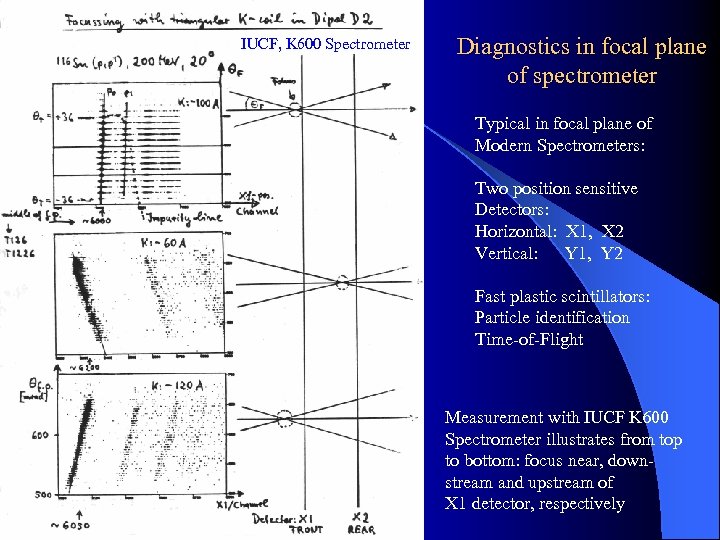 IUCF, K 600 Spectrometer Diagnostics in focal plane of spectrometer Typical in focal plane of Modern Spectrometers: Two position sensitive Detectors: Horizontal: X 1, X 2 Vertical: Y 1, Y 2 Fast plastic scintillators: Particle identification Time-of-Flight Measurement with IUCF K 600 Spectrometer illustrates from top to bottom: focus near, downstream and upstream of X 1 detector, respectively
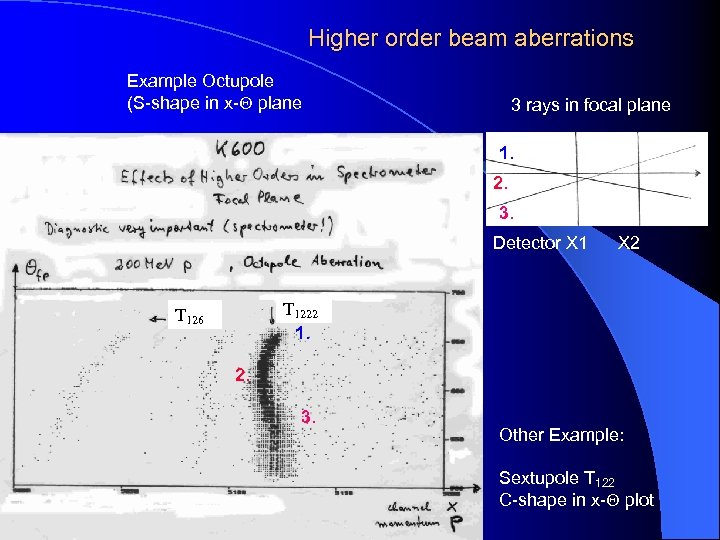 Higher order beam aberrations Example Octupole (S-shape in x-Q plane 3 rays in focal plane 1. 2. 3. Detector X 1 X 2 T 1222 1. T 126 2. 3. Other Example: Sextupole T 122 C-shape in x-Q plot
 Q&A • Question now? ASK! • Any topic you want to hear and I haven’t talked about? Let me know!
 End Lecture 1