 Скачать презентацию An Introduction to Interdomain Routing and the Border
a7de5e5a0e0fd1190959a49c77b5f854.ppt
- Количество слайдов: 126



An Introduction to Interdomain Routing and the Border Gateway Protocol (BGP) Timothy G. Griffin AT&T Research griffin@research. att. com http: //www. research. att. com/~griffin/interdomain. html ICNP PARIS November 12, 2002
Outline 1. The Internet is implemented with a diverse set of physical networks 2. Relationships between Autonomous Routing Domains (ARDs) 3. BGP as a means of implementing and maintaining relationships between ARDs 4. BGP as means of implementing local optimizations (“Traffic Engineering”) 5. What Problem is BGP Solving anyway? 6. Current Internet Growth Trends 7. Selected References

In Memory of Abha Ahuja Photo by Peter Lothberg. http: //www. caida. org/~kc/abha/gallery. html NANOG memorial site: http: //www. nanog. org/abha. html
PART I Physical Connectivity
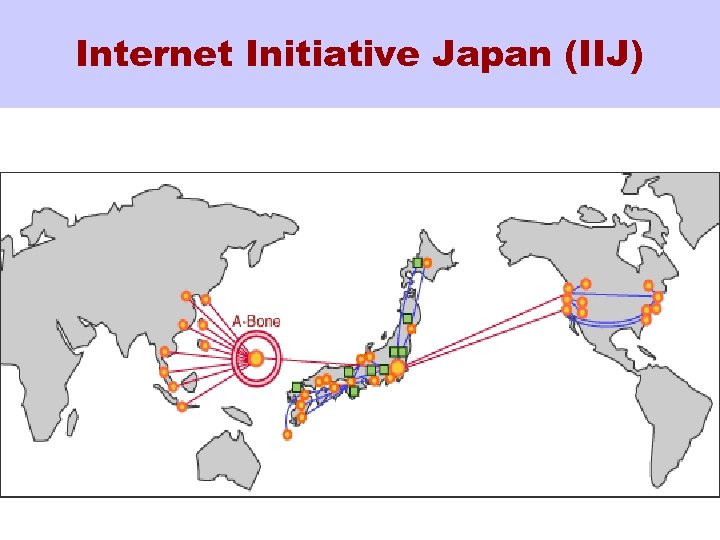
Internet Initiative Japan (IIJ)
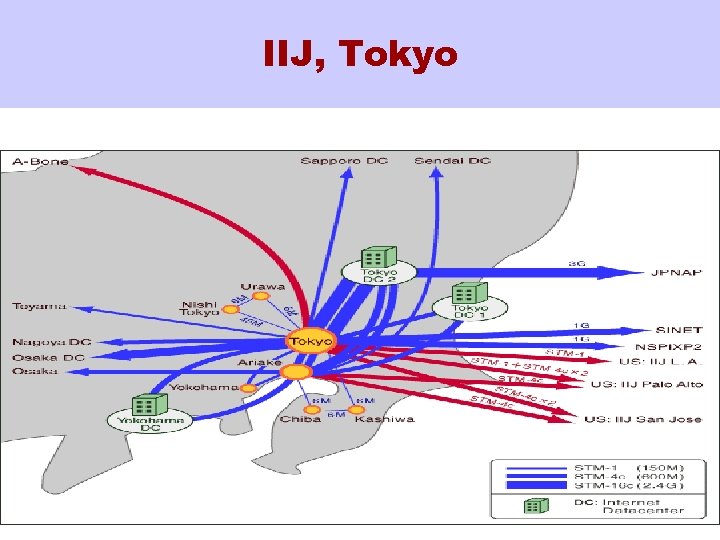
IIJ, Tokyo
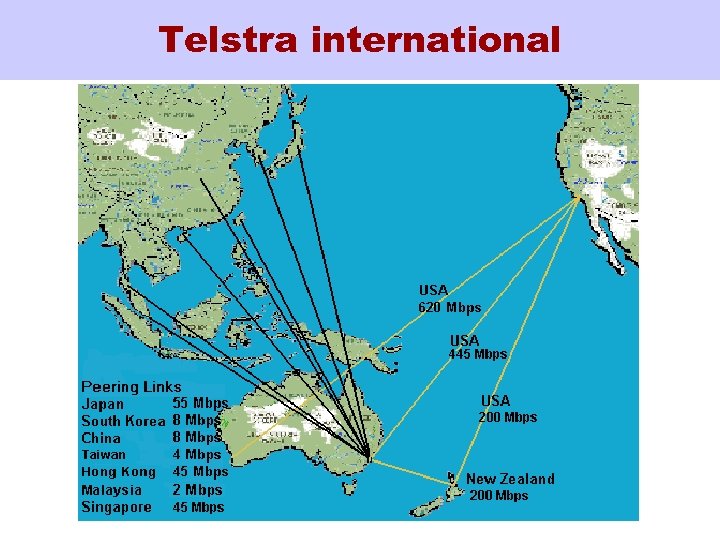
Telstra international
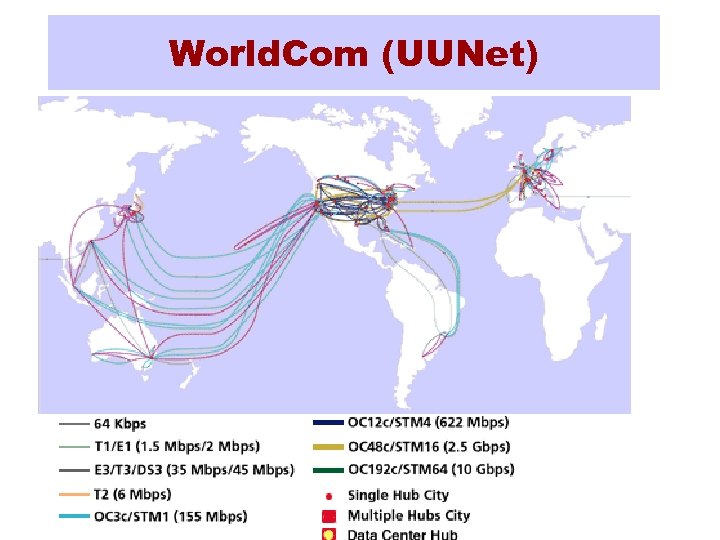
World. Com (UUNet)
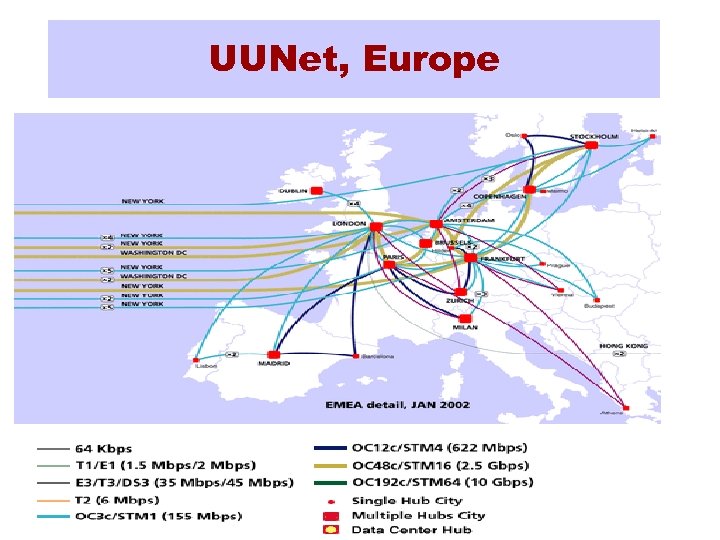
UUNet, Europe
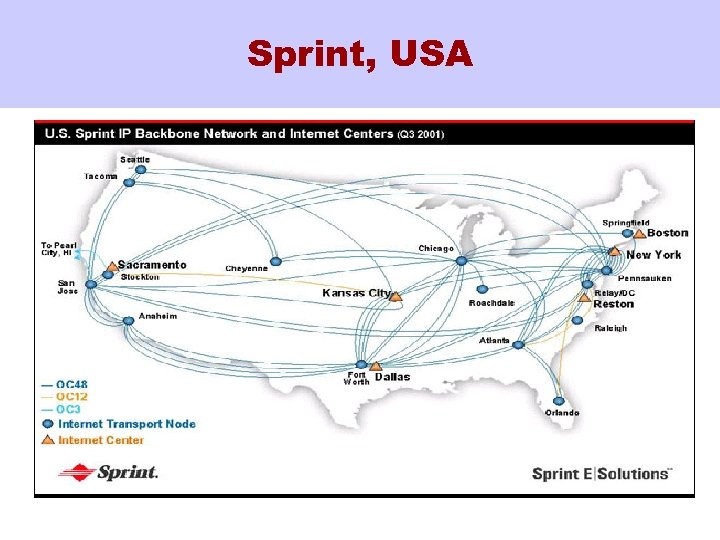
Sprint, USA
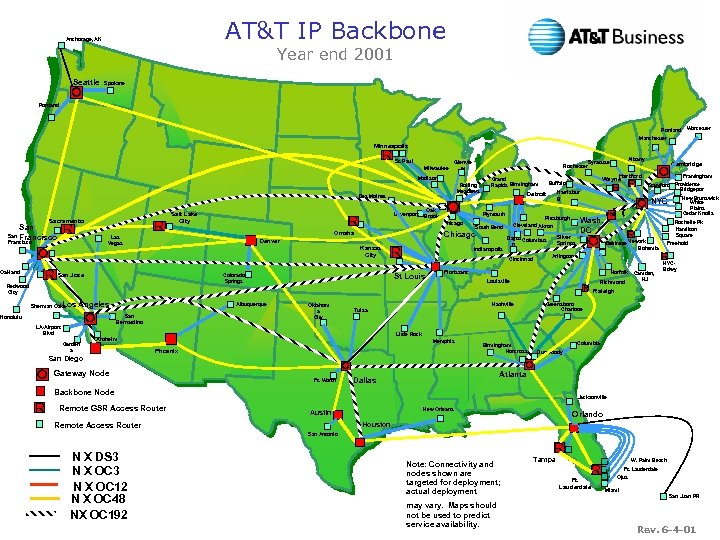
AT&T IP Backbone Anchorage, AK Year end 2001 Seattle Spokane Portland Manchester Worcester Minneapolis R St. Paul Milwaukee Glenvie w Rochester Madison Rolling Meadows Des Moines Sacramento R San Francisco R Salt Lake City Kansas City Los Angeles Albuquerque Sherman Oaks San Bernardino LA-Airport Blvd Oklahom a City Memphis Phoenix Gateway Node Richmond R Camden, NJ Freehold R NYCBdwy Raleigh Greensboro Charlotte Ft. Worth Birmingham Norcross Columbia Dunwoody Atlanta Dallas Backbone Node R R Baltimore Newark Bohemia Arlington Louisville Plains Cedar Knolls Rochelle Pk Hamilton Square Little Rock Anaheim San Diego Silver Springs Norfolk Nashville Framingham Providence Stamford Providence Bridgepor t New Brunswick White Phil Florissant Tulsa Cambridge NYC Wash. DC Cleveland Akron Dayto Columbus n Cincinnati St Louis Colorado Springs Honolulu R Indianapolis R R Harrisbur g Pittsburgh South Bend Chicago Hartford Wayne Buffalo Detroit Plymouth Chicago Denver Redwood City Garden a R Omaha Las Vegas R San Jose Oakland Davenport Oak Brook Grand Rapids Birmingham Albany Syracuse Remote GSR Access Router Jacksonville New Orleans Austin Remote Access Router Orlando Houston San Antonio N X DS 3 N X OC 12 N X OC 48 NX OC 192 R Note: Connectivity and nodes shown are targeted for deployment; actual deployment may vary. Maps should not be used to predict service availability. Tampa R Ft. Lauderdale W. Palm Beach Ft. Lauderdale Ojus Miami San Juan PR Rev. 6 -4 -01
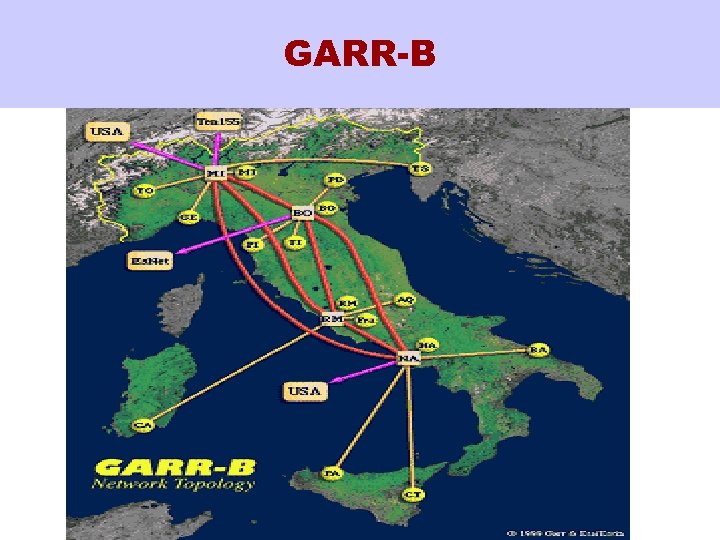
GARR-B
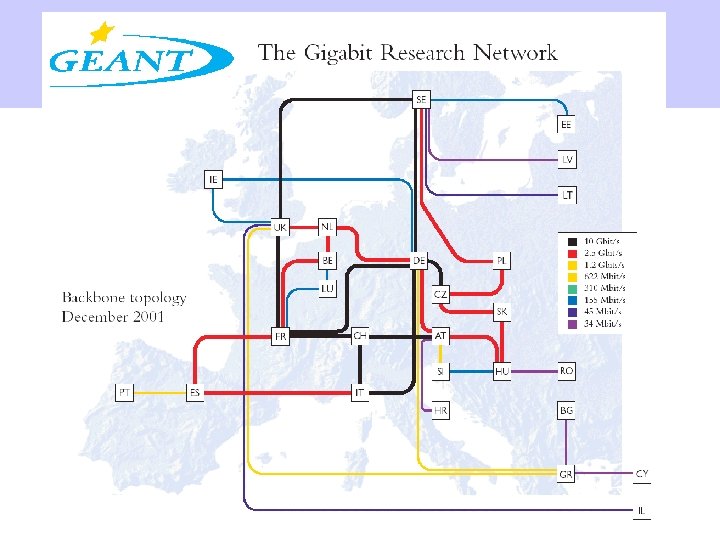
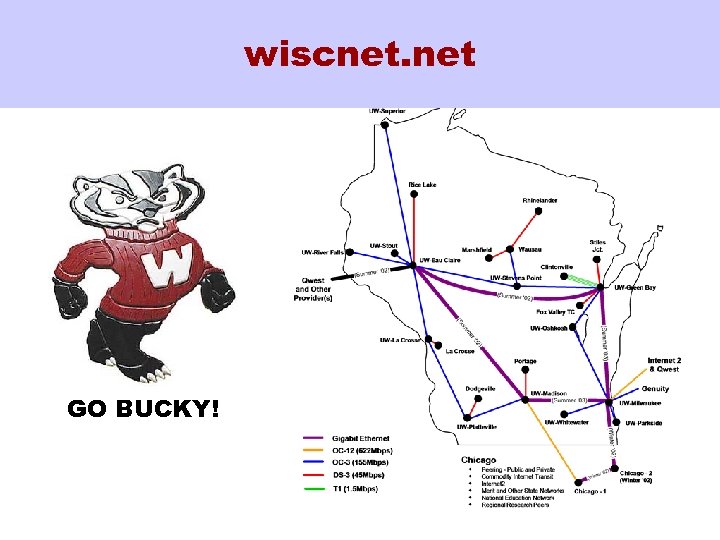
wiscnet. net GO BUCKY!
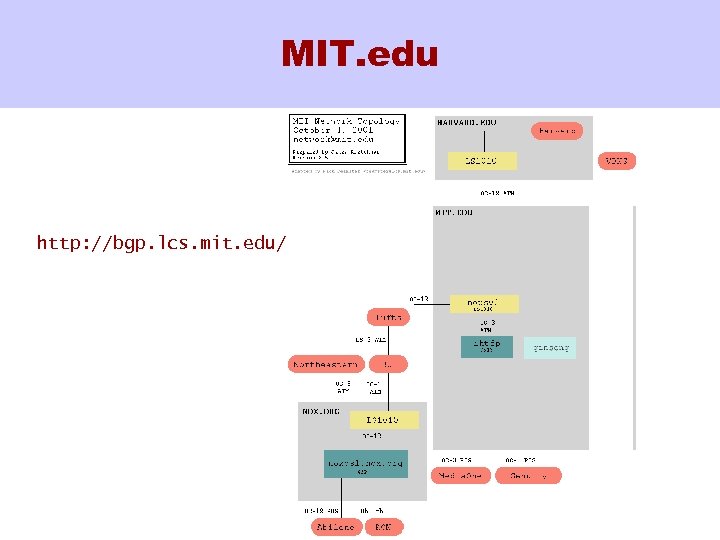
MIT. edu http: //bgp. lcs. mit. edu/
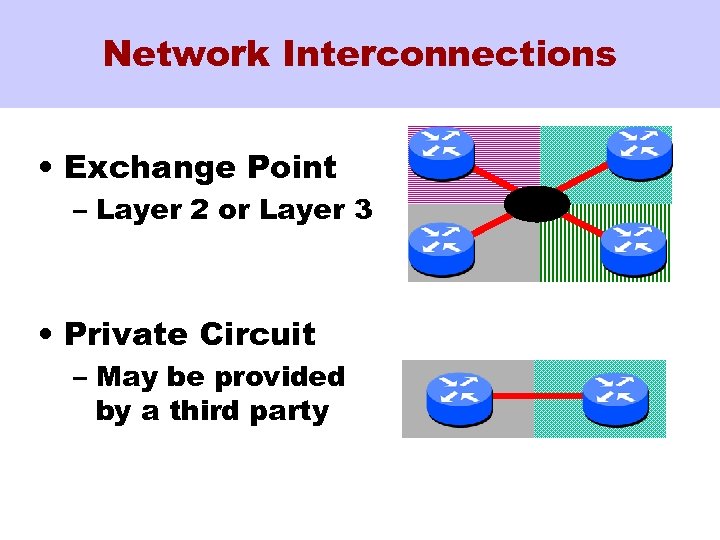
Network Interconnections • Exchange Point – Layer 2 or Layer 3 • Private Circuit – May be provided by a third party
PART II Relationships Between Networks
Some Costs of Running an ISP • People • Physical connectivity and bandwidth • Hardware • Data center space and power • …
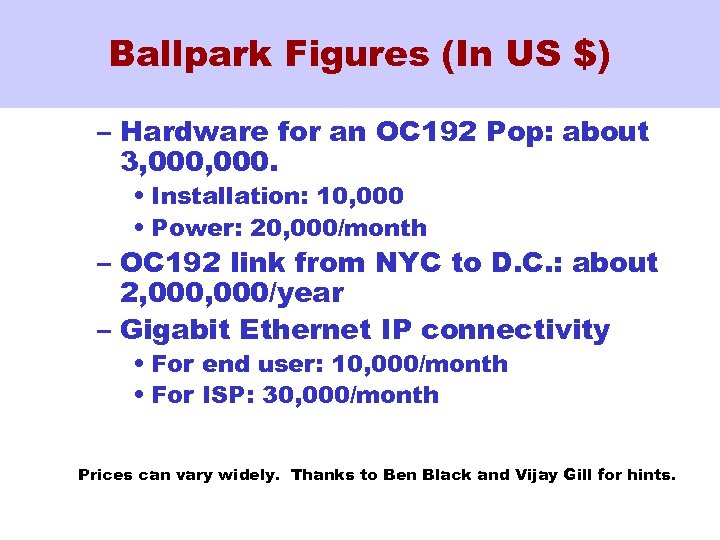
Ballpark Figures (In US $) – Hardware for an OC 192 Pop: about 3, 000. • Installation: 10, 000 • Power: 20, 000/month – OC 192 link from NYC to D. C. : about 2, 000/year – Gigabit Ethernet IP connectivity • For end user: 10, 000/month • For ISP: 30, 000/month Prices can vary widely. Thanks to Ben Black and Vijay Gill for hints.
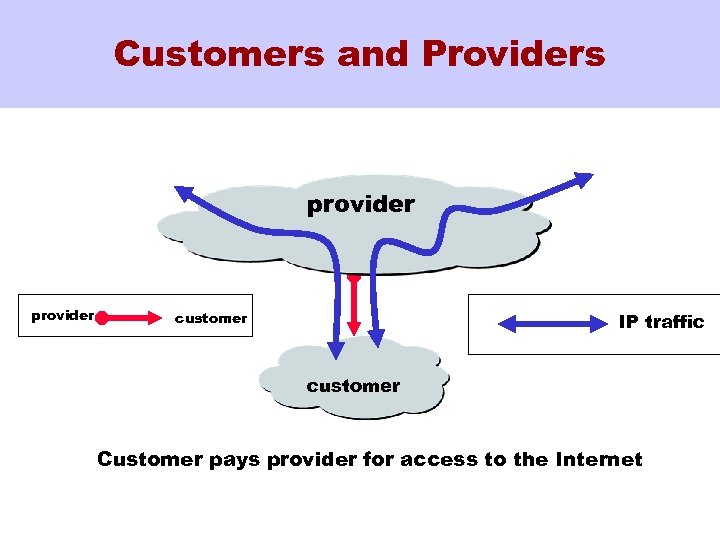
Customers and Providers provider customer IP traffic customer Customer pays provider for access to the Internet
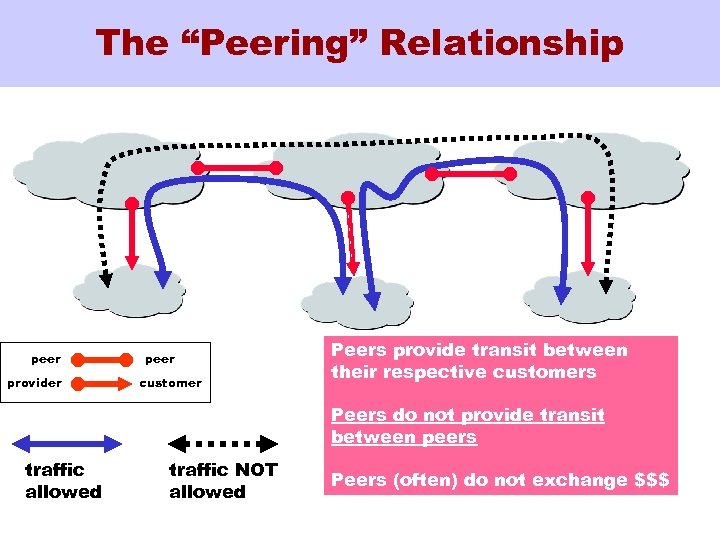
The “Peering” Relationship peer provider peer customer Peers provide transit between their respective customers Peers do not provide transit between peers traffic allowed traffic NOT allowed Peers (often) do not exchange $$$
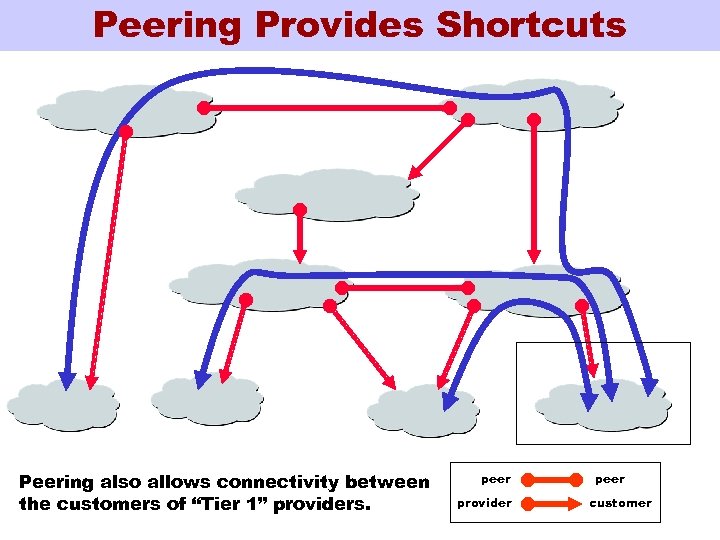
Peering Provides Shortcuts Peering also allows connectivity between the customers of “Tier 1” providers. peer provider peer customer
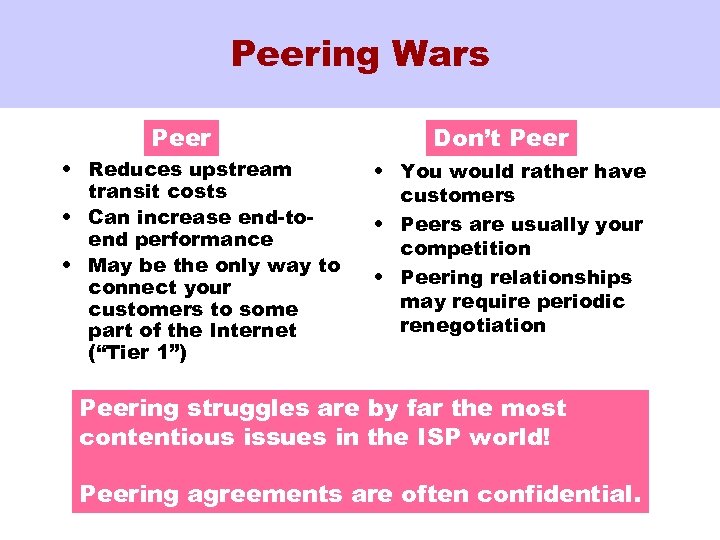
Peering Wars Peer • Reduces upstream transit costs • Can increase end-toend performance • May be the only way to connect your customers to some part of the Internet (“Tier 1”) Don’t Peer • You would rather have customers • Peers are usually your competition • Peering relationships may require periodic renegotiation Peering struggles are by far the most contentious issues in the ISP world! Peering agreements are often confidential.
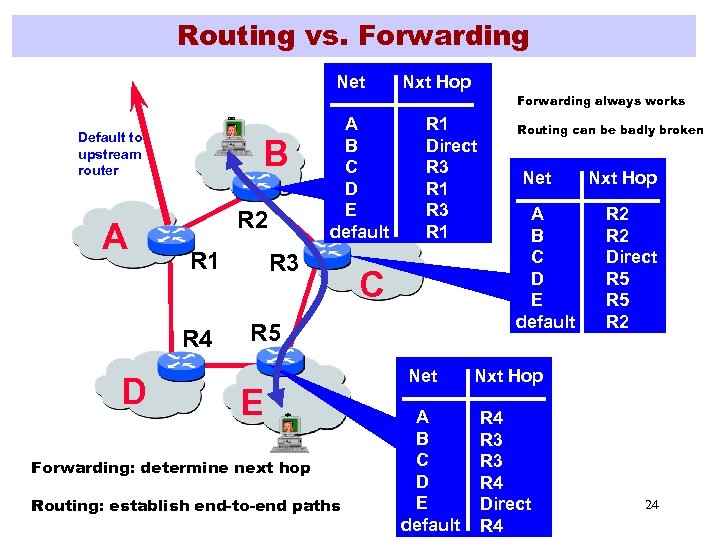
Routing vs. Forwarding Net Default to upstream router A B R R 2 R D R 3 R R 1 R 4 A B C D E default Nxt Hop R 1 Direct R 3 R 1 C R 5 E Forwarding: determine next hop Routing: establish end-to-end paths Forwarding always works Net A B C D E default Routing can be badly broken Net A B C D E default Nxt Hop R 2 Direct R 5 R 2 Nxt Hop R 4 R 3 R 4 Direct R 4 24
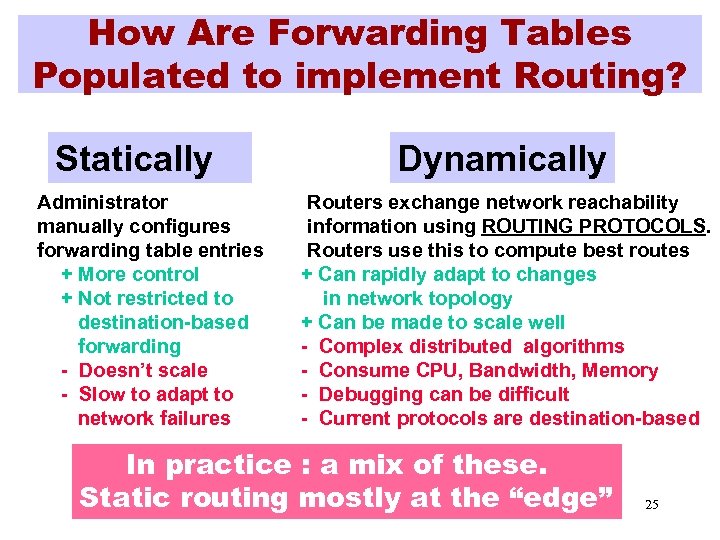
How Are Forwarding Tables Populated to implement Routing? Statically Administrator manually configures forwarding table entries + More control + Not restricted to destination-based forwarding - Doesn’t scale - Slow to adapt to network failures Dynamically Routers exchange network reachability information using ROUTING PROTOCOLS. Routers use this to compute best routes + Can rapidly adapt to changes in network topology + Can be made to scale well - Complex distributed algorithms - Consume CPU, Bandwidth, Memory - Debugging can be difficult - Current protocols are destination-based In practice : a mix of these. Static routing mostly at the “edge” 25
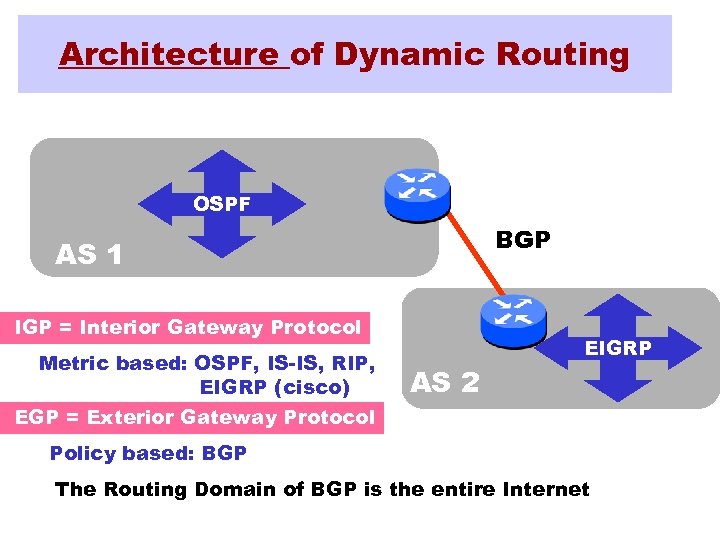
Architecture of Dynamic Routing OSPF BGP AS 1 IGP = Interior Gateway Protocol Metric based: OSPF, IS-IS, RIP, EIGRP (cisco) EIGRP AS 2 EGP = Exterior Gateway Protocol Policy based: BGP The Routing Domain of BGP is the entire Internet
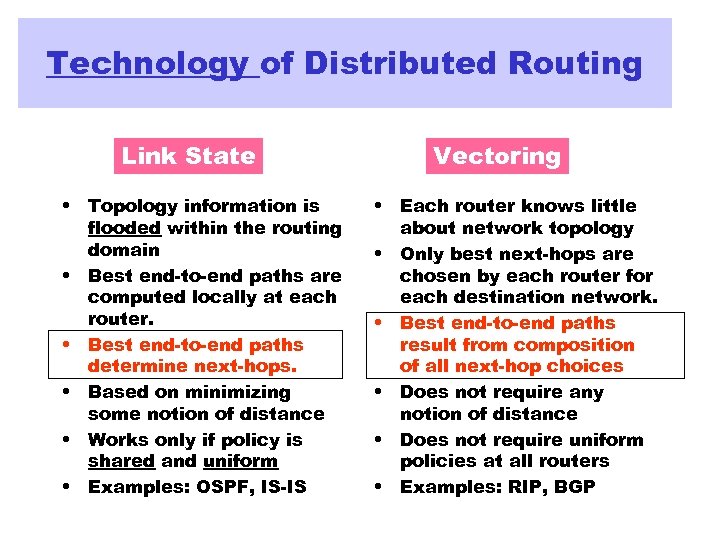
Technology of Distributed Routing Link State • Topology information is flooded within the routing domain • Best end-to-end paths are computed locally at each router. • Best end-to-end paths determine next-hops. • Based on minimizing some notion of distance • Works only if policy is shared and uniform • Examples: OSPF, IS-IS Vectoring • Each router knows little about network topology • Only best next-hops are chosen by each router for each destination network. • Best end-to-end paths result from composition of all next-hop choices • Does not require any notion of distance • Does not require uniform policies at all routers • Examples: RIP, BGP
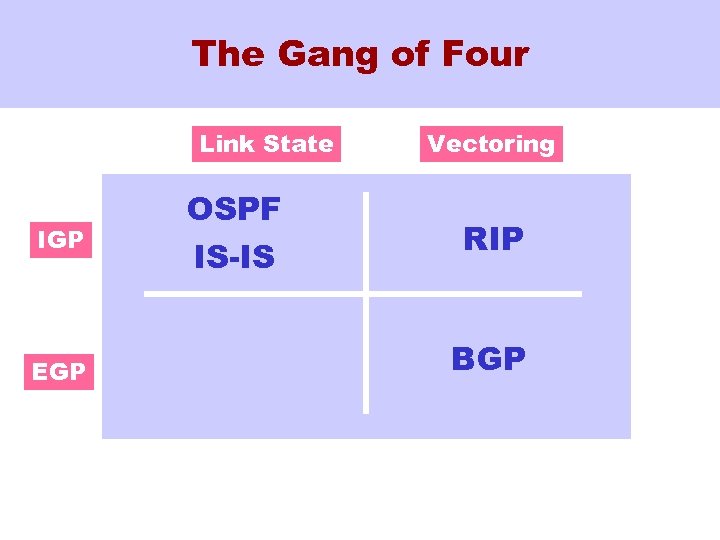
The Gang of Four Link State IGP EGP OSPF IS-IS Vectoring RIP BGP
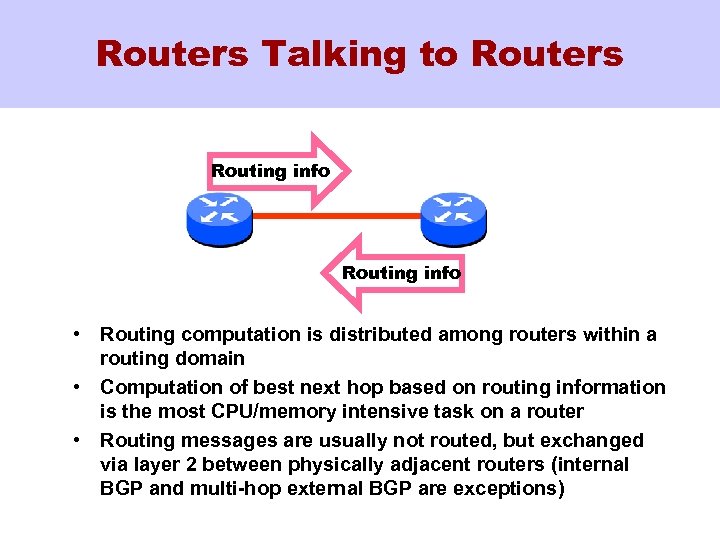
Routers Talking to Routers Routing info • Routing computation is distributed among routers within a routing domain • Computation of best next hop based on routing information is the most CPU/memory intensive task on a router • Routing messages are usually not routed, but exchanged via layer 2 between physically adjacent routers (internal BGP and multi-hop external BGP are exceptions)
Autonomous Routing Domains (ARDs) A collection of physical networks glued together using IP, that have a unified administrative routing policy. • • Campus networks Corporate networks ISP Internal networks …
Autonomous Systems (ASes) An autonomous system is an autonomous routing domain that has been assigned an Autonomous System Number (ASN). … the administration of an AS appears to other ASes to have a single coherent interior routing plan and presents a consistent picture of what networks are reachable through it. RFC 1930: Guidelines for creation, selection, and registration of an Autonomous System
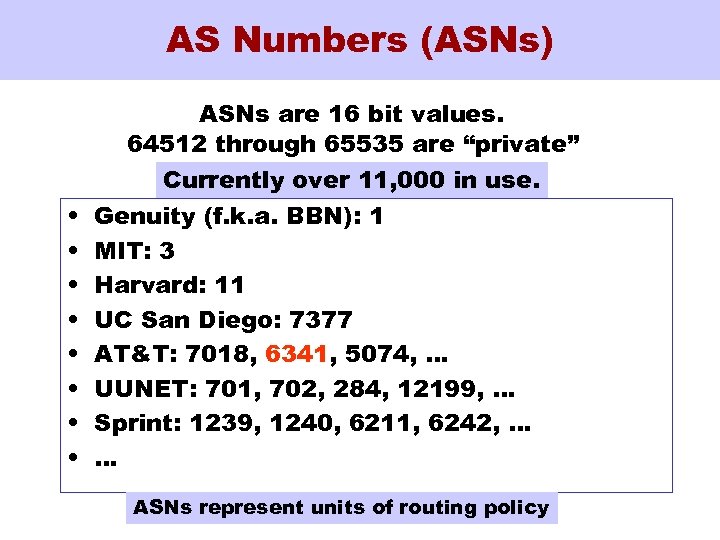
AS Numbers (ASNs) • • ASNs are 16 bit values. 64512 through 65535 are “private” Currently over 11, 000 in use. Genuity (f. k. a. BBN): 1 MIT: 3 Harvard: 11 UC San Diego: 7377 AT&T: 7018, 6341, 5074, … UUNET: 701, 702, 284, 12199, … Sprint: 1239, 1240, 6211, 6242, … … ASNs represent units of routing policy
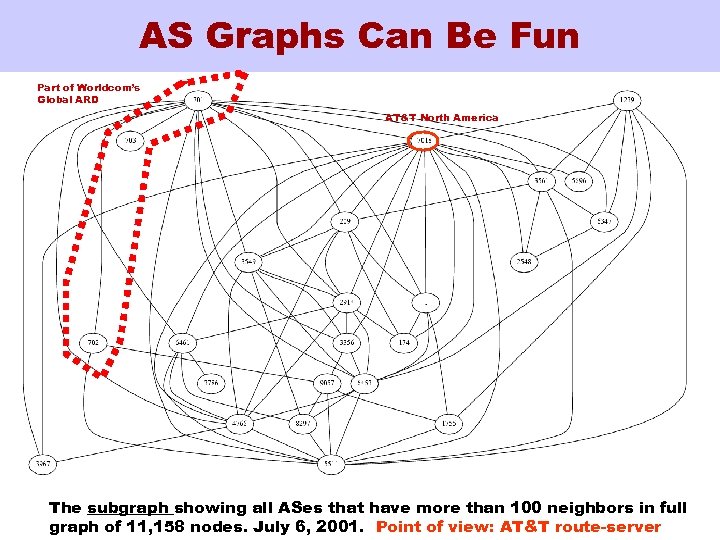
AS Graphs Can Be Fun Part of Worldcom’s Global ARD AT&T North America The subgraph showing all ASes that have more than 100 neighbors in full graph of 11, 158 nodes. July 6, 2001. Point of view: AT&T route-server
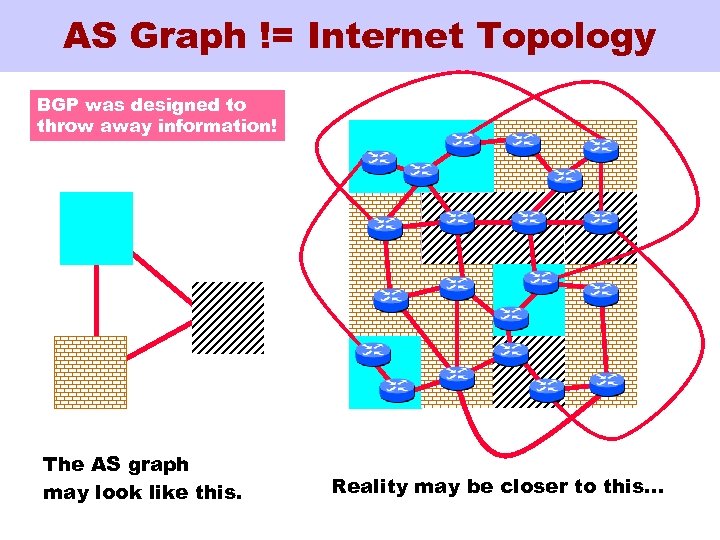
AS Graph != Internet Topology BGP was designed to throw away information! The AS graph may look like this. Reality may be closer to this…
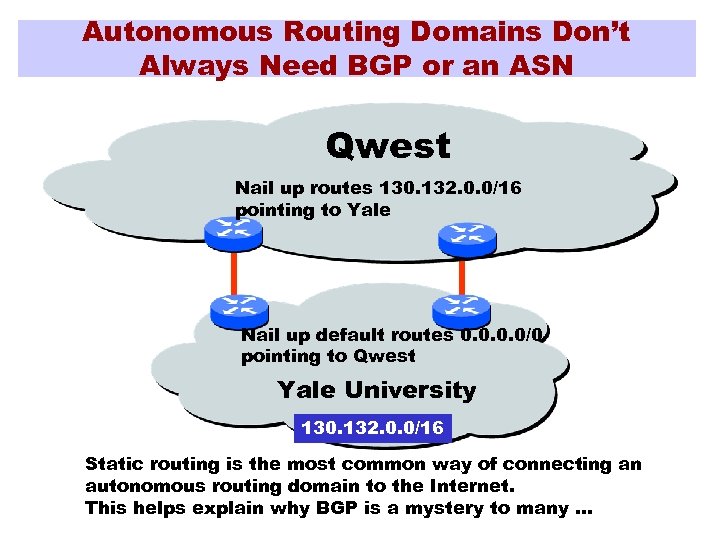
Autonomous Routing Domains Don’t Always Need BGP or an ASN Qwest Nail up routes 130. 132. 0. 0/16 pointing to Yale Nail up default routes 0. 0/0 pointing to Qwest Yale University 130. 132. 0. 0/16 Static routing is the most common way of connecting an autonomous routing domain to the Internet. This helps explain why BGP is a mystery to many …
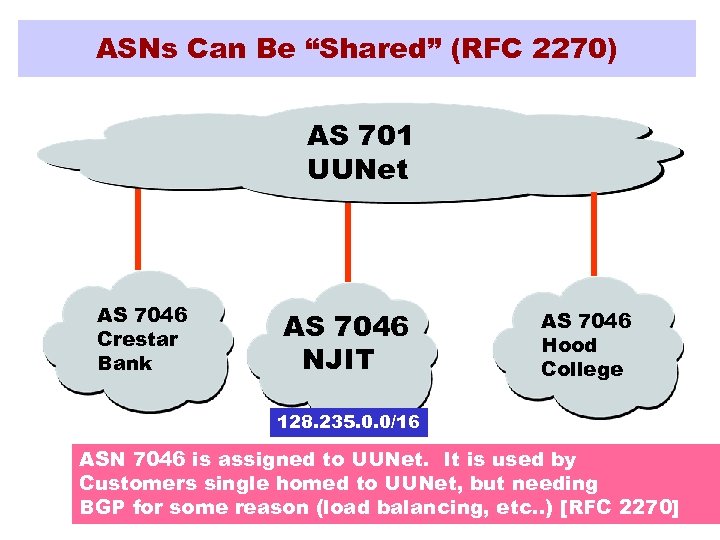
ASNs Can Be “Shared” (RFC 2270) AS 701 UUNet AS 7046 Crestar Bank AS 7046 NJIT AS 7046 Hood College 128. 235. 0. 0/16 ASN 7046 is assigned to UUNet. It is used by Customers single homed to UUNet, but needing BGP for some reason (load balancing, etc. . ) [RFC 2270]
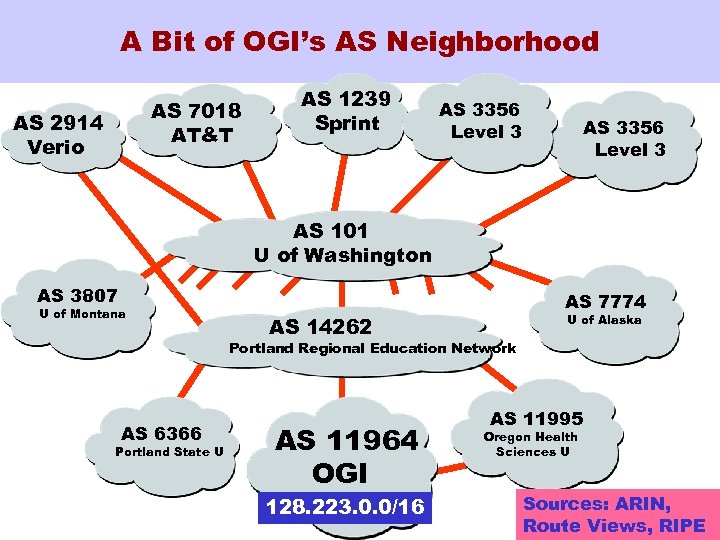
A Bit of OGI’s AS Neighborhood AS 7018 AT&T AS 2914 Verio AS 1239 Sprint AS 3356 Level 3 AS 101 U of Washington AS 3807 U of Montana AS 14262 AS 7774 U of Alaska Portland Regional Education Network AS 6366 Portland State U AS 11964 OGI 128. 223. 0. 0/16 AS 11995 Oregon Health Sciences U Sources: ARIN, Route Views, RIPE
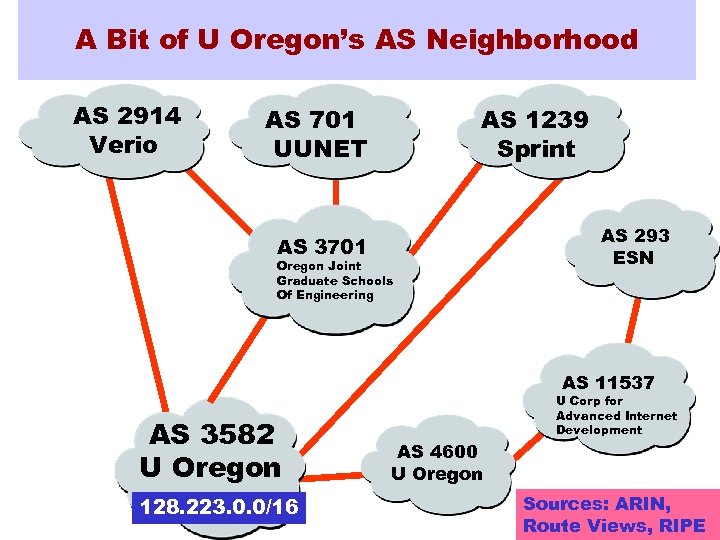
A Bit of U Oregon’s AS Neighborhood AS 2914 Verio AS 701 UUNET AS 1239 Sprint AS 3701 Oregon Joint Graduate Schools Of Engineering AS 293 ESN AS 11537 AS 3582 U Oregon 128. 223. 0. 0/16 U Corp for Advanced Internet Development AS 4600 U Oregon Sources: ARIN, Route Views, RIPE
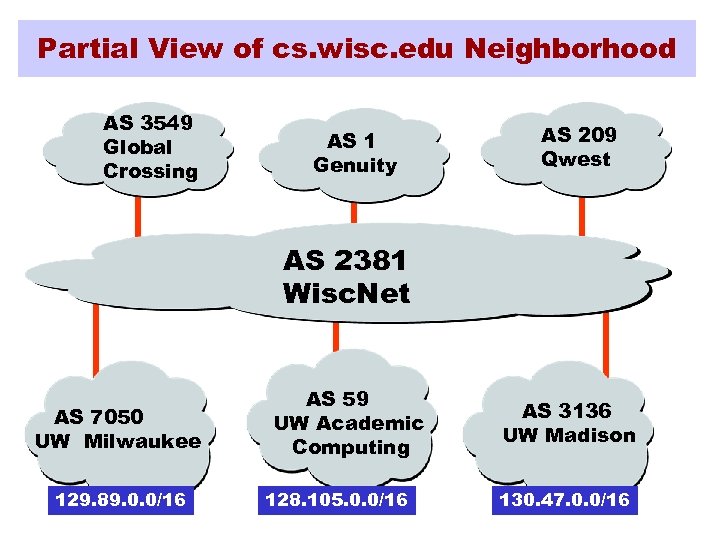
Partial View of cs. wisc. edu Neighborhood AS 3549 Global Crossing AS 1 Genuity AS 209 Qwest AS 2381 Wisc. Net AS 7050 UW Milwaukee 129. 89. 0. 0/16 AS 59 UW Academic Computing 128. 105. 0. 0/16 AS 3136 UW Madison 130. 47. 0. 0/16
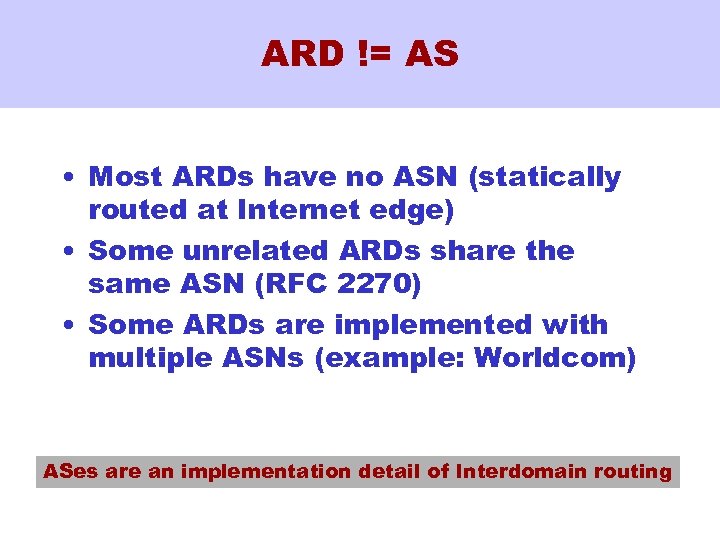
ARD != AS • Most ARDs have no ASN (statically routed at Internet edge) • Some unrelated ARDs share the same ASN (RFC 2270) • Some ARDs are implemented with multiple ASNs (example: Worldcom) ASes are an implementation detail of Interdomain routing
PART III Implementing Inter-Network Relationships with BGP
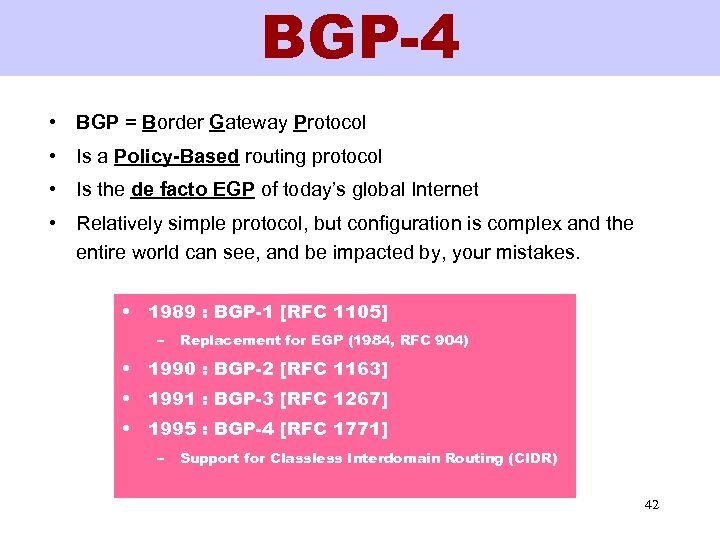
BGP-4 • BGP = Border Gateway Protocol • Is a Policy-Based routing protocol • Is the de facto EGP of today’s global Internet • Relatively simple protocol, but configuration is complex and the entire world can see, and be impacted by, your mistakes. • 1989 : BGP-1 [RFC 1105] – Replacement for EGP (1984, RFC 904) • 1990 : BGP-2 [RFC 1163] • 1991 : BGP-3 [RFC 1267] • 1995 : BGP-4 [RFC 1771] – Support for Classless Interdomain Routing (CIDR) 42
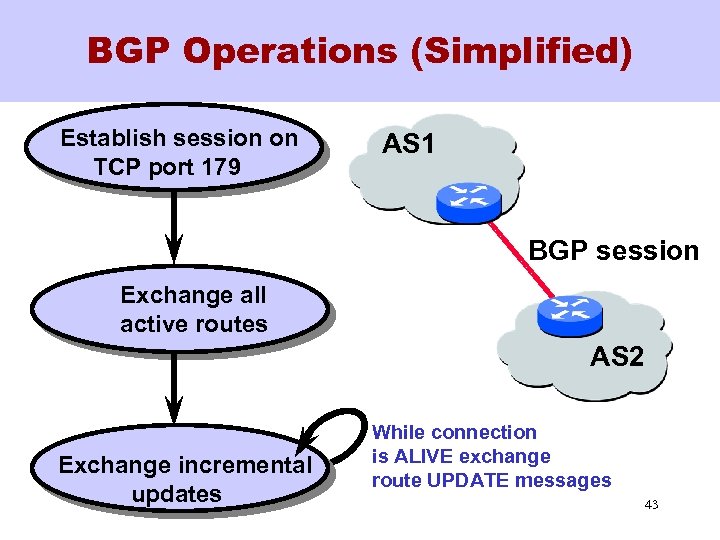
BGP Operations (Simplified) Establish session on TCP port 179 AS 1 BGP session Exchange all active routes AS 2 Exchange incremental updates While connection is ALIVE exchange route UPDATE messages 43
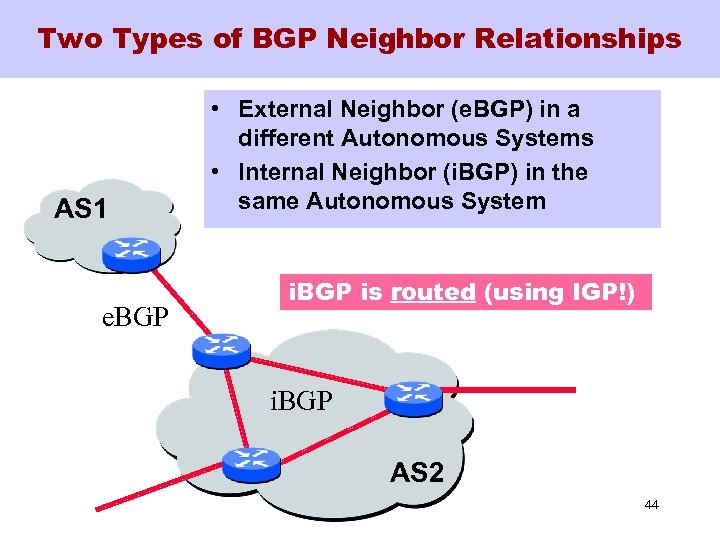
Two Types of BGP Neighbor Relationships AS 1 e. BGP • External Neighbor (e. BGP) in a different Autonomous Systems • Internal Neighbor (i. BGP) in the same Autonomous System i. BGP is routed (using IGP!) i. BGP AS 2 44
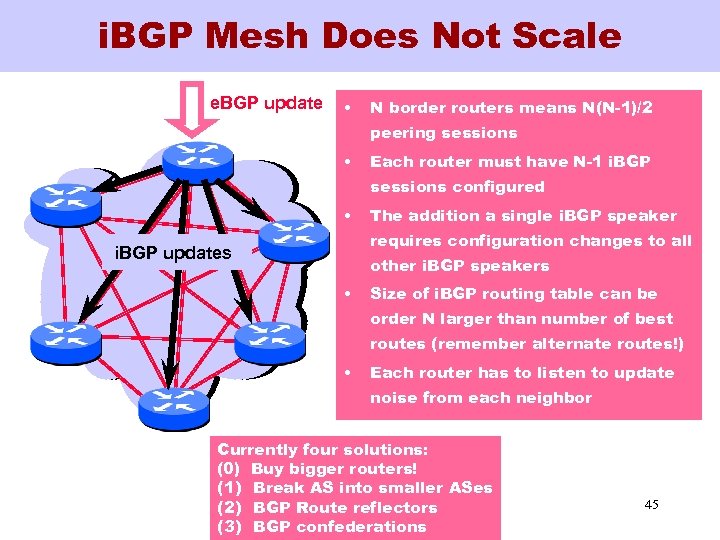
i. BGP Mesh Does Not Scale e. BGP update • N border routers means N(N-1)/2 peering sessions • Each router must have N-1 i. BGP sessions configured • The addition a single i. BGP speaker requires configuration changes to all i. BGP updates other i. BGP speakers • Size of i. BGP routing table can be order N larger than number of best routes (remember alternate routes!) • Each router has to listen to update noise from each neighbor Currently four solutions: (0) Buy bigger routers! (1) Break AS into smaller ASes (2) BGP Route reflectors (3) BGP confederations 45
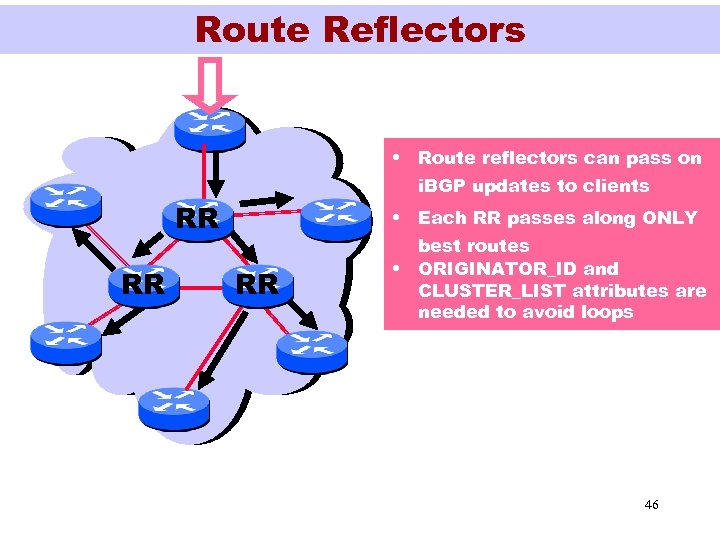
Route Reflectors • Route reflectors can pass on i. BGP updates to clients RR RR • Each RR passes along ONLY RR best routes • ORIGINATOR_ID and CLUSTER_LIST attributes are needed to avoid loops 46
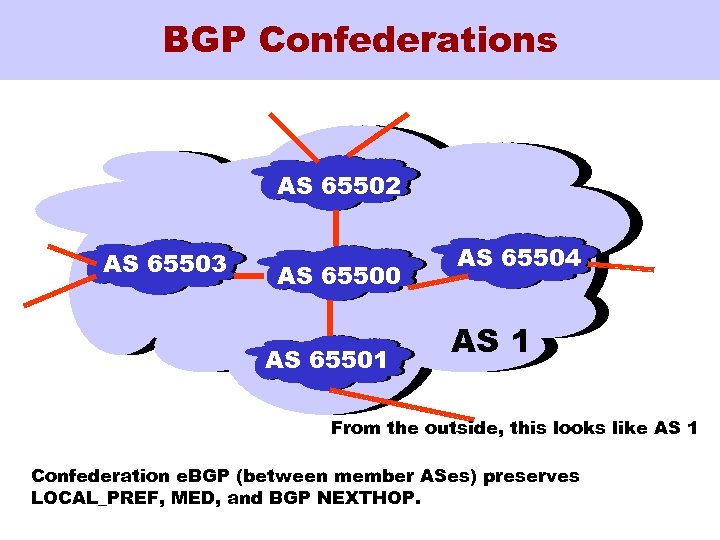
BGP Confederations AS 65502 AS 65503 AS 65500 AS 65501 AS 65504 AS 1 From the outside, this looks like AS 1 Confederation e. BGP (between member ASes) preserves LOCAL_PREF, MED, and BGP NEXTHOP.
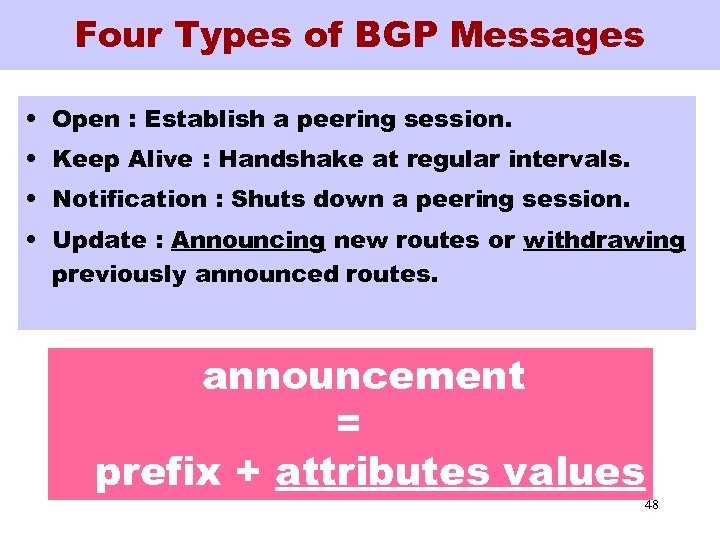
Four Types of BGP Messages • Open : Establish a peering session. • Keep Alive : Handshake at regular intervals. • Notification : Shuts down a peering session. • Update : Announcing new routes or withdrawing previously announced routes. announcement = prefix + attributes values 48
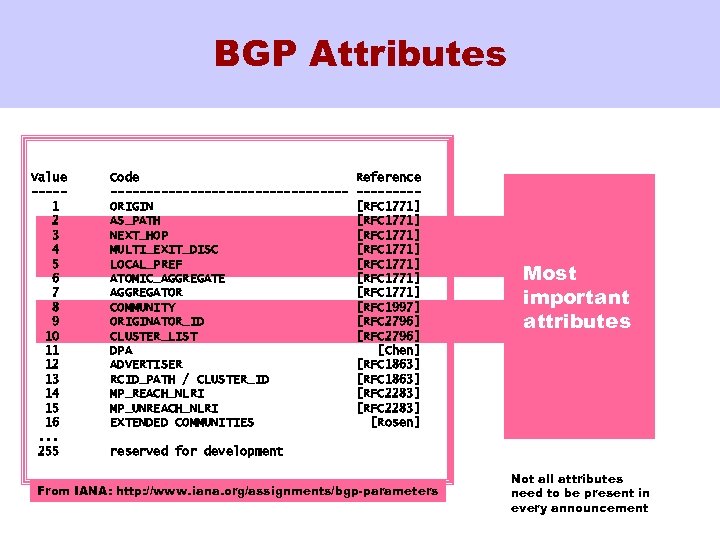
BGP Attributes Value ----1 2 3 4 5 6 7 8 9 10 11 12 13 14 15 16. . . 255 Code ----------------ORIGIN AS_PATH NEXT_HOP MULTI_EXIT_DISC LOCAL_PREF ATOMIC_AGGREGATE AGGREGATOR COMMUNITY ORIGINATOR_ID CLUSTER_LIST DPA ADVERTISER RCID_PATH / CLUSTER_ID MP_REACH_NLRI MP_UNREACH_NLRI EXTENDED COMMUNITIES Reference ----[RFC 1771] [RFC 1771] [RFC 1997] [RFC 2796] [Chen] [RFC 1863] [RFC 2283] [Rosen] Most important attributes reserved for development From IANA: http: //www. iana. org/assignments/bgp-parameters Not all attributes need to be present in every announcement
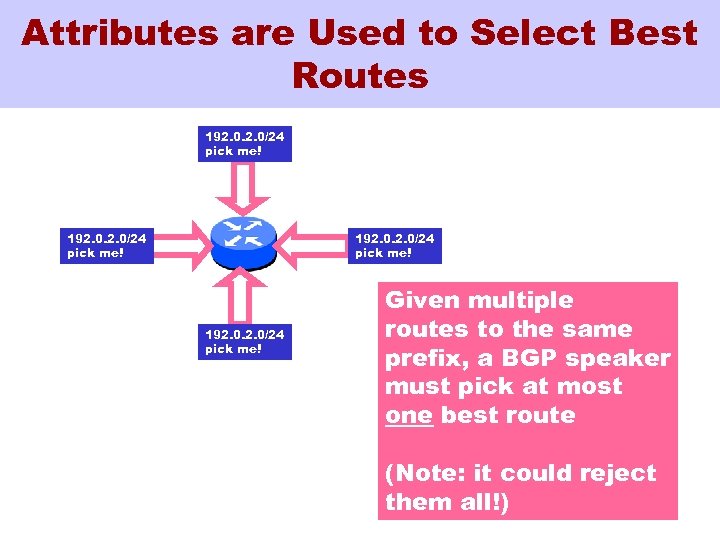
Attributes are Used to Select Best Routes 192. 0/24 pick me! Given multiple routes to the same prefix, a BGP speaker must pick at most one best route (Note: it could reject them all!)
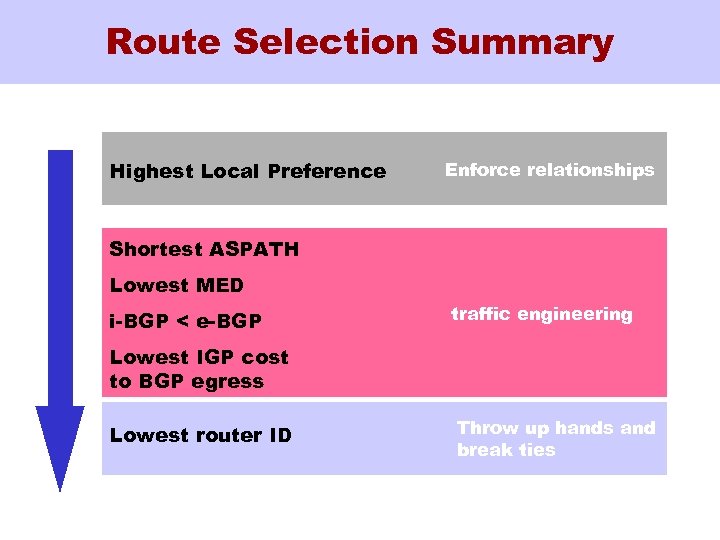
Route Selection Summary Highest Local Preference Enforce relationships Shortest ASPATH Lowest MED i-BGP < e-BGP traffic engineering Lowest IGP cost to BGP egress Lowest router ID Throw up hands and break ties
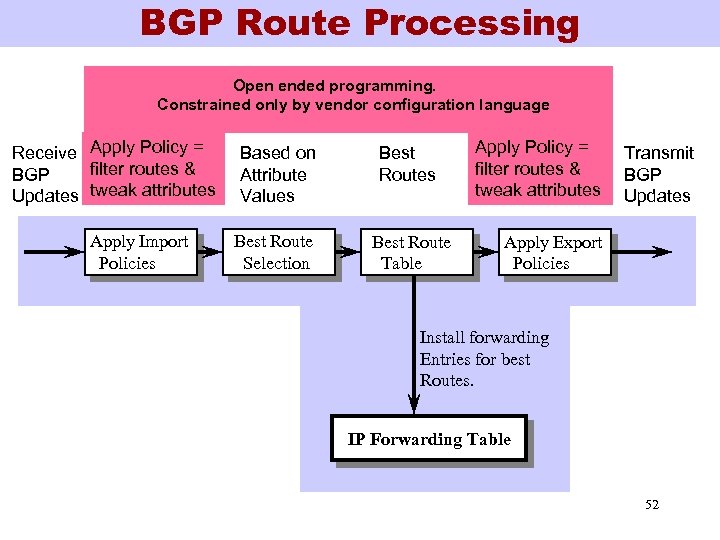
BGP Route Processing Open ended programming. Constrained only by vendor configuration language Receive Apply Policy = filter routes & BGP Updates tweak attributes Apply Import Policies Based on Attribute Values Best Route Selection Best Route Table Apply Policy = filter routes & tweak attributes Transmit BGP Updates Apply Export Policies Install forwarding Entries for best Routes. IP Forwarding Table 52
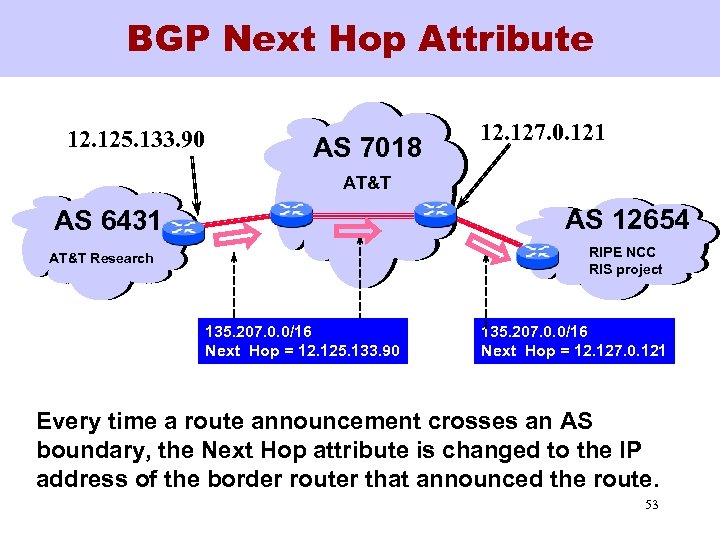
BGP Next Hop Attribute 12. 125. 133. 90 AS 7018 12. 127. 0. 121 AT&T AS 12654 AS 6431 RIPE NCC RIS project AT&T Research 135. 207. 0. 0/16 Next Hop = 12. 125. 133. 90 135. 207. 0. 0/16 Next Hop = 12. 127. 0. 121 Every time a route announcement crosses an AS boundary, the Next Hop attribute is changed to the IP address of the border router that announced the route. 53
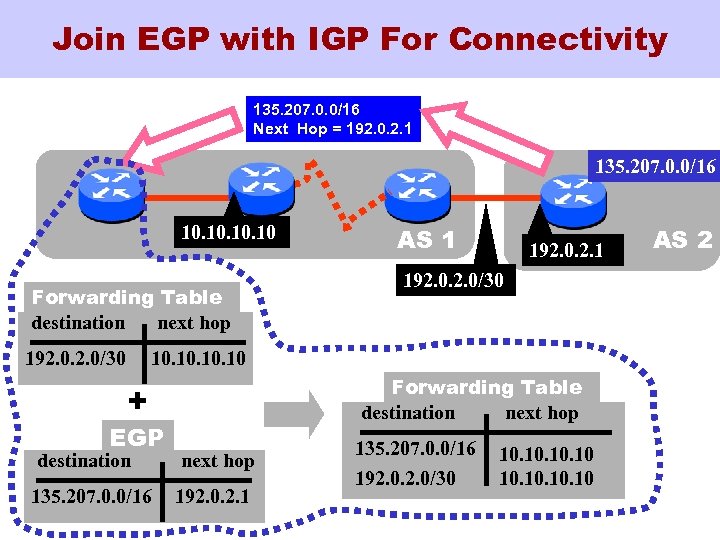
Join EGP with IGP For Connectivity 135. 207. 0. 0/16 Next Hop = 192. 0. 2. 1 135. 207. 0. 0/16 10. 10. 10 Forwarding Table destination next hop 192. 0/30 AS 1 192. 0/30 10. 10. 10 Forwarding Table destination next hop + EGP destination next hop 135. 207. 0. 0/16 192. 0. 2. 1 135. 207. 0. 0/16 192. 0/30 10. 10 AS 2
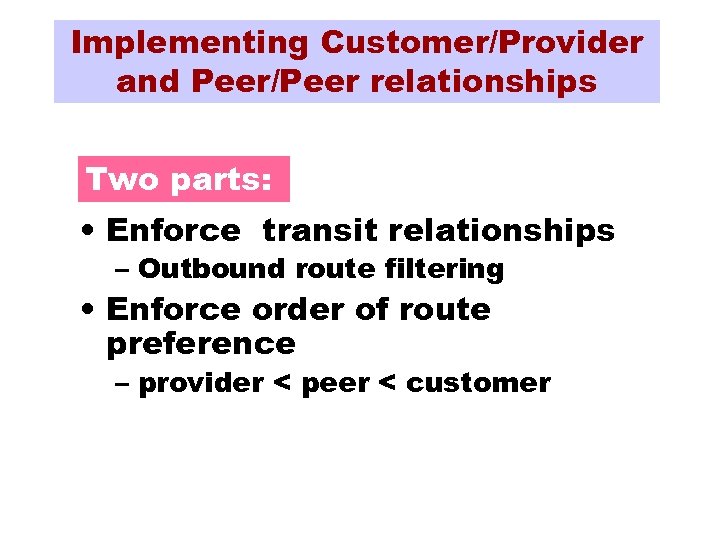
Implementing Customer/Provider and Peer/Peer relationships Two parts: • Enforce transit relationships – Outbound route filtering • Enforce order of route preference – provider < peer < customer
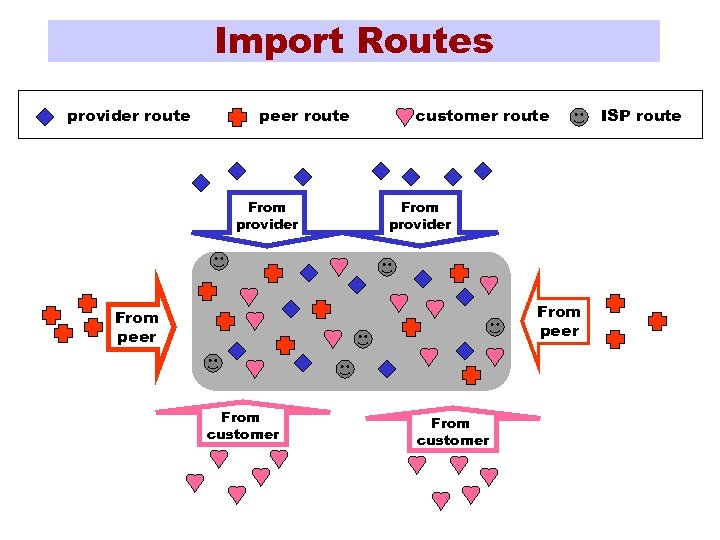
Import Routes provider route peer route From provider customer route From provider From peer From customer ISP route
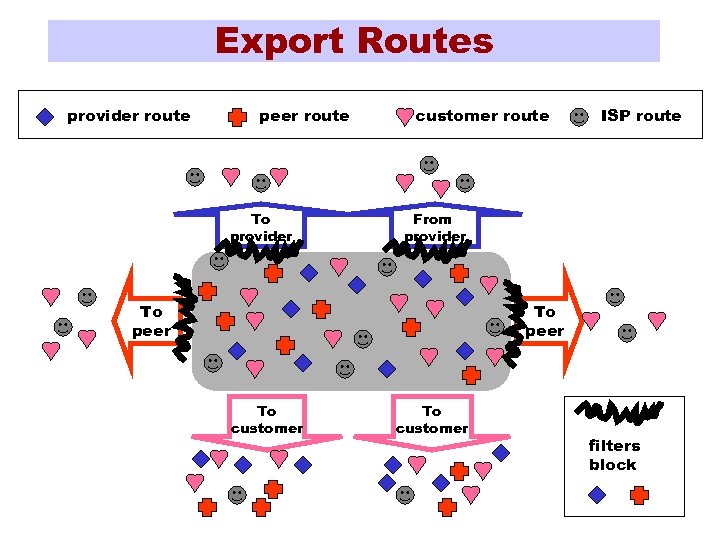
Export Routes provider route peer route To provider customer route ISP route From provider To peer To customer filters block
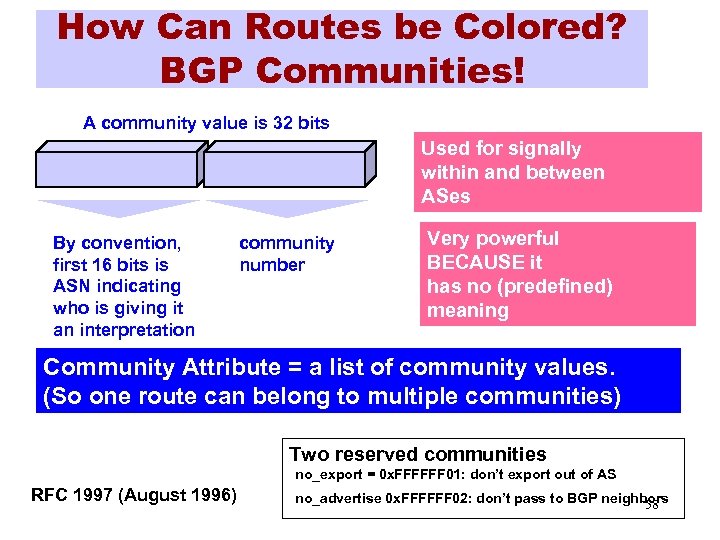
How Can Routes be Colored? BGP Communities! A community value is 32 bits Used for signally within and between ASes By convention, first 16 bits is ASN indicating who is giving it an interpretation community number Very powerful BECAUSE it has no (predefined) meaning Community Attribute = a list of community values. (So one route can belong to multiple communities) Two reserved communities no_export = 0 x. FFFFFF 01: don’t export out of AS RFC 1997 (August 1996) no_advertise 0 x. FFFFFF 02: don’t pass to BGP neighbors 58
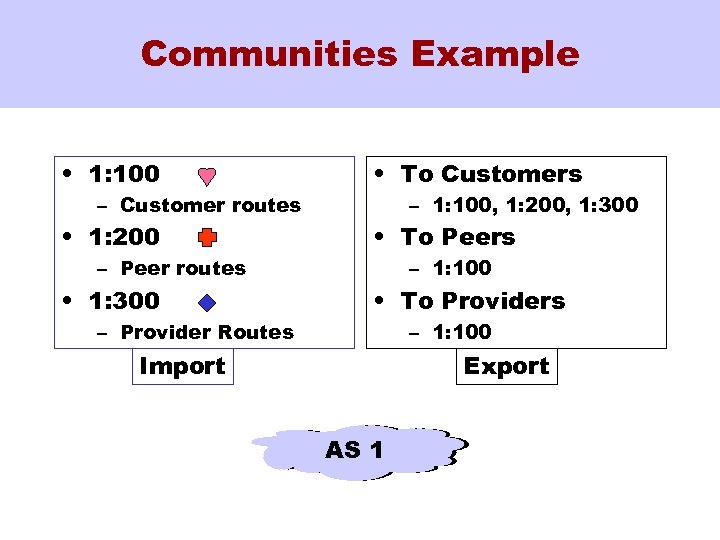
Communities Example • 1: 100 • To Customers • 1: 200 • To Peers • 1: 300 • To Providers – Customer routes – Peer routes – Provider Routes – 1: 100, 1: 200, 1: 300 – 1: 100 Import Export AS 1
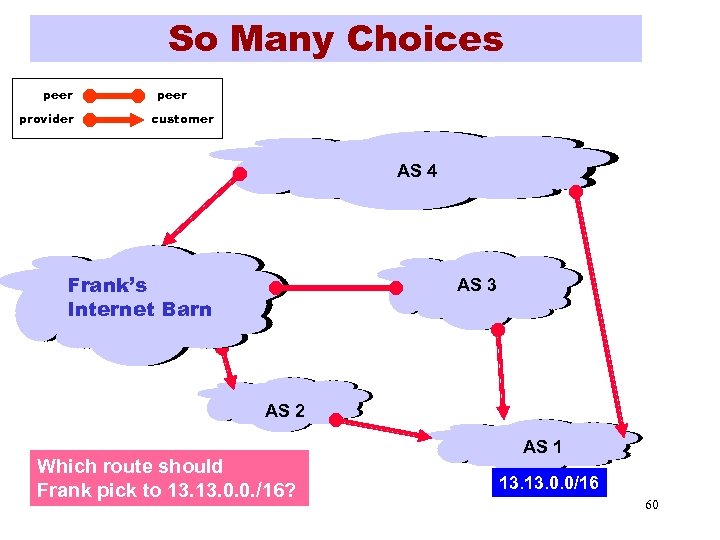
So Many Choices peer provider peer customer AS 4 Frank’s Internet Barn AS 3 AS 2 Which route should Frank pick to 13. 0. 0. /16? AS 1 13. 0. 0/16 60
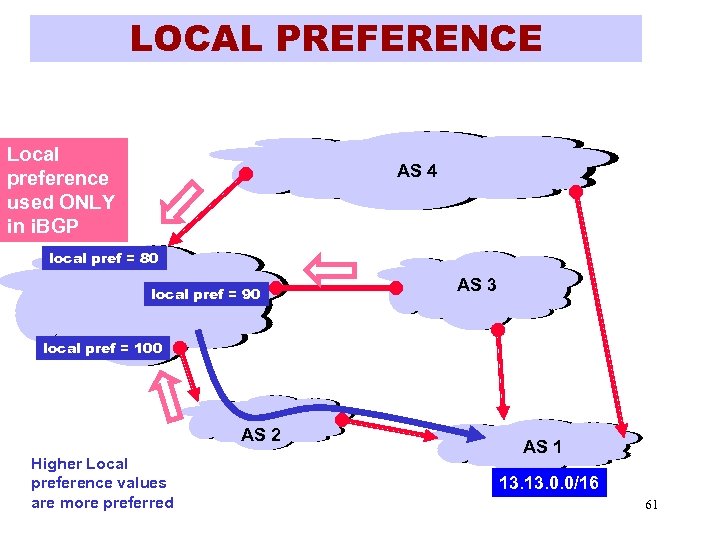
LOCAL PREFERENCE Local preference used ONLY in i. BGP AS 4 local pref = 80 local pref = 90 AS 3 local pref = 100 AS 2 Higher Local preference values are more preferred AS 1 13. 0. 0/16 61
PART IV Traffic Engineering with BGP
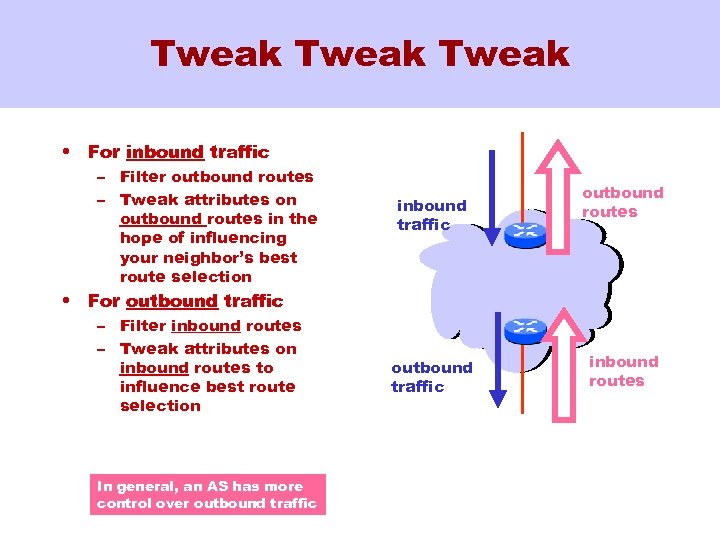
Tweak • For inbound traffic – Filter outbound routes – Tweak attributes on outbound routes in the hope of influencing your neighbor’s best route selection inbound traffic outbound routes • For outbound traffic – Filter inbound routes – Tweak attributes on inbound routes to influence best route selection In general, an AS has more control over outbound traffic inbound routes
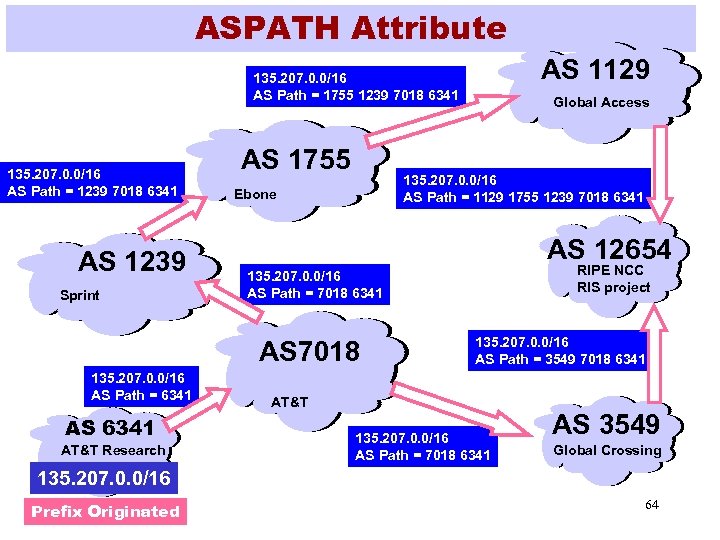
ASPATH Attribute AS 1129 135. 207. 0. 0/16 AS Path = 1755 1239 7018 6341 135. 207. 0. 0/16 AS Path = 1239 7018 6341 AS 1239 Sprint AS 1755 135. 207. 0. 0/16 AS Path = 1129 1755 1239 7018 6341 Ebone AS 12654 AS 6341 AT&T Research RIPE NCC RIS project 135. 207. 0. 0/16 AS Path = 7018 6341 AS 7018 135. 207. 0. 0/16 AS Path = 6341 Global Access 135. 207. 0. 0/16 AS Path = 3549 7018 6341 AT&T 135. 207. 0. 0/16 AS Path = 7018 6341 AS 3549 Global Crossing 135. 207. 0. 0/16 Prefix Originated 64
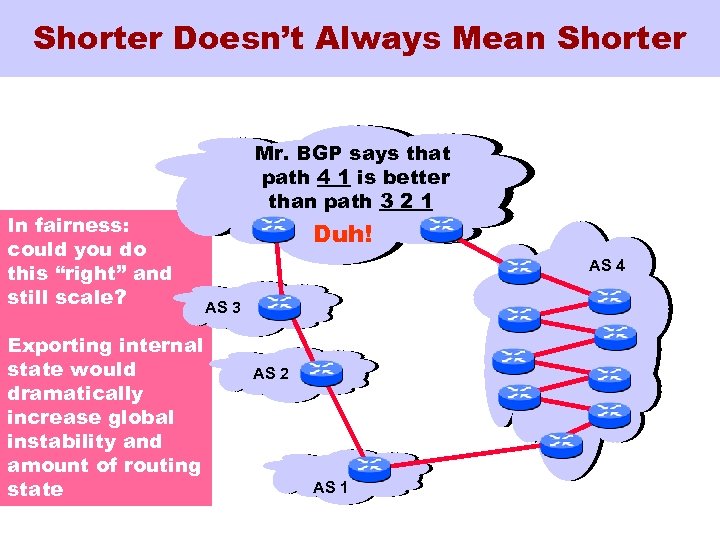
Shorter Doesn’t Always Mean Shorter In fairness: could you do this “right” and still scale? Exporting internal state would dramatically increase global instability and amount of routing state Mr. BGP says that path 4 1 is better than path 3 2 1 Duh! AS 4 AS 3 AS 2 AS 1
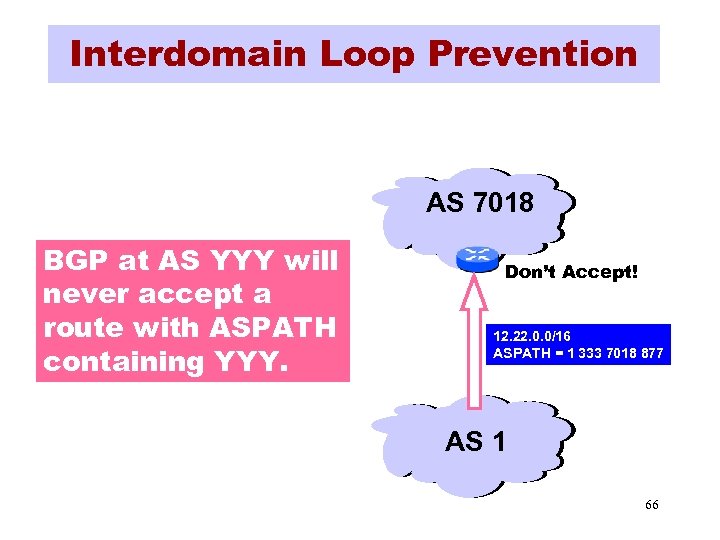
Interdomain Loop Prevention AS 7018 BGP at AS YYY will never accept a route with ASPATH containing YYY. Don’t Accept! 12. 22. 0. 0/16 ASPATH = 1 333 7018 877 AS 1 66
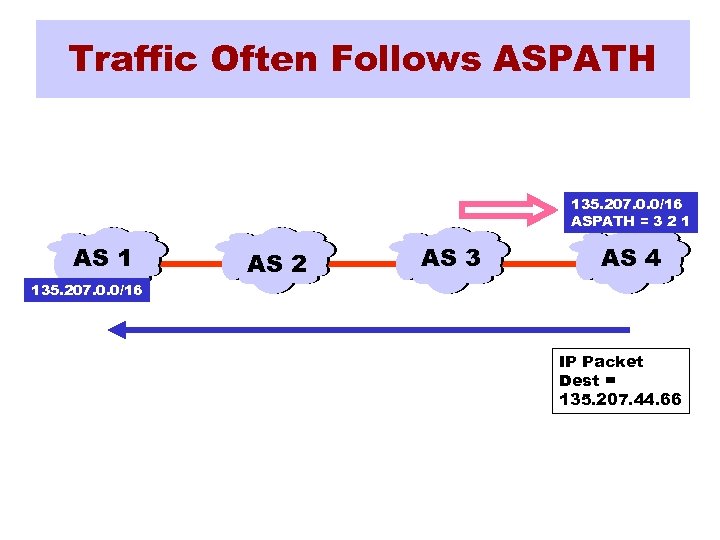
Traffic Often Follows ASPATH 135. 207. 0. 0/16 ASPATH = 3 2 1 AS 1 135. 207. 0. 0/16 AS 2 AS 3 AS 4 IP Packet Dest = 135. 207. 44. 66
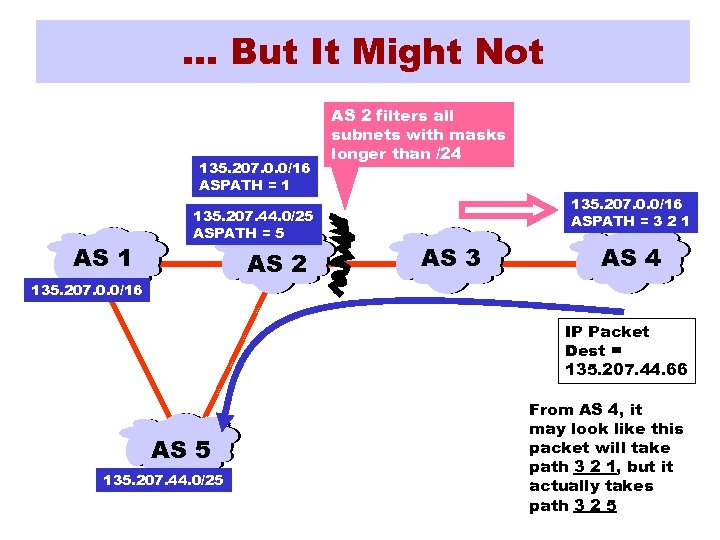
… But It Might Not 135. 207. 0. 0/16 ASPATH = 1 AS 1 135. 207. 44. 0/25 ASPATH = 5 AS 2 135. 207. 0. 0/16 AS 2 filters all subnets with masks longer than /24 135. 207. 0. 0/16 ASPATH = 3 2 1 AS 3 AS 4 IP Packet Dest = 135. 207. 44. 66 AS 5 135. 207. 44. 0/25 From AS 4, it may look like this packet will take path 3 2 1, but it actually takes path 3 2 5
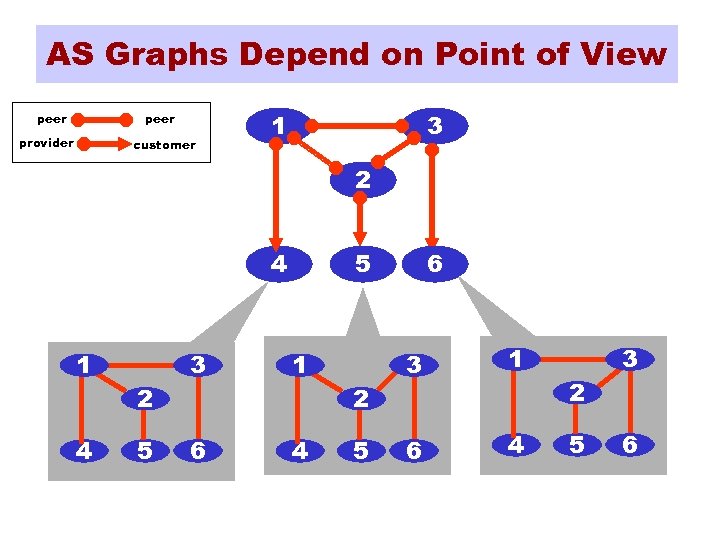
AS Graphs Depend on Point of View peer provider customer 1 3 2 4 1 4 2 5 5 3 1 6 4 2 5 6 3 1 6 4 2 5 3 6
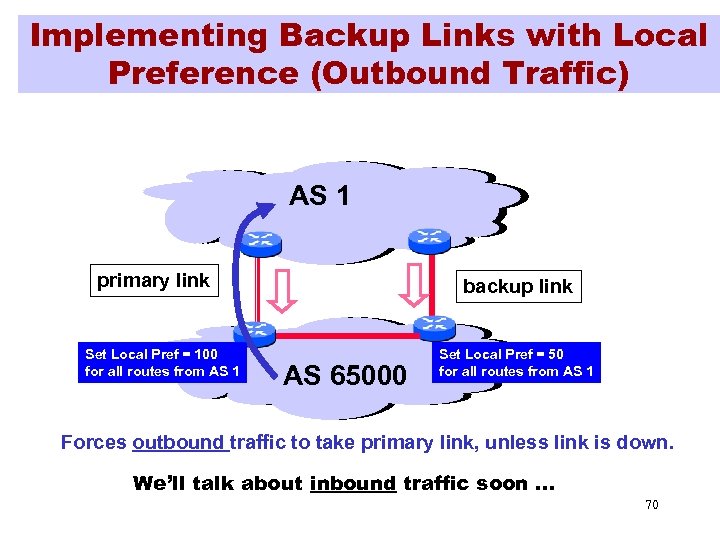
Implementing Backup Links with Local Preference (Outbound Traffic) AS 1 primary link Set Local Pref = 100 for all routes from AS 1 backup link AS 65000 Set Local Pref = 50 for all routes from AS 1 Forces outbound traffic to take primary link, unless link is down. We’ll talk about inbound traffic soon … 70
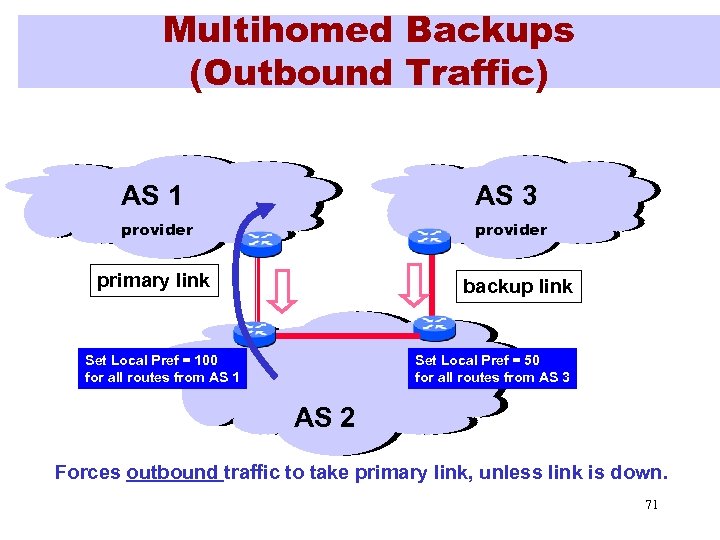
Multihomed Backups (Outbound Traffic) AS 1 AS 3 provider primary link backup link Set Local Pref = 100 for all routes from AS 1 Set Local Pref = 50 for all routes from AS 3 AS 2 Forces outbound traffic to take primary link, unless link is down. 71
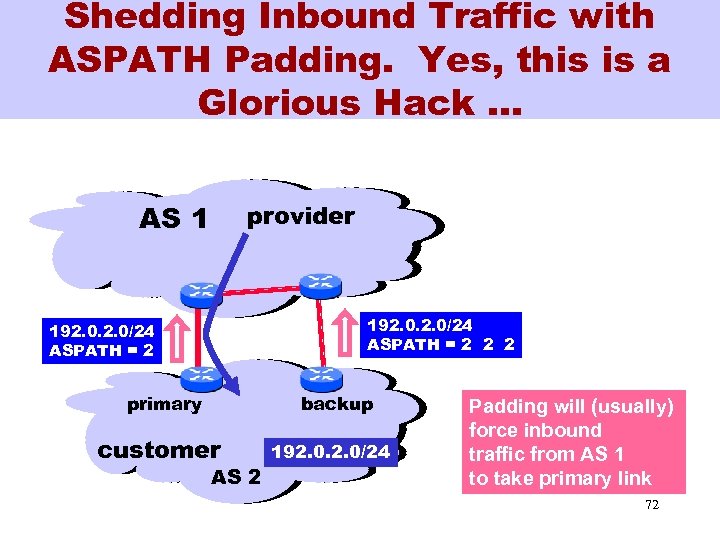
Shedding Inbound Traffic with ASPATH Padding. Yes, this is a Glorious Hack … AS 1 provider 192. 0/24 ASPATH = 2 2 2 192. 0/24 ASPATH = 2 primary backup customer AS 2 192. 0/24 Padding will (usually) force inbound traffic from AS 1 to take primary link 72
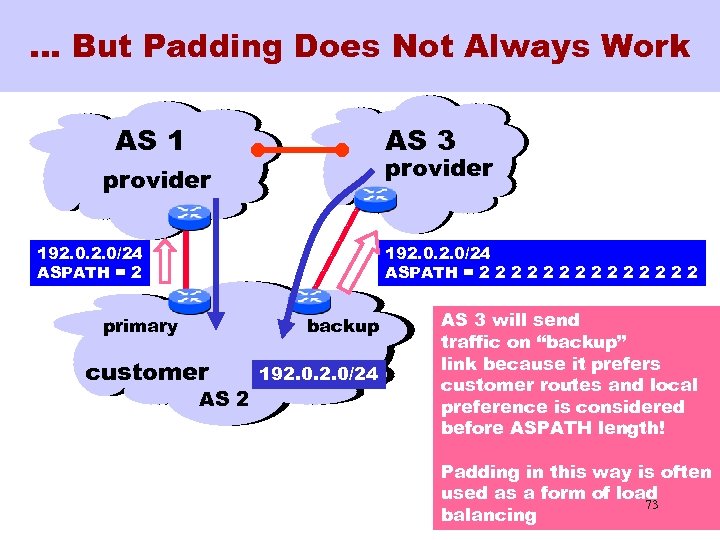
… But Padding Does Not Always Work AS 1 AS 3 provider 192. 0/24 ASPATH = 2 2 2 2 primary backup customer AS 2 192. 0/24 AS 3 will send traffic on “backup” link because it prefers customer routes and local preference is considered before ASPATH length! Padding in this way is often used as a form of load 73 balancing
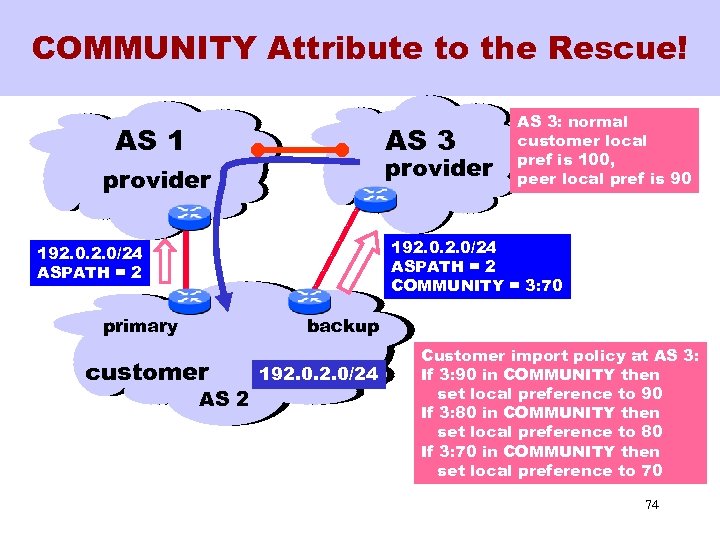
COMMUNITY Attribute to the Rescue! AS 1 AS 3 provider AS 3: normal customer local pref is 100, peer local pref is 90 192. 0/24 ASPATH = 2 COMMUNITY = 3: 70 192. 0/24 ASPATH = 2 primary backup customer AS 2 192. 0/24 Customer import policy at AS 3: If 3: 90 in COMMUNITY then set local preference to 90 If 3: 80 in COMMUNITY then set local preference to 80 If 3: 70 in COMMUNITY then set local preference to 70 74
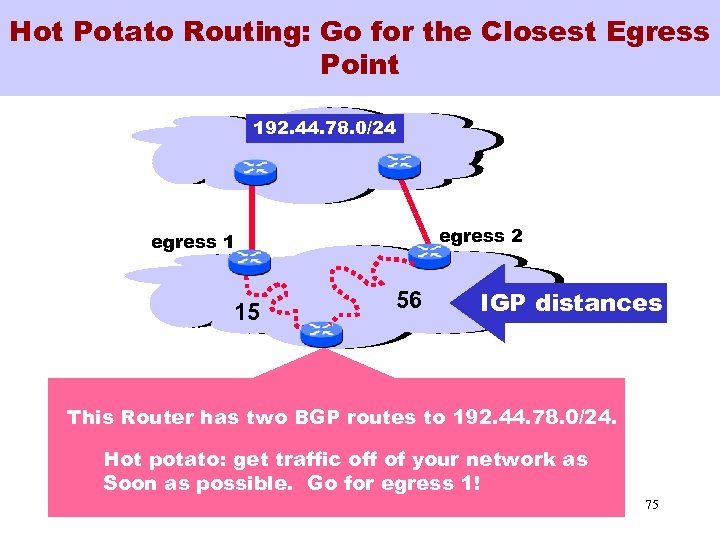
Hot Potato Routing: Go for the Closest Egress Point 192. 44. 78. 0/24 egress 2 egress 1 15 56 IGP distances This Router has two BGP routes to 192. 44. 78. 0/24. Hot potato: get traffic off of your network as Soon as possible. Go for egress 1! 75
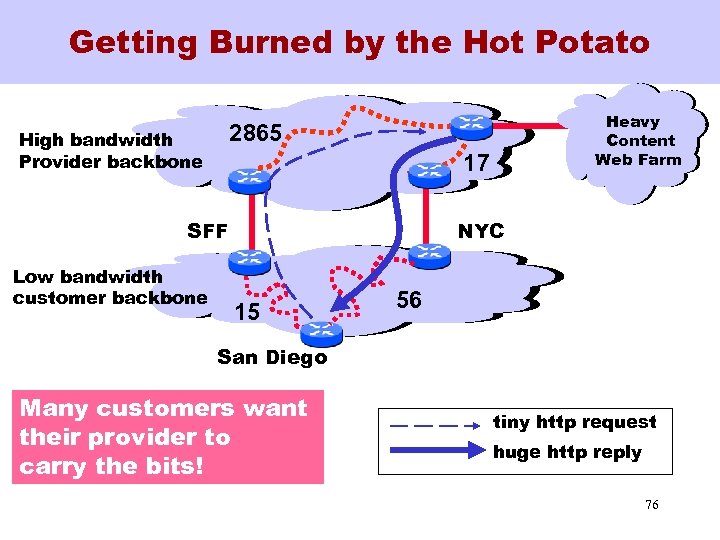
Getting Burned by the Hot Potato 2865 High bandwidth Provider backbone 17 SFF Low bandwidth customer backbone Heavy Content Web Farm NYC 15 56 San Diego Many customers want their provider to carry the bits! tiny http request huge http reply 76
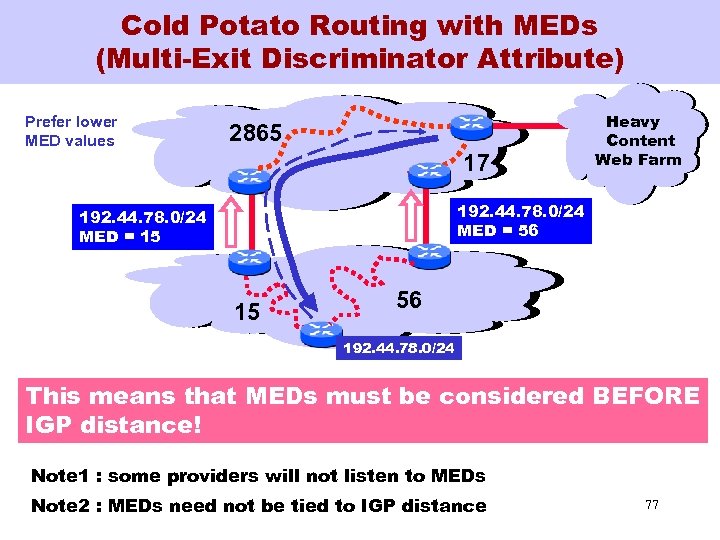
Cold Potato Routing with MEDs (Multi-Exit Discriminator Attribute) Prefer lower MED values 2865 17 Heavy Content Web Farm 192. 44. 78. 0/24 MED = 56 192. 44. 78. 0/24 MED = 15 15 56 192. 44. 78. 0/24 This means that MEDs must be considered BEFORE IGP distance! Note 1 : some providers will not listen to MEDs Note 2 : MEDs need not be tied to IGP distance 77

PART V A Wee Bit O’ Theory: What Problem is BGP Attempting to Solve?
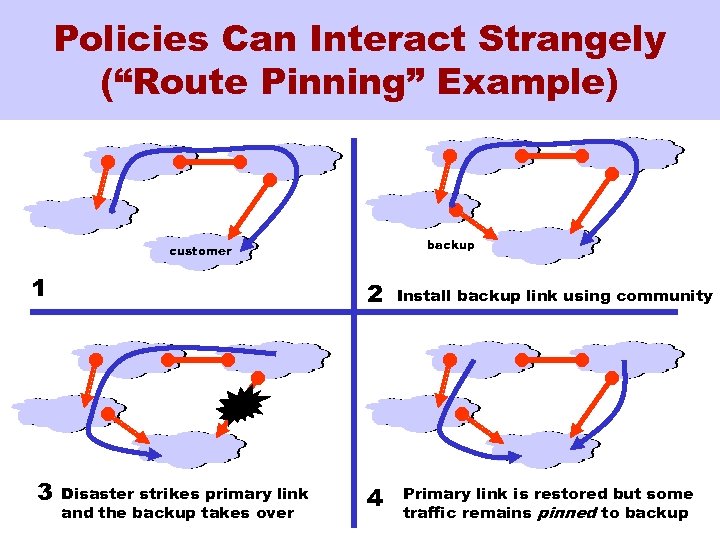
Policies Can Interact Strangely (“Route Pinning” Example) backup customer 1 3 2 Disaster strikes primary link and the backup takes over 4 Install backup link using community Primary link is restored but some traffic remains pinned to backup
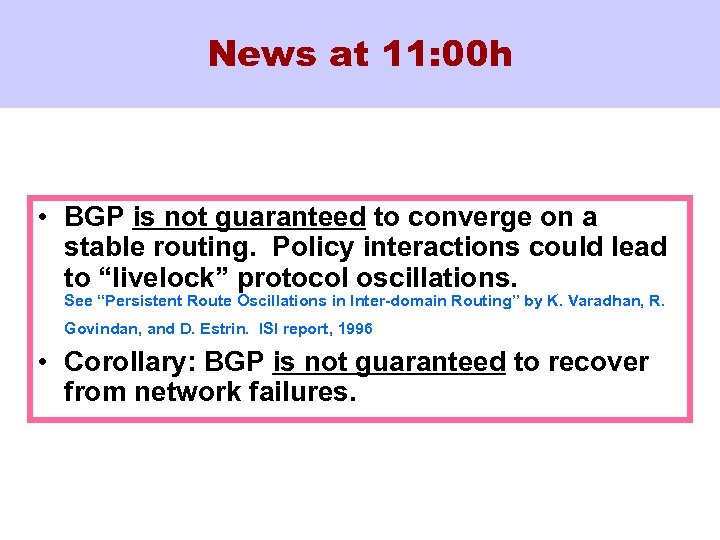
News at 11: 00 h • BGP is not guaranteed to converge on a stable routing. Policy interactions could lead to “livelock” protocol oscillations. See “Persistent Route Oscillations in Inter-domain Routing” by K. Varadhan, R. Govindan, and D. Estrin. ISI report, 1996 • Corollary: BGP is not guaranteed to recover from network failures.
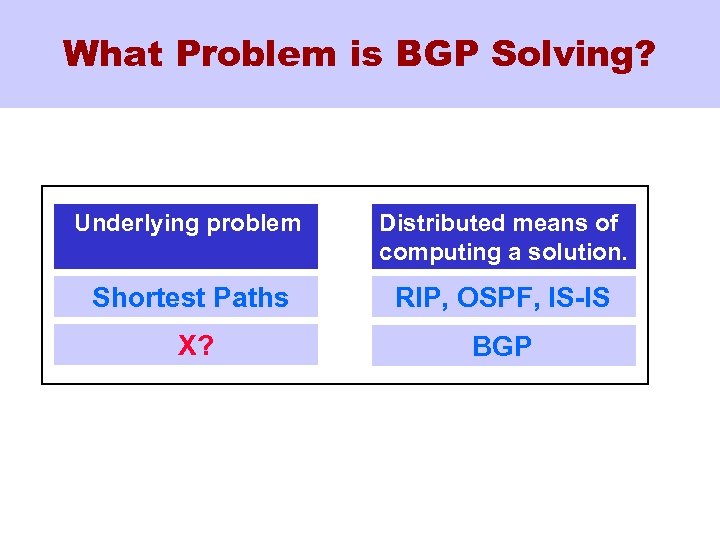
What Problem is BGP Solving? Underlying problem Distributed means of computing a solution. Shortest Paths RIP, OSPF, IS-IS X? BGP
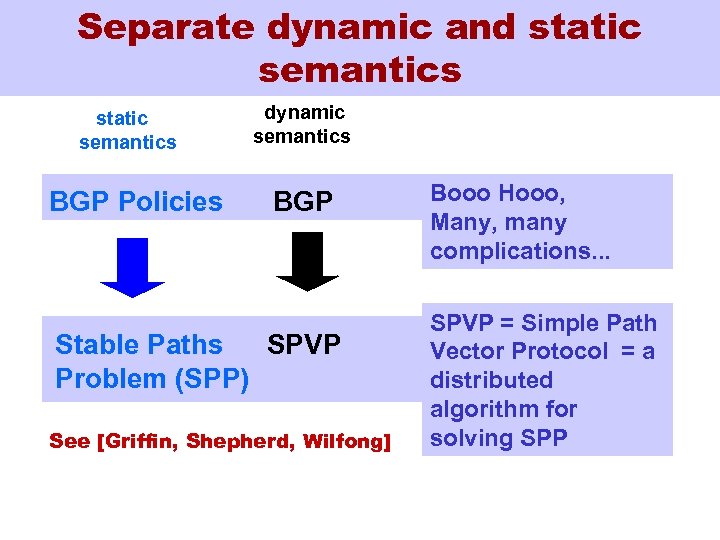
Separate dynamic and static semantics BGP Policies dynamic semantics BGP Stable Paths SPVP Problem (SPP) See [Griffin, Shepherd, Wilfong] Booo Hooo, Many, many complications. . . SPVP = Simple Path Vector Protocol = a distributed algorithm for solving SPP
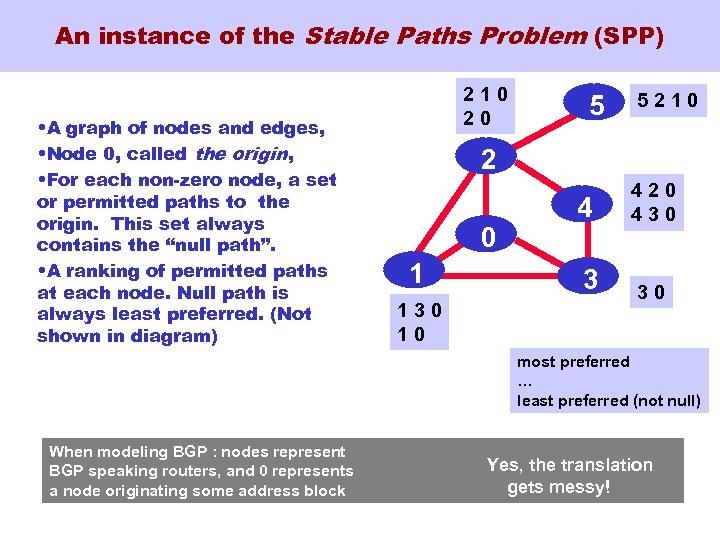
An instance of the Stable Paths Problem (SPP) • A graph of nodes and edges, • Node 0, called the origin, • For each non-zero node, a set or permitted paths to the origin. This set always contains the “null path”. • A ranking of permitted paths at each node. Null path is always least preferred. (Not shown in diagram) 1 When modeling BGP : nodes represent BGP speaking routers, and 0 represents a node originating some address block 210 2 20 5 5210 2 3 0 1 130 10 4 420 430 30 most preferred … least preferred (not null) Yes, the translation gets messy!
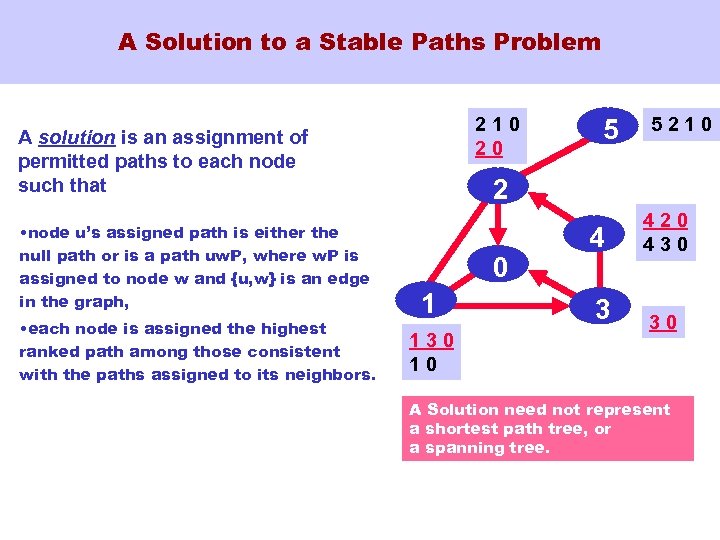
A Solution to a Stable Paths Problem 2 210 20 A solution is an assignment of permitted paths to each node such that • node u’s assigned path is either the null path or is a path uw. P, where w. P is assigned to node w and {u, w} is an edge in the graph, • each node is assigned the highest ranked path among those consistent with the paths assigned to its neighbors. 1 5 5210 2 0 1 130 10 4 420 430 3 30 A Solution need not represent a shortest path tree, or a spanning tree.
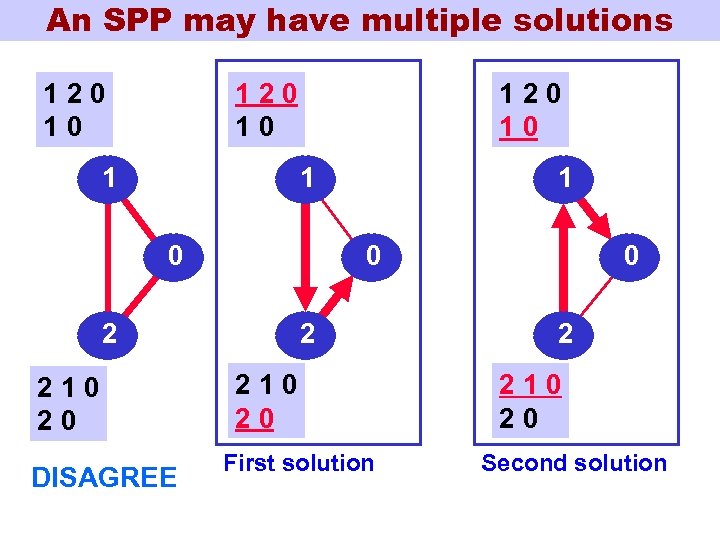
An SPP may have multiple solutions 120 10 1 0 DISAGREE 0 0 2 2 210 20 1 210 20 First solution 2 210 20 Second solution
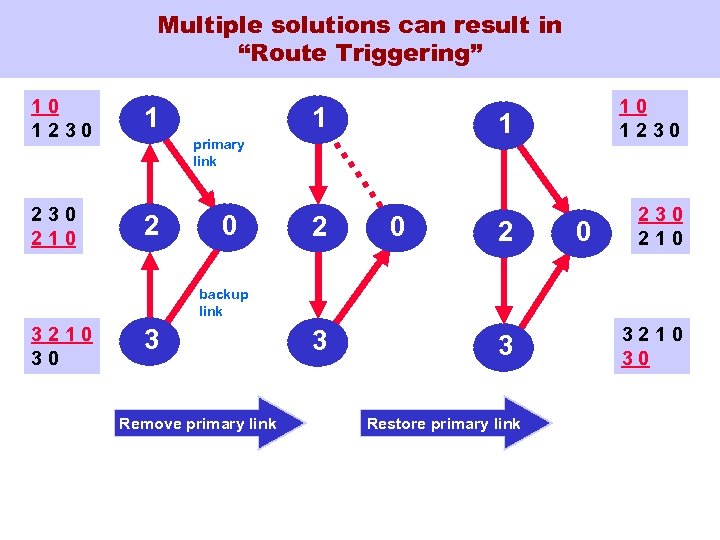
Multiple solutions can result in “Route Triggering” 10 1230 1 230 210 2 1 1 primary link 0 2 0 10 1230 210 0 backup link 3210 30 3 Remove primary link 3 3 Restore primary link 3210 30
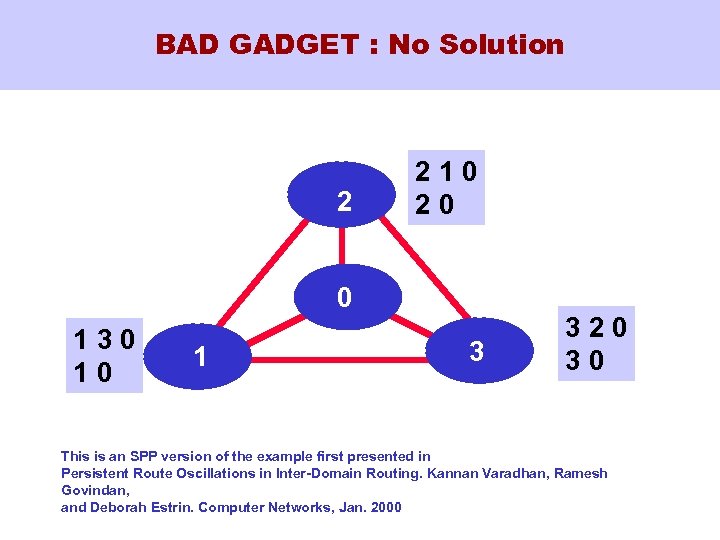
BAD GADGET : No Solution 2 210 20 4 0 130 10 1 3 3 320 30 This is an SPP version of the example first presented in Persistent Route Oscillations in Inter-Domain Routing. Kannan Varadhan, Ramesh Govindan, and Deborah Estrin. Computer Networks, Jan. 2000
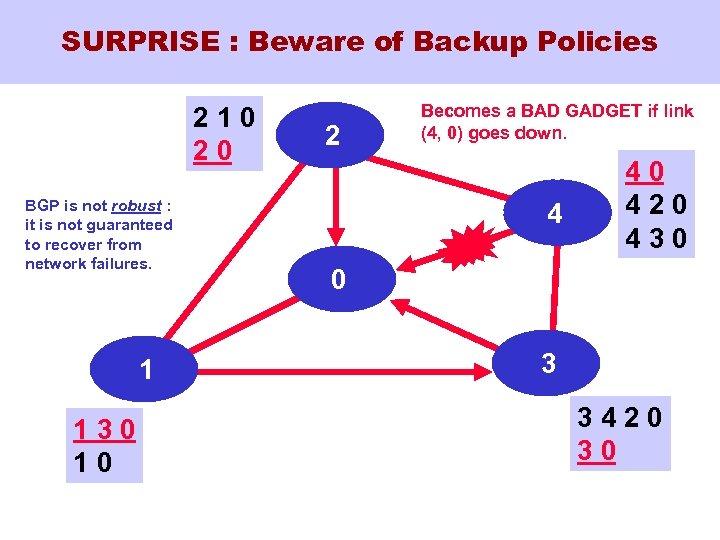
SURPRISE : Beware of Backup Policies 210 20 BGP is not robust : it is not guaranteed to recover from network failures. 1 130 10 2 Becomes a BAD GADGET if link (4, 0) goes down. 4 40 420 430 0 3 3420 30
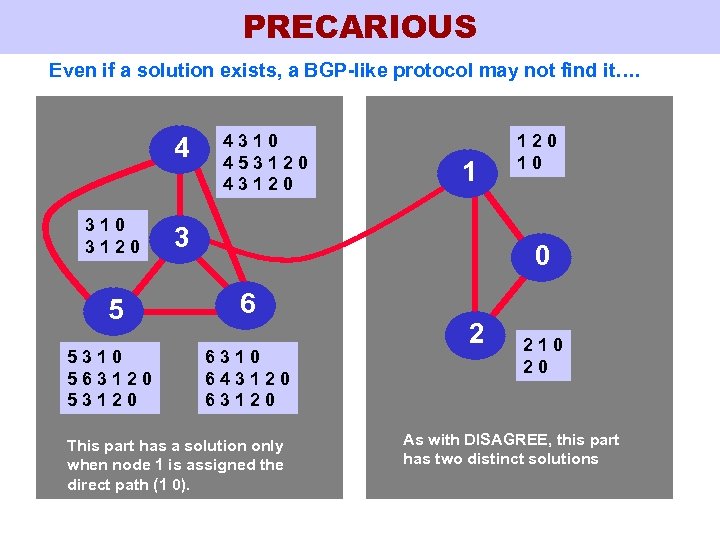
PRECARIOUS Even if a solution exists, a BGP-like protocol may not find it…. 4 310 3120 5 5310 563120 53120 4310 453120 43120 1 3 120 10 0 6 6310 643120 63120 This part has a solution only when node 1 is assigned the direct path (1 0). 2 210 20 As with DISAGREE, this part has two distinct solutions
PART VI Current Internet Growth Trends
Large BGP Tables Considered Harmful • Routing tables must store best routes and alternate routes • Burden can be large for routers with many alternate routes (route reflectors for example) • Routers have been known to die • Increases CPU load, especially during session reset Moore’s Law may save us in theory. But in practice it means spending money to upgrade equipment …
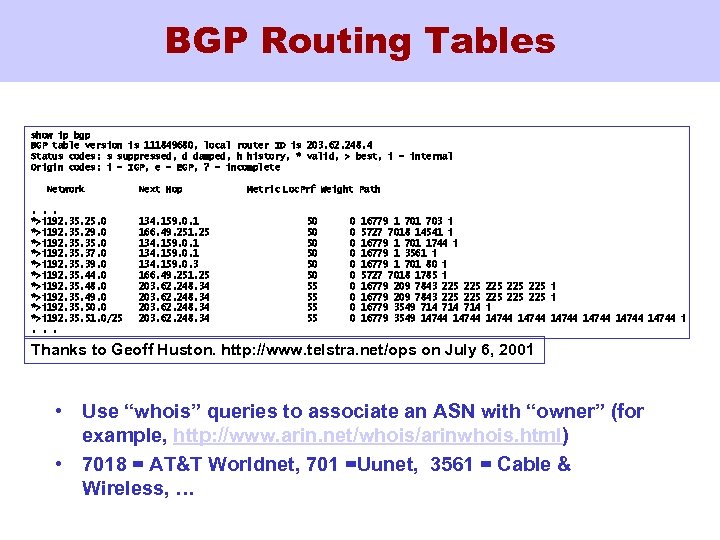
BGP Routing Tables show ip bgp BGP table version is 111849680, local router ID is 203. 62. 248. 4 Status codes: s suppressed, d damped, h history, * valid, > best, i - internal Origin codes: i - IGP, e - EGP, ? - incomplete Network. . . *>i 192. 35. 25. 0 *>i 192. 35. 29. 0 *>i 192. 35. 37. 0 *>i 192. 35. 39. 0 *>i 192. 35. 44. 0 *>i 192. 35. 48. 0 *>i 192. 35. 49. 0 *>i 192. 35. 50. 0 *>i 192. 35. 51. 0/25. . . Next Hop 134. 159. 0. 1 166. 49. 251. 25 134. 159. 0. 1 134. 159. 0. 3 166. 49. 251. 25 203. 62. 248. 34 Metric Loc. Prf Weight Path 50 50 50 55 55 0 0 0 0 0 16779 1 703 i 5727 7018 14541 i 16779 1 701 1744 i 16779 1 3561 i 16779 1 701 80 i 5727 7018 1785 i 16779 209 7843 225 225 16779 3549 714 714 16779 3549 14744 225 225 225 i i 14744 14744 i Thanks to Geoff Huston. http: //www. telstra. net/ops on July 6, 2001 • Use “whois” queries to associate an ASN with “owner” (for example, http: //www. arin. net/whois/arinwhois. html) • 7018 = AT&T Worldnet, 701 =Uunet, 3561 = Cable & Wireless, …
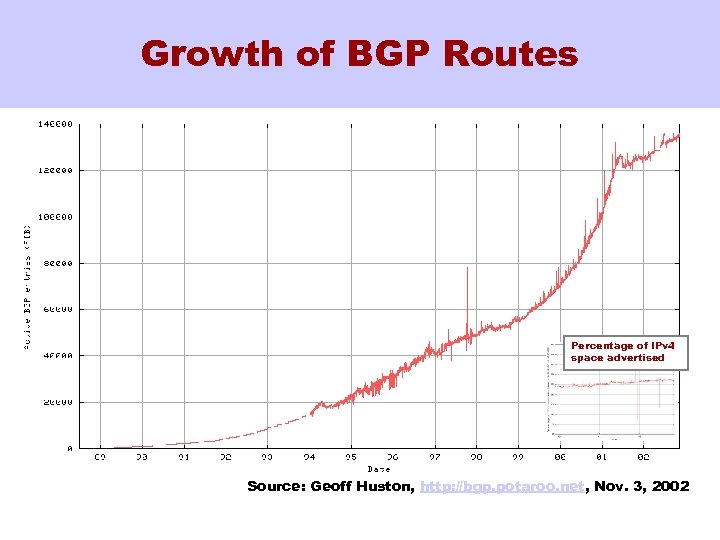
Growth of BGP Routes Percentage of IPv 4 space advertised Source: Geoff Huston, http: //bgp. potaroo. net, Nov. 3, 2002
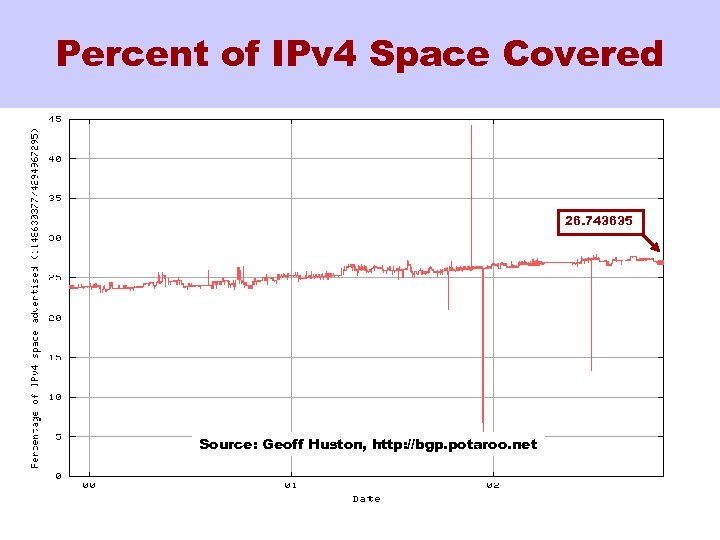
Percent of IPv 4 Space Covered 26. 743635 Source: Geoff Huston, http: //bgp. potaroo. net
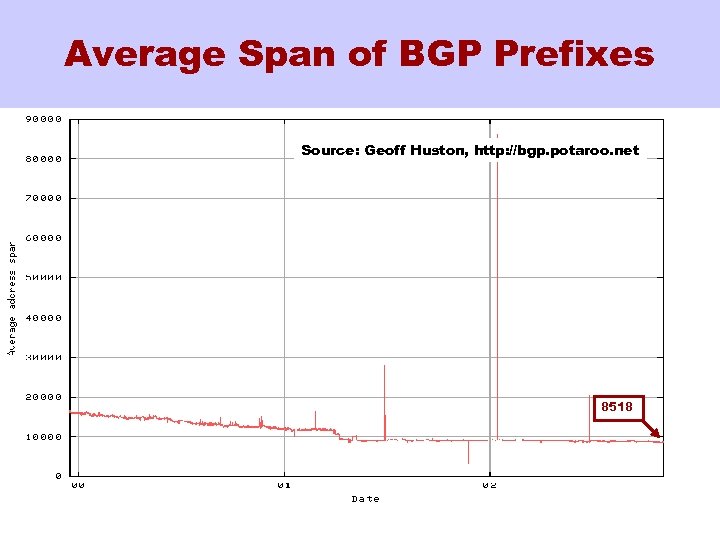
Average Span of BGP Prefixes Source: Geoff Huston, http: //bgp. potaroo. net 8518
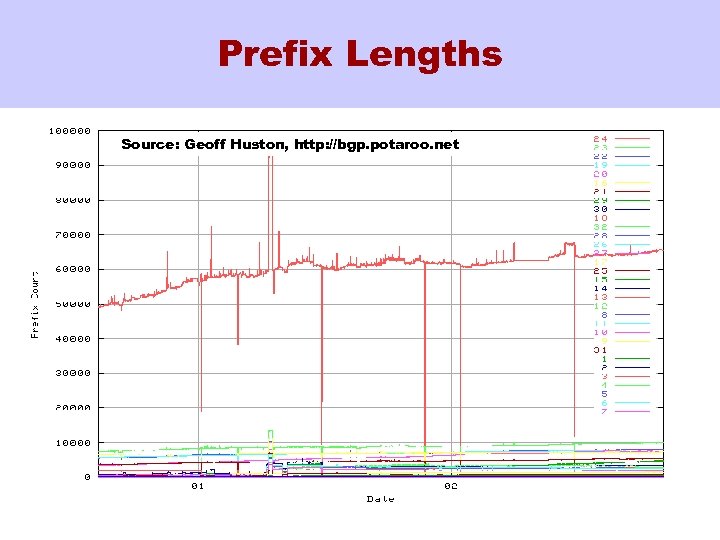
Prefix Lengths Source: Geoff Huston, http: //bgp. potaroo. net
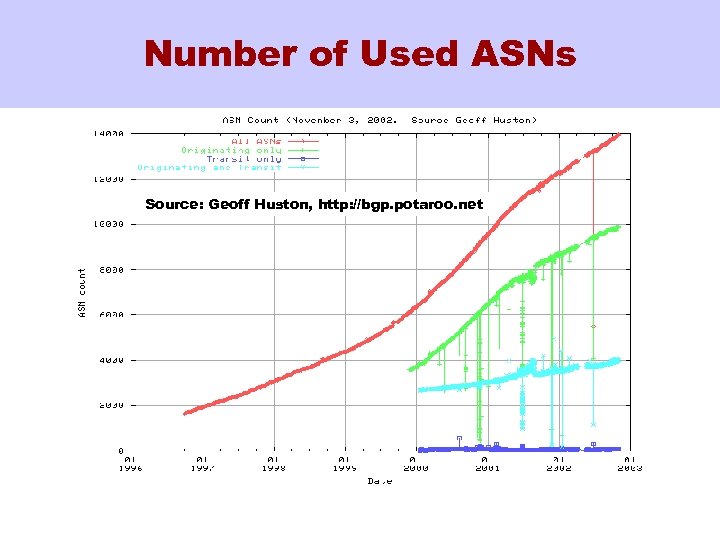
Number of Used ASNs Source: Geoff Huston, http: //bgp. potaroo. net
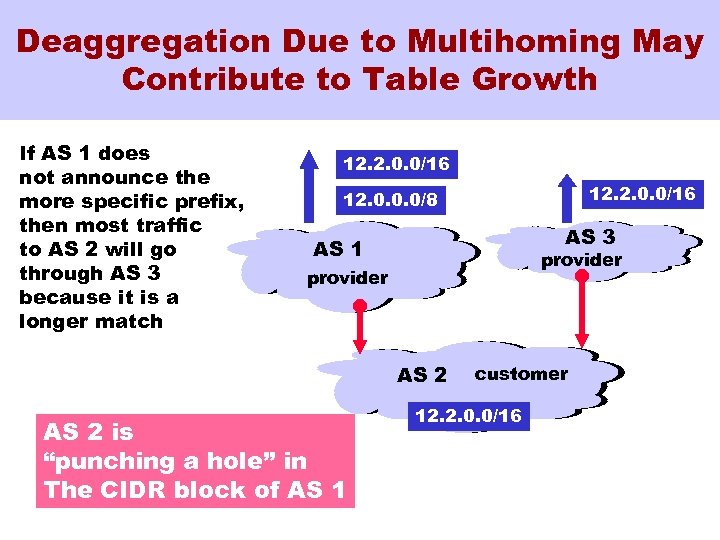
Deaggregation Due to Multihoming May Contribute to Table Growth If AS 1 does not announce the more specific prefix, then most traffic to AS 2 will go through AS 3 because it is a longer match 12. 2. 0. 0/16 12. 0. 0. 0/8 AS 3 AS 1 provider AS 2 is “punching a hole” in The CIDR block of AS 1 customer 12. 2. 0. 0/16

For a Detailed Analysis …. Internet Expansion, Refinement, and Churn Andre Broido, Evi Nemeth, and kc claffy Cooperative Association for Internet Data Analysis - CAIDA San Diego Supercomputer Center, University of California, San Diego http: //www. caida. org/outreach/papers/2002/EGR/
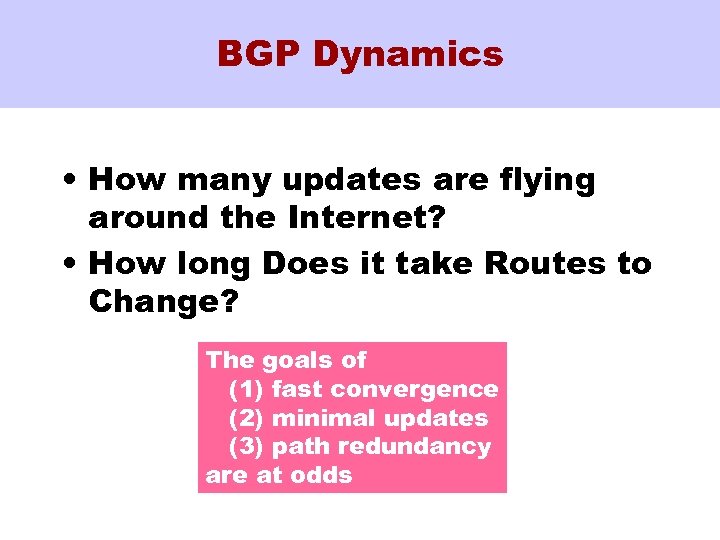
BGP Dynamics • How many updates are flying around the Internet? • How long Does it take Routes to Change? The goals of (1) fast convergence (2) minimal updates (3) path redundancy are at odds
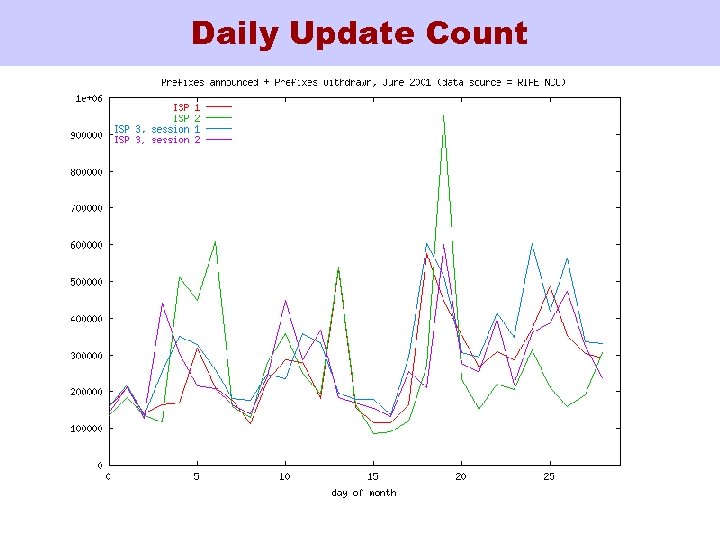
Daily Update Count
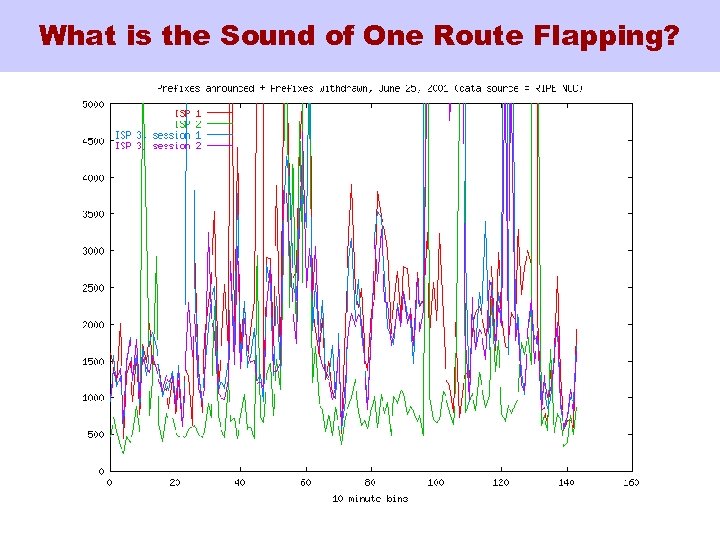
What is the Sound of One Route Flapping?
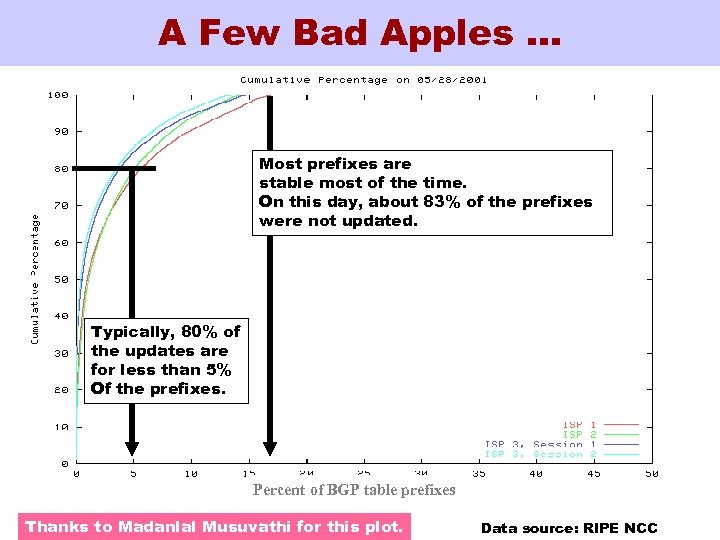
A Few Bad Apples … Most prefixes are stable most of the time. On this day, about 83% of the prefixes were not updated. Typically, 80% of the updates are for less than 5% Of the prefixes. Percent of BGP table prefixes Thanks to Madanlal Musuvathi for this plot. Data source: RIPE NCC
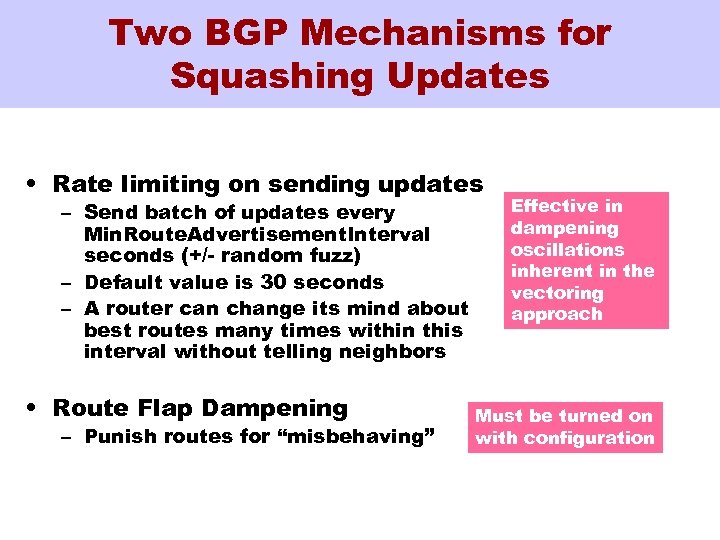
Two BGP Mechanisms for Squashing Updates • Rate limiting on sending updates – Send batch of updates every Min. Route. Advertisement. Interval seconds (+/- random fuzz) – Default value is 30 seconds – A router can change its mind about best routes many times within this interval without telling neighbors • Route Flap Dampening – Punish routes for “misbehaving” Effective in dampening oscillations inherent in the vectoring approach Must be turned on with configuration
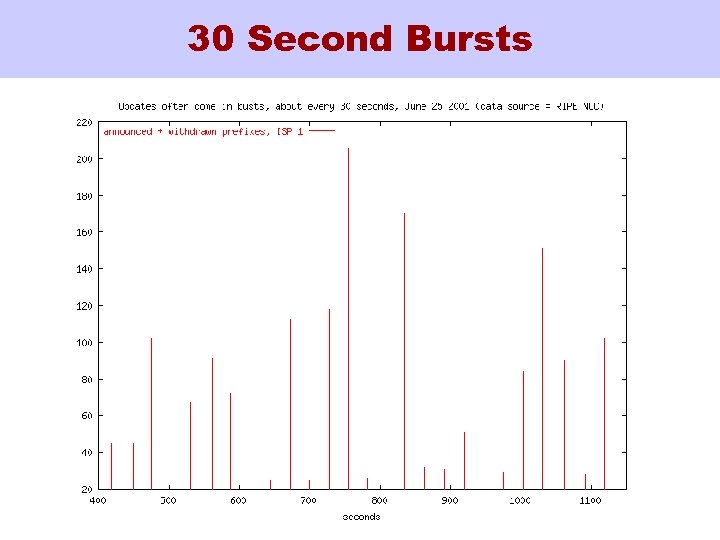
30 Second Bursts
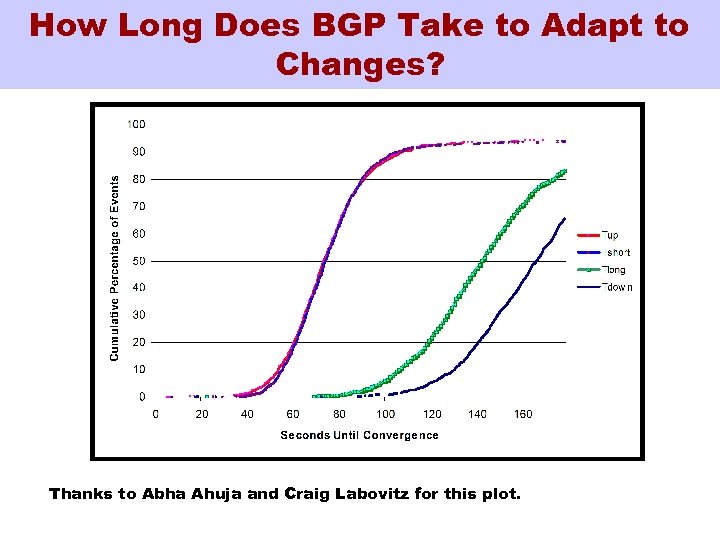
How Long Does BGP Take to Adapt to Changes? Thanks to Abha Ahuja and Craig Labovitz for this plot.
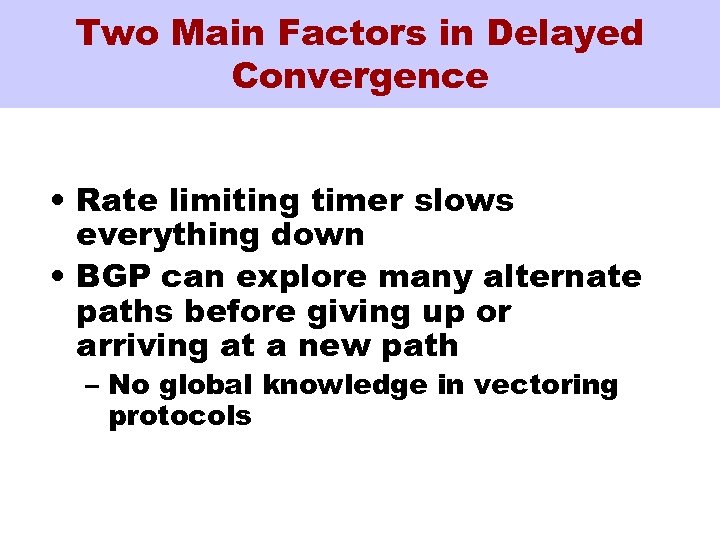
Two Main Factors in Delayed Convergence • Rate limiting timer slows everything down • BGP can explore many alternate paths before giving up or arriving at a new path – No global knowledge in vectoring protocols

Why is Rate Limiting Needed? Updates to convergence 0 Min. Route. Advertisement. Interval Time to convergence 0 Min. Route. Advertisement. Interval Rate limiting dampens some of the oscillation inherent in a vectoring protocol. Current interval (30 seconds) was picked “out of the blue sky” SSFNet (www. ssfnet. org) simulations, T. Griffin and B. J. Premore. To appear in ICNP 2001.
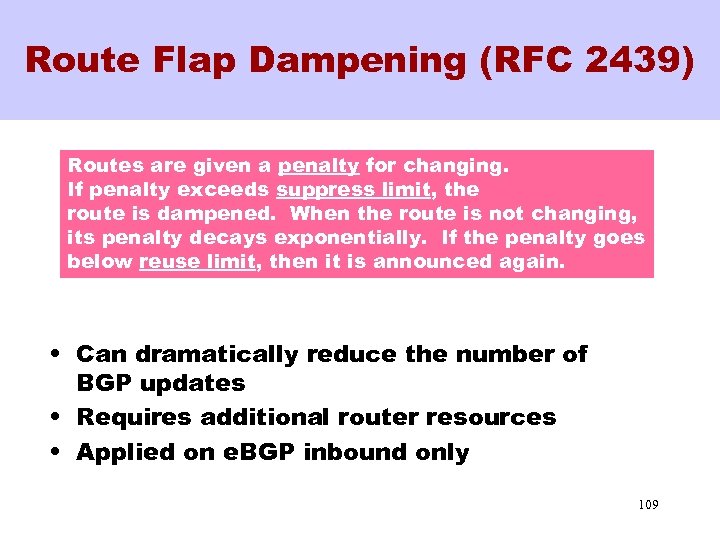
Route Flap Dampening (RFC 2439) Routes are given a penalty for changing. If penalty exceeds suppress limit, the route is dampened. When the route is not changing, its penalty decays exponentially. If the penalty goes below reuse limit, then it is announced again. • Can dramatically reduce the number of BGP updates • Requires additional router resources • Applied on e. BGP inbound only 109
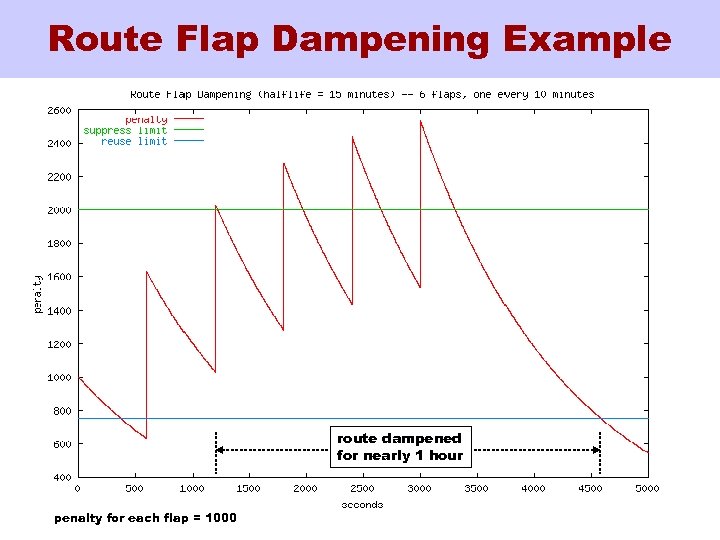
Route Flap Dampening Example route dampened for nearly 1 hour penalty for each flap = 1000
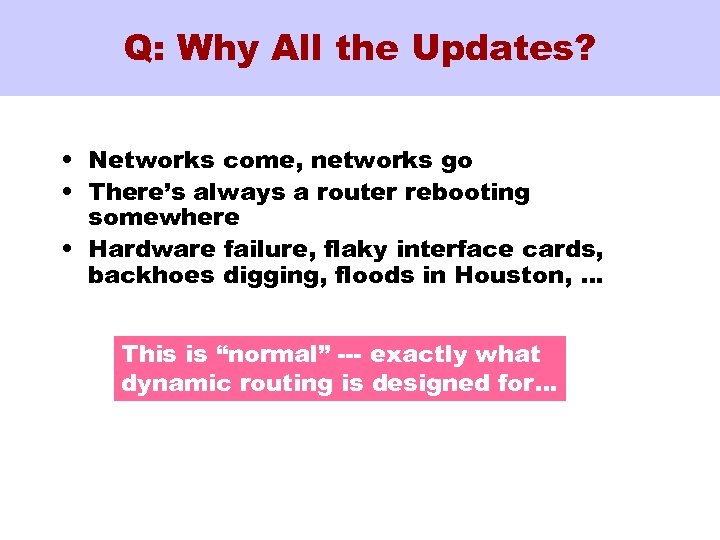
Q: Why All the Updates? • Networks come, networks go • There’s always a router rebooting somewhere • Hardware failure, flaky interface cards, backhoes digging, floods in Houston, … This is “normal” --- exactly what dynamic routing is designed for…
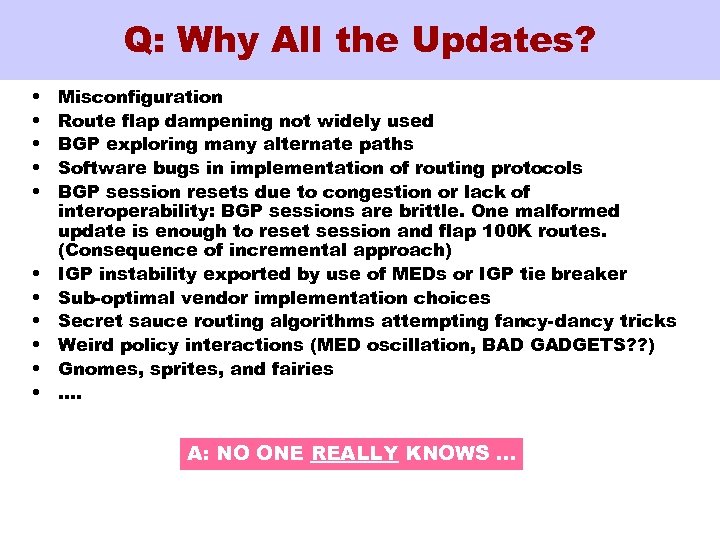
Q: Why All the Updates? • • • Misconfiguration Route flap dampening not widely used BGP exploring many alternate paths Software bugs in implementation of routing protocols BGP session resets due to congestion or lack of interoperability: BGP sessions are brittle. One malformed update is enough to reset session and flap 100 K routes. (Consequence of incremental approach) IGP instability exported by use of MEDs or IGP tie breaker Sub-optimal vendor implementation choices Secret sauce routing algorithms attempting fancy-dancy tricks Weird policy interactions (MED oscillation, BAD GADGETS? ? ) Gnomes, sprites, and fairies …. A: NO ONE REALLY KNOWS …
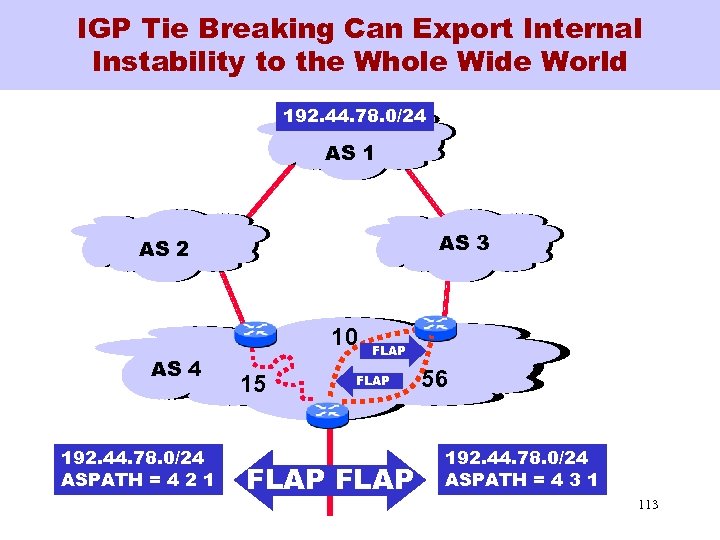
IGP Tie Breaking Can Export Internal Instability to the Whole Wide World 192. 44. 78. 0/24 AS 1 AS 3 AS 2 10 AS 4 192. 44. 78. 0/24 ASPATH = 4 2 1 15 FLAP 56 192. 44. 78. 0/24 ASPATH = 4 3 1 113
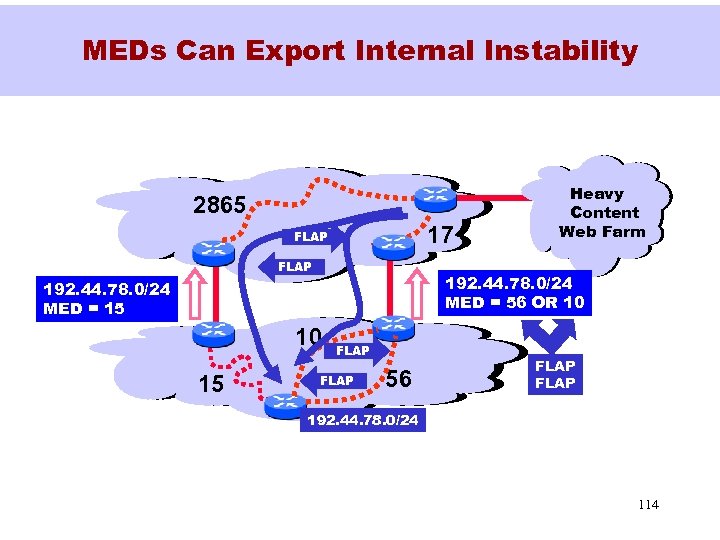
MEDs Can Export Internal Instability 2865 17 FLAP 192. 44. 78. 0/24 MED = 56 OR 10 192. 44. 78. 0/24 MED = 15 10 15 Heavy Content Web Farm FLAP 56 FLAP 192. 44. 78. 0/24 114
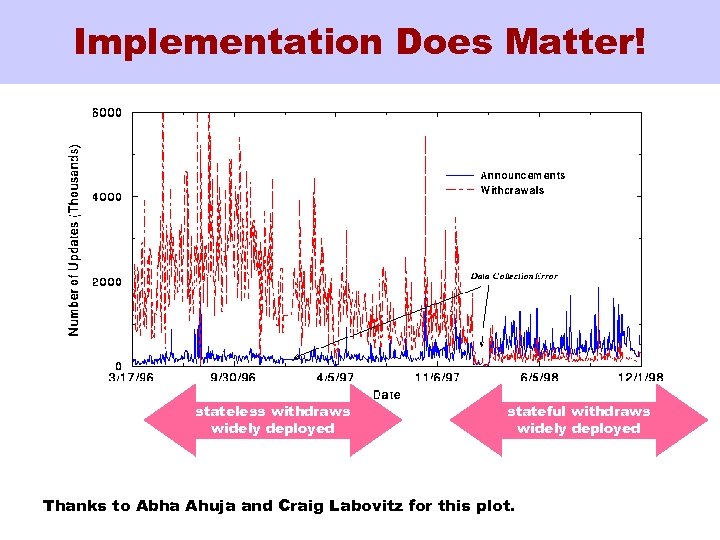
Implementation Does Matter! stateless withdraws widely deployed stateful withdraws widely deployed Thanks to Abha Ahuja and Craig Labovitz for this plot.
How Long Will Interdomain Routing Continue to Scale? A quote from some recent email: . . . the existing interdomain routing infrastructure is rapidly nearing the end of its useful lifetime. It appears unlikely that mere tweaks of BGP will stave off fundamental scaling issues, brought on by growth, multihoming and other causes. Is this true or false? How can we tell? Research required…
Summary • BGP is a fairly simple protocol … • … but it is not easy to configure • BGP is running on more than 100 K routers (my estimate), making it one of world’s largest and most visible distributed systems • Global dynamics and scaling principles are still not well understood

PART VII Selected Bibliography
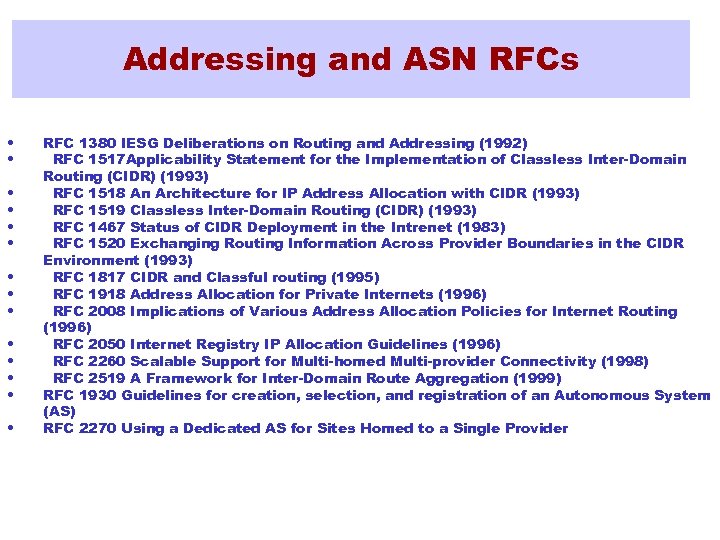
Addressing and ASN RFCs • • • • RFC 1380 IESG Deliberations on Routing and Addressing (1992) RFC 1517 Applicability Statement for the Implementation of Classless Inter-Domain Routing (CIDR) (1993) RFC 1518 An Architecture for IP Address Allocation with CIDR (1993) RFC 1519 Classless Inter-Domain Routing (CIDR) (1993) RFC 1467 Status of CIDR Deployment in the Intrenet (1983) RFC 1520 Exchanging Routing Information Across Provider Boundaries in the CIDR Environment (1993) RFC 1817 CIDR and Classful routing (1995) RFC 1918 Address Allocation for Private Internets (1996) RFC 2008 Implications of Various Address Allocation Policies for Internet Routing (1996) RFC 2050 Internet Registry IP Allocation Guidelines (1996) RFC 2260 Scalable Support for Multi-homed Multi-provider Connectivity (1998) RFC 2519 A Framework for Inter-Domain Route Aggregation (1999) RFC 1930 Guidelines for creation, selection, and registration of an Autonomous System (AS) RFC 2270 Using a Dedicated AS for Sites Homed to a Single Provider
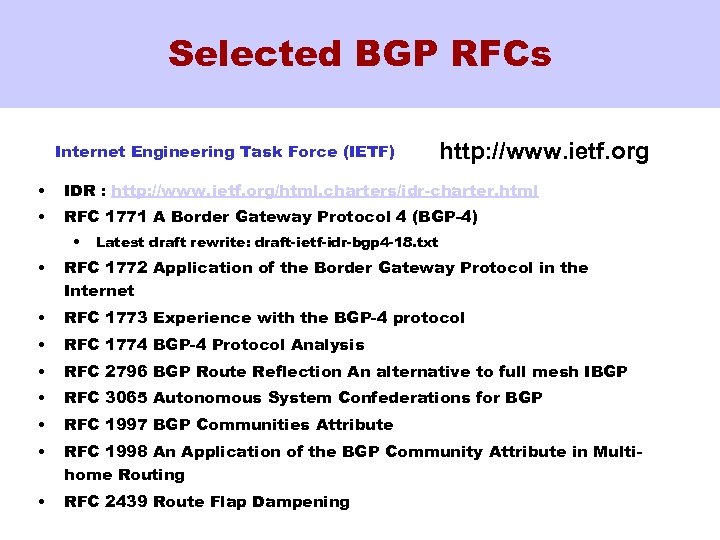
Selected BGP RFCs Internet Engineering Task Force (IETF) http: //www. ietf. org • IDR : http: //www. ietf. org/html. charters/idr-charter. html • RFC 1771 A Border Gateway Protocol 4 (BGP-4) • Latest draft rewrite: draft-ietf-idr-bgp 4 -18. txt • RFC 1772 Application of the Border Gateway Protocol in the Internet • RFC 1773 Experience with the BGP-4 protocol • RFC 1774 BGP-4 Protocol Analysis • RFC 2796 BGP Route Reflection An alternative to full mesh IBGP • RFC 3065 Autonomous System Confederations for BGP • RFC 1997 BGP Communities Attribute • RFC 1998 An Application of the BGP Community Attribute in Multihome Routing • RFC 2439 Route Flap Dampening
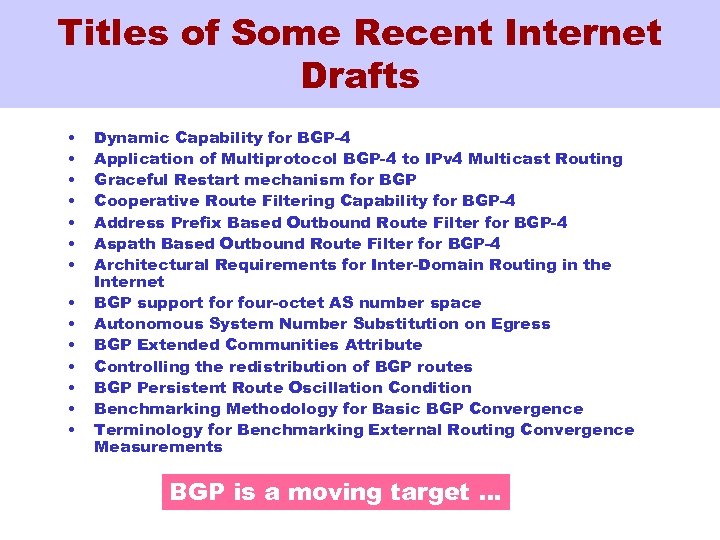
Titles of Some Recent Internet Drafts • • • • Dynamic Capability for BGP-4 Application of Multiprotocol BGP-4 to IPv 4 Multicast Routing Graceful Restart mechanism for BGP Cooperative Route Filtering Capability for BGP-4 Address Prefix Based Outbound Route Filter for BGP-4 Aspath Based Outbound Route Filter for BGP-4 Architectural Requirements for Inter-Domain Routing in the Internet BGP support for four-octet AS number space Autonomous System Number Substitution on Egress BGP Extended Communities Attribute Controlling the redistribution of BGP routes BGP Persistent Route Oscillation Condition Benchmarking Methodology for Basic BGP Convergence Terminology for Benchmarking External Routing Convergence Measurements BGP is a moving target …
Selected Bibliography on Routing • Internet Routing Architectures. Bassam Halabi. Second edition Cisco Press, 2000 • BGP 4: Inter-domain Routing in the Internet. John W. Stewart, III. Addison-Wesley, 1999 • Routing in the Internet. Christian Huitema. 2000 • ISP Survival Guide: Strategies for Running a Competitive ISP. Geoff Huston. Wiley, 1999. • Interconnection, Peering and Settlements. Geoff Huston. The Internet Protocol Journal. March and June 1999. 122
BGP Stability and Convergence • Route Flap Damping Exacerbates Internet Routing Convergence. Z. M. Mao, R. Govindan, G. Varghese, R. H. Kranz. SIGCOMM 2002. • The Impact of Internet Policy and Topology on Delayed Routing Convergence. Craig Labovitz, Abha Ahuja, Roger Wattenhofer, Srinivasan Venkatachary. INFOCOM 2001 • An Experimental Study of BGP Convergence. Craig Labovitz, Abha Ahuja, Abhijit Abose, Farnam Jahanian. SIGCOMM 2000 • Origins of Internet Routing Instability. C. Labovitz, R. Malan, F. Jahanian. INFOCOM 1999 • Internet Routing Instability. Craig Labovitz, G. Robert Malan and Farnam Jahanian. SIGCOMM 1997
Analysis of Interdomain Routing • Cooperative Association for Internet Data Analysis (CAIDA) – http: //www. caida. org/ – Tools and analyses promoting the engineering and maintenance of a robust, scalable global Internet infrastructure • Internet Performance Measurement and Analysis (IPMA) – http: //www. merit. edu/ipma/ – Studies the performance of networks and networking protocols in local and wide-area networks • National Laboratory for Applied Network Research (NLANR) – http: //www. nlanr. net/ – Analysis, tools, visualization. • IRTF Routing Research Group (IRTF-RR) – http: //puck. nether. net/irtf-rr/ • Geoff Huston: http: //bgp. potaroo. net
Internet Route Registries • Internet Route Registry – http: //www. irr. net/ • Routing Policy Specification Language (RPSL) – RFC 2622 Routing Policy Specification Language (RPSL) – RFC 2650 Using RPSL in Practice • Internet Route Registry Daemon (IRRd) – http: //www. irrd. net/ • RATool. Set – http: //www. isi. edu/ra/RATool. Set/
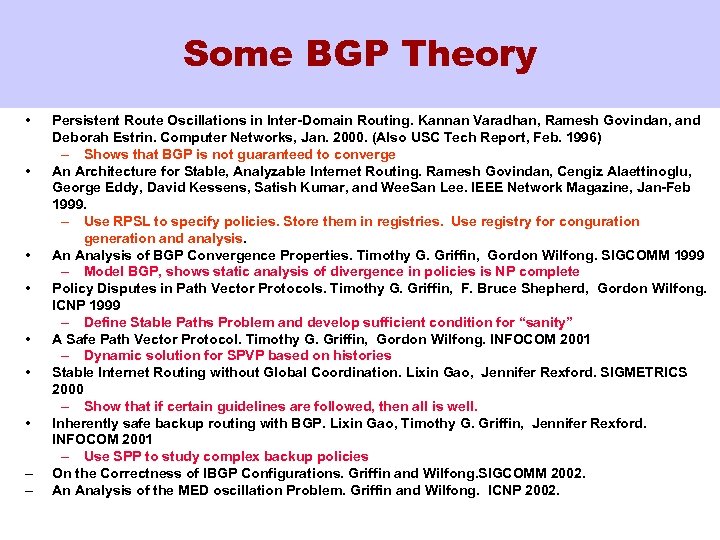
Some BGP Theory • • – – Persistent Route Oscillations in Inter-Domain Routing. Kannan Varadhan, Ramesh Govindan, and Deborah Estrin. Computer Networks, Jan. 2000. (Also USC Tech Report, Feb. 1996) – Shows that BGP is not guaranteed to converge An Architecture for Stable, Analyzable Internet Routing. Ramesh Govindan, Cengiz Alaettinoglu, George Eddy, David Kessens, Satish Kumar, and Wee. San Lee. IEEE Network Magazine, Jan-Feb 1999. – Use RPSL to specify policies. Store them in registries. Use registry for conguration generation and analysis. An Analysis of BGP Convergence Properties. Timothy G. Griffin, Gordon Wilfong. SIGCOMM 1999 – Model BGP, shows static analysis of divergence in policies is NP complete Policy Disputes in Path Vector Protocols. Timothy G. Griffin, F. Bruce Shepherd, Gordon Wilfong. ICNP 1999 – Define Stable Paths Problem and develop sufficient condition for “sanity” A Safe Path Vector Protocol. Timothy G. Griffin, Gordon Wilfong. INFOCOM 2001 – Dynamic solution for SPVP based on histories Stable Internet Routing without Global Coordination. Lixin Gao, Jennifer Rexford. SIGMETRICS 2000 – Show that if certain guidelines are followed, then all is well. Inherently safe backup routing with BGP. Lixin Gao, Timothy G. Griffin, Jennifer Rexford. INFOCOM 2001 – Use SPP to study complex backup policies On the Correctness of IBGP Configurations. Griffin and Wilfong. SIGCOMM 2002. An Analysis of the MED oscillation Problem. Griffin and Wilfong. ICNP 2002.
Скачать презентацию An Introduction to Interdomain Routing and the Border
a7de5e5a0e0fd1190959a49c77b5f854.ppt