


 Скачать презентацию An Introduction to Futures Single Stock and Currency
2a19c1083fb0d58851275288c5ca6af6.ppt
- Количество слайдов: 23
 An Introduction to Futures (Single Stock and Currency) Contact: Willem de Klerk 083 235 3050
 What is a Future? A futures contract is an agreement between two parties that: 1. is a standardised contract all contracts listed by the JSE have the same terms and conditions for the specific class 2. is of a standard quantity of a specific underlying asset each SSF contract is worth 100 of the underlying share (eg. Sasol) and the currency future is worth 1, 000 of the foreign currency (eg. US$). 3. is listed on the exchange traded on a regulated exchange (SAFEX) thus removing counterparty risk. Thus a client is protected from default by the person with whom they originally traded. 4. expires on a predetermined date in the future SSF’s expire on the third Thursday (and CF’s on the third Wednesday) of March, June, September and December. If you hold your SSF until expiration – you will have to either take delivery or make delivery of the underlying. Currency futures are always rand settled and as such you will never get delivery of the foreign currency. 5. Expires at a price agreed in the future the price on the day of expiry is the price at which the parties will exchange the underlying asset.
 Features and benefits General • Instruments that make it easier to hedge portfolios and capture market opportunities. • Require reduced capital to trade – Only pay a deposit (initial margin) • Allow you to benefit in both rising and falling markets – (short / bear sales) • As the underlying assets price goes up and down, so does the futures price. • Unlike shares, profits and losses on futures are realised and settled on a daily basis. • As the holder of a SSF’s you will have no voting rights on the underlying asset. SSF’s • Are cheaper to trade than shares – (brokerage reduced and no UST) • 1 Contract = 100 Shares Currency Futures • Allow SA residents, trusts, companies and CC’s to hedge exposure to fluctuations in foreign currency (holidays) or simply to speculate on expected movements in exchange rates • No impact on current R 2 m offshore allowance granted by SARB for individuals • 1 contract = 1, 000 of the foreign currency
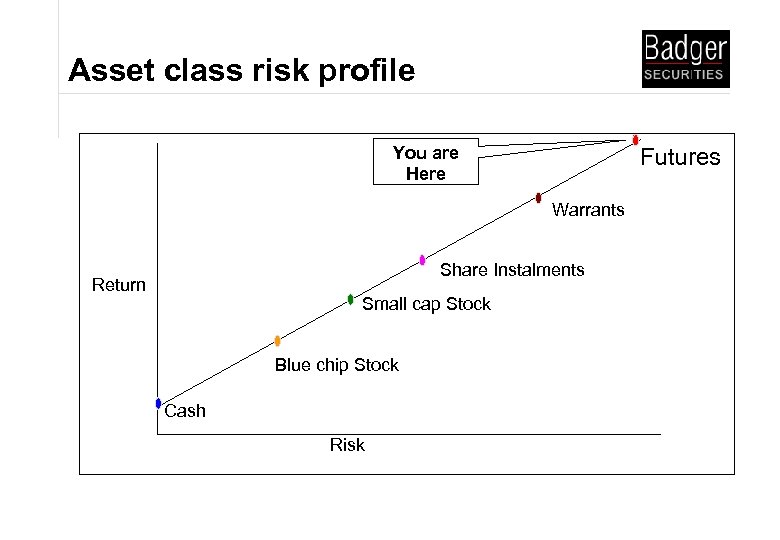 Asset class risk profile You are Here Futures Warrants Share Instalments Return Small cap Stock Blue chip Stock Cash Risk
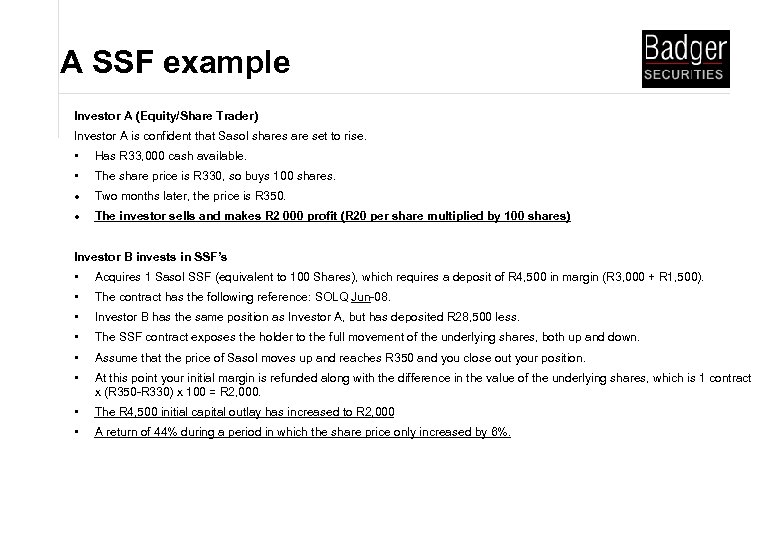 A SSF example Investor A (Equity/Share Trader) Investor A is confident that Sasol shares are set to rise. • Has R 33, 000 cash available. • The share price is R 330, so buys 100 shares. · Two months later, the price is R 350. · The investor sells and makes R 2 000 profit (R 20 per share multiplied by 100 shares) Investor B invests in SSF’s • Acquires 1 Sasol SSF (equivalent to 100 Shares), which requires a deposit of R 4, 500 in margin (R 3, 000 + R 1, 500). • The contract has the following reference: SOLQ Jun-08. • Investor B has the same position as Investor A, but has deposited R 28, 500 less. • The SSF contract exposes the holder to the full movement of the underlying shares, both up and down. • Assume that the price of Sasol moves up and reaches R 350 and you close out your position. • At this point your initial margin is refunded along with the difference in the value of the underlying shares, which is 1 contract x (R 350 -R 330) x 100 = R 2, 000. • The R 4, 500 initial capital outlay has increased to R 2, 000 • A return of 44% during a period in which the share price only increased by 6%.
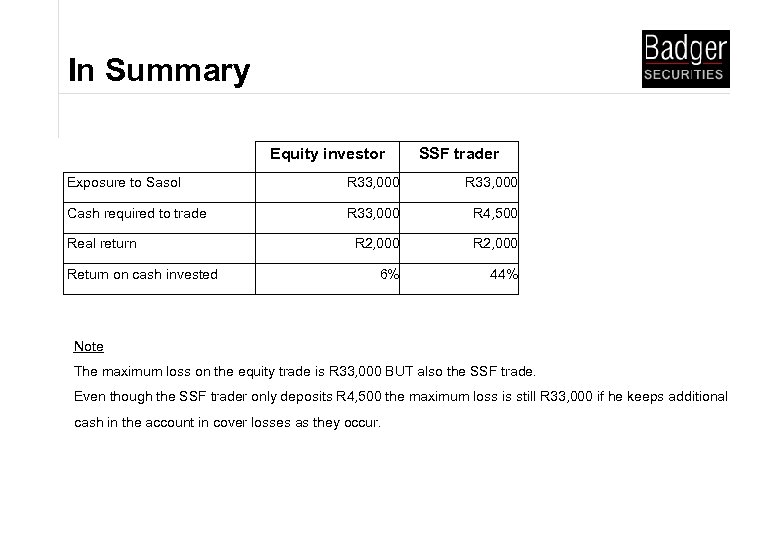 In Summary Equity investor SSF trader Exposure to Sasol R 33, 000 Cash required to trade R 33, 000 R 4, 500 R 2, 000 6% 44% Real return Return on cash invested Note The maximum loss on the equity trade is R 33, 000 BUT also the SSF trade. Even though the SSF trader only deposits R 4, 500 the maximum loss is still R 33, 000 if he keeps additional cash in the account in cover losses as they occur.
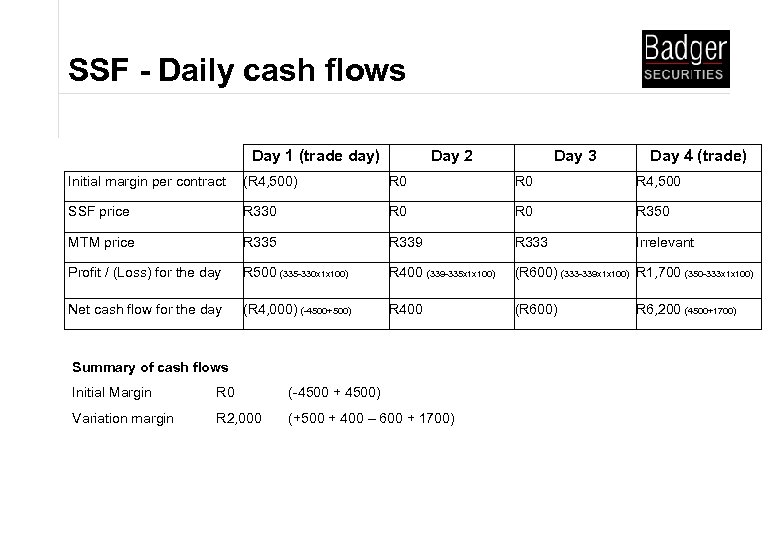 SSF - Daily cash flows Day 1 (trade day) Day 2 Day 3 Day 4 (trade) Initial margin per contract (R 4, 500) R 0 R 4, 500 SSF price R 330 R 0 R 350 MTM price R 335 R 339 R 333 Irrelevant Profit / (Loss) for the day R 500 (335 -330 x 1 x 100) R 400 (339 -335 x 1 x 100) (R 600) (333 -339 x 1 x 100) R 1, 700 (350 -333 x 1 x 100) Net cash flow for the day (R 4, 000) (-4500+500) R 400 (R 600) Summary of cash flows Initial Margin R 0 (-4500 + 4500) Variation margin R 2, 000 (+500 + 400 – 600 + 1700) R 6, 200 (4500+1700)
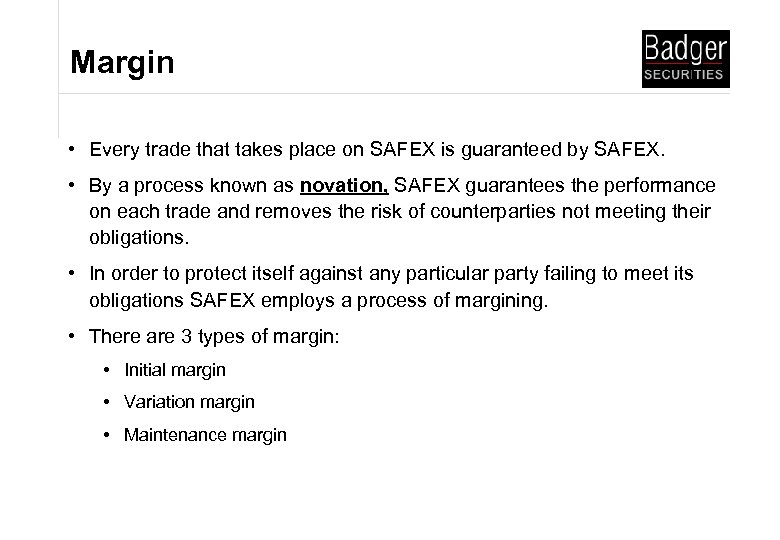 Margin • Every trade that takes place on SAFEX is guaranteed by SAFEX. • By a process known as novation, SAFEX guarantees the performance on each trade and removes the risk of counterparties not meeting their obligations. • In order to protect itself against any particular party failing to meet its obligations SAFEX employs a process of margining. • There are 3 types of margin: • Initial margin • Variation margin • Maintenance margin
 Initial Margin • To ensure that you meet the obligations of your trade, SAFEX requires that you post (deposit) initial margin. • Think of Initial margin as a “good faith” deposit. • This money remains on deposit as long as the position is open. • It earns a market related rate of interest. • The initial margin is returned to the investor when the position is closed out, or the contract expires. • Initial margin can vary from under 5% to 50% of the underlying value of the position. • It is meant to equal the highest loss that may occur in a one day’s trade. • Brokers may require that clients deposit initial margin in excess of the minimum SAFEX requirements. Online Share Trading requires an extra 50%. This is referred to as “maintenance margin” and is discussed later.
 Other margins Variation Margin • At day end, the JSE calculates a closing price (mark-to-market “MTM”) for each future. • The profit or loss for the day for each position is calculated based on the MTM of the current day less the MTM of the previous business day. • The profit or loss is referred to as the “variation margin” and is settled the next business day into your trading account. • Online Share Trading does this calculation on a real-time basis during the course of the business day to give clients a real-time view of the status of the portfolio. Maintenance Margin • The minimum account balance you must maintain before your broker will force you to deposit more funds or close out your position. • When this happens, it is known as a "margin call. " • First margin call when the available cash is exhausted – simply a warning that positions are losing cash. • Once the 50% extra initial margin is also exhausted the “Auto Close-out” occurs and the worst performing positions are closed out first to ensure that the available cash balance is once again a positive value.
 Quarterly close-out SSF’s expire on the third Thursday (and CF’s on the third Wednesday) of March, June, September and December. NB – Online Share Trading moves this date forward by 2 business days to ease administrative and trading pressures • Expire – what does it mean for SSF’s? • Any holder of a position at the close of business on each of these days that does not elect to “Roll-over” or “Close-out” will have to: • • Take delivery of the shares if it’s a long position AND pay for the shares or Make delivery of the shares if it’s a short position AND have the shares in your equity portfolio to do so. – what does it mean for CF’s? • • The position will be “sold” at the MTM price of the expiry day and the initial margin will be returned. No delivery of the base currency. Roll-over • • • Any holder of a position at the close of business on each of these days that has not “Rolled-over” will have their position “Expired”. The holder can request the broker to automatically convert the future that is due for expiry into a future that expires in the next period. E. g. close out the JUN-07 contract and enter into the SEP-07 contract The holder thus maintains the exposure Brokers usually offer this at a discounted costing Close-out • If the holder requests to “Close –out” the position will be closed and no further exposure exists after the transaction is concluded.
 Trade execution SSF transactions are only completed once the underlying share transaction has matched 1. You see the underlying bid and offer share price on the website 2. Place an order to buy / sell a SSF - @ underlying price 3. Standard Bank (Market maker) receives this order and places it in the underlying market 4. Share trade matches 5. The SSF price is calculated and the contracts are placed onto your portfolio Ownership after trade execution Standard Bank is hedged – Sold SSF’s and bought underlying shares. Standard Bank does not take a view on the share and will always be neutral. Only earns the commission Client has exposure – Bought the SSF’s CF transactions are completed directly on the JSE’s Yield. X trading system and are not reliant on the underlying asset being traded first. Ownership after trade execution Client has exposure – Bought CF’s. Seller is an anonymous counterpart
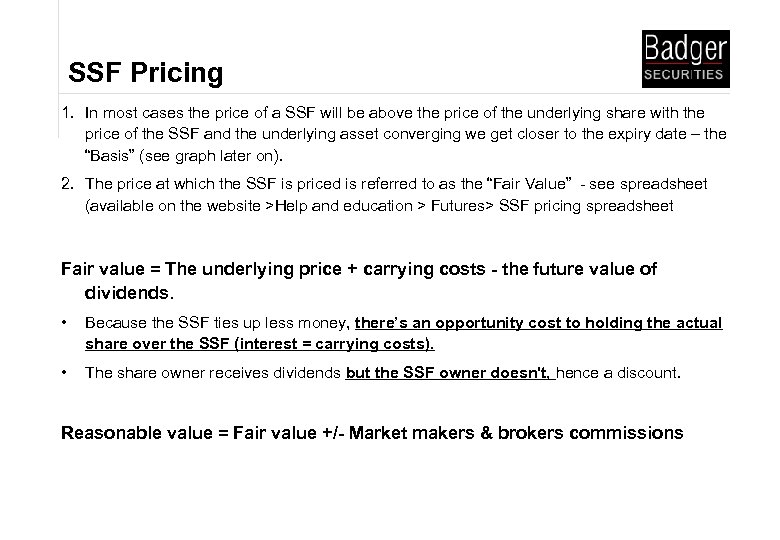 SSF Pricing 1. In most cases the price of a SSF will be above the price of the underlying share with the price of the SSF and the underlying asset converging we get closer to the expiry date – the “Basis” (see graph later on). 2. The price at which the SSF is priced is referred to as the “Fair Value” - see spreadsheet (available on the website >Help and education > Futures> SSF pricing spreadsheet Fair value = The underlying price + carrying costs - the future value of dividends. • Because the SSF ties up less money, there’s an opportunity cost to holding the actual share over the SSF (interest = carrying costs). • The share owner receives dividends but the SSF owner doesn't, hence a discount. Reasonable value = Fair value +/- Market makers & brokers commissions
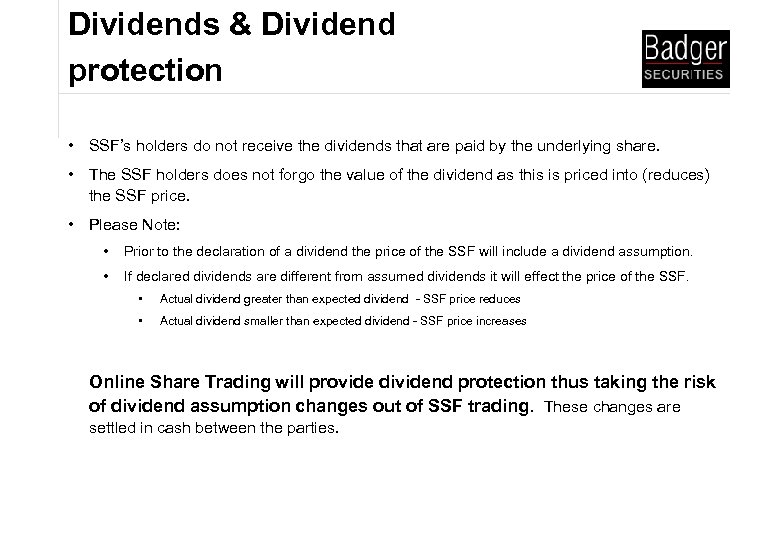 Dividends & Dividend protection • SSF’s holders do not receive the dividends that are paid by the underlying share. • The SSF holders does not forgo the value of the dividend as this is priced into (reduces) the SSF price. • Please Note: • Prior to the declaration of a dividend the price of the SSF will include a dividend assumption. • If declared dividends are different from assumed dividends it will effect the price of the SSF. • Actual dividend greater than expected dividend - SSF price reduces • Actual dividend smaller than expected dividend - SSF price increases Online Share Trading will provide dividend protection thus taking the risk of dividend assumption changes out of SSF trading. These changes are settled in cash between the parties.
 Detailed pricing Refer to the spreadsheet for detailed examples: Notes: ----------------------------------------------------------------------------------------------------------------------------------------------------------------------------------------------------------------------------------------------------------------------------------------------------------------------------------------------------------------------------------------------------------------
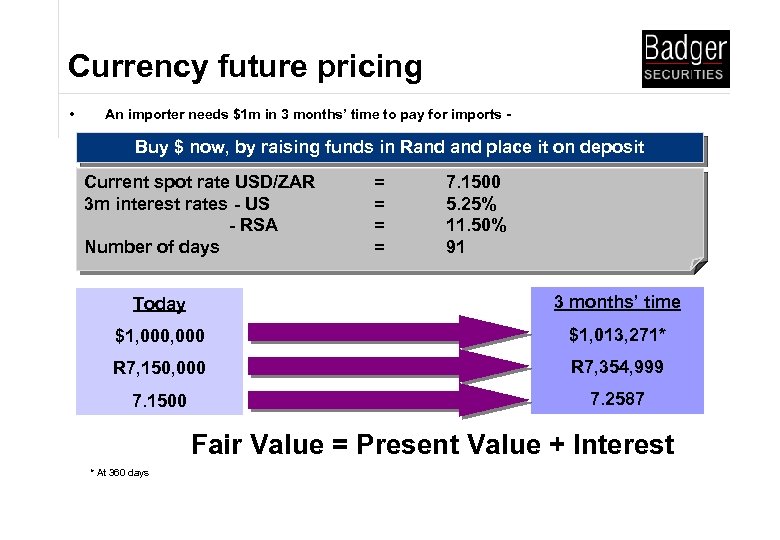 Currency future pricing • An importer needs $1 m in 3 months’ time to pay for imports - Buy $ now, by raising funds in Rand place it on deposit Current spot rate USD/ZAR 3 m interest rates - US - RSA Number of days = = 7. 1500 5. 25% 11. 50% 91 Today 3 months’ time $1, 000 $1, 013, 271* R 7, 150, 000 R 7, 354, 999 7. 1500 7. 2587 Fair Value = Present Value + Interest * At 360 days
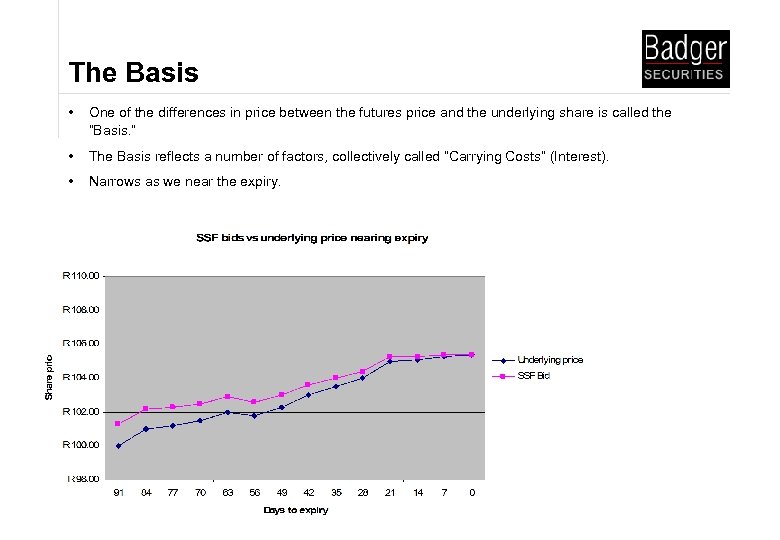 The Basis • One of the differences in price between the futures price and the underlying share is called the “Basis. ” • The Basis reflects a number of factors, collectively called “Carrying Costs” (Interest). • Narrows as we near the expiry.
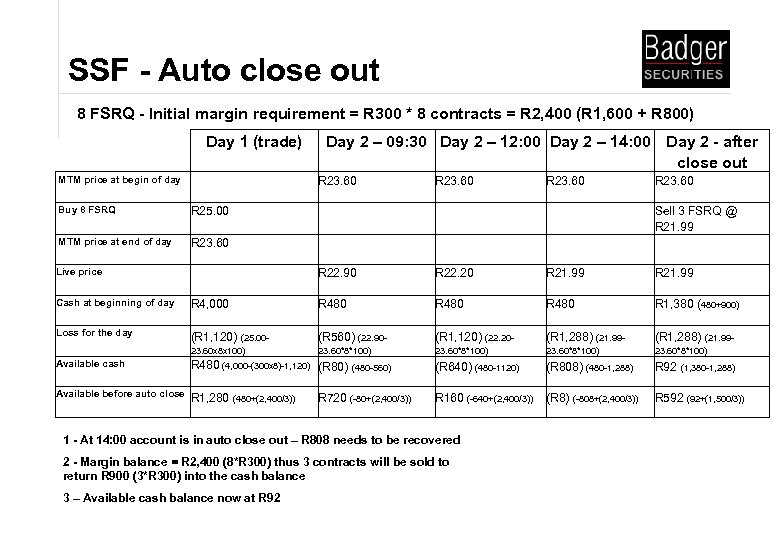 SSF - Auto close out 8 FSRQ - Initial margin requirement = R 300 * 8 contracts = R 2, 400 (R 1, 600 + R 800) Day 1 (trade) MTM price at begin of day Day 2 – 09: 30 Day 2 – 12: 00 Day 2 – 14: 00 Day 2 - after close out R 23. 60 Buy 8 FSRQ R 23. 60 R 25. 00 MTM price at end of day R 23. 60 Live price Sell 3 FSRQ @ R 21. 99 R 22. 90 R 22. 20 R 21. 99 Cash at beginning of day R 4, 000 R 480 R 1, 380 (480+900) Loss for the day (R 1, 120) (25. 00 - (R 560) (22. 90 - (R 1, 120) (22. 20 - (R 1, 288) (21. 99 - 23. 60 x 8 x 100) 23. 60*8*100) Available cash R 480 (4, 000 -(300 x 8)-1, 120) (R 80) (480 -560) (R 640) (480 -1120) (R 808) (480 -1, 288) R 92 (1, 380 -1, 288) Available before auto close R 1, 280 (480+(2, 400/3)) R 160 (-640+(2, 400/3)) (R 8) (-808+(2, 400/3)) R 592 (92+(1, 500/3)) R 720 (-80+(2, 400/3)) 1 - At 14: 00 account is in auto close out – R 808 needs to be recovered 2 - Margin balance = R 2, 400 (8*R 300) thus 3 contracts will be sold to return R 900 (3*R 300) into the cash balance 3 – Available cash balance now at R 92
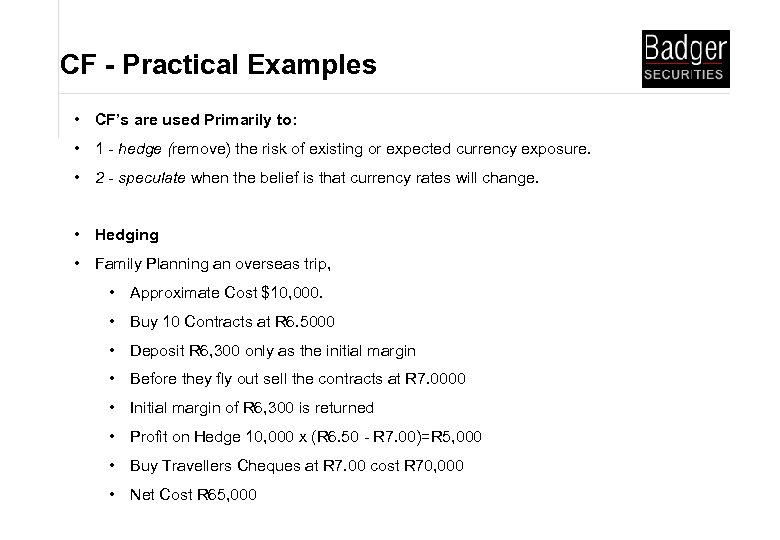 CF - Practical Examples • CF’s are used Primarily to: • 1 - hedge (remove) the risk of existing or expected currency exposure. • 2 - speculate when the belief is that currency rates will change. • Hedging • Family Planning an overseas trip, • Approximate Cost $10, 000. • Buy 10 Contracts at R 6. 5000 • Deposit R 6, 300 only as the initial margin • Before they fly out sell the contracts at R 7. 0000 • Initial margin of R 6, 300 is returned • Profit on Hedge 10, 000 x (R 6. 50 - R 7. 00)=R 5, 000 • Buy Travellers Cheques at R 7. 00 cost R 70, 000 • Net Cost R 65, 000
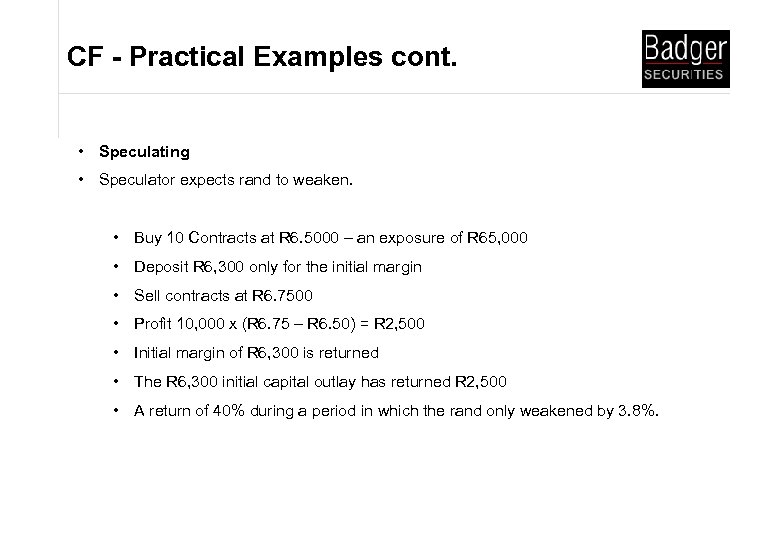 CF - Practical Examples cont. • Speculating • Speculator expects rand to weaken. • Buy 10 Contracts at R 6. 5000 – an exposure of R 65, 000 • Deposit R 6, 300 only for the initial margin • Sell contracts at R 6. 7500 • Profit 10, 000 x (R 6. 75 – R 6. 50) = R 2, 500 • Initial margin of R 6, 300 is returned • The R 6, 300 initial capital outlay has returned R 2, 500 • A return of 40% during a period in which the rand only weakened by 3. 8%.
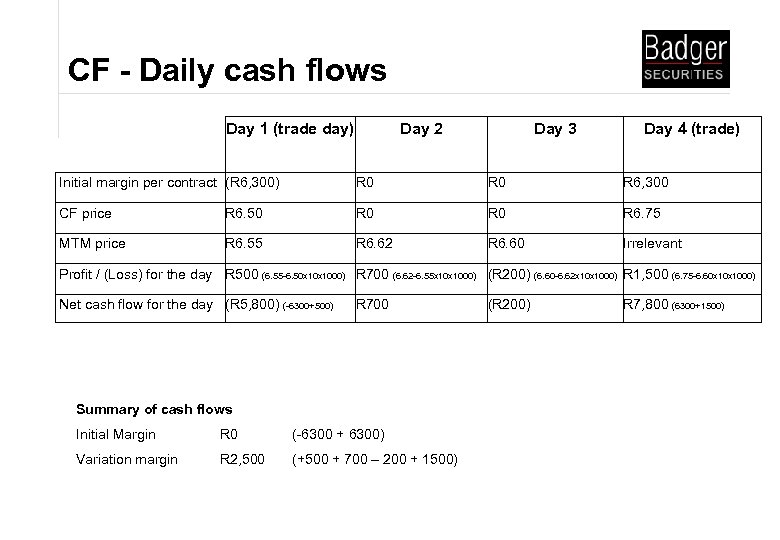 CF - Daily cash flows Day 1 (trade day) Day 2 Day 3 Day 4 (trade) Initial margin per contract (R 6, 300) R 0 R 6, 300 CF price R 6. 50 R 0 R 6. 75 MTM price R 6. 55 R 6. 62 R 6. 60 Irrelevant Profit / (Loss) for the day R 500 (6. 55 -6. 50 x 1000) R 700 (6. 62 -6. 55 x 1000) (R 200) (6. 60 -6. 62 x 1000) R 1, 500 (6. 75 -6. 60 x 1000) Net cash flow for the day (R 5, 800) (-6300+500) R 700 Summary of cash flows Initial Margin R 0 (-6300 + 6300) Variation margin R 2, 500 (+500 + 700 – 200 + 1500) (R 200) R 7, 800 (6300+1500)
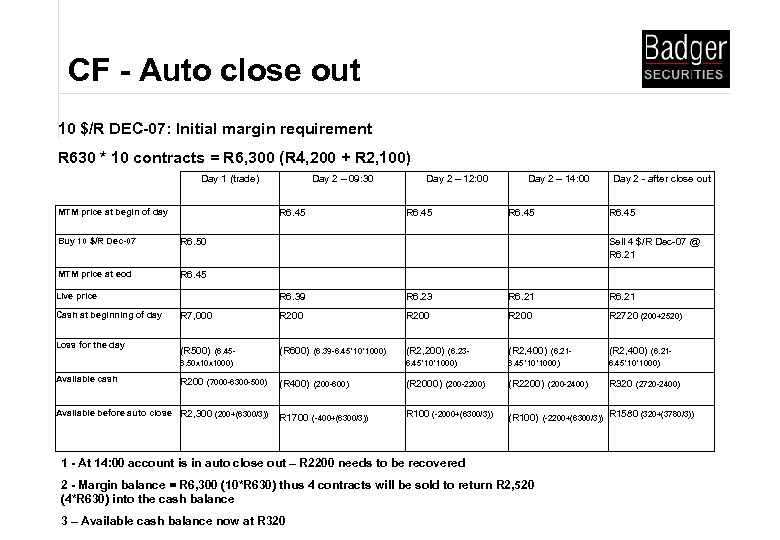 CF - Auto close out 10 $/R DEC-07: Initial margin requirement R 630 * 10 contracts = R 6, 300 (R 4, 200 + R 2, 100) Day 1 (trade) MTM price at begin of day Day 2 – 09: 30 R 6. 45 Buy 10 $/R Dec-07 R 6. 45 Day 2 – 14: 00 R 6. 45 R 6. 50 MTM price at eod Day 2 – 12: 00 Day 2 - after close out R 6. 45 Live price Sell 4 $/R Dec-07 @ R 6. 21 R 6. 39 R 6. 23 R 6. 21 Cash at beginning of day R 7, 000 R 200 R 2720 (200+2520) Loss for the day (R 500) (6. 45 - (R 600) (6. 39 -6. 45*10*1000) (R 2, 200) (6. 23 - (R 2, 400) (6. 21 - 6. 45*10*1000) (R 400) (200 -600) (R 2000) (200 -2200) (R 2200) (200 -2400) R 320 (2720 -2400) R 1700 (-400+(6300/3)) R 100 (-2000+(6300/3)) (R 100) (-2200+(6300/3)) R 1580 (320+(3780/3)) 6. 50 x 1000) Available cash R 200 (7000 -6300 -500) Available before auto close R 2, 300 (200+(6300/3)) 1 - At 14: 00 account is in auto close out – R 2200 needs to be recovered 2 - Margin balance = R 6, 300 (10*R 630) thus 4 contracts will be sold to return R 2, 520 (4*R 630) into the cash balance 3 – Available cash balance now at R 320
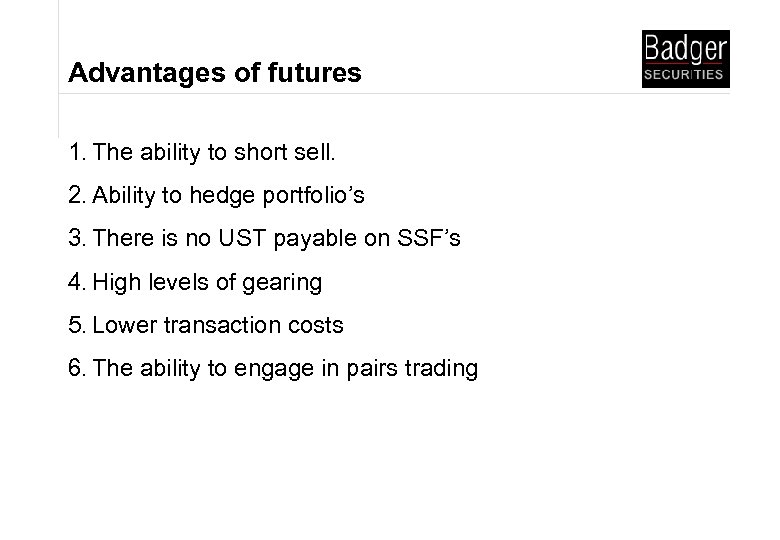 Advantages of futures 1. The ability to short sell. 2. Ability to hedge portfolio’s 3. There is no UST payable on SSF’s 4. High levels of gearing 5. Lower transaction costs 6. The ability to engage in pairs trading