


 Скачать презентацию An Introduction to Computer System Security CS-502 Operating
0de95125e505845fdcd09356d00e9c00.ppt
- Количество слайдов: 71
 An Introduction to Computer System Security CS-502 Operating Systems (Notes taken from guest CS-502 lecture by Bob Strong, April 4, 2005) CS 502 Spring 2006 Computer Security 1
 Outline • A few principles about security • The relationship between OS services and their implementation, and system and data security • The importance of the human side of the problem • A little fun with cryptography CS 502 Spring 2006 Computer Security 2
 Reading Material • Tanenbaum, Chapter 9 – Security and threats – Viruses • How to write and detect! – Protection – implementation of security • Silbershatz, Chapters 14 -15 – Protection – Security CS 502 Spring 2006 Computer Security 3
 Part 1: OS Issues • Why “Security”? …and Security principles • Authorization and the Access Control Policy • User Authentication CS 502 Spring 2006 Computer Security 4
 Fundamental Goals for Computer Security • Data Confidentiality • Data Integrity • System Availability • Related issue – Privacy • A legal and ethic question • Implemented by Confidentiality goal CS 502 Spring 2006 Computer Security 5
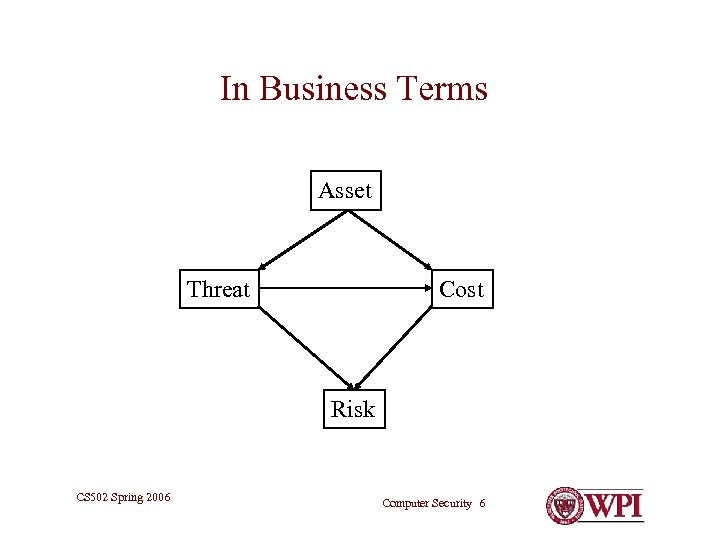 In Business Terms Asset Threat Cost Risk CS 502 Spring 2006 Computer Security 6
 Threat Analysis • What are we trying to protect? (and why? ) • What are the vulnerabilities of those assets? • Who might exploit a vulnerability? – Either on purpose or by accident • How can we prevent a specific threat? • How much is it worth to us to prevent it? • How much will it cost to prevent it? CS 502 Spring 2006 Computer Security 7
 Threat Analysis (2) • An Example: OCTAVE – Operationally Critical Threat And Vulnerability Evaluation • http: //www. cert. org/octave • CERT (Computer Emergency Response Team) – OCTAVE is a business-focused process • Example: – How much effort should I spend protecting my company’s web site? CS 502 Spring 2006 Computer Security 8
 The Core Technical Problem • Controlling access to machine and data resources • Controlling the way access rights are passed from holder to holder • person to person • program to program • Preventing maliciousness and errors from subverting the controls CS 502 Spring 2006 Computer Security 9
 Access Rights • In general case, need triplet for every possible combination of right, protected asset, and potential user (U, A, R) • …and some entity must be responsible for checking and enforcing any limitation. . . • The 3 -D matrix is hard to manage…We need a simpler approach! CS 502 Spring 2006 Computer Security 10
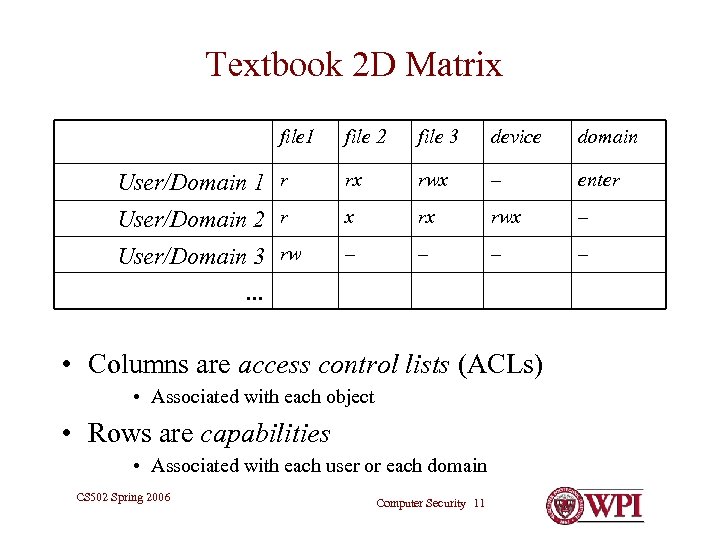 Textbook 2 D Matrix file 1 file 2 file 3 device domain User/Domain 1 r rx rwx – enter User/Domain 2 r x rx rwx – User/Domain 3 rw – – … • Columns are access control lists (ACLs) • Associated with each object • Rows are capabilities • Associated with each user or each domain CS 502 Spring 2006 Computer Security 11
 What about efficiency? • At run-time… – What does the OS know about the user? – What does the OS know about the resources? • What is the cost of checking and enforcing? – Access to the data – Cost of searching for a match CS 502 Spring 2006 Computer Security 12
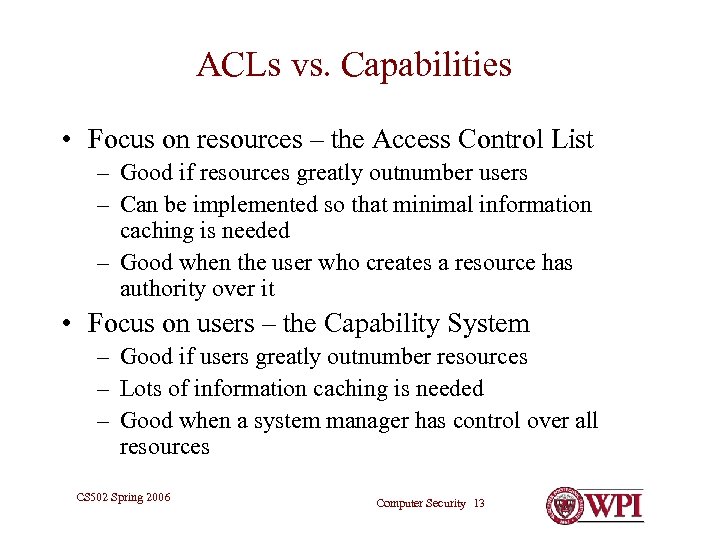 ACLs vs. Capabilities • Focus on resources – the Access Control List – Good if resources greatly outnumber users – Can be implemented so that minimal information caching is needed – Good when the user who creates a resource has authority over it • Focus on users – the Capability System – Good if users greatly outnumber resources – Lots of information caching is needed – Good when a system manager has control over all resources CS 502 Spring 2006 Computer Security 13
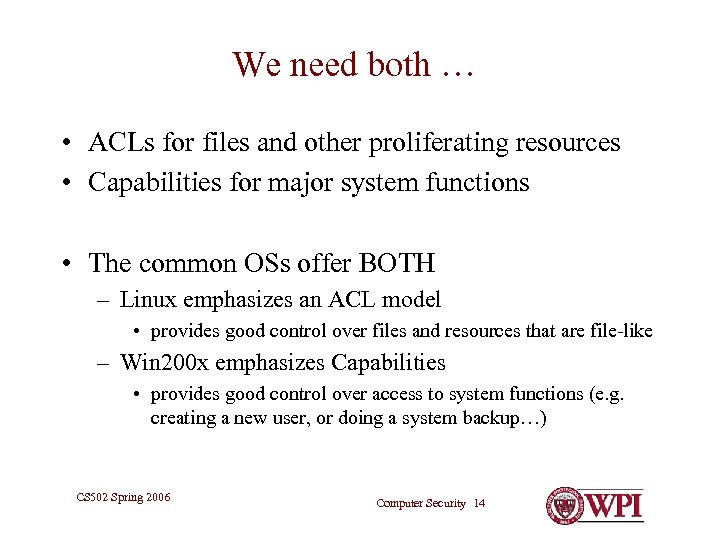 We need both … • ACLs for files and other proliferating resources • Capabilities for major system functions • The common OSs offer BOTH – Linux emphasizes an ACL model • provides good control over files and resources that are file-like – Win 200 x emphasizes Capabilities • provides good control over access to system functions (e. g. creating a new user, or doing a system backup…) CS 502 Spring 2006 Computer Security 14
 …and good management, too! • What do we need to know to set up a new user or to change their rights? • …to set up a new resource or to change the rights of its users? • …Who has the right to set/change access rights? • No OS allows you to implement all the possible policies easily. CS 502 Spring 2006 Computer Security 15
 Enforcing Access Control • User level privileges must always be less than OS privileges! – For example, a user should not be allowed to grab exclusive control of a critical device – or write to OS memory space • …and the user cannot be allowed to raise his privilege level! • The OS must enforce it…and the user must not be able to bypass the controls • In most modern operating systems, the code which manages the resource enforces the policy CS 502 Spring 2006 Computer Security 16
 Requirements: System Call Code • No user can interrupt it while it is running • No user can feed it data to make it – violate access control policies – stop serving other users • No user can replace or alter any system call code • No user can add functionality to the OS! • Data must NEVER be treated as code! CS 502 Spring 2006 Computer Security 17
 “Yeah, but …” • No user can interrupt it while it is running • Windows, Linux routinely interrupt system calls • No user can feed it data to make it – violate access control policies – stop serving other users • No user can replace or alter any system call code • Except your average virus • No user can add functionality to the OS! • Except dynamically loaded device drivers • Data must NEVER be treated as code! • “One man’s code is another man’s data” A. Perlis CS 502 Spring 2006 Computer Security 18
 Saltzer-Schroeder Guidelines • • • System design should be public Default should be no access Check current authority – no caching! Least privilege possible for processes Protection mechanism should be – Simple, uniform, built into lowest layers of system • Psychologically acceptable • KISS! CS 502 Spring 2006 Computer Security 19
 Authentication • How does the machine know who it is talking to? ? ? • Who do I SAY that I am? • How can I verify that? • Something I know (that nobody else should know) • Something I have (that nobody else should have) • Something I am (that nobody else should be…) CS 502 Spring 2006 Computer Security 20
 Threats against authentication I want to pretend to be you: • I can steal your password – the sticky on your monitor or the list in your desk drawer – by monitoring your communications or looking over your shoulder • I can guess your password (particularly useful if I can also guess your user name) • I can get between you and the system you are talking to CS 502 Spring 2006 Computer Security 21
 The Trouble with Passwords • • • They are given away They are too easy to guess They are used too often There are too many of them They are used in too many places CS 502 Spring 2006 Computer Security 22
 Some ways around the problem • Better passwords – longer – larger character set – more random in nature/encrypted • Used less often – changed frequently, one system per password – challenge/response – use only once (p. 599) CS 502 Spring 2006 Computer Security 23
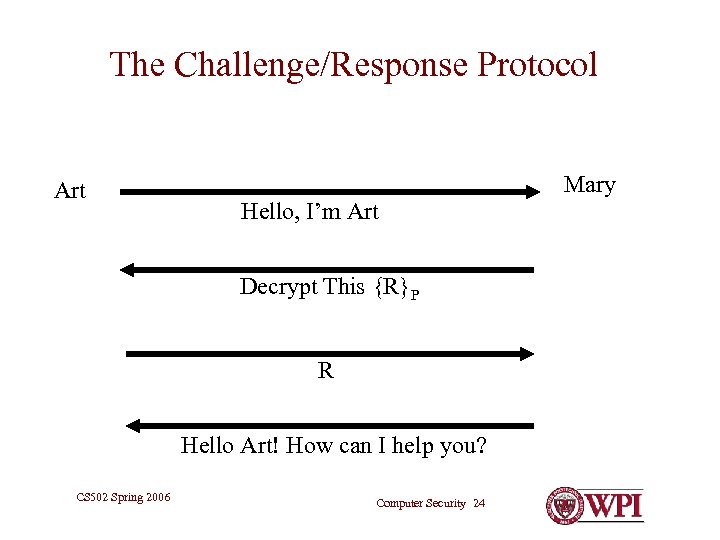 The Challenge/Response Protocol Art Mary Hello, I’m Art Decrypt This {R}P R Hello Art! How can I help you? CS 502 Spring 2006 Computer Security 24
 Threat: Steal passwords from the system • Don’t keep them in an obvious place • Encrypt them so that the version the system sees is not the same as the one the user enters or the version on the wire. CS 502 Spring 2006 Computer Security 25
 Too many passwords to remember? • Third-party authentication – Get someone to vouch for you • The basics: “This guy says you know him. . ” “Yes, I trust him, so you should too. . ” • Kerberos – Certificate-based authentication within a trust community CS 502 Spring 2006 Computer Security 26
 What is in a certificate? • • • Who issued it When was it issued For what purpose was it issued For what time frame is it valid (possibly other application-specific data) A “signature” that proves it has not been forged CS 502 Spring 2006 Computer Security 27
 Systems and Networks Are Not Different • Same basic rules about • Same Coding Rules code behavior apply Apply To: – An application • Same authentication – Code which manages rules apply incoming messages • The same security – Code which imposes principles apply access controls on a network –. . . CS 502 Spring 2006 Computer Security 28
 The Principles • Understand what you are trying to protect • Understand the threat(s) you are trying to protect against – Also, costs and risks • Be prepared to establish trust by telling people how you do it • Assume that the bad guys are at least as clever as you are! CS 502 Spring 2006 Computer Security 29
 Break CS 502 Spring 2006 Computer Security 30
 Part 2: Human and Application Issues • What are we defending against…and why? • Weaknesses and Responses – Technical – Human • Things to think about. . . CS 502 Spring 2006 Computer Security 31
 Reading Assignment • Ken Thompson, “Reflections on Trusting Trust, ” Communications of ACM, vol. 27, #8, August 1984, pp. 761 -763. – The very first virus. CS 502 Spring 2006 Computer Security 32
 How do these attacks work? • Messages that attack mail readers or browsers • Denial of service attacks against a web server • Password crackers • Viruses, Trojan Horses, other “malware” CS 502 Spring 2006 Computer Security 33
 The concept of a “Vulnerability” • Buffer overflow • Protocol/bandwidth interactions – Protocol elements which do no work • “execute this” messages – The special case of “mobile agents” • Human user vulnerabilities – e. Mail worms – Phishing CS 502 Spring 2006 Computer Security 34
 Another Principle • There is a never-ending war going on between the “black hats” and the rest of us. • For every asset, there is at least one vulnerability • For every protective measure we add, “they” will find another vulnerability CS 502 Spring 2006 Computer Security 35
 Yet Another Principle • There is no such thing as a bullet-proof barrier • Every level of the system and network deserves an independent threat evaluation and appropriate protection • Only a multi-layered approach has a chance of success! CS 502 Spring 2006 Computer Security 36
 Actual Losses: • Approximately 70% are due to user error • More than half of the remainder are caused by insiders • “Social Engineering” accounts for more loss than technical attacks. CS 502 Spring 2006 Computer Security 37
 What is “Social Engineering”? “Hello. This is Dr. Burnett of the cardiology department at the Conquest Hospital in Hastings. Your patient, Sam Simmonds has just been admitted here unconscious. He has an unusual ventricular arrhythmia. Can you tell me if there is anything relevant in his record? ” CS 502 Spring 2006 Computer Security 38
 Social Engineering (2) From: 3 dksobinsky@zoom-internet. net Sent: Sunday, March 26, 2006 8: 10 AM To: rmstronger@charter. net Subject: Re: Approved Please read the attached file. CS 502 Spring 2006 Computer Security 39
 Computerworld 3/19/04 • 10 cents on risk assessment • 15 cents on policy • 40 cents on awareness and employee education • 20 cents on technology • 15 cents on process, process Patrick Mc. Bride CS 502 Spring 2006 Computer Security 40
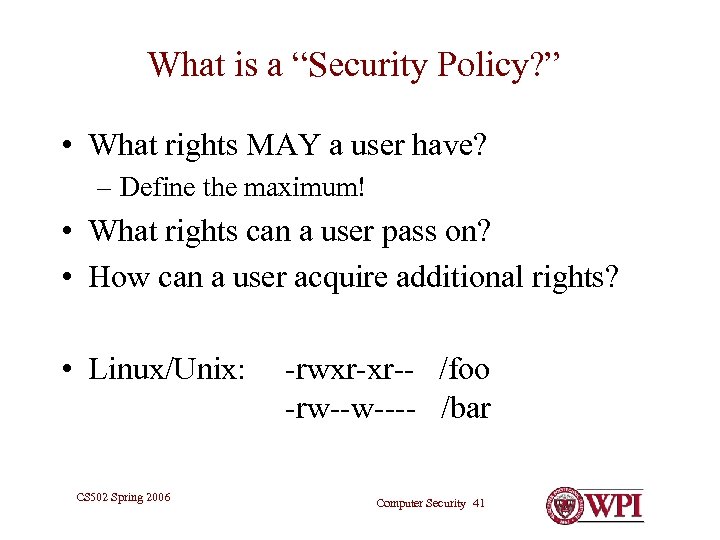 What is a “Security Policy? ” • What rights MAY a user have? – Define the maximum! • What rights can a user pass on? • How can a user acquire additional rights? • Linux/Unix: CS 502 Spring 2006 -rwxr-xr-- /foo -rw--w---- /bar Computer Security 41
 Policy Models (1) A “Policy Model” is a framework for creating a specific policy for a specific organization • Linux/Unix – Users, groups, everybody – “owner” (or “…”) controls grant of rights – Rights based on UID, GID – Focus on files – Process has rights of parent • can change GID or drop rights CS 502 Spring 2006 Computer Security 42
 Policy Models (2) • Win 200 X – Users and groups – Groups may be members of groups – Rights are the combined rights of all groups of which the user is a direct or indirect member – Administrator controls everything • can grant any right – The default is strong control over admin functions and little control over files CS 502 Spring 2006 Computer Security 43
 Policy Models (3) • Typical Business – Managers can (usually) grant rights to their staff – Information is visible to people above in the organization – Managers do not have authority to grant access downward for some classes of information – Overall control is maintained by restricting access to applications rather than to data – databases have their own distinct access controls CS 502 Spring 2006 Computer Security 44
 Policy Models (4) • The Military Mind – Access rights are granted only by a higher authority – Access is broken into two models • need-to-know (usually organizational with upward visibility) • item-by-item (classification may occur in advance of creation or after) – Creator may be denied access to own work – Some weird anomalies CS 502 Spring 2006 Computer Security 45
 Policy Models (5) • The BMA (British Medical Assoc. ) model (1995) – Each medical record has an access control list – Access may be granted to a new clinician by the subject or the primary clinician – Patient must be notified of all ACL changes, and may revoke access – Deletions are not allowed – All access must be logged and auditable – Information may be aggregated from A into B only if ACL(A) is a superset of ACL(B) • Reference Anderson, Ross, “An Update on the BMA Security Policy, ” 1996. (. pdf) CS 502 Spring 2006 Computer Security 46
 Policy Models (6) • The HIPAA model (1998) – The patient controls the right to access “personally identifiable health information” – Access is granted to any clinician or facility staff participating in the care of the patient – Patient must be notified of all breaches – Deletions are not allowed – All access must be logged and auditable – Privileges may be revoked CS 502 Spring 2006 Computer Security 47
 More Principles • Think about Assets, Threats and Vulnerabilities FIRST • Find an appropriate (and minimally complex) Policy Model • Match your OS capabilities to the policy model as best you can • Train staff to recognize social engineering! • Train staff to make a habit out of the policy! CS 502 Spring 2006 Computer Security 48
 Break CS 502 Spring 2006 Computer Security 49
 Part 3: Fun with Cryptography • What is cryptography about? • General Principles of Cryptography • Basic Protocols – Single-key cryptography – Public-key cryptography • An example. . . CS 502 Spring 2006 Computer Security 50
 Principles • Cryptography is about the exchange of messages • The key to success is that all parties to an exchange trust that the system will both protect them from threats and accurately convey their message • TRUST is essential CS 502 Spring 2006 Computer Security 51
 Therefore • Algorithms must be public and verifiable • We need to be able to estimate the risk of compromise • The solution must practical for its users, and impractical for an attacker to break CS 502 Spring 2006 Computer Security 52
 Guidelines • Cryptography is always based on algorithms which are orders of magnitude easier to compute in the forward (normal) direction than in the reverse (attack) direction. • The attacker’s problem is never harder than trying all possible keys • The more material the attacker has the easier his task CS 502 Spring 2006 Computer Security 53
 Example • What is 314159265358979? vs. • What are prime factors of 3912571506419387090594828508241? CS 502 Spring 2006 Computer Security 54
 Time marches on… • We must assume that there will be improvements in computational power, mathematics and algorithms. – Messages which hang around get less secure with time! • Increases in computing power help the good guys and HURT the bad guys for new and short-lived messages CS 502 Spring 2006 Computer Security 55
 Caveat • We cannot mathematically PROVE that the inverse operations are really as hard as they seem to be…It is all relative… The Fundamental Tenet of Cryptography: If lots of smart people have failed to solve a problem, it won’t be solved (soon) CS 502 Spring 2006 Computer Security 56
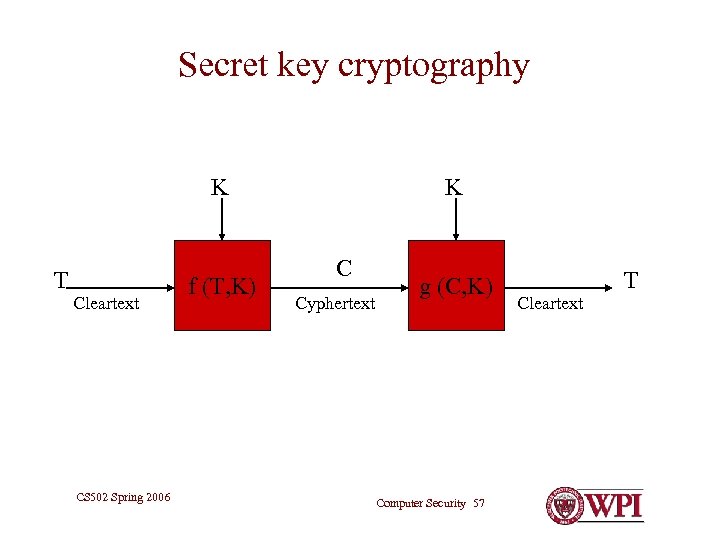 Secret key cryptography K T Cleartext CS 502 Spring 2006 f (T, K) K C Cyphertext g (C, K) Computer Security 57 Cleartext T
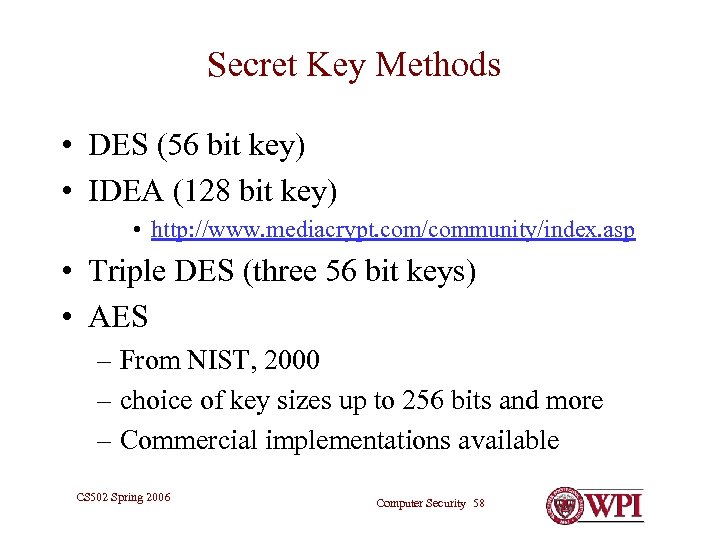 Secret Key Methods • DES (56 bit key) • IDEA (128 bit key) • http: //www. mediacrypt. com/community/index. asp • Triple DES (three 56 bit keys) • AES – From NIST, 2000 – choice of key sizes up to 256 bits and more – Commercial implementations available CS 502 Spring 2006 Computer Security 58
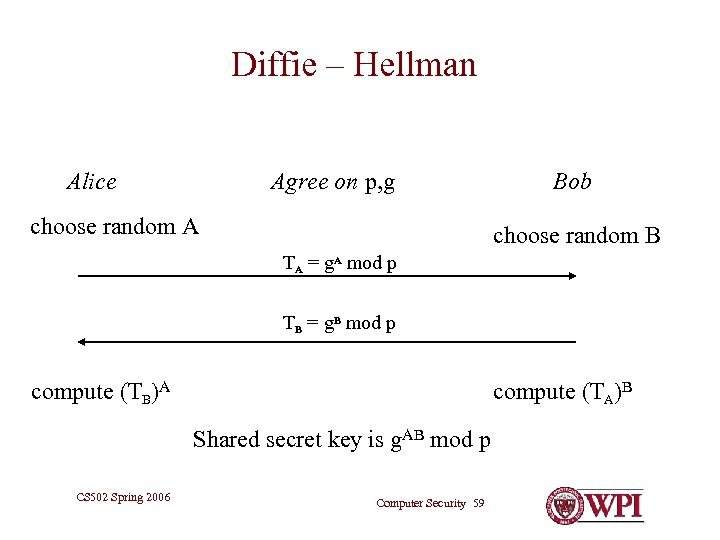 Diffie – Hellman Alice Agree on p, g choose random A Bob choose random B TA = g. A mod p TB = g. B mod p compute (TB)A compute (TA)B Shared secret key is g. AB mod p CS 502 Spring 2006 Computer Security 59
 D–H Problems • Not in itself an encryption method – we must still do a secret key encryption • Subject to a “man in the middle” attack (Alice thinks she is talking to Bob, but actually Trudy is intercepting all of the messages and substitution her own) CS 502 Spring 2006 Computer Security 60
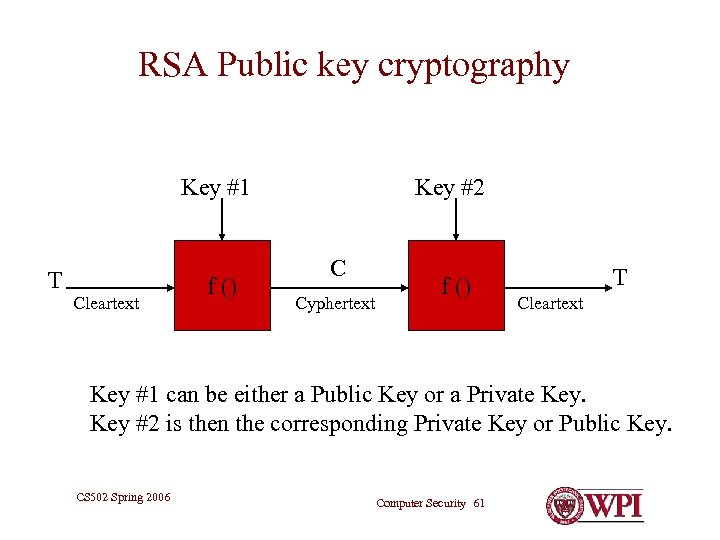 RSA Public key cryptography Key #1 T Cleartext f () Key #2 C Cyphertext f () T Cleartext Key #1 can be either a Public Key or a Private Key #2 is then the corresponding Private Key or Public Key. CS 502 Spring 2006 Computer Security 61
 RSA Public Key Cryptography • Rivest, Shamir and Adelman (1978) • I can send messages that only you can read • I can verify that you and only you could have sent a message • I can use a trusted authority to distribute my public key – The trusted authority is for your benefit! CS 502 Spring 2006 Computer Security 62
 RSA Details • We will use the same operation to encrypt and decrypt • To encrypt, we will use “e” as a key, to decrypt we will use “d” as a key • e and d are inverses with respect to the chosen algorithm CS 502 Spring 2006 Computer Security 63
 RSA Details • Choose n as the product of two large primes – Finding the factors of a large number is mathematically hard (difficult) – Finding primes is also hard • Choose e to be a (fairly small) prime and compute d from e and the factors of n • THROW AWAY THE FACTORS OF n! • Publish two numbers, e (public key) and n CS 502 Spring 2006 Computer Security 64
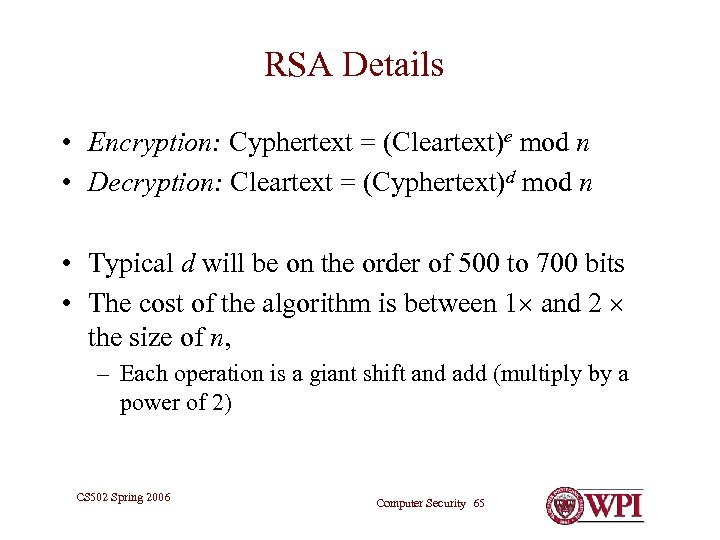 RSA Details • Encryption: Cyphertext = (Cleartext)e mod n • Decryption: Cleartext = (Cyphertext)d mod n • Typical d will be on the order of 500 to 700 bits • The cost of the algorithm is between 1 and 2 the size of n, – Each operation is a giant shift and add (multiply by a power of 2) CS 502 Spring 2006 Computer Security 65
 RSA Problems • It is much more costly than typical secretkey methods – Use RSA to hide (i. e. , encrypt) a secret key, – Encrypt the message with the secret key and append/prefix the encrypted key • Requires a “Public Key Infrastructure” for effective key generation and distribution – Chain of trust thing again! CS 502 Spring 2006 Computer Security 66
 Message Digests (aka Digital Signatures) • A message digest is a non-reversable algorithm which reduces a message to a fixed-length “summary” • The summary has the property that a change to the original will produce a new summary • The probability that the new summary is the same as the old should be 1/(size of digest) • Tanenbaum, p. 590 (§ 9. 2. 4) CS 502 Spring 2006 Computer Security 67
 Message Digests (2) • There are several good (but possibly no perfect) message digest algorithms • MD 5 is probably the most common one in use – 128 bit digest • has known weaknesses • SHA-1 – 160 bit digest (current best choice) • [Another product of NIST] CS 502 Spring 2006 Computer Security 68
 Resources • Network World Security Newsletter – http: //www. nwsubscribe. com – Practical advice, not a virus alert newsletter. Especially good for the links to other security resources at the bottom of each article • CERT Coordination Center at CMU – http: //www. cert. org • News about system threats, including viruses and other problems. Source for OCTAVE papers and process • Norton Anti. Virus Site (Symantec) – http: //securityresponse. symantec. com/avcenter/ • Mc. Afee Security (Network Associates) – http: //us. mcafee. com/virusinfo/ CS 502 Spring 2006 Computer Security 70
 Textbooks Network Security: C. Kaufman, R. Perlman, M. Speciner, Prentice Hall (2002) – A practical but rigorous presentation of network security issues and techniques with emphasis on cryptographic solutions Security Engineering: R. Anderson, Wiley (2001) – Focused on learning from past mistakes in security system design. – Excellent discussion of policies and policy models. – See author’s web site (www. ross-anderson. com) if you are interested in current research. CS 502 Spring 2006 Computer Security 71
 Other Books Real World Linux Security: R. Toxen, Prentice Hall (2003) – An excellent read. Lists hundreds of vulnerabilities and what to do about them. Valuable for non Linux users too. Windows 2003 Security Bible: B. Rampling, Wiley (2003) – Good example of a how-to book. Specific to WIN 2003 The Art of Deception: K. Mitnick, Wiley (2002) – Mitnick is one of the most famous social engineers. – Must-read for those involved in broad security planning, and fun for everyone. CS 502 Spring 2006 Computer Security 72