 Скачать презентацию An Introduction to Building Codes for Property Owners
cccf2e3c7e478e1b9ed6722453a608dc.ppt
- Количество слайдов: 32



An Introduction to Building Codes for Property Owners FEMA Building Science Branch – Building Disaster Resilient Communities
Goals and Outcomes To inform and equip property owners about: § Value of building codes in increasing your safety and disaster resilience. * § Building codes stakeholders, adoption process and implementation. § Available tools to support proper construction and rebuilding. *The Presidential Policy Directive/PPD-8: National Preparedness defines the term “resilience” as the ability to adapt to changing conditions and withstand rapidly recover from disruption due to emergencies. FEMA Building Science Branch: Introduction to Building Codes 2
Topics § The History of Building Codes § What are Building Codes? § Why are Building Codes Important? § Who’s Involved? § What are the Available Tools? FEMA Building Science Branch: Introduction to Building Codes 3
HISTORY OF BUILDING CODES FEMA Building Science Branch: Introduction to Building Codes 4
Building Codes- BC Codes of Hammurabi – 2000 BC § “In the case of collapse of a defective building, the builder is to be put to death if the owner is killed by accident; and the builder’s son if the son of the owner loses his life…” Socrates – 341 BC § He shall set the joists against each other, fitting, and before inserting the dowels he shall show the architect all the stones to be fitting, and shall set them true and sound and dowel them with iron dowels, two dowels to each stone…” FEMA Building Science Branch: Introduction to Building Codes 5
Origins of Modern Codes § Insurance industry: Establish standards to minimize accidents/claims. § Social organizations: Eliminate squalor and impact on health. § Local governments: Develop regulations to deliver health and safety to taxpayers. § Disasters: Mitigate loss of life and property based on public demand. FEMA Building Science Branch: Introduction to Building Codes 6
WHAT ARE BUILDING CODES? FEMA Building Science Branch: Introduction to Building Codes 7
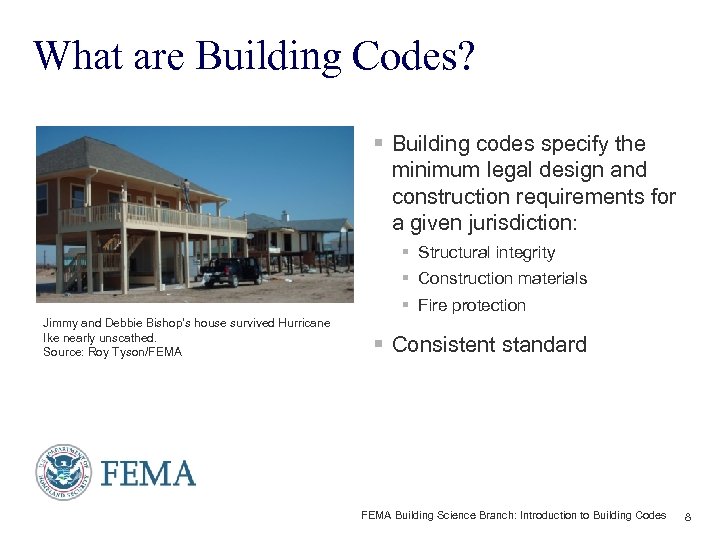
What are Building Codes? § Building codes specify the minimum legal design and construction requirements for a given jurisdiction: § Structural integrity § Construction materials § Fire protection Jimmy and Debbie Bishop’s house survived Hurricane Ike nearly unscathed. Source: Roy Tyson/FEMA § Consistent standard FEMA Building Science Branch: Introduction to Building Codes 8
Who is involved in developing the codes? § The International Code Council (ICC) develops codes in collaboration with: § Federal Emergency Management Agency (FEMA) § Other Federal, states, local and private authorities FEMA Building Science Branch: Introduction to Building Codes 9
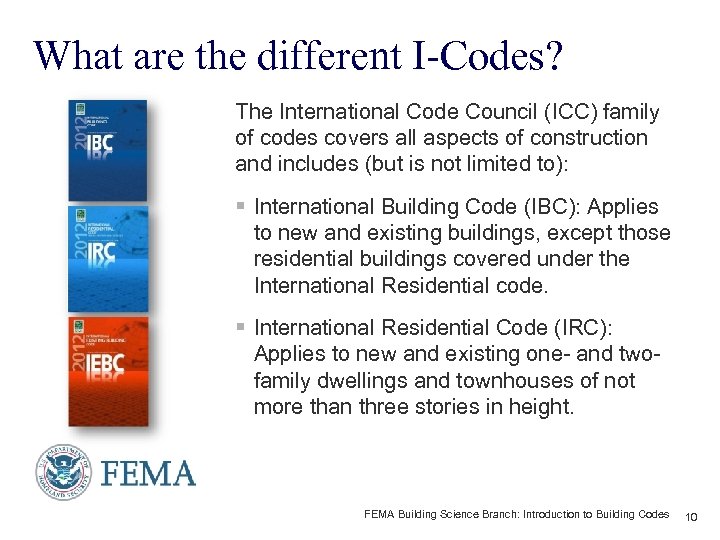
What are the different I-Codes? The International Code Council (ICC) family of codes covers all aspects of construction and includes (but is not limited to): § International Building Code (IBC): Applies to new and existing buildings, except those residential buildings covered under the International Residential code. § International Residential Code (IRC): Applies to new and existing one- and twofamily dwellings and townhouses of not more than three stories in height. FEMA Building Science Branch: Introduction to Building Codes 10
What are the different I-Codes? § International Property Maintenance Code (IPMC): Applies to all existing buildings and addresses maintenance issues for continued safe use of buildings. § International Existing Building Code (IEBC): Applies to the alteration, repair, addition, or change in occupancy of existing structures. § International Fire Code (IFC): Applies to fire and explosion hazards. FEMA Building Science Branch: Introduction to Building Codes 11
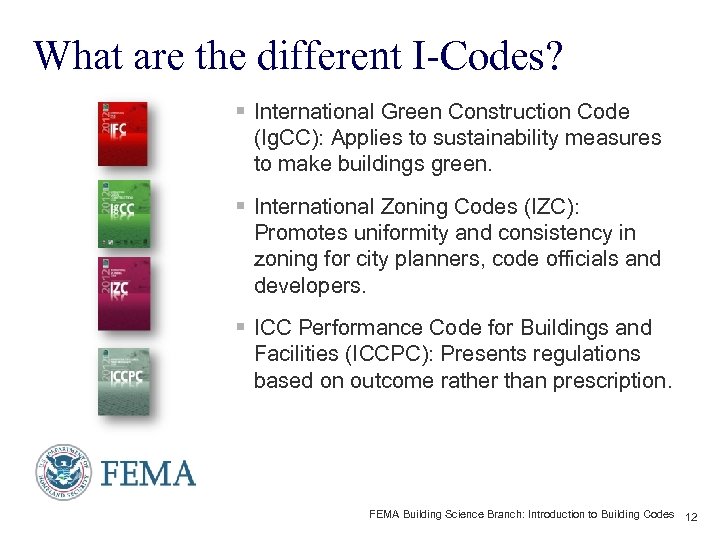
What are the different I-Codes? § International Green Construction Code (Ig. CC): Applies to sustainability measures to make buildings green. § International Zoning Codes (IZC): Promotes uniformity and consistency in zoning for city planners, code officials and developers. § ICC Performance Code for Buildings and Facilities (ICCPC): Presents regulations based on outcome rather than prescription. FEMA Building Science Branch: Introduction to Building Codes 12
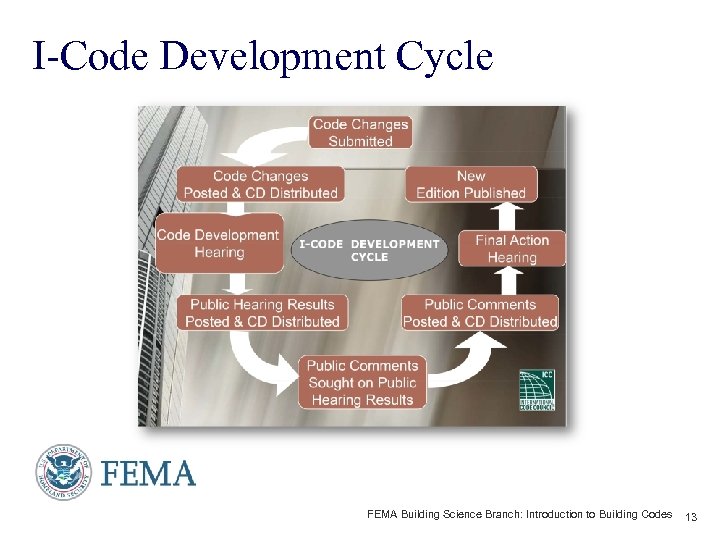
I-Code Development Cycle FEMA Building Science Branch: Introduction to Building Codes 13
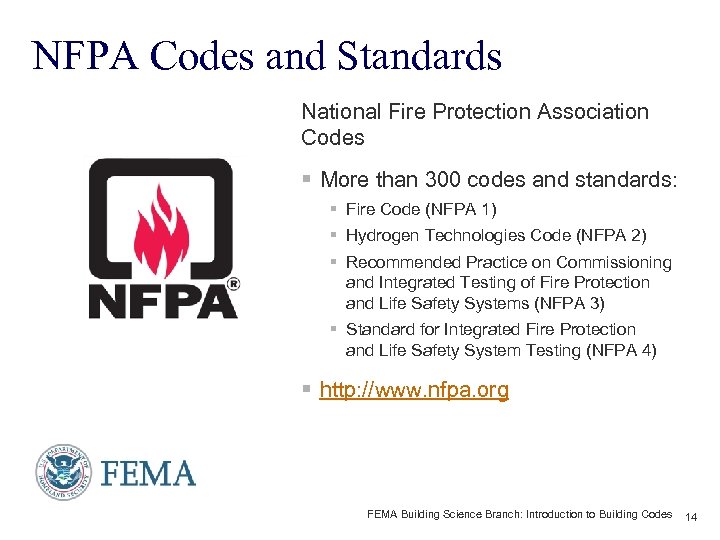
NFPA Codes and Standards National Fire Protection Association Codes § More than 300 codes and standards: § Fire Code (NFPA 1) § Hydrogen Technologies Code (NFPA 2) § Recommended Practice on Commissioning and Integrated Testing of Fire Protection and Life Safety Systems (NFPA 3) § Standard for Integrated Fire Protection and Life Safety System Testing (NFPA 4) § http: //www. nfpa. org FEMA Building Science Branch: Introduction to Building Codes 14
FEMA and the Codes § FEMA’s Strategic Goal is to support disaster resilience and the ability of our local communities to withstand recover rapidly from disaster events. Building Code adoption supports this goal. § FEMA Building Science Branch and the National Earthquake Hazards Reduction Program (NEHRP) serve as the agency’s technical resource for building codes information, standards, and guidance for proper rebuilding and construction. § FEMA partners with ICC, the regions, design professionals, and local jurisdictions to disseminate information on disaster resilient building codes, train local officials, and support building codes adoption and enforcement. FEMA Building Science Branch: Introduction to Building Codes 15
WHY ARE BUILDING CODES IMPORTANT? FEMA Building Science Branch: Introduction to Building Codes 16
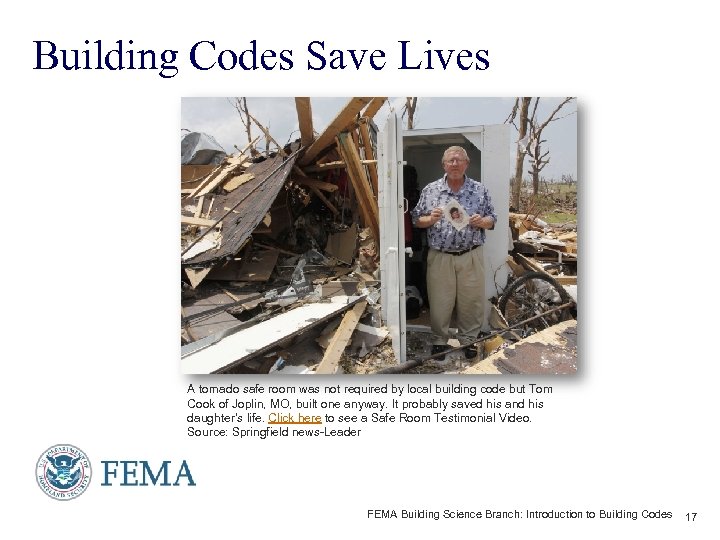
Building Codes Save Lives A tornado safe room was not required by local building code but Tom Cook of Joplin, MO, built one anyway. It probably saved his and his daughter’s life. Click here to see a Safe Room Testimonial Video. Source: Springfield news-Leader FEMA Building Science Branch: Introduction to Building Codes 17
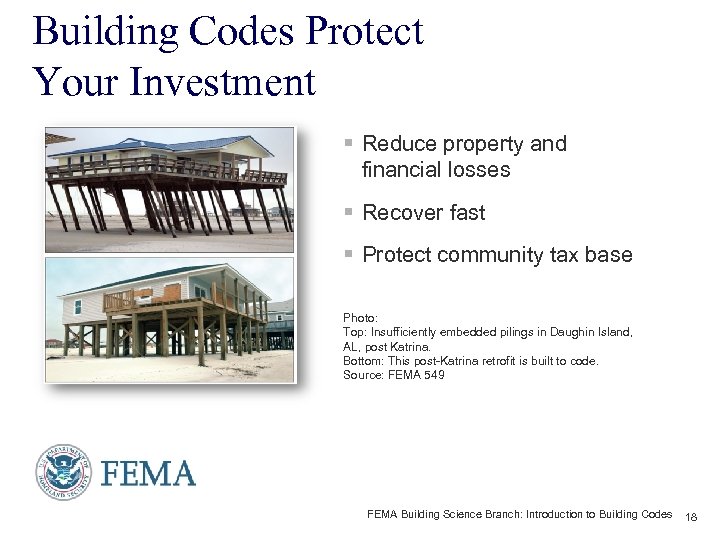
Building Codes Protect Your Investment § Reduce property and financial losses § Recover fast § Protect community tax base Photo: Top: Insufficiently embedded pilings in Daughin Island, AL, post Katrina. Bottom: This post-Katrina retrofit is built to code. Source: FEMA 549 FEMA Building Science Branch: Introduction to Building Codes 18
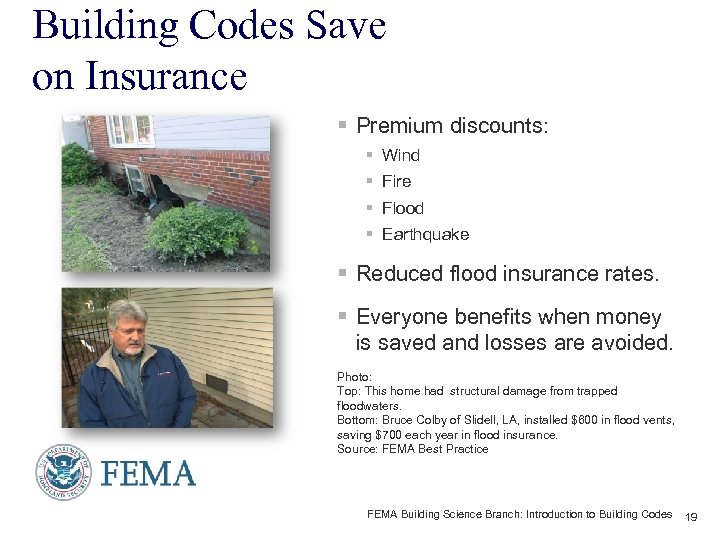
Building Codes Save on Insurance § Premium discounts: § Wind § Fire § Flood § Earthquake § Reduced flood insurance rates. § Everyone benefits when money is saved and losses are avoided. Photo: Top: This home had structural damage from trapped floodwaters. Bottom: Bruce Colby of Slidell, LA, installed $600 in flood vents, saving $700 each year in flood insurance. Source: FEMA Best Practice FEMA Building Science Branch: Introduction to Building Codes 19
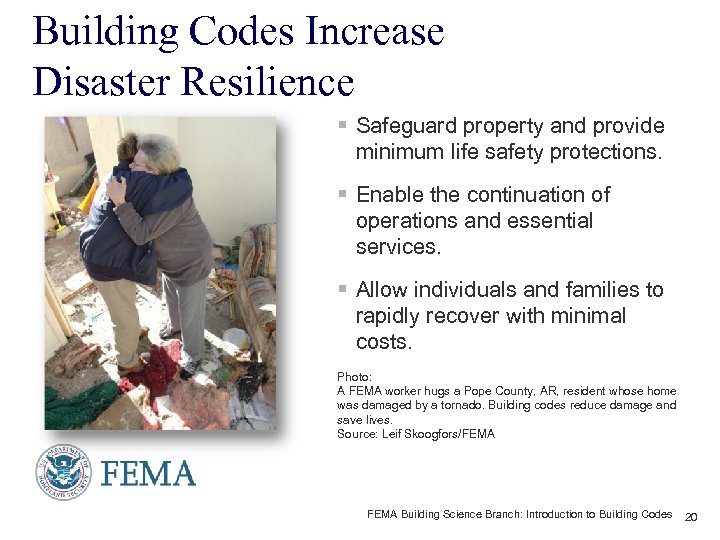
Building Codes Increase Disaster Resilience § Safeguard property and provide minimum life safety protections. § Enable the continuation of operations and essential services. § Allow individuals and families to rapidly recover with minimal costs. Photo: A FEMA worker hugs a Pope County, AR, resident whose home was damaged by a tornado. Building codes reduce damage and save lives. Source: Leif Skoogfors/FEMA Building Science Branch: Introduction to Building Codes 20
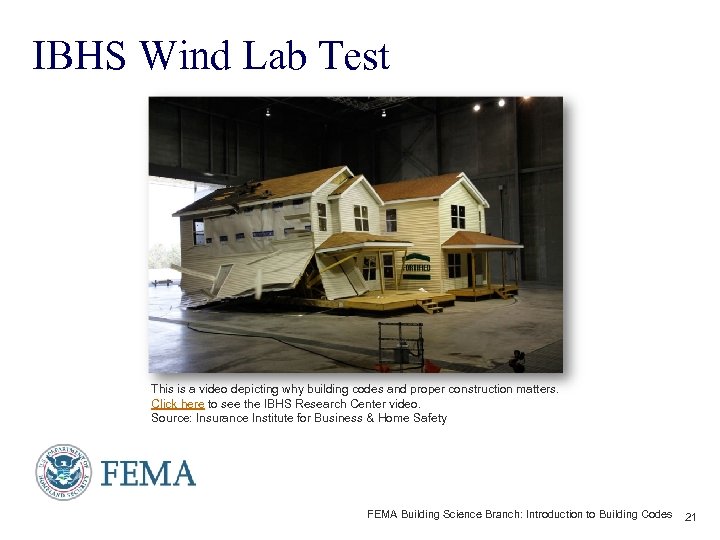
IBHS Wind Lab Test This is a video depicting why building codes and proper construction matters. Click here to see the IBHS Research Center video. Source: Insurance Institute for Business & Home Safety FEMA Building Science Branch: Introduction to Building Codes 21
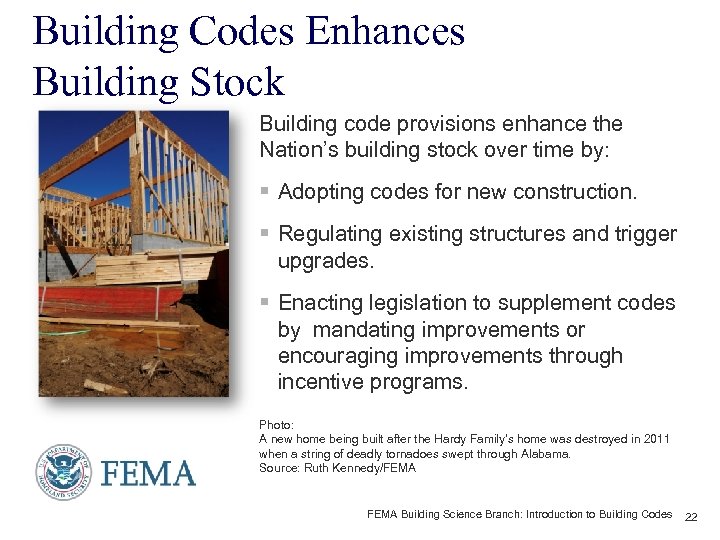
Building Codes Enhances Building Stock Building code provisions enhance the Nation’s building stock over time by: § Adopting codes for new construction. § Regulating existing structures and trigger upgrades. § Enacting legislation to supplement codes by mandating improvements or encouraging improvements through incentive programs. Photo: A new home being built after the Hardy Family’s home was destroyed in 2011 when a string of deadly tornadoes swept through Alabama. Source: Ruth Kennedy/FEMA Building Science Branch: Introduction to Building Codes 22
WHO’S INVOLVED? FEMA Building Science Branch: Introduction to Building Codes 23
Roles of ICC, FEMA, and Design Community § Development: Building codes are developed by a coalition of national organizations and experts. § Outreach: FEMA, ICC, and other partner organizations work together to educate and promote the value of building codes by sharing best practices and available resources. § Training: FEMA and ICC provide training options to educate and promote the adoption, enforcement, and use of building codes with communities. § Partnership: FEMA, ICC, and other partner organizations work together to ensure building codes are developed, adopted, enforced, and promoted nationwide. FEMA Building Science Branch: Introduction to Building Codes 24
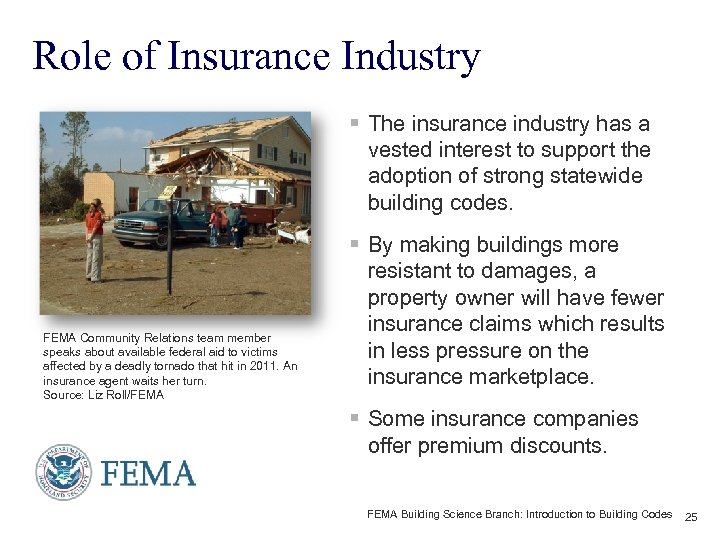
Role of Insurance Industry § The insurance industry has a vested interest to support the adoption of strong statewide building codes. FEMA Community Relations team member speaks about available federal aid to victims affected by a deadly tornado that hit in 2011. An insurance agent waits her turn. Source: Liz Roll/FEMA § By making buildings more resistant to damages, a property owner will have fewer insurance claims which results in less pressure on the insurance marketplace. § Some insurance companies offer premium discounts. FEMA Building Science Branch: Introduction to Building Codes 25
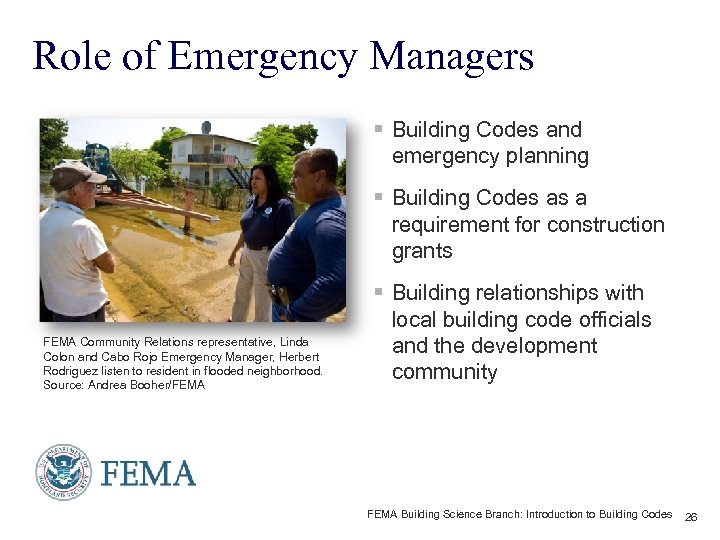
Role of Emergency Managers § Building Codes and emergency planning § Building Codes as a requirement for construction grants FEMA Community Relations representative, Linda Colon and Cabo Rojo Emergency Manager, Herbert Rodriguez listen to resident in flooded neighborhood. Source: Andrea Booher/FEMA § Building relationships with local building code officials and the development community FEMA Building Science Branch: Introduction to Building Codes 26
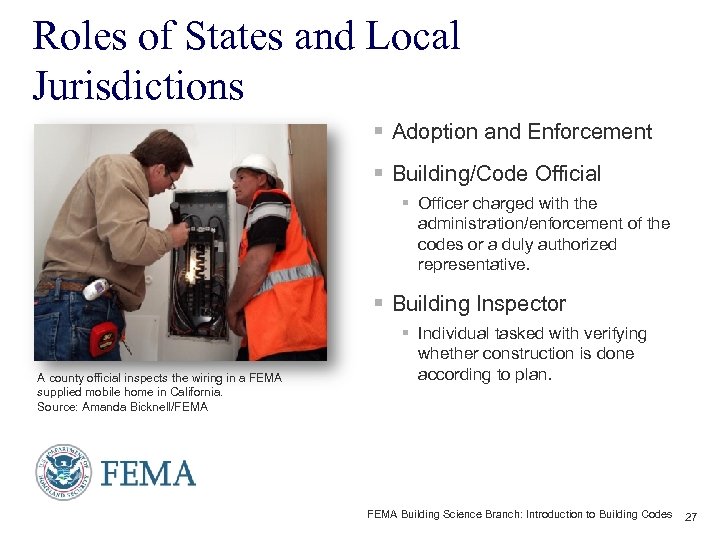
Roles of States and Local Jurisdictions § Adoption and Enforcement § Building/Code Official § Officer charged with the administration/enforcement of the codes or a duly authorized representative. § Building Inspector A county official inspects the wiring in a FEMA supplied mobile home in California. Source: Amanda Bicknell/FEMA § Individual tasked with verifying whether construction is done according to plan. FEMA Building Science Branch: Introduction to Building Codes 27
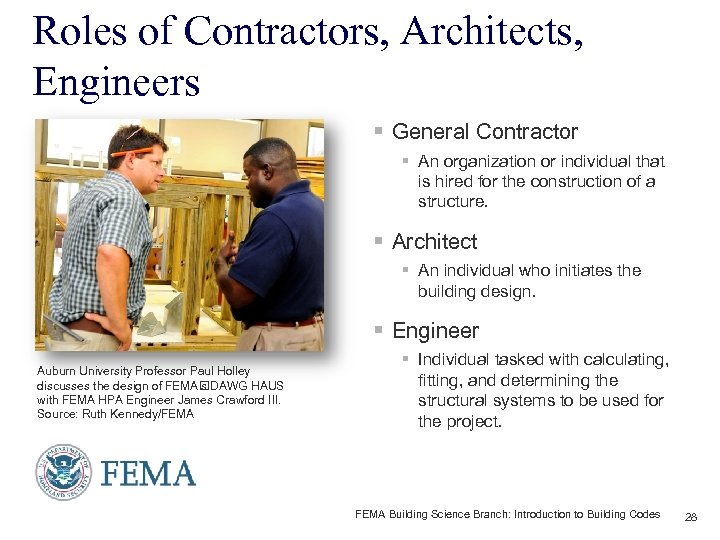
Roles of Contractors, Architects, Engineers § General Contractor § An organization or individual that is hired for the construction of a structure. § Architect § An individual who initiates the building design. § Engineer Auburn University Professor Paul Holley discusses the design of FEMA s DAWG HAUS with FEMA HPA Engineer James Crawford III. Source: Ruth Kennedy/FEMA § Individual tasked with calculating, fitting, and determining the structural systems to be used for the project. FEMA Building Science Branch: Introduction to Building Codes 28
WHAT TOOLS ARE AVAILABLE? FEMA Building Science Branch: Introduction to Building Codes 29
For More Information: § Consult your Local & State Building Departments § International Code Council: § www. iccsafe. org § http: //www. icc-foundation. org § International Code Council Call Center: Phone: (888) 422 -7233 and press 0 or Email: Care. Center@iccsafe. org § FEMA Building Science Branch: § http: //www. fema. gov/building-science § http: //www. fema. gov/earthquake § FEMA Building Science Helpline: Phone: (866) 927 -2104 or Email: FEMABuildingsciencehelp@fema. dhs. gov § FEMA Building Codes Toolkit: http: //www. fema. gov/earthquakepublications/building-codes-toolkit-0 FEMA Building Science Branch: Introduction to Building Codes 30
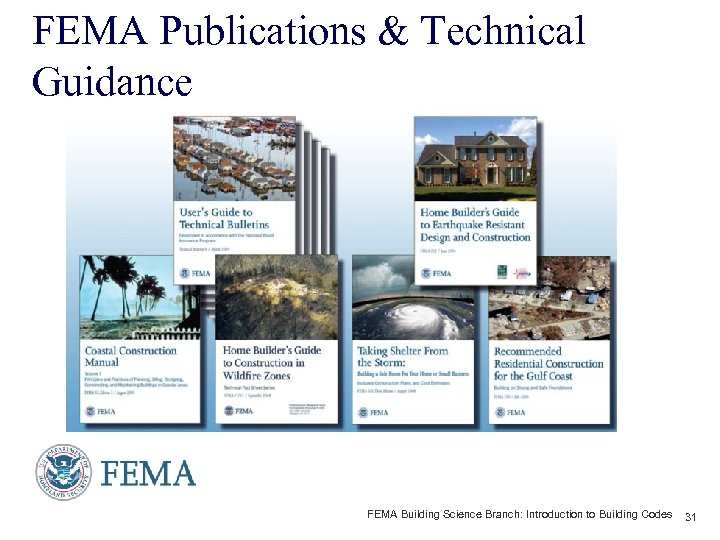
FEMA Publications & Technical Guidance FEMA Building Science Branch: Introduction to Building Codes 31
FEMA Building Science Branch: Introduction to Building Codes
Скачать презентацию An Introduction to Building Codes for Property Owners
cccf2e3c7e478e1b9ed6722453a608dc.ppt