 Скачать презентацию An Intelligent Broker Architecture for Context-Aware Systems Harry
c0a7e6b7d08e12aca3ce685b3b160bed.ppt
- Количество слайдов: 77



An Intelligent Broker Architecture for Context-Aware Systems Harry Chen Dept. of CSEE, UMBC Ph. D Dissertation Proposal Defense January 2003
Outline I. III. IV. Introduction Research Review Context Broker Architecture Research Plan & Summary

Part I. Introduction
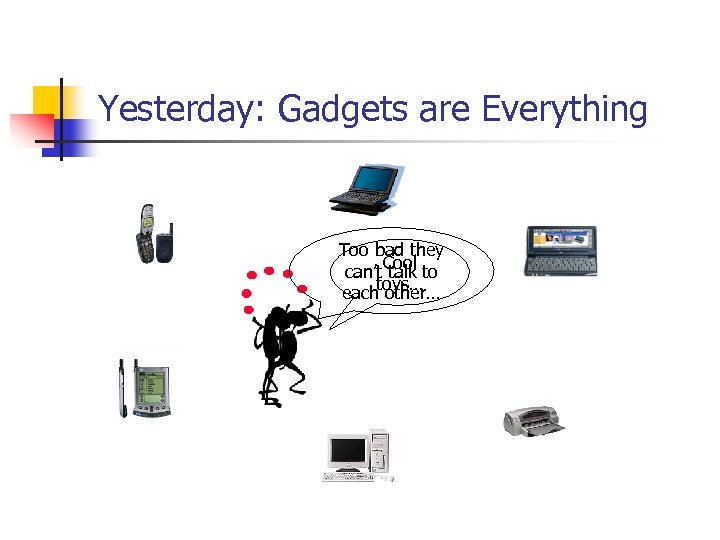
Yesterday: Gadgets are Everything Too bad they Cool can’t talk to toys… each other…
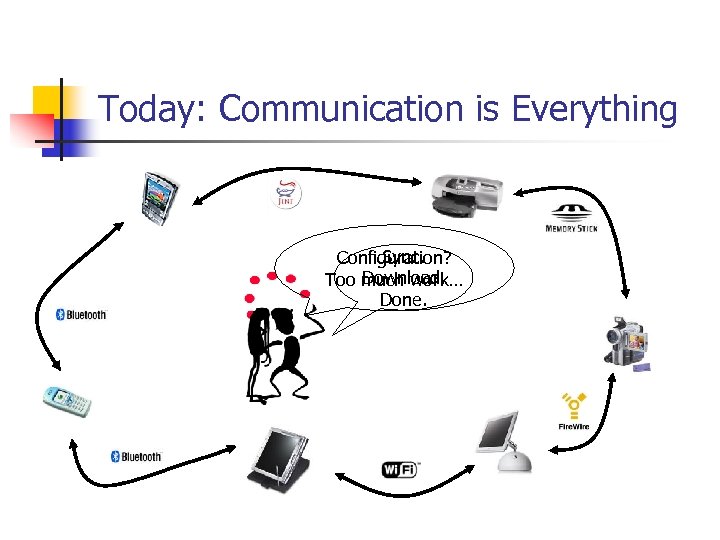
Today: Communication is Everything Sync. Configuration? Download. Too much work… Done.
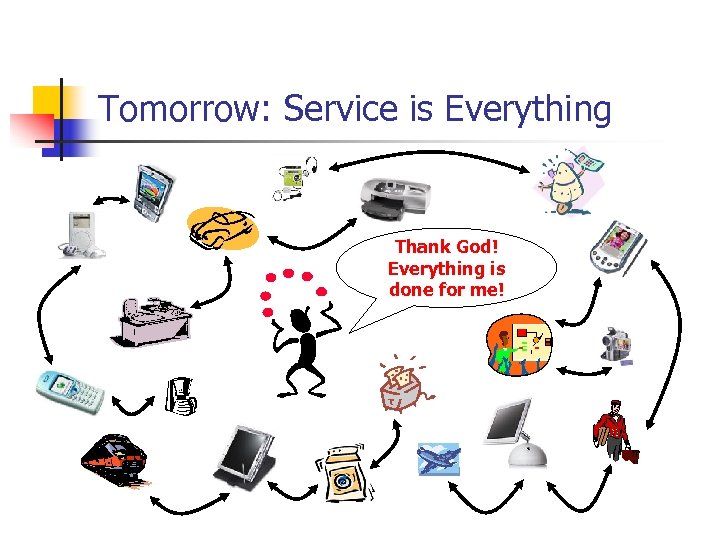
Tomorrow: Service is Everything Thank God! Everything is done for me!
One Step Towards Tomorrow n Context-aware Computing n n n Brings us one step closer to the Pervasive Computing vision Enables computer systems to anticipate users’ needs and to act in advance An emerging paradigm to free everyday users from manually configuring and instructing computer systems
Life is Not Perfect n Building context-aware systems for Pervasive Computing is often difficult and costly: n n n User privacy issues when sharing personal information Supporting resource-poor mobile devices How to reason about sophisticated contexts in a dynamic environment Inconsistent and ambiguous contextual knowledge Security, trust, . . . (goes on and on)
My Research Objective n n To develop and prototype a brokercentric agent architecture to support context-aware systems To demonstrate this architecture can be used to reduce the difficulty and cost of building context-aware systems in an Intelligent Meeting Room environment
Context Broker Architecture n The “broker” of this architecture will n n Sense and reason about contexts on the behalf of capability-limited agents Enable agents to share contextual knowledge Protect the privacy of users Maintain consistent contextual knowledge
Let’s talk about … n n Agent Broker Context-aware systems
About “Agent” n Study context-aware systems using intelligent agents (context-aware agents) n n Autonomous and Proactive Can communicate, not just connect Have beliefs about the World Have desires and intentions
About “Broker” n Broker, an overloaded term for agents with a specialized role: n n n Mediator: mediate communication messages in a Multi-agent system (MAS) Facilitator: facilitate task execution between agents to achieve cooperation Match-maker: match/recommend service advertisements
“Broker” in My Architecture n Broker is a server agent that controls and manages the contextual knowledge of a Pervasive Computing environment: n n Enables agents to contribute to and access a shared model of context Allows users to control the access of their personal information in a context-aware environment B
![About “Context” n In Merriam-Webster Dictionary n n [1] the parts of a discourse](https://present5.com/presentation/c0a7e6b7d08e12aca3ce685b3b160bed/image-15.jpg "About “Context” n In Merriam-Webster Dictionary n n [1] the parts of a discourse")
About “Context” n In Merriam-Webster Dictionary n n [1] the parts of a discourse that surround a word or passage and can throw light on its meaning [2] the interrelated condition in which something exists or occurs We are interested in [2]
Definitions of Context n In context-aware computing n n No unified definition of context Most of the definitions agree that context has something to do with the interactions between the users and the computing systems
My Definition of Context n Context is information that can be used to characterize the situation of a person or an object in a Pervasive Computing environment. n n The identities and attributes of people and devices The locations of people and devices The activities that people are participating in The roles and intentions of people when participating in the activities
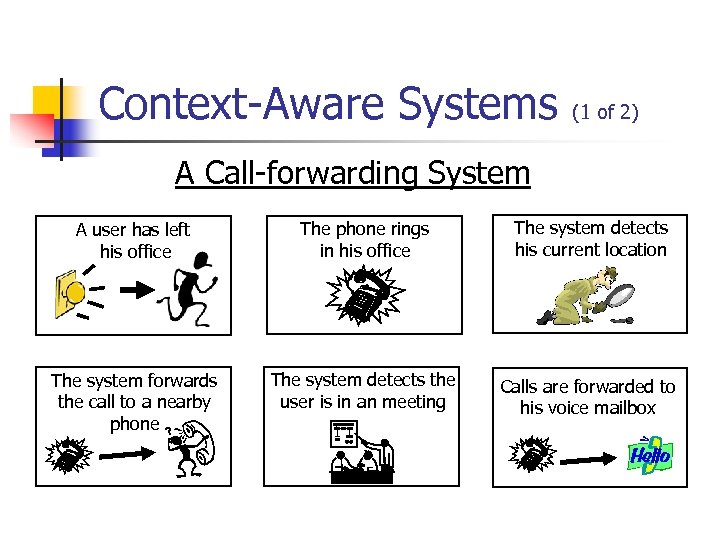
Context-Aware Systems (1 of 2) A Call-forwarding System A user has left his office The phone rings in his office The system detects his current location The system forwards the call to a nearby phone The system detects the user is in an meeting Calls are forwarded to his voice mailbox
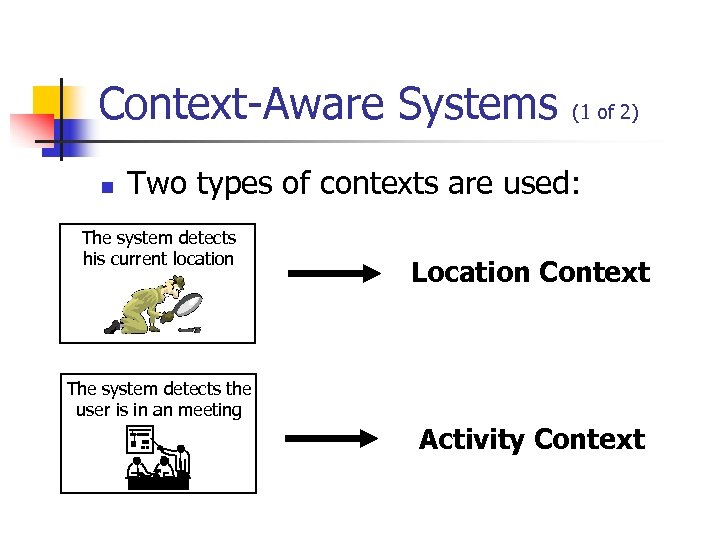
Context-Aware Systems n (1 of 2) Two types of contexts are used: The system detects his current location Location Context The system detects the user is in an meeting Activity Context
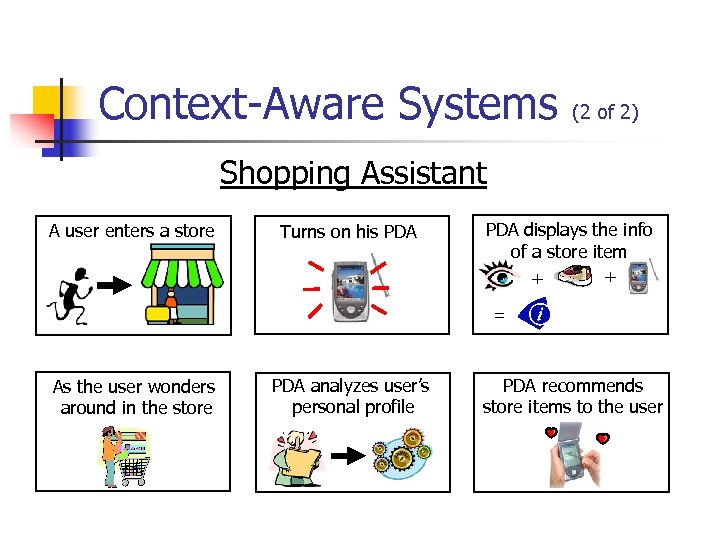
Context-Aware Systems (2 of 2) Shopping Assistant A user enters a store Turns on his PDA displays the info of a store item + + = As the user wonders around in the store PDA analyzes user’s personal profile PDA recommends store items to the user
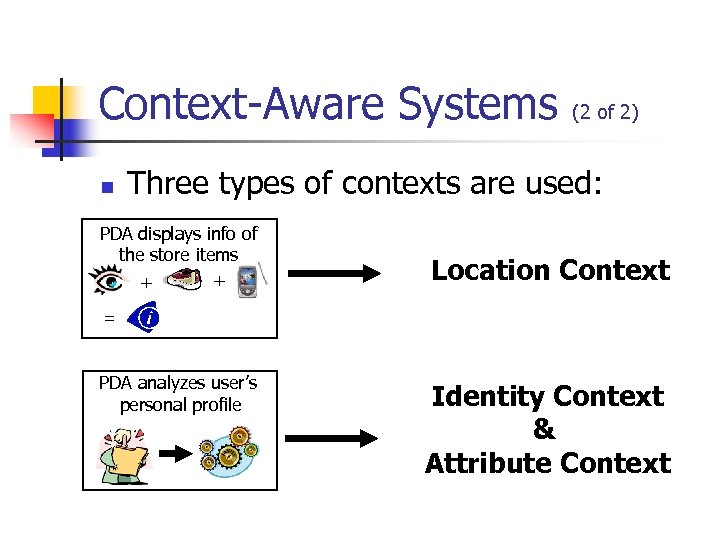
Context-Aware Systems n (2 of 2) Three types of contexts are used: PDA displays info of the store items + + Location Context = PDA analyzes user’s personal profile Identity Context & Attribute Context
System Characteristics n n n Context-aware agents often run on mobile devices For agents to become context-aware, context sensing and context reasoning mechanisms are required Context-aware systems often exploit user information (e. g. personal profile, user location & social activity)
Research Problem n Building context-aware systems can be difficult and costly because n n n (1) limited resources in mobile devices (2) lack of reusable context-aware mechanisms (3) privacy issues in accessing user information
(1) Limited Resources in Mobile Devices n Battery Power Constraint n n n Small devices => limited built-in sensors Big devices => too many external sensors can be awkward Information Storage Constraint n n Historic knowledge saves computation Limited storage => must intelligently choose what to save and delete (hard problem!)
(1) Limited Resources in Mobile Devices n Computing Power Constraint n n n To process contexts needs CPU power Limited CPU power => primitive contexts ONLY (limited intelligence)! Communication Constraint n n Contexts are “hidden” heterogeneous sources Not knowing where are the sources and how to communicate => limited contextawareness
(2) Lack of Reusable Context-Aware Mechanisms n 2 Essential Mechanisms: n n n Context Sensing: acquiring information from the physical environment Context Reasoning: interpreting the information that have been acquired In the existing systems, both are built from the scratch every time => no reuse!
(3) Privacy Issues in Accessing User Information n n Privacy is about control of information In context-aware systems, users may not have full control of their information n n Sensors are hidden in the environment Information are collected without explicit consent from the users
(3) Privacy Issues in Accessing User Information n What about sharing of information? n n You tell an agent something about you because you want its service, and later it tells someone else. . . (you are in trouble!) The downstream consequences of information are unknown or unspecified.
Proposed Solution n Context Broker Architecture n n Philosophy: agents can’t do “everything” by themselves, let’s provide a powerful server entity to help them Rationale: the Moore’s Law for mobile computing is likely to hold; developing a centralized solution is much easier than any P 2 P solutions.
Context Broker Architecture n The key features: n n Sense and reason about contexts on the behalf of capability-limited agents Enable agents to share contextual knowledge Protect the privacy of users Maintain consistent contextual knowledge

Part II. Research Review
The Purpose of Research Review n n (1) To argue building context-aware systems can be difficult and costly using the existing architecture (2) To put Context Broker Architecture research into perspective (so that we can compare and contrast it with the existing systems)
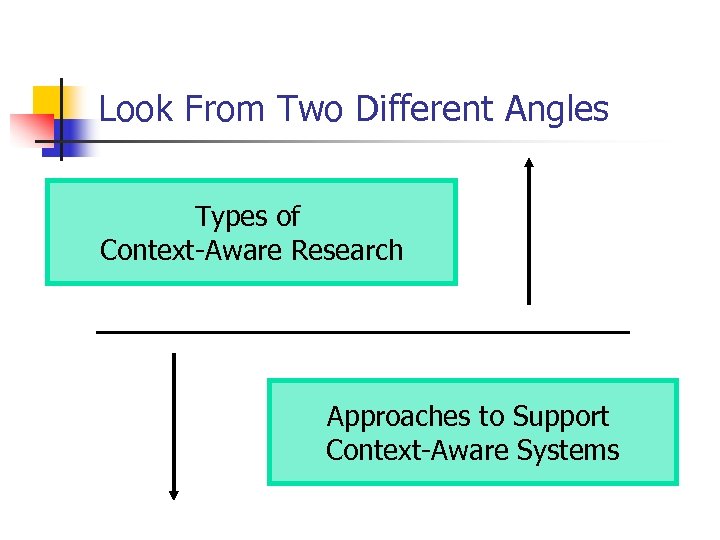
Look From Two Different Angles Types of Context-Aware Research Approaches to Support Context-Aware Systems
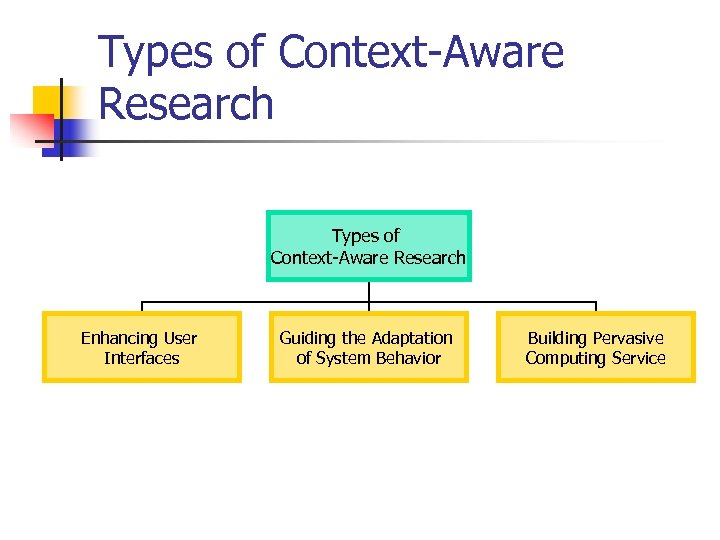
Types of Context-Aware Research Enhancing User Interfaces Guiding the Adaptation of System Behavior Building Pervasive Computing Service
Enhancing User Interfaces n n (1 of 2) Problem: the user interface of the existing mobile devices demand too much user attentions (i. e. cognitive and visual). Solution: to replace the traditional user interface by enabling devices to become context-aware.
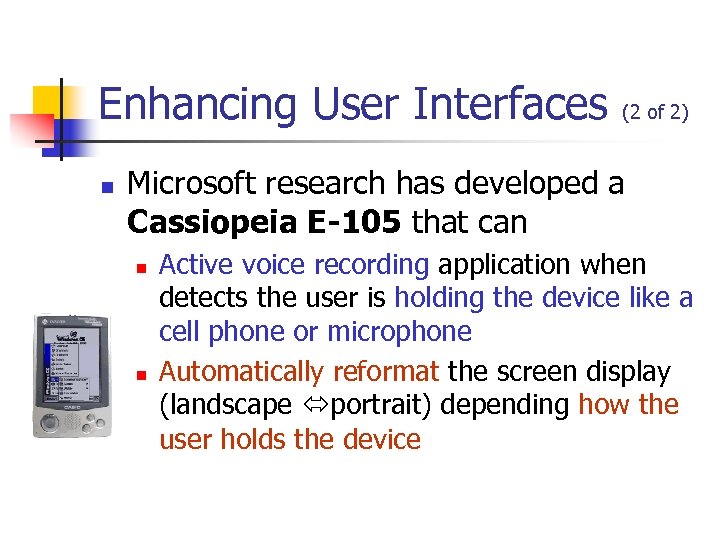
Enhancing User Interfaces n (2 of 2) Microsoft research has developed a Cassiopeia E-105 that can n n Active voice recording application when detects the user is holding the device like a cell phone or microphone Automatically reformat the screen display (landscape portrait) depending how the user holds the device
Guiding the Adaptation of System Behavior (1 of 2) n n Problem: Environment changes can affect the performance of applications (e. g. using wireless PDA while walking on the street) Solution: enabling applications to adapt their behavior in according to condition changes
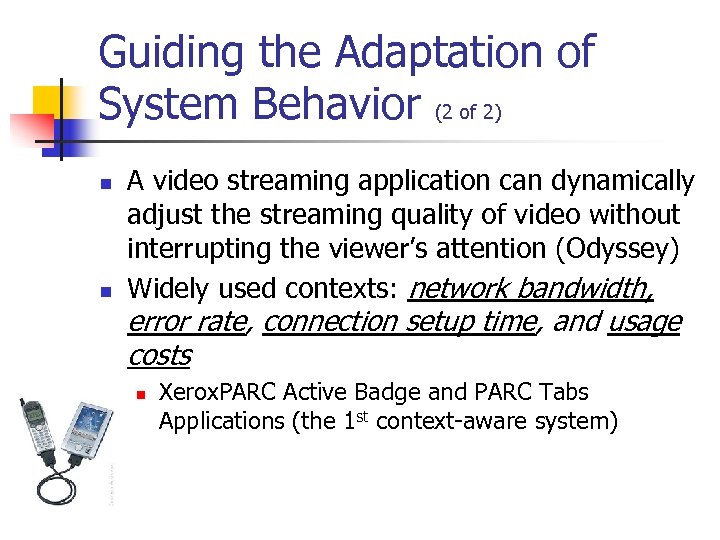
Guiding the Adaptation of System Behavior (2 of 2) n n A video streaming application can dynamically adjust the streaming quality of video without interrupting the viewer’s attention (Odyssey) Widely used contexts: network bandwidth, error rate, connection setup time, and usage costs n Xerox. PARC Active Badge and PARC Tabs Applications (the 1 st context-aware system)
Building Pervasive Computing Services (1 of 3) n Problem: Complex computer systems are drawing humans into the world of computing n n Think Oxygen & Mark Weiser’s vision Solution: enabling computers to reason and act in according to the situation of users as they carry out their every activities
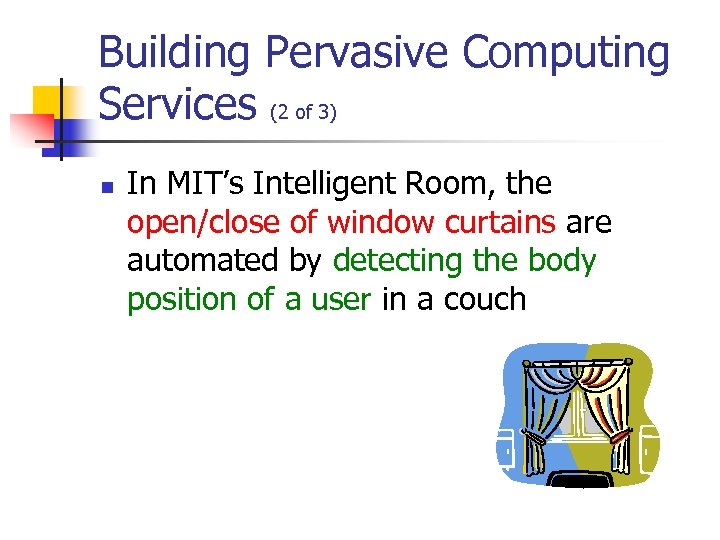
Building Pervasive Computing Services (2 of 3) n In MIT’s Intelligent Room, the open/close of window curtains are automated by detecting the body position of a user in a couch
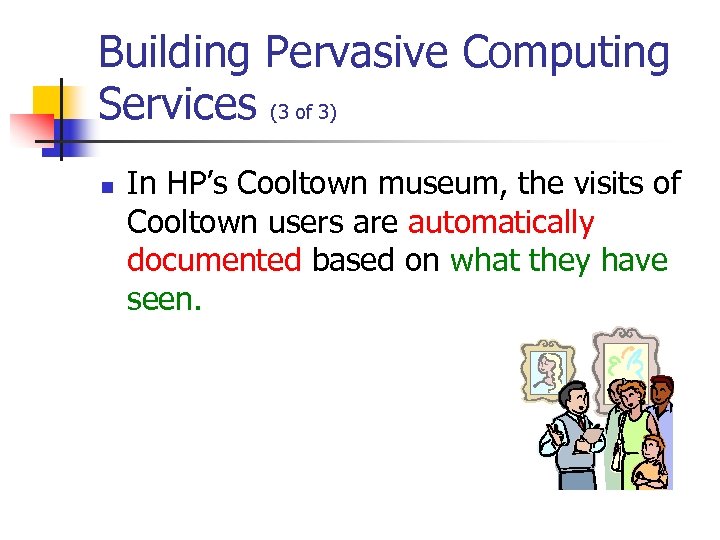
Building Pervasive Computing Services (3 of 3) n In HP’s Cooltown museum, the visits of Cooltown users are automatically documented based on what they have seen.
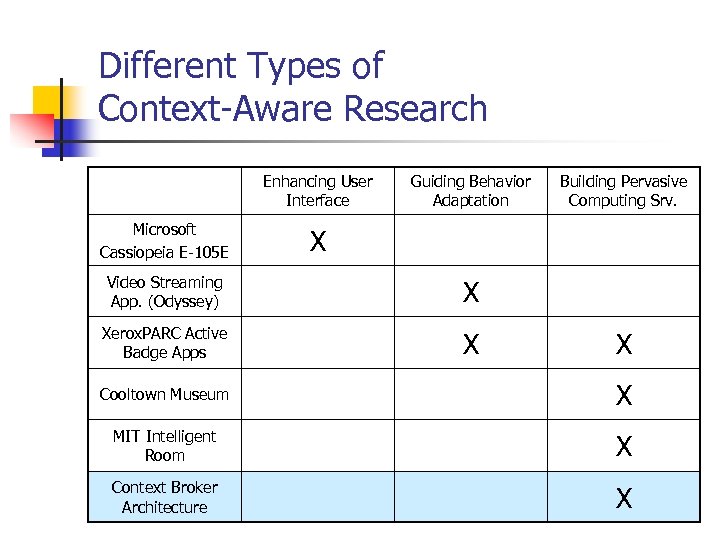
Different Types of Context-Aware Research Enhancing User Interface Microsoft Cassiopeia E-105 E Guiding Behavior Adaptation Building Pervasive Computing Srv. X Video Streaming App. (Odyssey) X Xerox. PARC Active Badge Apps X X Cooltown Museum X MIT Intelligent Room X Context Broker Architecture X
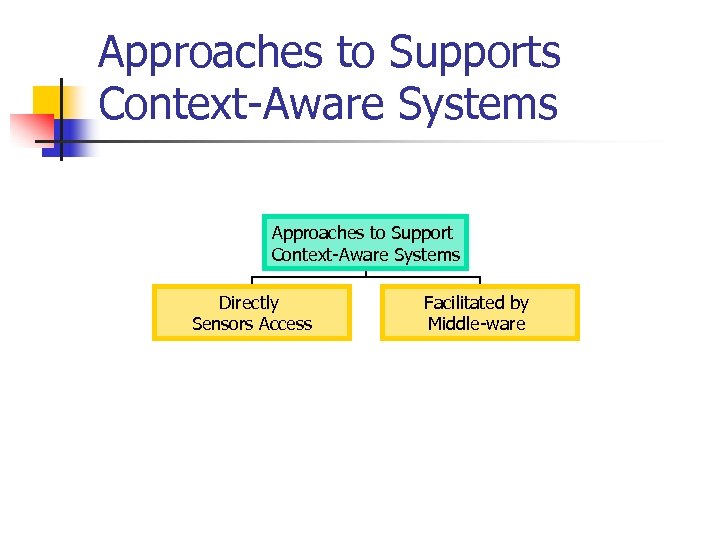
Approaches to Supports Context-Aware Systems Approaches to Support Context-Aware Systems Directly Sensors Access Facilitated by Middle-ware
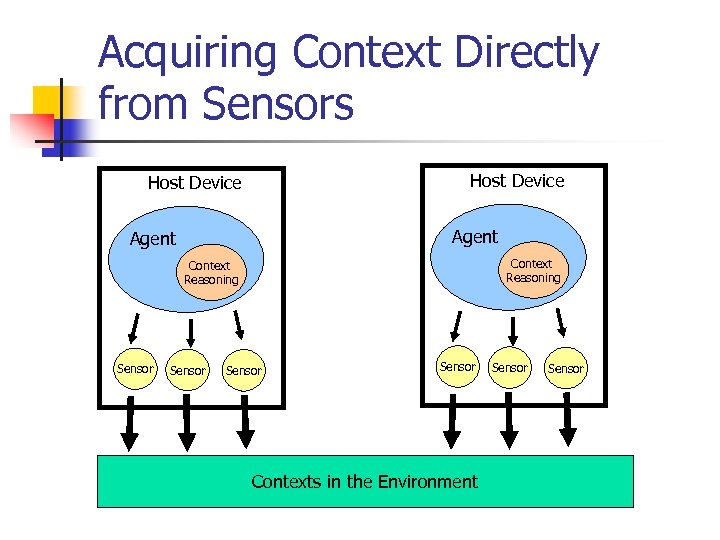
Acquiring Context Directly from Sensors Host Device Agent Context Reasoning Sensor Contexts in the Environment Sensor
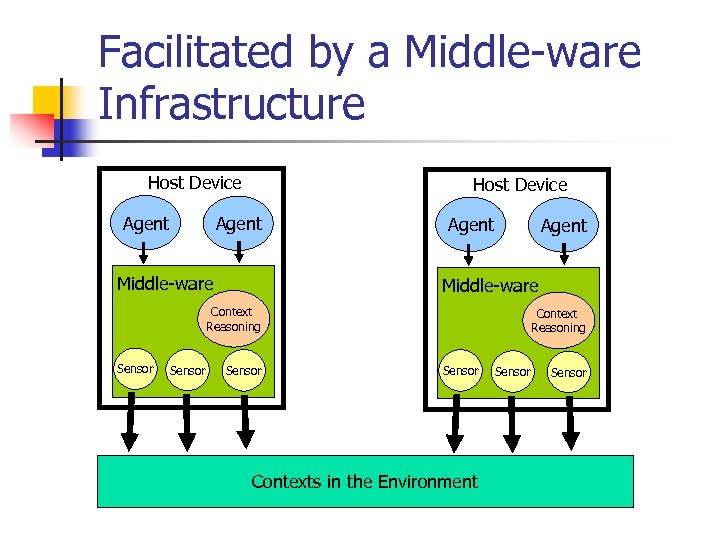
Facilitated by a Middle-ware Infrastructure Host Device Agent Middle-ware Context Reasoning Sensor Context Reasoning Sensor Contexts in the Environment Sensor
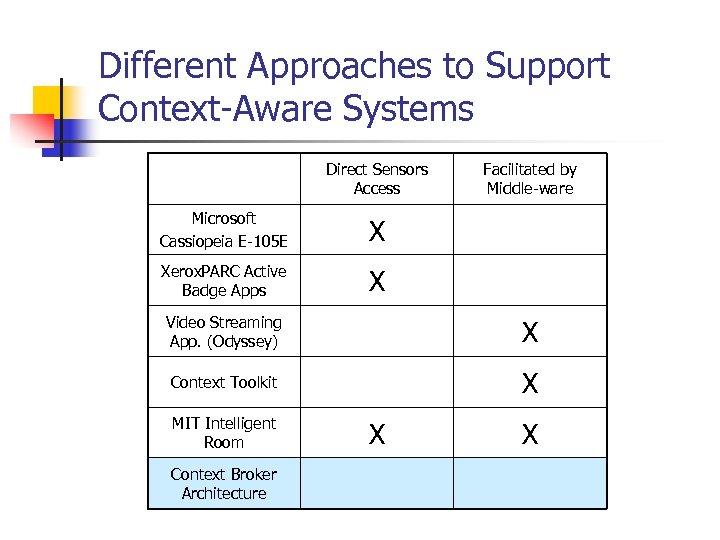
Different Approaches to Support Context-Aware Systems Direct Sensors Access Microsoft Cassiopeia E-105 E X Xerox. PARC Active Badge Apps Facilitated by Middle-ware X Video Streaming App. (Odyssey) X Context Toolkit X MIT Intelligent Room Context Broker Architecture X X
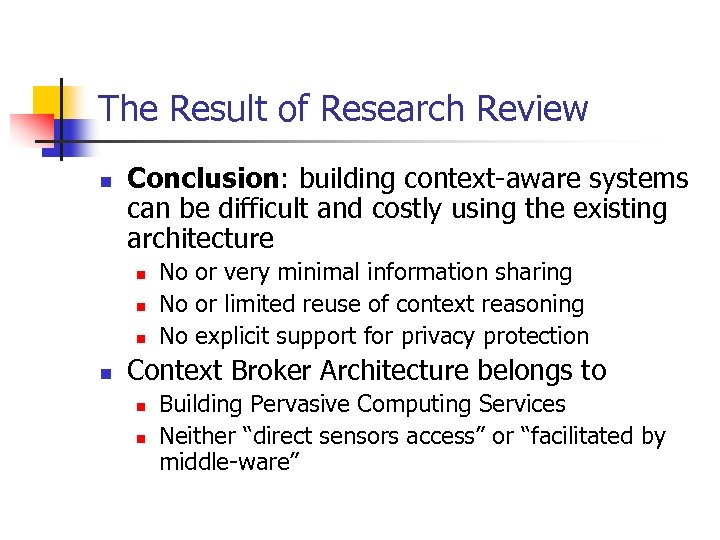
The Result of Research Review n Conclusion: building context-aware systems can be difficult and costly using the existing architecture n n No or very minimal information sharing No or limited reuse of context reasoning No explicit support for privacy protection Context Broker Architecture belongs to n n Building Pervasive Computing Services Neither “direct sensors access” or “facilitated by middle-ware”
Part III. Context Broker Architecture
Research Problems (again) n n n (1) Limited resources in mobile devices (2) Lack of reusable context-aware mechanisms (3) Privacy issues in accessing user information
What’s the Implication? n n n A single agent has limited capability to acquire contexts Building context sensing and reasoning mechanisms from the scratch can be expensive Protecting user privacy in a contextaware environment is critical
Context Broker Architecture Enterprise Servers … Semantic Web … DB Host Device Domain Context Broker Agent Context Reasoning Agent Middle-ware …… Agent Middle-ware Contexts in the Environment
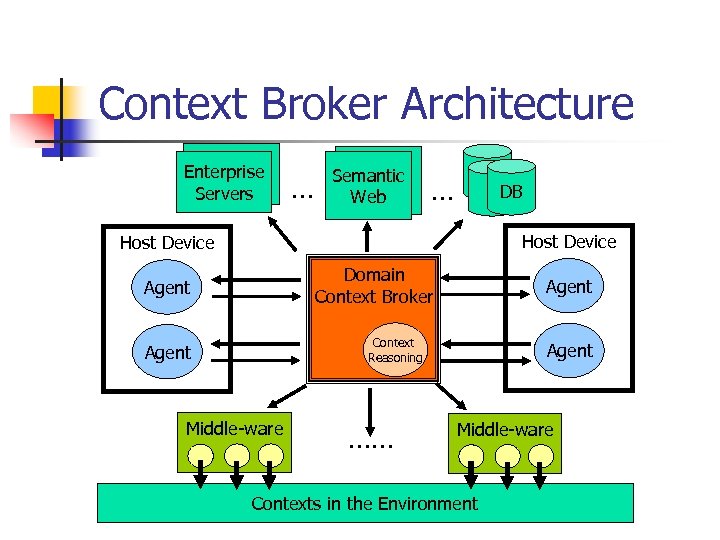
Domain Context Broker n The architecture structures contexts in a collection of micro-worlds, called domains. n n E. g. a meeting room domain, a school domain, a home domain etc. In each domain, there is a n Domain Context Broker (broker) B
A Broker’s Job is to… 1. Acquire contexts from heterogeneous sources on the behalf of context-aware agents 2. Enable agents to contribute to and access a shared model of context 3. Allow users to use policy to control the access of their personal information 4. Detect and resolve inconsistent contextual knowledge
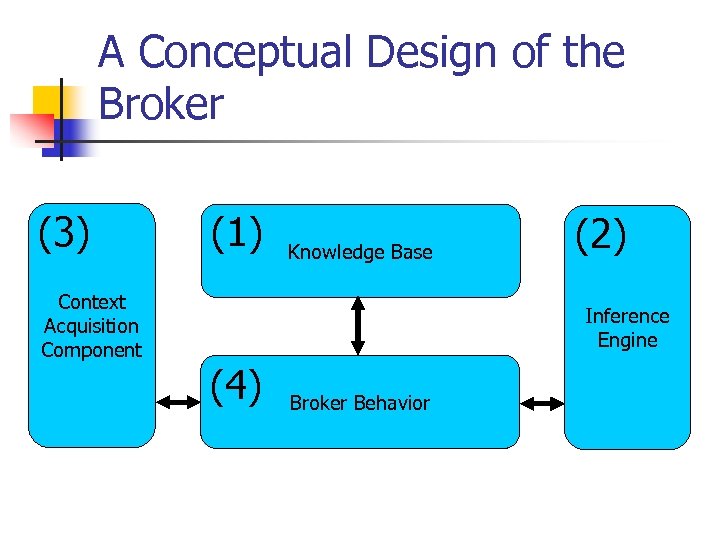
A Conceptual Design of the Broker (3) Context Acquisition Component (1) Knowledge Base (2) Inference Engine (4) Broker Behavior
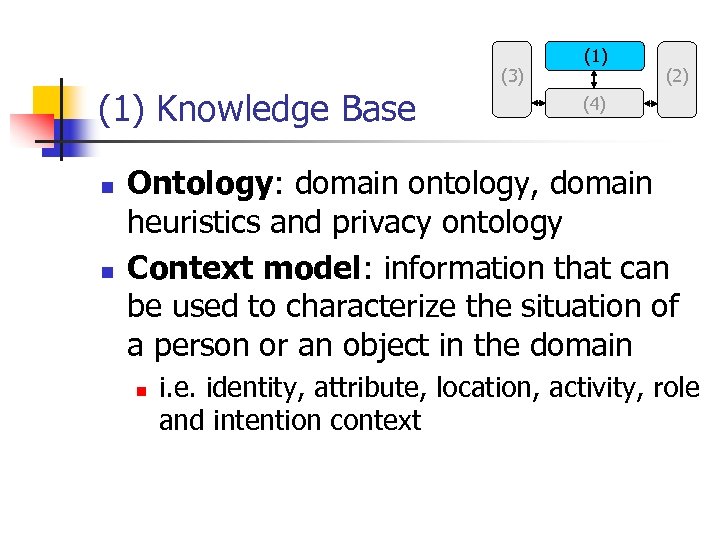
(1) Knowledge Base n n (3) (1) (2) (4) Ontology: domain ontology, domain heuristics and privacy ontology Context model: information that can be used to characterize the situation of a person or an object in the domain n i. e. identity, attribute, location, activity, role and intention context
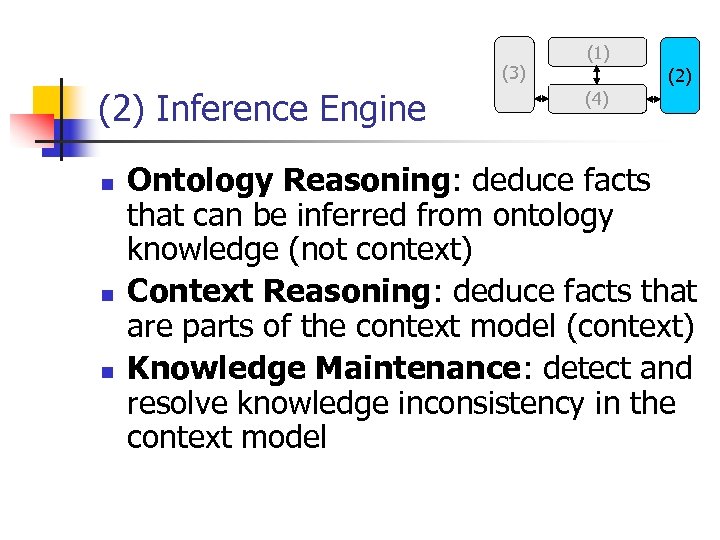
(3) (2) Inference Engine n n n (1) (2) (4) Ontology Reasoning: deduce facts that can be inferred from ontology knowledge (not context) Context Reasoning: deduce facts that are parts of the context model (context) Knowledge Maintenance: detect and resolve knowledge inconsistency in the context model
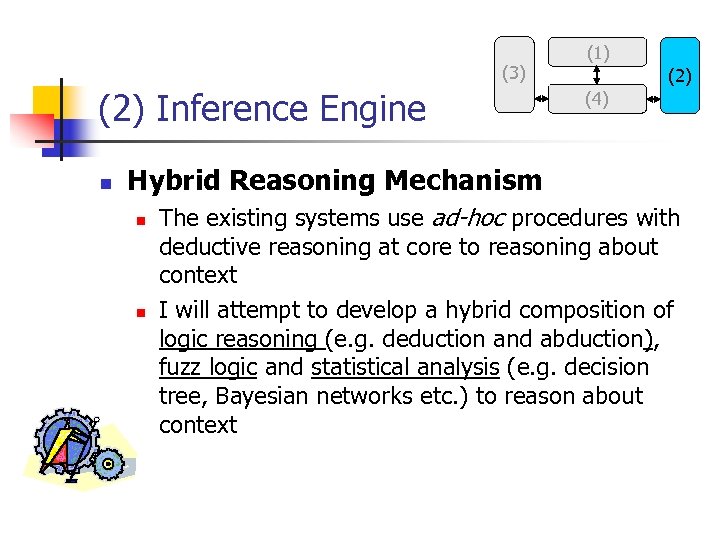
(3) (2) Inference Engine n (1) (2) (4) Hybrid Reasoning Mechanism n n The existing systems use ad-hoc procedures with deductive reasoning at core to reasoning about context I will attempt to develop a hybrid composition of logic reasoning (e. g. deduction and abduction), fuzz logic and statistical analysis (e. g. decision tree, Bayesian networks etc. ) to reason about context
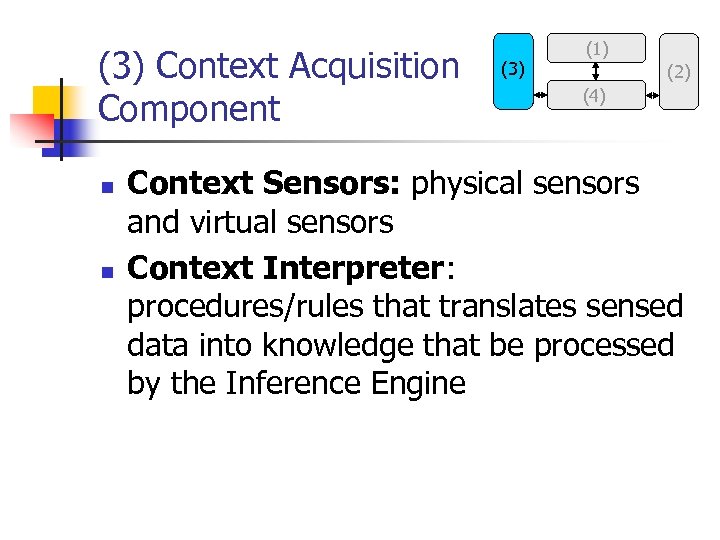
(3) Context Acquisition Component n n (3) (1) (2) (4) Context Sensors: physical sensors and virtual sensors Context Interpreter: procedures/rules that translates sensed data into knowledge that be processed by the Inference Engine
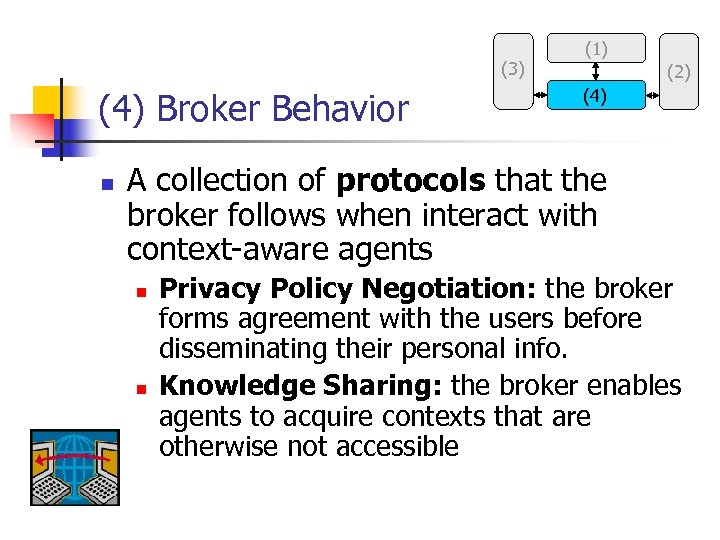
(3) (4) Broker Behavior n (1) (2) (4) A collection of protocols that the broker follows when interact with context-aware agents n n Privacy Policy Negotiation: the broker forms agreement with the users before disseminating their personal info. Knowledge Sharing: the broker enables agents to acquire contexts that are otherwise not accessible
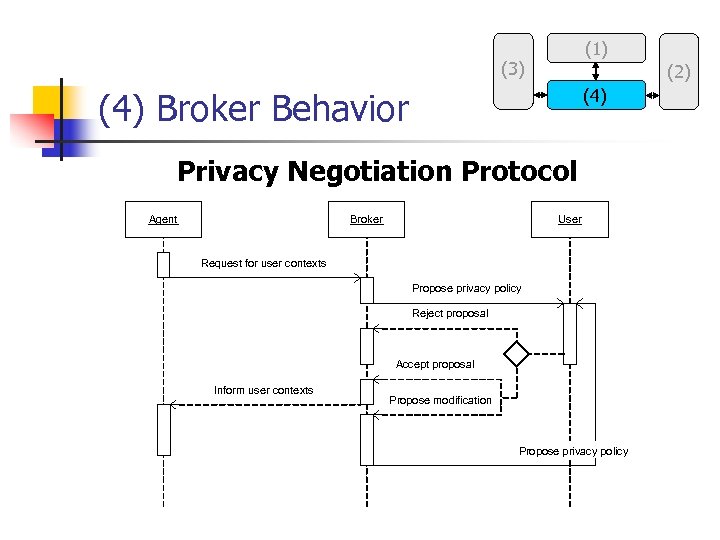
(1) (3) (2) (4) Broker Behavior Privacy Negotiation Protocol Agent Broker User Request for user contexts Propose privacy policy Reject proposal Accept proposal Inform user contexts Propose modification Propose privacy policy
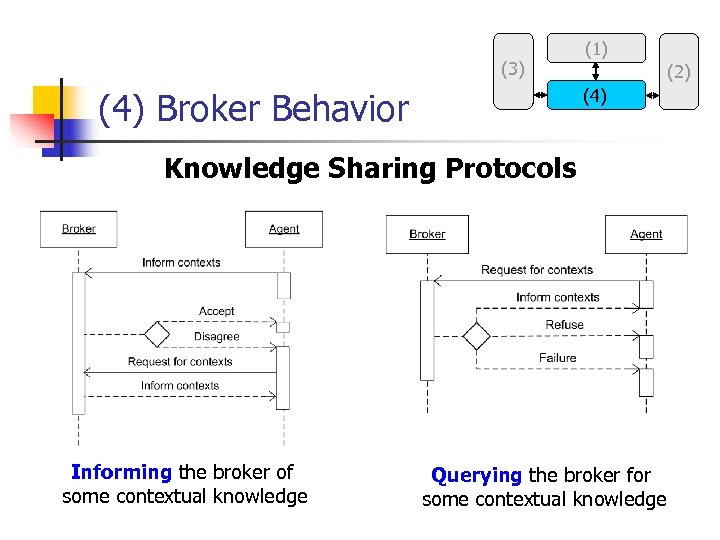
(3) (1) (2) (4) Broker Behavior Knowledge Sharing Protocols Informing the broker of some contextual knowledge Querying the broker for some contextual knowledge
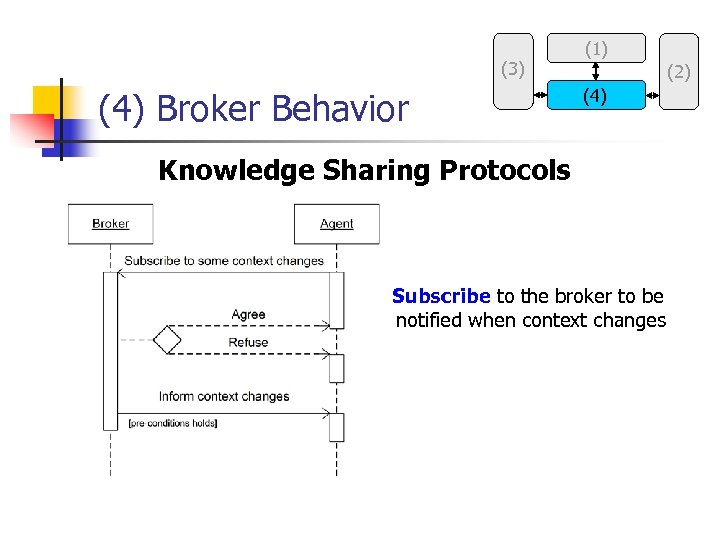
(3) (4) Broker Behavior (1) (2) (4) Knowledge Sharing Protocols Subscribe to the broker to be notified when context changes

Part IV. Research Plan and Summary
Expected Research Contribution n To show the difficulty and cost of building context-aware systems can be greatly reduced by using the Context Broker Architecture n n Prototype this architecture (COBRA) Evaluate the feasibility of COBRA through a series of experiments in an Intelligent Meeting Room environment
How Will I Know When I am Done? n n n (1) If I can show a working prototype of COBRA that exhibits certain system characteristics (2) If COBRA can help to build an extensible Intelligent Meeting Room system (3) If I can “qualitatively” compare COBRA with the existing architecture
A working prototype means… n COBRA can support: n n Context acquisitions (sensing and reasoning) from heterogeneous sources Knowledge sharing between distributed agents User privacy protection using policy rules Knowledge maintenance to resolve inconsistent and ambiguous contexts
Help to build an extensible Intelligent Meeting Room means… n The end system is not “hard-wired” and “ad-hoc” n n Is built using well-defined protocols, ontologies, APIs etc. Within a reasonable amount of effort, other developers can use COBRA to enhance or extend the system functionalities
Comparing COBRA with the existing architecture means … n I can show why COBRA is better/worse than other system architectures n n For example, MIT’s Intelligent Room, GTI’s Context Toolkit etc. But this may not substantial because n n No comprehensive Pervasive Computing architecture has yet been developed What I am proposing to work on is still relative new research
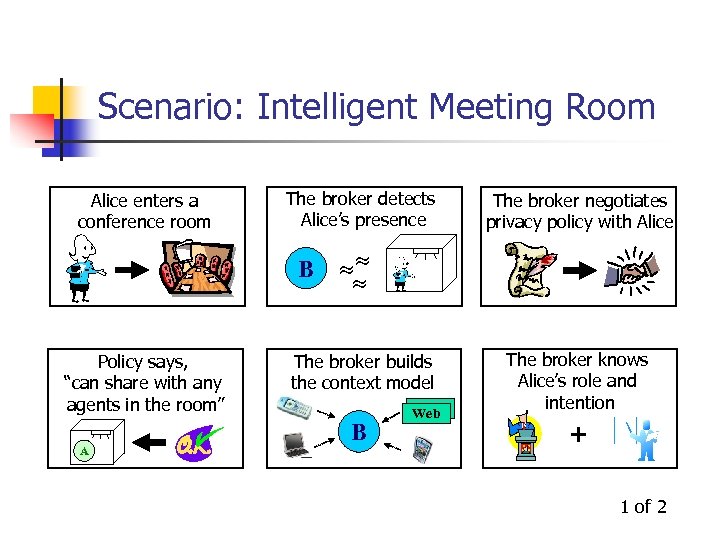
Scenario: Intelligent Meeting Room Alice enters a conference room The broker detects Alice’s presence B Policy says, “can share with any agents in the room” A The broker negotiates privacy policy with Alice » » » The broker builds the context model B Web The broker knows Alice’s role and intention + 1 of 2
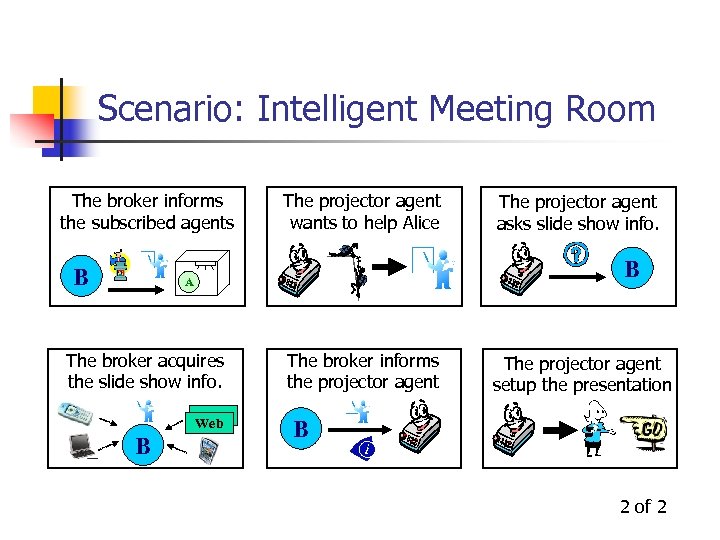
Scenario: Intelligent Meeting Room The broker informs the subscribed agents B The projector agent wants to help Alice B A The broker acquires the slide show info. Web B The projector agent asks slide show info. The broker informs the projector agent The projector agent setup the presentation B 2 of 2
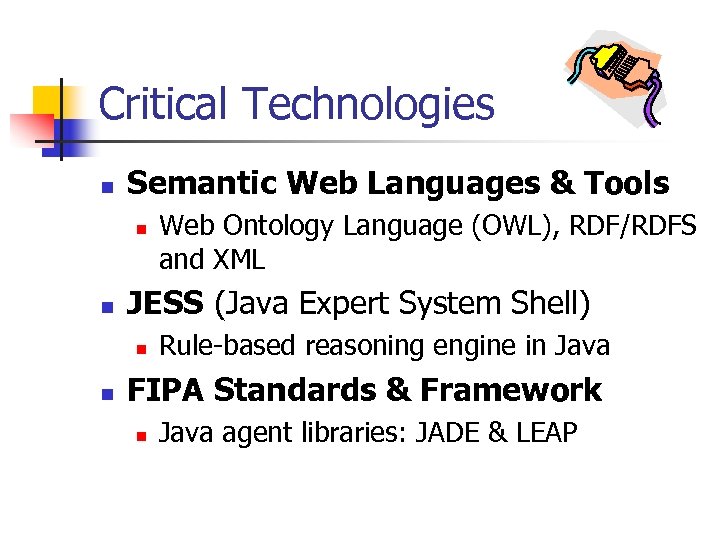
Critical Technologies n Semantic Web Languages & Tools n n JESS (Java Expert System Shell) n n Web Ontology Language (OWL), RDF/RDFS and XML Rule-based reasoning engine in Java FIPA Standards & Framework n Java agent libraries: JADE & LEAP
Semantic Web in COBRA n Benefit: a new source of context! n n n Vast information: web services, personal websites, public announcements, news etc. Useful => determining context, resolving inconsistent knowledge, predicting the future context etc. COBRA implementation: ontologies & privacy policies
JESS in COBRA n Benefit: practical, efficient & Javacompatible. n n n Supports both forward & backwardchaining Good experience in building HP’s Cool. Agent RS (context-aware system) COBRA implementation: inference engine, heuristic rules & knowledge maintenance
FIPA Standards in COBRA n Benefit: standards for programming distributed agents; readily available Java framework n n n FIPA: agent management, communication, life-cycle and more. JADE/LEAP: VERY Good experience; run agents on GSM phones and Pocket PC COBRA implementation: broker behavior, Intelligent Meeting Room
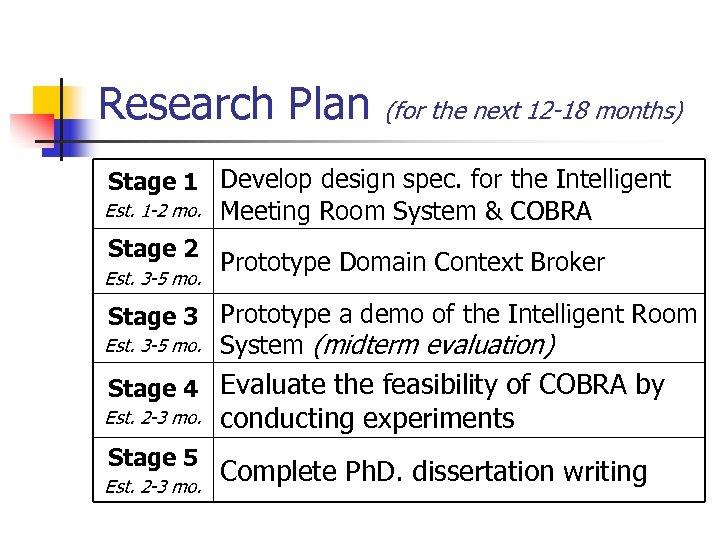
Research Plan (for the next 12 -18 months) Stage 1 Develop design spec. for the Intelligent Est. 1 -2 mo. Stage 2 Est. 3 -5 mo. Meeting Room System & COBRA Prototype Domain Context Broker Stage 3 Prototype a demo of the Intelligent Room Est. 3 -5 mo. System (midterm evaluation) Stage 4 Evaluate the feasibility of COBRA by Est. 2 -3 mo. Stage 5 Est. 2 -3 mo. conducting experiments Complete Ph. D. dissertation writing
Summary n The initial design of Context Broker Architecture shows great promise in reducing the difficult and cost of building context-aware systems. n n COBRA will enable resource-limited agents to contribute to and access a shared context model COBRA will allow users to control the access of their personal information in a context-aware environment
Question? n Related material http: //users. ebiquity. org/~hchen 4/phd/
Скачать презентацию An Intelligent Broker Architecture for Context-Aware Systems Harry
c0a7e6b7d08e12aca3ce685b3b160bed.ppt