


 Скачать презентацию An Integrated West Coast Science DMZ for Data-Intensive
473edefddc02fbc15b145d53a38d9dfd.ppt
- Количество слайдов: 39
 “An Integrated West Coast Science DMZ for Data-Intensive Research” Panel CENIC Annual Conference University of California, Irvine, CA March 9, 2015 Dr. Larry Smarr Director, California Institute for Telecommunications and Information Technology Harry E. Gruber Professor, Dept. of Computer Science and Engineering Jacobs School of Engineering, UCSD 1 http: //lsmarr. calit 2. net
 CENIC 2015 Panel: Building the Pacific Research Platform • Presenters: – – – – Larry Smarr, Calit 2 Eli Dart, ESnet John Haskins, UCSC John Hess, CENIC Erik Mc. Croskey, UC Berkeley Paul Murray, Stanford Michael van Norman, UCLA Abstract: The Pacific Research Platform is a project to forward the work of advanced researchers and their access to technical infrastructure, with a vision of connecting all the National Science Foundation Cyberinfrastructure grants (NSF CC-NIE & CC-IIE) to research universities within the region, as well as the Department of Energy (DOE) labs and the San Diego Supercomputer Center (SDSC). Larry Smarr, founding Director of Calit 2, will present an overview of the project, followed by a panel discussion of regional inter-site connectivity challenges and opportunities. • LS had assistance today from: – Tom De. Fanti, Research Scientist, Calit 2’s Qualcomm Institute, UC San Diego – John Graham, Senior Development Engineer, Calit 2’s Qualcomm Institute, UC San Diego – Richard Moore, Deputy Director, San Diego Supercomputer Center, UC San Diego – Phil Papadopoulos, CTO, San Diego Supercomputer Center, UC San Diego
 Vision: Creating a West Coast “Big Data Freeway” Connected by CENIC/Pacific Wave to I 2 & GLIF Use Lightpaths to Connect All Data Generators and Consumers, Creating a “Big Data” Plane Integrated With High Performance Global Networks “The Bisection Bandwidth of a Cluster Interconnect, but Deployed on a 10 -Campus Scale. ” This Vision Has Been Building for Over Two Decades
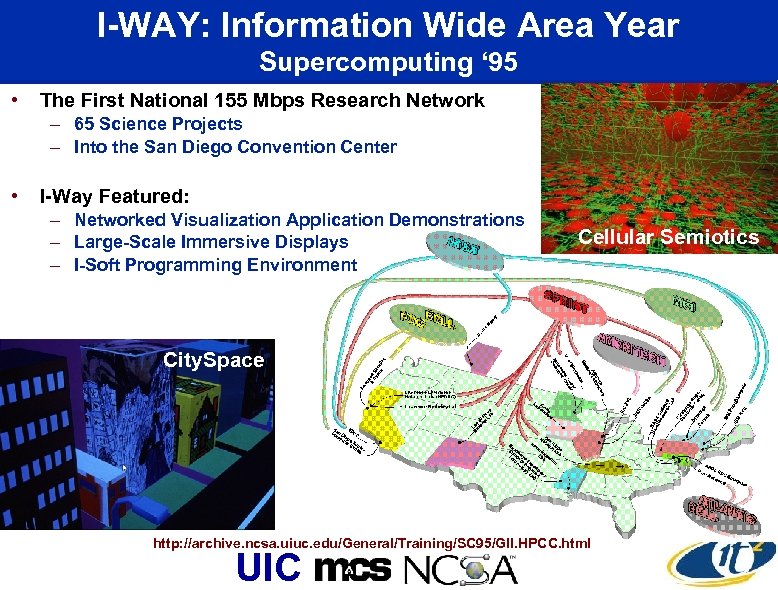 I-WAY: Information Wide Area Year Supercomputing ‘ 95 • The First National 155 Mbps Research Network – 65 Science Projects – Into the San Diego Convention Center • I-Way Featured: – Networked Visualization Application Demonstrations – Large-Scale Immersive Displays – I-Soft Programming Environment Cellular Semiotics City. Space http: //archive. ncsa. uiuc. edu/General/Training/SC 95/GII. HPCC. html UIC
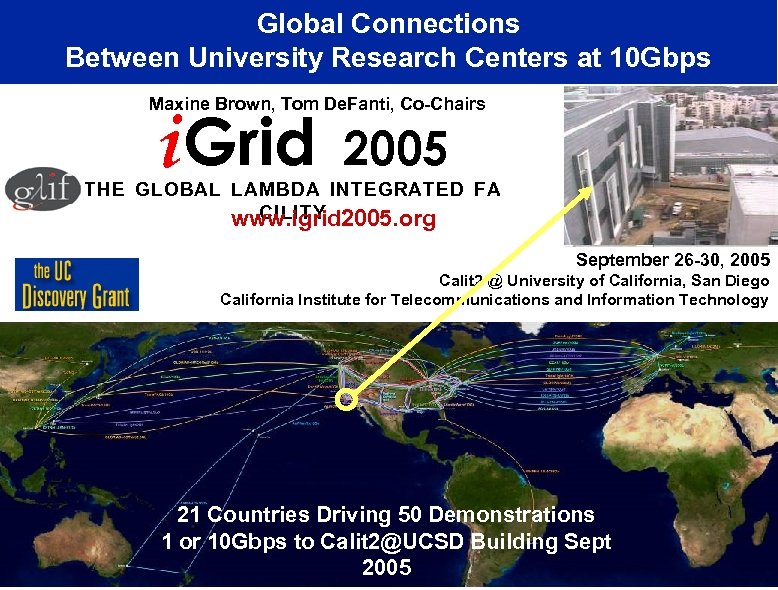 Global Connections Between University Research Centers at 10 Gbps Maxine Brown, Tom De. Fanti, Co-Chairs i. Grid 2005 THE GLOBAL LAMBDA INTEGRATED FA CILITY www. igrid 2005. org September 26 -30, 2005 Calit 2 @ University of California, San Diego California Institute for Telecommunications and Information Technology 21 Countries Driving 50 Demonstrations 1 or 10 Gbps to Calit 2@UCSD Building Sept 2005
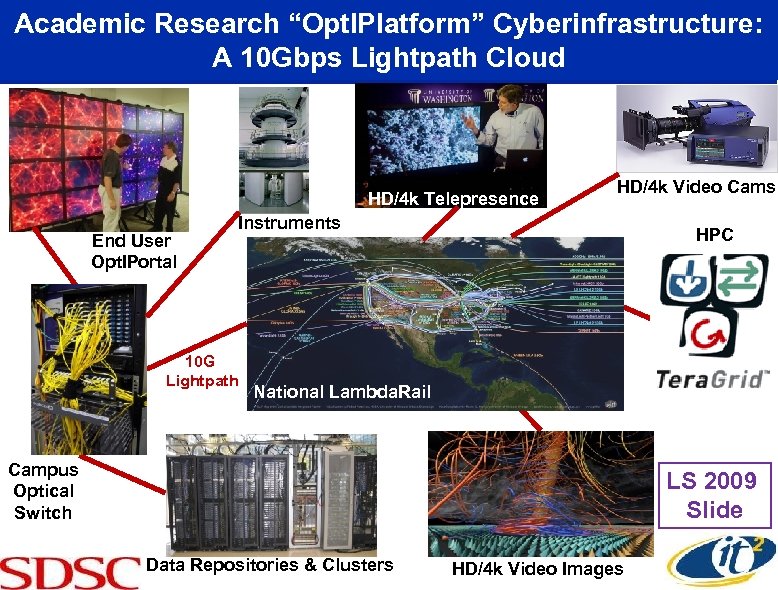 Academic Research “Opt. IPlatform” Cyberinfrastructure: A 10 Gbps Lightpath Cloud HD/4 k Telepresence End User Opt. IPortal HD/4 k Video Cams Instruments 10 G Lightpath HPC National Lambda. Rail Campus Optical Switch LS 2009 Slide Data Repositories & Clusters HD/4 k Video Images
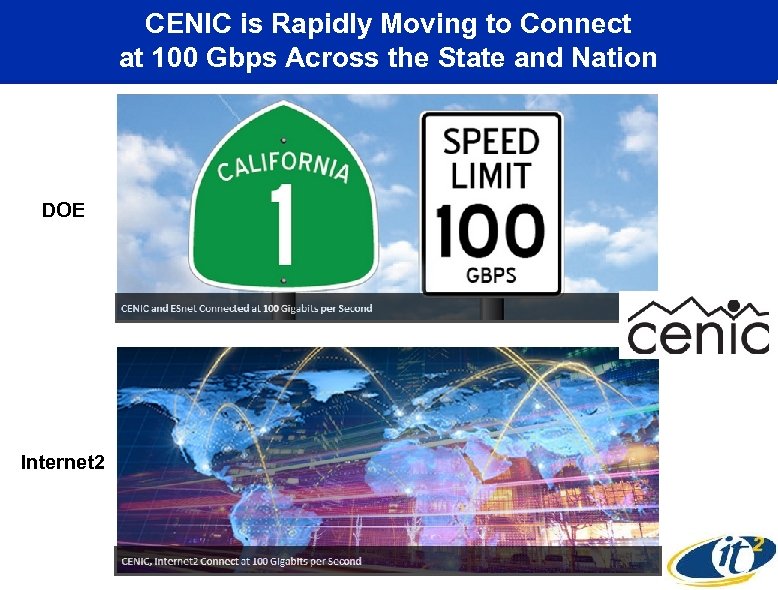 CENIC is Rapidly Moving to Connect at 100 Gbps Across the State and Nation DOE Internet 2
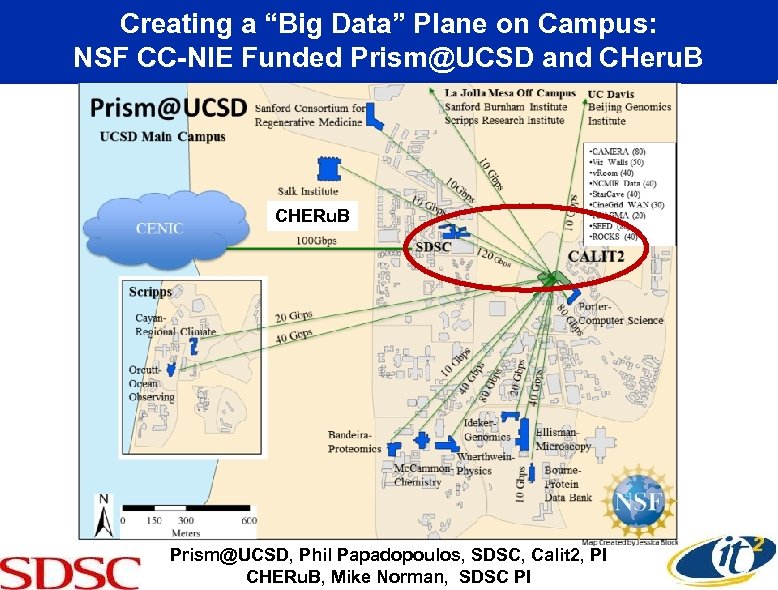 Creating a “Big Data” Plane on Campus: NSF CC-NIE Funded Prism@UCSD and CHeru. B CHERu. B Prism@UCSD, Phil Papadopoulos, SDSC, Calit 2, PI CHERu. B, Mike Norman, SDSC PI
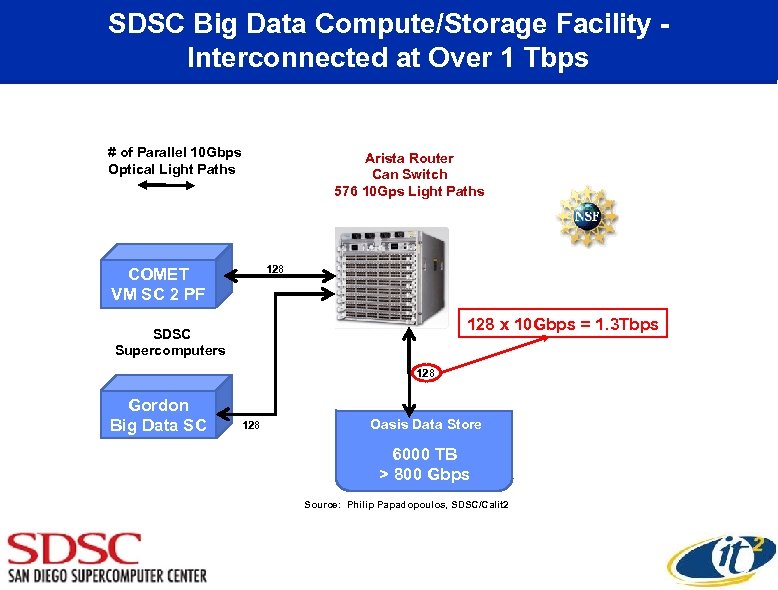 SDSC Big Data Compute/Storage Facility Interconnected at Over 1 Tbps # of Parallel 10 Gbps Optical Light Paths Arista Router Can Switch 576 10 Gps Light Paths 128 COMET VM SC 2 PF 128 x 10 Gbps = 1. 3 Tbps SDSC Supercomputers 128 Gordon Big Data SC Oasis Data Store 128 • 6000 TB > 800 Gbps Source: Philip Papadopoulos, SDSC/Calit 2
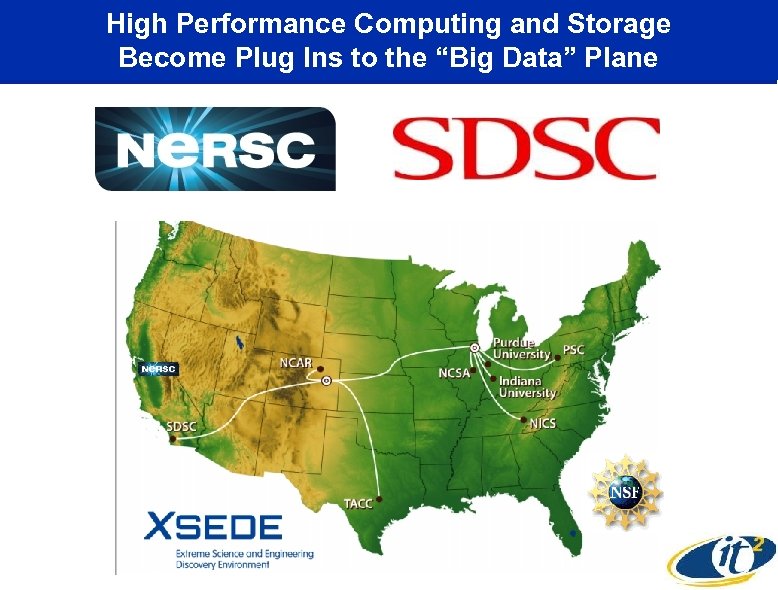 High Performance Computing and Storage Become Plug Ins to the “Big Data” Plane
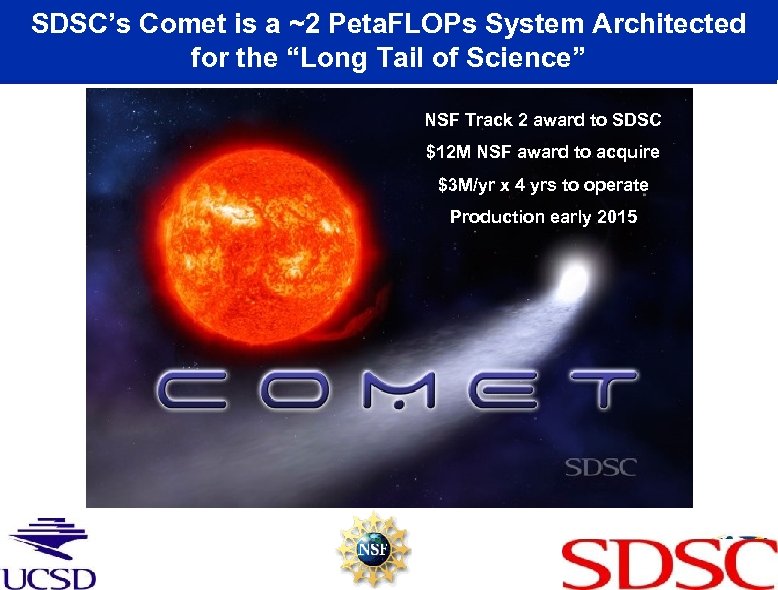 SDSC’s Comet is a ~2 Peta. FLOPs System Architected for the “Long Tail of Science” NSF Track 2 award to SDSC $12 M NSF award to acquire $3 M/yr x 4 yrs to operate Production early 2015
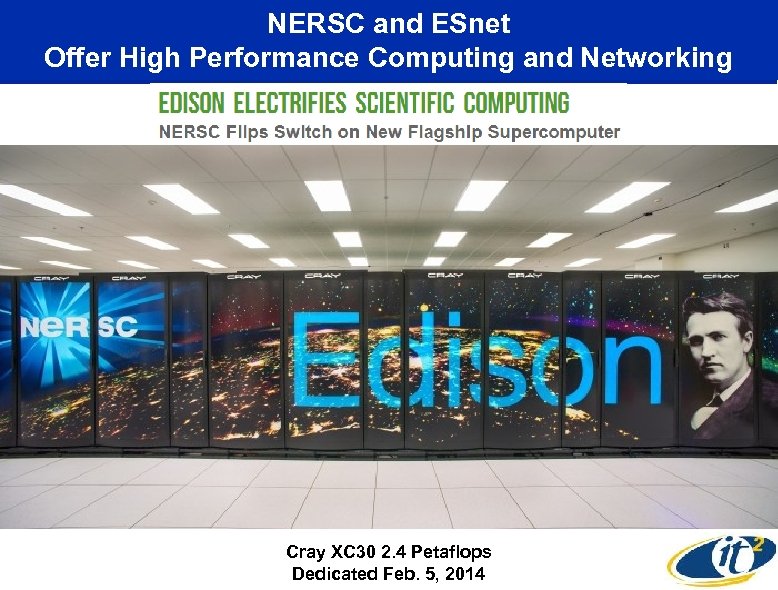 NERSC and ESnet Offer High Performance Computing and Networking Cray XC 30 2. 4 Petaflops Dedicated Feb. 5, 2014
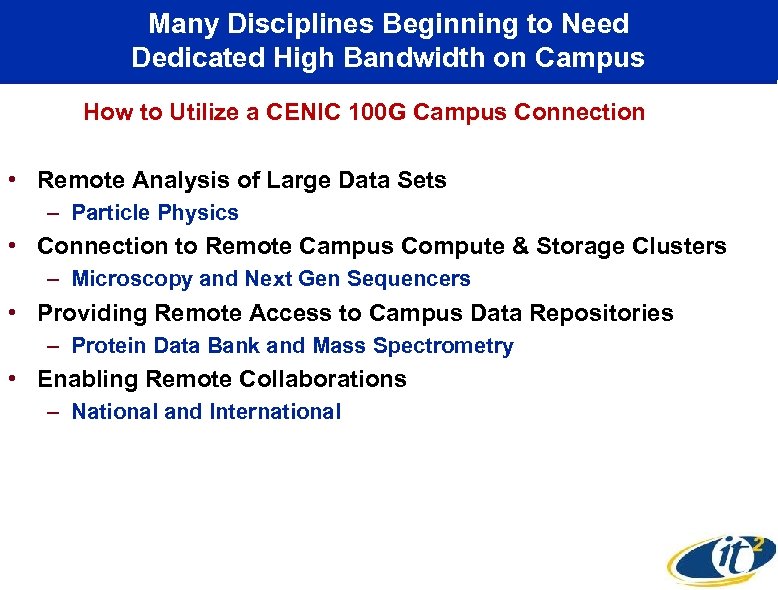 Many Disciplines Beginning to Need Dedicated High Bandwidth on Campus How to Utilize a CENIC 100 G Campus Connection • Remote Analysis of Large Data Sets – Particle Physics • Connection to Remote Campus Compute & Storage Clusters – Microscopy and Next Gen Sequencers • Providing Remote Access to Campus Data Repositories – Protein Data Bank and Mass Spectrometry • Enabling Remote Collaborations – National and International
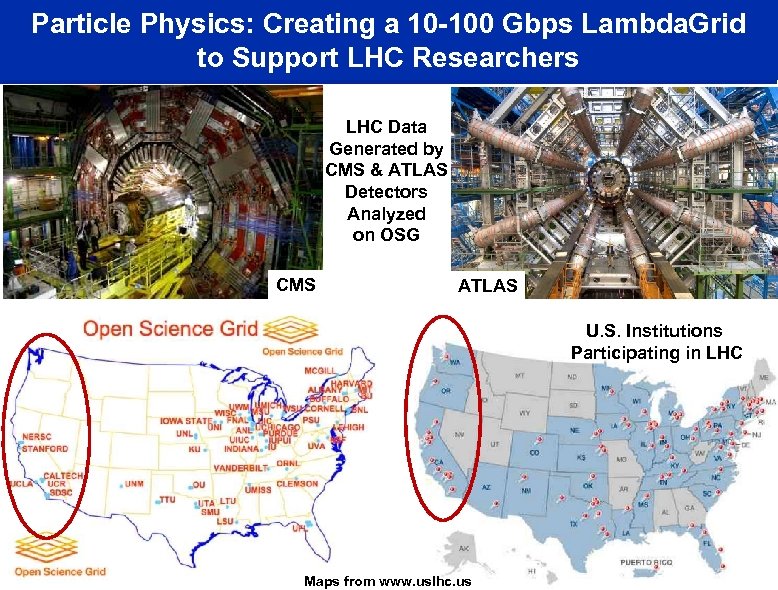 Particle Physics: Creating a 10 -100 Gbps Lambda. Grid to Support LHC Researchers LHC Data Generated by CMS & ATLAS Detectors Analyzed on OSG CMS ATLAS U. S. Institutions Participating in LHC Maps from www. uslhc. us
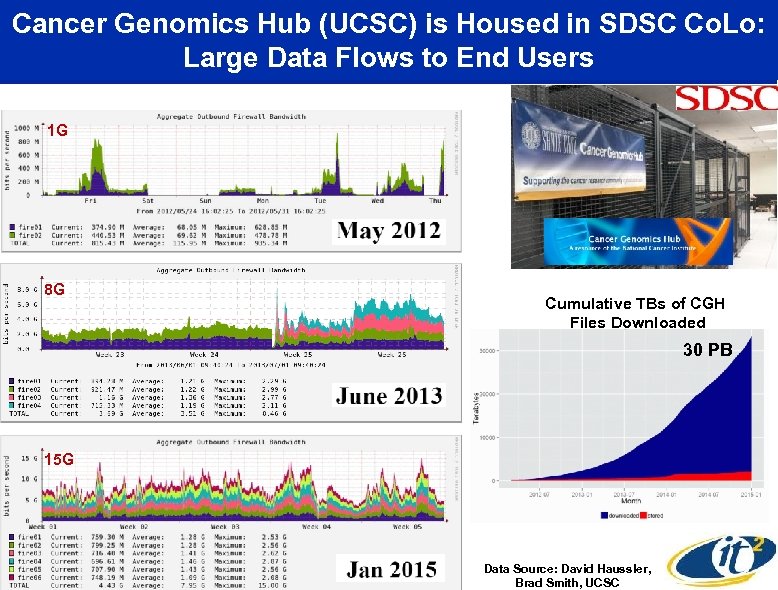 Cancer Genomics Hub (UCSC) is Housed in SDSC Co. Lo: Large Data Flows to End Users 1 G 8 G Cumulative TBs of CGH Files Downloaded 30 PB 15 G Data Source: David Haussler, Brad Smith, UCSC
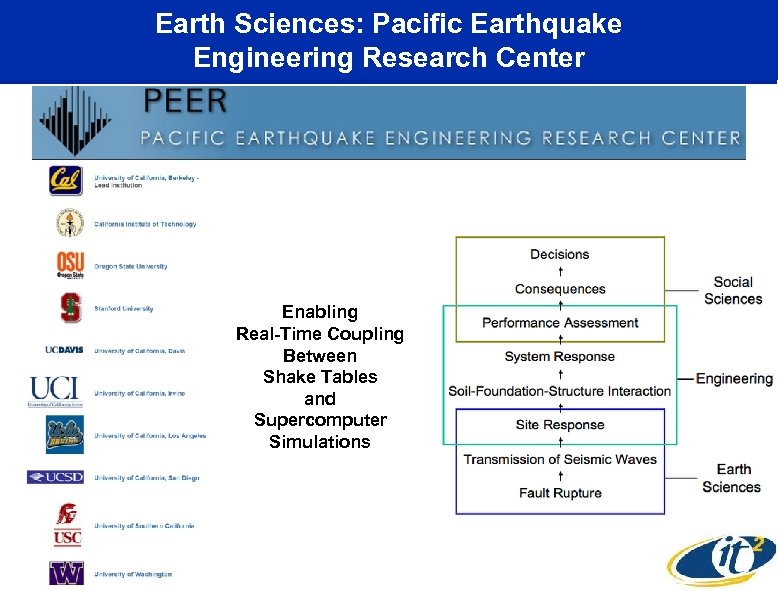 Earth Sciences: Pacific Earthquake Engineering Research Center Enabling Real-Time Coupling Between Shake Tables and Supercomputer Simulations
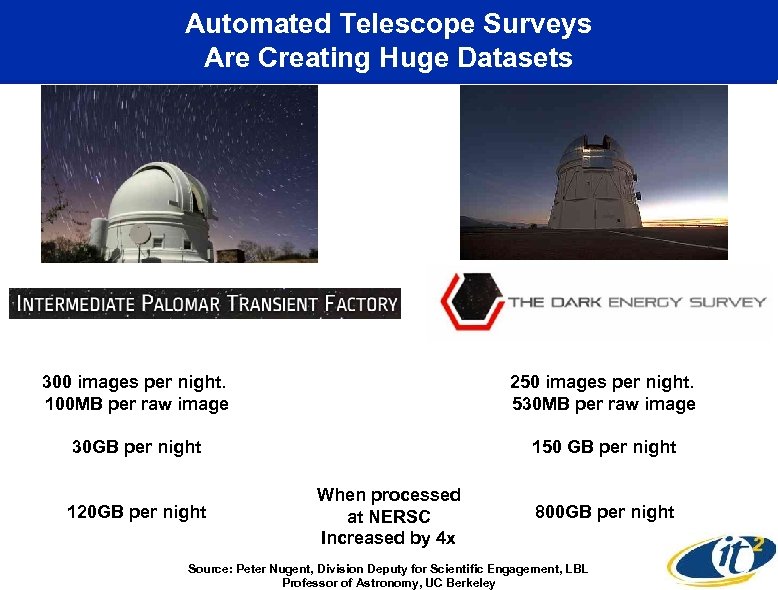 Automated Telescope Surveys Are Creating Huge Datasets 300 images per night. 100 MB per raw image 250 images per night. 530 MB per raw image 30 GB per night 150 GB per night 120 GB per night When processed at NERSC Increased by 4 x 800 GB per night Source: Peter Nugent, Division Deputy for Scientific Engagement, LBL Professor of Astronomy, UC Berkeley
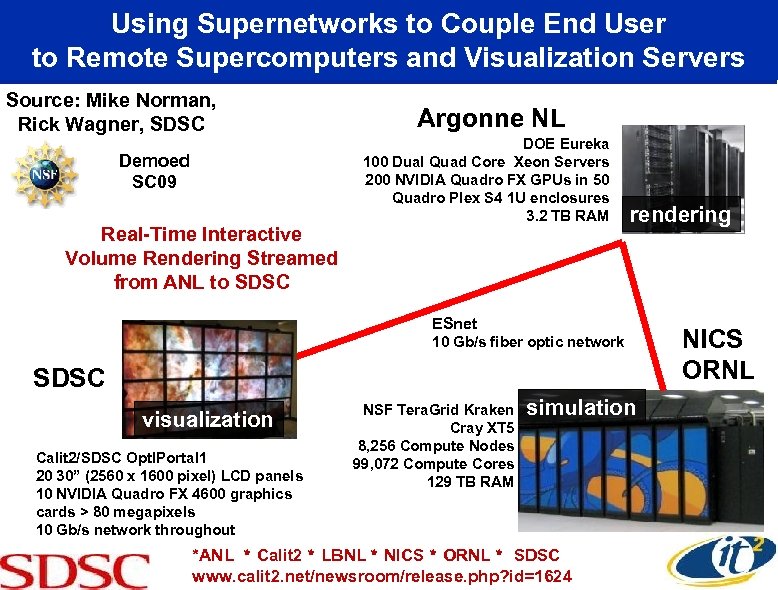 Using Supernetworks to Couple End User to Remote Supercomputers and Visualization Servers Source: Mike Norman, Rick Wagner, SDSC Demoed SC 09 Real-Time Interactive Volume Rendering Streamed from ANL to SDSC Argonne NL DOE Eureka 100 Dual Quad Core Xeon Servers 200 NVIDIA Quadro FX GPUs in 50 Quadro Plex S 4 1 U enclosures 3. 2 TB RAM rendering ESnet 10 Gb/s fiber optic network SDSC visualization Calit 2/SDSC Opt. IPortal 1 20 30” (2560 x 1600 pixel) LCD panels 10 NVIDIA Quadro FX 4600 graphics cards > 80 megapixels 10 Gb/s network throughout NSF Tera. Grid Kraken Cray XT 5 8, 256 Compute Nodes 99, 072 Compute Cores 129 TB RAM simulation *ANL * Calit 2 * LBNL * NICS * ORNL * SDSC www. calit 2. net/newsroom/release. php? id=1624 NICS ORNL
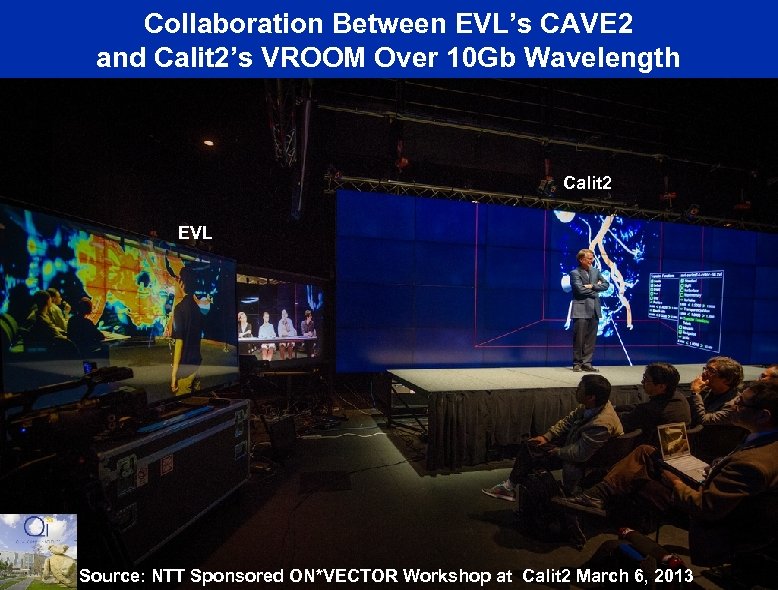 Collaboration Between EVL’s CAVE 2 and Calit 2’s VROOM Over 10 Gb Wavelength Calit 2 EVL Source: NTT Sponsored ON*VECTOR Workshop at Calit 2 March 6, 2013
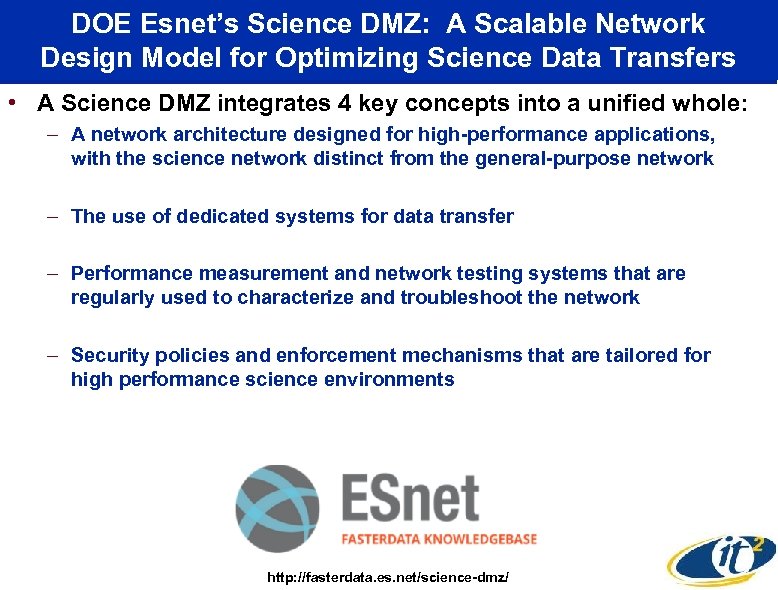 DOE Esnet’s Science DMZ: A Scalable Network Design Model for Optimizing Science Data Transfers • A Science DMZ integrates 4 key concepts into a unified whole: – A network architecture designed for high-performance applications, with the science network distinct from the general-purpose network – The use of dedicated systems for data transfer – Performance measurement and network testing systems that are regularly used to characterize and troubleshoot the network – Security policies and enforcement mechanisms that are tailored for high performance science environments http: //fasterdata. es. net/science-dmz/
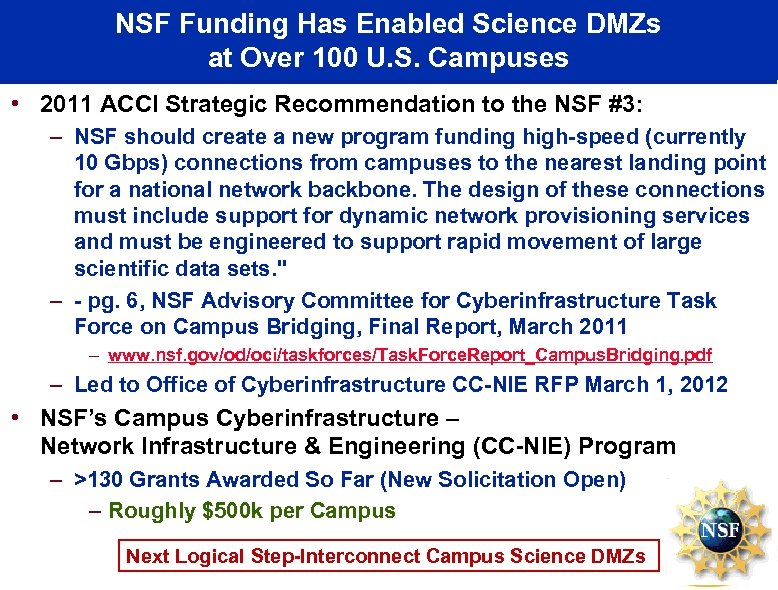 NSF Funding Has Enabled Science DMZs at Over 100 U. S. Campuses • 2011 ACCI Strategic Recommendation to the NSF #3: – NSF should create a new program funding high-speed (currently 10 Gbps) connections from campuses to the nearest landing point for a national network backbone. The design of these connections must include support for dynamic network provisioning services and must be engineered to support rapid movement of large scientific data sets. " – - pg. 6, NSF Advisory Committee for Cyberinfrastructure Task Force on Campus Bridging, Final Report, March 2011 – www. nsf. gov/od/oci/taskforces/Task. Force. Report_Campus. Bridging. pdf – Led to Office of Cyberinfrastructure CC-NIE RFP March 1, 2012 • NSF’s Campus Cyberinfrastructure – Network Infrastructure & Engineering (CC-NIE) Program – >130 Grants Awarded So Far (New Solicitation Open) – Roughly $500 k per Campus Next Logical Step-Interconnect Campus Science DMZs
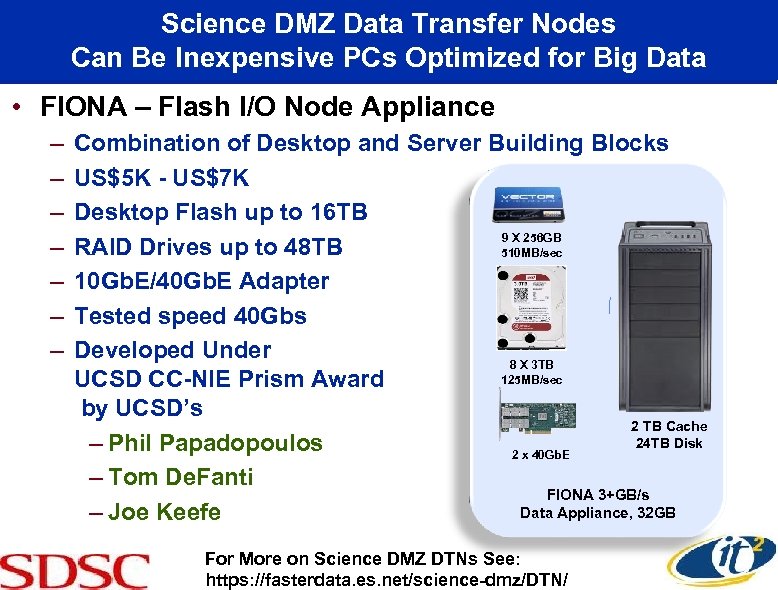 Science DMZ Data Transfer Nodes Can Be Inexpensive PCs Optimized for Big Data • FIONA – Flash I/O Node Appliance – – – – Combination of Desktop and Server Building Blocks US$5 K - US$7 K Desktop Flash up to 16 TB 9 X 256 GB RAID Drives up to 48 TB 510 MB/sec 10 Gb. E/40 Gb. E Adapter Tested speed 40 Gbs Developed Under 8 X 3 TB 125 MB/sec UCSD CC-NIE Prism Award by UCSD’s 2 TB Cache 24 TB Disk – Phil Papadopoulos 2 x 40 Gb. E – Tom De. Fanti FIONA 3+GB/s Data Appliance, 32 GB – Joe Keefe For More on Science DMZ DTNs See: https: //fasterdata. es. net/science-dmz/DTN/
 Audacious Goal: Build a West Coast Science DMZ • Why Did We Think This Was Possible? – Esnet Designed Science DMZs to be: – Scalable and incrementally deployable, – Easily adaptable to incorporate emerging technologies such as: – 100 Gigabit Ethernet services, – virtual circuits, and – software-defined networking capabilities – Many Campuses on the West Coast Created Science DMZs – CENIC/Pacific Wave is Upgrading to 100 G Services – UCSD’s FIONAs Are Rapidly Deployable Inexpensive DTNs • So Can We Use CENIC/PW to Interconnect Many Science DMZs?
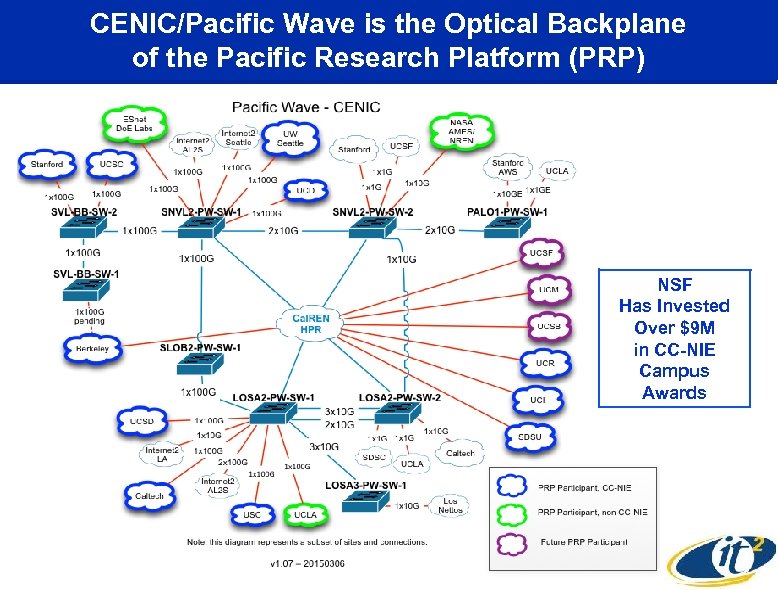 CENIC/Pacific Wave is the Optical Backplane of the Pacific Research Platform (PRP) NSF Has Invested Over $9 M in CC-NIE Campus Awards
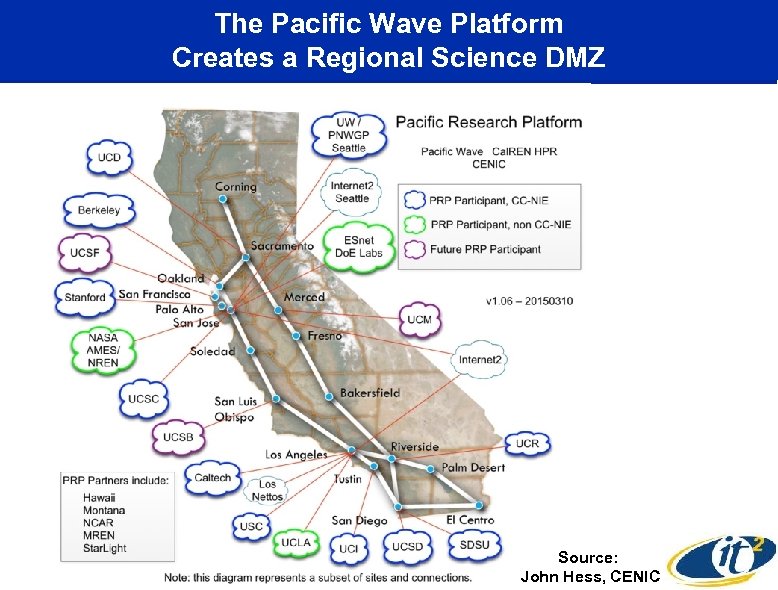 The Pacific Wave Platform Creates a Regional Science DMZ Source: John Hess, CENIC
 Pacific Research Platform – Panel Discussion CENIC 2015 March 9, 2015
 Thanks to: Caltech CENIC / Pacific Wave ESnet / LBNL San Diego State University SDSC Stanford University of Washington USC UC Berkeley UC Davis UC Irvine UC Los Angeles UC Riverside UC San Diego UC Santa Cruz
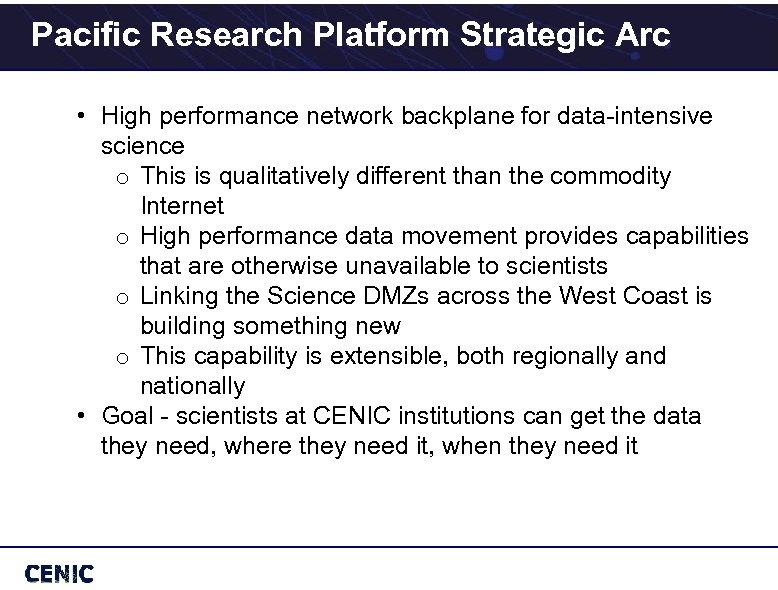 Pacific Research Platform Strategic Arc • High performance network backplane for data-intensive science o This is qualitatively different than the commodity Internet o High performance data movement provides capabilities that are otherwise unavailable to scientists o Linking the Science DMZs across the West Coast is building something new o This capability is extensible, both regionally and nationally • Goal - scientists at CENIC institutions can get the data they need, where they need it, when they need it
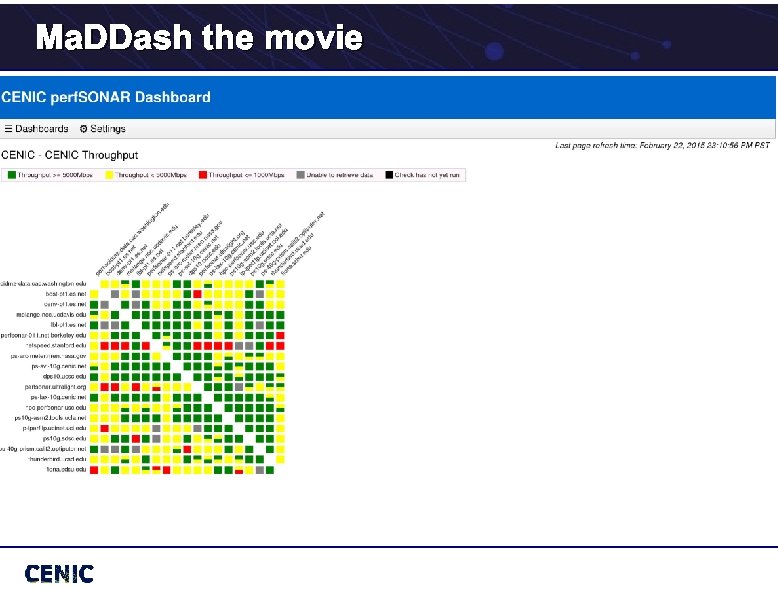
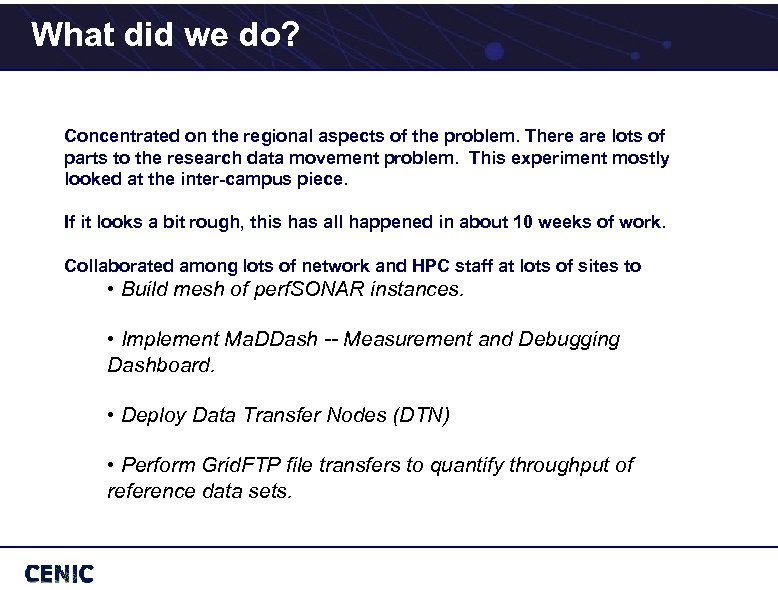 What did we do? Concentrated on the regional aspects of the problem. There are lots of parts to the research data movement problem. This experiment mostly looked at the inter-campus piece. If it looks a bit rough, this has all happened in about 10 weeks of work. Collaborated among lots of network and HPC staff at lots of sites to • Build mesh of perf. SONAR instances. • Implement Ma. DDash -- Measurement and Debugging Dashboard. • Deploy Data Transfer Nodes (DTN) • Perform Grid. FTP file transfers to quantify throughput of reference data sets.
 What did we do? • Constructed a temporary network using 100 G links to demonstrate the potential of networks with burst capacity greater than that of a single DTN. • Partial ad-hoc BGP peering mesh between some test points to make use of 100 G paths. • Identified some specific optimizations needed. • Fixed a few problems in pursuit of gathering illustrative data for this preso. • Identified anomalies for further investigation.
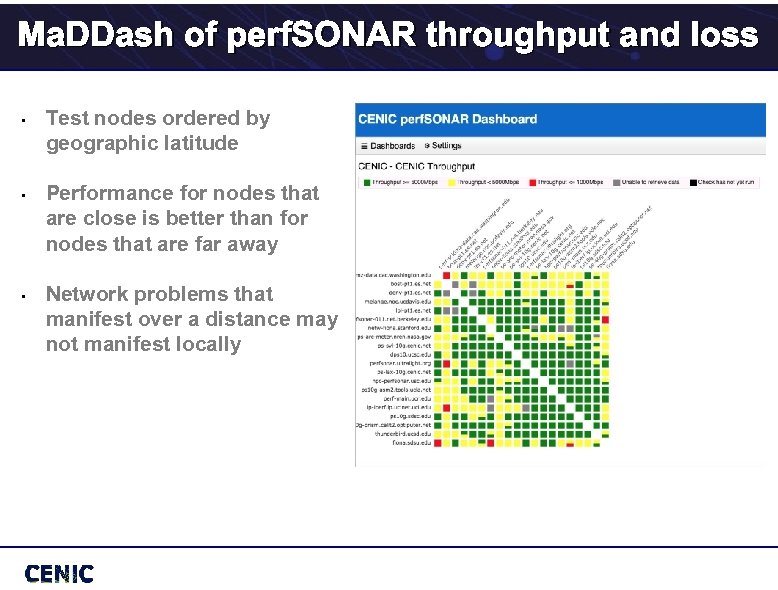 Ma. DDash of perf. SONAR throughput and loss • • • Test nodes ordered by geographic latitude Performance for nodes that are close is better than for nodes that are far away Network problems that manifest over a distance may not manifest locally
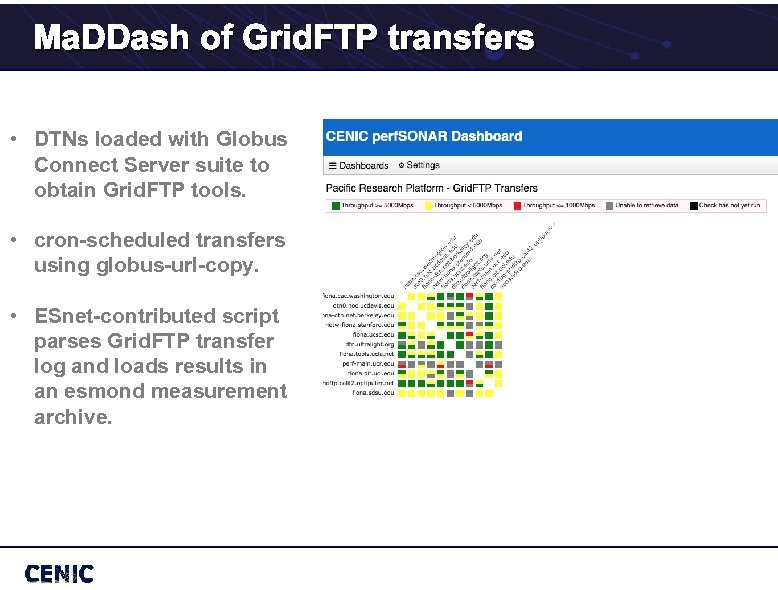 Ma. DDash of Grid. FTP transfers • DTNs loaded with Globus Connect Server suite to obtain Grid. FTP tools. • cron-scheduled transfers using globus-url-copy. • ESnet-contributed script parses Grid. FTP transfer log and loads results in an esmond measurement archive.
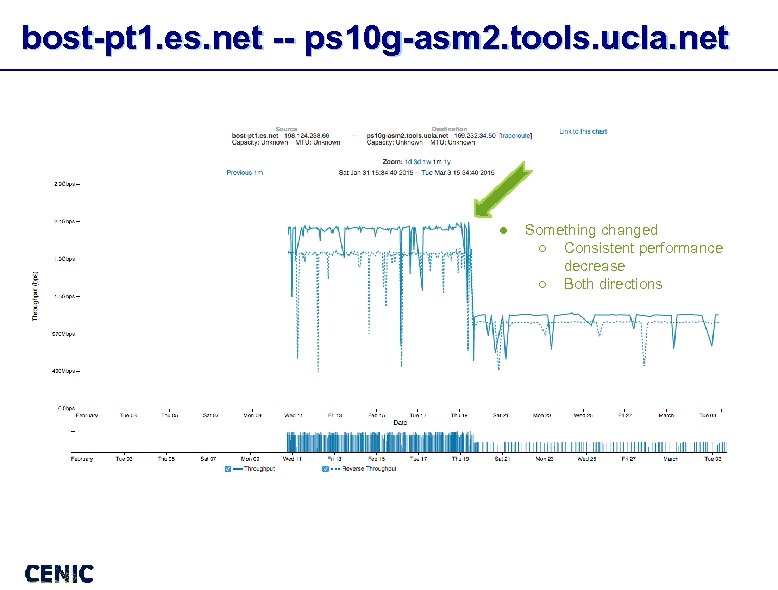 bost-pt 1. es. net -- ps 10 g-asm 2. tools. ucla. net ● Something changed ○ Consistent performance decrease ○ Both directions
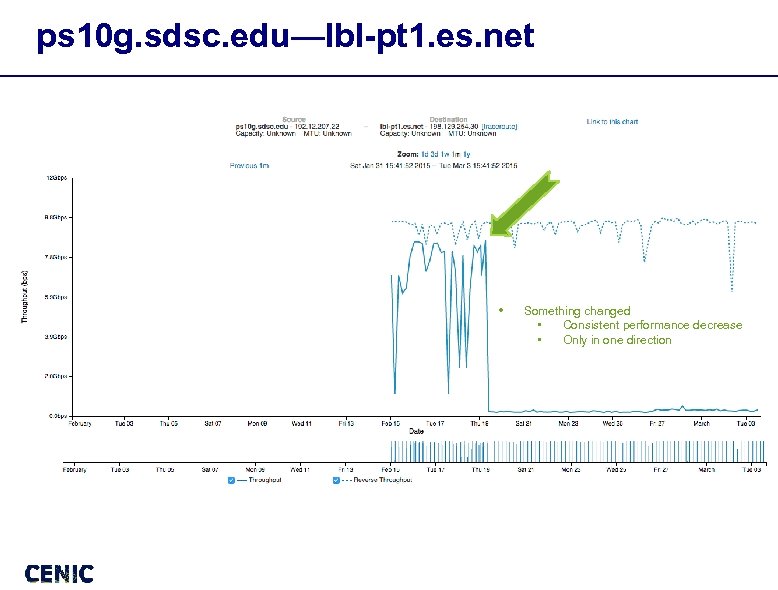 ps 10 g. sdsc. edu—lbl-pt 1. es. net • Something changed • Consistent performance decrease • Only in one direction
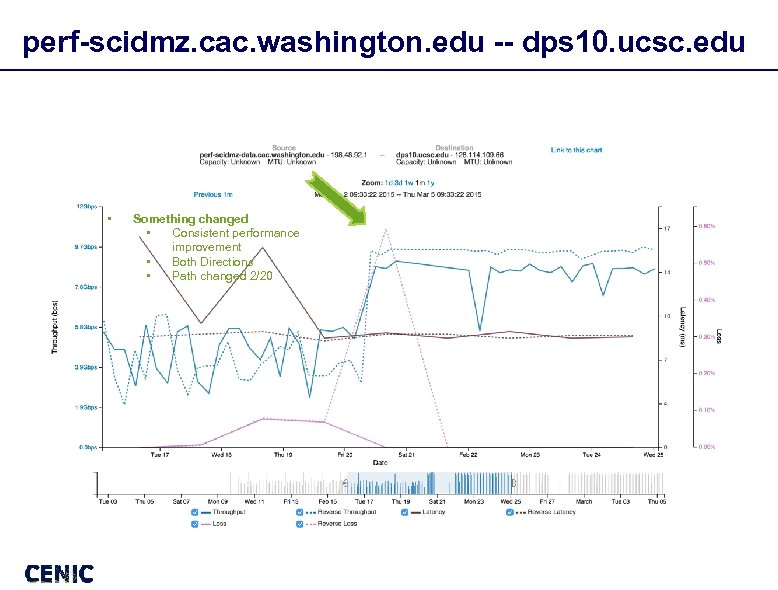 perf-scidmz. cac. washington. edu -- dps 10. ucsc. edu • Something changed • Consistent performance improvement • Both Directions • Path changed 2/20
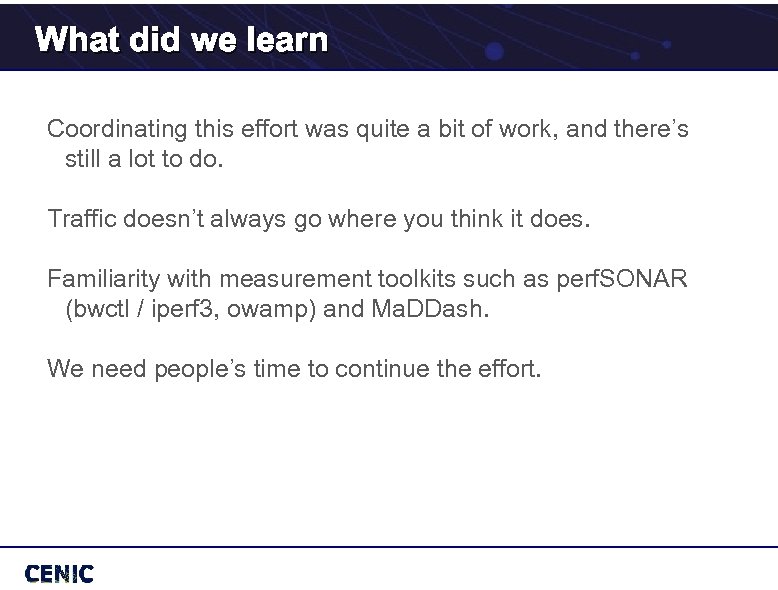 What did we learn Coordinating this effort was quite a bit of work, and there’s still a lot to do. Traffic doesn’t always go where you think it does. Familiarity with measurement toolkits such as perf. SONAR (bwctl / iperf 3, owamp) and Ma. DDash. We need people’s time to continue the effort.
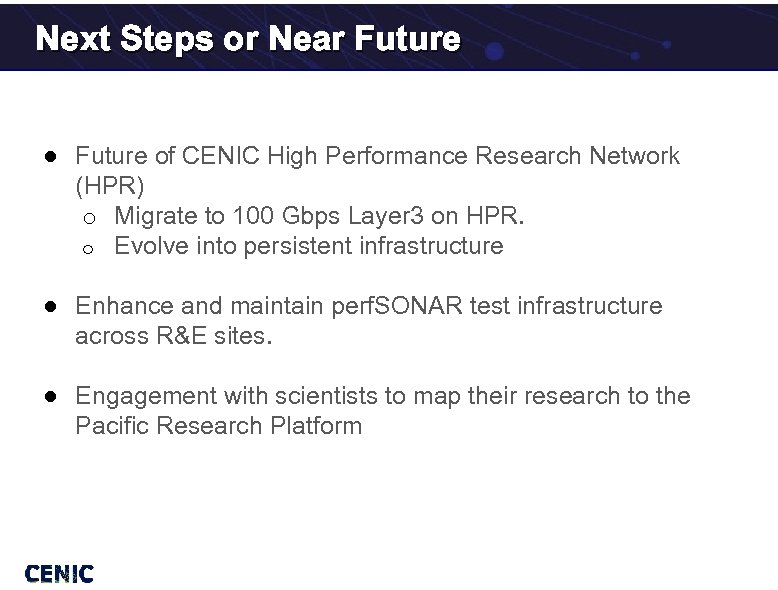 Next Steps or Near Future ● Future of CENIC High Performance Research Network (HPR) o Migrate to 100 Gbps Layer 3 on HPR. o Evolve into persistent infrastructure ● Enhance and maintain perf. SONAR test infrastructure across R&E sites. ● Engagement with scientists to map their research to the Pacific Research Platform
 Links § ESnet fasterdata knowledge base • § Science DMZ paper • § http: //fasterdata. es. net/ http: //www. es. net/assets/pubs_presos/sc 13 sci. DMZ-final. pdf Science DMZ email list • • § To subscribe, send email to sympa@lists. lbl. gov subject "subscribe esnet-sciencedmz” perf. SONAR • • § http: //fasterdata. es. net/performance-testing/perfsonar/ http: //psps. perfsonar. net perf. SONAR dashboard • http: //ps-dashboard. es. net/ 38 – ESnet Science Engagement ( engage@es. net) - 3/19/2018 © 2014, Energy Sciences Network
 Ma. DDash the movie