


 Скачать презентацию An Inside Look at ANSI ASHRAE IESNA Standard 90 1
b393cfaa0ec4cb64e8ef4f7cab59b56d.ppt
- Количество слайдов: 103
 An Inside Look at ANSI/ASHRAE/IESNA Standard 90. 1 -2007 Energy Standard for Buildings Except Low-Rise Residential Buildings Mick Schwedler, PE Manager Trane Applications Engineering Chair, SSPC 90. 1 © 2008 Trane
 Help you gain a working knowledge of ASHRAE Standard 90. 1 © 2008 Trane
 ASHRAE Standard 90. 1 -2007 Topics for Today’s Discussion s Brief history s Implementation u Codes u U. S. military requirements u LEED® s green building rating program Contents u Title, purpose, scope u Aspects © 2008 Trane of building addressed by provisions
 ASHRAE Standard 90. 12007 Brief history • Milestones • Plan for reprints • Scope of 2007 revision © 2008 Trane
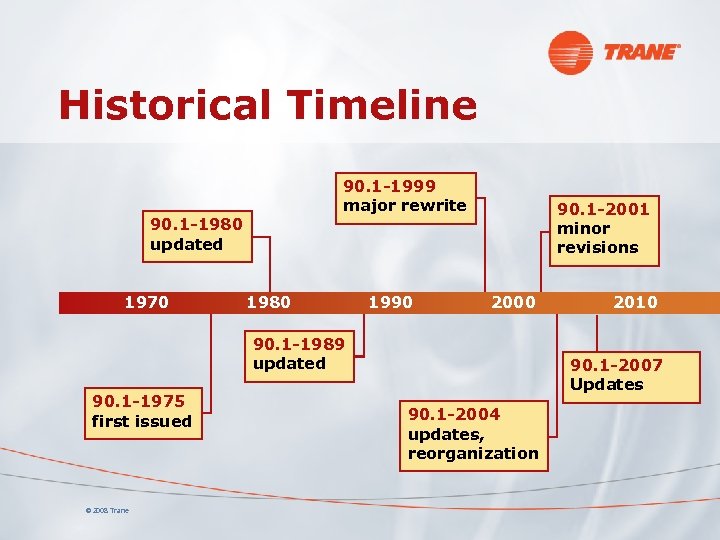 Historical Timeline 90. 1 -1999 major rewrite 90. 1 -1980 updated 1970 1980 1990 90. 1 -2001 minor revisions 2000 90. 1 -1989 updated 90. 1 -1975 first issued © 2008 Trane 2010 90. 1 -2007 Updates 90. 1 -2004 updates, reorganization
 ASHRAE Standard 90. 1 2007 Changes from 2004 s Incorporates 42 addenda published since 90. 1 -2004 was released © 2008 Trane
 ASHRAE Standard 90. 12007 Implementation • • © 2008 Trane Model codes U. S. government Outside U. S. LEED® program © 2008 Trane
 ASHRAE Standard 90. 1 and Model Codes ASHRAE Standard 90. 1 is adopted by: u American National Standards Institute (90. 1 -2007) u National Fire Protection Association u International Code Council (International Energy Conservation Code) © 2008 Trane
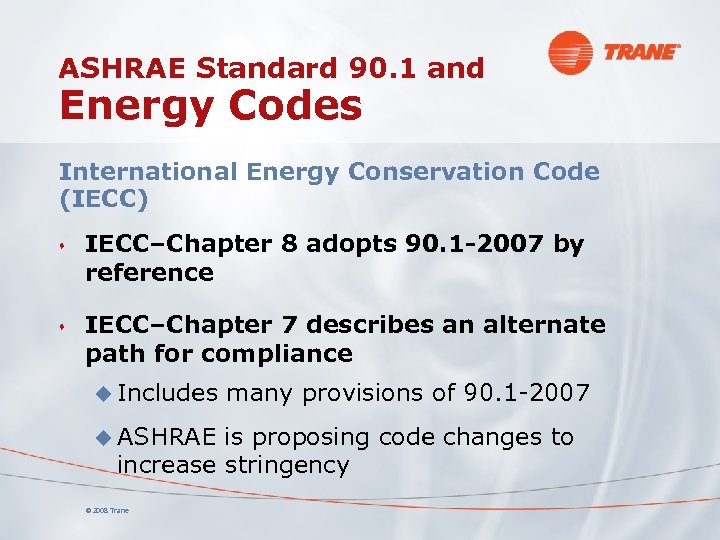 ASHRAE Standard 90. 1 and Energy Codes International Energy Conservation Code (IECC) s s IECC–Chapter 8 adopts 90. 1 -2007 by reference IECC–Chapter 7 describes an alternate path for compliance u Includes u ASHRAE many provisions of 90. 1 -2007 is proposing code changes to increase stringency © 2008 Trane
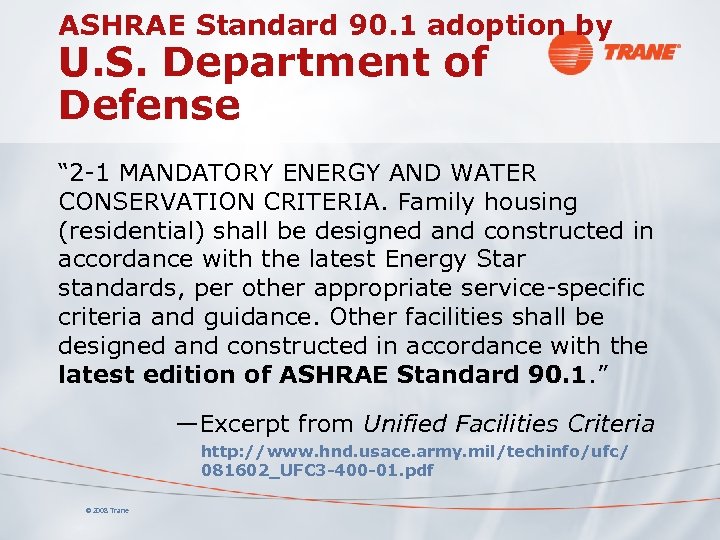 ASHRAE Standard 90. 1 adoption by U. S. Department of Defense “ 2 -1 MANDATORY ENERGY AND WATER CONSERVATION CRITERIA. Family housing (residential) shall be designed and constructed in accordance with the latest Energy Star standards, per other appropriate service-specific criteria and guidance. Other facilities shall be designed and constructed in accordance with the latest edition of ASHRAE Standard 90. 1. ” —Excerpt from Unified Facilities Criteria http: //www. hnd. usace. army. mil/techinfo/ufc/ 081602_UFC 3 -400 -01. pdf © 2008 Trane
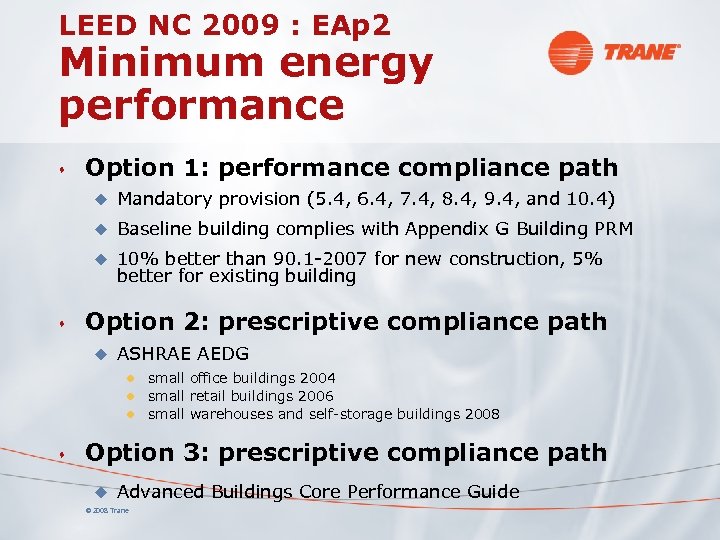 LEED NC 2009 : EAp 2 Minimum energy performance s Option 1: performance compliance path u u Baseline building complies with Appendix G Building PRM u s Mandatory provision (5. 4, 6. 4, 7. 4, 8. 4, 9. 4, and 10. 4) 10% better than 90. 1 -2007 for new construction, 5% better for existing building Option 2: prescriptive compliance path u ASHRAE AEDG small office buildings 2004 l small retail buildings 2006 l small warehouses and self-storage buildings 2008 l s Option 3: prescriptive compliance path u Advanced Buildings Core Performance Guide © 2008 Trane
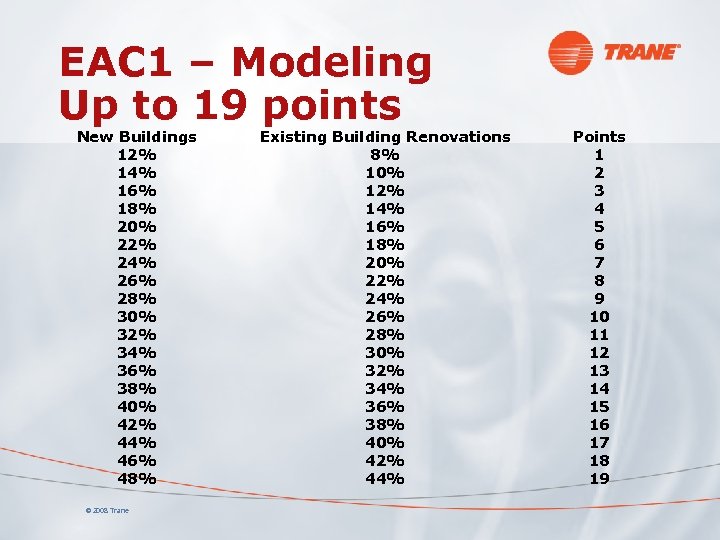 EAC 1 – Modeling Up to 19 points New Buildings 12% 14% 16% 18% 20% 22% 24% 26% 28% 30% 32% 34% 36% 38% 40% 42% 44% 46% 48% © 2008 Trane Existing Building Renovations 8% 10% 12% 14% 16% 18% 20% 22% 24% 26% 28% 30% 32% 34% 36% 38% 40% 42% 44% Points 1 2 3 4 5 6 7 8 9 10 11 12 13 14 15 16 17 18 19
 ASHRAE Standard 90. 1 -2007 Contents • Purpose • Scope • Aspects of building addressed by provisions © 2005 American Standard All rights reserved
 ASHRAE Standard 90. 1 -2007 Purpose “… Provide minimum requirements for the energyefficient design of buildings except low-rise residential buildings” © 2008 Trane
 ASHRAE Standard 90. 1 -2007 Scope s s s © 2008 Trane New buildings and their systems New portions of buildings and their systems New systems and equipment in existing buildings
 ASHRAE Standard 90. 1 -2007 Exclusions s Low-rise residential buildings u ASHRAE Standard 90. 2 covers low-rise (3 stories or less), one-family, and twofamily residential buildings s s Buildings that do not use electricity or fossil fuel Equipment and portions of building systems that use energy to support industrial, manufacturing, or commercial processes © 2008 Trane
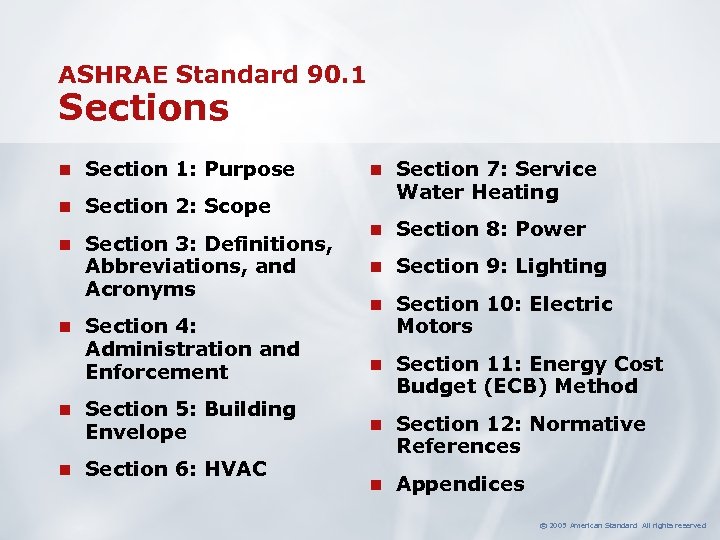 ASHRAE Standard 90. 1 Sections n Section 1: Purpose n Section 2: Scope n Section 3: Definitions, Abbreviations, and Acronyms n Section 4: Administration and Enforcement n Section 5: Building Envelope n Section 6: HVAC n Section 7: Service Water Heating n Section 8: Power n Section 9: Lighting n Section 10: Electric Motors n Section 11: Energy Cost Budget (ECB) Method n Section 12: Normative References n Appendices © 2005 American Standard All rights reserved
 ASHRAE Standard 90. 1 Section 5: Building Envelope © 2005 American Standard All rights reserved
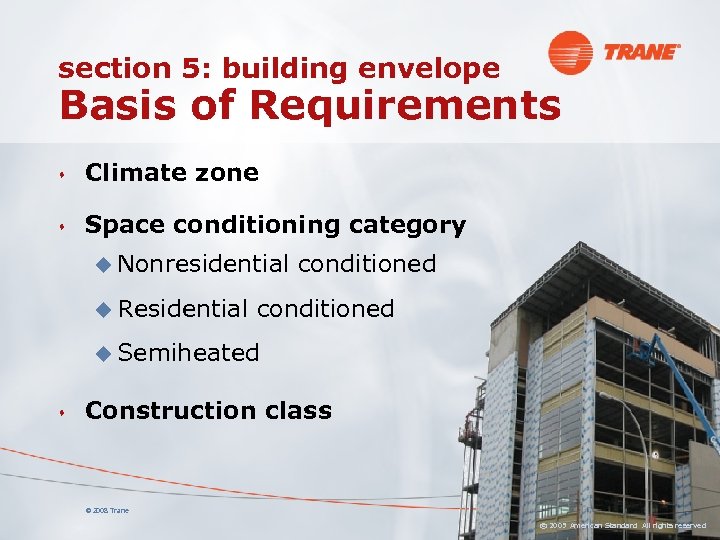 section 5: building envelope Basis of Requirements s Climate zone s Space conditioning category u Nonresidential u Residential conditioned u Semiheated s Construction class © 2008 Trane © 2005 American Standard All rights reserved
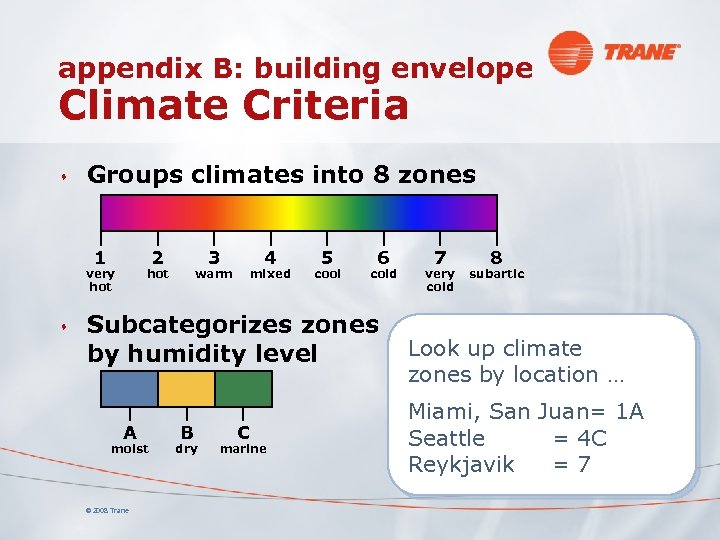 appendix B: building envelope Climate Criteria s Groups climates into 8 zones 1 2 very hot s 3 hot warm 4 mixed 5 cool 6 cold Subcategorizes zones by humidity level A moist © 2008 Trane B dry C marine 7 very cold 8 subartic Look up climate zones by location … Miami, San Juan= 1 A Seattle = 4 C Reykjavik =7
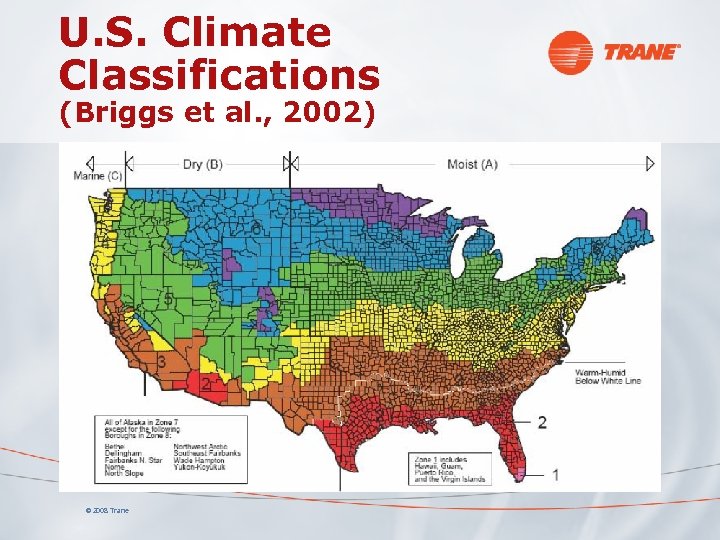 U. S. Climate Classifications (Briggs et al. , 2002) © 2008 Trane
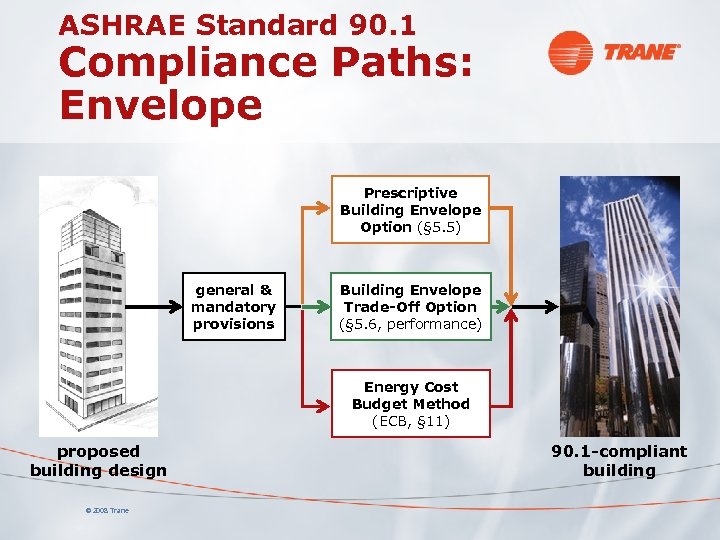 ASHRAE Standard 90. 1 Compliance Paths: Envelope Prescriptive Building Envelope Option (§ 5. 5) general & mandatory provisions Building Envelope Trade-Off Option (§ 5. 6, performance) Energy Cost Budget Method (ECB, § 11) proposed building design © 2008 Trane 90. 1 -compliant building
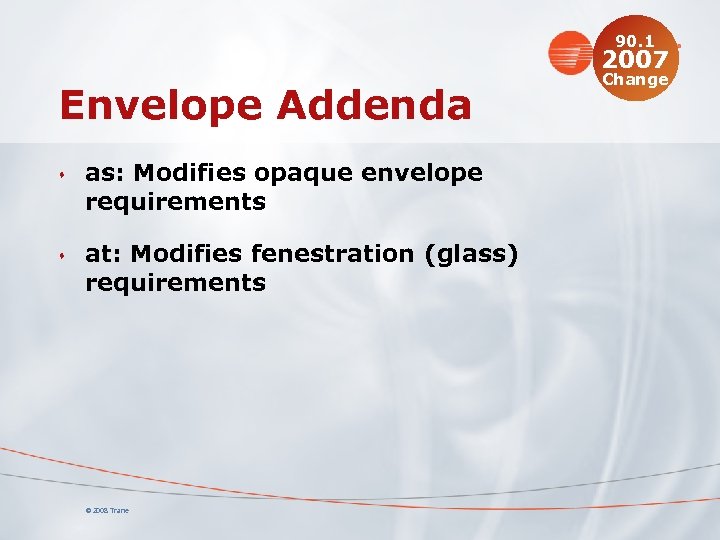 90. 1 2007 Envelope Addenda s s as: Modifies opaque envelope requirements at: Modifies fenestration (glass) requirements © 2008 Trane Change
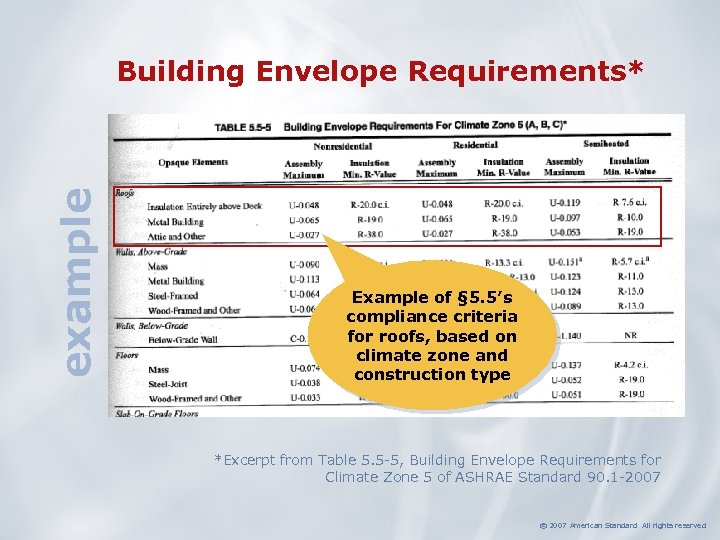 example Building Envelope Requirements* Example of § 5. 5’s compliance criteria for roofs, based on climate zone and construction type *Excerpt from Table 5. 5 -5, Building Envelope Requirements for Climate Zone 5 of ASHRAE Standard 90. 1 -2007 © 2007 American Standard All rights reserved
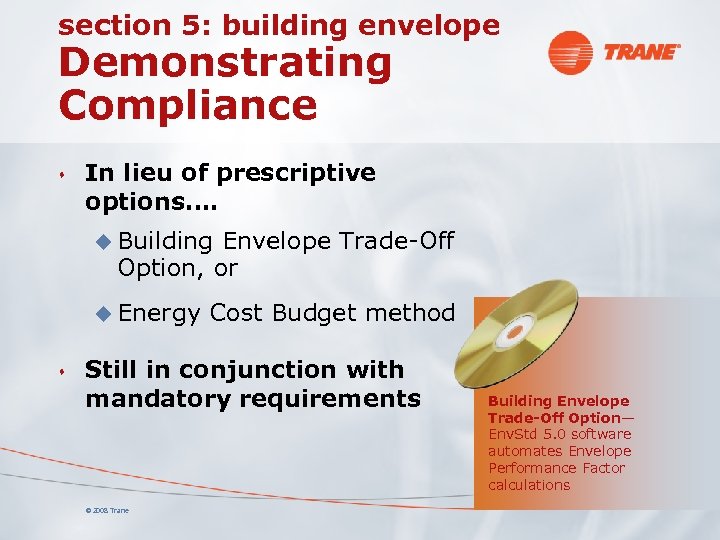 section 5: building envelope Demonstrating Compliance s In lieu of prescriptive options…. u Building Envelope Trade-Off Option, or u Energy s Cost Budget method Still in conjunction with mandatory requirements © 2008 Trane Building Envelope Trade-Off Option— Env. Std 5. 0 software automates Envelope Performance Factor calculations
 section 5: building envelope Summary s s Criteria based on space type One table summarizes envelope requirements per climate zone Precalculated U-factors for common construction types Computerized “building envelope trade-off” procedure © 2008 Trane © 2007 American Standard All rights reserved
 ASHRAE Standard 90. 1 Section 6: HVAC Section 7: Service Water Heating © 2005 American Standard All rights reserved
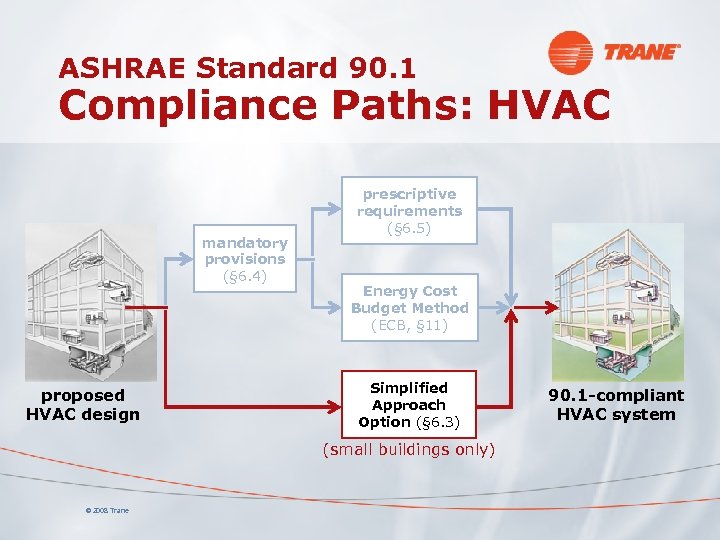 ASHRAE Standard 90. 1 Compliance Paths: HVAC mandatory provisions (§ 6. 4) proposed HVAC design prescriptive requirements (§ 6. 5) Energy Cost Simplified Budget Method Approach Option § 11) (ECB, (§ 6. 3) Simplified Approach Option (§ 6. 3) (small buildings only) © 2008 Trane 90. 1 -compliant HVAC system
 HVAC compliance with Std 90. 1 Simplified Approach s Minimal effort s Equally stringent requirements s Fits on two pages s Limited to … u Buildings with 1 or 2 stories u Buildings less than 25, 000 square feet u Single-zone u Air-cooled © 2008 Trane systems or evaporatively cooled
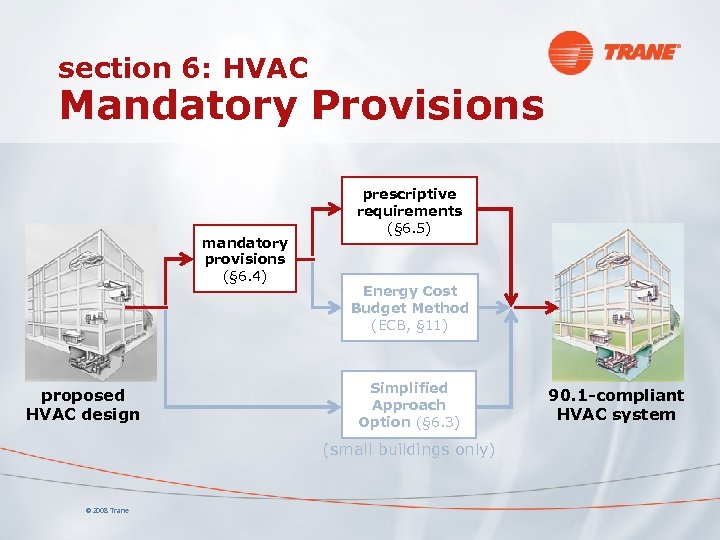 section 6: HVAC Mandatory Provisions mandatory provisions (§ 6. 4) proposed HVAC design prescriptive requirements (§ 6. 5) Energy Cost Simplified Budget Method Approach Option § 11) (ECB, (§ 6. 3) Simplified Approach Option (§ 6. 3) (small buildings only) © 2008 Trane 90. 1 -compliant HVAC system
 section 6: HVAC Mandatory Provisions s Equipment efficiencies s Load calculations s Controls s Construction and insulation s Completion requirements Drawings, manuals, balancing, and commissioning © 2008 Trane
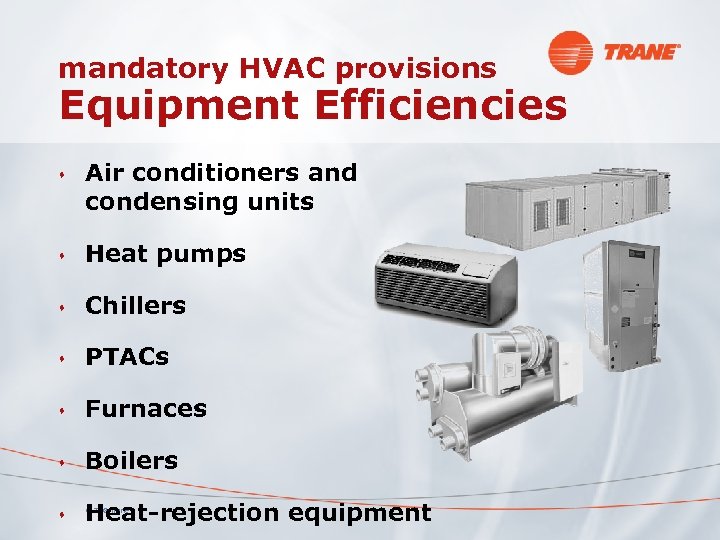 mandatory HVAC provisions Equipment Efficiencies s Air conditioners and condensing units s Heat pumps s Chillers s PTACs s Furnaces s Boilers s Heat-rejection equipment © 2008 Trane
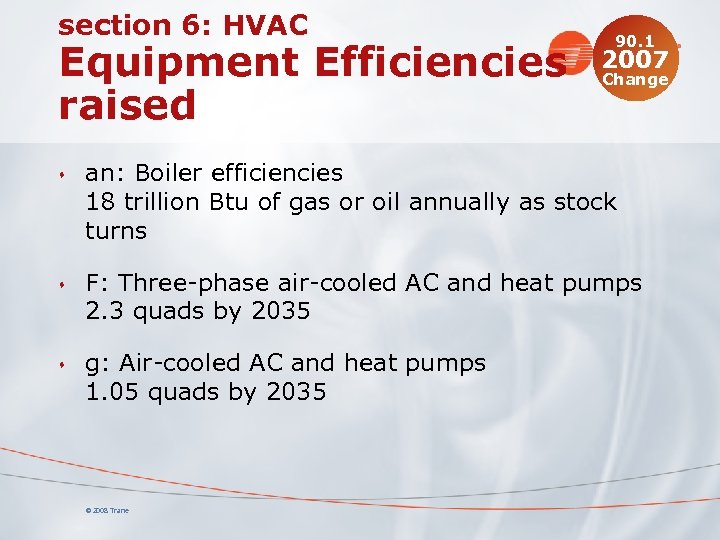 section 6: HVAC Equipment Efficiencies raised s s s 90. 1 2007 Change an: Boiler efficiencies 18 trillion Btu of gas or oil annually as stock turns F: Three-phase air-cooled AC and heat pumps 2. 3 quads by 2035 g: Air-cooled AC and heat pumps 1. 05 quads by 2035 © 2008 Trane
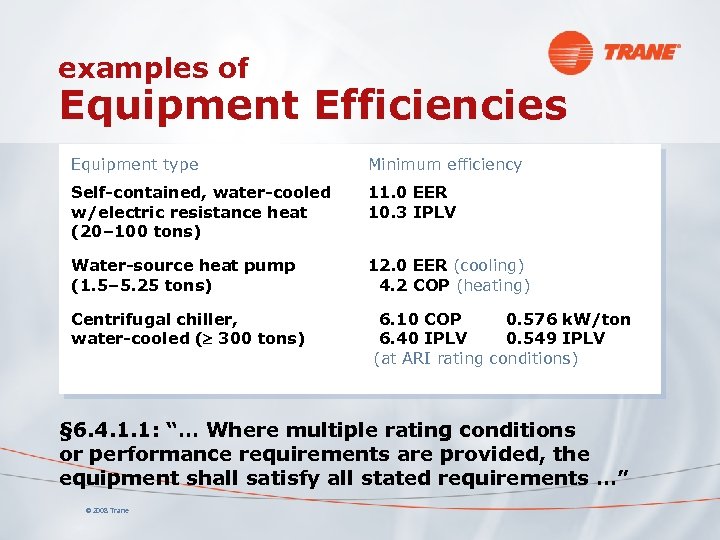 examples of Equipment Efficiencies Equipment type Minimum efficiency Self-contained, water-cooled w/electric resistance heat (20– 100 tons) 11. 0 EER 10. 3 IPLV Water-source heat pump (1. 5– 5. 25 tons) 12. 0 EER (cooling) 4. 2 COP (heating) Centrifugal chiller, water-cooled ( 300 tons) 6. 10 COP 0. 576 k. W/ton 6. 40 IPLV 0. 549 IPLV (at ARI rating conditions) § 6. 4. 1. 1: “… Where multiple rating conditions or performance requirements are provided, the equipment shall satisfy all stated requirements …” © 2008 Trane
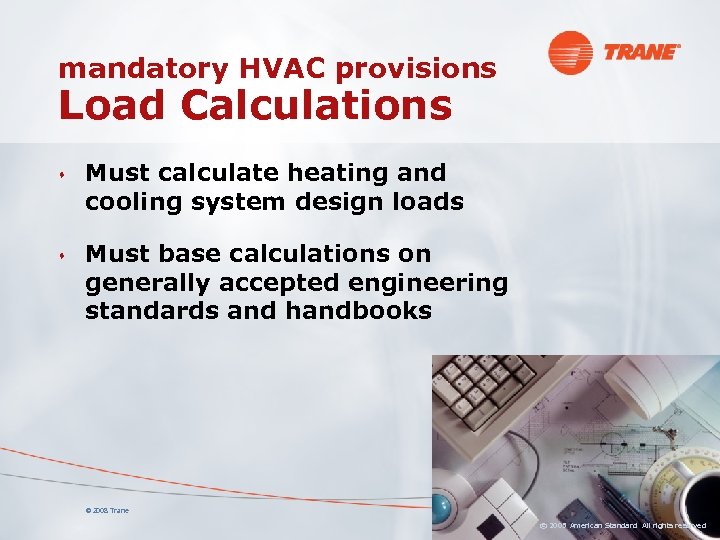 mandatory HVAC provisions Load Calculations s s Must calculate heating and cooling system design loads Must base calculations on generally accepted engineering standards and handbooks © 2008 Trane © 2005 American Standard All rights reserved
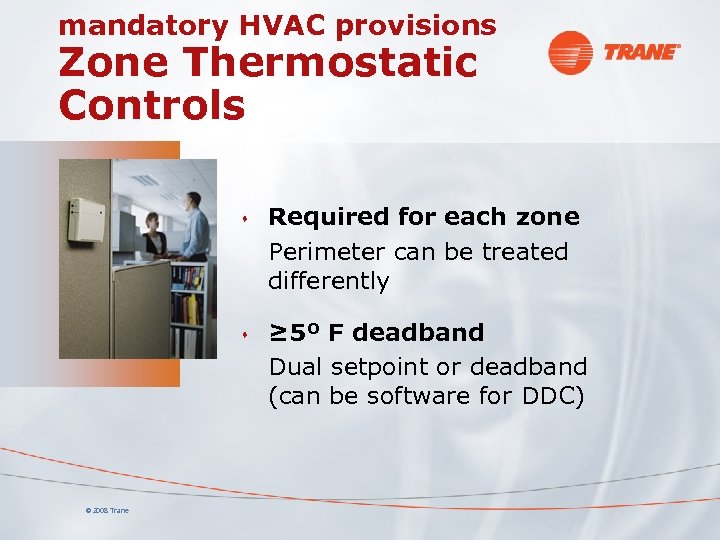 mandatory HVAC provisions Zone Thermostatic Controls s s © 2008 Trane Required for each zone Perimeter can be treated differently ≥ 5º F deadband Dual setpoint or deadband (can be software for DDC)
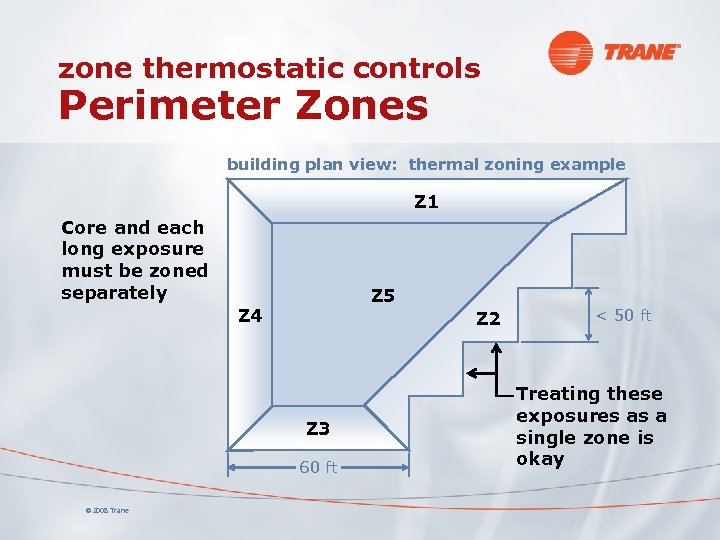 zone thermostatic controls Perimeter Zones building plan view: thermal zoning example Z 1 Core and each long exposure must be zoned separately Z 5 Z 4 Z 2 Z 3 60 ft © 2008 Trane < 50 ft Treating these exposures as a single zone is okay
 90. 1 2007 Off-hour Controls s Change Exception was deleted for HVAC systems serving hotel/motel guest rooms © 2008 Trane
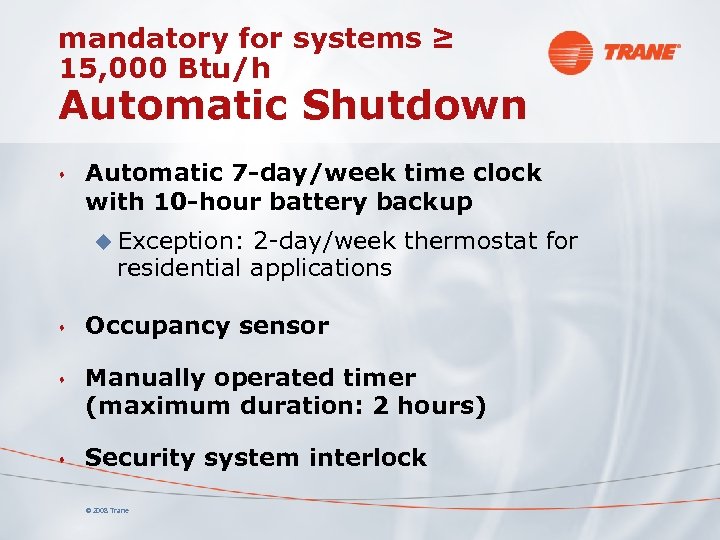 mandatory for systems ≥ 15, 000 Btu/h Automatic Shutdown s Automatic 7 -day/week time clock with 10 -hour battery backup u Exception: 2 -day/week thermostat for residential applications s Occupancy sensor Manually operated timer (maximum duration: 2 hours) Security system interlock © 2008 Trane
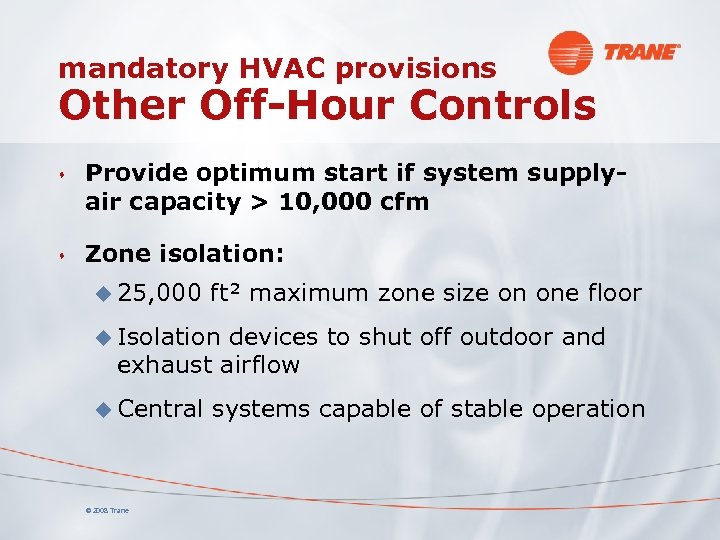 mandatory HVAC provisions Other Off-Hour Controls s s Provide optimum start if system supplyair capacity > 10, 000 cfm Zone isolation: u 25, 000 ft² maximum zone size on one floor u Isolation devices to shut off outdoor and exhaust airflow u Central © 2008 Trane systems capable of stable operation
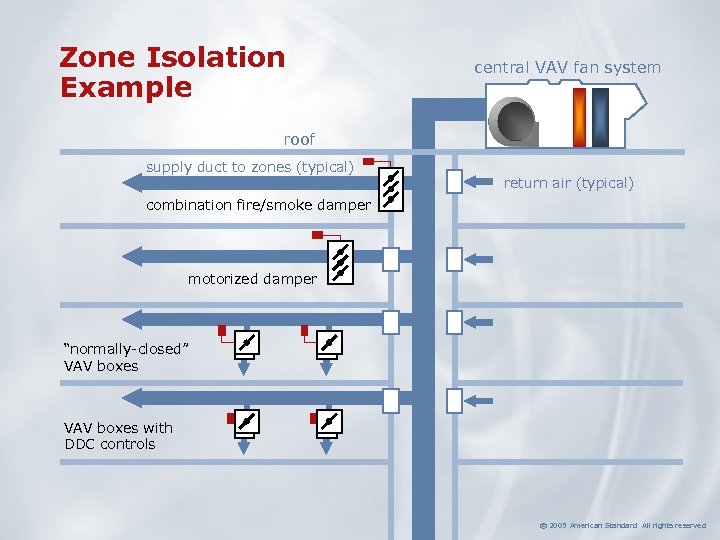 Zone Isolation Example central VAV fan system roof supply duct to zones (typical) return air (typical) combination fire/smoke damper motorized damper “normally-closed” VAV boxes with DDC controls © 2005 American Standard All rights reserved
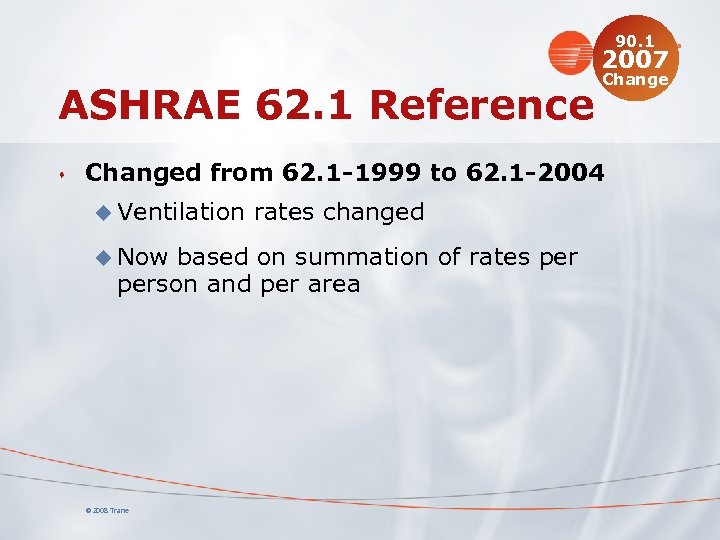 90. 1 2007 ASHRAE 62. 1 Reference s Changed from 62. 1 -1999 to 62. 1 -2004 u Ventilation u Now rates changed based on summation of rates person and per area © 2008 Trane
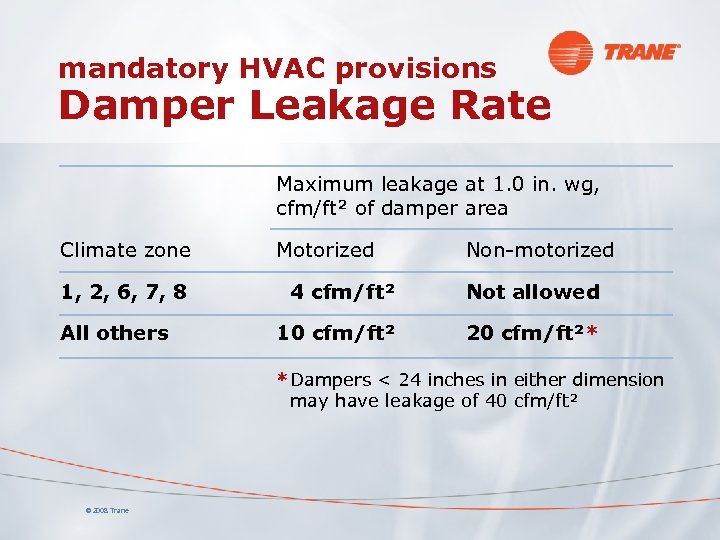 mandatory HVAC provisions Damper Leakage Rate Maximum leakage at 1. 0 in. wg, cfm/ft² of damper area Climate zone 1, 2, 6, 7, 8 All others Motorized Non-motorized 4 cfm/ft² Not allowed 10 cfm/ft² 20 cfm/ft²* *Dampers < 24 inches in either dimension may have leakage of 40 cfm/ft² © 2008 Trane
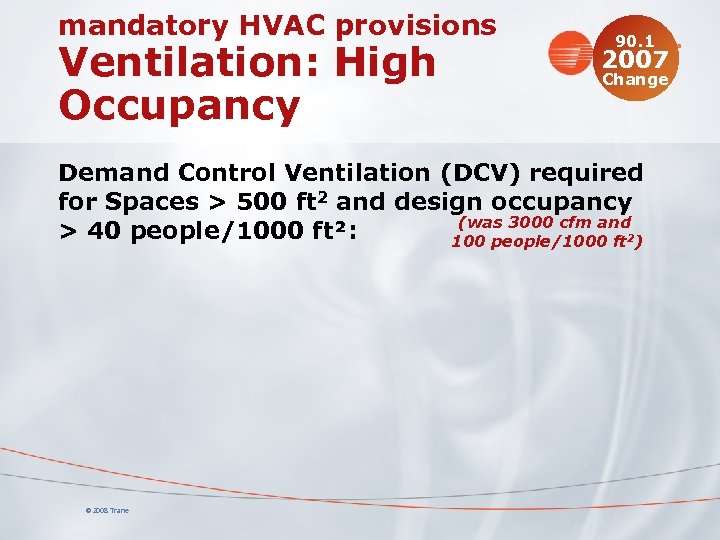 mandatory HVAC provisions Ventilation: High Occupancy 90. 1 2007 Change Demand Control Ventilation (DCV) required for Spaces > 500 ft 2 and design occupancy (was 3000 cfm and > 40 people/1000 ft²: 100 people/1000 ft 2) © 2008 Trane
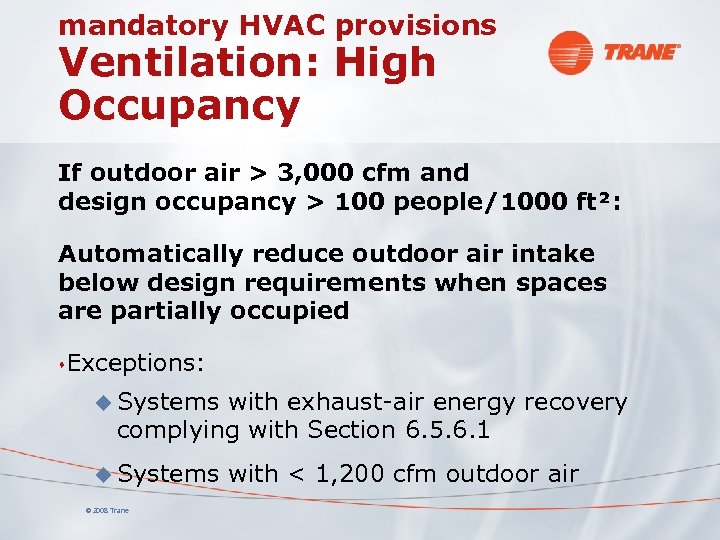 mandatory HVAC provisions Ventilation: High Occupancy If outdoor air > 3, 000 cfm and design occupancy > 100 people/1000 ft²: Automatically reduce outdoor air intake below design requirements when spaces are partially occupied s. Exceptions: u Systems with exhaust-air energy recovery complying with Section 6. 5. 6. 1 u Systems © 2008 Trane with < 1, 200 cfm outdoor air
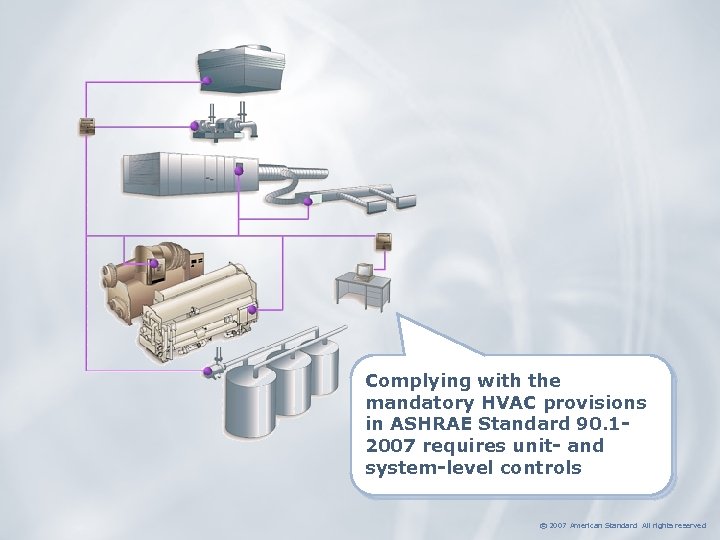 Complying with the mandatory HVAC provisions in ASHRAE Standard 90. 12007 requires unit- and system-level controls © 2007 American Standard All rights reserved
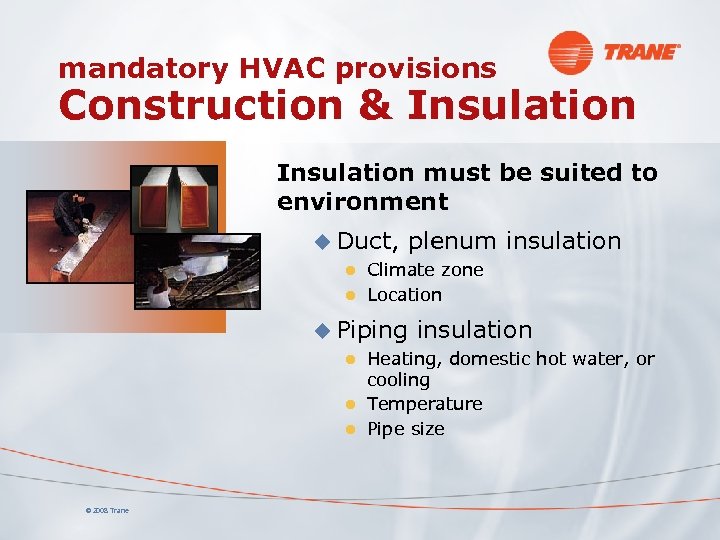 mandatory HVAC provisions Construction & Insulation must be suited to environment u Duct, plenum insulation Climate zone l Location l u Piping insulation Heating, domestic hot water, or cooling l Temperature l Pipe size l © 2008 Trane
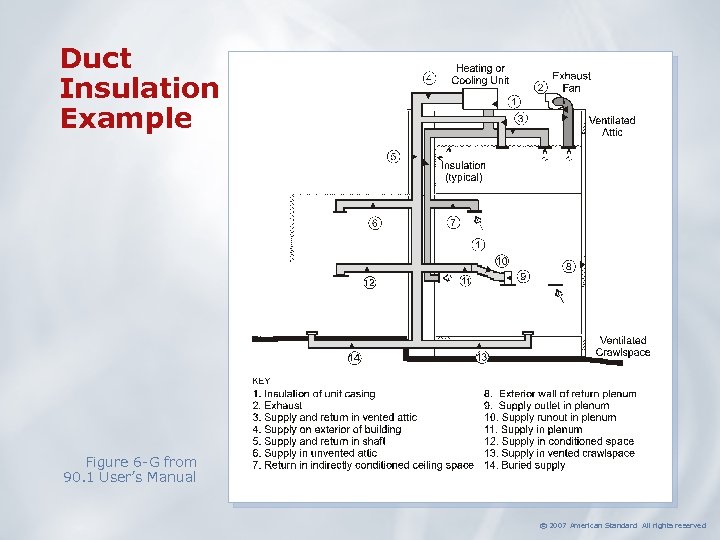 Duct Insulation Example Figure 6 -G from 90. 1 User’s Manual © 2007 American Standard All rights reserved
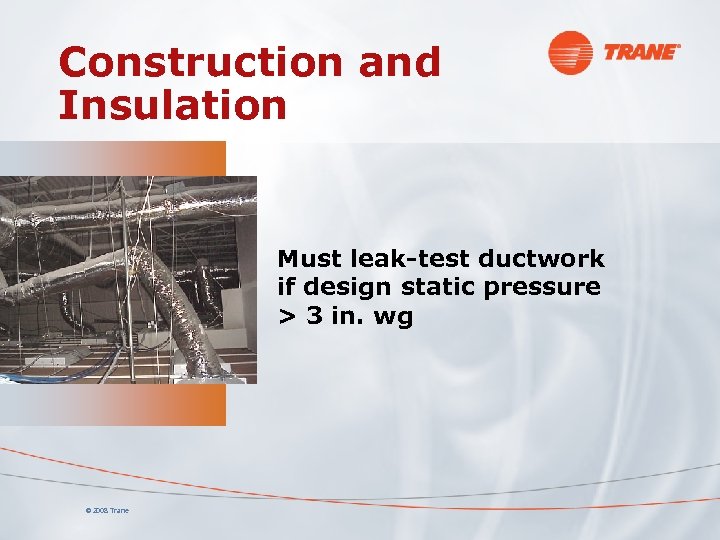 Construction and Insulation Must leak-test ductwork if design static pressure > 3 in. wg © 2008 Trane
 mandatory HVAC provisions Completion Requirements Documentation within 90 days of system acceptance: u u Submittal data u Operation and maintenance manuals u Service agency information u © 2008 Trane Drawings of actual installation Control sequences and schematics
 mandatory HVAC provisions Completion Requirements continued System balancing u Written ft² report conditioned spaces > 5000 u For airside system fan power > 1 hp and hydronic pumps >10 hp: 1. Minimize throttling losses 2. Trim impeller or adjust design speed © 2008 Trane
 mandatory HVAC provisions Completion Requirements concluded Commissioning (Appendix E) u Control elements calibrated, adjusted, and in working order u Designer must provide detailed instructions (per Appendix E) for projects > 50, 000 ft² Exceptions: Warehouses, semi-heated spaces © 2008 Trane
 section 6: HVAC Mandatory Provisions Recap s s Must be met whether using prescriptive or performance (ECB method) path Mandates include: u Equipment efficiency u Controls u Construction u Completion manuals) u Balancing © 2008 Trane and insulation requirements (drawings, and commissioning
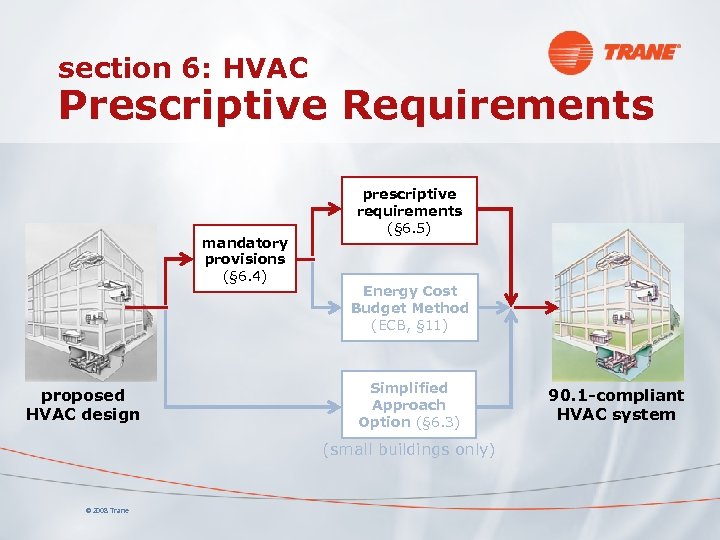 section 6: HVAC Prescriptive Requirements mandatory provisions (§ 6. 4) proposed HVAC design prescriptive requirements (§ 6. 5) Energy Cost Simplified Budget Method Approach Option § 11) (ECB, (§ 6. 3) Simplified Approach Option (§ 6. 3) (small buildings only) © 2008 Trane 90. 1 -compliant HVAC system
 section 6: HVAC Prescriptive Requirements s s Economizers Simultaneous heating and cooling Air system design and control Hydronic system design and control Heat rejection equipment © 2008 Trane s Energy recovery s Exhaust hoods s s Radiant heating s Hot gas bypass limitation
 prescriptive HVAC requirements Economizers s s Climate and system size determine need for an economizer May be either airside or waterside Numerous (9) exceptions, including an efficiency tradeoff Control must be integrated with mechanical cooling Operation must not increase heating energy consumption © 2008 Trane
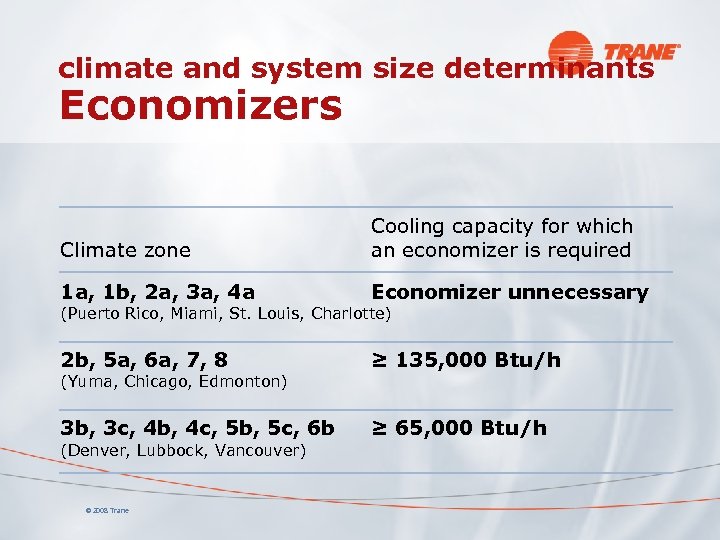 climate and system size determinants Economizers Climate zone Cooling capacity for which an economizer is required 1 a, 1 b, 2 a, 3 a, 4 a Economizer unnecessary 2 b, 5 a, 6 a, 7, 8 ≥ 135, 000 Btu/h 3 b, 3 c, 4 b, 4 c, 5 b, 5 c, 6 b ≥ 65, 000 Btu/h (Puerto Rico, Miami, St. Louis, Charlotte) (Yuma, Chicago, Edmonton) (Denver, Lubbock, Vancouver) © 2008 Trane
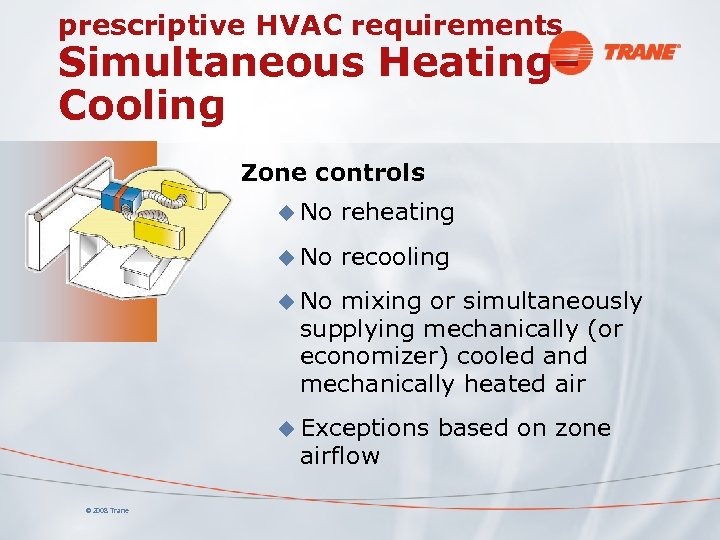 prescriptive HVAC requirements Simultaneous Heating– Cooling Zone controls u No reheating u No recooling u No mixing or simultaneously supplying mechanically (or economizer) cooled and mechanically heated air u Exceptions airflow © 2008 Trane based on zone
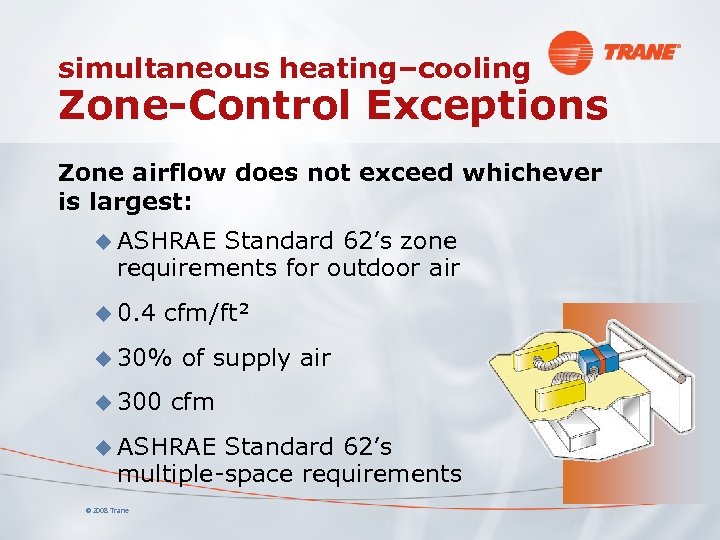 simultaneous heating–cooling Zone-Control Exceptions Zone airflow does not exceed whichever is largest: u ASHRAE Standard 62’s zone requirements for outdoor air u 0. 4 cfm/ft² u 30% u 300 of supply air cfm u ASHRAE Standard 62’s multiple-space requirements © 2008 Trane
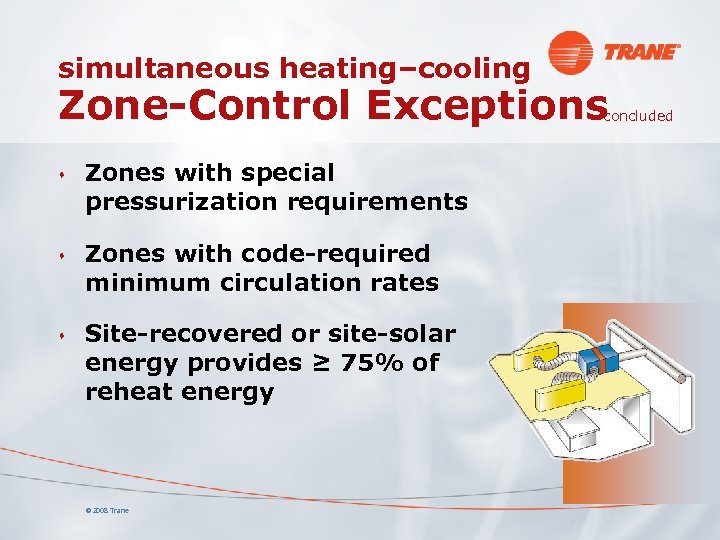 simultaneous heating–cooling Zone-Control Exceptions concluded s s s Zones with special pressurization requirements Zones with code-required minimum circulation rates Site-recovered or site-solar energy provides ≥ 75% of reheat energy © 2008 Trane
 prescriptive HVAC requirements Simultaneous Heating– Cooling Hydronic (water loop) heat pump systems u Deadband ≥ 20°F (Exception: Optimized loop control) u Climate zones 3 -8: Bypass for closed-circuit fluid cooler l Isolate open towers from heat-pump loop l © 2008 Trane
 prescriptive HVAC requirements Simultaneous Heating– Cooling Dehumidification Prevent: u Reheating u Mixing of hot and cold air streams u Heating © 2008 Trane and cooling the same air stream
 simultaneous heating–cooling Dehumidification Exceptions s s Reducing supply airflow to 50%, or minimum ventilation rate Systems < 6. 67 tons that can unload at least 50% Systems smaller than 3. 3 tons Systems with specific humidity requirements (museums, surgical suites) 75% of reheat/recool energy is siterecovered or site-solar © 2008 Trane
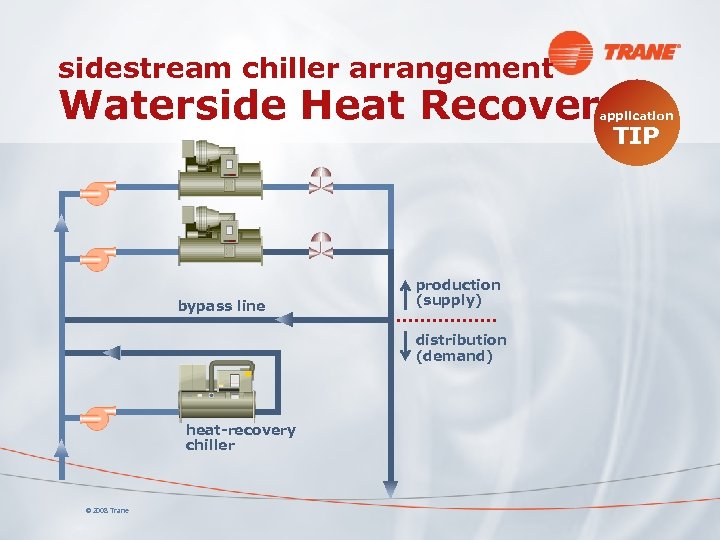 sidestream chiller arrangement Waterside Heat Recovery application TIP bypass line production (supply) distribution (demand) heat-recovery chiller © 2008 Trane
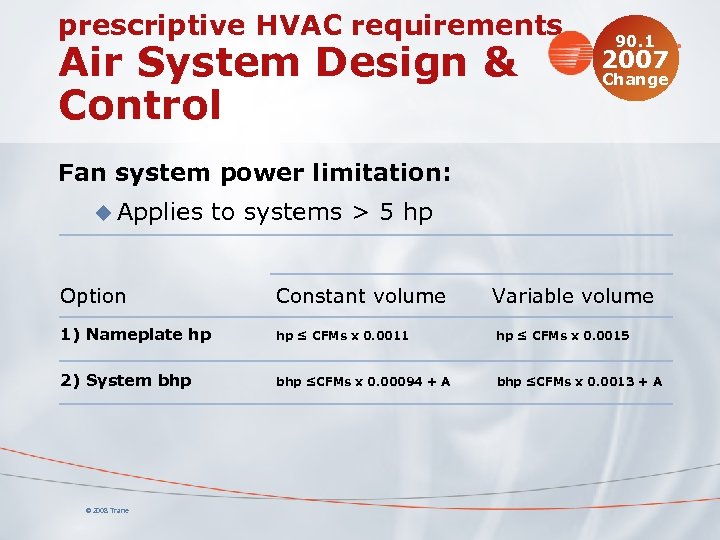 prescriptive HVAC requirements Air System Design & Control 90. 1 2007 Change Fan system power limitation: u Applies to systems > 5 hp Option Constant volume 1) Nameplate hp hp ≤ CFMs x 0. 0011 hp ≤ CFMs x 0. 0015 2) System bhp ≤CFMs x 0. 00094 + A bhp ≤CFMs x 0. 0013 + A © 2008 Trane Variable volume
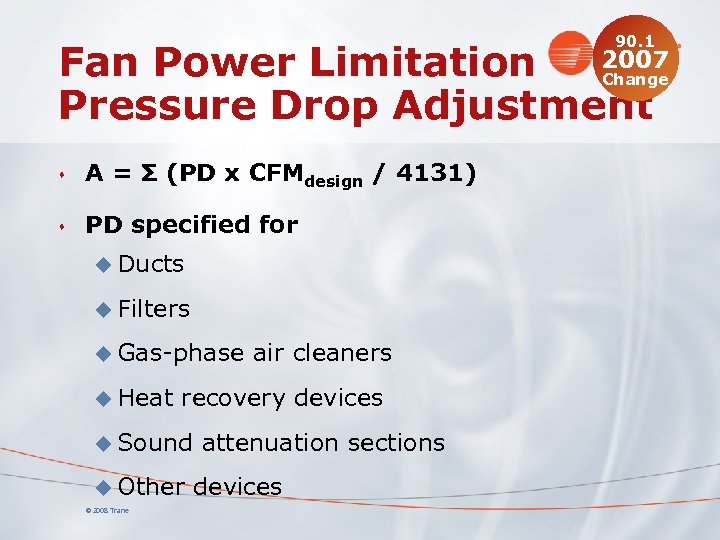 90. 1 2007 Fan Power Limitation Pressure Drop Adjustment Change s A = Σ (PD x CFMdesign / 4131) s PD specified for u Ducts u Filters u Gas-phase u Heat recovery devices u Sound u Other © 2008 Trane air cleaners attenuation sections devices
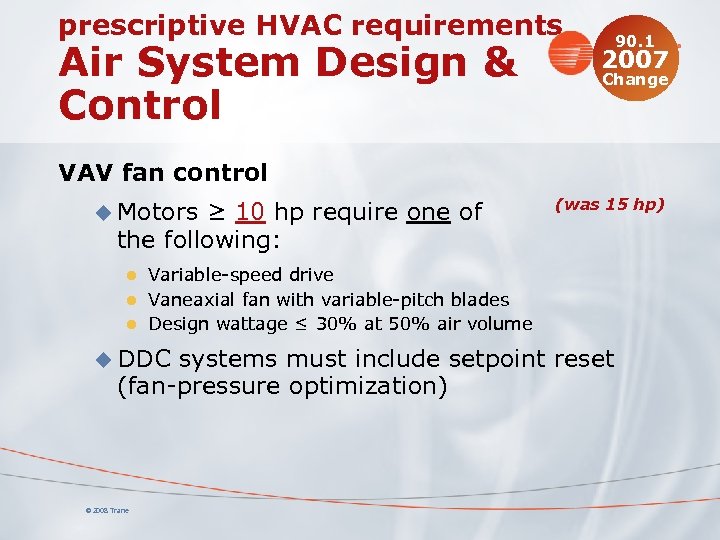 prescriptive HVAC requirements Air System Design & Control 90. 1 2007 Change VAV fan control u Motors ≥ 10 hp require one of the following: (was 15 hp) Variable-speed drive l Vaneaxial fan with variable-pitch blades l Design wattage ≤ 30% at 50% air volume l u DDC systems must include setpoint reset (fan-pressure optimization) © 2008 Trane
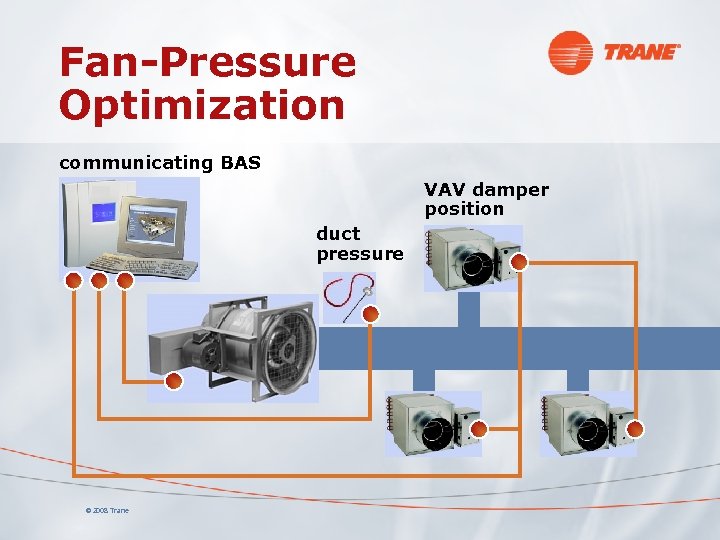 Fan-Pressure Optimization communicating BAS VAV damper position duct pressure © 2008 Trane
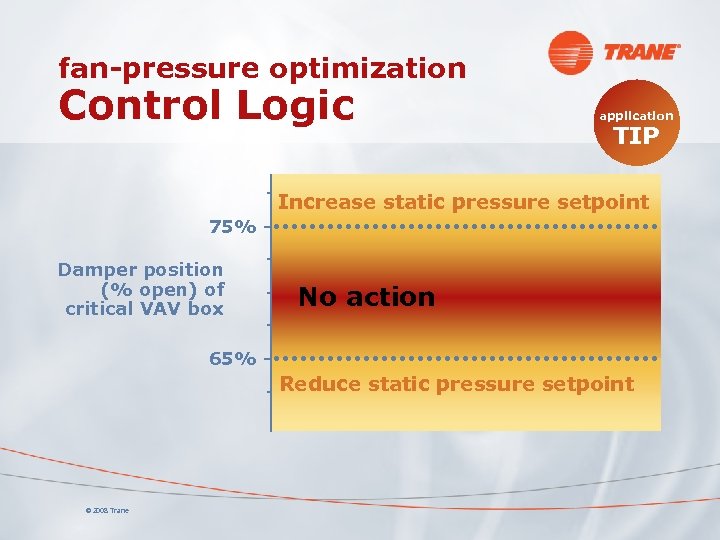 fan-pressure optimization Control Logic application TIP Increase static pressure setpoint 75% Damper position (% open) of critical VAV box No action 65% Reduce static pressure setpoint © 2008 Trane
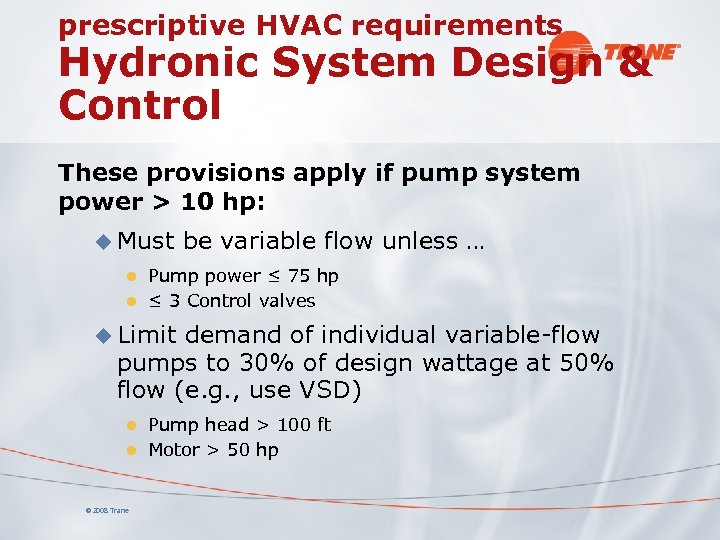 prescriptive HVAC requirements Hydronic System Design & Control These provisions apply if pump system power > 10 hp: u Must be variable flow unless … Pump power ≤ 75 hp l ≤ 3 Control valves l u Limit demand of individual variable-flow pumps to 30% of design wattage at 50% flow (e. g. , use VSD) Pump head > 100 ft l Motor > 50 hp l © 2008 Trane
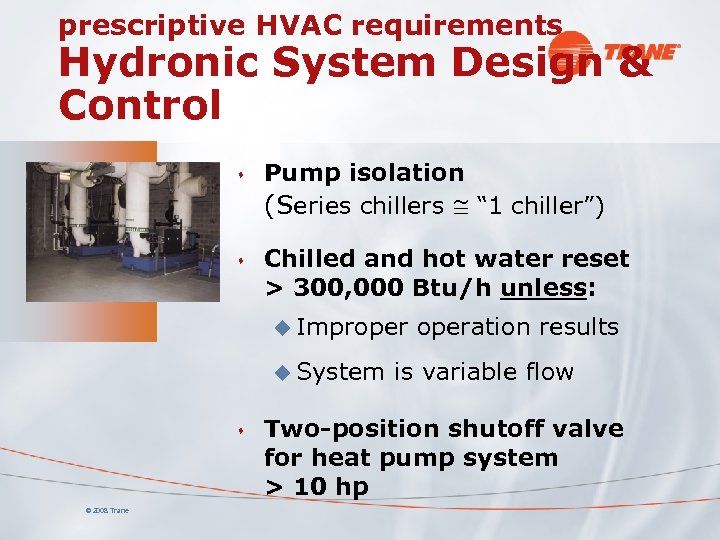 prescriptive HVAC requirements Hydronic System Design & Control s s Pump isolation (Series chillers “ 1 chiller”) Chilled and hot water reset > 300, 000 Btu/h unless: u Improper u System s © 2008 Trane operation results is variable flow Two-position shutoff valve for heat pump system > 10 hp
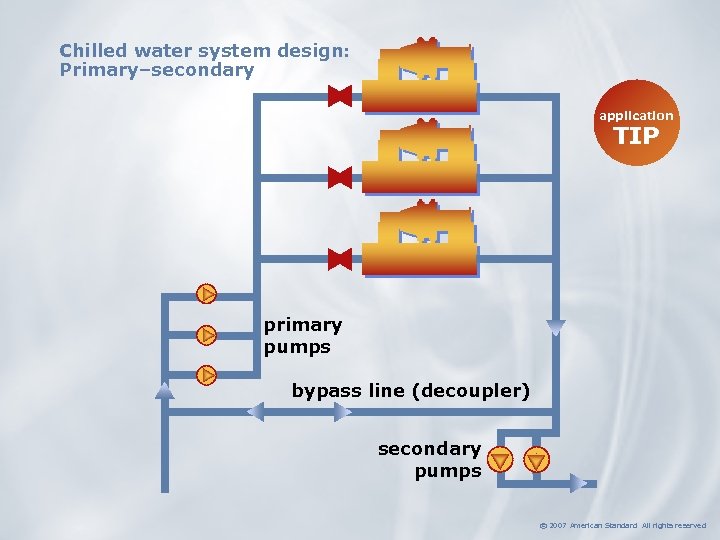 Chilled water system design: Primary–secondary application TIP primary pumps bypass line (decoupler) secondary pumps © 2007 American Standard All rights reserved
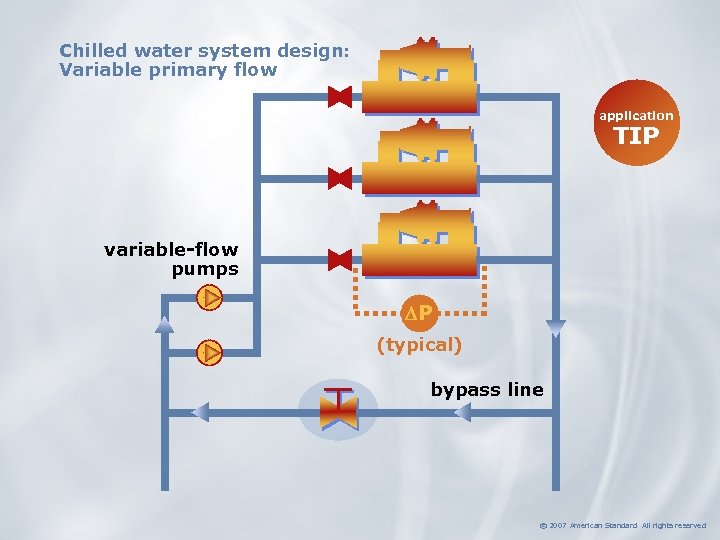 Chilled water system design: Variable primary flow application TIP variable-flow pumps DP (typical) bypass line © 2007 American Standard All rights reserved
 prescriptive HVAC requirements Heat-Rejection Equipment Fan speed control u Motors ≥ 7. 5 hp must be able to operate at 2/3 of full speed or less u Exceptions: Condenser fans serving multiple circuits or flooded condensers l Installations in climate zones 1 and 2 l Up to 1/3 of the fans on a multiple-fan application (if lead fans meet speed control requirement) l © 2008 Trane
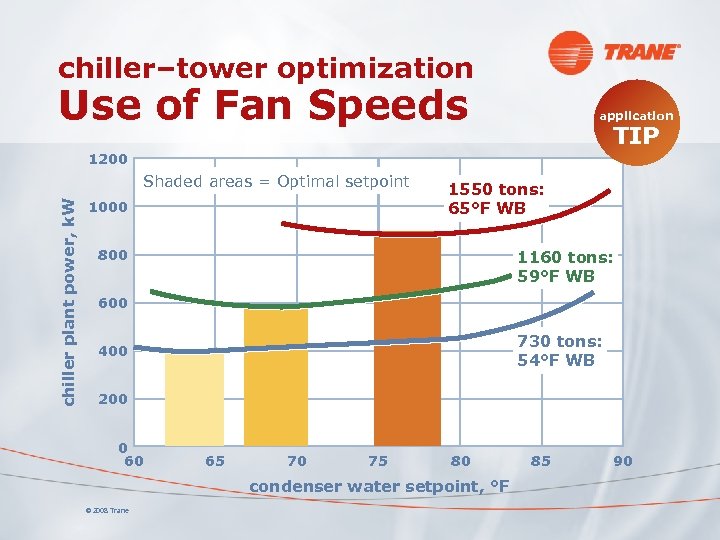 chiller–tower optimization Use of Fan Speeds application TIP 1200 chiller plant power, k. W Shaded areas = Optimal setpoint 1000 1550 tons: 65°F WB 800 1160 tons: 59°F WB 600 730 tons: 54°F WB 400 200 0 60 65 70 75 80 condenser water setpoint, °F © 2008 Trane 85 90
 prescriptive HVAC requirements Airside Energy Recovery s Required if: u Supply air capacity ≥ 5, 000 cfm u Minimum outdoor air ≥ 70% s Recovery system effectiveness ≥ 50% s Exceptions (9) u Labs, toxic exhaust, etc. u Largest © 2008 Trane exhaust < 75% outdoor airflow
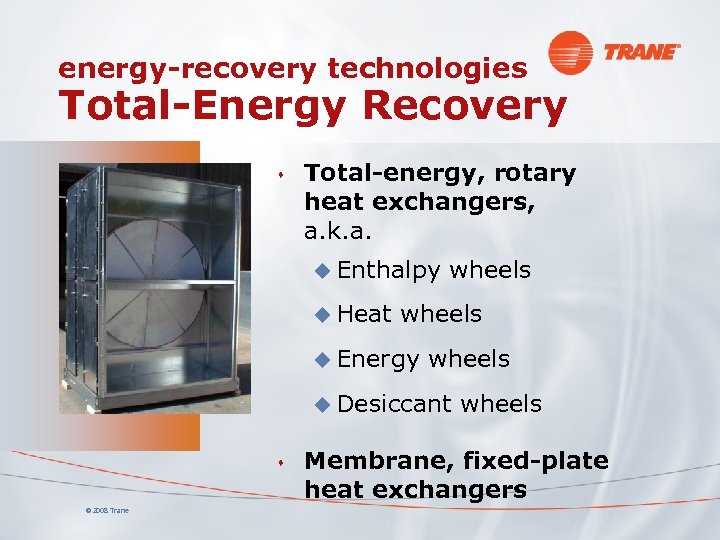 energy-recovery technologies Total-Energy Recovery s Total-energy, rotary heat exchangers, a. k. a. u Enthalpy u Heat wheels u Energy wheels u Desiccant s © 2008 Trane wheels Membrane, fixed-plate heat exchangers
 prescriptive HVAC requirements Waterside Energy Recovery s Must recover condenser heat for service water heating (SWH) if: u Facility operates “ 24/7” and u Heat u SWH s rejection > 6, 000 Btu/h and load > 1, 000 Btu/h Where required, meet the smaller of: u Recover 60% of rejected condenser heat or u Preheat water to 85°F © 2008 Trane
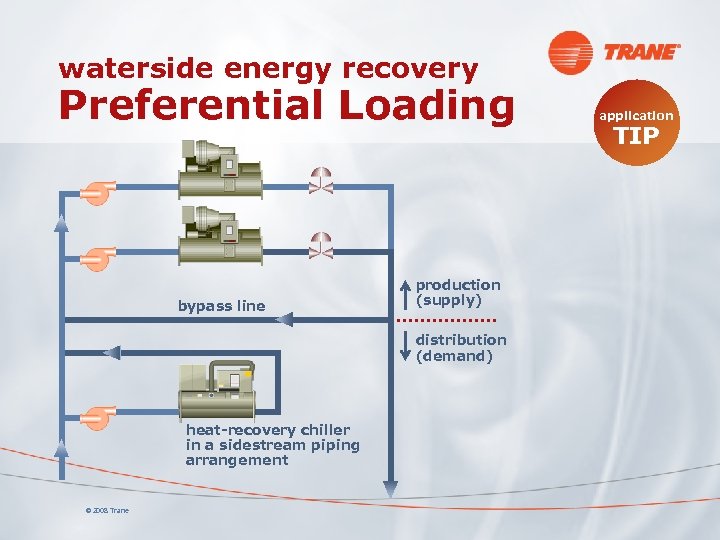 waterside energy recovery Preferential Loading bypass line production (supply) distribution (demand) heat-recovery chiller in a sidestream piping arrangement © 2008 Trane application TIP
 section 7: Service Water Heating s Mandatory provisions: u u Piping insulation u SWH system controls (temperature, pump operation) u s Equipment efficiency Pool heaters and covers Prescriptive requirements: u Space and water heating u Service water heating © 2008 Trane
 ASHRAE Standard 90. 1 Section 9: Lighting © 2008 Trane
 section 9: lighting Scope s Lighting control u Interior spaces u Exterior building features and grounds lighting s Lighting power u Interior spaces u Exterior building features and grounds lighting © 2008 Trane u Building type and use
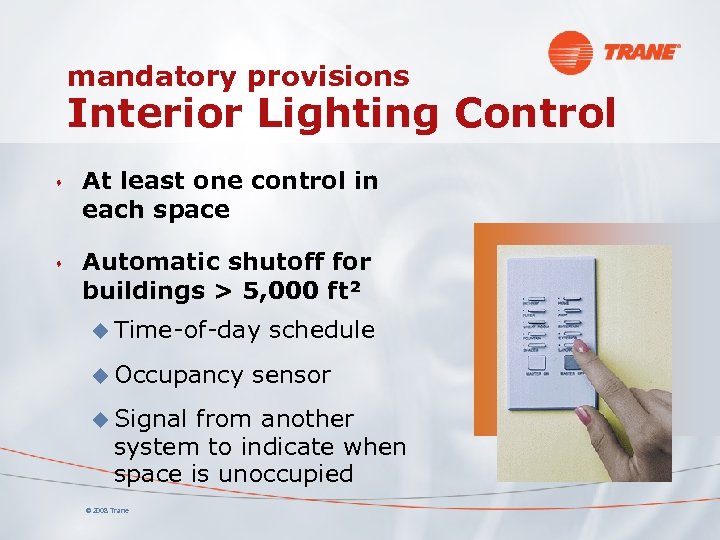 mandatory provisions Interior Lighting Control s s At least one control in each space Automatic shutoff for buildings > 5, 000 ft² u Time-of-day u Occupancy u Signal schedule sensor from another system to indicate when space is unoccupied © 2008 Trane
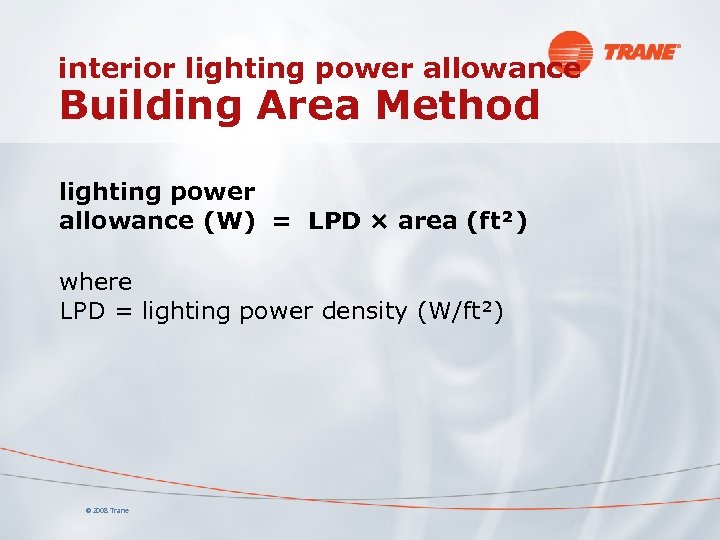 interior lighting power allowance Building Area Method lighting power allowance (W) = LPD × area (ft²) where LPD = lighting power density (W/ft²) © 2008 Trane
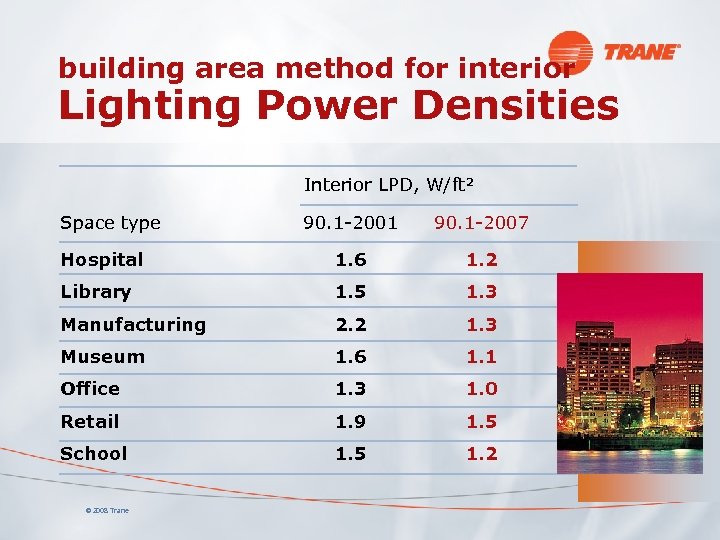 building area method for interior Lighting Power Densities Interior LPD, W/ft² Space type 90. 1 -2001 90. 1 -2007 Hospital 1. 6 1. 2 Library 1. 5 1. 3 Manufacturing 2. 2 1. 3 Museum 1. 6 1. 1 Office 1. 3 1. 0 Retail 1. 9 1. 5 School 1. 5 1. 2 © 2008 Trane
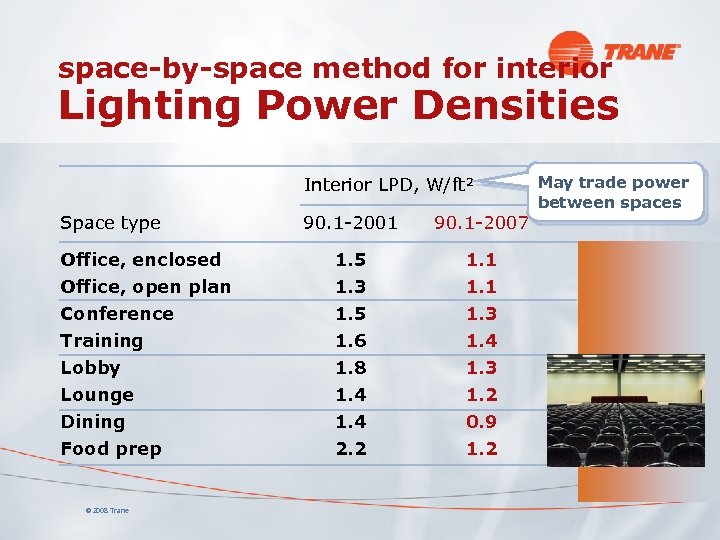 space-by-space method for interior Lighting Power Densities Interior LPD, W/ft² Space type 90. 1 -2001 90. 1 -2007 Office, enclosed 1. 5 1. 1 Office, open plan Conference Training Lobby Lounge Dining Food prep 1. 3 1. 5 1. 6 1. 8 1. 4 2. 2 1. 1 1. 3 1. 4 1. 3 1. 2 0. 9 1. 2 © 2008 Trane May trade power between spaces
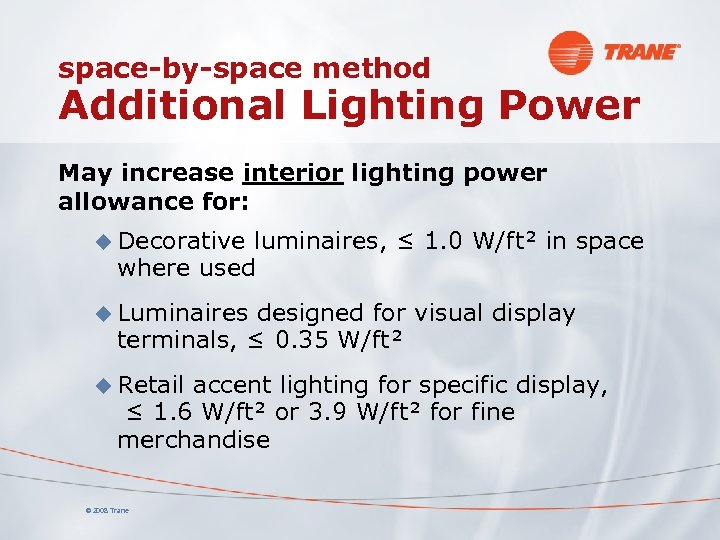 space-by-space method Additional Lighting Power May increase interior lighting power allowance for: u Decorative luminaires, ≤ 1. 0 W/ft² in space where used u Luminaires designed for visual display terminals, ≤ 0. 35 W/ft² u Retail accent lighting for specific display, ≤ 1. 6 W/ft² or 3. 9 W/ft² for fine merchandise © 2008 Trane
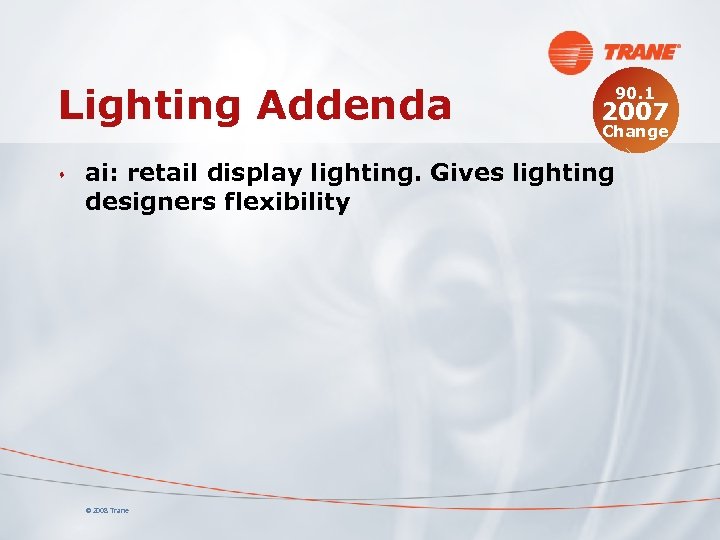 Lighting Addenda s 90. 1 2007 Change ai: retail display lighting. Gives lighting designers flexibility © 2008 Trane
 mandatory provisions Exterior Lighting Control Must have some means of automatic shutoff during daylight hours © 2008 Trane
 ASHRAE Standard 90. 1 Section 11: Energy Cost Budget (ECB) Method © 2008 Trane
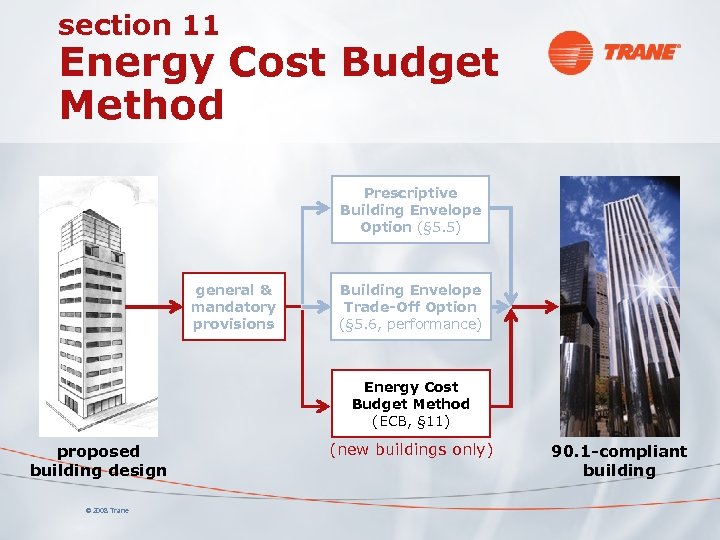 section 11 Energy Cost Budget Method Prescriptive Building Envelope Option (§ 5. 5) general & mandatory provisions Building Envelope Trade-Off Option (§ 5. 6, performance) Energy Cost Budget Method (ECB, § 11) proposed building design © 2008 Trane (new buildings only) 90. 1 -compliant building
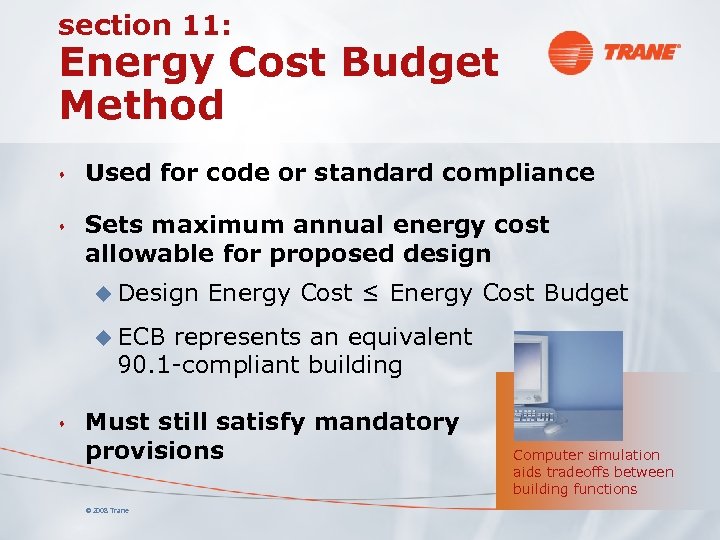 section 11: Energy Cost Budget Method s s Used for code or standard compliance Sets maximum annual energy cost allowable for proposed design u Design Energy Cost ≤ Energy Cost Budget u ECB represents an equivalent 90. 1 -compliant building s Must still satisfy mandatory provisions © 2008 Trane Computer simulation aids tradeoffs between building functions
 section 11: energy cost budget method Simulation Requirements s s 1, 400 hours per year Hourly variations (occupancy, lighting, thermostat setpoints, etc. ) s Thermal mass effects s Ten or more thermal zones s Equipment (part-load performance, capacity and efficiency correction curves) s Economizers s Budget building design characteristics © 2008 Trane
 performance rating method Appendix G s s Modification of ECB Method (§ 11) “Provided … to quantify performance that substantially exceeds the requirements of Standard 90. 1” Used for Energy & Atmosphere Credit 1 calculation in LEED-NC version 2. 2 Does NOT offer an alternative compliance path for minimum standard compliance © 2008 Trane
 appendix G: performance rating method Simulation Requirements s s 8, 760 hours per year Hourly variations (occupancy, lighting, thermostat setpoints, etc. ) s Thermal mass effects s Ten or more thermal zones s Equipment (part-load performance, capacity and efficiency correction curves) s Economizers s Budget building design characteristics © 2008 Trane
 Appendix G Changes to 90. 1 -2007 s s s Improved identification of baseline buildings Improved identification of baseline systems Increased information for energy modelers © 2008 Trane
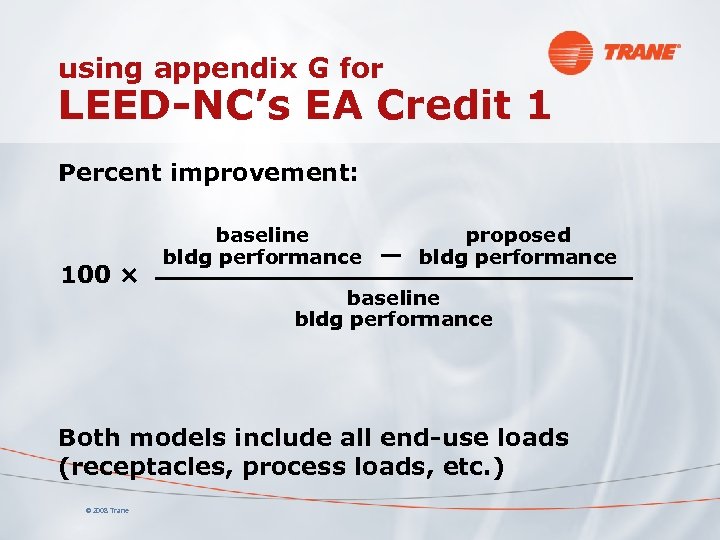 using appendix G for LEED-NC’s EA Credit 1 Percent improvement: 100 × baseline bldg performance — proposed bldg performance baseline bldg performance Both models include all end-use loads (receptacles, process loads, etc. ) © 2008 Trane
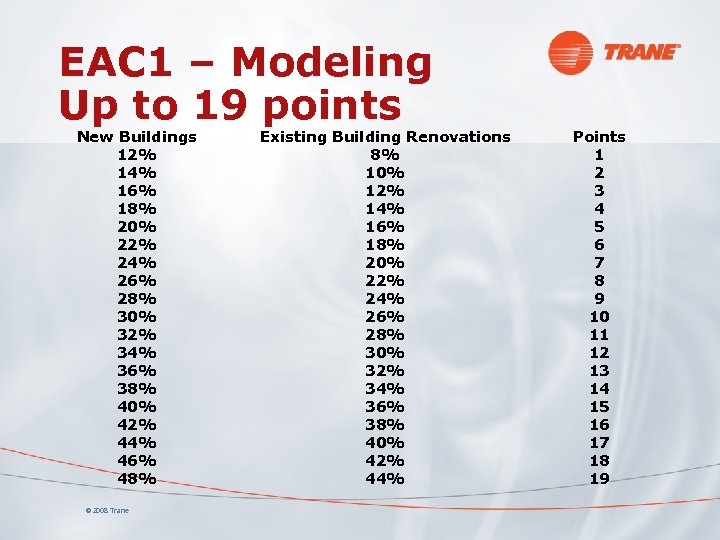 EAC 1 – Modeling Up to 19 points New Buildings 12% 14% 16% 18% 20% 22% 24% 26% 28% 30% 32% 34% 36% 38% 40% 42% 44% 46% 48% © 2008 Trane Existing Building Renovations 8% 10% 12% 14% 16% 18% 20% 22% 24% 26% 28% 30% 32% 34% 36% 38% 40% 42% 44% Points 1 2 3 4 5 6 7 8 9 10 11 12 13 14 15 16 17 18 19
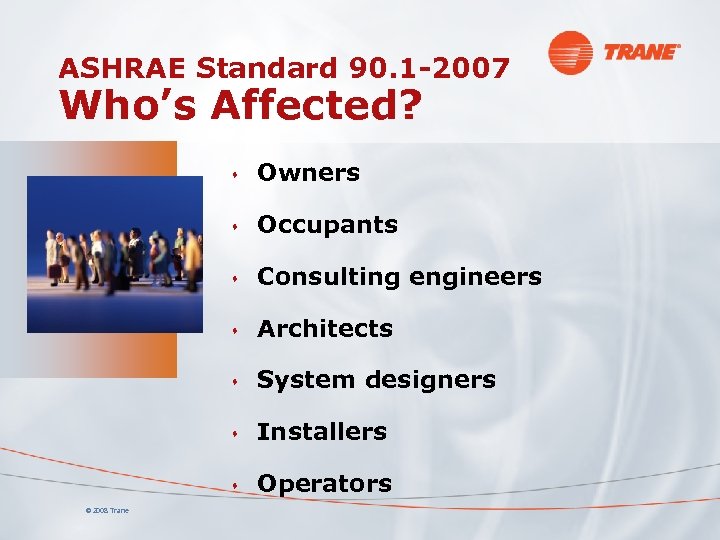 ASHRAE Standard 90. 1 -2007 Who’s Affected? s s Occupants s Consulting engineers s Architects s System designers s Installers s © 2008 Trane Owners Operators
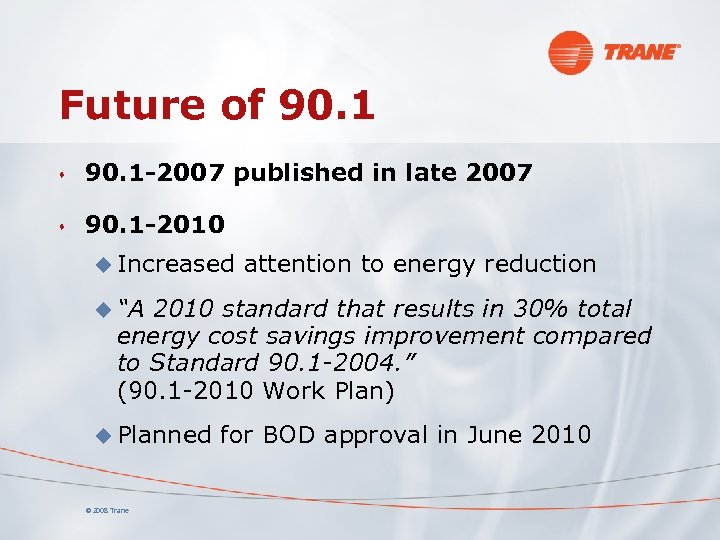 Future of 90. 1 s 90. 1 -2007 published in late 2007 s 90. 1 -2010 u Increased attention to energy reduction u “A 2010 standard that results in 30% total energy cost savings improvement compared to Standard 90. 1 -2004. ” (90. 1 -2010 Work Plan) u Planned © 2008 Trane for BOD approval in June 2010
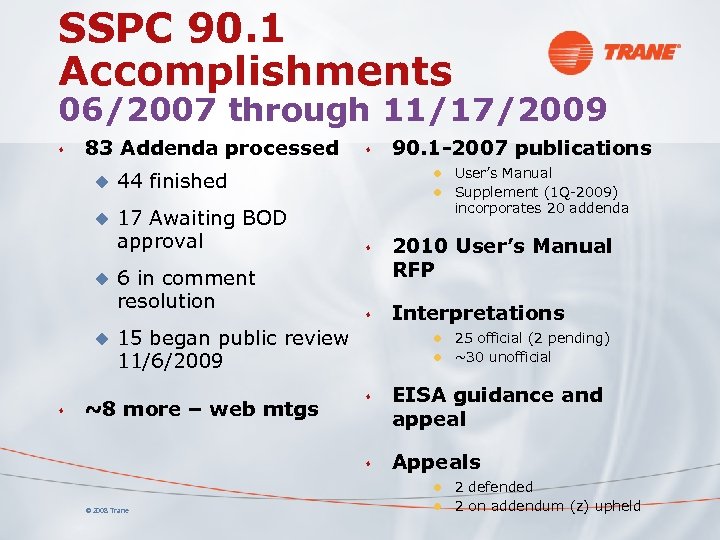 SSPC 90. 1 Accomplishments 06/2007 through 11/17/2009 s 83 Addenda processed u 17 Awaiting BOD approval u u s 6 in comment resolution User’s Manual l Supplement (1 Q-2009) incorporates 20 addenda s s 15 began public review 11/6/2009 ~8 more – web mtgs 90. 1 -2007 publications l 44 finished u s 2010 User’s Manual RFP Interpretations 25 official (2 pending) l ~30 unofficial l s s EISA guidance and appeal Appeals 2 defended l 2 on addendum (z) upheld l © 2008 Trane
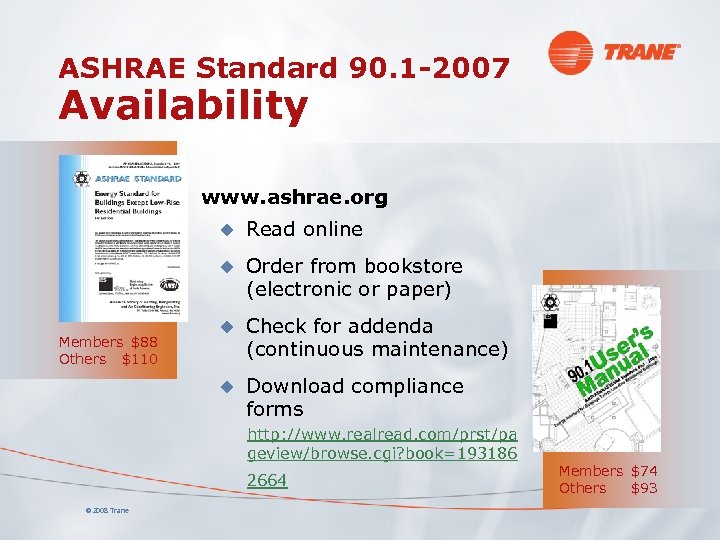 ASHRAE Standard 90. 1 -2007 Availability www. ashrae. org u u Order from bookstore (electronic or paper) u Check for addenda (continuous maintenance) u Members $88 Others $110 Read online Download compliance forms http: //www. realread. com/prst/pa geview/browse. cgi? book=193186 2664 © 2008 Trane Members $74 Others $93
 ASHRAE Standard 90. 12007 Questions? © 2008 Trane