 Скачать презентацию An information infrastructure for vegetation science Robert K
91da6eba3a8597c33c66507b711b1315.ppt
- Количество слайдов: 34



An information infrastructure for vegetation science Robert K. Peet for the Ecological Society of America Vegetation Classification Panel
ESA Vegetation Panel Founded in 1995 to • Foster collaboration among federal, NGO and academic communities. • Develop standards. • Increase credibility through a process of peer review and formal publication. Primary funding provided by GAP.
Partner Organizations 1999 MOU Ecological Society of America Role: to develop and implement professional standards, including peer review, for vegetation documentation and classification. Nature. Serve Role: to develop, support & maintain a standard vegetation classification for conservation, inventory, and monitoring.
Partner Organizations FGDC Vegetation Subcommittee Role: to establish standards within the federal community for vegetation data and vegetation classification units. USGS – NBII Role: to “make the NVC system, and its associated data and information products, broadly accessible by incorporating them in the NBII federation. ”
A Federal Standard • The “National Vegetation Classification” adopted as a federal standard in 1997 following ESA Panel review. • Finest-scale floristic classification based on quantitative field data was adopted only in concept with the process left unspecified.
ESA Guidelines The ESA Vegetation Panel and its partners have developed guidelines for the floristic levels of the classification covering: • Vegetation field plots (Classification plots & EO plots), • Documentation & description of floristic types. • Submission & peer review of proposed types. • Management, citation, & archiving of data (including XML schemas).
Guidelines for describing the associations and alliances of the U. S. National Vegetation Classification. The Ecological Society of America Vegetation Classification Panel. Version 4. 0. July, 2004 http: //www. esa. org/vegweb/ Under review by FGDC as a U. S. federal standard
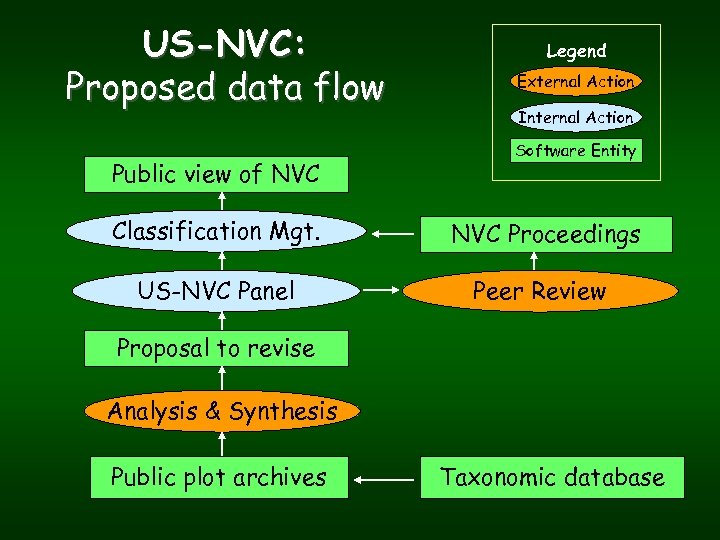
US-NVC: Proposed data flow Public view of NVC Legend External Action Internal Action Software Entity Classification Mgt. NVC Proceedings US-NVC Panel Peer Review Proposal to revise Analysis & Synthesis Public plot archives Taxonomic database
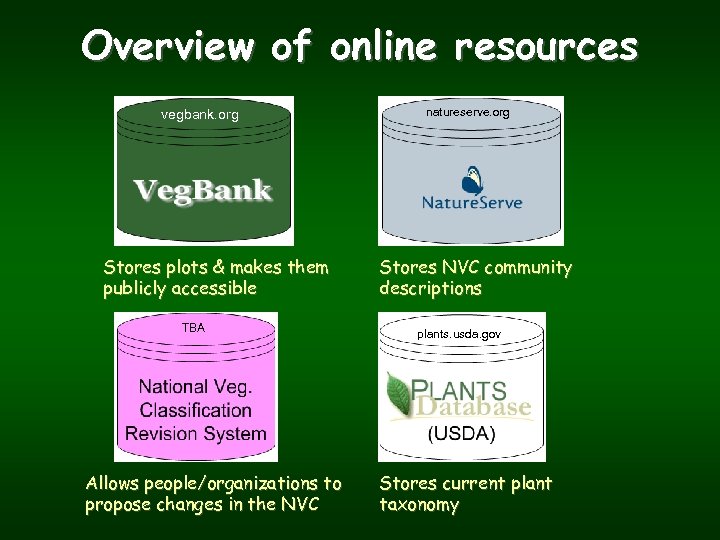
Overview of online resources vegbank. org Stores plots & makes them publicly accessible TBA Allows people/organizations to propose changes in the NVC natureserve. org Stores NVC community descriptions plants. usda. gov Stores current plant taxonomy
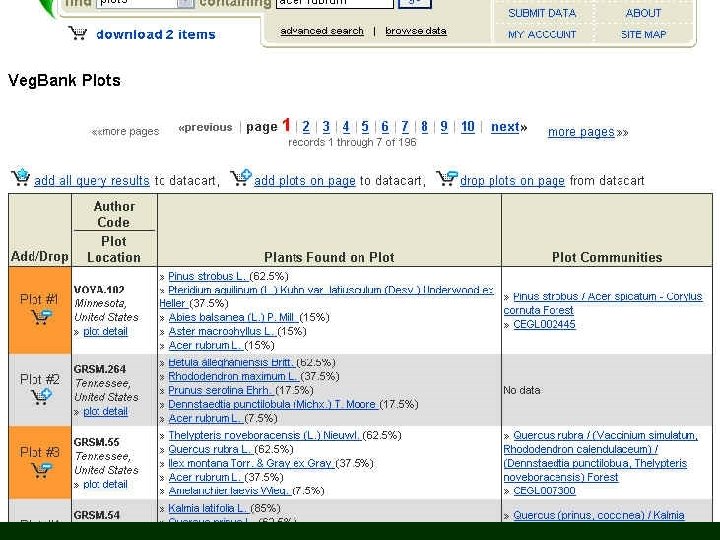
Veg. Bank • The ESA Vegetation Panel is developing a public archive for vegetation plots known as Veg. Bank (http: //vegbank. org). • Veg. Bank is expected to function for vegetation plot data in a manner analogous to Gen. Bank. • Primary data will be archived for - Documentation & citation - Discovery & access - Analysis
Veg. Bank applications • • Vegetation classification Vegetation occurrence (EO) Vegetation/taxon monitoring & resurvey High-quality ground truth points Species presence & absence for modeling Community assembly Ecological attributes of taxa Indicator taxa for taxa/communities
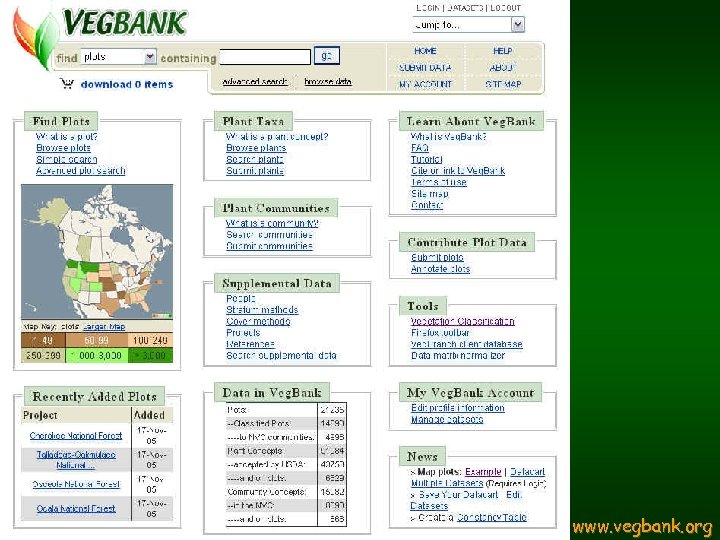
www. vegbank. org
T
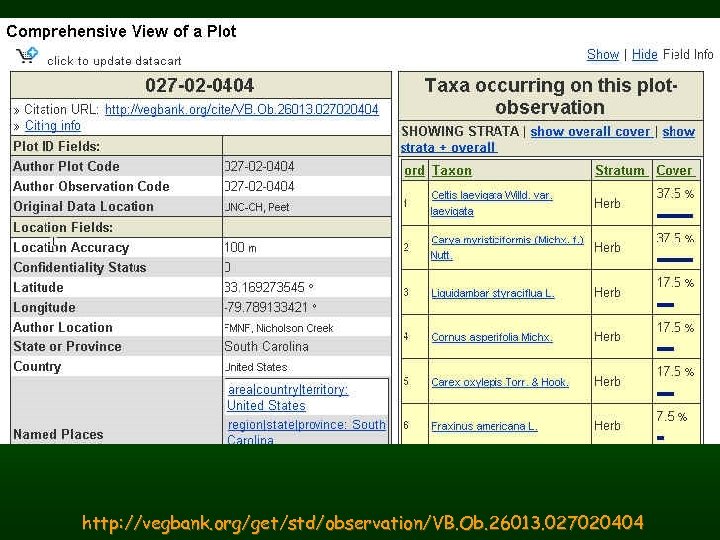
http: //vegbank. org/get/std/observation/VB. Ob. 26013. 027020404
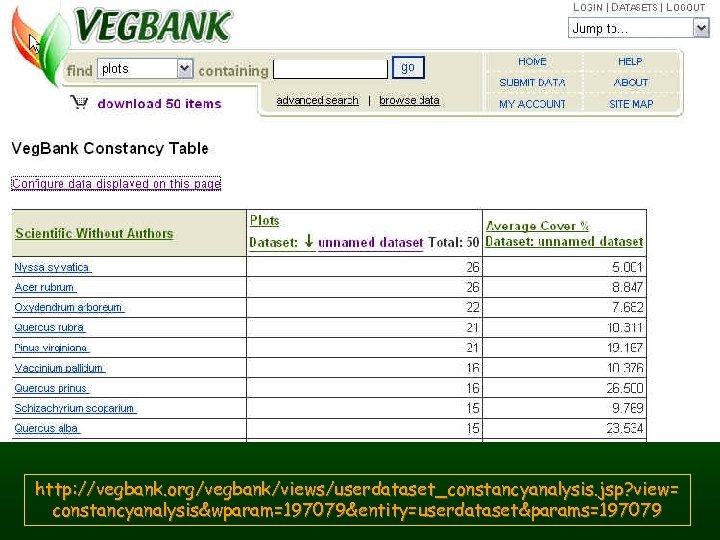
http: //vegbank. org/vegbank/views/userdataset_constancyanalysis. jsp? view = constancyanalysis&wparam=197079&entity=userdataset¶ms=197079
Veg. Bank data are open access • All data in Veg. Bank are freely available to the public (except for embargoed location data). • Key data can be viewed by a simple web link. (http: //vegbank. org/get/std/observation/5153, 5906)
Veg. Branch Access database • Free download from Veg. Bank • Data entry tools & forms • Local plot database system • Legacy data migration tools • Automated export to Veg. Bank • Easy import from Veg. Bank
Taxonomic database challenge: Standardizing organisms and communities The problem: Integration of data potentially representing different times, places, investigators and taxonomic standards. The traditional solution: A standard list of organisms / communities.
Standardized taxon lists fail to allow dataset integration The reasons include: • The user cannot reconstruct the database as viewed at an arbitrary time in the past, • Taxonomic concepts are not defined (just lists), • Multiple party perspectives on taxonomic concepts and names cannot be supported or reconciled.
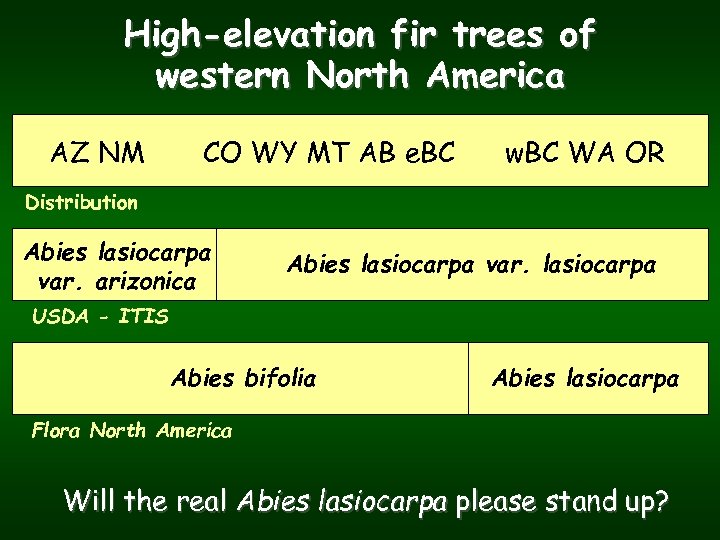
High-elevation fir trees of western North America AZ NM CO WY MT AB e. BC w. BC WA OR Distribution Abies lasiocarpa var. arizonica Abies lasiocarpa var. lasiocarpa USDA - ITIS Abies bifolia Abies lasiocarpa Flora North America Will the real Abies lasiocarpa please stand up?
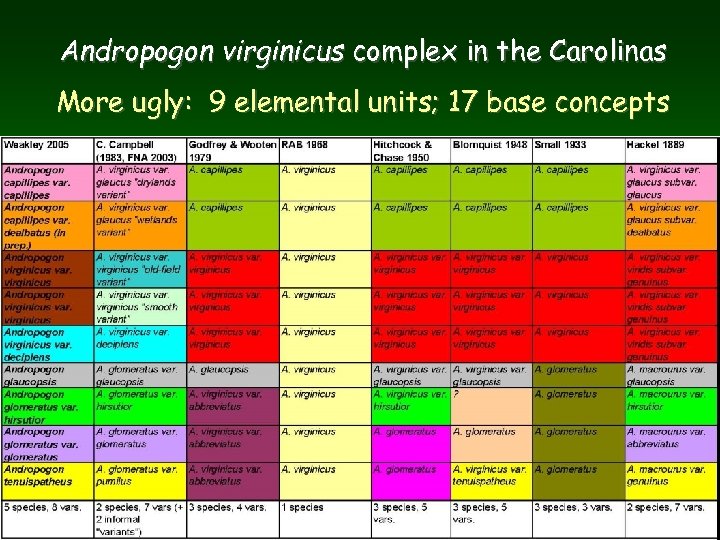
Andropogon virginicus complex in the Carolinas More ugly: 9 elemental units; 17 base concepts
Toward concept-based taxonomy • Veg. Bank provides concept-based taxonomy and dataset resolution. • Veg. Bank aims to provide an initial set of concept relationships for use by USDA PLANTS and ITIS.
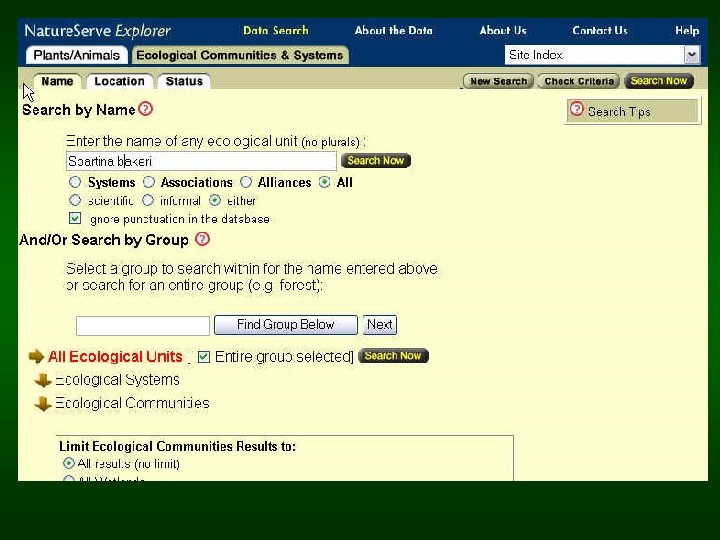
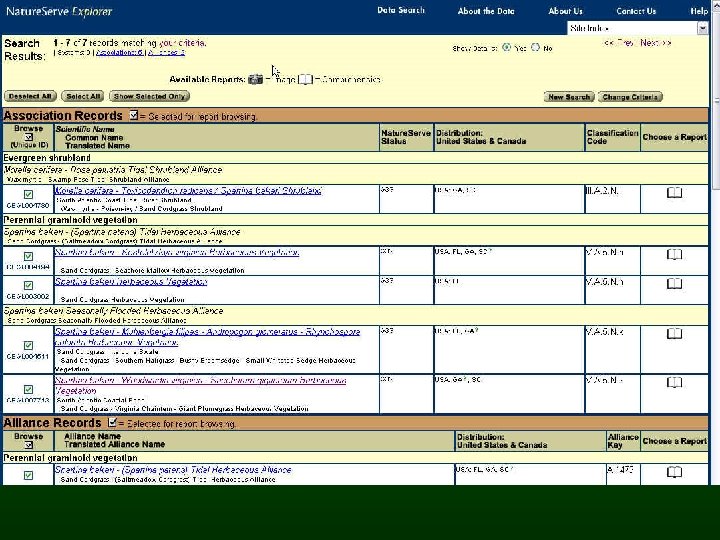
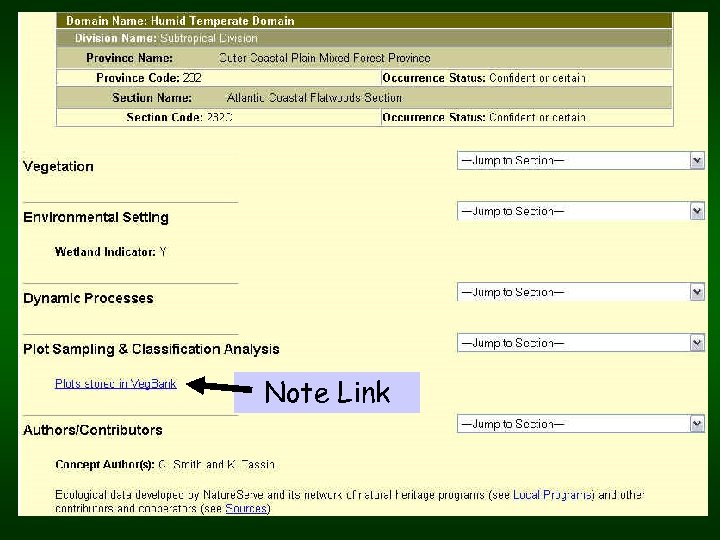
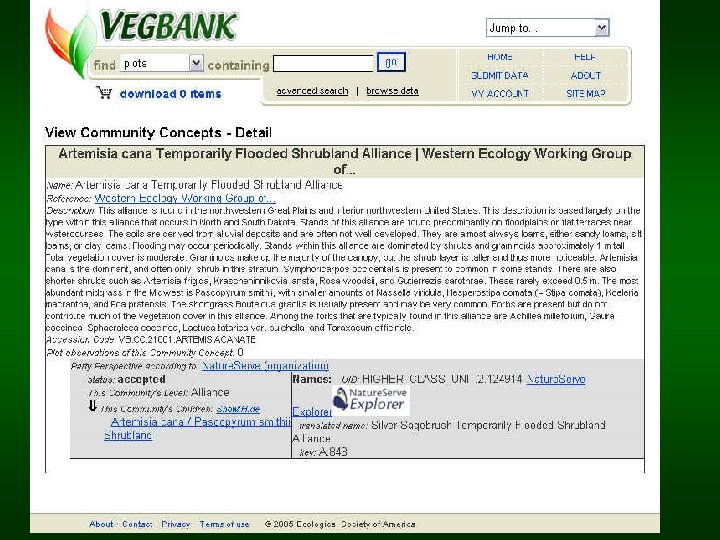
Public access to the NVC • Nature. Serve Explorer • Veg. Bank
T
T
Note Link T
T
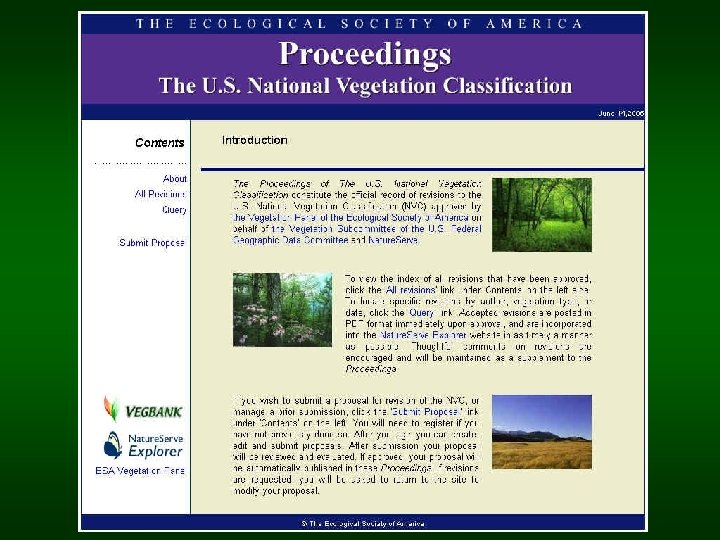
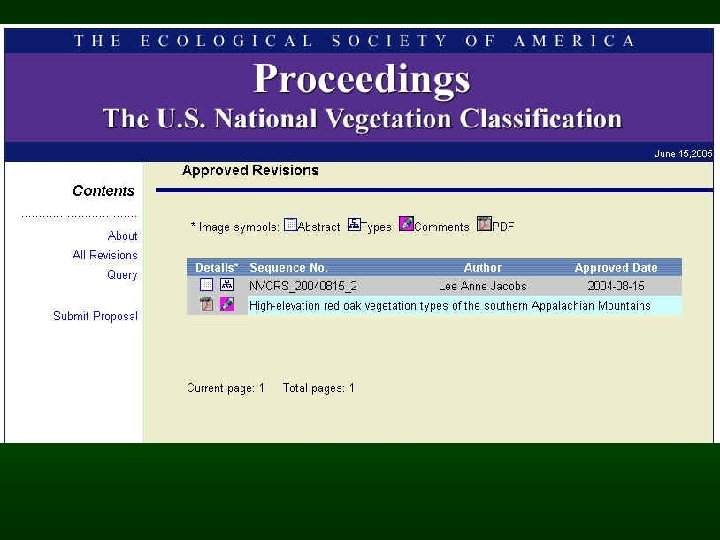
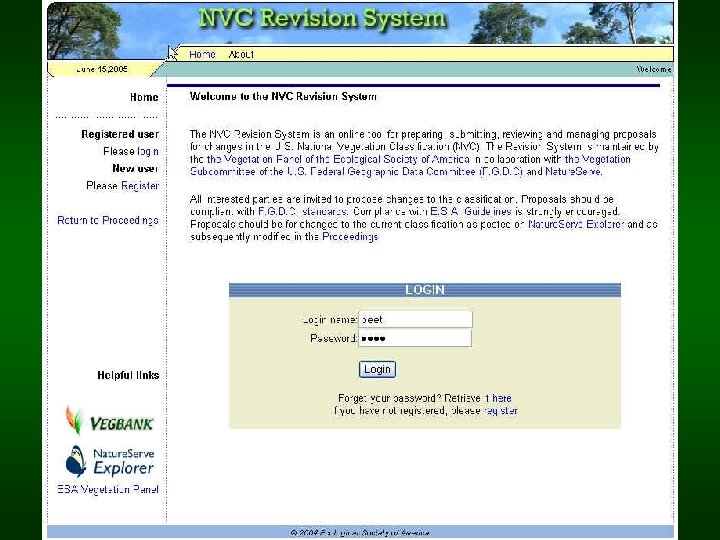
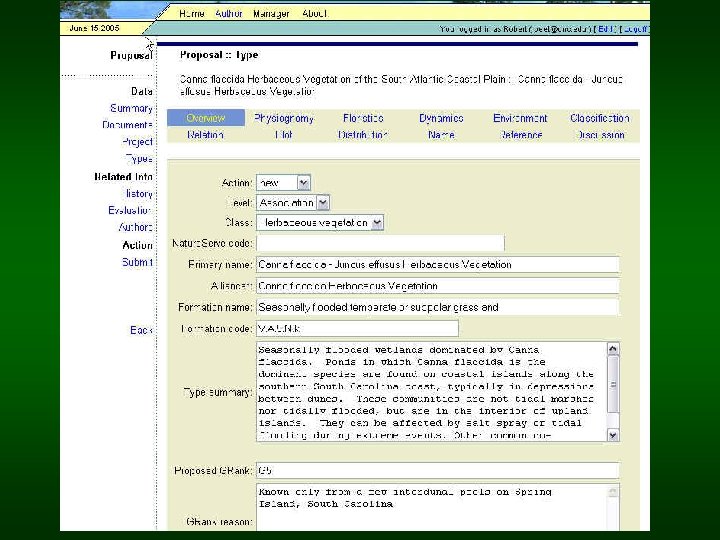
NVC Peer Review • Goal – The NVC must be open in the sense that any person (independently or representing some institution) is free to submit proposed revisions. – The rules, standards, and opportunities must be the same for all potential contributors. • Process – NVC Peer Review Board – oversight – Several Regional Editorial Boards
T
T
Concluding remarks • Veg. Bank, the NVC Proceedings, and the NVC Revision System are being used to test and demonstrate implementation strategies for the proposed FGDC Vegetation Standards. • The ESA Vegetation Panel looks foreword to continued collaboration with its partner organizations (GAP, FGDC, Nature. Serve, and NBII) in the advancement of an open US National Vegetation Classification.
We are pleased to acknowledge the support and cooperation of Ecological Society of America National Center for Ecological Analysis and Synthesis Federal Geographic Data Committee National Biological Information Infrastructure Gap Analysis Program National Science Foundation
Скачать презентацию An information infrastructure for vegetation science Robert K
91da6eba3a8597c33c66507b711b1315.ppt