 Скачать презентацию An Evidence Based Approach to Mental Health Dr
b56932c24b831ca0c9d2e4a4dc67160e.ppt
- Количество слайдов: 19



An Evidence Based Approach to Mental Health Dr. Louise Oland Specialist Senior Educational Psychologist and Youth Mental Health First Aid Trainer
Aims • To give an overview of the national picture of mental health • Evidence for what works to support young people in this area • To reflect on practical solutions for your setting
Mental Health: Definition “A state of wellbeing in which every individual recognises his or her own potential, can cope with the normal stresses of life, can work productively and fruitfully, and is able to make a contribution to his or her own community. ” World Health Organization, 2014
True or False? a) 1 in 4 adults are likely to have a mental health problem in any given year b) Half of all mental ill health starts before age 18 c) Mental ill health is the second largest cause of disability in the UK d) 6% YP may have self-harmed (based on self report data) e) Suicide is the leading cause of death for YP (up to age 35) f) 1 in 10 children are likely to have a mental health problem in any given year
National Picture • One in four adults and one in ten children are likely to have a mental health problem in any given year (Mental Health Core Skills Framework, 2016). • Half of all mental ill health starts before age 14 (Future in Mind, 2015) • 75% of mental health problems in adult life start before the age of 18 (Future in Mind, 2015) • Mental ill health is largest cause of disability in the UK (No Health without Mental Health, 2011) • 6%-20% YP may have self-harmed (Improving YP’s Health and Wellbeing, 2015) • Suicide is the leading cause of death for YP (up to age 35) (Papyrus, and Royal College of Paediatrics and Child Health)
Govt. Expectations • 5 year plan Children – increasing access from 25% to 35% by 2020/21 • - eating disorders 95% target • Will be training more people • 5 Year plan Adults – 60% first episode psychosis – treatment within 2 weeks • - Individual placement and support – employment specialists within these services to be expanded • IAPT – psychosis, bipolar disorder and personality disorder • “over time we would expect to see all schools providing access to counselling services. ” (Counselling in Schools, 2016)
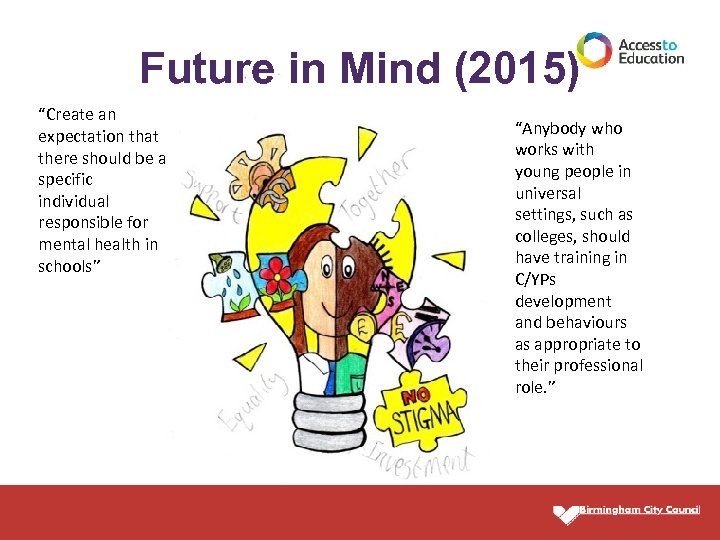
Future in Mind (2015) “Create an expectation that there should be a specific individual responsible for mental health in schools” “Anybody who works with young people in universal settings, such as colleges, should have training in C/YPs development and behaviours as appropriate to their professional role. ”
• • Evidence Base Promotion rather than prevention Modify the environment Support to manage transitions Targeted intervention based on CBT - context - experiential - skills competence - sound theoretical base - explicit guidelines/manualised - complete and accurate implementation
Evidence Base • FRIENDS resilience building programme www. friendsresilience. org • New areas: Mindfulness. b www. mindfulnessinschools. org : on line resources (Mood. GYM) www. youthwellbeingdirectory. co. uk
Policies/Guidance • Promoting children and young people’s emotional health and well-being (Public Health England & Children and YP’s Mental Health Coalition, 2015) • Improving YP’s health and wellbeing (Public Health England & Association for YP’s Health, 2015) • Future in Mind (Department of Health, 2015)
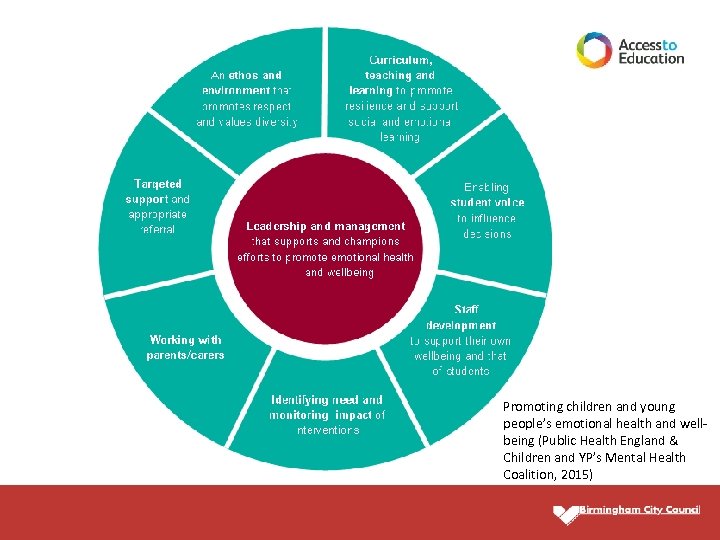
Promoting children and young people’s emotional health and wellbeing (Public Health England & Children and YP’s Mental Health Coalition, 2015)
Further training • Warwick et al (2006) – tiered professional development programme • Youth Mental Health First Aid – www. mhfaengland. org • Mind. Ed (www. minded. org. uk) • More specialised training, e. g. Suicide prevention, Dealing with self harm, CBT, coaching, person centred approaches
Evidence of impact • • Retention Attainment YP views Destinations Reduction in support www. acseed. org www. wellbeingcharter. org. uk
Before you leave… • Declaration Turn to the person next to you and state one thing that you will do following this workshop.
References • • • Warwick, I. , Maxwell, C. , Simon, A. , Statham, J and Aggleton, P. (2006) Mental Health and emotional well-being of students in further education – a scoping study. Thomas Coram Research Unit: Institute of Education, University of London Green H, Mc. Ginnity A, Meltzer H, Ford T and Goodman R (2005) Mental health of children and young people in Great Britain, London, Palgrave Macmillan Harden, A. , Rees, R. , Shepherd, J. , Brunton, G. , Oliver, S. and Oakley, A. (2001) Young People and Mental Health: a systematic review of research on barriers and facilitators, London, EPPI-Centre. http: //eppi. ioe. ac. uk/EPPIWeb. Content/hp/reports/mental_health. pdf Accessed 20 Feb 2017 NHS (2016) Implementing the five year forward view for mental health. Caulfield, R. (2016) Mental Health webinar. Association of Colleges. Accessed 5 Jan 2017 Future in mind DOH (2015 ) https: //www. gov. uk/government/uploads/system/uploads/attachment_data/file/414024/Childrens_Mental_Health. p df Accessed 20 Feb 2017 Murphy, M. , and Fonagy, P. (2012) Mental health problems in children and young people. Annual report of the Chief Medical Officer 2012: London: Department of Health Foster, A. (2005) Realising the potential: a review of the future role of further education colleges, Annesley, Df. ES Publications http: //dera. ioe. ac. uk/5535/1/realising 06. pdf Accessed 20 Feb 2017 Aston H. J. (2014) An ecological model of mental health promotion for school communities: adolescent views about mental health promotion in secondary schools in the UK, International Journal of Mental Health Promotion, 16: 5, 289 -307, Department of Health and developed in collaboration by Skills for Health, Skills for Care and Health Education England (2016). Mental Health Core Skills Education and Training Framework Borrill, J. & Kuczynska, p. (2013) Evaluation of Youth Mental Health First Aid training in the North-East of England. University of Westminster, Accessed via www. mhfaengland. org. uk
References • • • Education Policy Institute Submission Health Select Committee Inquiry on children and young people’s mental health – the role of education https: //epi. org. uk/wp-content/uploads/2017/01/Health-Select-Committee. Submission_PDF. pdf Accessed 22 Feb 2017 Barrett, P. M. , Farrell, L. J. , Ollendick, T. H. and Dadds, M. (2006), Long-term outcomes of an Australian universal prevention trial of anxiety and depression symptoms in children and youth: an evaluation of the FRIENDS programme, Journal of Clinical Child and Adolescent Psychology, Vol. 35 No. 3, pp. 403 -11. Stallard, P. , Simpson, N. , Anderson, S. , Hibbert, S. , Osborn and C. (2007), The FRIENDS emotional health programme: initial findings from a school-based project, Child and Adolescent Mental Health, Vol. 12 No. 1, pp. 327. Wells, J. , Barlow, J. and Stewart-Brown, S. (2003), A systematic review of universal approaches to mental health promotion in schools, Health Education, Vol. 103 No. 4, pp. 197 -220. Green, J. , Howes, F. , Waters, E. , Maher, E. and Oberklaid, F. (2005), Promoting the social and emotional health of primary school-aged children: reviewing the evidence base for school-based interventions, International Journal of Mental Health Promotion, Vol. 7 No. 3, pp. 30 -6. Durlak, J. A. and Wells, A. M. (1997), Primary prevention mental health programs for children and adolescents: a meta-analytic review, American Journal of Community Psychology, Vol. 25 No. 2, pp. 115 -52. Maxwell, C. , Aggleton, P. , Warwick, I. , Yankah E. , Hill, V. , & Mehmedbegovic, D. (2008), Supporting children's emotional wellbeing and mental health in England: a review, Health Education, Vol. 108 Iss: 4 pp. 272 – 286 Cane F. , & Oland, L. , (2014) Evaluating the outcomes and implementation of a Ta. MHS (Targeting Mental Health in Schools) project in four West Midlands (UK) schools using activity theory, Educational Psychology in Practice: Vol. 31, 1. pp. 1 -20 http: //www. rcpch. ac. uk/improving-child-health/child-mortality www. papyrus-uk. org/
References • • • Weeks, C. , Hill, V. & Owen, C. (2016): Changing thoughts, changing practice: examining the delivery of a group CBT-based intervention in a school setting , Educational Psychology in Practice, pp 1 -15 Higgins, E. , & O’Sullivan, S. (2015) What Works”: systematic review of the “FRIENDS for Life” programme as a universal school-based intervention programme for the prevention of child and youth anxiety, Educational Psychology in Practice, 31: 4, 424 -438, Ardern, C. (2016) How does Mindfulness training change the narratives of young people identified as having behavioural difficulties? An exploratory study, Educational Psychology in Practice, 32: 4, 374 -394, Mindfulness in Schools. (2011). Mindfulness in Schools project. Retrieved from http: //Mindfulnessinschools. org Accessed 7 Jan 2017 Kabat-Zinn, J. (2003). Mindfulness-based interventions in context: Past, present, and future. Clinical Psychology: Science and Practice, 10(2), 144– 156. Burke, C. (2010). Mindfulness-based approaches with children and adolescents: A preliminary review of current research in an emergent field. Journal of Child and Family Studies, 19(2), 133– 144. Weare, K. , & Hind, M. (2011) Mental health promotion and problem prevention in schools: what does the evidence say? Health Promotion International, Vol. 26 No. S 1 pp 29 -69 Clarke, A. M. , Kuosmanen, T. , Barry, M. (2015) A Systematic Review of Online Youth Mental Health Promotion and Prevention Interventions. Journal Youth Adolescence (2015) 44: 90– 113 www. oxfordmindfulness. org Mindfulness CPD event, Birmingham EPS (2016) (unpublished) Improving young people’s health and well being (2015) Public Health England Association for Young People’s Health; London
Helpful Resources for young people • Teenage Health Freak – www. teenagehealthfreak. org • www. moodgym. anu. edu. au • Young Minds – www. youngmings. org. uk • ‘Choosing What is Best for you’ guide – www. annafreudcentre. org/ebpu/ • Youthspace – www. youthspace. me/ • Royal College of Psychiatrists – http: //www. rcpsych. ac. uk/mentalhealthinfoforall/youngpeop le. aspx
Sources of help for Adults • GP Surgery – GP, Counselling – Adult Mental Health Team • Mind Helpline tel 0300 123 3393 www. mind. org. uk • www. rethink. org • Samaritans tel 116 123. www. samaritans. org
Скачать презентацию An Evidence Based Approach to Mental Health Dr
b56932c24b831ca0c9d2e4a4dc67160e.ppt