 Скачать презентацию An Employer s Obligations and Opportunities Under the Affordable
f0c095a3ec40c98605eaac11ae8702dd.ppt
- Количество слайдов: 92



An Employer’s Obligations and Opportunities Under the Affordable Care Act By: Nicole Radziewicz, Esq. Allen Warshaw, Esq. Renee Martin, Esq. 1
INTRODUCTION § Overview of ACA topics, including: § Employer Mandate § Individual Mandate § SHOP Marketplace § Medicaid Expansion § Grandfathered Plans § Can you keep your insurance § Contraceptive Mandate. © 2013 Rhoads & Sinon LLP. All Rights Reserved. 2
EMPLOYER MANDATE § POSTPONED UNTIL 2015 § Employers should be in the process of determining: § (1) Whether they are “large employers” subject to the mandate; § (2) If so, the number of full-time workers within their employment that are eligible for coverage; § (3) Measurement periods for ongoing and variable hour employees; § (4) Whether the health plan provides “minimum” and “affordable” coverage; § (5) Potential monetary penalties for non-compliance, and § (6) Whether required notices and written policies are in place . © 2013 Rhoads & Sinon LLP. All Rights Reserved. 3
EMPLOYER MANDATE § Large Employers Subject to the Mandate § “Large employers “are those “who employed an average of at least 50 full-time employees on business days during the preceding calendar year. ” § Under the ACA, a “full-time employee” is one that, “with respect to any month, is employed on average at least 30 hours of service per week” (or one hundred thirty hours (130) per month). § Part-time and seasonal employees are taken into consideration under the full-time equivalent (“FTE”) method. § An employer determines the number of full-time equivalents (FTEs) by dividing the total number of hours worked by part-time and seasonal employees each month by one hundred twenty (120) - the result being the number of equivalents. § Note, seasonal employees are considered to an extent. © 2013 Rhoads & Sinon LLP. All Rights Reserved. 4
EMPLOYER MANDATE § The “large employer” determination is measured on a controlled group basis § Employees of a controlled group of corporations, partnerships or proprietorships under common control, affiliated services group or others as prescribed by Treasury. . © 2013 Rhoads & Sinon LLP. All Rights Reserved. 5
EMPLOYER MANDATE § Large employers must offer health coverage that is “affordable” and of “minimum value” to substantially all (95%) of their “fulltime employees, ” and their dependents, to avoid monetary penalties. § Dependents are the employee’s children under the age of 26. § Dependents DO NOT include spouses § Questions surrounding affordability of dependent care . © 2013 Rhoads & Sinon LLP. All Rights Reserved. 6
EMPLOYER MANDATE §Employers do not have to offer health insurance coverage to part-time or seasonal employees, including former full-time employees who are now parttime. . © 2013 Rhoads & Sinon LLP. All Rights Reserved. 7
EMPLOYER MANDATE § Employees that are reasonably expected to be employed 30 hours or more per week on average (and who are not seasonal employees) must be offered health insurance within their first ninety (90) days of employment. . © 2013 Rhoads & Sinon LLP. All Rights Reserved. 8
EMPLOYER MANDATE § IRS has provided for the implementation of measurement and stability periods § Used to keep track of the status of ongoing employees § Used to determine the status of new variable hour or seasonal employees if employers are unsure whether they will be working 30 hours per week on average. § Should have written policies in place regarding the use of measurement and stability periods. Specific rules regarding their implementation . © 2013 Rhoads & Sinon LLP. All Rights Reserved. 9
EMPLOYER MANDATE § Measurement periods may range between 3 and 12 months. Subsequent stability periods may range between 6 and 12 months. § You may have an administrative period of ninety (90) days in between the measurement and stability periods but the initial measurement period and the administrative period combined cannot extend beyond the last day of the first calendar month beginning on or after the employee’s one year anniversary (up to 13 mos. ) § Measurement and stability periods must uniformly apply to all employees. Distinctions are only allowed with regard to: § Salaried and hourly employees § Employees located in different states § Employees working at different business entities . © 2013 Rhoads & Sinon LLP. All Rights Reserved. 10
EMPLOYER MANDATE § If it is difficult to determine hours worked by salaried employees, one of three methods set forth by the IRS may be used: § Actual hours worked from payroll records § Days-worked equivalency of 8 hours per day § Weeks worked equivalency of 40 hours per week . © 2013 Rhoads & Sinon LLP. All Rights Reserved. 11
EMPLOYER MANDATE § Employer- sponsored plans must be of “minimum value” and must be “affordable” § A plan is of “minimum value” if it covers at least 60 percent of the total allowed cost of benefits that are expected to be incurred under the plan. § Not required to provide essential health benefits but MV will be determined in comparison to standard pop. claims data based on: § Hospital/ER Services § Physician/mid-level practitioner care § Pharmacy benefits § Lab/imaging services § Use minimum value calculator released by HHS or get a certification from a member of the American Academy of Actuaries to ensure of MV. © 2013 Rhoads & Sinon LLP. All Rights Reserved. 12
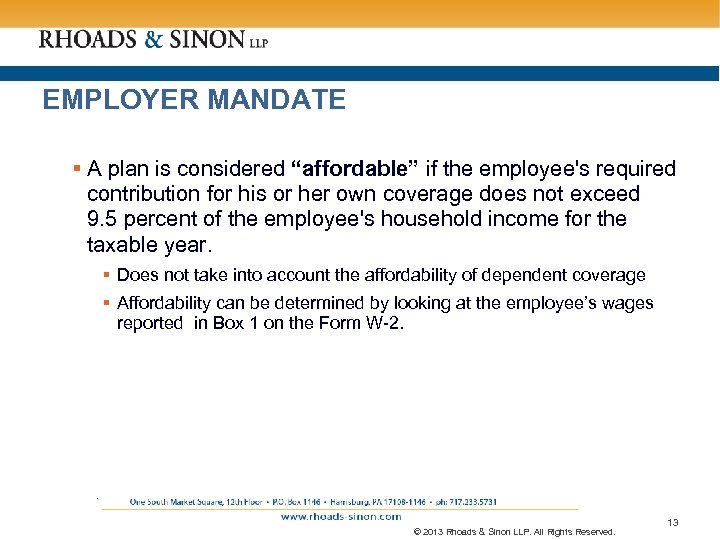
EMPLOYER MANDATE § A plan is considered “affordable” if the employee's required contribution for his or her own coverage does not exceed 9. 5 percent of the employee's household income for the taxable year. § Does not take into account the affordability of dependent coverage § Affordability can be determined by looking at the employee’s wages reported in Box 1 on the Form W-2. . © 2013 Rhoads & Sinon LLP. All Rights Reserved. 13
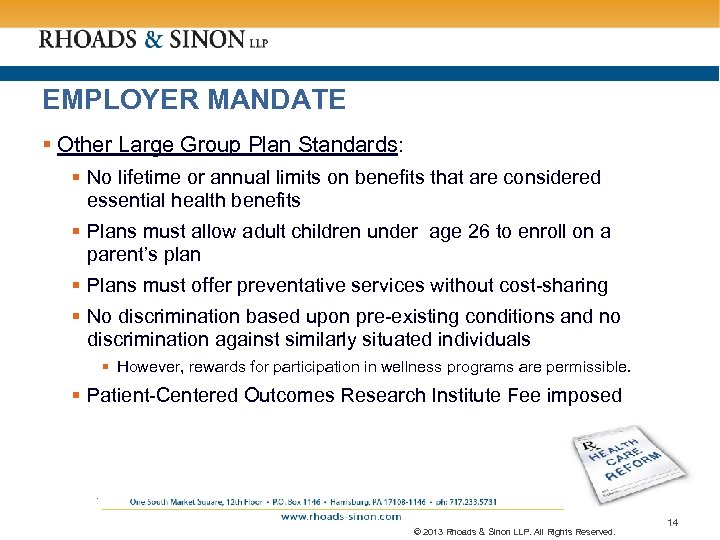
EMPLOYER MANDATE § Other Large Group Plan Standards: § No lifetime or annual limits on benefits that are considered essential health benefits § Plans must allow adult children under age 26 to enroll on a parent’s plan § Plans must offer preventative services without cost-sharing § No discrimination based upon pre-existing conditions and no discrimination against similarly situated individuals § However, rewards for participation in wellness programs are permissible. § Patient-Centered Outcomes Research Institute Fee imposed . © 2013 Rhoads & Sinon LLP. All Rights Reserved. 14
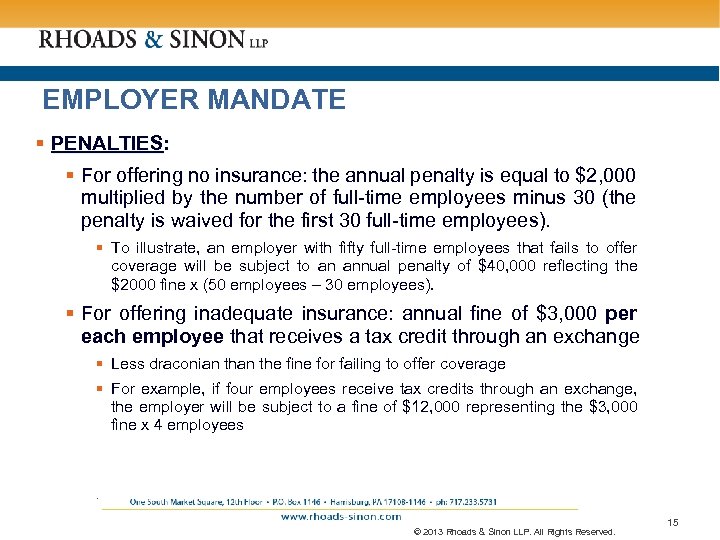
EMPLOYER MANDATE § PENALTIES: § For offering no insurance: the annual penalty is equal to $2, 000 multiplied by the number of full-time employees minus 30 (the penalty is waived for the first 30 full-time employees). § To illustrate, an employer with fifty full-time employees that fails to offer coverage will be subject to an annual penalty of $40, 000 reflecting the $2000 fine x (50 employees – 30 employees). § For offering inadequate insurance: annual fine of $3, 000 per each employee that receives a tax credit through an exchange § Less draconian the fine for failing to offer coverage § For example, if four employees receive tax credits through an exchange, the employer will be subject to a fine of $12, 000 representing the $3, 000 fine x 4 employees . © 2013 Rhoads & Sinon LLP. All Rights Reserved. 15
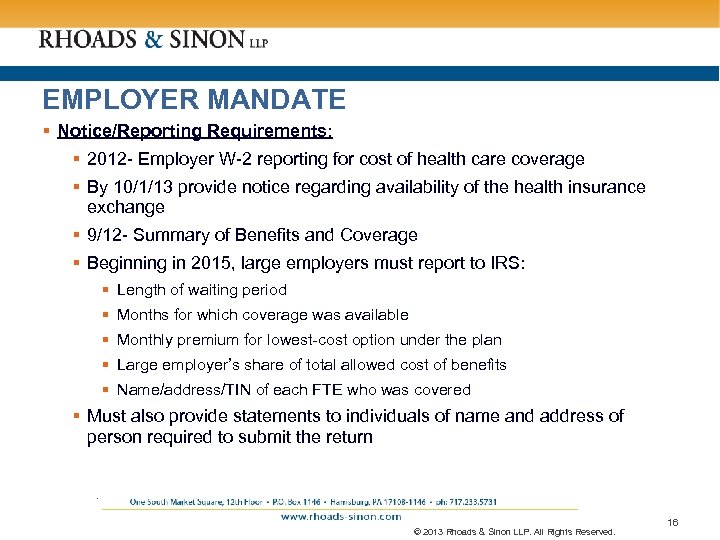
EMPLOYER MANDATE § Notice/Reporting Requirements: § 2012 - Employer W-2 reporting for cost of health care coverage § By 10/1/13 provide notice regarding availability of the health insurance exchange § 9/12 - Summary of Benefits and Coverage § Beginning in 2015, large employers must report to IRS: § Length of waiting period § Months for which coverage was available § Monthly premium for lowest-cost option under the plan § Large employer’s share of total allowed cost of benefits § Name/address/TIN of each FTE who was covered § Must also provide statements to individuals of name and address of person required to submit the return . © 2013 Rhoads & Sinon LLP. All Rights Reserved. 16
![INDIVIDUAL MANDATE § The individual mandate, requires “applicable individual[s]” to maintain “minimum essential” health](https://present5.com/presentation/f0c095a3ec40c98605eaac11ae8702dd/image-17.jpg "INDIVIDUAL MANDATE § The individual mandate, requires “applicable individual[s]” to maintain “minimum essential” health")
INDIVIDUAL MANDATE § The individual mandate, requires “applicable individual[s]” to maintain “minimum essential” health insurance coverage, or face a mandatory “shared responsibility payment” . © 2013 Rhoads & Sinon LLP. All Rights Reserved. 17
INDIVIDUAL MANDATE § Persons not subject to penalty, include: § (i) persons with religious exemptions; § (ii) members of health sharing ministries; § (iii) individuals not lawfully present (not in the country); § (iv) incarcerated individuals § (v) persons who do not meet the income threshold for filing income tax returns; § (vi) members of Indian tribes; § (vii) persons who have breaks in coverage for no longer than three continuous months; § (viii) persons qualifying for a hardship exemption . © 2013 Rhoads & Sinon LLP. All Rights Reserved. 18
INDIVIDUAL MANDATE § Must have “minimum essential coverage” § Either employer-sponsored coverage, private insurance; or governmentsponsored insurance. § Exchanges: § Government-operated health insurance marketplaces offering qualified health insurance plans by competing companies. § Pennsylvania’s exchange is being operated by the federal government § Use of healthcare exchange in Massachusetts helped result in 97% coverage . © 2013 Rhoads & Sinon LLP. All Rights Reserved. 19
INDIVIDUAL MANDATE § Individual and small group plans must include ten essential health benefits: § Ambulatory patient services; § Emergency services; § Hospitalization; § Maternity and newborn care; § Mental health and substance use disorder services, including behavioral health treatment; § Prescription drugs; § Rehabilitative and habilitative services and devices; § Laboratory services; § Preventive and wellness services and chronic disease management; and § Pediatric services, including oral and vision care. . © 2013 Rhoads & Sinon LLP. All Rights Reserved. 20
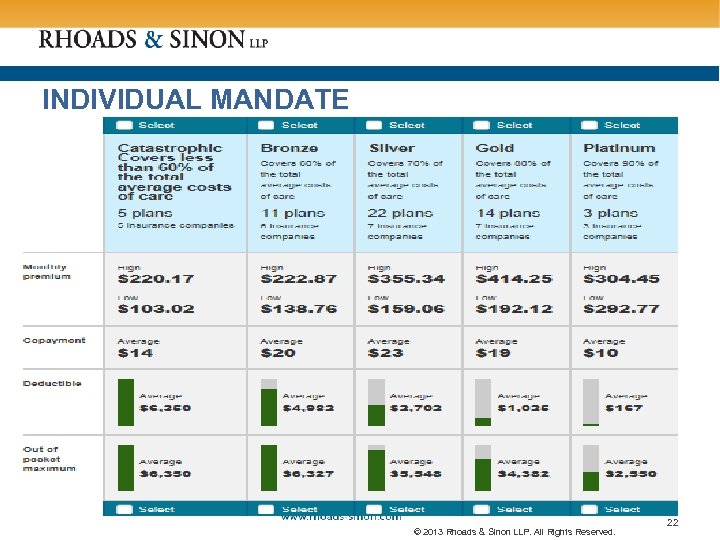
INDIVIDUAL MANDATE § Benefit Plan Tiers § Bronze: actuarial value of 60% of plan costs § Silver: actuarial value of 70% of plan costs § Gold: actuarial value of 80% of plan costs § Platinum: actuarial value of 90% of plan costs § Catastrophic: available for individuals up to age 30. Coverage levels set at HSA current law . © 2013 Rhoads & Sinon LLP. All Rights Reserved. 21
INDIVIDUAL MANDATE . © 2013 Rhoads & Sinon LLP. All Rights Reserved. 22
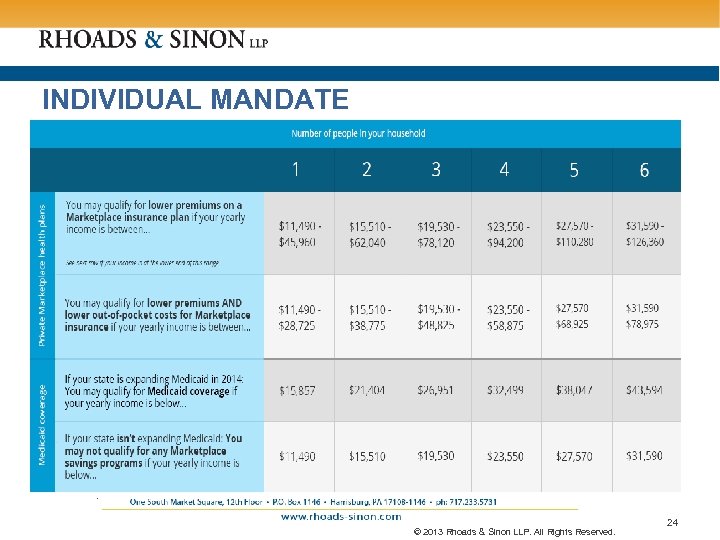
INDIVIDUAL MANDATE § Advance Premium Tax Credit § Those making up to 400% of the poverty level ($46, 000 for individuals/$94. 200 for families) will be eligible for subsidies in the form of advance premium tax credits (“APTC”) § Not eligible if have an offer of affordable coverage through employer or if eligible for government insurance . © 2013 Rhoads & Sinon LLP. All Rights Reserved. 23
INDIVIDUAL MANDATE . © 2013 Rhoads & Sinon LLP. All Rights Reserved. 24
INDIVIDUAL MANDATE § Advance Premium Tax Credit § Three ways it can be applied: § In its entirety, evenly across all monthly payments § In part towards monthly payments, with the balance being refunded as part of tax return § None of the credit is applied toward monthly payments, and it is refunded in its entirety as part of tax return § Changes in life such as marriage/divorce, births/deaths, change of jobs will affect eligibility. § Can immediately update information through exchange account § If information isn’t updated, may have to pay-in difference or will receive a refund. © 2013 Rhoads & Sinon LLP. All Rights Reserved. 25
INDIVIDUAL MANDATE § PENALTIES § Greater of: $695 per individual (up to $2085 per family) OR 2. 5% of household income § Phased-in: § 2014: $95. 00 or 1% of household income (higher of two) § 2015: $325 or 2% of household income (higher of two). © 2013 Rhoads & Sinon LLP. All Rights Reserved. 26
SMALL BUSINESS HEALTH OPTIONS PROGRAM § The Small Business Health Options Program (“SHOP”) Marketplace is open to employers with 50 or fewer full-time-equivalent employees (FTEs). Beginning in 2016, 100 or fewer FTEs. § Updated: the day before Thanksgiving the administration announced a one year delay of the online SHOP exchange. Small businesses must go through agents or brokers, or directly through health insurance companies, to sign up for plans and to receive tax credits, if qualified. . © 2013 Rhoads & Sinon LLP. All Rights Reserved. 27
SMALL BUSINESS HEALTH OPTIONS PROGRAM § According to HHS, advantages of SHOP include: § Controlling the coverage you offer and how much you pay toward employee premiums. § Obtaining ability to compare health plans online on an applesto-apples basis, which helps you make a decision that's right for your business. § Possibly qualifying for a small business health care tax credit worth up to 50% of your premium costs. You can still deduct from your taxes the rest of your premium costs not covered by the tax credit. Beginning 2014 the tax credit is available only for plans purchased through SHOP. . © 2013 Rhoads & Sinon LLP. All Rights Reserved. 28
SMALL BUSINESS HEALTH OPTIONS PROGRAM § You may qualify for employer health care tax credits if you have fewer than 25 full-time equivalent employees making an average of about $50, 000 a year or less. § To qualify for the Small Business Health Care Tax Credit, you must pay at least 50% of your full-time employees' premium costs. § You don’t need to offer coverage to your part-time employees or to dependents. § Starting in 2014, the tax credit is worth up to 50% of your contribution toward employees' premium costs (up to 35% for tax-exempt employers). § Sliding scale. The tax credit is highest for companies with fewer than 10 employees who are paid an average of $25, 000 or less. The smaller the business, the bigger the credit. . © 2013 Rhoads & Sinon LLP. All Rights Reserved. 29
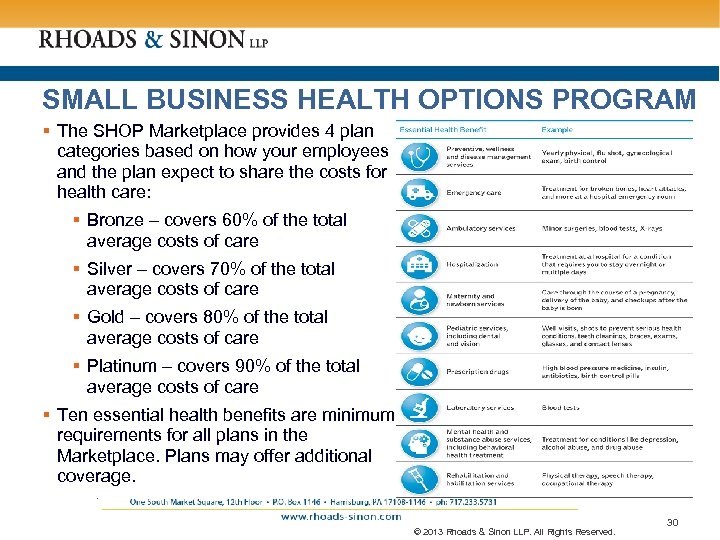
SMALL BUSINESS HEALTH OPTIONS PROGRAM § The SHOP Marketplace provides 4 plan categories based on how your employees and the plan expect to share the costs for health care: § Bronze – covers 60% of the total average costs of care § Silver – covers 70% of the total average costs of care § Gold – covers 80% of the total average costs of care § Platinum – covers 90% of the total average costs of care § Ten essential health benefits are minimum requirements for all plans in the Marketplace. Plans may offer additional coverage. . © 2013 Rhoads & Sinon LLP. All Rights Reserved. 30
SMALL BUSINESS HEALTH OPTIONS PROGRAM § ENROLLING IN SHOP § To start coverage on January 1, 2014, you must select a plan to offer your employees and your employees must enroll in the plan by December 15, 2013. You submit your employees’ applications along with your completed employer application. § You can apply for coverage any time after that. To get coverage, you must submit your completed application along with your employees’ applications by the 15 th of any month for coverage to take effect on the 1 st of the following month. § For example, if you enroll by April 15 th, coverage will begin May 1 st. If you enroll between April 16 th and April 30 th, coverage will begin June 1 st. § You will be able to use a licensed agent or broker to provide help or handle your SHOP business. You won’t pay more if you use a SHOP agent or broker. . © 2013 Rhoads & Sinon LLP. All Rights Reserved. 31
SMALL BUSINESS HEALTH OPTIONS PROGRAM § How to sign up for a Marketplace account: § Visit Health. Care. gov/marketplace/shop/ and click on the “Apply Now” link. Click on the link to “Set up a Marketplace account online” and follow 3 steps: § 1. Provide some basic information like your name, address, and email address § 2. Choose a user name and password § 3. Create security questions for added protection § You’ll get an email confirming account creation. The email will explain how to access your Marketplace account and go to the application. Before starting the SHOP application, you’ll be asked to complete an identity proofing section. . © 2013 Rhoads & Sinon LLP. All Rights Reserved. 32
MEDICAID EXPANSION § The current Medicaid program generally offers federal funding to States to assist pregnant women, children, needy families, the blind, the elderly, and the disabled in obtaining medical care. 42 U. S. C. § 1396 d(a). § The Affordable Care Act provides for the expansion of the Medicaid program to increase the number of individuals the States may cover. § Federal government will cover the full cost of newly eligible Medicaid beneficiaries for the first 3 years and not less than 90% of the cost in years thereafter § Individuals earning up to 133% of the FPL (138% using the current formula) § $15, 800 for individuals, $32, 400 families . © 2013 Rhoads & Sinon LLP. All Rights Reserved. 33
MEDICAID EXPANSION § States have the choice of whether or not to expand Medicaid per Nat'l Fed'n of Indep. Bus. v. Sebelius, 132 S. Ct. 2566, 2595 (2012). § Pennsylvania is considering an alternative expansion program § Affects approximately 520, 000 low-income Pennsylvanians § Follows Arkansas’ approach . © 2013 Rhoads & Sinon LLP. All Rights Reserved. 34
MEDICAID EXPANSION § The “Healthy Pennsylvania Plan” § Qualified individuals use Medicaid funds to purchase private insurance through the exchange § Cost-sharing requirements for current adult Medicaid recipients ─ accomplished through instituting a monthly premium on a sliding scale up to $25 for an individual and $35 for families § Work search requirement for all unemployed working-age Medicaid beneficiaries, with limited exceptions, connecting them to jobs and job training as needed through Pennsylvania’s Job. Gateway. SM . © 2013 Rhoads & Sinon LLP. All Rights Reserved. 35
MEDICAID EXPANSION § The “Healthy Pennsylvania Plan” § As of now NO PLAN – only Concepts § Need federal approval of a waiver § State needs to file a waiver application before process begins § It appears the Healthy Pennsylvania Plan contemplates a waiver similar to that CMS approved for Arkansas § But no work search requirement in Arkansas § AND the devil is in the details and there are not yet any details . © 2013 Rhoads & Sinon LLP. All Rights Reserved. 36
. © 2013 Rhoads & Sinon LLP. All Rights Reserved. 37
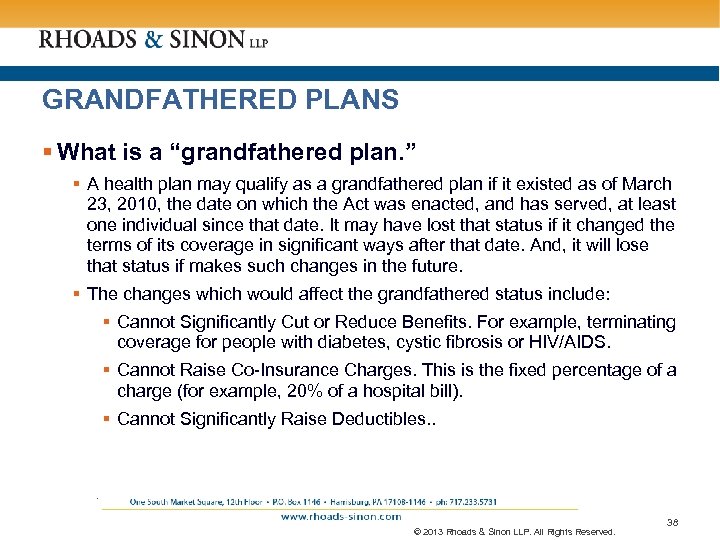
GRANDFATHERED PLANS § What is a “grandfathered plan. ” § A health plan may qualify as a grandfathered plan if it existed as of March 23, 2010, the date on which the Act was enacted, and has served, at least one individual since that date. It may have lost that status if it changed the terms of its coverage in significant ways after that date. And, it will lose that status if makes such changes in the future. § The changes which would affect the grandfathered status include: § Cannot Significantly Cut or Reduce Benefits. For example, terminating coverage for people with diabetes, cystic fibrosis or HIV/AIDS. § Cannot Raise Co-Insurance Charges. This is the fixed percentage of a charge (for example, 20% of a hospital bill). § Cannot Significantly Raise Deductibles. . . © 2013 Rhoads & Sinon LLP. All Rights Reserved. 38
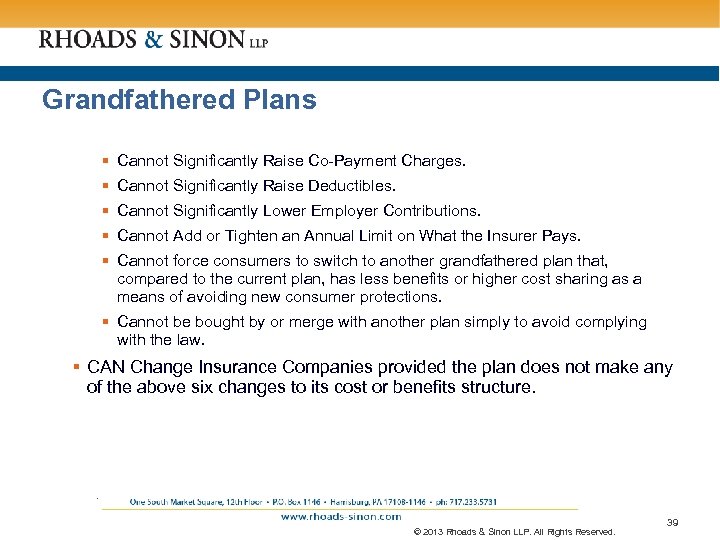
Grandfathered Plans § Cannot Significantly Raise Co-Payment Charges. § Cannot Significantly Raise Deductibles. § Cannot Significantly Lower Employer Contributions. § Cannot Add or Tighten an Annual Limit on What the Insurer Pays. § Cannot force consumers to switch to another grandfathered plan that, compared to the current plan, has less benefits or higher cost sharing as a means of avoiding new consumer protections. § Cannot be bought by or merge with another plan simply to avoid complying with the law. § CAN Change Insurance Companies provided the plan does not make any of the above six changes to its cost or benefits structure. . © 2013 Rhoads & Sinon LLP. All Rights Reserved. 39
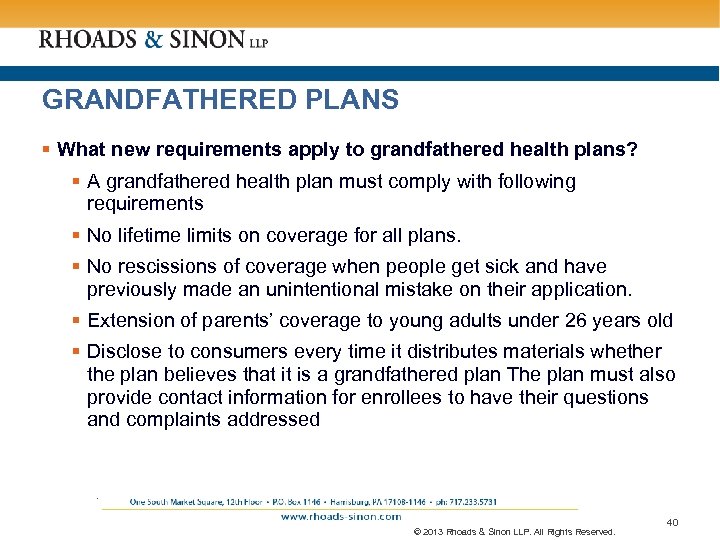
GRANDFATHERED PLANS § What new requirements apply to grandfathered health plans? § A grandfathered health plan must comply with following requirements § No lifetime limits on coverage for all plans. § No rescissions of coverage when people get sick and have previously made an unintentional mistake on their application. § Extension of parents’ coverage to young adults under 26 years old § Disclose to consumers every time it distributes materials whether the plan believes that it is a grandfathered plan The plan must also provide contact information for enrollees to have their questions and complaints addressed . © 2013 Rhoads & Sinon LLP. All Rights Reserved. 40
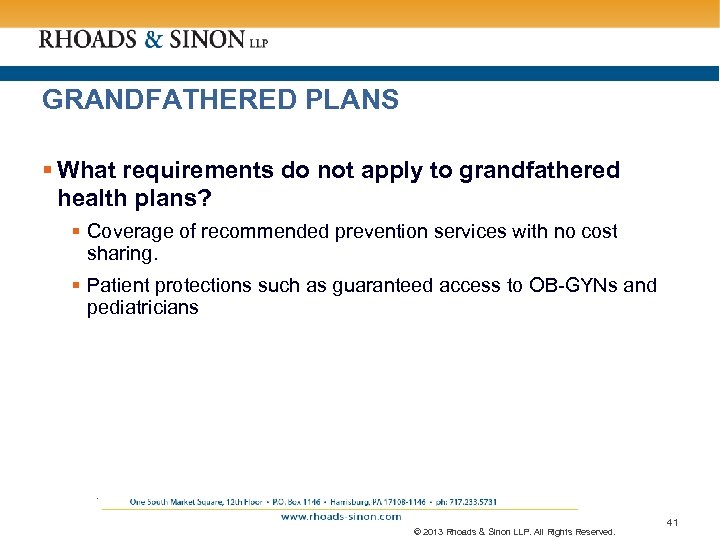
GRANDFATHERED PLANS § What requirements do not apply to grandfathered health plans? § Coverage of recommended prevention services with no cost sharing. § Patient protections such as guaranteed access to OB-GYNs and pediatricians . © 2013 Rhoads & Sinon LLP. All Rights Reserved. 41
Can you keep your insurance? § The Problem § The President Said that “if you like your plan you will be able to keep it. ” § Turned out not to be accurate § PPACA requires all insurance policies plans provide a certain minimum level of benefits § Many existing policies do not provide the required benefits § Insurance companies were required to cancel those policies. © 2013 Rhoads & Sinon LLP. All Rights Reserved. 42
. © 2013 Rhoads & Sinon LLP. All Rights Reserved. 43
Can you keep your insurance? § Under the Current Law – you can only keep your existing policy § if it is part of grandfathered plan § If it meets minimum benefit requirements § Many plans – mostly individual policies -- do not meet the minimum benefit requirement . © 2013 Rhoads & Sinon LLP. All Rights Reserved. 44
Can you keep your insurance? § The solution § Three alternatives on the table as of November 15 § President Obama – allow everyone to keep their existing policy for one or two years § House Republicans – allow everyone to keep their policies indefinitely and allow everyone to buy whatever kind of policy they want even if the policy does not meet the Act’s minimum requirements § Senate Democrats – allow everyone to keep their existing policy indefinitely . © 2013 Rhoads & Sinon LLP. All Rights Reserved. 45
Can you keep your insurance? § NONE OF THE ABOVE § Obama has declared that insurance companies may renew non-compliant policies for a year IF state insurance regulatory agency permits such renenwals § Many states have refused to permit such renewals § Pennsylvania is permitting them . © 2013 Rhoads & Sinon LLP. All Rights Reserved. 46
Can you keep your insurance? STAY TUNED . © 2013 Rhoads & Sinon LLP. All Rights Reserved. 47
CONTRACEPTION MANDATE § The preventative health provisions of the PPACA, require that all employers, with the exception of religious employers, must provide insurance that covers contraception and contraception counselling, without cost-sharing. § Effective August 1, 2013, a religious employer is defined as an employer that is organized and operates as a non-profit entity and is referred to in section 6033(a)(3)(A)(i) or (iii) of the Internal Revenue Code. § The full range of FDA-approved prescription contraceptive methods are included. . © 2013 Rhoads & Sinon LLP. All Rights Reserved. 48
Contraception Mandate § The final rules also lay out the accommodation for other non-profit religious organizations - such as non-profit religious hospitals and institutions of higher education - that object to contraceptive coverage. Under the accommodation these organizations will not have to contract, arrange, pay for or refer contraceptive coverage to which they object on religious grounds, but such coverage is separately provided to women enrolled in their health plans at no cost. . © 2013 Rhoads & Sinon LLP. All Rights Reserved. 49
Contraception Mandate § With respect to an insured health plan, including a student health plan, the non-profit religious organization provides notice to its insurer that it objects to contraception coverage. The insurer then notifies enrollees in the health plan that it is providing them separate no-cost payments for contraceptive services for as long as they remain enrolled in the health plan. § Similarly, with respect to self-insured health plans, the non-profit religious organization provides notice to its third party administrator that objects to contraception coverage. The third party administrator then notifies enrollees in the health plans that it is providing or arranging separate no-cost payments for contraceptive services for them for as long as they remain enrolled in the health plan. . © 2013 Rhoads & Sinon LLP. All Rights Reserved. 50
CONTRACEPTION MANDATE § Many for profit corporations and their owners rejected this accommodation § At least seventy lawsuits have been filed, with six Circuit Court splitting 4 -2 on the issue of whether the mandate, even as modified, violates the rights of corporations or their owners setting the stage for a Supreme Court intervention: . © 2013 Rhoads & Sinon LLP. All Rights Reserved. 51
Contraception Mandate § Hobby Lobby Stores, Inc. v. Sebelius, 723 F. 3 d 1114 (10 th Cir. 2013) § Conestoga Wood Specialties Corp. v. Sec'y of U. S. Dep't of Health & Human Servs. , 724 F. 3 d 377 (3 d Cir. 2013) § Autocam Corp. v. Sebelius, 2013 WL 5182544 (6 th Cir. Sept. 17, 2013) § Korte v. Sebelius, No. 3: 12 -CV-01072 -MJR (7 th Cir. Nov. 8, 2013) § Gilardi, et al v. HHS, No. 1: 13 -cv-00104 (D. C. Cir. Nov. 1, 2013) § O’Brien v. HHS (8 th Cir. November 27, 2013) . © 2013 Rhoads & Sinon LLP. All Rights Reserved. 52
CONTRACEPTION MANDATE § Cases involve the Religious Freedom Restoration Act (“RFRA”) § Under the RFRA, “[g]overnment shall not substantially burden a person's exercise of religion even if the burden results from a rule of general applicability [unless the burden] (1) is in furtherance of a compelling governmental interest; and (2) is the least restrictive means of furthering that compelling governmental interest. ” Conestoga Wood Specialties Corp. v. Sec'y of U. S. Dep't of Health & Human Servs. , 724 F. 3 d 377, 388 (3 d Cir. 2013). § Cases seek injunction against the contraception mandate . © 2013 Rhoads & Sinon LLP. All Rights Reserved. 53
CONTRACEPTION MANDATE § Hobby Lobby Stores, Inc. v. Sebelius, 723 F. 3 d 1114, 1133 (10 th Cir. 2013) § Two companies operating according to Christian principles brought suit § Argued contraception mandate violated their sincerely held religious beliefs § Tenth Circuit held that privately held, for-profit secular corporations were “persons, ” within the meaning of the RFRA § The Tenth Circuit went on to hold that, under RFRA, the plaintiffs established a likelihood of success that their rights under this statute are substantially burdened by the contraceptive-coverage requirement § A substantial burden on their religious beliefs was established by requiring them to compromise their religious beliefs or face substantial tax penalties. . © 2013 Rhoads & Sinon LLP. All Rights Reserved. 54
CONTRACEPTION MANDATE § Hobby Lobby Stores, Inc. v. Sebelius, 723 F. 3 d 1114, 1140 (10 th Cir. 2013) § Burden emanated from what plaintiffs described as “a sincere religious objection to providing coverage for Plan B and Ella since they believe those drugs could prevent a human embryo. . . from implanting in the wall of the uterus, causing the death of the embryo. ” § They alleged a “sincere religious objection to providing coverage for certain contraceptive [IUDs] since they believe those devices could prevent a human embryo from implanting in the wall of the uterus, causing the death of the embryo. ” § Further, objected to “participating in, providing access to, paying for, training others to engage in, or otherwise supporting” the devices and drugs that yield these effects. . © 2013 Rhoads & Sinon LLP. All Rights Reserved. 55
CONTRACEPTION MANDATE § Conestoga Wood Specialties Corp. v. Sec'y of U. S. Dep't of Health & Human Servs. , 724 F. 3 d 377, 388 (3 d Cir. 2013). § Plaintiffs were Conestoga Wood Specialities Corp. (a for-profit company operated according to religious principles), and its 100% shareholders, the Mennonite Hahn family § Held that for-profit company that created secular product and had no formal ties to church or other religious group did not fall within definition of “religious organization” with First Amendment right to free exercise of religion. § Held that a secular, for-profit corporation could not “exercise religion” within the meaning of Religious Freedom Restoration Act (RFRA). Thus, plaintiff Conestoga Wood did not have a claim under the RFRA. . © 2013 Rhoads & Sinon LLP. All Rights Reserved. 56
CONTRACEPTION MANDATE § Conestoga Wood Specialties Corp. v. Sec'y of U. S. Dep't of Health & Human Servs. , 724 F. 3 d 377, 388 (3 d Cir. 2013). § Thirdly the Court held that, in regard to the individual plaintiffs (the Hahn’s), the mandate did not “substantially burden” their religious exercise, in part, because “free exercise protections are not absolute, and that, while religious beliefs are to be accommodated, there is a point at which accommodations would ‘radically restrict the operating latitude of the legislature. ” . © 2013 Rhoads & Sinon LLP. All Rights Reserved. 57
CONTRACEPTION MANDATE § Conestoga Wood Specialties Corp. v. Sec'y of U. S. Dep't of Health & Human Servs. , 724 F. 3 d 377, 388 (3 d Cir. 2013). § Here, the burden was too “indirect” because: § (i) they are a for-profit company who voluntarily engaged in business knowing that doing so subjects them to a certain level of regulation, and § (ii) their employees’ potential use of an abortifacient drug (emergency contraceptive) was too attenuated to constitute a substantial burden on their religious beliefs because “they remain free to make their own independent decisions about their use or non-use of different forms of contraception, as that clearly remains a personal matter. ” . © 2013 Rhoads & Sinon LLP. All Rights Reserved. 58
CONTRACEPTION MANDATE § Autocam Corp. v. Sebelius, 12 -2673, 2013 WL 5182544 (6 th Cir. Sept. 17, 2013) § Plaintiffs were for-profit, secular corporations engaged in highvolume manufacturing for the automotive and medical industries and controlling shareholders. Controlling shareholders members of the Kennedy family, all of whom are practicing Roman Catholics. § Held, shareholders did not have standing to assert religious claims on behalf of the corporation. § Court stated: “We are without authority to ignore the choice the Kennedys made to create a separate legal entity to operate their business. ” § Held that Autocam is not a “person” capable of “religious exercise” as intended by RFRA . © 2013 Rhoads & Sinon LLP. All Rights Reserved. 59
CONTRACEPTION MANDATE § Autocam Corp. v. Sebelius, 12 -2673, 2013 WL 5182544 (6 th Cir. Sept. 17, 2013) § Sixth Circuit stated “we need not ‘draw the conclusion that, just because courts have recognized the free exercise rights of churches and other religious entities, it necessarily follows that for-profit, secular corporations can exercise religion. ’” . © 2013 Rhoads & Sinon LLP. All Rights Reserved. 60
CONTRACEPTION MANDATE § Korte v. Sebelius, No. 3: 12 -CV-01072 -MJR (7 th Cir. Nov. 8, 2013) § Plaintiffs are two Catholic families and their closely held corporations—one a construction company in Illinois and the other a manufacturing firm in Indiana. The businesses are secular and for profit. § The Court held that both the companies and their owners were protected by the Religious Freedom Restoration Act. RFRA protects “persons, ” but does not define the word. The Dictionary Act, which supplies rules of construction, defines the term to include corporations, the court said. § Thus, the health care law violated their rights under the Religious Freedom Restoration Act. § First to issue preliminary injunction . © 2013 Rhoads & Sinon LLP. All Rights Reserved. 61
CONTRACEPTION MANDATE § Gilardi, et al v. HHS, No. 1: 13 -cv-00104 (D. C. Cir. Nov. 1, 2013) § Somewhat splits the baby- entity’s rights not violated but individual owner’s religious freedom rights are by the mandate. § Two brothers sued on behalf of the two corporations, and on their own behalf, contending that the mandate forces them and their firms to choose between their faith by denying the required coverage in their health plans, or paying penalties of $14 million for disobeying the mandate. § The 2 -1 majority found that Freshway, as a secular organization, cannot exercise religion under the Religious Freedom Restoration Act (RFRA) and therefore lacks standing to challenge the mandate. But a different majority of judges found that the Gilardis as individuals could bring a claim under the RFRA. . © 2013 Rhoads & Sinon LLP. All Rights Reserved. 62
CONTRACEPTION MANDATE § Gilardi, et al v. HHS, No. 1: 13 -cv-00104 (D. C. Cir. Nov. 1, 2013) § “The burden on religious exercise does not occur at the point of contraception purchase; instead, it occurs when a company’s owners fill the basket of goods and services that constitute a health care plan, ” wrote Brown. “In other words, the Gilardi‘s are burdened when they are pressured to choose between violating their religious beliefs in managing their selected plan or paying onerous penalties. § The Court found by a 2 -1 majority that the brothers were likely to prevail . © 2013 Rhoads & Sinon LLP. All Rights Reserved. 63
CONTRACEPTION MANDATE § Eden Foods, Inc. v. Sebelius, Sixth Circuit Docket No. 131677 § Plaintiff, Michael Potter—founder, chairperson, president, and shareholder of Eden Foods—is a Roman Catholic who challenged the mandate on the grounds it violates his “deeply held religious beliefs. ” § Held, a secular, for-profit company is not a person that can exercise religion under the Religious Freedom Restoration Act. . © 2013 Rhoads & Sinon LLP. All Rights Reserved. 64
Contraception Mandate O’Brien v. HHS (8 th Cir. November 27, 2013) § Plaintiffs -- Frank O’Brien and his company, O’Brien Industrial Holdings LLC of St. Louis, § O’Brien, a devout Catholic, claimed the requirement that workplace health plans cover birth control infringes on his religious beliefs. § District Court rejected his claim, holding that requiring indirect financial support of a practice, from which plaintiff himself abstains according to his religious principles, does not constitute a substantial burden on plaintiff’s religious exercise § Eighth Circuit, by a 2 -1 vote, disagreed and entered an injunction without issuing an opinion explaining its decision . © 2013 Rhoads & Sinon LLP. All Rights Reserved. 65
Contraception Mandate § Overall, Sixth and Third Circuits have held that the contraception mandate applies to for-profit secular businesses, while the D. C. and Seventh have held that the mandate may impose a substantial burden on a for-profit company’s sincerely held religious beliefs. The Tenth, on the other hand, has held that while corporations cannot make a claim under the RFRA, the mandate likely imposes a substantial burden on the owner of a for-profit company’s sincerely held religious beliefs. Finally, the Eighth has apparently held that the owners and/or the corporation have rights under the RFRA which are violated by the contraception mandate – absent an opinion we do not know which. . © 2013 Rhoads & Sinon LLP. All Rights Reserved. 66
Other Legal Issues § Does the ACA permit subsidies in the Federal Exchanges § If the ACA is a tax law, should it have originated in the House rather than the Senate . © 2013 Rhoads & Sinon LLP. All Rights Reserved. 67
HIPAA Under the Affordable Care Act By: Renee H. Martin, JD, RN, MSN 68
HIPAA Basics Who is covered under HIPAA? . © 2013 Rhoads & Sinon LLP. All Rights Reserved. 69
Covered Entity § Health plans § Health care clearinghouses – public/private entity that process or facilitates processing of standard electronic transactions § Health care providers who transmit any protected health information in electronic form in connection with financial and administrative transactions . © 2013 Rhoads & Sinon LLP. All Rights Reserved. 70
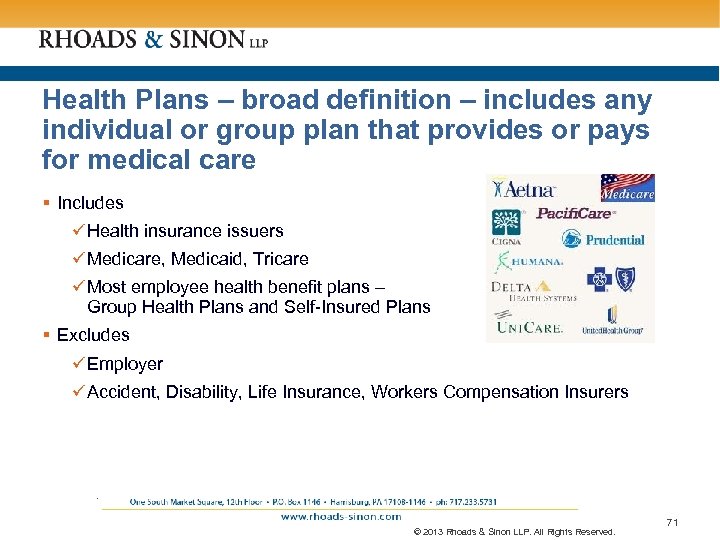
Health Plans – broad definition – includes any individual or group plan that provides or pays for medical care § Includes ü Health insurance issuers ü Medicare, Medicaid, Tricare ü Most employee health benefit plans – Group Health Plans and Self-Insured Plans § Excludes ü Employer ü Accident, Disability, Life Insurance, Workers Compensation Insurers . © 2013 Rhoads & Sinon LLP. All Rights Reserved. 71
§ So, HIPAA not applicable to employers – employers are not Covered Entities, but HIPAA has an impact on employers who act as health plan sponsors § The ERISA/self-funded plan is covered . © 2013 Rhoads & Sinon LLP. All Rights Reserved. 72
HIPAA Basics What is covered? . © 2013 Rhoads & Sinon LLP. All Rights Reserved. 73
HIPAA Basics Protected Health Information (PHI) § Health information including demographics that: ü Is created or received by a health care provider or health plan ü Relates to the past, present or future physical or mental health or condition; the provision of health care; or the past, present or future payment for the provisions of health care to an individual • Identifies the individual or allows creation of a reasonable basis to believe the information identifies an individual . © 2013 Rhoads & Sinon LLP. All Rights Reserved. 74
Application to Employer Sponsored Plans § HIPAA as it relates to employers – ü Employers must ensure that PHI is not used for employment-related decisions ü How it affects employer-sponsored plans will depend upon level of employer’s involvement in administering medical benefits to its current and former employees and their dependents . © 2013 Rhoads & Sinon LLP. All Rights Reserved. 75
Application to Employer Sponsored Plans § HIPAA recognizes that the employer as plan sponsor and the “plan” are not self-operating and that employers frequently are involved in plan administration § Therefore HIPAA does not prohibit employers from obtaining access to PHI – instead sets PHI access boundaries . © 2013 Rhoads & Sinon LLP. All Rights Reserved. 76
Application to Employer Sponsored Plans Insured with TPA vs. Self-Insured § Insured with TPA ü To the extent that employer’s plan provides benefits through an insurer or HMO, employer can substantially rely on insurer or HMO to comply with HIPAA’s administrative requirements provided: • Employer does not create or receive PHI other than Summary Health Information and enrollment information . © 2013 Rhoads & Sinon LLP. All Rights Reserved. 77
Application to Employer Sponsored Plans Fully Self-Insured § Fully Self-Insured ü Employer may review PHI for purposes of claim appeals, claim audits and other administrative purposes provided that: • The Plan amends plans documents to incorporate HIPAA’s required provisions • Amendments essentially must incorporate many of HIPAA’s administrative and security requirements (Notice of Privacy Practices, Privacy Officer, HIPAA privacy and security policies, individual rights) . © 2013 Rhoads & Sinon LLP. All Rights Reserved. 78
Fully Self-Insured ACA Changes Comply with Genetic Information Nondiscrimination Act of 2008 (GINA) § Review existing vendor relationships with respect to group health plans: ü To identify any business associates not having existing business associate agreement and to put such agreements in place as soon as possible but no later than September 23, 2013; and ü To make any revisions necessary to existing business associate agreements by September 23, 2014, or as part of any earlier non-HIPAArelated amendment (for example, breach notification, subcontractor requirements, compliance with the security regulations, and optional provisions allocating compliance responsibilities and/or providing for indemnification). § Amend (or, if necessary, adopt) written breach notification procedures. § Update and redistribute the Notice of Privacy Practices regarding new or revised individual rights and changes in policies and procedures. . © 2013 Rhoads & Sinon LLP. All Rights Reserved. 79
Fully Self-Insured ACA Changes § Prepare or revise documentation for new or revised individual privacy rights ü To implement new access rights to an electronic copy of “personal health information” (PHI); ü For authorization to use or disclose PHI for marketing purposes; ü For restrictions of disclosures of health services paid for “out of pocket”; ü For requests to transmit PHI to third persons; and ü For disclosures of PHI to family members of a deceased patient. § Comply with Genetic Information Nondiscrimination Act of 2008 (GINA) . © 2013 Rhoads & Sinon LLP. All Rights Reserved. 80
Fully Self-Insured ACA Changes § Update privacy, security, and breach notification policies and procedures (GINA, types of information used for fund-raising without authorization, protection of PHI of deceased individuals for at least 50 years, disclosures of immunization records to schools. ) § Train workers with access to PHI on all applicable changes. . © 2013 Rhoads & Sinon LLP. All Rights Reserved. 81
OVERVIEW SHARED SAVINGS PROGRAM & ACOs © 2013 Rhoads & Sinon LLP. All Rights Reserved. 82
Shared Savings Program § PPACA established a “Shared Savings Program”: ü Promotes accountability for Medicare beneficiaries ü Coordinates items/services under Medicare Parts A & B ü Encourages investment in infrastructure and re-designed care processes for high quality and efficient service delivery ü Incent higher value care § Providers work together to manage and coordinate care for Medicare fee-forservices beneficiaries through “Accountable Care Organizations” © 2013 Rhoads & Sinon LLP. All Rights Reserved. 83
Definitions § An accountable care organization (ACO) is a legal entity recognized and authorized under applicable State law, as identified by a Taxpayer Identification Number (TIN), and is formed by one or more ACO participants § ACO Participant is an individual or group of ACO providers/suppliers identified by a TIN and alone or together with one or more other ACO participants comprises an ACO and is on the list of ACO participants (Continued) © 2013 Rhoads & Sinon LLP. All Rights Reserved. 84
ACO Participants? 1. ACO professionals (M. D. , D. O. , P. A. , N. P. , C. N. S. ) in a group practice arrangement 2. Network of individual practices of ACO professionals 3. Partnership or joint venture arrangement between hospitals and ACO Professionals 4. Hospital (Acute care) employing ACO professionals 5. CAHs 6. RHCs 7. FQHCs © 2013 Rhoads & Sinon LLP. All Rights Reserved. 85
Eligibility of ACO § Legal entity formed under state/federal tribal law § Receive and distribute shared savings § Repay shared losses § Establish, report and ensure provider compliance with quality performance standards § Perform other ACO functions (including shared governance) © 2013 Rhoads & Sinon LLP. All Rights Reserved. 86
Required Processes § Promote evidence-based medicine § Promote Patient Engagement ü Patient experience of care survey ü Beneficiary representation ü Process for evaluating health needs of ACO population including a plan to address diversity § Internally report on quality and cost metrics § Coordinate care among providers/suppliers ü Develop an individualized care program ü Coordinate care through an episode of care © 2013 Rhoads & Sinon LLP. All Rights Reserved. 87
Payment Models § All providers continue to receive fee-for-service payments § Shared savings model ü CMS establishes a per capita Part A and Part B FFS benchmark expenditures for ACO based on 3 -month claims run out ü Using claims data, CMS computes per capita expenditures for the year – adjusted for changes in severity growth and health status ü Separate calculation for ESRD, disabled, dual vs. non-dual eligibles § PQRI Payments to ACO © 2013 Rhoads & Sinon LLP. All Rights Reserved. 88
Eligibility for Shared Savings § Meet all contractual requirements of ACO Agreement with CMS § Meet the quality performance standards § Realize savings compared to the Expenditure Benchmark that meet or exceed the Minimum Savings Rate © 2013 Rhoads & Sinon LLP. All Rights Reserved. 89
Quality Performance Measures § Grouped into 4 domains: ü Patient/caregiver experience ü Care coordination/patient safety ü Preventative health ü At risk population/frail elderly health © 2013 Rhoads & Sinon LLP. All Rights Reserved. 90
Data Sharing § ACO needs data to be accountable for care § CMS will share aggregate reports at the request of the ACO provided ACO complies with privacy/security of PHI pursuant to a Data Use Agreement © 2013 Rhoads & Sinon LLP. All Rights Reserved. 91
QUESTIONS? . © 2013 Rhoads & Sinon LLP. All Rights Reserved. 92
Скачать презентацию An Employer s Obligations and Opportunities Under the Affordable
f0c095a3ec40c98605eaac11ae8702dd.ppt