


 Скачать презентацию An Empirical Study of Typology of Jokes KADOOKA
0f77996313e90215a13d1dfc09fd673d.ppt
- Количество слайдов: 24
 An Empirical Study of Typology of Jokes KADOOKA Ken-Ichi Ryukoku University, Kyoto, Japan
 1. Introduction Universality of jokes: in every culture, jokes are told generation by generation as one of the narrative arts | Ways of laughing are different from one culture to another | Types of jokes would be suggested as a methodological framework |
 2. Typology of jokes Puns or story-like | Punch line told by one of the characters, or told by the narrator | Puns are language-specific, basically not translatable | Story-like jokes: Non-puns may be translatable | In jokes, it is unmarked the punch lines are told by one of the characters |
 Criteria of the typology Division into puns and story-like ones is arbitrary: there would be countless criteria among story-like jokes | Who tells the punch line is absolute: it is unmarked when told by one of the characters, while it is marked when told by the narration |
 Type-one: puns punch line told by one of the characters “I suppose your baby reigns as king in your family. ” | “No – Prince of Wails. ” |
 Type-one, another joke “How do you say ‘thank you’ in Japanese? | “We say ‘arigato. ’” | “Oh, I see… ari, ga, to… it’s difficult to pronounce. ” | “Then, you can remember it as alligator. It sounds like arigato. | “Hm… let’s try. Arigato, alligator, arigato, alligator…” |
 Next day | “Here, I’ll buy you a cup of coffee. It’s on me. ” | “Wow, ah… crocodile!” |
 Type two: puns, punch line told by the narration | When a champion Sumo wrestler became ill, the impresario decided for a lantern-maker, who was alike the real champion but not good at Sumo at all, to play the roll on a provincial tour. On the last day of the tour, the fake champion had to be challenged by a local amateur champion. In the match, the fake champion won by hitting the amateur on the face.
 Punch line: narration It is natural that the lantern maker was good at both hitting and sticking the paper on the lantern. | Double meanings of the verb ‘haru’ | One is to hit on one’s face | Another one is to stick and paste paper on the lantern |
 Japanese original punch line Haru no ga umai hazu-desu, | Hit/stick N NOM good-at should-be | Moto ga chouchin-ya no shokunin desu. | Original lantern craftsman COPULA |
 Rakugo Japanese traditional narrative art telling funny stories | Began in the 17 th century, in Kyoto, Osaka and Edo (Tokyo) | Around 1000 stories, short and long | Some short stories told before a longer one | One performer plays all the characters |
 Type three: story-like, punch line told by one of the characters 1 Mother decided that her daughter Judy, a nine-year old, was old enough to have her own bank account. | 2 So she took Judy to the local bank. | 3 Judy liked this idea very much. | 4 “This is to be your account. | 5 You must fill out the application yourself. ” |
 6 Judy did well until she came to the space marked, “Name of your former bank. ” | 7 She thought for a while and wrote down, | 8 “Piggy. ” |
 Type-three subspecific: punch line performed by the gesture There was a car accident in the mountains, and the family in the car was sent to the hospital. Their pet, a monkey, was standing by the car. He was with a policeman. | Policeman: Oh, that was a bad accident. I wonder what happened. I wish this monkey could talk: | Monkey: Chatter, chatter. (I know, I know. ) |
 Policeman: Hey, Monkey, do you understand what I am saying? | Monkey: Chatter, chatter. (I know, I know) | Policeman: Wow, good! OK, so what were the children doing when the accident happened? | Monkey: Chatter, chatter. (playing) | Policeman: I see. They were playing around in the car. Maybe they were bothering the driver. Well, what was the mother doing when the accident happened? |
 Monkey: Chatter, chatter. (sleeping) | Policeman: I see. She was sleeping. Maybe she was sleeping and driving. What about the father? What was the father doing when the accident happened? | Monkey: Chatter, chatter. (drinking) | Policeman: I see. He was drinking. Maybe he was drinking and driving. Well, Monkey, what about you? What were you doing when the accident happened? | Monkey: Chatter, chatter. (driving) |
 Type four: story-like, punch line told by the narration A man called an airline company and an operator answered the phone. | Man: Excuse me, how long does it take to fly from San Francisco to Honolulu? | Operator: Just a minute. | Man: Wow, that fast? Thank you! (Click) | The man hung up. |
 Type four, another joke 1 A Frenchman was visiting New York for the first time in his life. 2 He could not speak English at all. 3 One day he decided to go for a walk. 4 He was afraid of getting lost, 5 so he carefully looked at the street sign in front of his hotel 6 and wrote it down on a piece of paper.
 7 He walked around for quite a long time. 8 Then he realized he was lost. 9 He saw a policeman 10 and showed the piece of paper. 11 It said 12 “ONE WAY STREET. ”
 Definition of “Paratone” (Tench 1996) 1. high in the onset syllable 2. high baseline in the initial intonation unit 3. gradual lowering of the baseline 4. lowest fall before the final 5. slowing down in the final 6. longer pause (before the final)
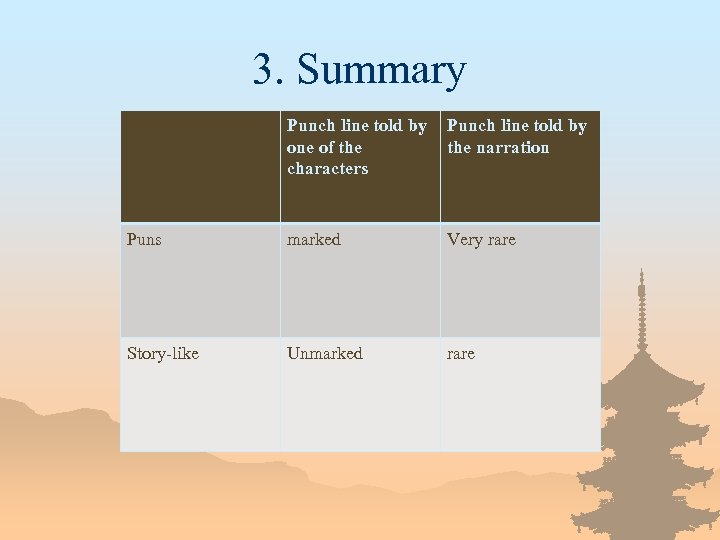 3. Summary Punch line told by one of the characters Punch line told by the narration Puns marked Very rare Story-like Unmarked rare
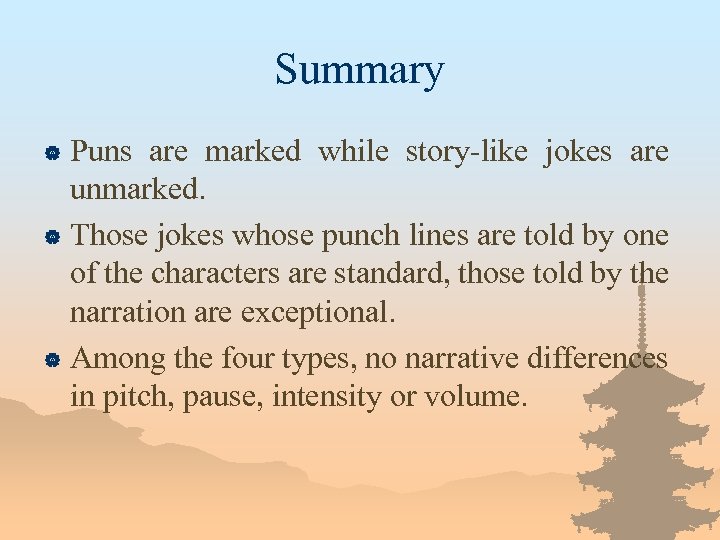 Summary Puns are marked while story-like jokes are unmarked. | Those jokes whose punch lines are told by one of the characters are standard, those told by the narration are exceptional. | Among the four types, no narrative differences in pitch, pause, intensity or volume. |
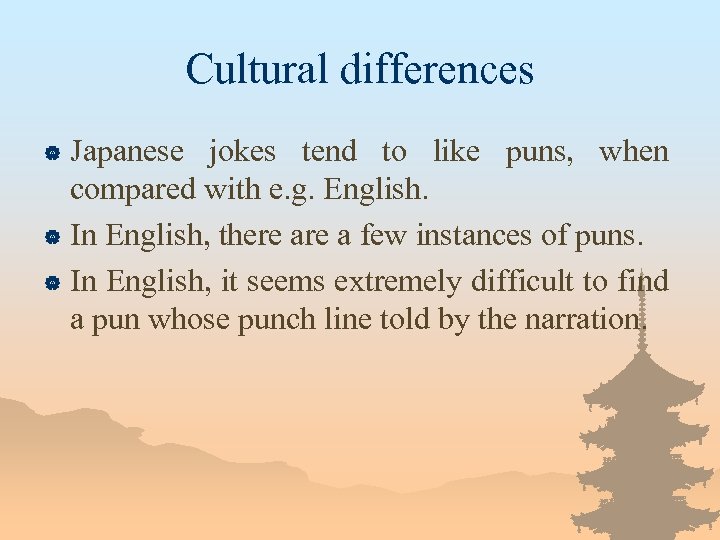 Cultural differences Japanese jokes tend to like puns, when compared with e. g. English. | In English, there a few instances of puns. | In English, it seems extremely difficult to find a pun whose punch line told by the narration. |
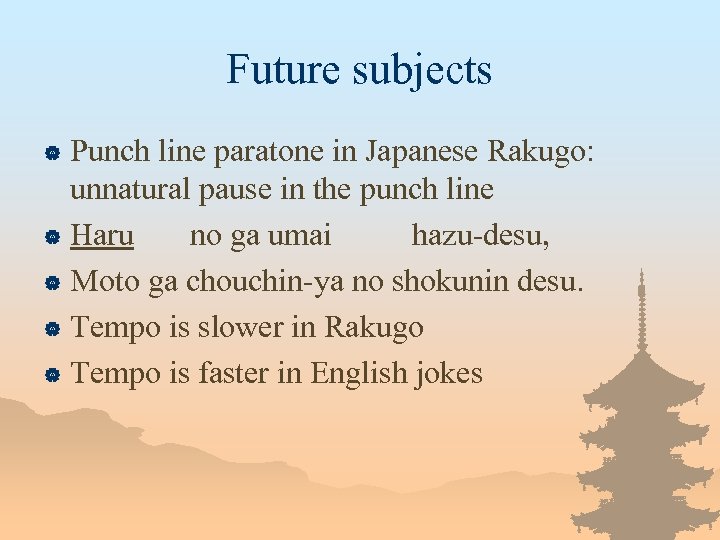 Future subjects Punch line paratone in Japanese Rakugo: unnatural pause in the punch line | Haru no ga umai hazu-desu, | Moto ga chouchin-ya no shokunin desu. | Tempo is slower in Rakugo | Tempo is faster in English jokes |