


 Скачать презентацию An Empirical Study of OTAs Research Issues
280c55ef841961b22ea162af7c0702d3.ppt
- Количество слайдов: 28
 An Empirical Study of OTAs
 Research Issues • Whether prices offered by different online travel agent (OTA) converge in electronic markets? • To what extent, strategic actions prevalent in traditional markets, such as product differentiation, are utilized in electronic markets? 2
 Main Results (I) Different OTAs offer different types of tickets at substantially different prices. – The highest price agent is, on average, 28% more expensive than the lowest price agent 3
 Main Results (II) The variation in prices across OTAs is reduced to about 18%, when variations in ticket characteristics are controlled. These results suggest that product differentiation is indeed occurring. 4
 Remaining Price Dispersion? Possible explanations – Search engine inefficiency – Principal-agent problems – price discrimination 5
 Search Engine Inefficiency • Signing up for another OTA • learning its user interface • entering flight preferences into multiple OTAs • evaluating flight recommendations from multiple OTAs • inflexibility in the search process 6
 Agency Problem Agents are representatives of the airlines and not the consumer. However, agency problem will only affect observed price dispersion if incentives indeed differ among OTAs. 7
 Price discrimination One company offers two different on -line services with different interface characteristics and very different prices. Why? The difficulty in using interface design serves as a screen to prevent the time sensitive-travels from exercising personal arbitrage. 8
 An Case Study AUCNET, introduced in 1985 by an entrepreneurial used-car dealer, is a centralized, online wholesale market where cars are sold using video images, character -based data and a standardized inspector rating. 9
 The product prices in AUCNET are higher than those of traditional markets. Why? 10
 Reasons for Higher Prices in AUCNET Three possible institutional and economic factors – relatively newer second-hand cars – increased market power of sellers – buyer externalities 11
 1. Shopping around the Web Nightmare on e-street – E-commerce is growing very fast – Critical mass effect – It changes the rules of the retailing game 12
 The Survey will argue that despite its teething troubles, B 2 C e-commerce will grow significantly, and it will be especially important for certain kinds of goods and services. 13
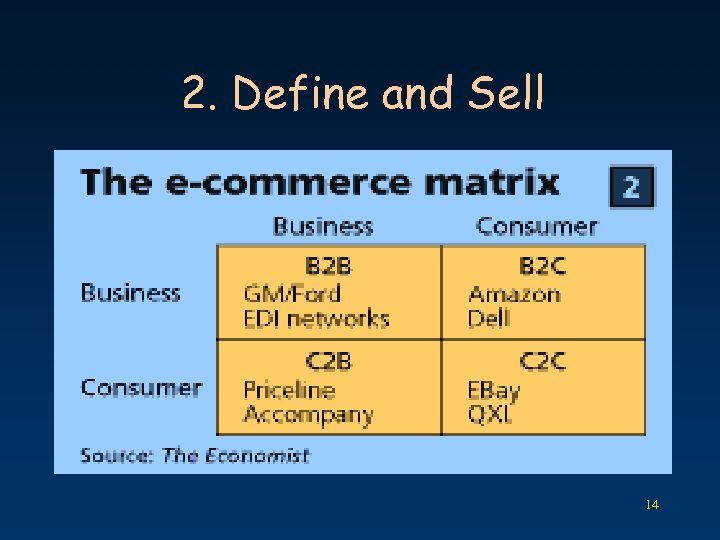 2. Define and Sell 14
 Question (1) What kinds of goods and services sell well electronically? 15
 There may be no such thing as a product that is unsuitable for being sold over the web. 16
 What’s Important The biggest boost to e-commerce over the next few years will come not from snazzier websites or snappier marketing, but from the proliferation of broadband internet connections. . . 17
 Other Boost • PC has lost its monopoly position in providing internet access • The linking of websites to call centers 18
 3. Something Old, Something New • Legacy business or pure plays • Legacy firms face problems – resistance to change – fear of cannibalization – capital markets – first-mover advantage 19
 Question (2) Will mixing the best of online and offline, which has been variously labelled as “clicks‘n’mortar”, “clicks and bricks” or the more prosaic “multichannel”, produce the e-commerce winners of the future? 20
 Within each defined market segment, there may eventually be room for just one or two ecommerce firms. 21
 4. Amazon’s amazing ambition • patented “one-click” technology • patented “customer referral system” 22
 5. Distribution Dilemmas The fulfillment and distribution end of the internet has been troublesome – Amazon is building seven automated warehouses around the country 23
 6. Saturday Morning Syndrome • The real battleground for the online supermarket will be guaranteed delivery times. • Webvan in San Francisco uses a “hub-and-spokes” system to guarantee delivery. 24
 7. In the great Web Bazaar • Different trading models occur – The role of comparisonshopping agents could become far more significant. • The intermediaries have to answer the question: which side are they on? 25
 8. First American, then the World American global domination? • Hard to cross borders in the retail world • Fulfillment and delivery trouble • American web retailers may have left it too late 26
 American Government’s Push • Permitting the patenting • sales taxes exemption – tax debate is coming – it is regulation that American ecommerce firms are most concerned about when they contemplate Europe 27
 9. We’re off to the Online Mall Who will be handling the business? 28