


 Скачать презентацию An attempt to achieve qualifications via a competence
a8d4b1fa374e0550c331b124207d7bca.ppt
- Количество слайдов: 11
![An attempt to achieve qualifications via a competence based approach [FPT APR 2005] 1](https://present5.com/presentation/a8d4b1fa374e0550c331b124207d7bca/image-1.jpg "An attempt to achieve qualifications via a competence based approach [FPT APR 2005] 1") An attempt to achieve qualifications via a competence based approach [FPT APR 2005] 1
An attempt to achieve qualifications via a competence based approach [FPT APR 2005] 1
 Background • Political guidance – new missions • Ministry of Defence: ”Working Group on ajustment of the Personel & Training Structure (AGPU) • AGPU agree on the competence based approach [FPT APR 2005] 2
 The Competence Based Approach • By breaking down the content of any given function to a number of competences – a profile – one can estimate the degree of match between the competences of any given individual and a job desciption. • Visa Versa: Once the relevant competences have been identified one can compose the training package that would lead to achievement of the ideal competences. • Competences need not be based upon formal qualifications – could also be natural talents or competences from a civilian career. [FPT APR 2005] 3
 Competence Profiles • Job description listing the main tasks to be done and related requirements with links to relevant competences – professional as well as personal. • To be worked out by the End User – who knows the operational need. • At present 85 profiles. • Tool for Commanders and training authorities and very much for the individual person. • It is a long haul – it takes time to implement. [FPT APR 2005] 4
 Competence profile for a linguist MAIN TASKS • Foreign Area Specialist • Bde/TF/Wing-level and below • CULAD • Command responsibilities • Training responsibilities [FPT APR 2005] 5
 Competence profile for a linguist Professional competences • Leadership • Training • Society and culture • Language [FPT APR 2005] 6
 Competence profile for a linguist Personal competences • Learning abilities • Adaptation • Attitude • Endurance [FPT APR 2005] 7
 Competences translated into training • The profiles will be broken down and converted into subjects (eg leadership, political science …). • The convertion takes place at the training units and will be coordinated in the Training Forum. • Progression is essential to ensure coherence between the training levels. [FPT APR 2005] 8
 Strategic Forum for Training • Joint platform for cooperation within the training field & for sharing of knowledge. • Safeguard of high quality/safeguard progression for training of officers and senior ranks. • Clearing house for research. • Knowledge sharing and reinforces cooperation on training development with a focus on the new comprehensive approach and jointness. [FPT APR 2005] 9
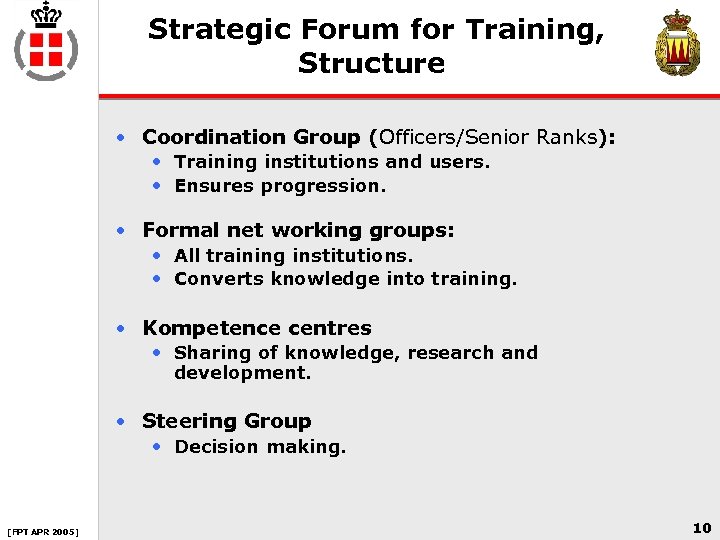 Strategic Forum for Training, Structure • Coordination Group (Officers/Senior Ranks): • Training institutions and users. • Ensures progression. • Formal net working groups: • All training institutions. • Converts knowledge into training. • Kompetence centres • Sharing of knowledge, research and development. • Steering Group • Decision making. [FPT APR 2005] 10
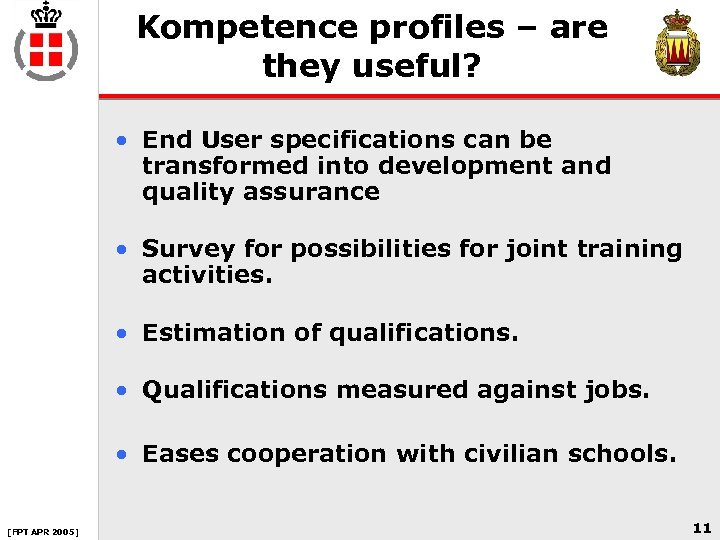 Kompetence profiles – are they useful? • End User specifications can be transformed into development and quality assurance • Survey for possibilities for joint training activities. • Estimation of qualifications. • Qualifications measured against jobs. • Eases cooperation with civilian schools. [FPT APR 2005] 11