 Скачать презентацию An Architecture for Application-Based Network Operations Adrian Farrel
5ac9a791b9bc2537634d71f156198ba0.ppt
- Количество слайдов: 14



An Architecture for Application-Based Network Operations Adrian Farrel - Old Dog Consulting adrian@olddog. co. uk Daniel King – Old Dog Consulting daniel@olddog. co. uk www. isocore. com/mpls 2013
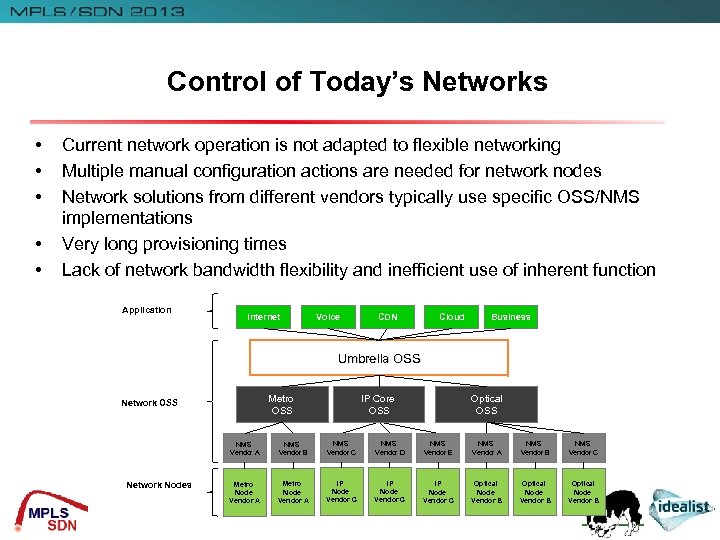
Control of Today’s Networks • • • Current network operation is not adapted to flexible networking Multiple manual configuration actions are needed for network nodes Network solutions from different vendors typically use specific OSS/NMS implementations Very long provisioning times Lack of network bandwidth flexibility and inefficient use of inherent function Application Internet Voice CDN Cloud Business Umbrella OSS Metro OSS Network OSS IP Core OSS Optical OSS NMS Vendor A Network Nodes NMS Vendor B NMS Vendor C NMS Vendor D NMS Vendor E NMS Vendor A NMS Vendor B NMS Vendor C Metro Node Vendor A IP Node Vendor C Optical Node Vendor B
Network Operation Requirements • The network does not need to be seen any longer as a composition of individual elements • Applications need to be capable of interaction with the network • Support of the next generation of variable and dynamic transport characteristics • Automated deployment and operation of services. • • • “Create a new transport connection for me” “Reoptimize my network after restoration switching” “Respond to how my network is being used” “Schedule these services” “Resize tunnels”
SDN Controller for Network Operations • • “SDN Controller” is a contentious term, it can have many different meanings: • Historically the term was derived from the network domain, technology and protocol mechanism SDN controller wars are ongoing: • Operators have an expectation of standards-based technologies for deploying and operating networks • SDN controller vendors rarely provide multivendor interoperability using open standards • Provisioning should be a compelling feature of SDN, however many SDN controllers use non-standardised APIs Typically SDN controllers have a very limited view of topology, multi-layer and multidomain is not supported Flexibility has been notably absent from most controller architectures both in terms of southbound protocol support and northbound application requests 4
Network Operation Framework Building Blocks • Avoiding the mistake of a single “controller” architecture • • • Discovery of network resources and topology management Network resource abstraction, and presentation Routing and path computation Multi-layer coordination and interworking • • • As it encourages the expansion and use of specific protocols Multi-domain & multi-vendor network resources provisioning through different control mechanisms (e. g. , Optical, Open. Flow, GMPLS, MPLS) Policy Control OAM and performance monitoring A wide variety of southbound northbound protocol support Leveraging existing technologies • • What is currently available? Must integrate with existing and developing standards
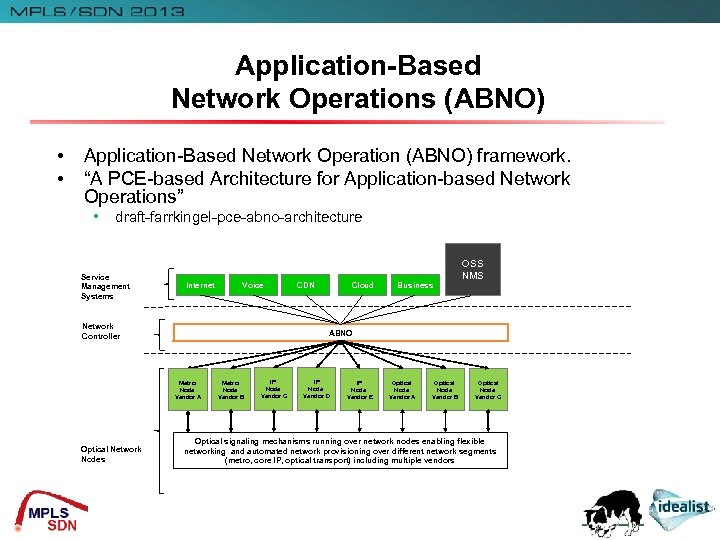
Application-Based Network Operations (ABNO) • • Application-Based Network Operation (ABNO) framework. “A PCE-based Architecture for Application-based Network Operations” • draft-farrkingel-pce-abno-architecture Service Management Systems Internet Voice Network Controller Cloud Business ABNO Metro Node Vendor A Optical Network Nodes CDN OSS NMS Metro Node Vendor B IP Node Vendor C IP Node Vendor D IP Node Vendor E Optical Node Vendor A Optical Node Vendor B Optical Node Vendor C Optical signaling mechanisms running over network nodes enabling flexible networking and automated network provisioning over different network segments (metro, core IP, optical transport) including multiple vendors
ABNO - A PCE-enabled Network Controller • PCE provides a set of tools for deterministic path computation • • • Prior to PCE network operators might use complex planning tools to compute paths and predict network behavior PCE reduces the onerous network operation process of coordinating planning, computation, signaling and placement of LSP-based services PCE has evolved: • • • Computes single and dependant LSPs in a stateless manner Concurrent optimization of sets of LSPs Performing P 2 P and P 2 MP path computation Hierarchical PCE Architecture Stateful computation and monitoring of LSPs • • The state in “stateful” is an LSP-DB Stored information about some or all LSPs in the network Active PCE, resize or recomputed based on BW or network triggers PCE-initiated LSP setup • • Delegate LSP control to the PCE Recommend rerouting of LSPs 7
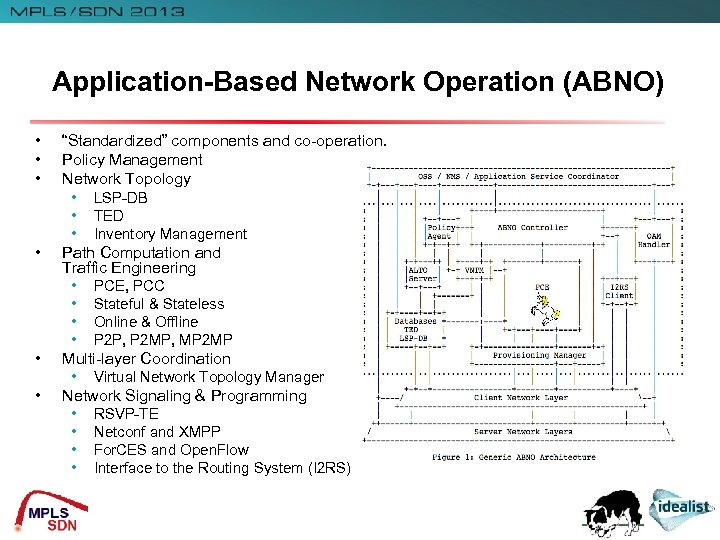
Application-Based Network Operation (ABNO) • • • “Standardized” components and co-operation. Policy Management Network Topology • LSP-DB • TED • Inventory Management Path Computation and Traffic Engineering • PCE, PCC • Stateful & Stateless • Online & Offline • P 2 P, P 2 MP, MP 2 MP Multi-layer Coordination • Virtual Network Topology Manager Network Signaling & Programming • RSVP-TE • Netconf and XMPP • For. CES and Open. Flow • Interface to the Routing System (I 2 RS)
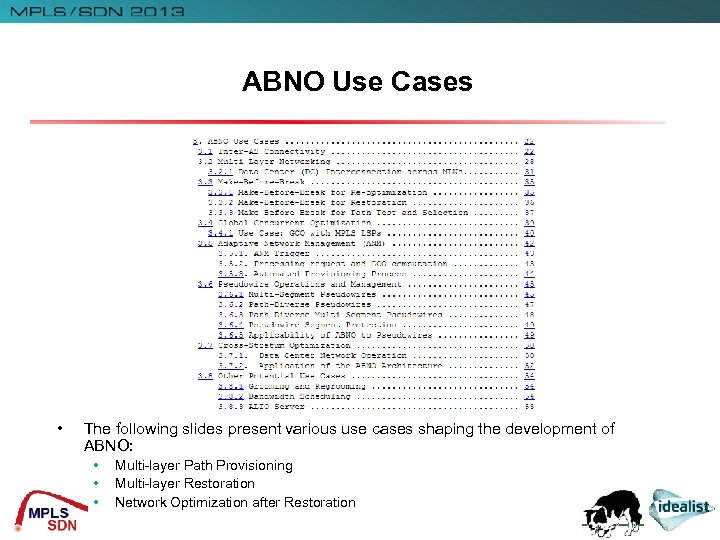
ABNO Use Cases • The following slides present various use cases shaping the development of ABNO: • • • Multi-layer Path Provisioning Multi-layer Restoration Network Optimization after Restoration
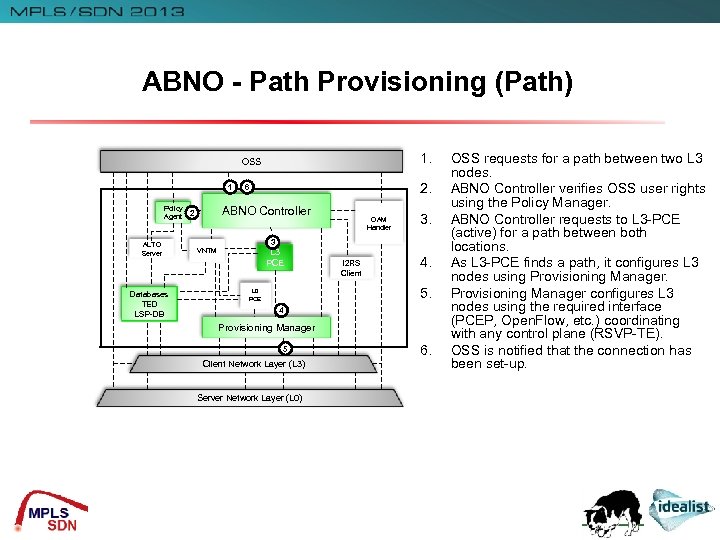
ABNO - Path Provisioning (Path) 1. OSS 1 Policy Agent ALTO Server Databases TED LSP-DB 2. 6 ABNO Controller 2 OAM Handler 3. 3 L 3 PCE VNTM I 2 RS Client 4. 5. L 0 PCE 4 Provisioning Manager 5 Client Network Layer (L 3) Server Network Layer (L 0) 6. OSS requests for a path between two L 3 nodes. ABNO Controller verifies OSS user rights using the Policy Manager. ABNO Controller requests to L 3 -PCE (active) for a path between both locations. As L 3 -PCE finds a path, it configures L 3 nodes using Provisioning Manager configures L 3 nodes using the required interface (PCEP, Open. Flow, etc. ) coordinating with any control plane (RSVP-TE). OSS is notified that the connection has been set-up.
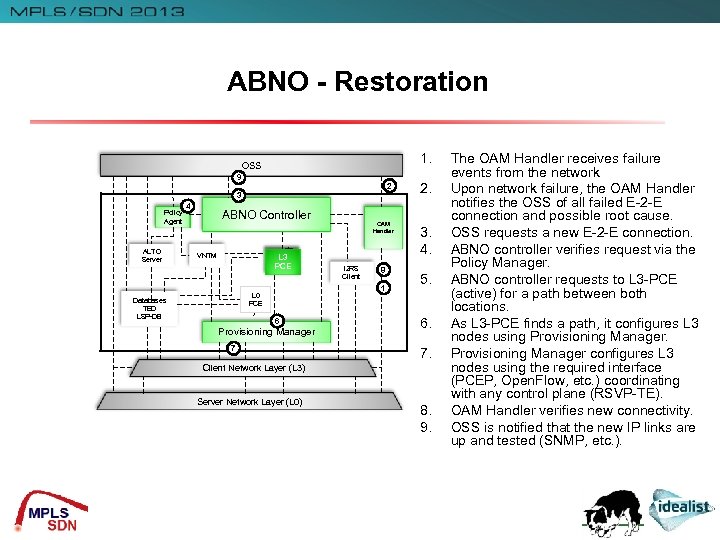
ABNO - Restoration 1. OSS 9 2 3 Policy Agent ALTO Server 4 ABNO Controller L 35 PCE VNTM I 2 RS Client 8 1 L 0 PCE Databases TED LSP-DB OAM Handler 6 Provisioning Manager 7 2. 3. 4. 5. 6. 7. Client Network Layer (L 3) Server Network Layer (L 0) 8. 9. The OAM Handler receives failure events from the network Upon network failure, the OAM Handler notifies the OSS of all failed E-2 -E connection and possible root cause. OSS requests a new E-2 -E connection. ABNO controller verifies request via the Policy Manager. ABNO controller requests to L 3 -PCE (active) for a path between both locations. As L 3 -PCE finds a path, it configures L 3 nodes using Provisioning Manager configures L 3 nodes using the required interface (PCEP, Open. Flow, etc. ) coordinating with any control plane (RSVP-TE). OAM Handler verifies new connectivity. OSS is notified that the new IP links are up and tested (SNMP, etc. ).
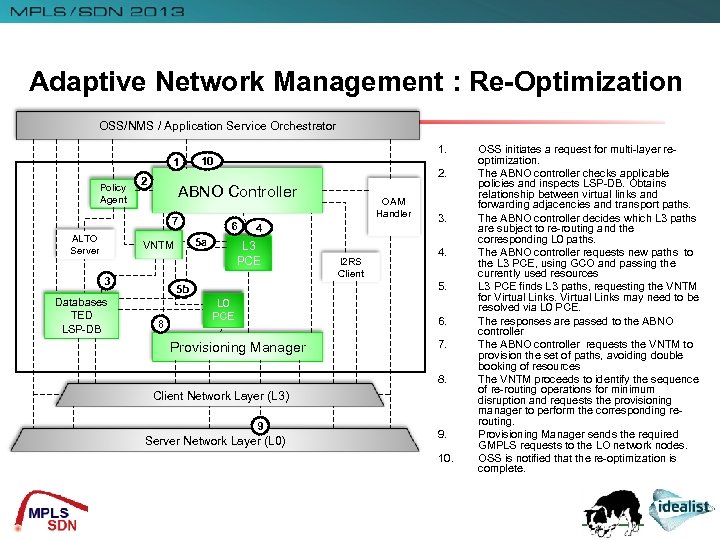
Adaptive Network Management : Re-Optimization OSS/NMS / Application Service Orchestrator 1 Policy Agent 2 3 6 5 a VNTM Databases TED LSP-DB 2. ABNO Controller 7 ALTO Server 1. 10 4 L 3 PCE I 2 RS Client 3. 4. 5. 5 b 8 OAM Handler L 0 PCE 6. Provisioning Manager 7. 8. Client Network Layer (L 3) 9 Server Network Layer (L 0) 9. 10. OSS initiates a request for multi-layer reoptimization. The ABNO controller checks applicable policies and inspects LSP-DB. Obtains relationship between virtual links and forwarding adjacencies and transport paths. The ABNO controller decides which L 3 paths are subject to re-routing and the corresponding L 0 paths. The ABNO controller requests new paths to the L 3 PCE, using GCO and passing the currently used resources L 3 PCE finds L 3 paths, requesting the VNTM for Virtual Links may need to be resolved via L 0 PCE. The responses are passed to the ABNO controller The ABNO controller requests the VNTM to provision the set of paths, avoiding double booking of resources The VNTM proceeds to identify the sequence of re-routing operations for minimum disruption and requests the provisioning manager to perform the corresponding rerouting. Provisioning Manager sends the required GMPLS requests to the LO network nodes. OSS is notified that the re-optimization is complete.
Next Steps for ABNO • Application-Based Network Operations • Continued definition of use cases. • Continued identification of protocol, interface and functionality gaps. • Service interface to/from application/OSS/NMS. • Definition of service templates. • Investigation of protocol methods for communicating templates.
Questions? Adrian Farrel - Old Dog Consulting adrian@olddog. co. uk Daniel King – Old Dog Consulting daniel@olddog. co. uk This work was supported in part by the European Union FP-7 IDEALIST project under grant agreement number 317999. 14
Скачать презентацию An Architecture for Application-Based Network Operations Adrian Farrel
5ac9a791b9bc2537634d71f156198ba0.ppt