 Скачать презентацию An American Perspective on Not-for-Profit Tax Concessions by
d6c5c0aaa0c8c0d1affbdec252ecc6a0.ppt
- Количество слайдов: 80



An American Perspective on Not-for-Profit Tax Concessions by Jon Forman Alfred P. Murrah Professor of Law University of Oklahoma Norman, Oklahoma Treasury Seminar Canberra 25 July 2011
Outline o Overview of U. S. nonprofit law, with an emphasis on the role of the Internal Revenue Service in regulating nonprofits o React to your Treasury’s recent reform proposal o Review some recent tax reform proposals in the U. S. 2
Size of the Nonprofit Sector o 1. 5 million nonprofits, foundations, and religious congregations n http: //www. independentsector. org/our_sector o Returns of Tax-Exempt Organizations, Fiscal Year 2010 n Total 776, 300 n Internal Revenue Service Data Book, 2010, Table 13, http: //www. irs. gov/pub/irssoi/10 databk. pdf 3
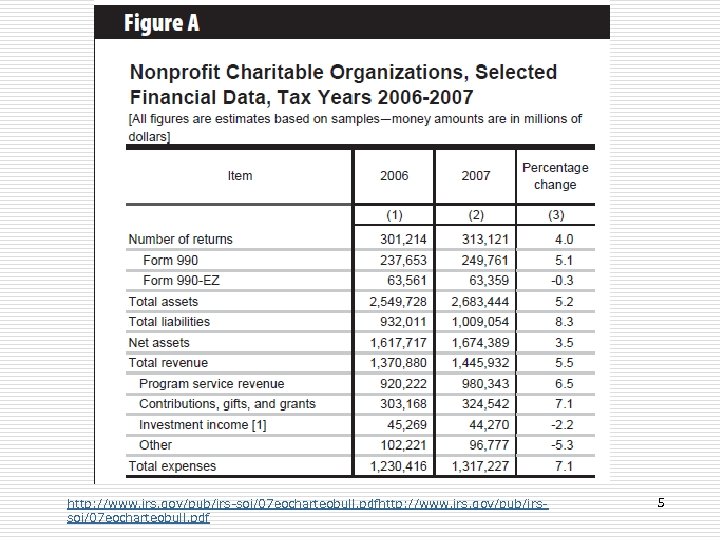
More Nonprofit Statistics o 501(c)(3)s filed 313, 121 information returns for Tax Year 2007 o Held nearly $2. 7 trillion in assets o Reported $1. 4 trillion in revenue, more than two-thirds of which came from program services (Figure A). http: //www. irs. gov/pub/irs-soi/07 eocharteobull. pdfhttp: //www. irs. gov/pub/irssoi/07 eocharteobull. pdf 4
http: //www. irs. gov/pub/irs-soi/07 eocharteobull. pdfhttp: //www. irs. gov/pub/irssoi/07 eocharteobull. pdf 5
6
Top 10 Charities, $billions 7
Life Cycle of a Public Charity/Private Foundation o Organizations that meet the requirements of Internal Revenue Code section 501(c)(3) are exempt from federal income tax as charitable organizations. o In addition, contributions made to charitable organizations by individuals and corporations are deductible under Code section 170. http: //www. irs. gov/charities/charitable/article/0, , id=136459, 00. html 8
Charities o Every exempt charitable organization is classified as either a public charity or a private foundation. o Generally, organizations that are classified as public charities are those that n (i) are churches, hospitals, qualified medical research organizations affiliated with hospitals, schools, colleges and universities, n (ii) have an active program of fundraising and receive contributions from many sources, including the general public, governmental agencies, corporations, private foundations or other public charities, n (iii) receive income from the conduct of activities in furtherance of the organization’s exempt purposes, or n (iv) actively function in a supporting relationship to one or more existing public charities. 9
Private Foundations o Private foundations, in contrast, typically have a single major source of funding (usually gifts from one family or corporation rather than funding from many sources) and most have as their primary activity the making of grants to other charitable organizations and to individuals, rather than the direct operation of charitable programs. 10
Life Cycle of a Public Charity o During its existence, a public charity has numerous interactions with the IRS – from filing an application for recognition of tax-exempt status, to filing the required annual information returns, to making changes in its mission and purpose. The IRS provides information, explanations, guides, forms and publications on all of these subjects – they are available through this IRS Web site. The illustration below provides an easy-to-use way of linking to the documents most charities will need as they proceed though the phases of their “life cycle. ” o Graphical depiction, http: //www. irs. gov/pub/irstege/pc_lifecyclechart_062910. pdf http: //www. irs. gov/charities/charitable/article/0, , id=122670, 00. html 11
Benefits of 501(c)(3) Status o Tax exemption under Internal Revenue Code (the Code) section 501(c)(3) provides a number of benefits: n Exemption from Federal income tax; n Tax-deductible contributions; n Possible exemption from state income, sales, and employment taxes; n Reduced postal rates; n Exemption from Federal unemployment tax; and n Tax-exempt financing. http: //www. stayexempt. irs. gov/Resource-Library/pdfs/Mod 1_Summary. pdf 12
Tax-Exempt Organizations and 501(c)(3)s o A tax-exempt organization is a trust, unincorporated association, or nonprofit corporation described in the Internal Revenue Code as exempt from Federal income tax. 13
501(c)(3) Charities o A 501(c)(3) is a type of exempt organization. It must be organized and operated for one or more exempt purposes described in Code section 501(c)(3): Charitable, Educational, Religious, Scientific, Literary, Testing for public safety, Fostering national or international amateur sports competition, and/or n Preventing cruelty to children or animals. n n n n 14
Public Charity Status o When an entity qualifies as a 501(c)(3), the IRS presumes it is a private foundation (except for statutory public charities, such as churches and schools) unless the organization can show it is a public charity. 15
Public Charity Status o To qualify as a public charity, the 501(c)(3) must demonstrate it is a type of organization classified as a public charity by statute such as a church, hospital or school, or that supports another public charity. o In addition, an organization may be classified as a public charity if it is publicly supported and receives substantial support in the form of gifts, grants and contributions from the general public or a governmental unit and or income from activities related to their exempt activities like admissions. 16
Public Charity Status o If your 501(c)(3) is so new that it cannot show it is publicly supported, the IRS will treat you as a public charity for your first five years from the organization’s formation if it demonstrates that it can reasonably be expected to be publicly supported. o Beginning with the organization’s sixth year, the IRS will monitor your public charity status based on your public support as reported on Schedule A, Public Charity Status and Public Support of your Form 990. o If the organization cannot show broad financial support, the IRS will reclassify it as a private foundation. 17
Jeopardizing 501(c)(3) Status o There are four types of activities that can jeopardize a charity’s 501(c)(3)’s tax-exempt status: n n Private benefit/inurement, Lobbying, Political activity, and Excessive unrelated business income (UBI). 18
Private Benefit o 501(c)(3)s must avoid all activities that will substantially benefit the private interest of any individual or organization. 19
Inurement o No part of an organization’s net earnings may inure to the benefit of a private shareholder or individual. This means that a 501(c)(3) organization is prohibited from allowing its income or assets to accrue to insiders. The prohibition of inurement is absolute. Any amount will jeopardize the organization’s 501(c)(3) status. 20
Lobbying o Lobbying is an activity designed to influence legislation. If its lobbying activities are substantial, a 501(c)(3) may risk losing its taxexempt status. The IRS uses two tests to determine whether lobbying is substantial: the substantial part test and the expenditure test. 21
Political Campaign Activity o Political campaign activity involves directly or indirectly participating or intervening in any political campaign on behalf of or in opposition to any candidate for elective office. The prohibition of political campaign activity is absolute. Any violation may result in the loss of tax-exempt status and the imposition of excise taxes. 22
Excessive Unrelated Business Income (UBI) o Unrelated Business Income Defined n For most organizations, an activity is an unrelated business (and subject to unrelated business income tax) if it meets three requirements: o It is a trade or business, o It is regularly carried on, and o It is not substantially related to furthering the exempt purpose of the organization. http: //www. irs. gov/charities/article/0, , id=96104, 00. html 23
Size of the Untaxed Business Sector o Nonprofit institutions that serve households – most 501(c)(3) organizations, etc. – $483 billion (5. 3% GDP) in 2002 o State and local governments – $749 billion (8. 2% GDP) Congressional Budget Office, Taxing the Untaxed Business Sector (July 2005), at 6, http: //www. cbo. gov/doc. cfm? index=6567. 24
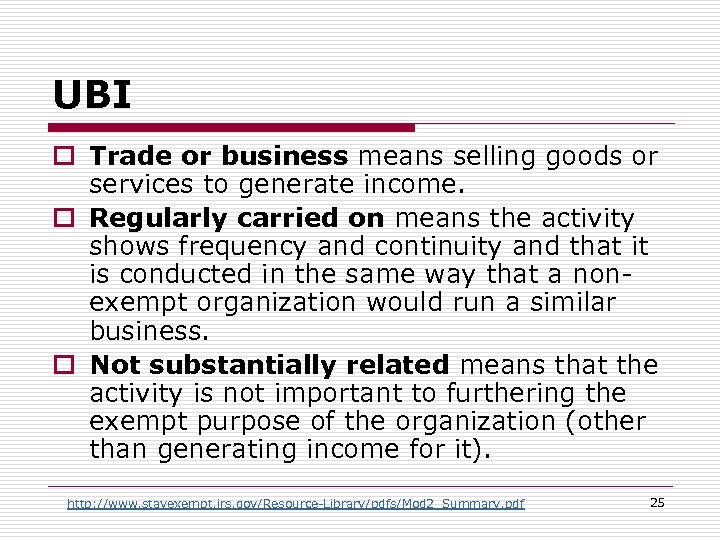
UBI o Trade or business means selling goods or services to generate income. o Regularly carried on means the activity shows frequency and continuity and that it is conducted in the same way that a nonexempt organization would run a similar business. o Not substantially related means that the activity is not important to furthering the exempt purpose of the organization (other than generating income for it). http: //www. stayexempt. irs. gov/Resource-Library/pdfs/Mod 2_Summary. pdf 25
Exceptions to UBI o The Internal Revenue Code contains a number of exceptions to the usual rules of UBI. That means that some UBI is not subjected to tax. These exceptions include, but are not limited to, activities: n Conducted by a volunteer workforce, n Conducted for the convenience of organizational members, 26
Exceptions to UBI continued n Involving the sale of donated merchandise, n Involving the distribution of low-cost articles, n Involving income from convention or trade show participation, n Involving income from qualified sponsorship, and n Traditional bingo. 27
Exclusions and Deductions from UBI o In addition to the exceptions discussed, the Code allows certain other exclusions and deductions in calculating UBI tax. 28
Exclusions o The exclusions include, but are not limited to, income generated from: n Interest and dividends, n Royalties, n Certain rents from real properties with the exception of income from debtfinanced property, and n Certain gains and losses. 29
Deductions o Allowable deductions include certain expenses, depreciation, and similar items directly connected with carrying on an unrelated trade or business. In addition, other modifications allow for deductions like: n The net operating loss deduction, where an unrelated business loss in a previous or current tax year is deductible; n Charitable contributions made by the organization regardless of whether they are directly connected with the unrelated trade or business; and n The specific deduction that allows for $1, 000 to be automatically deducted from the UBI tax calculation. 30
Charitable Gaming and Applicable Taxes o A small amount of unrelated trade or business activity in relation to an organization’s exempt purpose activity will have no impact on exempt status. Exempt status is only jeopardized when the activity generating unrelated income makes up a substantial part of the organization’s overall activities. n Gaming is one of the most common and successful types of fundraising. It can range from sponsoring a bingo game to a once-a-year raffle or casino night. Most often, gaming will generate UBI. Federal wagering excise taxes apply to certain types of gaming, but these taxes are typically not applicable to gaming conducted by 501(c)(3) organizations. 31
Filing Procedures for Form 990 -T o Organizations with gross income of $1, 000 or more from unrelated business must file Form 990 -T annually. o Form 990 -T is due the 15 th day of the 5 th month following the end of the organization’s accounting period. 32
UBIT Statistics o unrelated business income tax (UBIT) of $364. 6 million reported by charities for 2004 o Corporate entities made up 85 percent of the Form 990 -T filing population and reported nearly 90% of total gross UBI http: //www. irs. gov/pub/irs-soi/tehistory. pdf 33
Title XII of the Pension Protection Act of 2006 o Detailed Summary of Charitable Provisions o http: //waysandmeans. house. gov/media/pdf /taxdocs/072806 charitable. pdf o Charitable Giving Incentives o Charitable Reform o IRS, Pension Protection Act of 2006 Revises EO Tax Rules o http: //www. irs. gov/charities/article/0, , id=1 61145, 00. html 34
Charitable Reform Provisions o Appraisal Reform o Notification Requirement for Exempt Organizations –Annual Notice n 3 years to comply; revocation o Encourage IRS Information-Sharing with State Charity Officials o Public Disclosure of Information Relating to Unrelated Business Income Tax Returns 35
Reactions to your Treasury’s recent reform proposal o General concerns about Nonprofits o Specific Reactions to the proposal 36
Concerns about Nonprofits: high salaries, high expenses o IRS o e. g. , OU Foundation’s Form 990, https: //www. oufoundation. org/990. pdf o http: //www. nytimes. com/2011/02/15/busines s/15 charity. html o States o e. g. , Oklahoma Attorney General, http: //www. oag. state. ok. us/oagweb. nsf/0/0 a 9 382 d 6 ed 29978 f 862572 b 400738 e 2 f/$FILE/char ityflier. PDF 37
Concerns about Nonprofits: high salaries, high expenses o Charity watch groups, etc. o http: //www. charitywatch. org/toprated. html o http: //liveunited. org/pages/accountability o Guide. Star. National directory of nonprofit organizations, http: //www 2. guidestar. org/ o Better Business Bureau. For Charities and Donors. Includes evaluative reports on some national and regional charities. http: //www. bbb. org/us/charity/ 38
Concerns about Nonprofits: enriching related parties o Hospitals and trade associations use nonprofit status in ways that enrich doctors, etc. n Nonprofit, For-profit, and Government Hospitals: Uncompensated Care and Other Community Benefits (GAO-05 -743 T (2005), http: //www. gao. gov/new. items/d 05743 t. pdf o State property tax exemption n http: //www. state. il. us/court/opinions/supreme court/2010/march/107328. pdf 39
Concerns about Nonprofits: tax evasion o IRS, Exempt Organization Tax Avoidance Transactions, http: //www. irs. gov/charities/article/0 , , id=128722, 00. html o OECD, Report on Abuse of Charities for Money-Laundering and Tax Evasion (2009), http: //www. oecd. org/dataoecd/30/20 /42232037. pdf 40
Treasury proposal: Scope of Unrelated Business o 1. What should be the scope of a related business, unrelated business, primary purpose or non‑primary purpose test? o Reconsider the whole concept n How much of your economy should go untaxed? n Passive income? 41
Small-scale Threshold? o 2. Should there be a small‑scale threshold, and if so, what would be the appropriate threshold? o 3. Is there an alternative principle that could be used to provide a small‑scale or low‑risk activity exemption? 42
Separate Entity Structure? o 4. Would there be any unintended consequences resulting from any of these options? o 5. Which option do you prefer and why? o 6. Would we need to proceed with more than one option? 43
Transition: Existing Activities o o o o 7. Would assistance be required to transition to the new arrangements? 8. What costs will need to be borne by the entity? 9. What are the implications of longer versus shorter transitional periods? 10. Would identification of the existing activity be by reference to the overall business or to particular activities? 11. Should activities intended to be carried on or contracted to enter into before 10 May 2011 be included? How would these be evidenced? 12. What should be the test for identifying new activities? 13. What is an acceptable time limit for allowing tax concessions for existing government service delivery? Why? 44
Tax Treatment of Entities Moving from Exempt to Taxable o 14. Will the continuation of the ‘rule of books’ model in Division 57 in Schedule 2 f of the ITAA 1936 achieve an appropriate transition from exemption to taxable status? o 15. Are there any other factors to consider in transferring a taxable function or activity of an exempt entity to a separate entity? 45
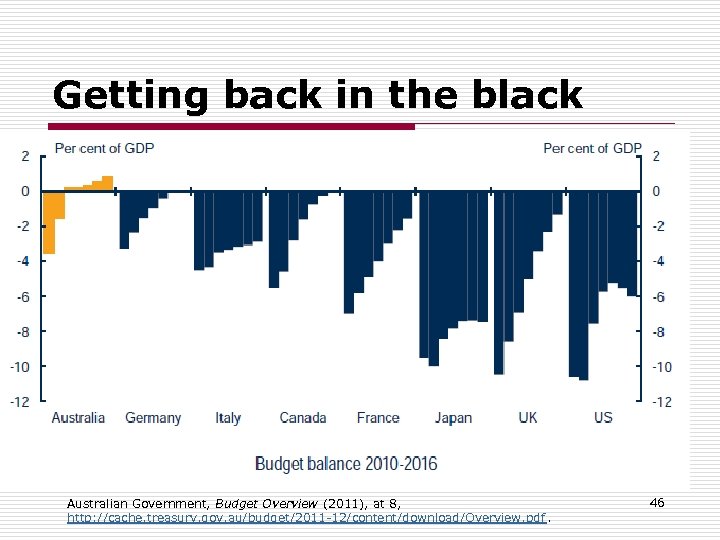
Getting back in the black Australian Government, Budget Overview (2011), at 8, http: //cache. treasury. gov. au/budget/2011 -12/content/download/Overview. pdf. 46
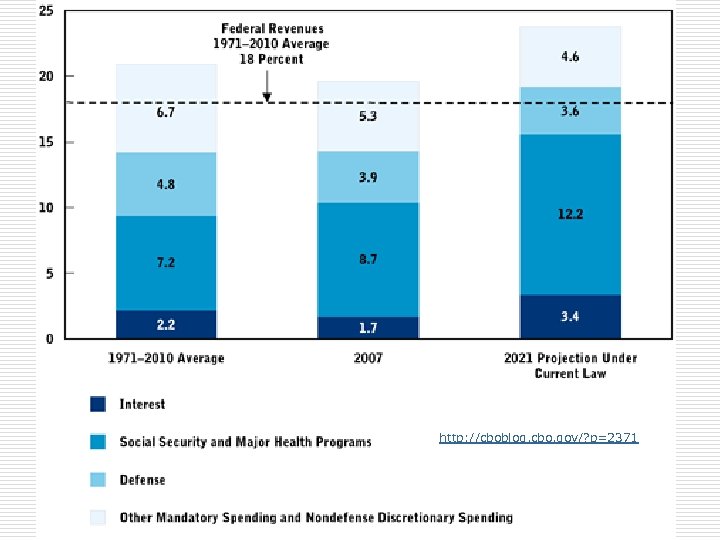
http: //cboblog. cbo. gov/? p=2371 47
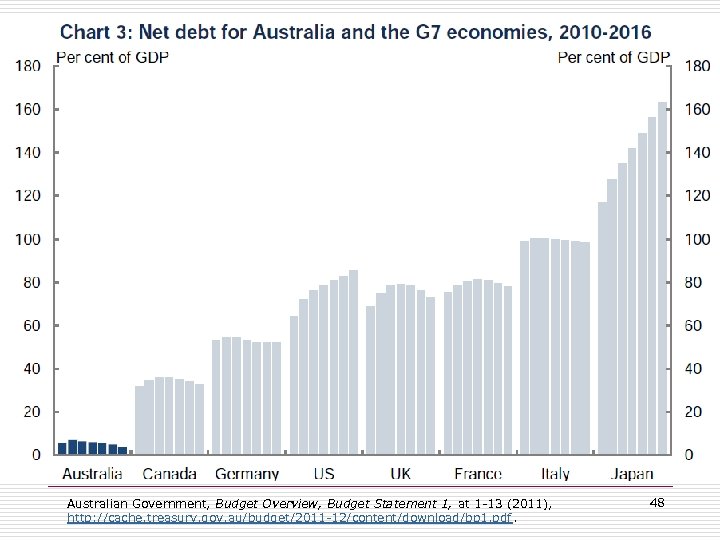
Australian Government, Budget Overview, Budget Statement 1, at 1 -13 (2011), http: //cache. treasury. gov. au/budget/2011 -12/content/download/bp 1. pdf. 48
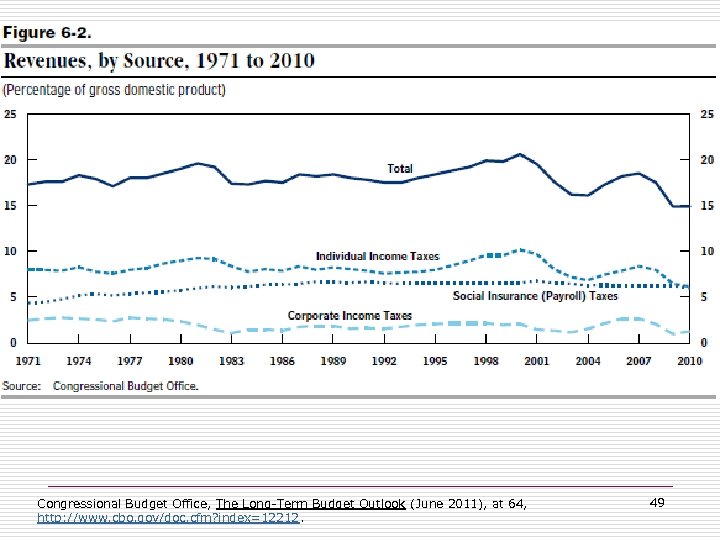
Congressional Budget Office, The Long-Term Budget Outlook (June 2011), at 64, http: //www. cbo. gov/doc. cfm? index=12212. 49
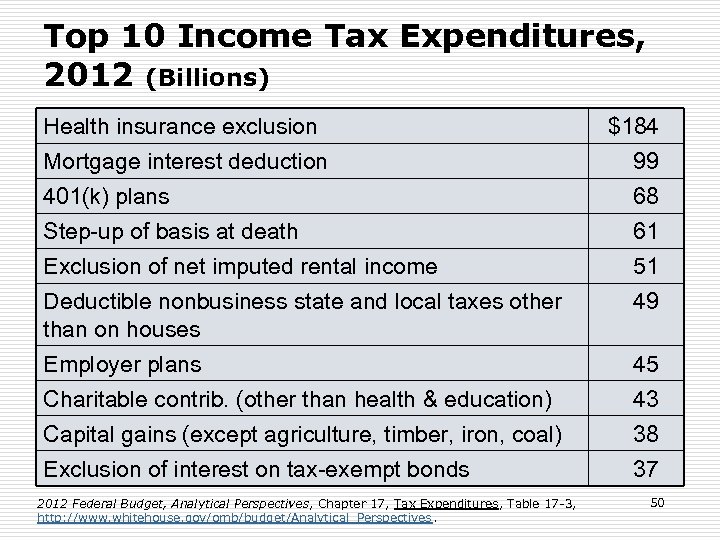
Top 10 Income Tax Expenditures, 2012 (Billions) Health insurance exclusion $184 Mortgage interest deduction 99 401(k) plans 68 Step-up of basis at death 61 Exclusion of net imputed rental income 51 Deductible nonbusiness state and local taxes other than on houses 49 Employer plans 45 Charitable contrib. (other than health & education) 43 Capital gains (except agriculture, timber, iron, coal) 38 Exclusion of interest on tax-exempt bonds 37 2012 Federal Budget, Analytical Perspectives, Chapter 17, Tax Expenditures, Table 17 -3, http: //www. whitehouse. gov/omb/budget/Analytical_Perspectives. 50
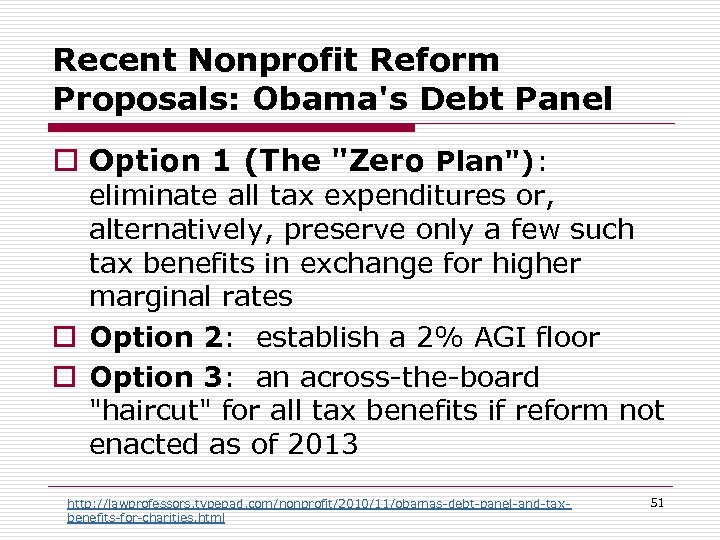
Recent Nonprofit Reform Proposals: Obama's Debt Panel o Option 1 (The "Zero Plan"): eliminate all tax expenditures or, alternatively, preserve only a few such tax benefits in exchange for higher marginal rates o Option 2: establish a 2% AGI floor o Option 3: an across-the-board "haircut" for all tax benefits if reform not enacted as of 2013 http: //lawprofessors. typepad. com/nonprofit/2010/11/obamas-debt-panel-and-taxbenefits-for-charities. html 51
Recent Nonprofit Reform Proposals, CBO o Congressional Budget Office, Options for Changing the Tax Treatment of Charitable Giving (2011), http: //www. cbo. gov/ftpdocs/121 xx/d oc 12167/Charitable. Contributions. pdf o Slides borrowed from a 15 June 2011 presentation by Athiphat. Muthitacharoen@cbo. gov 52
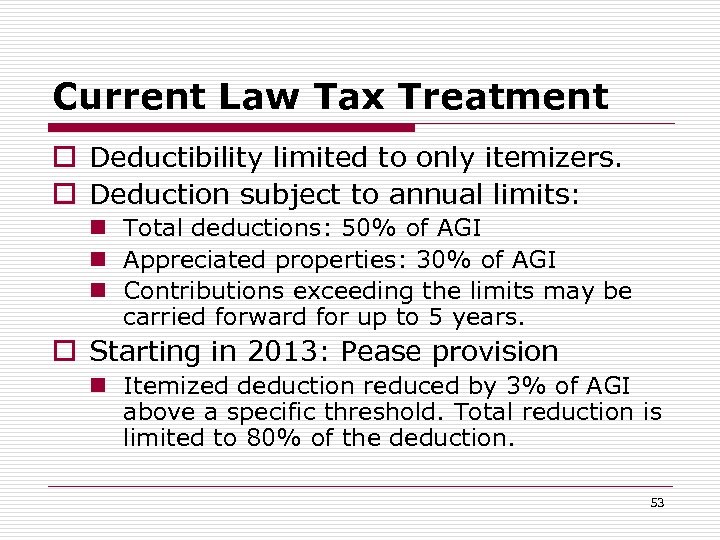
Current Law Tax Treatment o Deductibility limited to only itemizers. o Deduction subject to annual limits: n Total deductions: 50% of AGI n Appreciated properties: 30% of AGI n Contributions exceeding the limits may be carried forward for up to 5 years. o Starting in 2013: Pease provision n Itemized deduction reduced by 3% of AGI above a specific threshold. Total reduction is limited to 80% of the deduction. 53
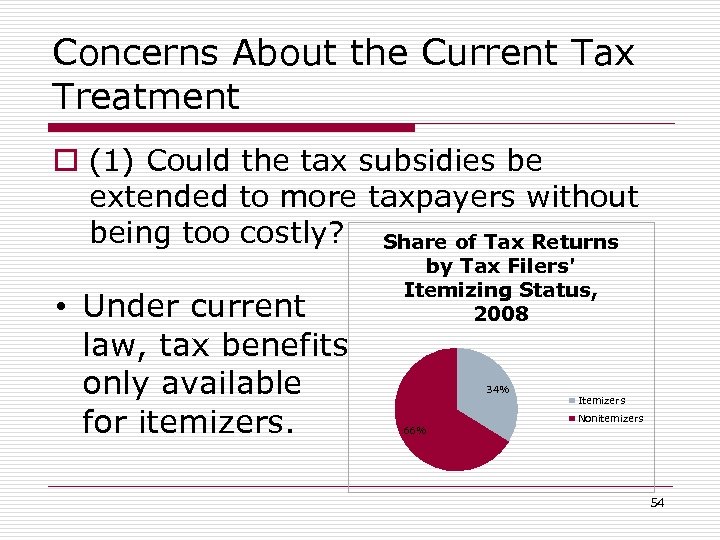
Concerns About the Current Tax Treatment o (1) Could the tax subsidies be extended to more taxpayers without being too costly? Share of Tax Returns • Under current law, tax benefits only available for itemizers. by Tax Filers' Itemizing Status, 2008 34% 66% Itemizers Nonitemizers 54
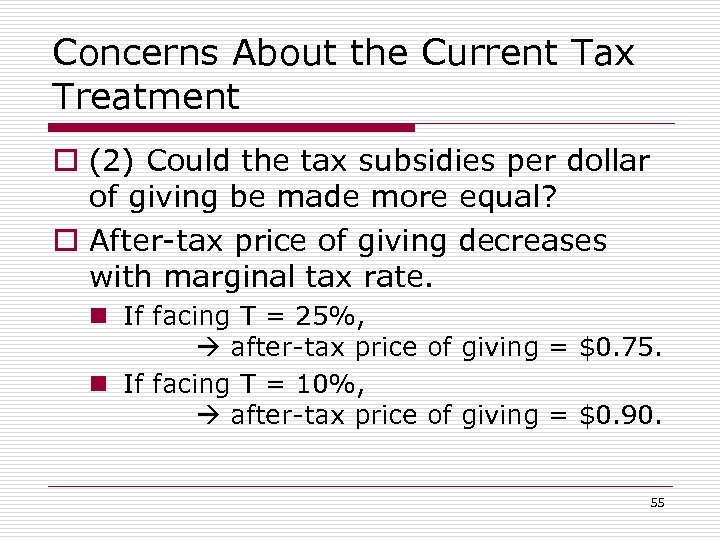
Concerns About the Current Tax Treatment o (2) Could the tax subsidies per dollar of giving be made more equal? o After-tax price of giving decreases with marginal tax rate. n If facing T = 25%, after-tax price of giving = $0. 75. n If facing T = 10%, after-tax price of giving = $0. 90. 55
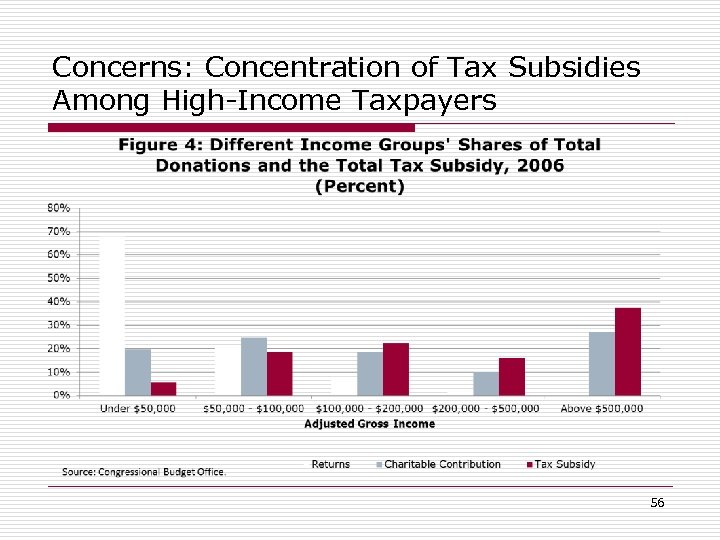
Concerns: Concentration of Tax Subsidies Among High-Income Taxpayers 56
The 11 Policy Options o Reflecting 3 important characteristics: n 1) whether the tax benefit includes a floor n 2) whether it is restricted to itemizers n 3) whether it takes the form a deduction or a credit. 57
The 11 Policy Options o Grouped into 4 categories: n Retaining current deduction for itemizers but adding a floor n Allowing all taxpayers to claim the deduction, with or without a floor n Replacing the deduction with a 25% credit for all taxpayers, with or without a floor n Replacing the deduction with a 15% credit for all taxpayers, with or without a floor 58
The 11 Policy Options o Two floors examined: n $500 for single; $1000 for joint filers. n 2% of AGI. 59
Basis for the Estimates o Micro-simulation model n 2006 Public-use sample of tax returns, n 2007 CPS. o Impute nonitemizers’ charitable giving: SCF and CEX o All estimates are for tax year 2006. (The tax treatments are largely the same as those in 2011). 60
Caveats about the Estimates o Include only price effects (income effects are likely to very small). o Does not account for possible transformative changes that could lead to a major behavioral shift. 61
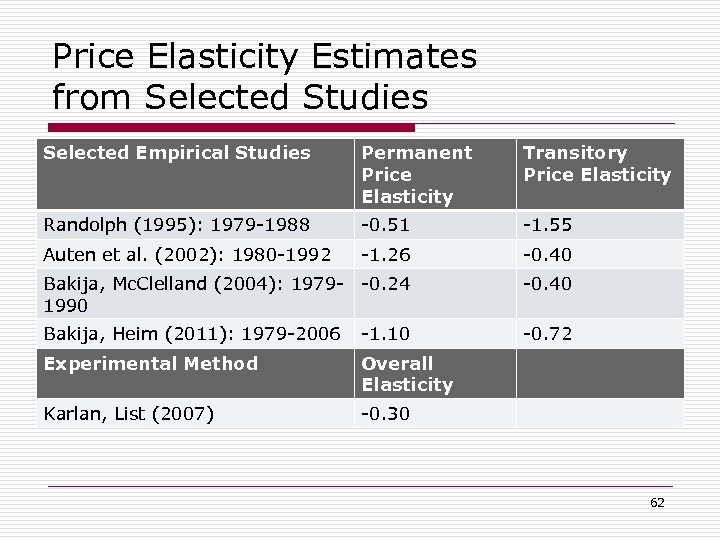
Price Elasticity Estimates from Selected Studies Selected Empirical Studies Permanent Price Elasticity Transitory Price Elasticity Randolph (1995): 1979 -1988 -0. 51 -1. 55 Auten et al. (2002): 1980 -1992 -1. 26 -0. 40 Bakija, Mc. Clelland (2004): 1979 - -0. 24 1990 -0. 40 Bakija, Heim (2011): 1979 -2006 -1. 10 -0. 72 Experimental Method Overall Elasticity Karlan, List (2007) -0. 30 62
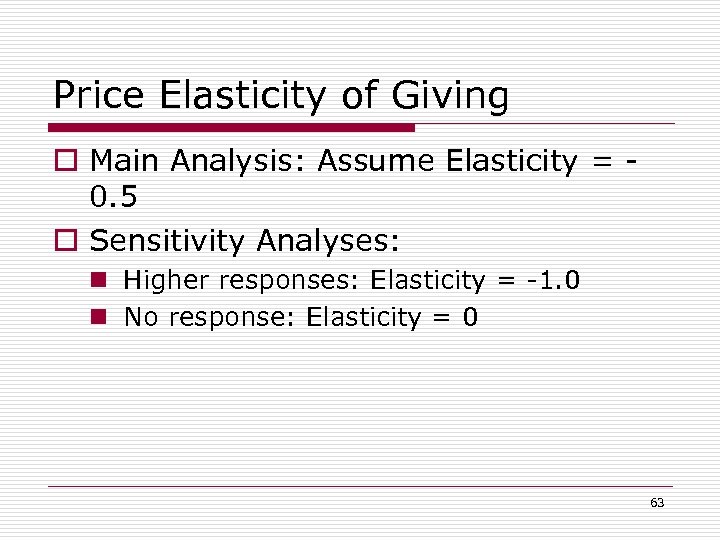
Price Elasticity of Giving o Main Analysis: Assume Elasticity = 0. 5 o Sensitivity Analyses: n Higher responses: Elasticity = -1. 0 n No response: Elasticity = 0 63
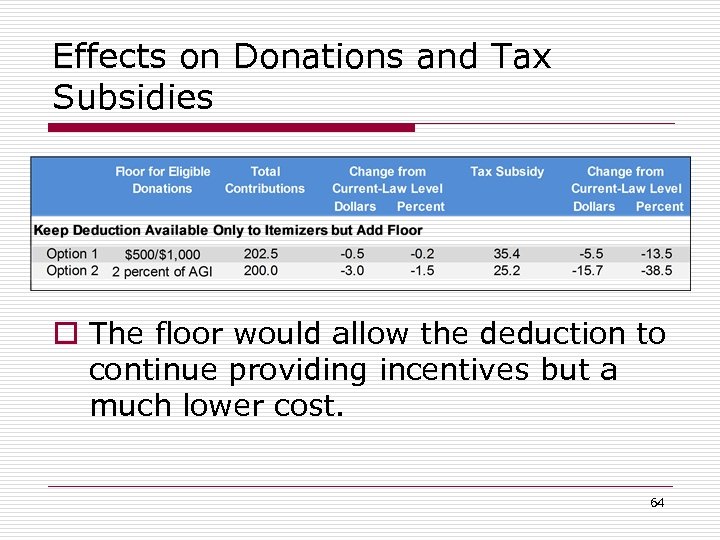
Effects on Donations and Tax Subsidies o The floor would allow the deduction to continue providing incentives but a much lower cost. 64
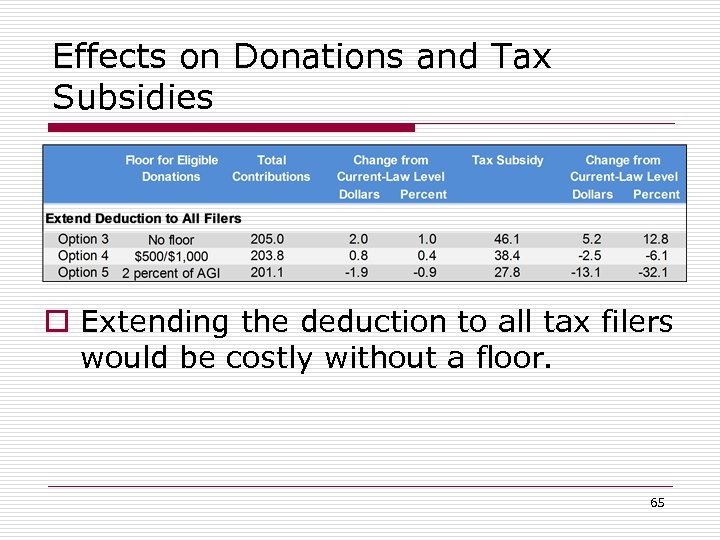
Effects on Donations and Tax Subsidies o Extending the deduction to all tax filers would be costly without a floor. 65
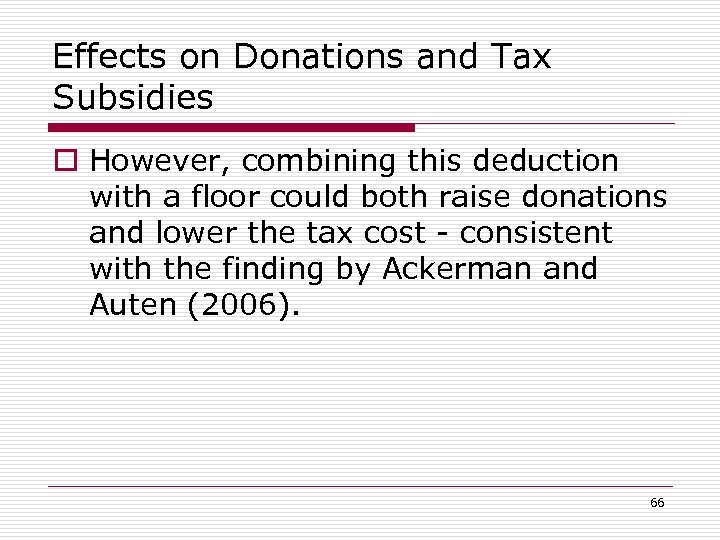
Effects on Donations and Tax Subsidies o However, combining this deduction with a floor could both raise donations and lower the tax cost - consistent with the finding by Ackerman and Auten (2006). 66
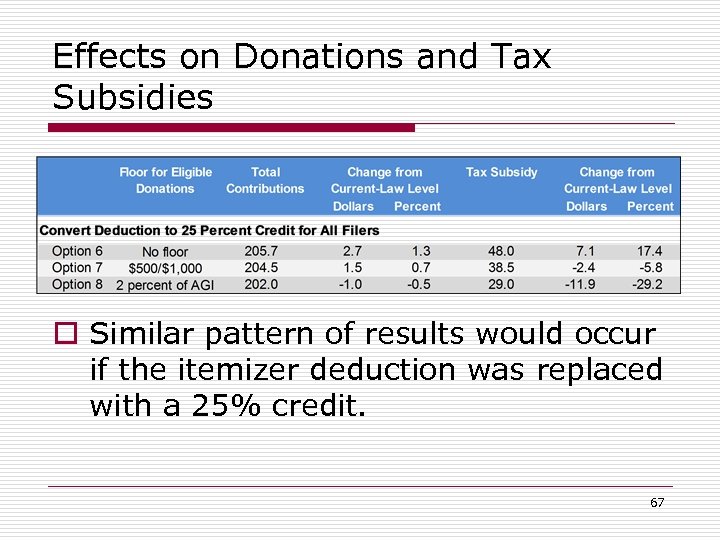
Effects on Donations and Tax Subsidies o Similar pattern of results would occur if the itemizer deduction was replaced with a 25% credit. 67
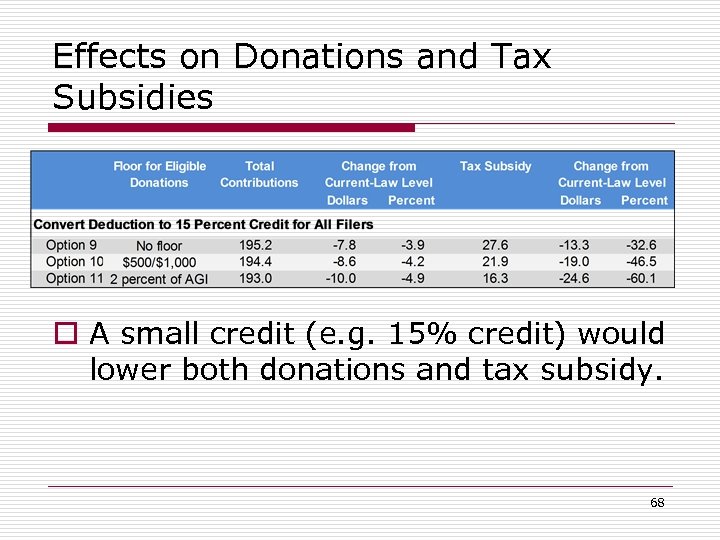
Effects on Donations and Tax Subsidies o A small credit (e. g. 15% credit) would lower both donations and tax subsidy. 68
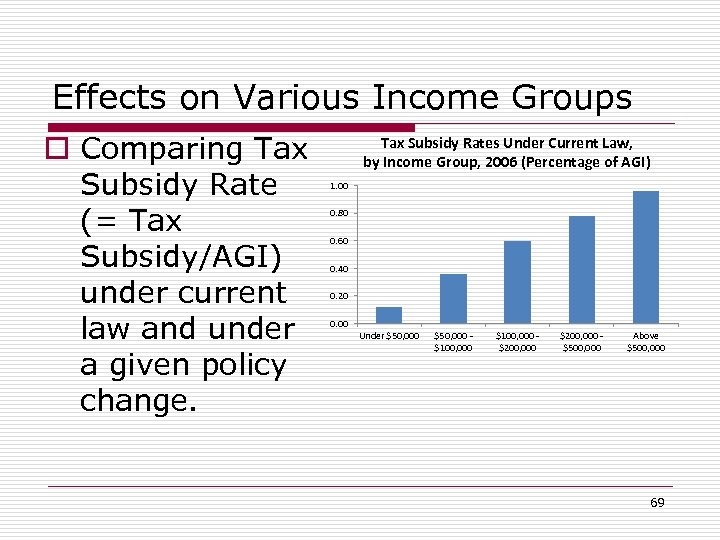
Effects on Various Income Groups o Comparing Tax Subsidy Rate (= Tax Subsidy/AGI) under current law and under a given policy change. Tax Subsidy Rates Under Current Law, by Income Group, 2006 (Percentage of AGI) 1. 00 0. 80 0. 60 0. 40 0. 20 0. 00 Under $50, 000 $100, 000 $200, 000 $500, 000 Above $500, 000 69
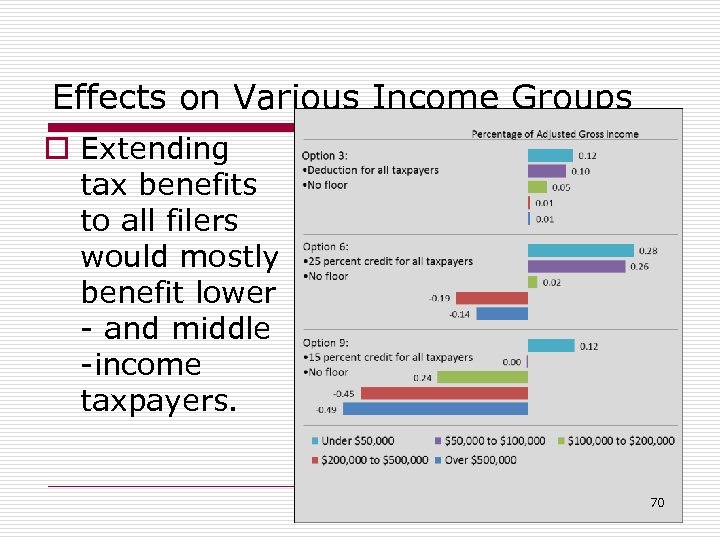
Effects on Various Income Groups o Extending tax benefits to all filers would mostly benefit lower - and middle -income taxpayers. 70
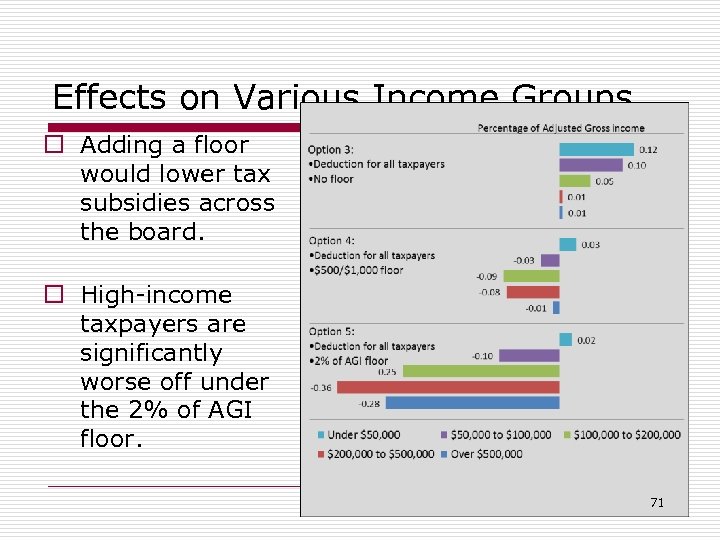
Effects on Various Income Groups o Adding a floor would lower tax subsidies across the board. o High-income taxpayers are significantly worse off under the 2% of AGI floor. 71
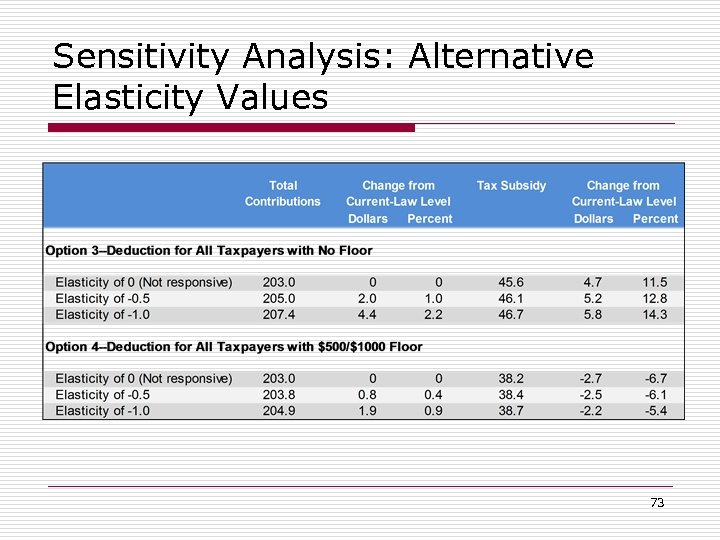
Sensitivity Analysis: Alternative Elasticity Values o Two alternative assumptions: n Zero elasticity n Elasticity of -1. 0 o Main results still hold. n Adding a floor would lower revenue cost significantly with moderate effects on giving. n Extending tax subsidies to all filers without a floor is very costly. 72
Sensitivity Analysis: Alternative Elasticity Values 73
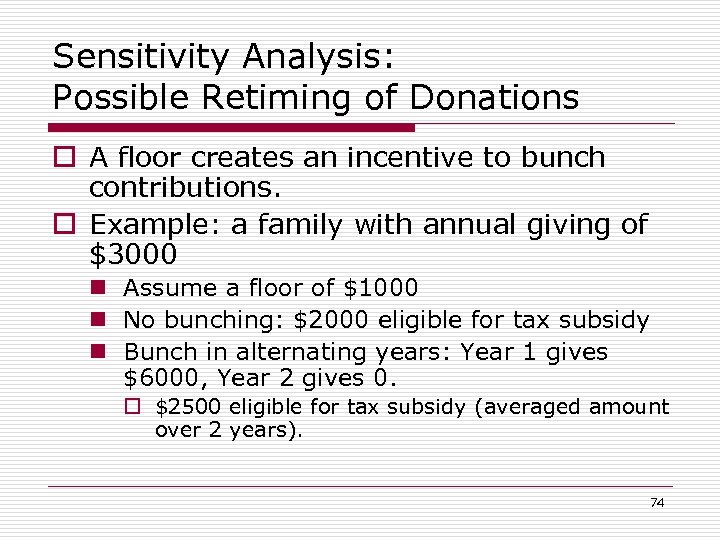
Sensitivity Analysis: Possible Retiming of Donations o A floor creates an incentive to bunch contributions. o Example: a family with annual giving of $3000 n Assume a floor of $1000 n No bunching: $2000 eligible for tax subsidy n Bunch in alternating years: Year 1 gives $6000, Year 2 gives 0. o $2500 eligible for tax subsidy (averaged amount over 2 years). 74
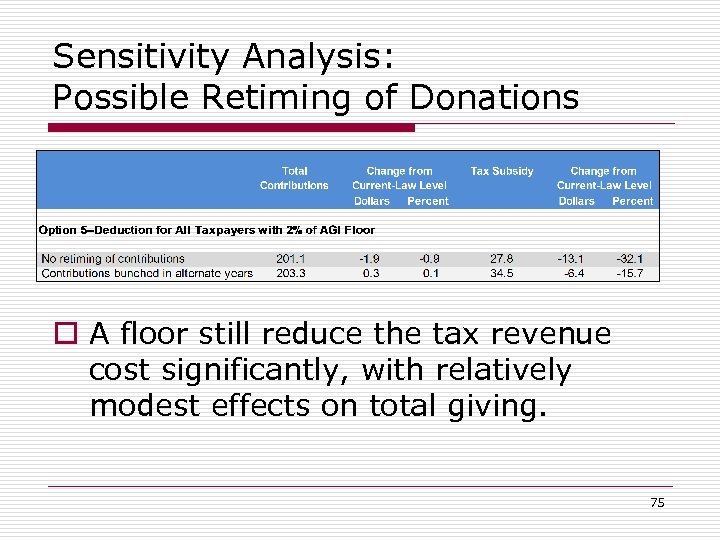
Sensitivity Analysis: Possible Retiming of Donations o A floor still reduce the tax revenue cost significantly, with relatively modest effects on total giving. 75
Some Key IRS Resources o Internal Revenue Service, Tax Information for Charities & Other Non-Profits web page, http: //www. irs. gov/charities/index. html? navmenu=men u 1 o Forms and Instructions for Exempt Organizations Links to current tax forms for tax-exempt organizations, http: //www. irs. gov/charities/article/0, , id=214269, 00. ht ml o Form 990 Resources and Tools Educational materials about EO annual return filings, http: //www. irs. gov/charities/article/0, , id=214479, 00. ht ml o IRS Stay Exempt: Tax Basics for Exempt Organizations, http: //www. stayexempt. irs. gov/Home. aspx 76
More IRS Resources o Stay Exempt (Course Summary: Unrelated Business Income), http: //www. stayexempt. irs. gov/Resource. Library/pdfs/Mod 2_Summary. pdf o Unrelated Business Income Tax - Special Rules for Organizations Exempt Under Code Section 501(c)(7), 501(c)(9), 501(c)(17), or 501(c)(20), http: //www. irs. gov/charities/article/0, , id=96106, 00. html o Publication 598, Tax on Unrelated Business Income of Exempt Organizations o Unrelated Business Income Tax Course, http: //www. stayexempt. irs. gov/virtualworkshop/ Unrelated. Business. Income. aspx 77
More Resources o Roger Colinvaux, Charity in the 21 st Century: Trending Toward Decay (2011), http: //papers. ssrn. com/sol 3/papers. cfm? abstract_id=18 09171 o Molly F. Sherlock & Jane G. Gravelle, An Overview of the Nonprofit and Charitable Sector (2009), http: //www. fas. org/sgp/crs/misc/R 40919. pdf o Joint Committee on Taxation, Historical Development And Present Law Of The Federal Tax Exemption For Charities And Other Tax-Exempt Organizations (2005), http: //www. jct. gov/publications. html? func=startdown&id =1586 78
More Resources o Senate Finance Committee Hearing on Charity Oversight and Reform (Congressional Research Service Report No. R 40919, June 22, 2004), http: //finance. senate. gov/hearings/hearing/? id=48 ca 4 cc e-afe 1 -db 95 -0 fcb-8 ff 9255 e 780 a o Nonprofit Law Prof Blog, http: //lawprofessors. typepad. com/nonprofit/ o National Center on Philanthropy and the Law (NCPL), http: //www 1. law. nyu. edu/ncpl/ n Conferences: o o Shades of Virtue: Measuring the Comparative Worthiness of Charities (2009) (Published Proceedings forthcoming 2011) Structures at the Seam: The Architecture of Charities’ Commercial Activities (2008) 79
About the Author o Jonathan Barry Forman (“Jon”) is the Alfred P. Murrah Professor of Law at the University of Oklahoma College of Law and the author of Making America Work (Washington, DC: Urban Institute Press, 2006). o Jon was the Professor in Residence at the Internal Revenue Service Office of Chief Counsel, Washington, DC, for the 2009 -2010 academic year. o Jon can be reached at jforman@ou. edu, 405 -325 -4779, www. law. ou. edu/faculty/forman. shtml. 80
Скачать презентацию An American Perspective on Not-for-Profit Tax Concessions by
d6c5c0aaa0c8c0d1affbdec252ecc6a0.ppt