 Скачать презентацию An Agricultural Model for Biodiversity Conservation Alexander J
af16d2db9e782d7c19f903b4cb01e144.ppt
- Количество слайдов: 40



An Agricultural Model for Biodiversity Conservation Alexander J. Travis May 26, 2008
Community Markets for Conservation
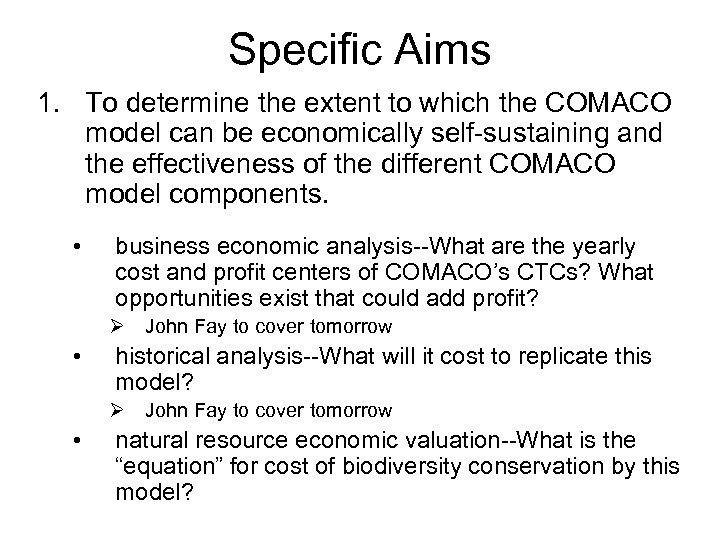
Specific Aims 1. To determine the extent to which the COMACO model can be economically self-sustaining and the effectiveness of the different COMACO model components. • business economic analysis--What are the yearly cost and profit centers of COMACO’s CTCs? What opportunities exist that could add profit? Ø John Fay to cover tomorrow • historical analysis--What will it cost to replicate this model? Ø John Fay to cover tomorrow • natural resource economic valuation--What is the “equation” for cost of biodiversity conservation by this model?
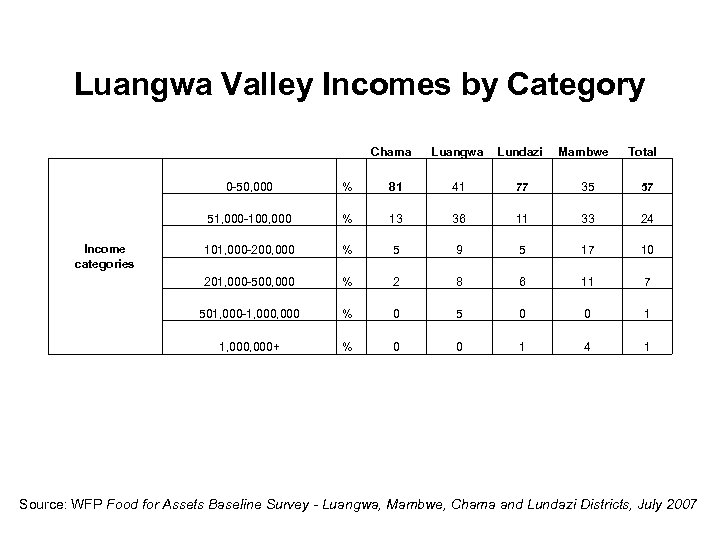
Luangwa Valley Incomes by Category Chama Luangwa Lundazi Mambwe Total 0 -50, 000 81 41 77 35 57 51, 000 -100, 000 % 13 36 11 33 24 101, 000 -200, 000 % 5 9 5 17 10 201, 000 -500, 000 % 2 8 6 11 7 501, 000 -1, 000 % 0 5 0 0 1 1, 000+ Income categories % % 0 0 1 4 1 Source: WFP Food for Assets Baseline Survey - Luangwa, Mambwe, Chama and Lundazi Districts, July 2007
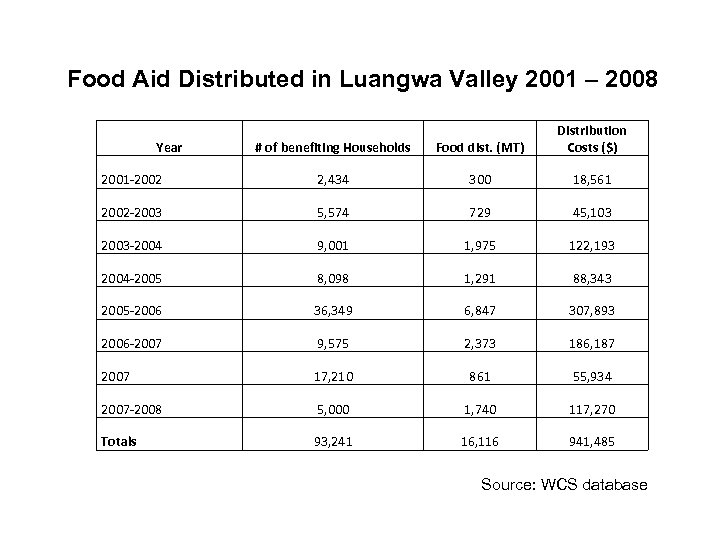
Food Aid Distributed in Luangwa Valley 2001 – 2008 # of benefiting Households Food dist. (MT) Distribution Costs ($) 2001 -2002 2, 434 300 18, 561 2002 -2003 5, 574 729 45, 103 2003 -2004 9, 001 1, 975 122, 193 2004 -2005 8, 098 1, 291 88, 343 2005 -2006 36, 349 6, 847 307, 893 2006 -2007 9, 575 2, 373 186, 187 2007 17, 210 861 55, 934 2007 -2008 5, 000 1, 740 117, 270 Totals 93, 241 16, 116 941, 485 Year Source: WCS database
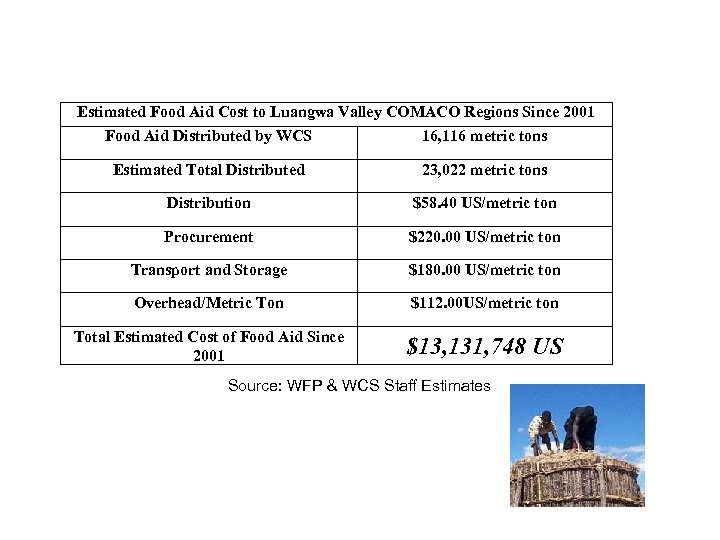
Estimated Food Aid Cost to Luangwa Valley COMACO Regions Since 2001 Food Aid Distributed by WCS 16, 116 metric tons Estimated Total Distributed 23, 022 metric tons Distribution $58. 40 US/metric ton Procurement $220. 00 US/metric ton Transport and Storage $180. 00 US/metric ton Overhead/Metric Ton $112. 00 US/metric ton Total Estimated Cost of Food Aid Since 2001 $13, 131, 748 US Source: WFP & WCS Staff Estimates
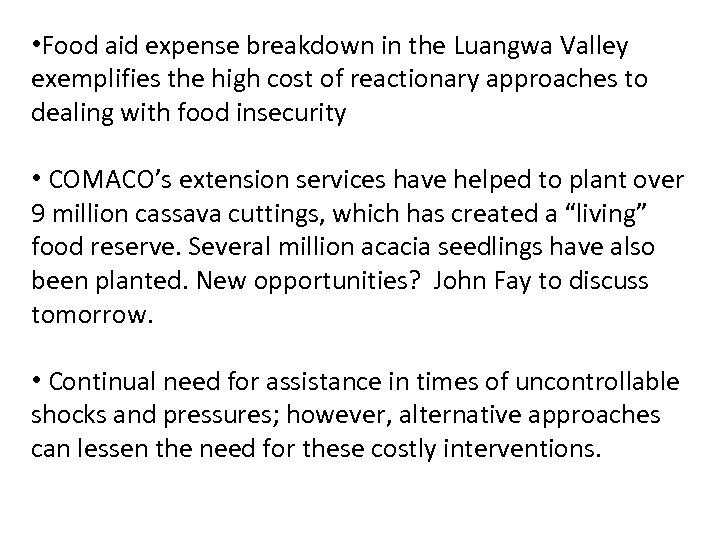
• Food aid expense breakdown in the Luangwa Valley exemplifies the high cost of reactionary approaches to dealing with food insecurity • COMACO’s extension services have helped to plant over 9 million cassava cuttings, which has created a “living” food reserve. Several million acacia seedlings have also been planted. New opportunities? John Fay to discuss tomorrow. • Continual need for assistance in times of uncontrollable shocks and pressures; however, alternative approaches can lessen the need for these costly interventions.
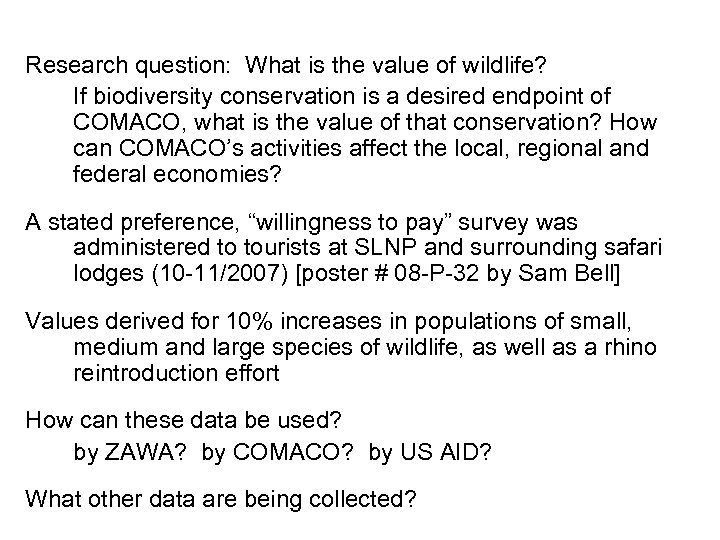
Research question: What is the value of wildlife? If biodiversity conservation is a desired endpoint of COMACO, what is the value of that conservation? How can COMACO’s activities affect the local, regional and federal economies? A stated preference, “willingness to pay” survey was administered to tourists at SLNP and surrounding safari lodges (10 -11/2007) [poster # 08 -P-32 by Sam Bell] Values derived for 10% increases in populations of small, medium and large species of wildlife, as well as a rhino reintroduction effort How can these data be used? by ZAWA? by COMACO? by US AID? What other data are being collected?
Specific Aims 2. To identify and integrate new technologies into the COMACO model to improve its profitability, food security, and rural incomes. • • food sciences crop and soil sciences Ø Lydiah Gatere to cover tomorrow • veterinary sciences (goats) Ø Alex Travis to cover poultry tomorrow
Specific Aims Food sciences: For COMACO to become profitable, it will rely heavily on value-added food products. Facilities improvements and capacity building in food safety and hygienic production practices are essential for COMACO to expand their products and market access.
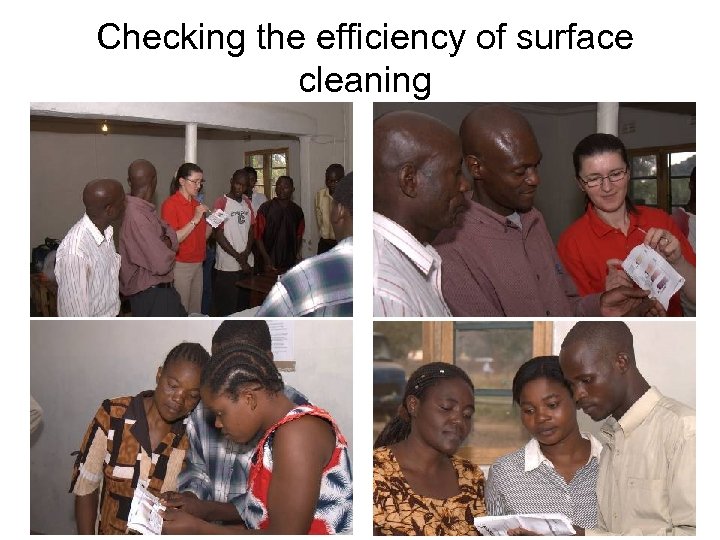
Checking the efficiency of surface cleaning
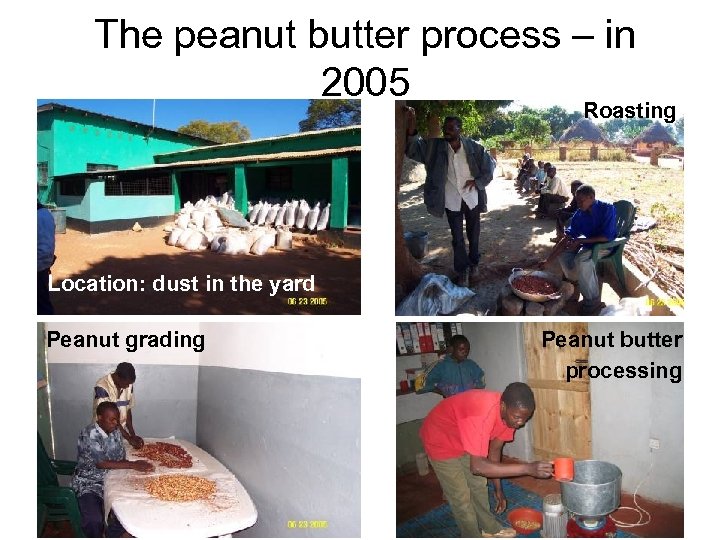
The peanut butter process – in 2005 Roasting Location: dust in the yard Peanut grading Peanut butter processing
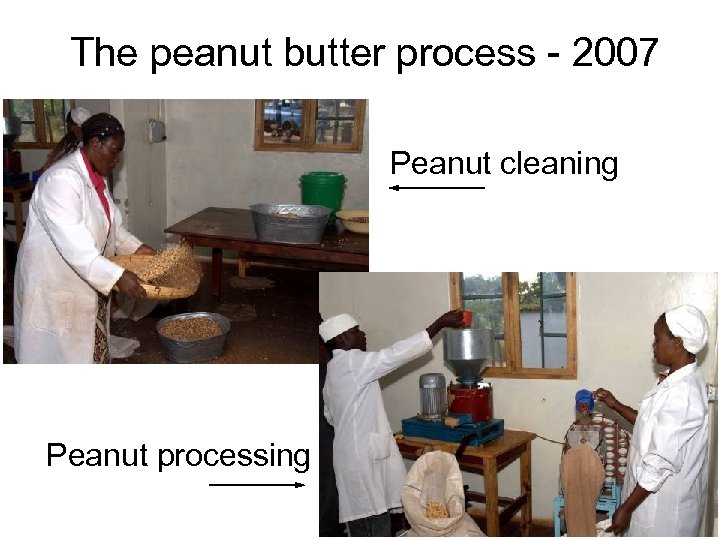
The peanut butter process - 2007 Peanut cleaning Peanut processing
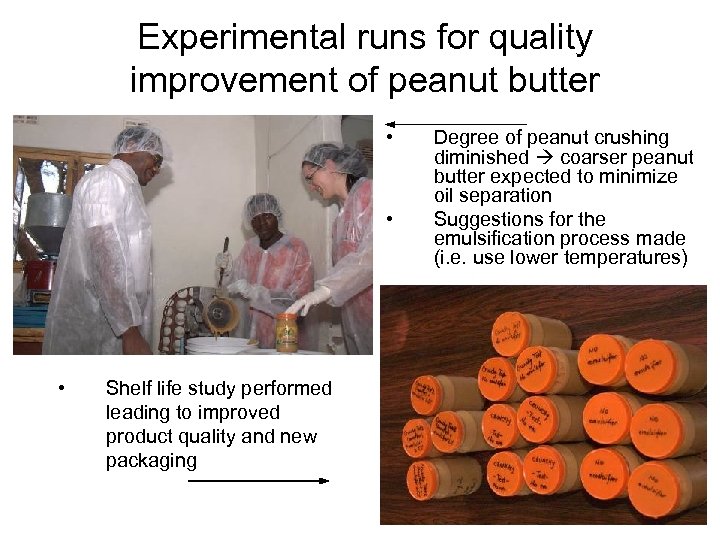
Experimental runs for quality improvement of peanut butter • • • Shelf life study performed leading to improved product quality and new packaging Degree of peanut crushing diminished coarser peanut butter expected to minimize oil separation Suggestions for the emulsification process made (i. e. use lower temperatures)
Continued Impacts COMACO has hired a food science technician to maintain compliance with best production practices, and SANREM is helping them set up a small lab to perform additional product research, develop new products, troubleshoot COMACO has met their quality and safety tests since the training workshop COMACO has obtained a contract for 300 tons of HEPS (previously had to be imported) rice breakage and wastage significantly reduced new soy-based products made and marketed
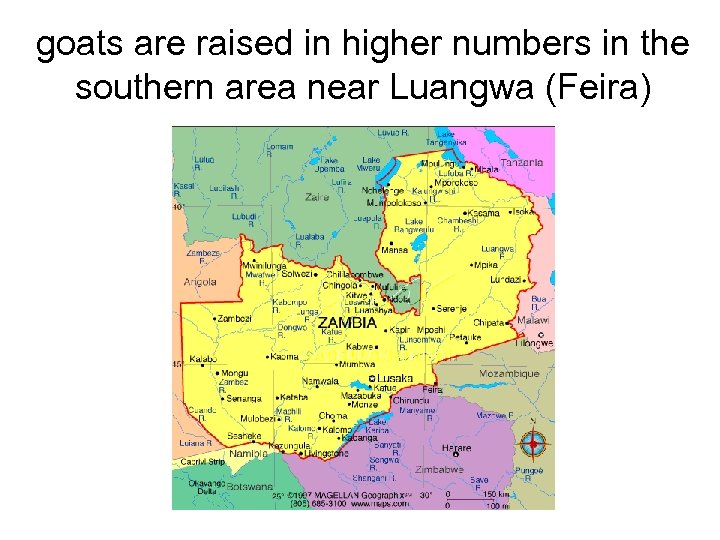
goats are raised in higher numbers in the southern area near Luangwa (Feira)
• contribution of goats to COMACO model – fertilizer (crops, fish ponds) – efficient (crop residues, less expensive than cattle) – fodder trees/agroforestry • lower morbidity than other ruminants • increase household security – leather, fiber, meat, milk – “bank account”
Participatory survey of practices and concerns modeled after our poultry work in year 1 (to be discussed tomorrow) • 6 chiefdoms • almost every household keeps at least a few goats (esp. Mburuma and Mphuka) • numerous producer groups being formed (Mpanshya, Shikabeta, Nyalugwe) • semi-intensive management • failed introduction of Boer goats last year • some cross-breeds still going
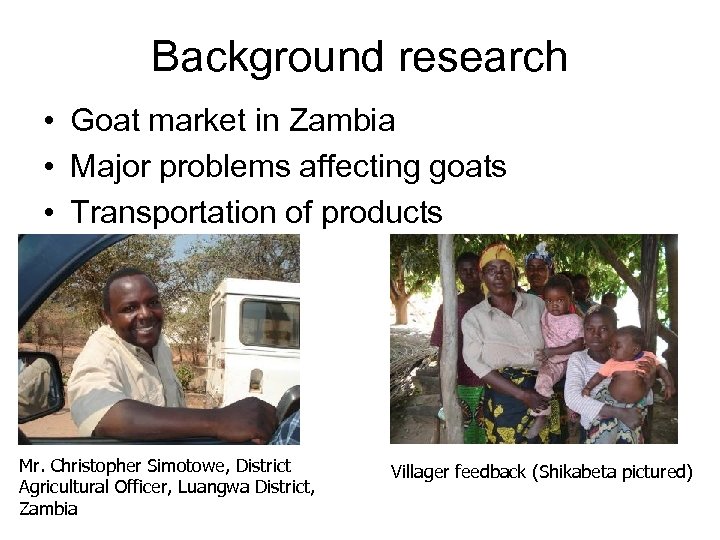
Background research • Goat market in Zambia • Major problems affecting goats • Transportation of products Mr. Christopher Simotowe, District Agricultural Officer, Luangwa District, Zambia Villager feedback (Shikabeta pictured)
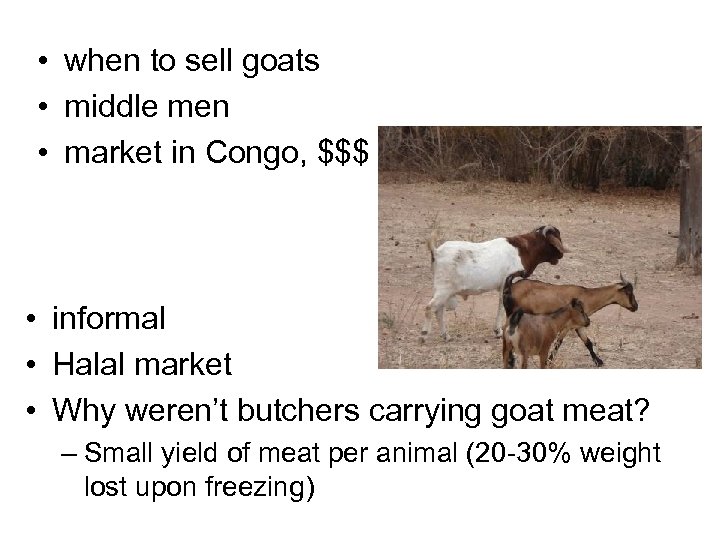
• when to sell goats • middle men • market in Congo, $$$ • informal • Halal market • Why weren’t butchers carrying goat meat? – Small yield of meat per animal (20 -30% weight lost upon freezing)
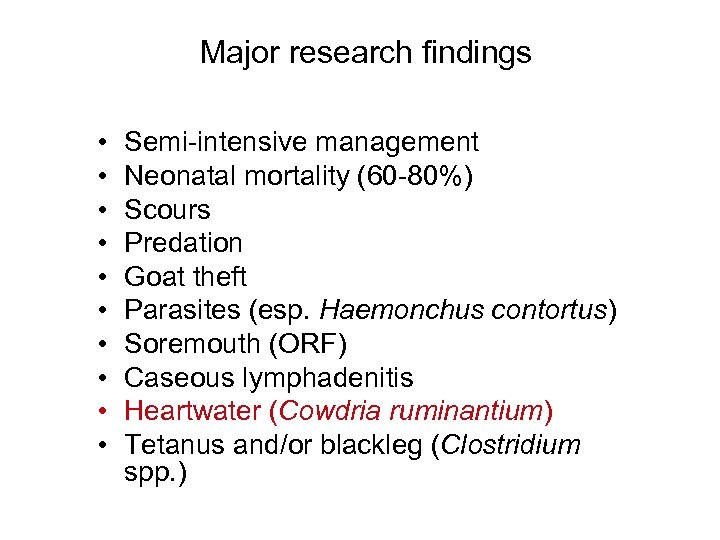
Major research findings • • • Semi-intensive management Neonatal mortality (60 -80%) Scours Predation Goat theft Parasites (esp. Haemonchus contortus) Soremouth (ORF) Caseous lymphadenitis Heartwater (Cowdria ruminantium) Tetanus and/or blackleg (Clostridium spp. )
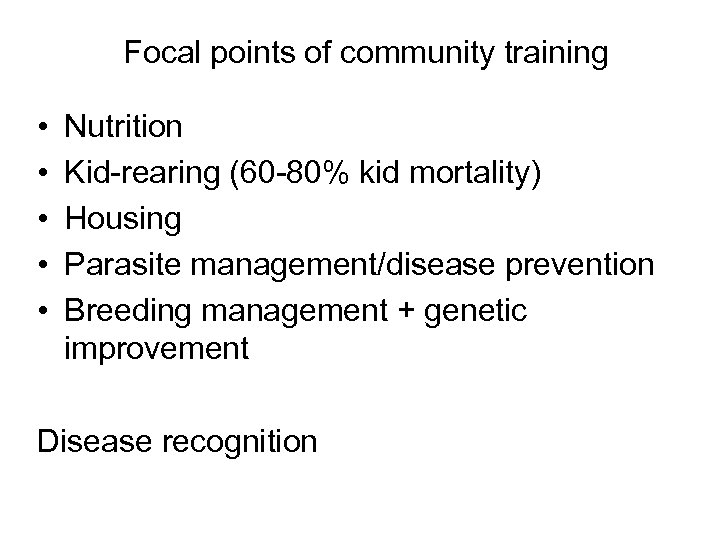
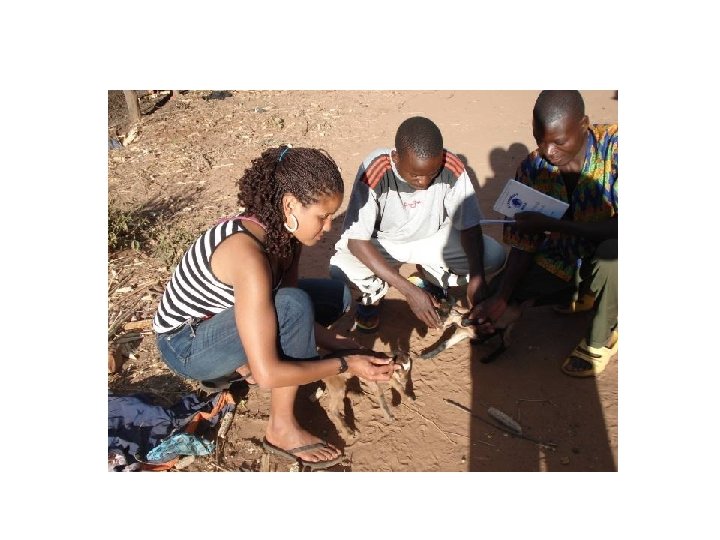
Focal points of community training • • • Nutrition Kid-rearing (60 -80% kid mortality) Housing Parasite management/disease prevention Breeding management + genetic improvement Disease recognition
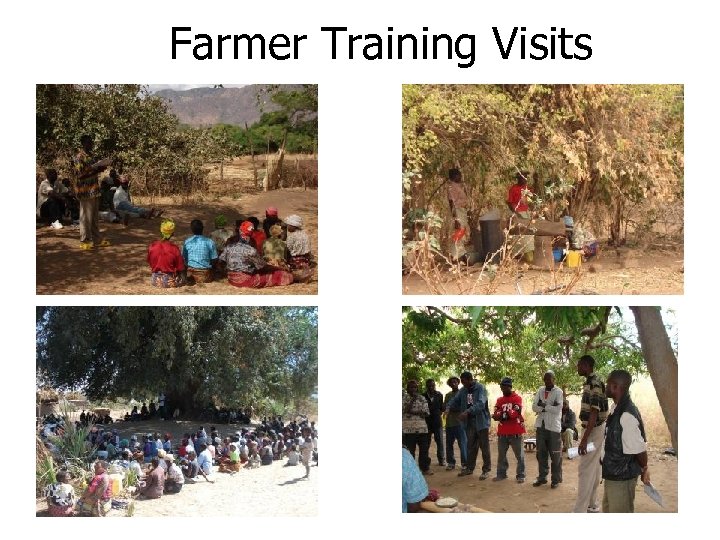
Farmer Training Visits
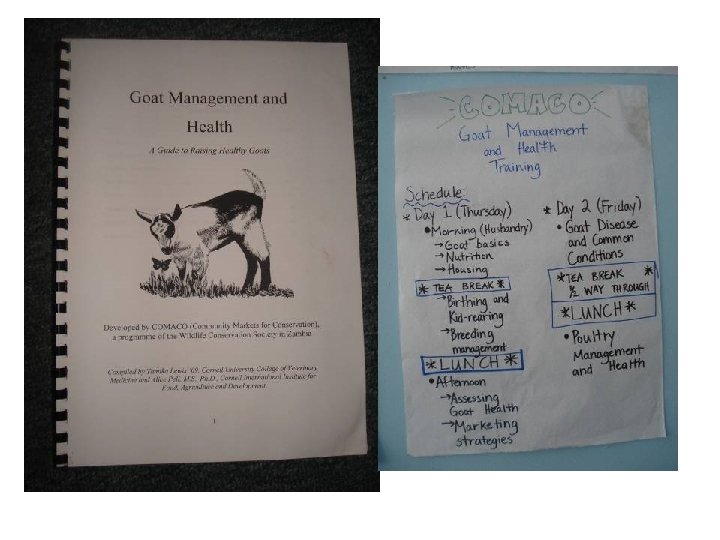
“Training the Trainers” manual • Trained 26 extension officers and community trainers • Officers and trainers then went and trained COMACO farmers (>5000 households participating in Feira) • 2 day workshop • Follow-up visits to training sessions
Specific Aims 3. To determine the extent to which the COMACO model provides self-sustaining social institutions and meaningful roles for COMACO participants. • yearly surveys to assess family economic and food security impacts • yearly surveys to monitor compliance with preferred agricultural and NRM practices • “one-off” surveys to gather specific points of information Ø Vongai Kandiwa to cover aspects of gender studies at the workshop • stakeholder meeting for government officials
Social surveys--evaluating the model as it is COMACO routinely performs several surveys on a routine basis to monitor family economics, food security, and compliance with sustainable practices This year, one chiefdom was found NOT to be in compliance and will therefore not be given the “conservation farmer” premium. Will this encourage compliance, or discourage compliance?
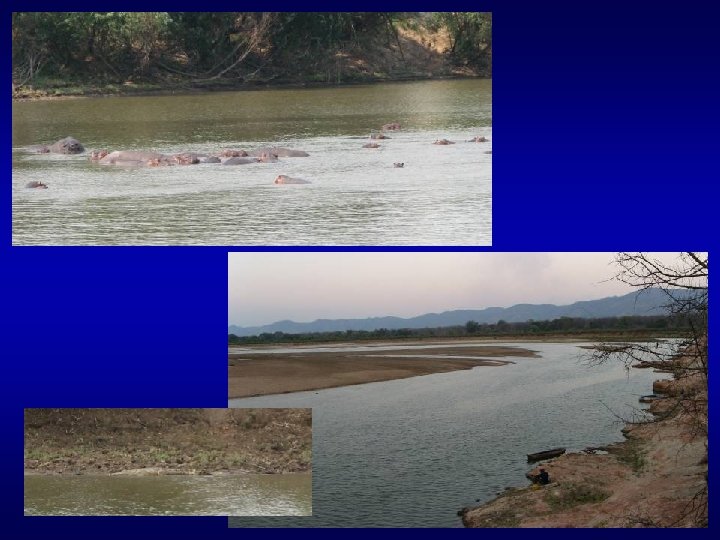
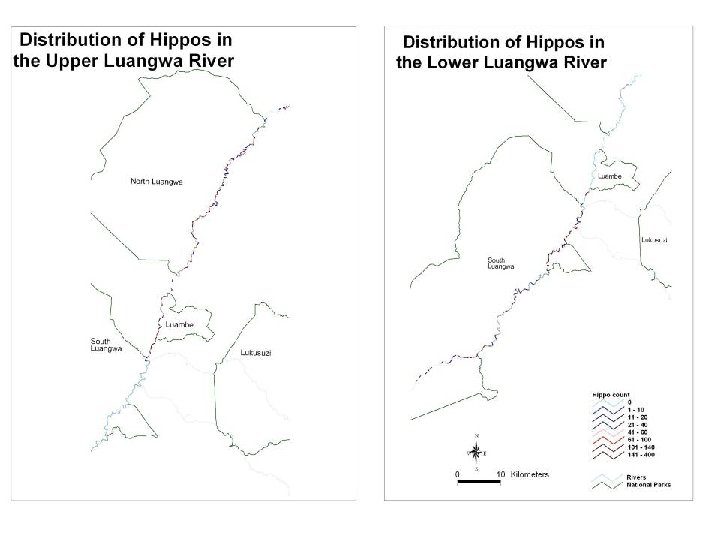
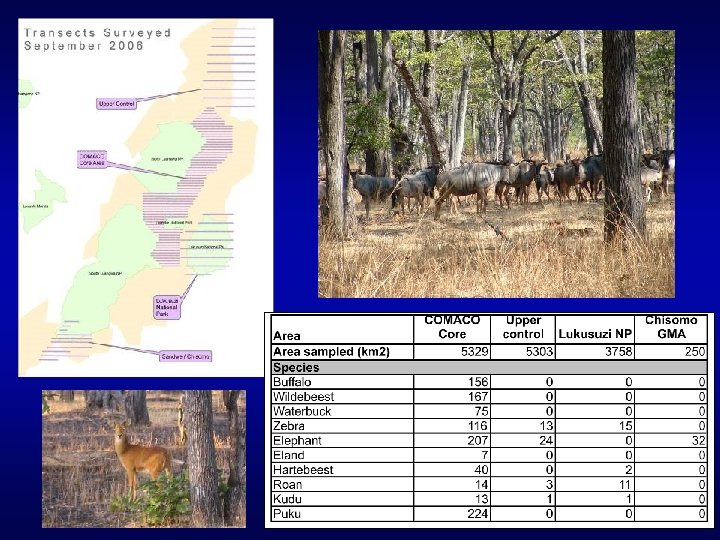
Specific Aims 4. To determine the extent to which the COMACO model improves biodiversity and watershed conservation. • aerial survey of hippos • aerial wildlife survey (primarily ungulates) • watershed, canopy and bushfire analysis Ø Conrad Heatwole to cover
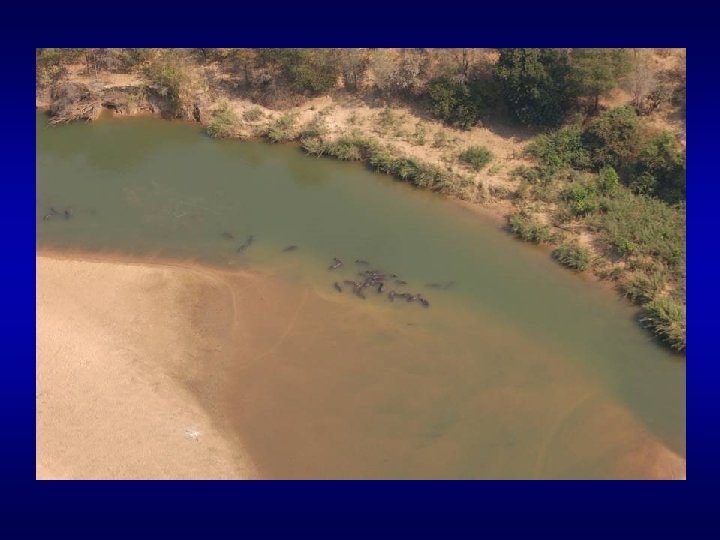
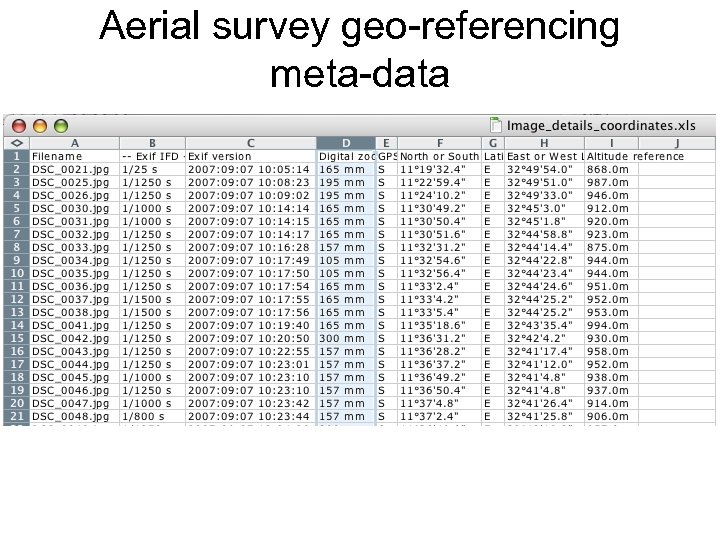
Aerial survey geo-referencing meta-data
Acknowledgements Cornell University Alfonso Torres Sam Bell Beth Buckles Jon Conrad Parfait Eloundou-Enyegue John Fay Lydiah Gatere Peter Hobbs Vongai Kandiwa Johannes Lehmann Benjamin Lucio Carmen Moraru Alice Pell William Schulze International Rural Poultry Centre Robyn Alders Brigitte Bagnol Wildlife Conservation Society Dale Lewis Steve Osofsky David Moyer* Virginia Tech University Conrad Heatwole Keith Moore Theo Dillaha Tropical Soil Biology & Fertility Robert Delve
Скачать презентацию An Agricultural Model for Biodiversity Conservation Alexander J
af16d2db9e782d7c19f903b4cb01e144.ppt