


 Скачать презентацию AN AGE OF LIMITS Chapter 32 Second
22f9c996a16639c6bef566f05a5a97e8.ppt
- Количество слайдов: 37
 AN AGE OF LIMITS Chapter 32
 Second, was the nation’s need foreign oil. The U. S. received much of its oil from the Middle East. Many of these countries belonged to a cartel called OPEC (Organization of Petroleum Exporting Countries).
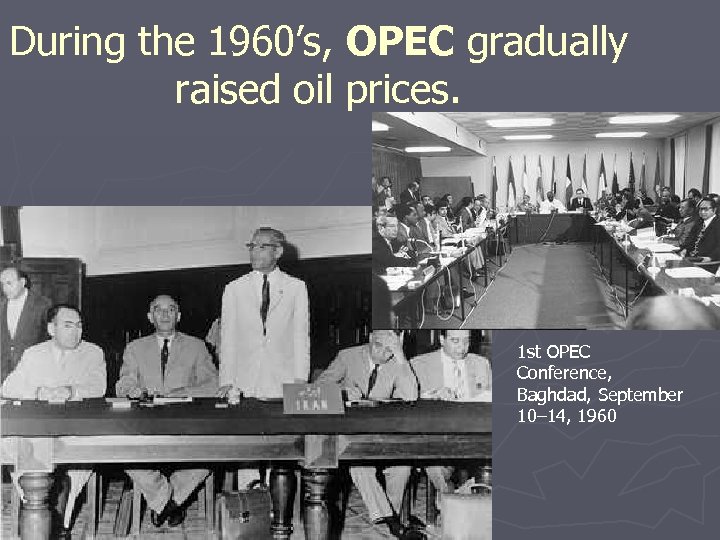 During the 1960’s, OPEC gradually raised oil prices. 1 st OPEC Conference, Baghdad, September 10– 14, 1960
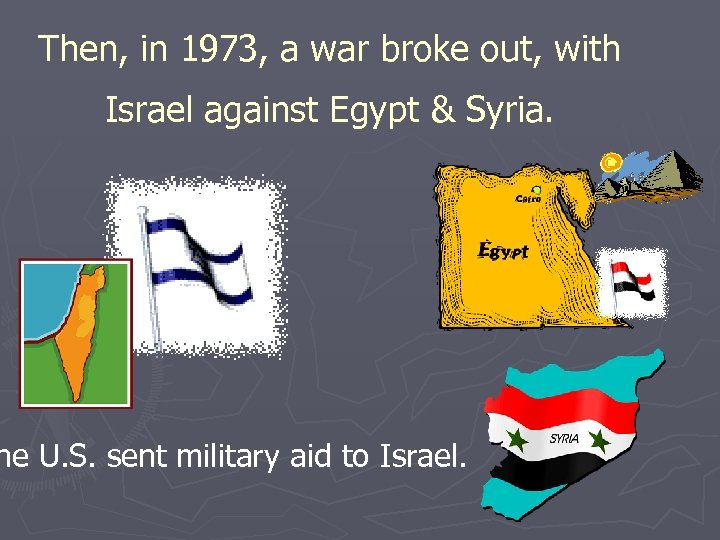 Then, in 1973, a war broke out, with Israel against Egypt & Syria. he U. S. sent military aid to Israel.
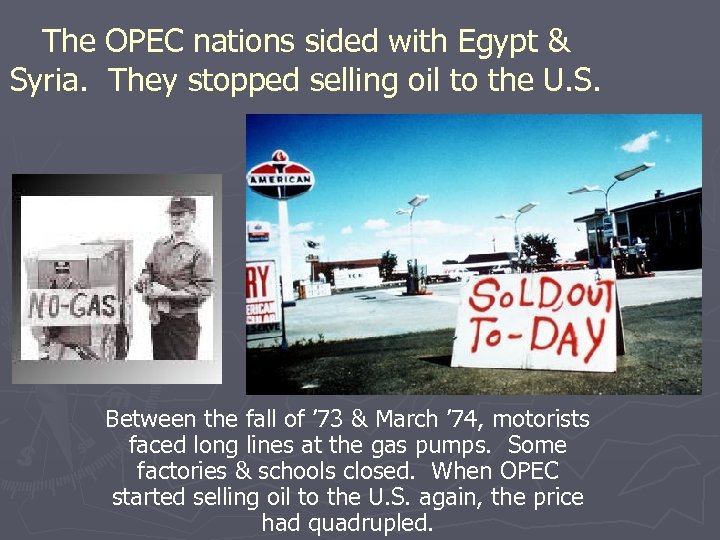 The OPEC nations sided with Egypt & Syria. They stopped selling oil to the U. S. Between the fall of ’ 73 & March ’ 74, motorists faced long lines at the gas pumps. Some factories & schools closed. When OPEC started selling oil to the U. S. again, the price had quadrupled.
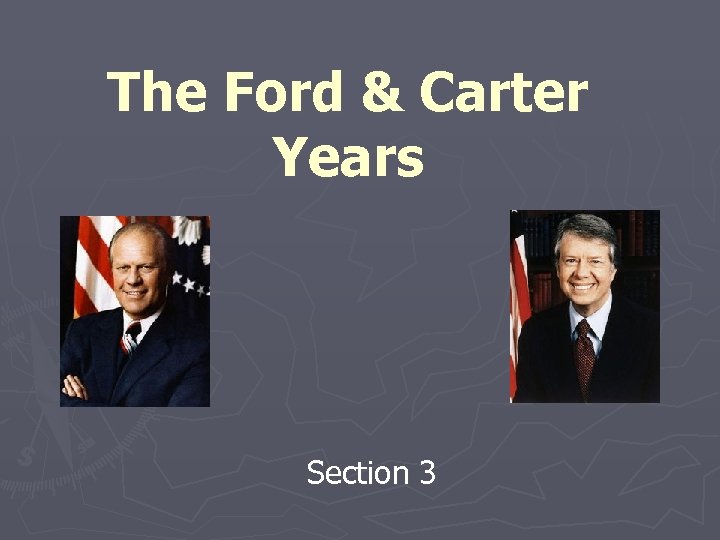 The Ford & Carter Years Section 3
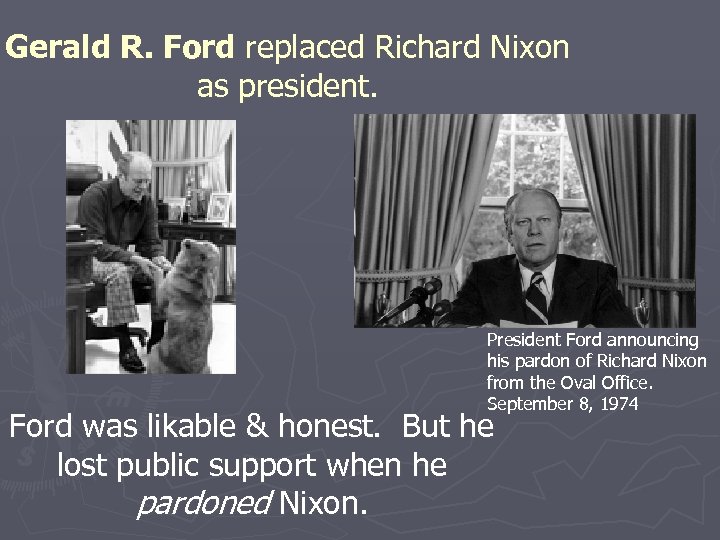 Gerald R. Ford replaced Richard Nixon as president. President Ford announcing his pardon of Richard Nixon from the Oval Office. September 8, 1974 Ford was likable & honest. But he lost public support when he pardoned Nixon.
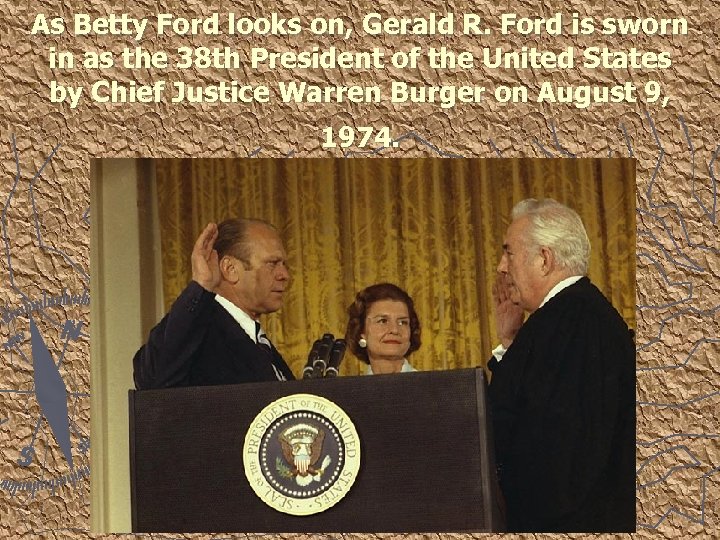 As Betty Ford looks on, Gerald R. Ford is sworn in as the 38 th President of the United States by Chief Justice Warren Burger on August 9, 1974.
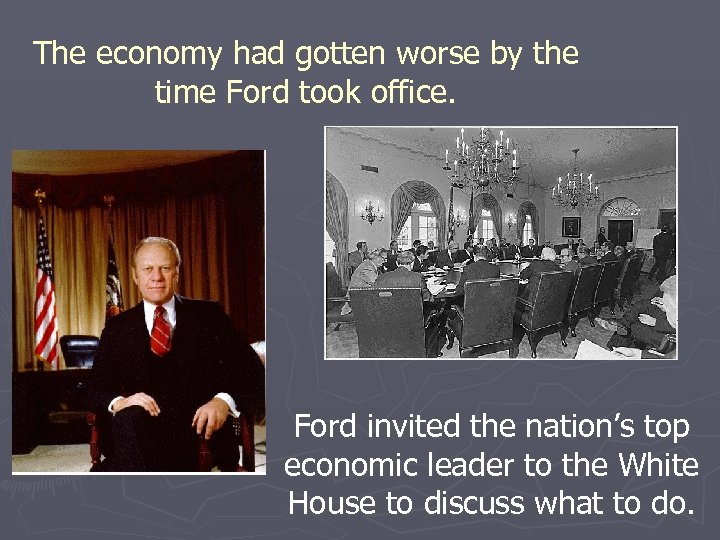 The economy had gotten worse by the time Ford took office. Ford invited the nation’s top economic leader to the White House to discuss what to do.
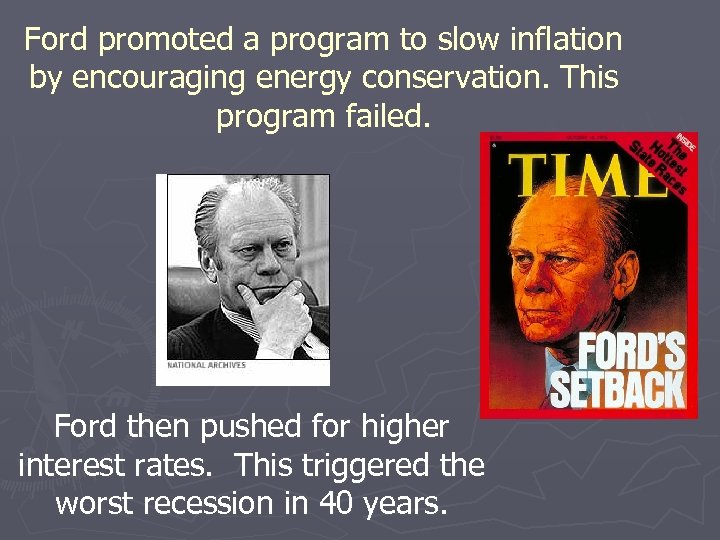 Ford promoted a program to slow inflation by encouraging energy conservation. This program failed. Ford then pushed for higher interest rates. This triggered the worst recession in 40 years.
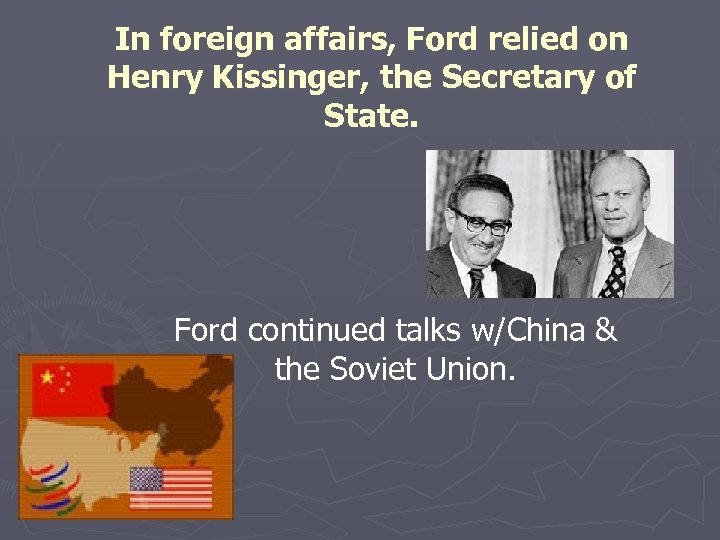 In foreign affairs, Ford relied on Henry Kissinger, the Secretary of State. Ford continued talks w/China & the Soviet Union.
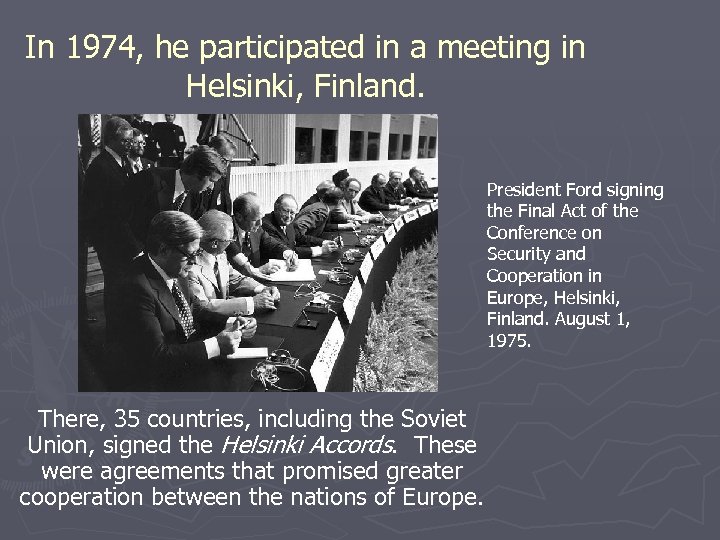 In 1974, he participated in a meeting in Helsinki, Finland. President Ford signing the Final Act of the Conference on Security and Cooperation in Europe, Helsinki, Finland. August 1, 1975. There, 35 countries, including the Soviet Union, signed the Helsinki Accords. These were agreements that promised greater cooperation between the nations of Europe.
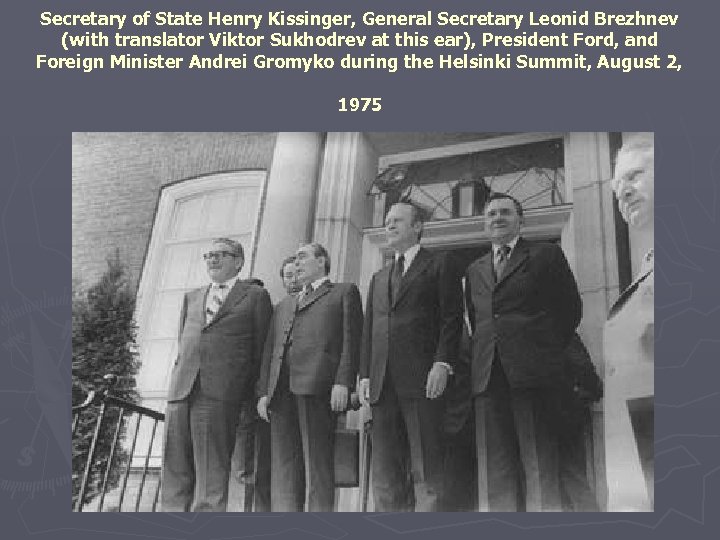 Secretary of State Henry Kissinger, General Secretary Leonid Brezhnev (with translator Viktor Sukhodrev at this ear), President Ford, and Foreign Minister Andrei Gromyko during the Helsinki Summit, August 2, 1975
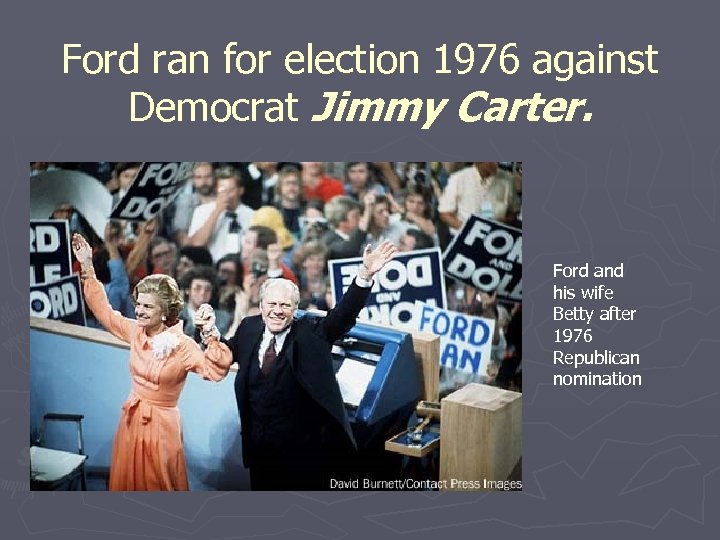 Ford ran for election 1976 against Democrat Jimmy Carter. Ford and his wife Betty after 1976 Republican nomination
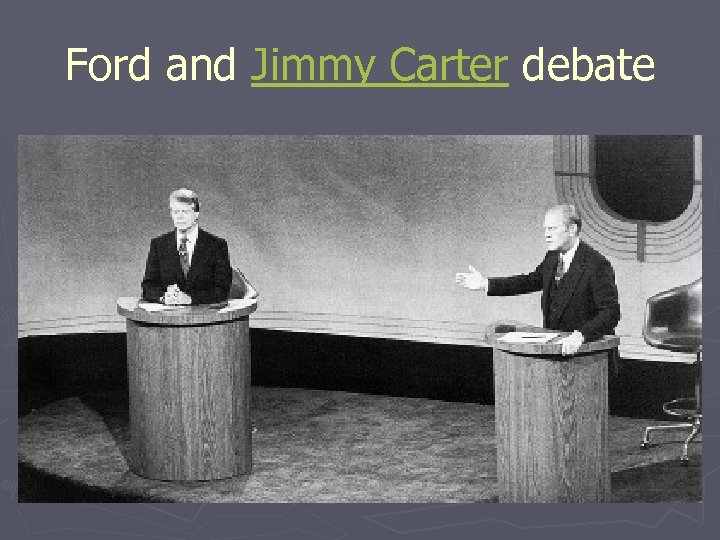 Ford and Jimmy Carter debate
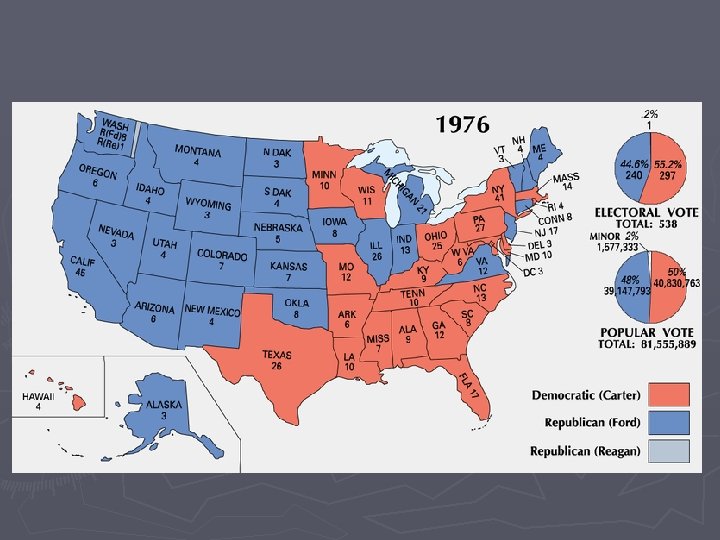
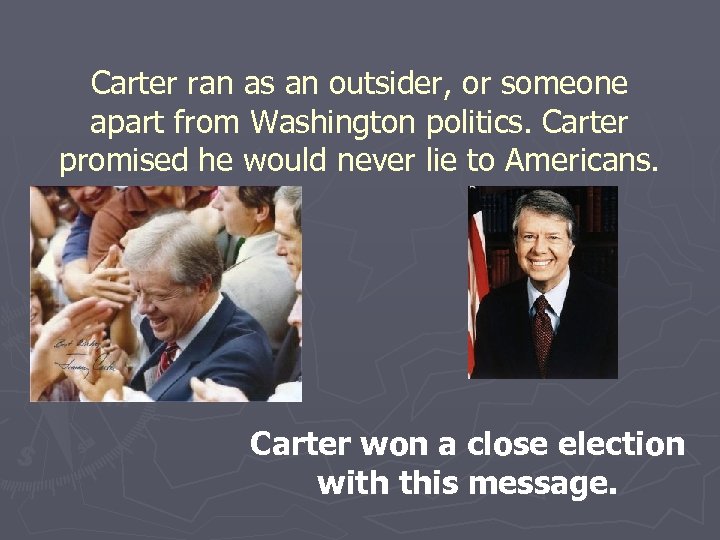 Carter ran as an outsider, or someone apart from Washington politics. Carter promised he would never lie to Americans. Carter won a close election with this message.
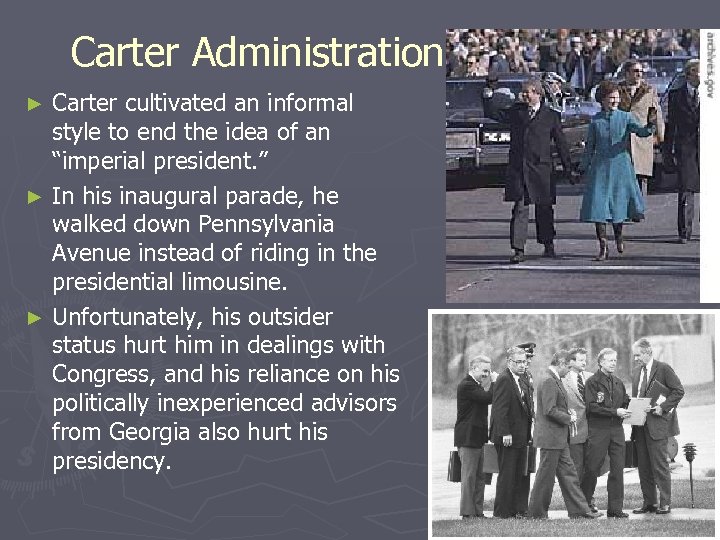 Carter Administration Carter cultivated an informal style to end the idea of an “imperial president. ” ► In his inaugural parade, he walked down Pennsylvania Avenue instead of riding in the presidential limousine. ► Unfortunately, his outsider status hurt him in dealings with Congress, and his reliance on his politically inexperienced advisors from Georgia also hurt his presidency. ►
 Although Carter stayed in touch with the people by holding “fireside chats” on radio and television, he did not try to reach out to Congress. Carter refused to take part in deal-making. As a result, he angered both Republicans and Democrats in Congress.
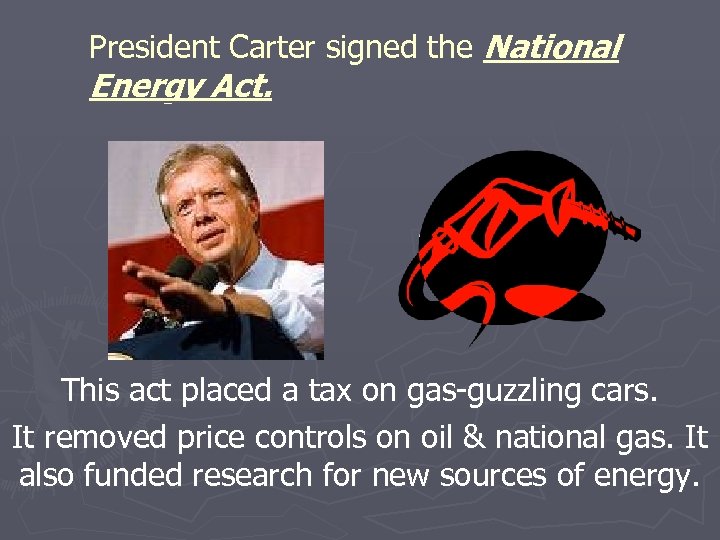 President Carter signed the National Energy Act. This act placed a tax on gas-guzzling cars. It removed price controls on oil & national gas. It also funded research for new sources of energy.
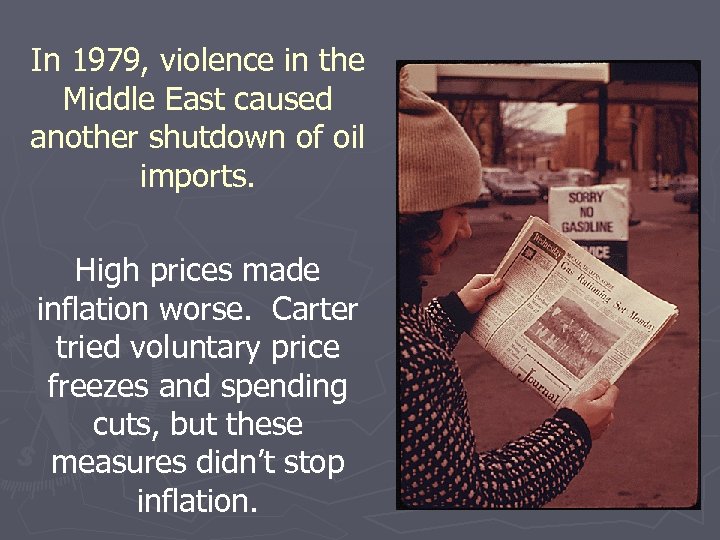 In 1979, violence in the Middle East caused another shutdown of oil imports. High prices made inflation worse. Carter tried voluntary price freezes and spending cuts, but these measures didn’t stop inflation.
 Other changes in the economy caused problems in the 1970’s. Greater automation meant fewer manufacturing jobs.
 Competition from other countries cost American jobs, too. Many companies moved their factories from the Northeast to the South & West. They were looking for lower energy costs & cheaper labor
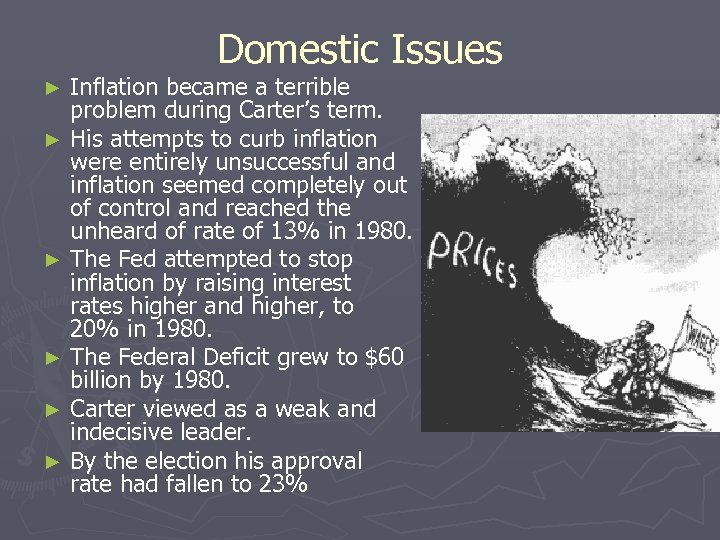 Domestic Issues Inflation became a terrible problem during Carter’s term. ► His attempts to curb inflation were entirely unsuccessful and inflation seemed completely out of control and reached the unheard of rate of 13% in 1980. ► The Fed attempted to stop inflation by raising interest rates higher and higher, to 20% in 1980. ► The Federal Deficit grew to $60 billion by 1980. ► Carter viewed as a weak and indecisive leader. ► By the election his approval rate had fallen to 23% ►
 President Carter tried to follow moral principles in his foreign policy. He believed the U. S. should promote human rights. Human rights are freedoms & liberties like those listed in the Declaration of Independence & the Bill of Rights.
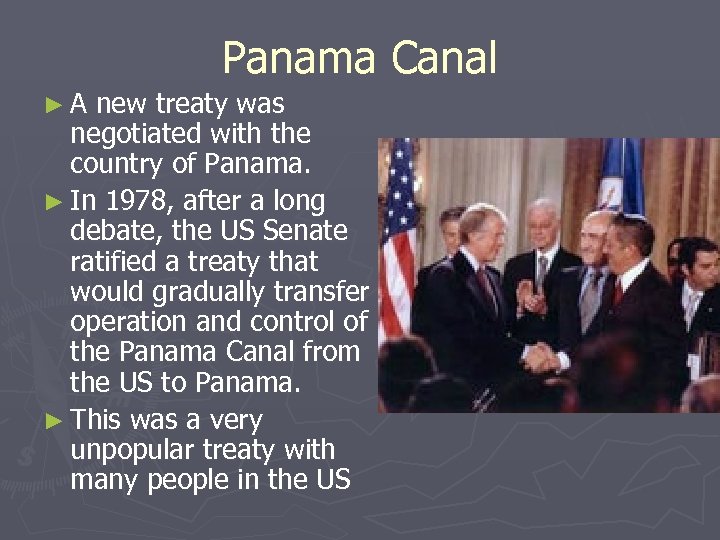 Panama Canal ►A new treaty was negotiated with the country of Panama. ► In 1978, after a long debate, the US Senate ratified a treaty that would gradually transfer operation and control of the Panama Canal from the US to Panama. ► This was a very unpopular treaty with many people in the US
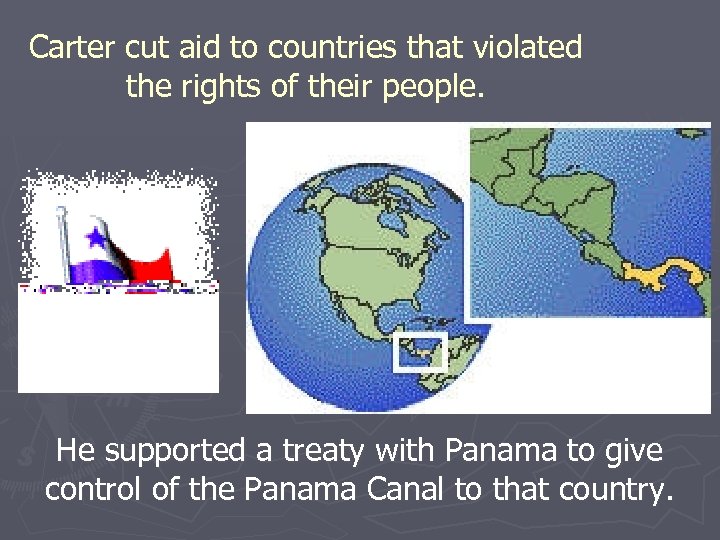 Carter cut aid to countries that violated the rights of their people. He supported a treaty with Panama to give control of the Panama Canal to that country.
 In 1978, Carter arranged a meeting between the leaders of Egypt & Israel. The 2 nations had been enemies for years. After several days of talks, Carter & the 2 leaders reached agreements known as the Camp David Accords.
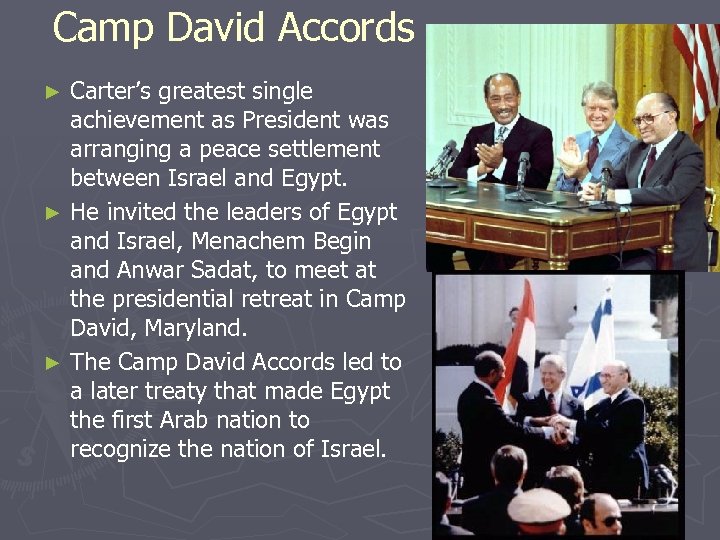 Camp David Accords Carter’s greatest single achievement as President was arranging a peace settlement between Israel and Egypt. ► He invited the leaders of Egypt and Israel, Menachem Begin and Anwar Sadat, to meet at the presidential retreat in Camp David, Maryland. ► The Camp David Accords led to a later treaty that made Egypt the first Arab nation to recognize the nation of Israel. ►
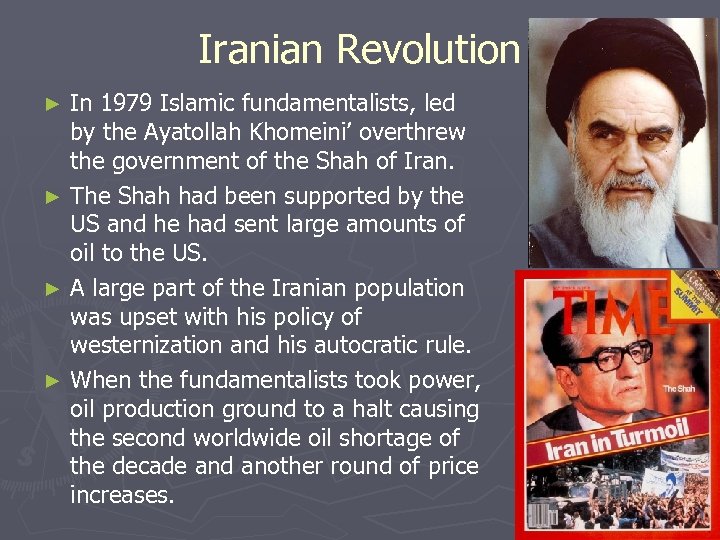 Iranian Revolution In 1979 Islamic fundamentalists, led by the Ayatollah Khomeini’ overthrew the government of the Shah of Iran. ► The Shah had been supported by the US and he had sent large amounts of oil to the US. ► A large part of the Iranian population was upset with his policy of westernization and his autocratic rule. ► When the fundamentalists took power, oil production ground to a halt causing the second worldwide oil shortage of the decade and another round of price increases. ►
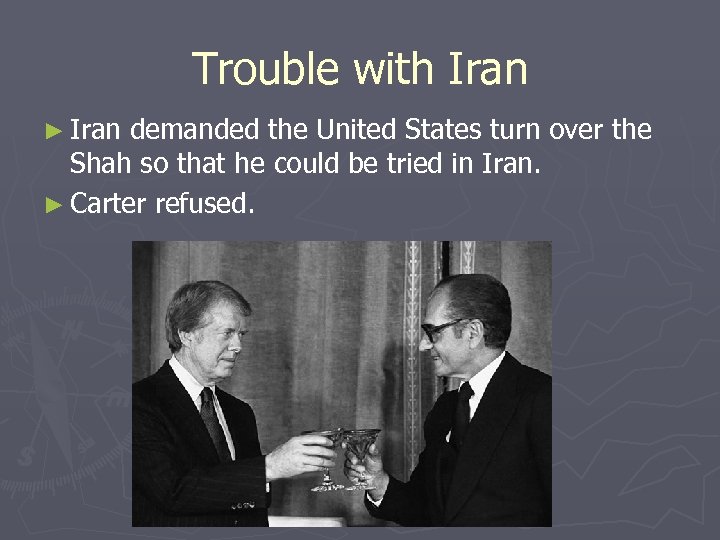 Trouble with Iran ► Iran demanded the United States turn over the Shah so that he could be tried in Iran. ► Carter refused.
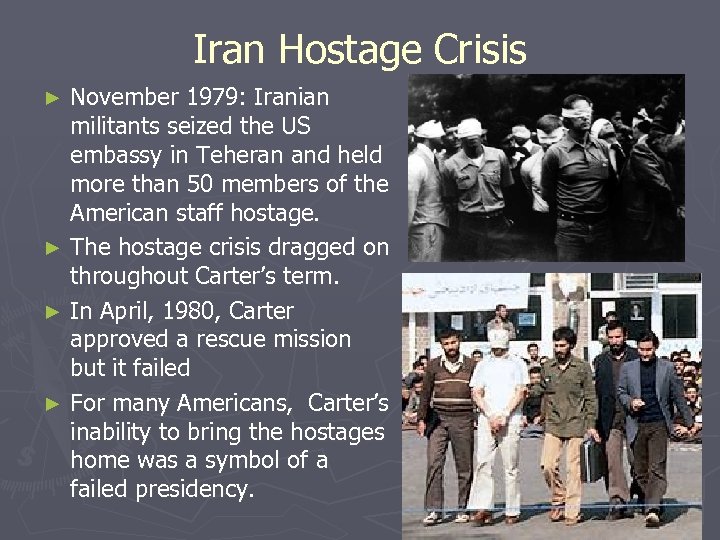 Iran Hostage Crisis November 1979: Iranian militants seized the US embassy in Teheran and held more than 50 members of the American staff hostage. ► The hostage crisis dragged on throughout Carter’s term. ► In April, 1980, Carter approved a rescue mission but it failed ► For many Americans, Carter’s inability to bring the hostages home was a symbol of a failed presidency. ►
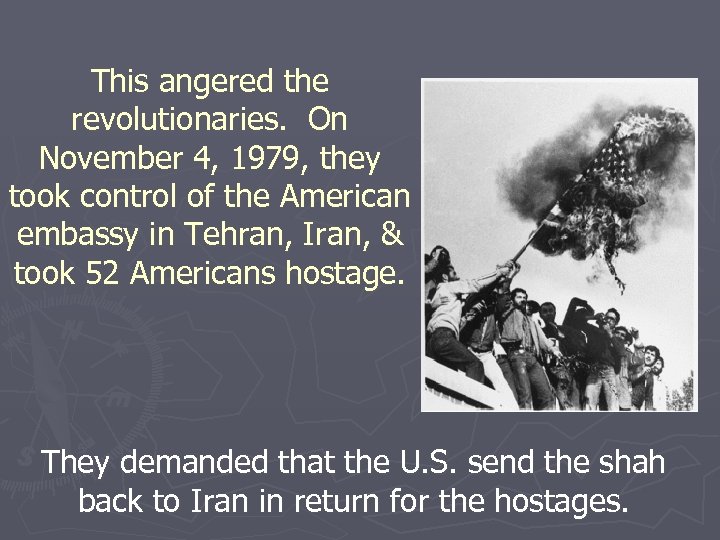 This angered the revolutionaries. On November 4, 1979, they took control of the American embassy in Tehran, Iran, & took 52 Americans hostage. They demanded that the U. S. send the shah back to Iran in return for the hostages.
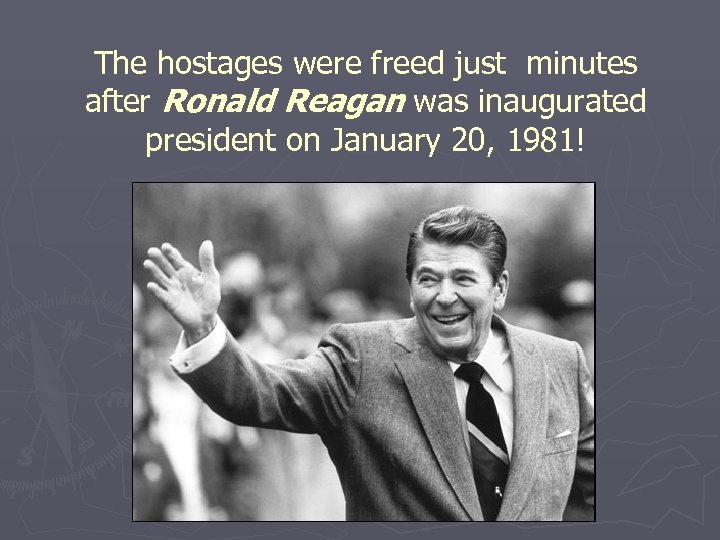 The hostages were freed just minutes after Ronald Reagan was inaugurated president on January 20, 1981!
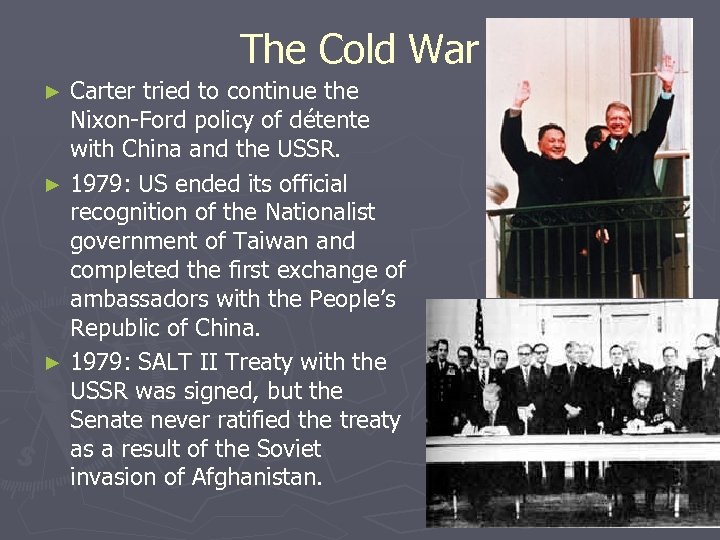 The Cold War Carter tried to continue the Nixon-Ford policy of détente with China and the USSR. ► 1979: US ended its official recognition of the Nationalist government of Taiwan and completed the first exchange of ambassadors with the People’s Republic of China. ► 1979: SALT II Treaty with the USSR was signed, but the Senate never ratified the treaty as a result of the Soviet invasion of Afghanistan. ►
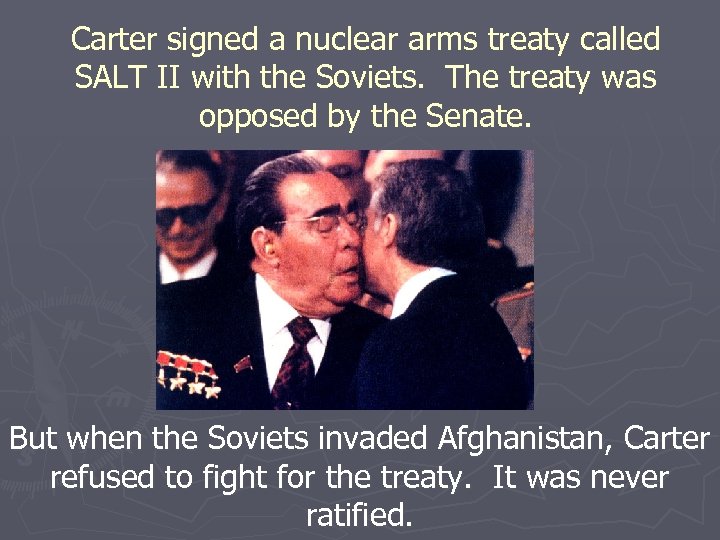 Carter signed a nuclear arms treaty called SALT II with the Soviets. The treaty was opposed by the Senate. But when the Soviets invaded Afghanistan, Carter refused to fight for the treaty. It was never ratified.
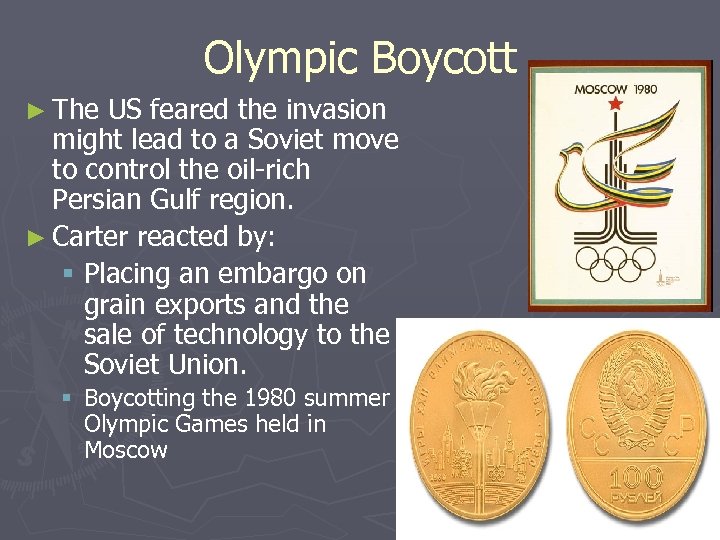 Olympic Boycott ► The US feared the invasion might lead to a Soviet move to control the oil-rich Persian Gulf region. ► Carter reacted by: § Placing an embargo on grain exports and the sale of technology to the Soviet Union. § Boycotting the 1980 summer Olympic Games held in Moscow