


 Скачать презентацию An Academy for Developmental Intervention Assistants Fundamentals
183cbe09b1790938d8e939f8d7be57e9.ppt
- Количество слайдов: 159
 An Academy for Developmental Intervention Assistants Fundamentals of the IFSP Process Slides This document contains slides/transparencies that are used with the Orientation to Early Intervention Instructor’s Guide and Handout. The instructor may project the slides using a LCD projector or print slides and convert them into transparencies to project them using a traditional overhead projector 1
 LOGISTICS & NORMS 2
 Activity: Have you ever…. ? • Use the handout provided to you. • Find a peer participant who has participated in the activity/ item mentioned in the handout. • Only one name needs to be included per item • A participant cannot be named for more than one item. • You have ten minutes. • You time starts now…. 3
 Module A: The IFSP- First Steps 1. Demonstrate understanding of Individualized Family Service Plan (IFSP) process and the required timelines. 2. Describe the timelines and requirements regarding referral and identification of infants and toddlers for early intervention services as described in federal and state regulations. 3. Recognize the importance of delivering supports and services using a family-centered approach. 4
 Module B: Overview of Evaluation and Assessment in the IFSP process 1. Demonstrate understanding of key concepts and requirements regarding evaluation and assessment. 2. Develop an understanding of how early intervention teams use informed clinical opinion to determine eligibility for early intervention services. 3. Describe the criteria for eligibility for early intervention services. 4. Develop an understanding of the DI Assistant role as well as the roles of parents, service coordinator and other professionals in the IFSP process. 5
 Module C: Understanding the Development and Implementation of the IFSP 1. Describe the steps to be followed after eligibility determination. 2. Describe the allowable early intervention services. 3. Explain the process of an IFSP meeting. 4. Recognize the components a meaningful IFSP. 5. Explain the steps taken to implement the IFSP. 6
 Module D: Teaming and Collaboration in the IFSP process 1. Describe the membership of the IFSP team. 2. Recognize the importance of collaboration in the IFSP process. 3. Describe factors that lead to successful collaboration. 7
 Module A: The IFSP- First Steps 1. Demonstrate understanding of the Individualized Family Service Plan (IFSP) process and the required timelines. 2. Describe the timelines and requirements regarding referral and identification of infants and toddlers for early intervention services as described in both federal and state regulations. 3. Recognize the importance of delivering supports and services using a family-centered approach. 8
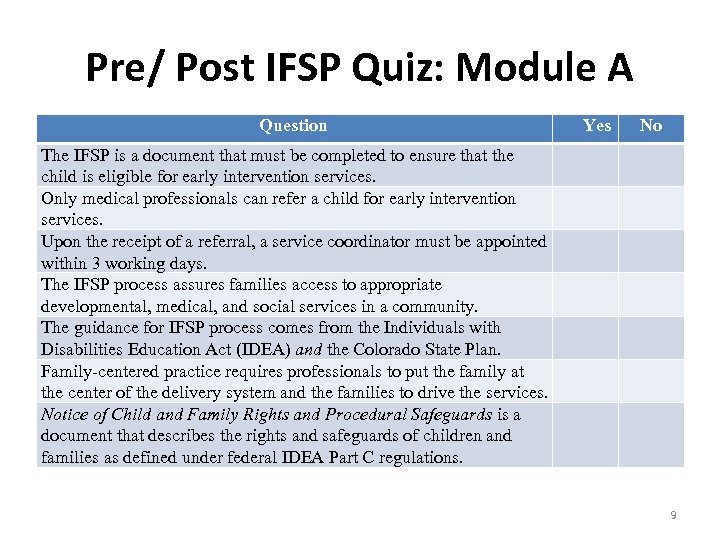 Pre/ Post IFSP Quiz: Module A Question Yes No The IFSP is a document that must be completed to ensure that the child is eligible for early intervention services. Only medical professionals can refer a child for early intervention services. Upon the receipt of a referral, a service coordinator must be appointed within 3 working days. The IFSP process assures families access to appropriate developmental, medical, and social services in a community. The guidance for IFSP process comes from the Individuals with Disabilities Education Act (IDEA) and the Colorado State Plan. Family-centered practice requires professionals to put the family at the center of the delivery system and the families to drive the services. Notice of Child and Family Rights and Procedural Safeguards is a document that describes the rights and safeguards of children and families as defined under federal IDEA Part C regulations. 9
 What is IFSP? What does the acronym IFSP stand for? 10
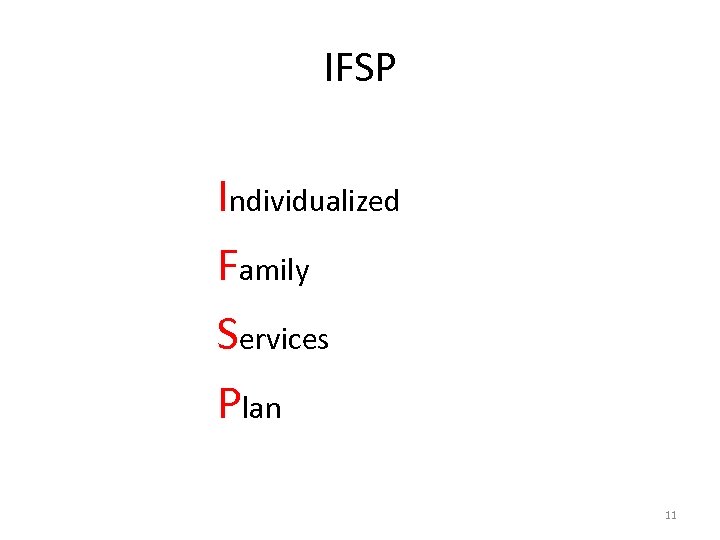 IFSP Individualized Family Services Plan 11
 General Description of the IFSP The IFSP is a process of looking at the strengths of the child and family, and developing a written plan to identify the individualized supports and services that will support a family in enhancing their child’s development. 12
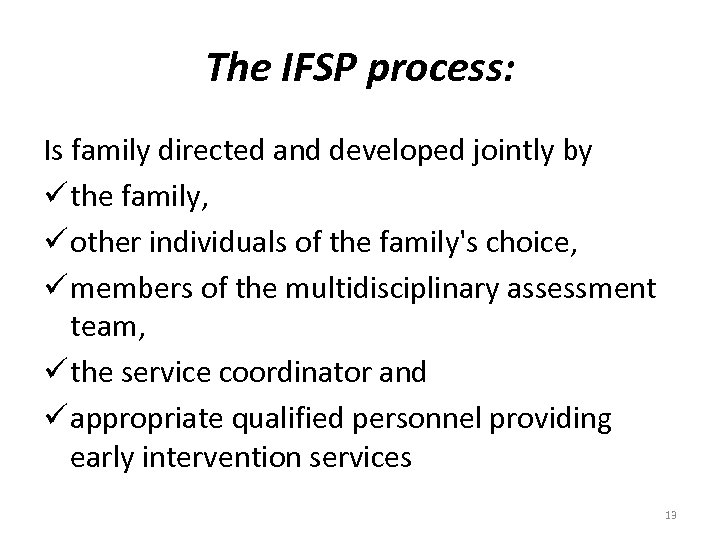 The IFSP process: Is family directed and developed jointly by ü the family, ü other individuals of the family's choice, ü members of the multidisciplinary assessment team, ü the service coordinator and ü appropriate qualified personnel providing early intervention services 13
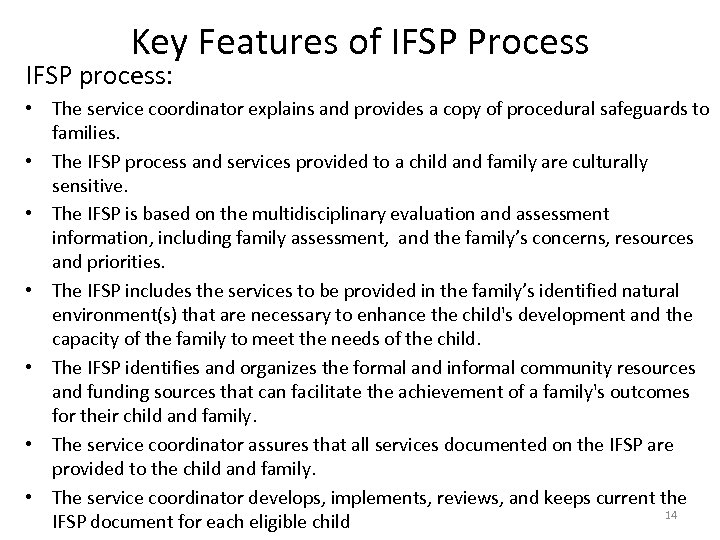 Key Features of IFSP Process IFSP process: • The service coordinator explains and provides a copy of procedural safeguards to families. • The IFSP process and services provided to a child and family are culturally sensitive. • The IFSP is based on the multidisciplinary evaluation and assessment information, including family assessment, and the family’s concerns, resources and priorities. • The IFSP includes the services to be provided in the family’s identified natural environment(s) that are necessary to enhance the child's development and the capacity of the family to meet the needs of the child. • The IFSP identifies and organizes the formal and informal community resources and funding sources that can facilitate the achievement of a family's outcomes for their child and family. • The service coordinator assures that all services documented on the IFSP are provided to the child and family. • The service coordinator develops, implements, reviews, and keeps current the 14 IFSP document for each eligible child
 Nolan’s Story 15
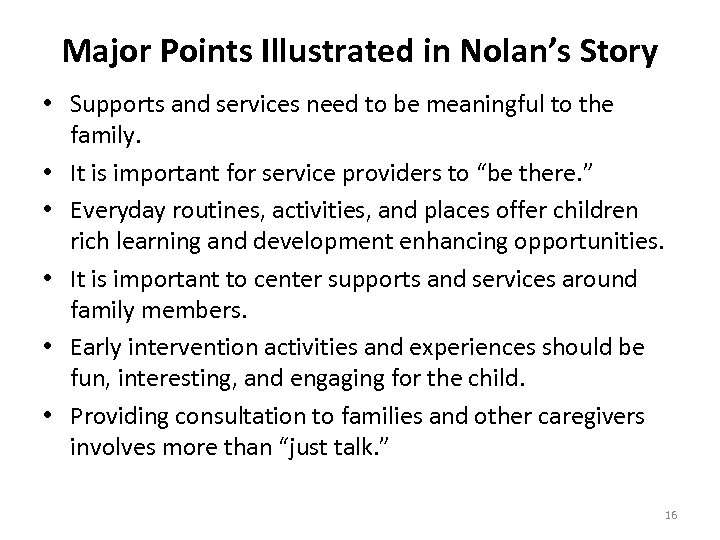 Major Points Illustrated in Nolan’s Story • Supports and services need to be meaningful to the family. • It is important for service providers to “be there. ” • Everyday routines, activities, and places offer children rich learning and development enhancing opportunities. • It is important to center supports and services around family members. • Early intervention activities and experiences should be fun, interesting, and engaging for the child. • Providing consultation to families and other caregivers involves more than “just talk. ” 16
 The IFSP is not a race to fill a form with information. It is a walk of discovery. 17
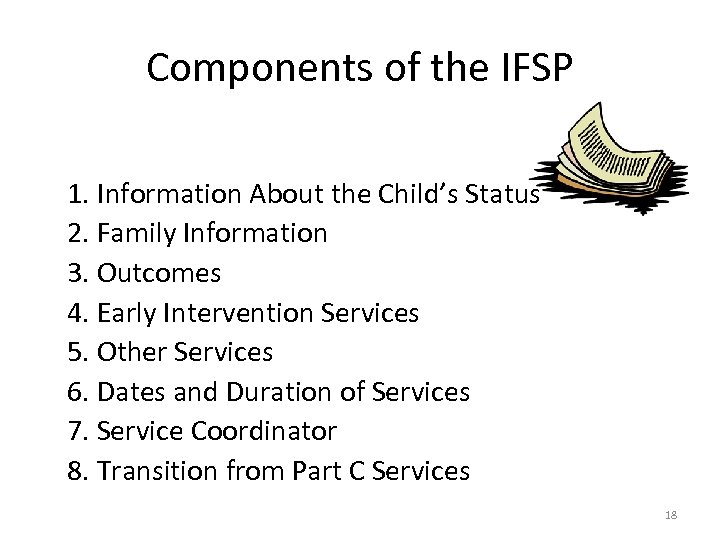 Components of the IFSP 1. Information About the Child’s Status 2. Family Information 3. Outcomes 4. Early Intervention Services 5. Other Services 6. Dates and Duration of Services 7. Service Coordinator 8. Transition from Part C Services 18
 Colorado’s IFSP Forms • Individualized Family Service Plan (IFSP) Form • Individualized Family Service Plan (IFSP) with Infant Developmental Focus (for children less than one year of age) form 19
 Steps involved from child’s referral to exit at age 3 20
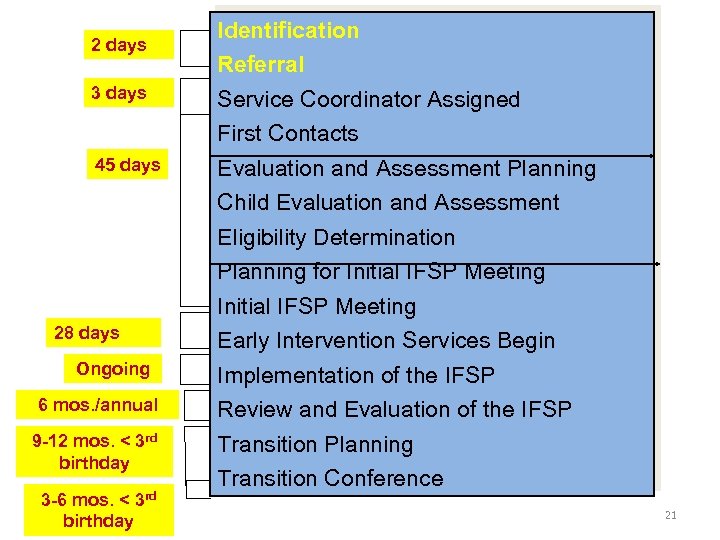 2 days 3 days 45 days 28 days Ongoing 6 mos. /annual 9 -12 mos. < 3 rd birthday 3 -6 mos. < 3 rd birthday Identification Referral Service Coordinator Assigned First Contacts Evaluation and Assessment Planning Child Evaluation and Assessment Eligibility Determination Planning for Initial IFSP Meeting Early Intervention Services Begin Implementation of the IFSP Review and Evaluation of the IFSP Transition Planning Transition Conference 21
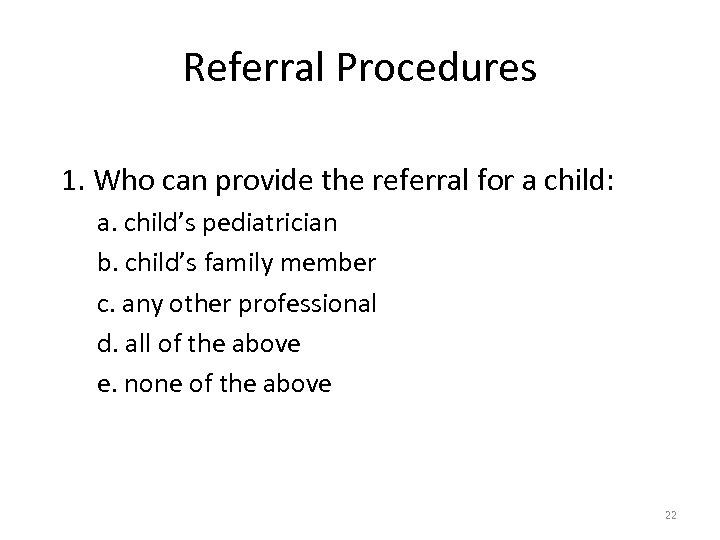 Referral Procedures 1. Who can provide the referral for a child: a. child’s pediatrician b. child’s family member c. any other professional d. all of the above e. none of the above 22
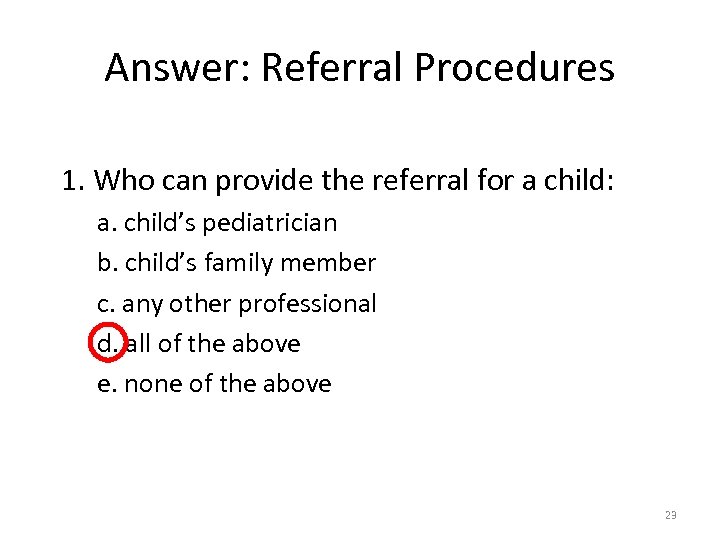 Answer: Referral Procedures 1. Who can provide the referral for a child: a. child’s pediatrician b. child’s family member c. any other professional d. all of the above e. none of the above 23
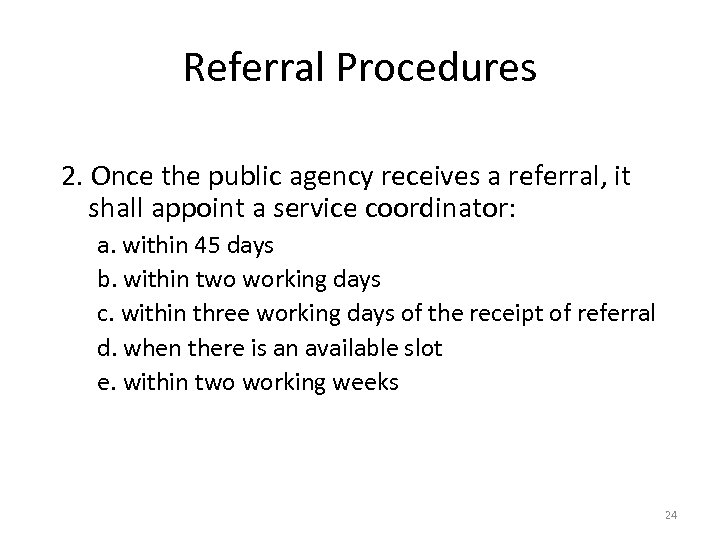 Referral Procedures 2. Once the public agency receives a referral, it shall appoint a service coordinator: a. within 45 days b. within two working days c. within three working days of the receipt of referral d. when there is an available slot e. within two working weeks 24
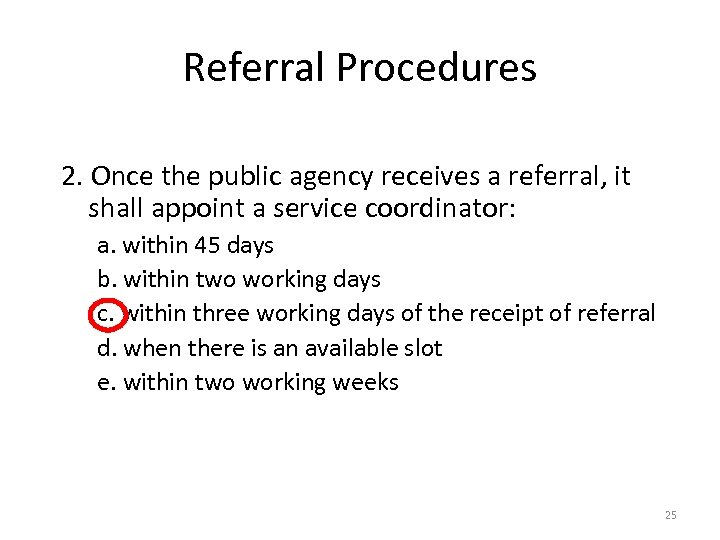 Referral Procedures 2. Once the public agency receives a referral, it shall appoint a service coordinator: a. within 45 days b. within two working days c. within three working days of the receipt of referral d. when there is an available slot e. within two working weeks 25
 Identification and Referral • Anyone in the community may identify (meets, knows of) a child who may be eligible for early intervention. • The point of entry for the early intervention system is contacted to make a formal referral. • A service coordinator is assigned within 3 working days of referral. 26
 Colorado’s Referral Procedures Referrals are made to the early intervention system no more than two working days after a child has been identified. Upon the receipt of a referral, a service coordinator is appointed within 3 working days. 27
 Referral to Early Intervention Services The Community Center Boards needs to: – Collect necessary information to initiate referral. – Provide information about the early intervention system, including procedural safeguards. – Link to another parent or support group if family wishes. – Obtain written parental consent to share information. – Provide service coordination within 3 days. 28
 Identification and Referral: Colorado’s Public Awareness Efforts • Statewide toll free number • Posters, brochures and other printed material • Referral information by county • Outreach to physicians • Links to other websites (central directory) 29
 Agencies That Need To Coordinate Identification Efforts • Early Intervention Programs at Community Centered Boards • Child Find (or other local assessment teams) • Maternal and Child Health Programs • Early Periodic Screening, Diagnosis and Treatment (EPSDT) • Head Start and Early Head Start • Neonatal Intensive Care Units (NICUs) • Social Services agencies 30
 Primary Referral Sources for Early Intervention • • • Parents Hospitals Prenatal and postnatal care facilities Physicians Child care programs Local Educational Agencies or other school personnel Public health facilities Homeless shelters Social service agencies Other health care providers 31
 The importance of delivering supports and services using a family-centered approach 32
 Prioritizing and Understanding One’s Values are a belief, a mission, or a philosophy that is meaningful and that people follow to help make the ‘right’ decision in life. • Activity: independently and silently, participants write down their top 5 values. (The top five things that are most important to you– the things you value above all else in life – your priorities). Wait for further directions…. . 33
 Here ‘s a deal for you…. . • You can trade one of the values that you kept for 2 values that you crossed out…. • Share the values that you kept. 34
 Family-Centered Supports & Services 35
 What Is A Family? 36
 What Is A Family? Families are big, small, extended, nuclear, multi-generational, with one parent, two parents, and grandparents. We live under one roof or many. A family can be as temporary as a few weeks, as permanent as forever. We become part of a family by birth, adoption, marriage, or from a desire for mutual support. . . A family is a culture unto itself, with different values and unique ways of realizing its dream; together, our families become the source of our rich cultural heritage and spiritual diversity. . . Our families create neighborhoods, communities, states and nations. Task Force on Young Children and Families, New Mexico Legislature 37
 Question? ? What do family–centered supports and service mean? 38
 Definition : Family-Centered Practices Family-centered practices refers to a combination of beliefs and practices that define particular ways of working with families that are consumer driven and competency enhancing. (Dunst, Trivette, and Deal, 1994) 39
 Family-Centered Practices • “ a philosophy or way of thinking that leads to a set of practices in which families or parent are considered central and the most important decision maker in a child’s life and that service systems and personnel must support, respects, encourage and enhance the strengths and competence of the family” Division of Early Childhood Education (DEC) Recommended Practices Early Intervention Teamwork Academy • Slide 40
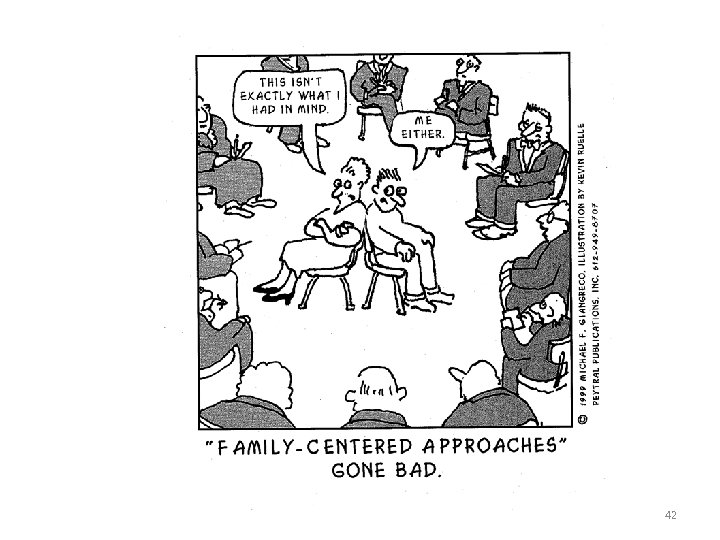
 Family-Centered practices: – Are characterized by beliefs and practices that treat families with dignity and respect; – Are individualized, flexible, and responsive to family situations; – Focus on information sharing so that families can make informed decisions – Focus on family choice regarding any number of aspects of program practices and intervention options – Focus on parent-professional collaboration and partnerships as a context for family-program relations and the active involvement of families in mobilization of resources and supports necessary for them to care for and rear their children in ways that produces optimal child, parent, and family benefits. Dunst, 2008, p. xii) 41
 42
42
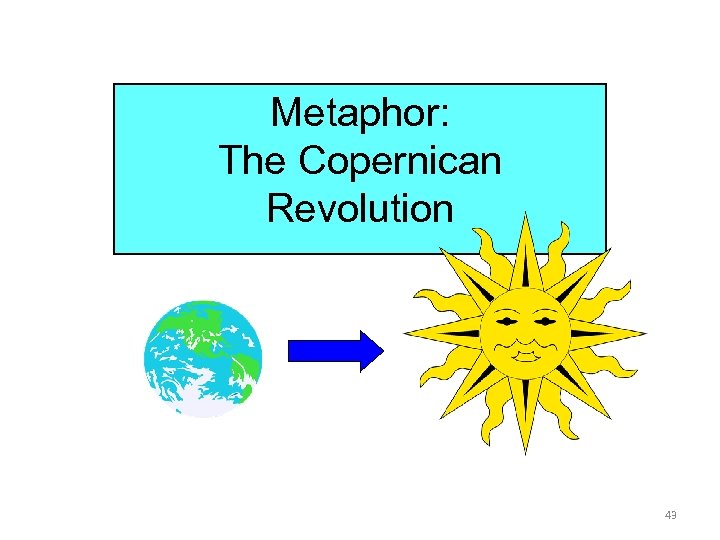 Metaphor: The Copernican Revolution 43
 ……. We would move from an emphasis on parent involvement (i. e. parents participating in the program) to family support (i. e. programs providing a range of support services to families). This is not a semantic exercise – such a revolution leads us to a new set of assumptions and a new vista of options for service. " ~Turnbull & Summers, 1985, p. 12 44
 Family Rights and Procedural Safeguards in Early Intervention Colorado System • Families involved with Colorado’s early intervention system have special rights protected by federal law to protect parents and children. • Notice of Child and Family Rights and Procedural Safeguards in the Early Intervention Colorado System is an official notice of the rights and safeguards of children and families as defined under IDEA Part C regulations. • This Information is provided to families through local CCBs or other appointed participating agency(ies)/providers, which are responsible for early intervention services under federal IDEA Part C at the community level. 45
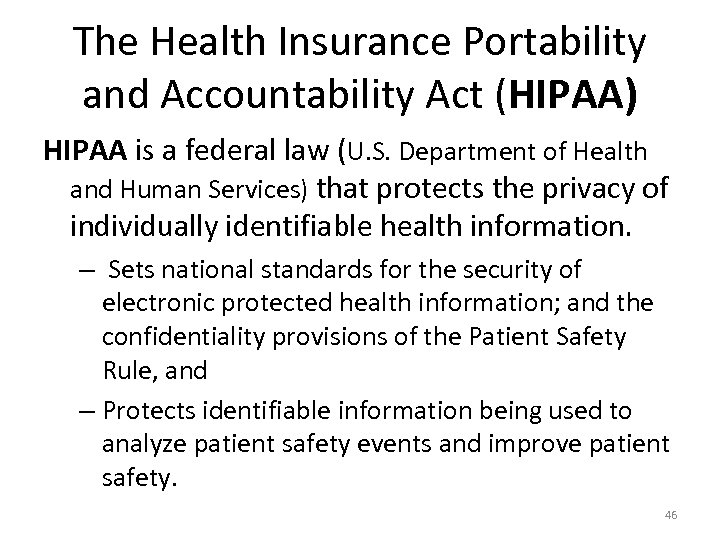 The Health Insurance Portability and Accountability Act (HIPAA) HIPAA is a federal law (U. S. Department of Health and Human Services) that protects the privacy of individually identifiable health information. – Sets national standards for the security of electronic protected health information; and the confidentiality provisions of the Patient Safety Rule, and – Protects identifiable information being used to analyze patient safety events and improve patient safety. 46
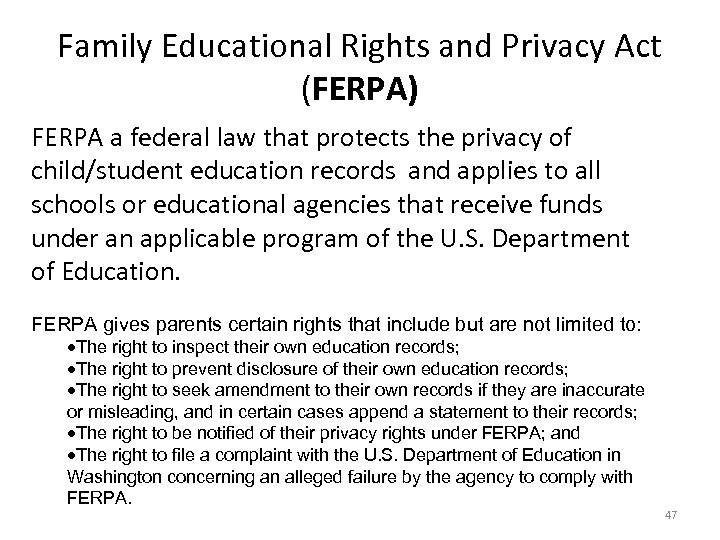 Family Educational Rights and Privacy Act (FERPA) FERPA a federal law that protects the privacy of child/student education records and applies to all schools or educational agencies that receive funds under an applicable program of the U. S. Department of Education. FERPA gives parents certain rights that include but are not limited to: The right to inspect their own education records; The right to prevent disclosure of their own education records; The right to seek amendment to their own records if they are inaccurate or misleading, and in certain cases append a statement to their records; The right to be notified of their privacy rights under FERPA; and The right to file a complaint with the U. S. Department of Education in Washington concerning an alleged failure by the agency to comply with FERPA. 47
 Post Quiz: Module A • Pull out the quiz (H 3) you had completed at the beginning of the Module. • Review your answers from last time and make changes to correct the responses based on your new learning. • Share responses with the large group 48
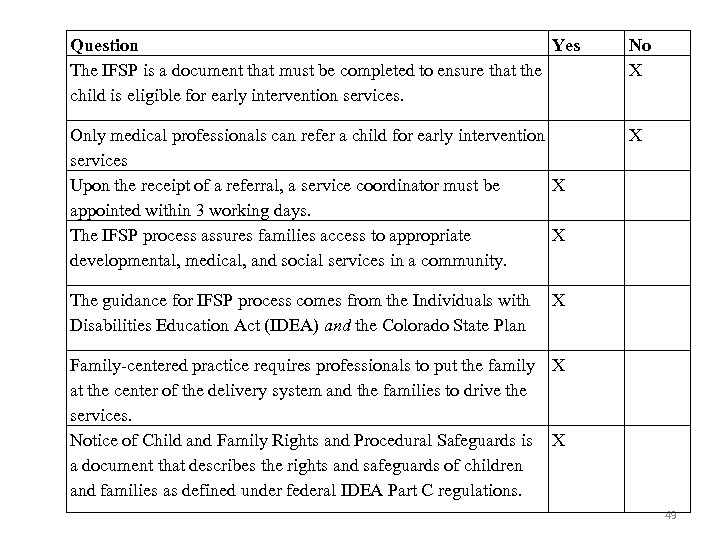 Question Yes Ye The IFSP is a document that must be completed to ensure that the child is eligible for early intervention services. No X Only medical professionals can refer a child for early intervention services Upon the receipt of a referral, a service coordinator must be X appointed within 3 working days. The IFSP process assures families access to appropriate X developmental, medical, and social services in a community. X The guidance for IFSP process comes from the Individuals with Disabilities Education Act (IDEA) and the Colorado State Plan X Family-centered practice requires professionals to put the family X at the center of the delivery system and the families to drive the services. Notice of Child and Family Rights and Procedural Safeguards is X a document that describes the rights and safeguards of children and families as defined under federal IDEA Part C regulations. 49
 Recap of Module A: The IFSP- First Steps You previously learned about: – Individualized Family Service Plan (IFSP) process and the required timelines – The timelines and requirements regarding referral and identification. – The importance of delivering supports and services using a family-centered approach. 50
 Module B: Overview of Evaluation and Assessment in the IFSP process At the end of this module, you will: 1. Demonstrate understanding of key concepts and requirements regarding evaluation and assessment. 2. Develop understanding of how early intervention teams use informed clinical opinion to determine eligibility for Early Intervention Services. 3. Describe the criteria for eligibility for Early Intervention Services. 4. Develop an understanding of the DI Assistant role as well as the roles of parents, service coordinator and other professionals in the IFSP process. 51
 California Driving Test 52
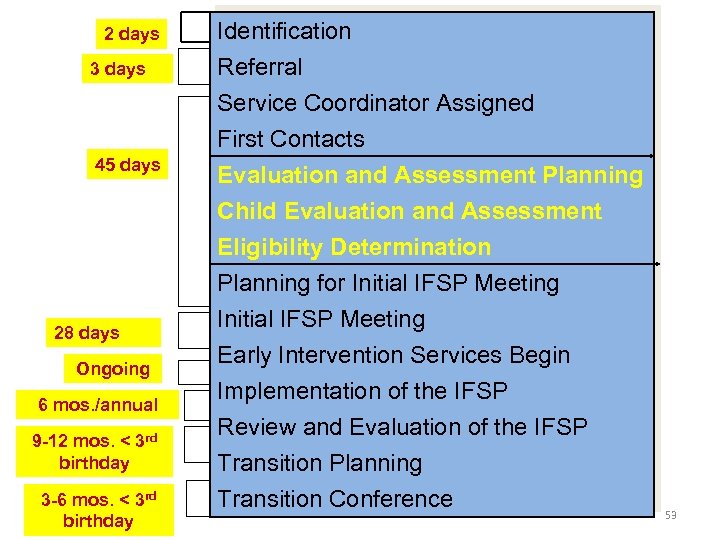 2 days 3 days 45 days 28 days Ongoing 6 mos. /annual 9 -12 mos. < 3 rd birthday 3 -6 mos. < 3 rd birthday Identification Referral Service Coordinator Assigned First Contacts Evaluation and Assessment Planning Child Evaluation and Assessment Eligibility Determination Planning for Initial IFSP Meeting Early Intervention Services Begin Implementation of the IFSP Review and Evaluation of the IFSP Transition Planning Transition Conference 53
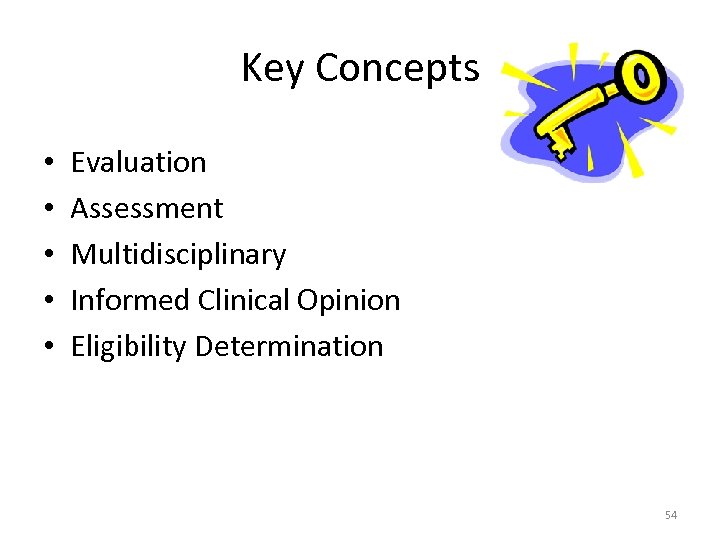 Key Concepts • • • Evaluation Assessment Multidisciplinary Informed Clinical Opinion Eligibility Determination 54
 Evaluation means the procedures used by appropriately qualified personnel to: determine a child’s initial and continuing eligibility, including determining the status of the child in each of the developmental areas. 55
 Evaluation Must Include. . . • A review of pertinent records related to the child’s current health status and medical history. • An evaluation by a multidisciplinary team to determine the child’s level of capacity in each of the following developmental areas: – Cognitive – Physical, including vision and hearing – Communication – Social or emotional – Adaptive Section 303. 322(c)(3) 56
 Assessment The ongoing procedures used by appropriate qualified personnel throughout the period of a child’s eligibility to identify: – The child’s unique strengths and needs and services appropriate to meet those needs – The resources, priorities and concerns of the family and the supports/services necessary to enhance the family’s capacity to meet those needs Section 303. 322 (b) (2) 57
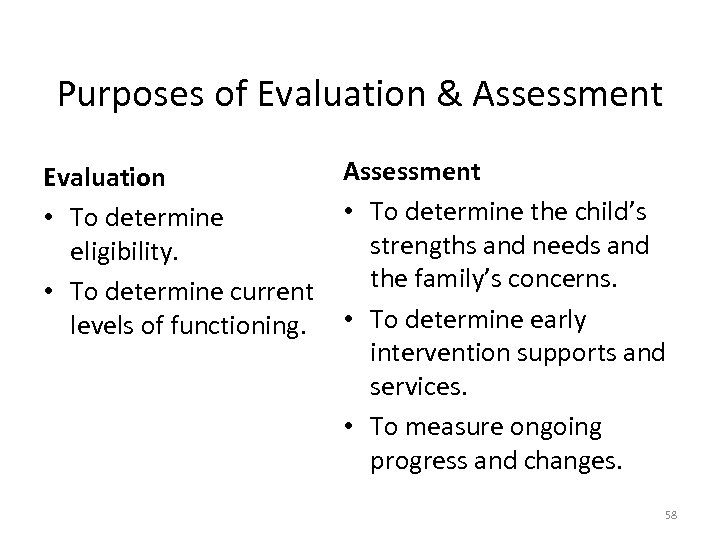 Purposes of Evaluation & Assessment Evaluation • To determine the child’s • To determine strengths and needs and eligibility. the family’s concerns. • To determine current levels of functioning. • To determine early intervention supports and services. • To measure ongoing progress and changes. 58
 Evaluation and Assessment Procedures • Must be conducted by personnel trained to utilize appropriate methods and procedures. • Must be based on informed clinical opinion. Section 303. 322(c)(1)(2) 59
 Information should be collected from. . . • • • Developmental history Review of records Additional reports from the family Routines based interview Language samples Observation of the child Play-based observations Developmental checklists Criterion referenced instruments Norm referenced instruments 60
 Family Assessment as part of Child Evaluation and Assessment § Family-centered practice warrants it § Families have a role in evaluation and assessment Family’s role includes: üParticipate as a team member üShare information and observations within developmental areas üIdentify concerns, priorities, and resources üParticipate in decision making üIdentify strengths and challenges within the context of daily routines 61
 Family Assessment “Family assessment under this part must be family directed and designed to determine the resources, priorities and concerns of the family related to enhancing the development of the child”. Section 303. 322(d) 62
 Activity: Routines-Based Interview • • • To prepare the family to report on routines: . To have the family report on their routines: To review concerns and strength areas To have the family select outcomes To have the family put outcomes into priority order 63
 RECAP: Evaluation & Assessment o How is an assessment different than an evaluation? How are they similar? o What is the different kind of information that the evaluation/ assessment team gathers? o How can this information be gathered? o What are some typical daily routines that a family may participate in? o Select a routine and suggest the questions that a facilitator may ask to gather information about the child’s skills and the family’s resources, priorities, and concerns. o What kind of information may a facilitator receive from the discussion of the selected routine? o Besides a Routines Based Interview, what other forms of assessment may the facilitator use to gain information about the family’s resources, priorities, and concerns? 64
 Multidisciplinary Under IDEA, every child is entitled to a multidisciplinary evaluation and assessment. Multidisciplinary: The involvement of two or more disciplines or professions in the provision of integrated and coordinated services, including evaluation and assessment activities. 65
 Informed Clinical Opinion A decision made by a multidisciplinary team using qualitative and quantitative information in order to determine eligibility and as a basis for planning. 66
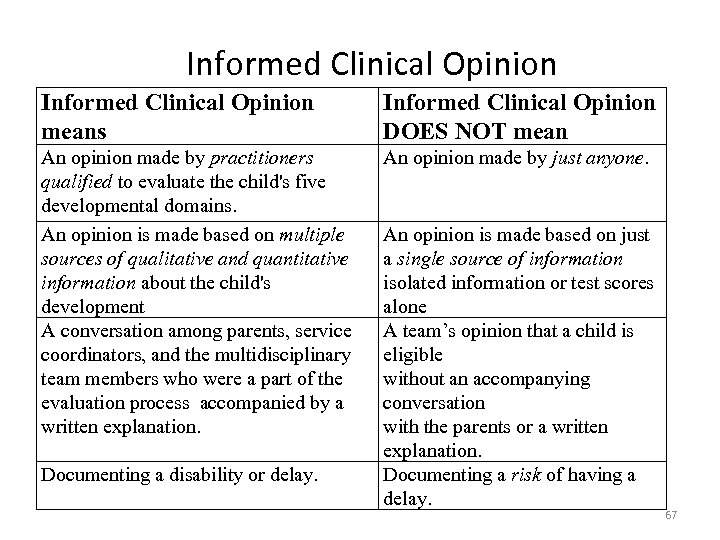 Informed Clinical Opinion means Informed Clinical Opinion DOES NOT mean An opinion made by practitioners qualified to evaluate the child's five developmental domains. An opinion is made based on multiple sources of qualitative and quantitative information about the child's development A conversation among parents, service coordinators, and the multidisciplinary team members who were a part of the evaluation process accompanied by a written explanation. An opinion made by just anyone. Documenting a disability or delay. An opinion is made based on just a single source of information isolated information or test scores alone A team’s opinion that a child is eligible without an accompanying conversation with the parents or a written explanation. Documenting a risk of having a delay. 67
 Eligibility Determination in Colorado In Colorado, Community Center Boards are responsible for ensuring a local system of child find that includes public awareness, identification and referral, eligibility determination, and evaluation. There are two ways to determine eligibility for the Early Intervention System. 68
 Category # 1: Eligibility Determination in Colorado 1. Children who have a Developmental Delay: having a significant delay in development in one or more of the following domains: cognition, communication, physical including vision and hearing, social or emotional development or adaptive behavior. 69
 Colorado’s Definition of Developmental Delay In Colorado the rigorous definition of a “developmental delay” means an infant or toddler who has a 25% or greater delay in one or more areas of development when compared with chronological age or the equivalent of 1. 5 standard deviations or more below the mean in one or more areas of development. 70
 Category # 2: Eligibility Determination in Colorado 2. Children with an Established Condition: having a diagnosed physical or mental condition that has a high probability of resulting in significant delays in development Often referred to as “categorical eligibility”. 71
 Eligibility Determination Conditions That May Be Associated with Delays in Development: Low birth weight infants weighing less than 1, 200 grams Postnatal acquired problems resulting in delays in development, including but not limited to severe attachment disorder Chromosomal syndromes and conditions (e. g. Down syndrome) Congenital syndromes and conditions Sensory impairments (some hearing and visual impairments) Metabolic disorders Prenatal or perinatal infections resulting in significant medical problems 72
 Scenario #1: Demitri is 22 months old. His multidisciplinary team conducted an evaluation and found that he was performing at a 14 month level in his expressive and receptive language. Additionally, unlike his peers, he was just learning to walk. His walk was broad based and he often fell. His team feels that without additional intervention, Demitri will increasingly fall behind his peers in both these areas. Is Demitri likely to be eligible to receive early intervention services? 73
 Scenario #2: Josie is 9 months old. Her pediatrician recently diagnosed that she has bilateral sensorineural profound hearing loss. Based on this information alone, is Josie likely to be eligible to receive early intervention services? 74
 Scenario #3: Taniya Chris, the father of Taniya, who is seven months old, had noticed that Taniya turned stiff when he picked her up or when she was excited. He also noticed that she was unable to turn from side to side when lying and unable to sit when supported. During the next few weeks of consulting and testing with her pediatrician, Dr. Rose, it was confirmed that Taniya had cerebral palsy. Dr. Rose referred them to the early intervention system in their community. Is the evaluation team likely to find Taniya eligible to receive early intervention services? 75
 Scenario #4: Asad, who is 30 months old, was born two months prematurely. Asad is developing typically, when his age is adjusted for prematurity. Asad’s parents are refugees from Somalia who have recently moved to Colorado. Asad’s father is looking for a job. They are currently barely able to make ends meet. The family speaks Somali at home. Dad is learning English at the local community center. A neighbor suggested that Asad may qualify to receive early intervention services. Due to the economic and language challenges, Asad may be at risk of falling behind his peers. Is the evaluation team likely to find Asad eligible to receive early intervention services? 76
 What are the roles of parents, service coordinator, other professionals and DI Assistant in the IFSP process? 77
 Definition of DI Assistant Title for some early intervention paraprofessionals in Colorado is Developmental Intervention Assistant (DI Assistant): The DI Assistant provides developmental intervention services to families, infants and toddlers under the supervision of a qualified early intervention provider who holds a current license/certificate that meets the personnel standards identified by Early Intervention Colorado. 78
 Take Home learning activities • Evaluation: Take Home Activity #1 Guidelines • Assessment: Take Home Activity #2 Guidelines 79
 Recap of Module B: Overview of Evaluation and Assessment in the IFSP Process In the previous module you learned: – The purpose of evaluation and assessment – Key concepts and requirements regarding evaluation and assessment – The criteria for eligibility for the system of early intervention in Colorado – Their role as well as that of others in the different steps of the IFSP process 80
 Module C: Understanding the Development and Implementation of the IFSP In this Module, the DI Assistants will: 1. Describe the steps to be followed after eligibility determination. 2. Describe the allowable early intervention services. 3. Explain the process of an IFSP meeting. 4. Recognize the components of a meaningful IFSP. 5. Explain the steps taken to implement the IFSP. 81
 Energizer: IFSP Word Game • In groups of three or four, create as many words as possible from the phrase INDIVIDUALIZED FAMILY SERVICE PLAN. • For example, some of words could be: INDIA, LAZY, MAFIA • 3 or 4 letter words = 1 point , 5 letter word = 2 points , 6 letter word = 3 points. • You have 5 minutes! 82
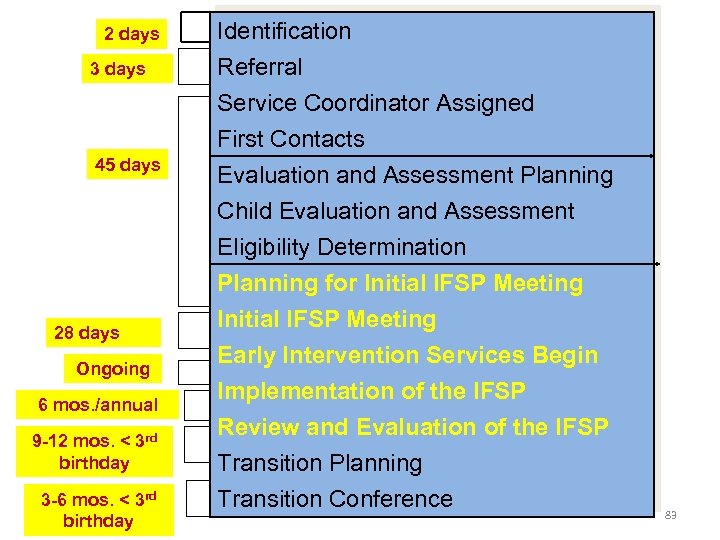 2 days 3 days 45 days 28 days Ongoing 6 mos. /annual 9 -12 mos. < 3 rd birthday 3 -6 mos. < 3 rd birthday Identification Referral Service Coordinator Assigned First Contacts Evaluation and Assessment Planning Child Evaluation and Assessment Eligibility Determination Planning for Initial IFSP Meeting Early Intervention Services Begin Implementation of the IFSP Review and Evaluation of the IFSP Transition Planning Transition Conference 83
 What are Allowable Services? Allowable early intervention services are those services that are: • Designed to meet the developmental needs of an infant or toddler with a significant developmental delay or the needs of the family related to enhancing the infant’s or toddler’s development; • Selected in collaboration with the infant’s or toddler’s family; • Provided in conformity with an Individualized Family Service Plan (IFSP); • Based on appropriate evidence-based practices and related to functional outcomes; 84
 LM: changed wording on bullet 2 What are Allowable Services? Allowable early intervention services are those services that are: • Provided under public supervision to assure, through monitoring, that services are provided in accordance with these requirements; • Provided by qualified personnel as defined in the Early Intervention Colorado state plan. • Provided in the natural environments of the infant or toddler and the family including the family’s home and/or community settings in which infants and toddlers without disabilities participate, unless otherwise justified on the IFSP; • Provided in a culturally relevant manner, including the use of an interpreter if needed. 85
 Types of Allowable Early Intervention Services 1. Assistive Technology 2. Audiology Services 3. Developmental Intervention 4. Health Services 5. Nutrition Services 6. Occupational Therapy 7. Physical Therapy 8. 9. 10. 11. Psychological services Respite care Service Coordination Social/Emotional intervention 12. Speech-language pathology 13. Transportation 14. Vision 86
 Activity: Why Plan? 87
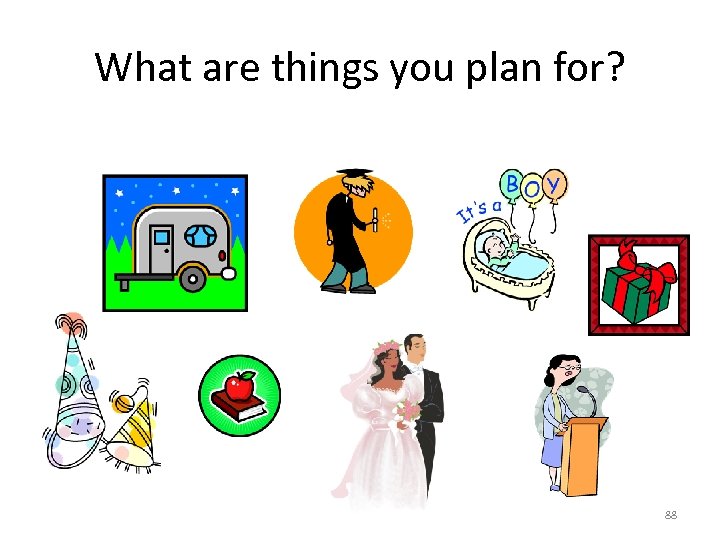 What are things you plan for? 88
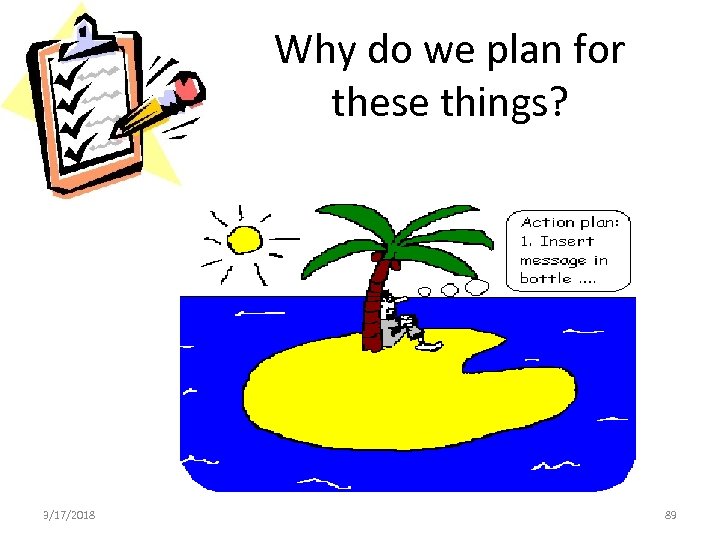 Why do we plan for these things? 3/17/2018 89
 We plan……. We plan: – – – – • to reduce anxiety to be organized for better outcomes to ease stress to have some control because we want to because someone says we have to to avoid complications so it works so we can afford it so it will happen so we can look forward to it so it will be pleasant 90
 What things do families who have children eligible for early intervention need to plan for? 3/17/2018 91
 Steps: Before IFSP Meeting Service coordinator must: – Complete intake, including supporting the family in the completion of required forms – Review and explain procedural safeguards with family – Coordinate with other agencies and professionals to schedule evaluation to determine eligibility or to document the child’s level of functioning in all developmental domains. – With agreement from family, gather family information, including pertinent medical and developmental information. Through family interview, gather and document the activities of the family’s day, including resources, concerns, and priorities 92
 Steps: Before IFSP Meeting continued… Service coordinator must: – Schedule the IFSP meeting, ensuring that the time and place are accessible and convenient to the family and with sufficient notice to ensure that all participants can attend – Contact and invite all appropriate participants – Conduct all of the “before” activities in a manner that begins the building of a collaborative team and partnership with the family. Begin developing a positive relationship from the first contact! 93
 Steps: During IFSP Meeting The whole IFSP team will be involved, but the Service Coordinator will be primarily responsible for coordinating the event specified below – Introduce members of the IFSP team – Briefly go over agenda and timeline for meeting; periodically as meeting progresses check with family and others for questions – Review and confirm child eligibility – Share and document information gathered during the family interview – Document a child’s present abilities in all developmental domains, both strengths and challenges – Review family concerns – Review family priorities 94
 Steps: During the IFSP Process – Along with IFSP team members, develop outcomes based on the priorities of the family and brainstorm strategies to meet the outcomes – Identify family resources and needs for each outcome – Identify services necessary to meet the outcomes and document the details for each service – Develop a transition plan, if child is between 2 years 3 months and 2 years, 9 months of age. – Complete IFSP Form as meeting progresses, checking with all members for wording, and provide family with copy at the end of the meeting We will review Transitions this in Academy XV: Transition to Age 3 95
 Steps: After the IFSP Process The team must : – Complete regular reviews and evaluations of the child’s progress toward the IFSP outcomes, updating or revising as needed – Must formally review no less than every 6 months 96
 IFSP Process: Quick Review Put the Following Components of The IFSP Meeting in Order from First to Last. – Identifying Family resources and needs for each outcome – Introduction of IFSP team members – Documentation of a child’s present abilities in all developmental domains – Development of a transition plan – Identifying services necessary to implement strategies – Developing outcomes and brainstorming strategies – Reviewing family concerns – Reviewing family priorities 97
 Quick Review: Correct Order 1. Introduction of IFSP team members 2. Documentation a child’s present abilities in all developmental domains 3. Reviewing family concerns 4. Reviewing family priorities 5. Developing outcomes and brainstorming strategies 6. Identifying Family resources and needs for each outcome 7. Identifying services necessary to implement strategies 8. Development of a transition plan 98
 Activity: Michelle’s Story Planning for the Initial IFSP Meeting 99
 “Before beginning a long journey, it is wise to know where you are going…that way you will know that you’ve arrived once you get there. ” Pooh Bear 3/17/2018 100
 Creating Meaningful IFSPs Remember: • Creating IFSPs is not within the scope of the responsibilities of the DI Assistant, but it is important for you to develop an understanding of what it takes to create a meaningful IFSP. • The DI Assistant helps implement the plan under the direction and guidance of the supervisor, i. e. the early intervention provider. Thus, it is important to understand the different components of the plan. 101
 Content of the IFSP 1. Information About the Child’s Status 2. Family Information 3. Outcomes 4. Early Intervention Services 5. Other Services 6. Dates and Duration of Services 7. Service Coordinator 8. Transition from Early Intervention Services 3/17/2018 102
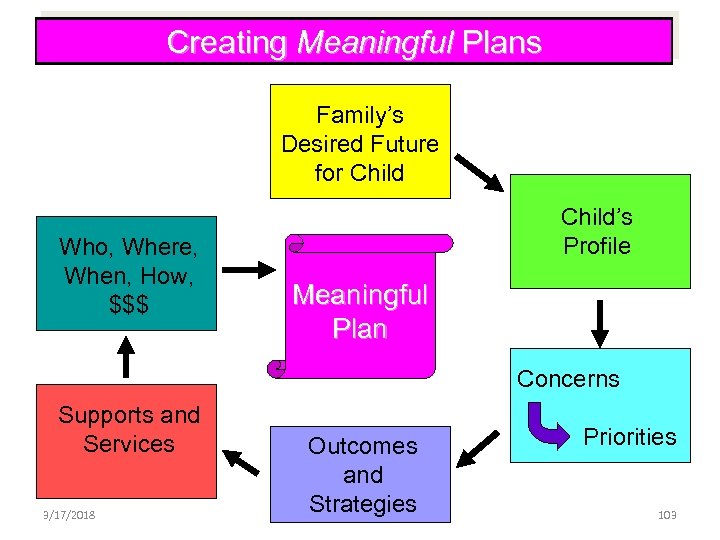 Creating Meaningful Plans Family’s Desired Future for Child Who, Where, When, How, $$$ Child’s Profile Meaningful Plan Concerns Supports and Services 3/17/2018 Outcomes and Strategies Priorities 103
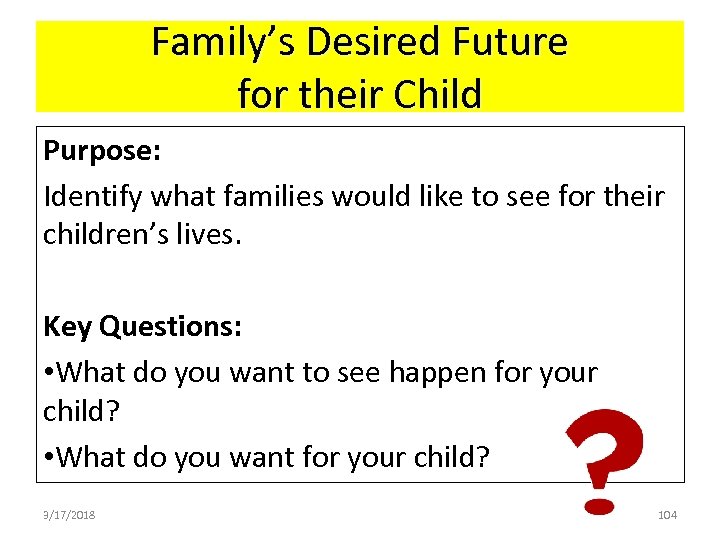 Family’s Desired Future for their Child Purpose: Identify what families would like to see for their children’s lives. Key Questions: • What do you want to see happen for your child? • What do you want for your child? 3/17/2018 104
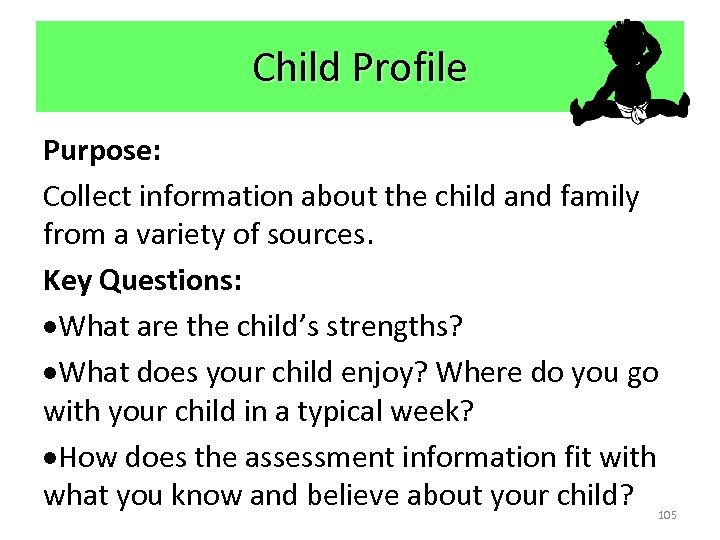 Child Profile Purpose: Collect information about the child and family from a variety of sources. Key Questions: What are the child’s strengths? What does your child enjoy? Where do you go with your child in a typical week? How does the assessment information fit with what you know and believe about your child? 105
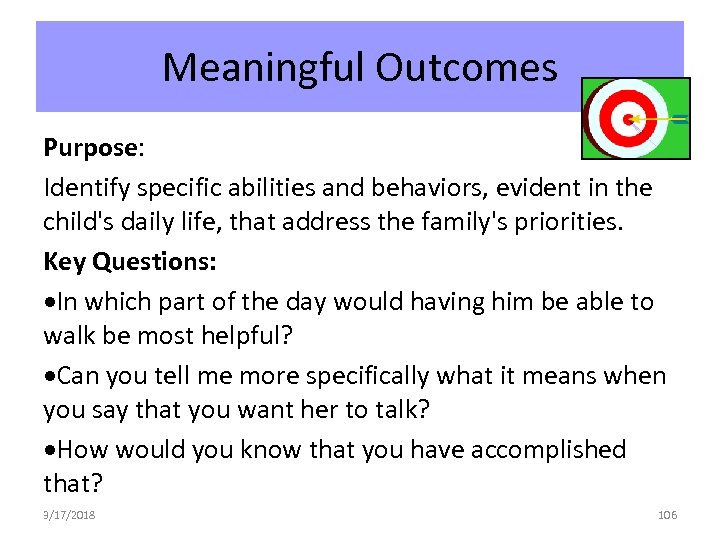 Meaningful Outcomes Purpose: Identify specific abilities and behaviors, evident in the child's daily life, that address the family's priorities. Key Questions: In which part of the day would having him be able to walk be most helpful? Can you tell me more specifically what it means when you say that you want her to talk? How would you know that you have accomplished that? 3/17/2018 106
 LM: Added word on bullet 2 Best Practices in Identifying Outcomes • Outcomes are based on the family’s priorities. • Outcomes are written within the context of daily routines/activities. • Outcomes are developed through a team process. • Outcomes are meaningful to families. • Outcomes are worded in ways that are understood by families. 3/17/2018 107
 LM: changed wording on bullet 2 Supports and Services Purpose: Identify the people, places, and routines that facilitate accomplishing meaningful outcomes. Key Questions: How can the strategies be addressed through the people, places, and routines in which the family is already involved? Who are the people that are a part of the family’s daily lives and can help implement these strategies? Which of the allowable early intervention services are needed to implement the strategies? Are there “Other Services” (typically medical) needed to address the outcome? 3/17/2018 108
 Who, Where, When, How, and $$$ Purpose: Identify the details of the plan that will let everyone know who will do what, when, where, and how. Examples of Key Questions: Who are the people who can provide the identified early intervention services? Where will the intervention occur that best fits the family’s typical routine? When will the intervention occur that will have the greatest impact? How will the identified provider work with the family and others? What funding sources need to be explored? 3/17/2018 109
 The IFSP Must Specify. . . A statement of the specific early intervention services necessary to meet the unique needs of the child and family including: – Frequency and intensity; – Method of delivery; – The natural environments in which the service will be provided; – The location; – Payment arrangements. 3/17/2018 110
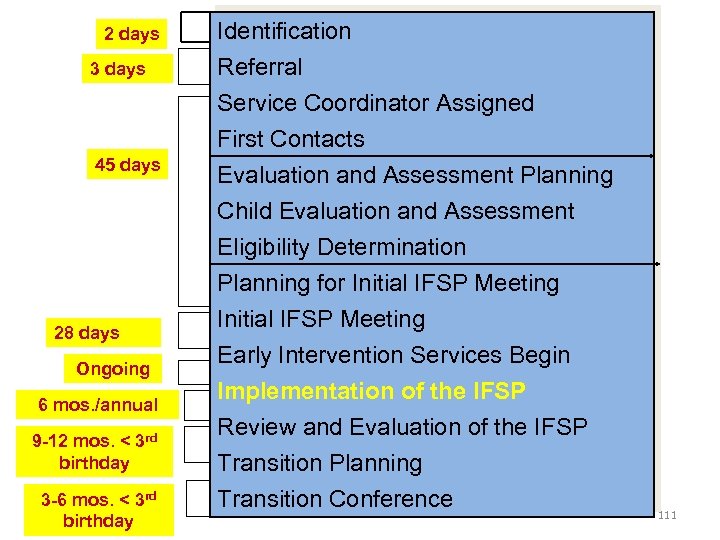 2 days 3 days 45 days 28 days Ongoing 6 mos. /annual 9 -12 mos. < 3 rd birthday 3 -6 mos. < 3 rd birthday Identification Referral Service Coordinator Assigned First Contacts Evaluation and Assessment Planning Child Evaluation and Assessment Eligibility Determination Planning for Initial IFSP Meeting Early Intervention Services Begin Implementation of the IFSP Review and Evaluation of the IFSP Transition Planning Transition Conference 111
 Tips for putting the Plan in Motion • The service coordinator needs to: – Serve as the single point of contact in helping families obtain the services and assistance they need. – Send copies of the completed IFSP to members of the IFSP team and others requested by the family as soon as possible. – Make a list of what has to happen immediately to set the wheels in motion and be sure that all steps of the process are addressed. – Offer assistance to the family in contacting new people or agencies. – Check back with the family early and often in the beginning to make sure that things are happening as planned. – Make sure that everything on the IFSP gets put in place.
 Tips for putting the Plan in Motion • The Service coordinators and early intervention providers need to; – View implementation as the beginning of the process, rather than the end. – Realize that the planning piece is critical - the better the planning, the fewer problems with implementation. – Be sure that everyone knows who will do what, when, where, and how. • The DI Assistants need to: – Follow directions and intervention plans, based on the IFSP, given to them by their supervisors i. e. early intervention providers
 Why Document Progress and Collect Data? – IFSPs require monitoring of child’s progress, known as on-going assessment. – Planning, implementing modifications and teaching families takes a great deal of time and effort; therefore warrants documentation of progress. – Data collected on the child’s progress is the only way of determining: • If intervention strategies are working or making a difference. • What changes are required in the strategies being used. • When a child has mastered a skill.
 Key Messages about Documenting Progress • Remember, families have the right to look at records. This means that we need to communicate in our written notes the same way we would communicate verbally i. e. respectfully, using people-first language. • Respect families' right to confidentiality. Only those who have the family's written permission should have access to the date/notes that you take and put in a child's file 115
 Guidance on Periodic and Annual Reviews 116
 Periodic Review • Is conducted at least every six months • Service coordinator reviews progress achieved on outcomes based on ongoing assessment information and progress information from all members of the IFSP team, including the DI Assistants. 117
 Periodic Review Service Coordinator along with the family, service providers, and DI Assistants, completes the Periodic Review page of the IFSP • Review family’s current concerns and priorities and document as needed. • Document new information on the following pages of the IFSP (as needed): – Health Information – Present Levels of Development – Concerns and Priorities – Plan of Action – Supports and Services 118
 Annual Review • Conducted at least annually. • Review any current evaluations and ongoing assessment information. • Update the IFSP. • Full team participation. 119
 Activity: Michelle’s Story- Part II • Read Michelle's Story: Part Two. • Highlight information that relates to what we've just been discussing about implementation (including documentation) and review. • Discuss as a large group. 120
 Take Away Message It is essential to have a plan that is "written" in a way that is meaningful to families, but the implementation of such a plan is where the "rubber hits the road. " 121
 Challenges During Implementation 122
 123
123
 Take home learning activities Observe an IFSP Meeting 124
 Recap Module C: Understanding the Development and Implementation of the IFSP In the previous model, you learned: ⁻ The steps to be followed after eligibility determination ⁻ The process of an IFSP meeting ⁻ The components of the IFSP in Colorado ⁻ The steps taken to implement an IFSP 125
 Module D: Teaming and Collaboration in the IFSP process In this module, you will: 1. Describe the membership of the IFSP team. 2. Recognize the importance of collaboration in the IFSP process. 3. Describe factors that lead to successful collaboration. 126
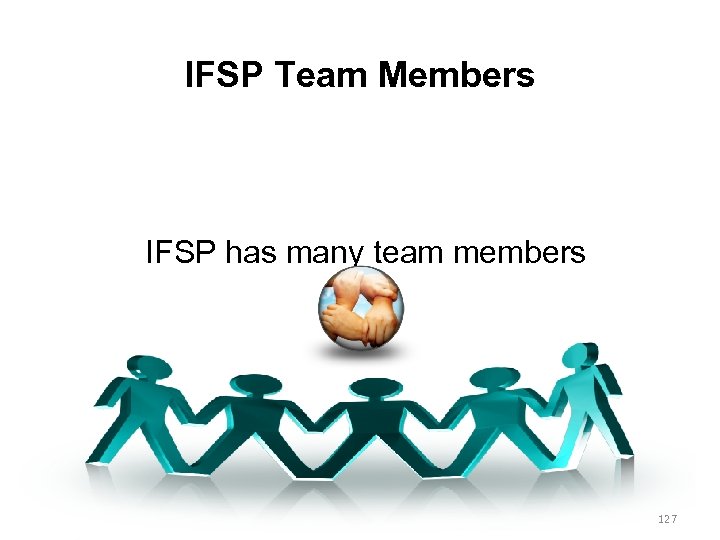 IFSP Team Members IFSP has many team members 127
 So. . . Who Are the IFSP Team Members? • • Parents 2. Service Coordinators 3. Early intervention providers 4. Additional people important to the family Note: parents and service coordinators are the only constants on the team, other members vary depending on which landmark of the IFSP process is the focus 128
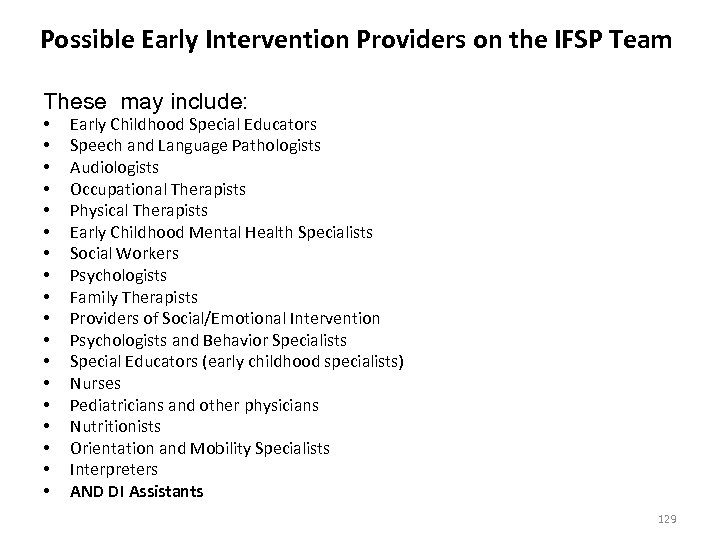 Possible Early Intervention Providers on the IFSP Team These may include: • • • • • Early Childhood Special Educators Speech and Language Pathologists Audiologists Occupational Therapists Physical Therapists Early Childhood Mental Health Specialists Social Workers Psychologists Family Therapists Providers of Social/Emotional Intervention Psychologists and Behavior Specialists Special Educators (early childhood specialists) Nurses Pediatricians and other physicians Nutritionists Orientation and Mobility Specialists Interpreters AND DI Assistants 129
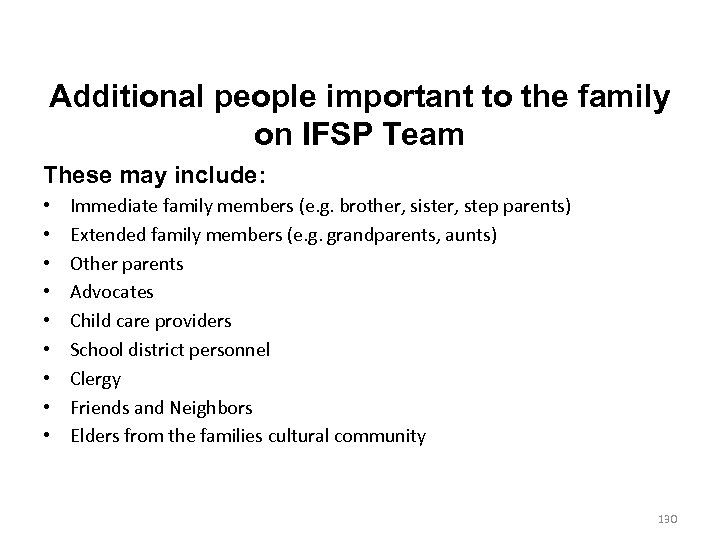 Additional people important to the family on IFSP Team These may include: • • • Immediate family members (e. g. brother, sister, step parents) Extended family members (e. g. grandparents, aunts) Other parents Advocates Child care providers School district personnel Clergy Friends and Neighbors Elders from the families cultural community 130
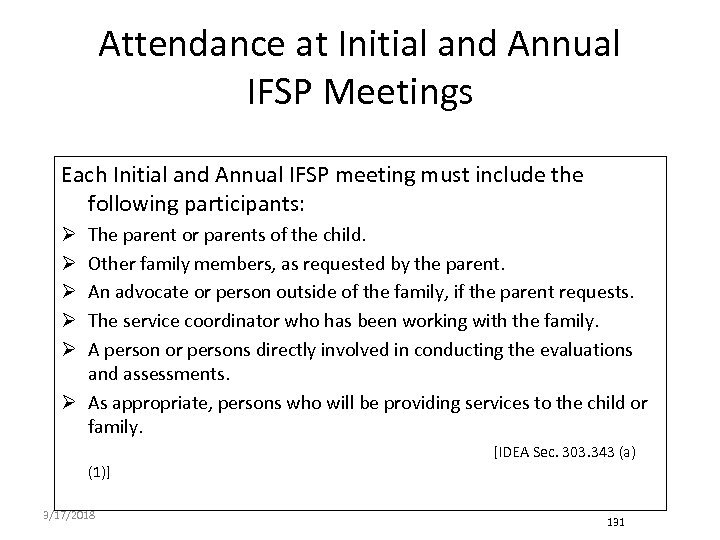 Attendance at Initial and Annual IFSP Meetings Each Initial and Annual IFSP meeting must include the following participants: The parent or parents of the child. Other family members, as requested by the parent. An advocate or person outside of the family, if the parent requests. The service coordinator who has been working with the family. A person or persons directly involved in conducting the evaluations and assessments. Ø As appropriate, persons who will be providing services to the child or family. Ø Ø Ø [IDEA Sec. 303. 343 (a) (1)] 3/17/2018 131
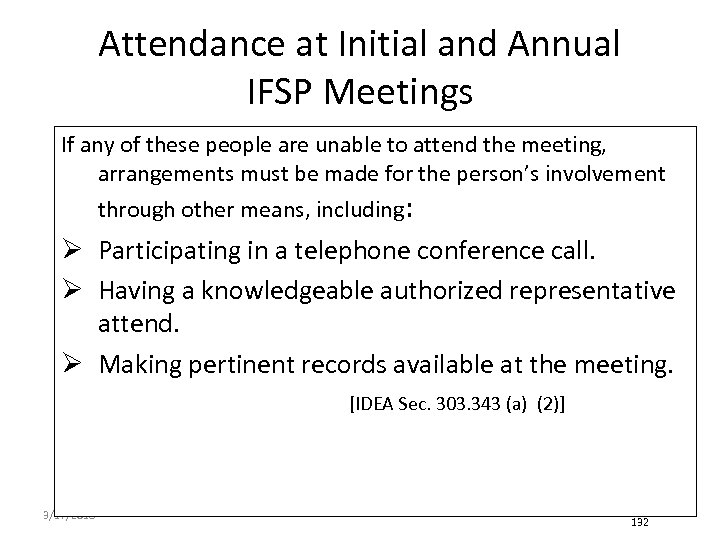 Attendance at Initial and Annual IFSP Meetings If any of these people are unable to attend the meeting, arrangements must be made for the person’s involvement through other means, including: Ø Participating in a telephone conference call. Ø Having a knowledgeable authorized representative attend. Ø Making pertinent records available at the meeting. [IDEA Sec. 303. 343 (a) (2)] 3/17/2018 132
 Activity: Drawing Game • Divide in teams of 3 or 4 member. • One person in each team starts by drawing a shape or outline when the instructor shouts “start. ” • Pass the drawing to the next member when you hear the word “change” from the instructor. (Each participant gets 5 seconds). • Next member adds to the drawing until the instructor shouts “change” again. • Remember, no discussion is permitted during the drawing, nor can you decide previously what you plan to draw. • The drawing continues to pass around in the group until the instructor shouts “Stop”. YOU HAVE A TOTAL ONE MINUTE TO COMPLETE THE DRAWING. 133
 Review the Drawing o o o o o Did the team draw anything recognizable? How easy was the understanding between the team members? How did each team member work similarly or differently on the task? What was the effect of time pressure? Was there a natural tendency to draw supportively and harmoniously, or were there conflicting ideas? What factors led to the drawings being recognizable? Or unrecognizable? Are “drawing skills” helpful for this exercise? Or are there other competencies or characteristics that supported you to create a “meaningful” drawing? What does this activity demonstrate about mutual understanding and how to achieve success? What obstacles to understanding and teamwork does this activity illustrate? Would this activity have gone differently if you had mutually agreed on a theme or topic for your drawing? 134
 Collaboration in IFSP Process IFSP process requires coordinated teamwork in a variety of stages of the IFSP process. From a Family’s Perspective: o Professionals must be available to answer families’ questions and support them to achieve the direction in which they want to go. o In order for parents to make informed decisions they need complete and reliable information. One person can’t provide all information to families. o The team concept brings together all of the pieces of information that can help families. From a Practitioner’s Perspective: o As professionals we can’t know all of the perspectives of the various players unless we have collaborative team process. o We need teaming and collaboration to assure that all team members are working toward common goals and that those goals are meaningful to the family. o We need teaming and collaboration to help assure that the federally mandated process happens. 135
 What is Teaming? Professional and parental sharing of information and expertise in which two or more persons work together to meet a common goal. (Correa, date, p. 5 ) Interactive teaming: “where there is mutual or reciprocal effort among and between team members to meet this goal” (p. 5) 136
 What does the word collaboration mean to you? 137
 Co • labor = “to work together” 3/17/2018
 Collaboration is………. A particular kind of relationship among professionals. One characterized by: 1. shared goal 2. voluntariness 3. parity 4. shared responsibility for decision making 5. shared accountability for outcomes 6. shared resources 7. and the emergence of trust, respect, and a sense of community (Friend & Cook, 1996) 139
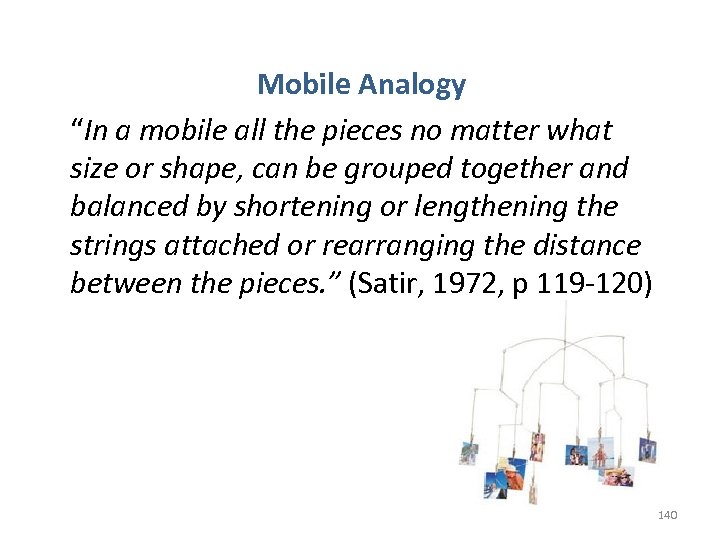 Mobile Analogy “In a mobile all the pieces no matter what size or shape, can be grouped together and balanced by shortening or lengthening the strings attached or rearranging the distance between the pieces. ” (Satir, 1972, p 119 -120) 140
 What are the elements that for successful collaboration?
 Elements of Successful Collaboration Mutual respect for skills and knowledge Honest and clear communication Understanding and empathy Mutually agreed upon goals Shared planning and decision making Open and two-way sharing of information Accessibility and responsiveness Joint evaluation of progress Absence of labeling and blaming 142
 Collaboration: Take Home Messages We often need to work together to achieve a common goal. We need to collaborate. Collaboration can happen in different ways. There are many elements to collaboration. Professionals must recognize that parents are competent individuals, and that in order to truly collaborate, a respectful partnership must be formed. We need to ask families how they want to collaborate, what roles they want to play. We need to recognize how we as individuals define professional and family roles in collaboration. The qualities that served the team to draw successfully a recognizable picture are the same kinds of qualities that make any kind of team successful. 143

 Collaboration? An unnatural act committed by non-consenting adults. Frank Heron What are some of the barriers to collaboration? 145
 Activity Work in groups to identify: 1. What are the potential benefits of collaboration (for yourself, team members, students, families, etc? ) 2. What are some potential barriers to successful collaboration? 146
 Collaboration: Potential Challenges and Benefits Potential Challenges: • Separate entities of professionals (turf/ language/ jargon) • Time • Inadequate resources/ unequal resource allocation • Differences in levels of skills / expertise • Lack of role definition • Policies at the leadership level • Lack of consistent implementation • Lack of common mission Potential benefits: • Synergy • Potential for improved services for children and families • Opportunity for professional development • Professional retention 147
 Activity: State Agency Partners Think about the broad range of services that are included in the IFSP and identify what other state departments or agencies might be involved in the IFSP process. 148
 State Agency Partners Department of Human Services Department of Education Department of Public Health and Environment Department of Health Care Policy and Financing • Colorado Division of Insurance • • 149
 Colorado Department of Human Services (CDHS) • The Colorado Department of Human Services (CDHS), Division for Developmental Disabilities (DDD) is lead agency for Part C in Colorado, and the program is Early Intervention Colorado. CDHS has many additional sub-agencies, including Child Care and Child Welfare. • The Colorado Interagency Coordinating Council (CICC) acts as the advisory body to the DDD and consists of representatives of from a variety of statewide stakeholders (parents, providers) , representatives of other state departments involved in early intervention services and other entities (Head Start, Protection and Advocacy agency, etc. ). Next, we will briefly discuss other state departments that may be involved in providing early intervention services outlined in the IFSP. 150
 Colorado Department of Education (CDE) • The CDE administers preschool special education (Part B of IDEA) and many other early care and education programs • CDE, through Child Find: – evaluates children entering the early intervention system. – determines eligibility for preschool special education. – assists in facilitating the transition between early intervention and preschool for eligible children. 151
 Colorado Department of Public Health and Environment (CDPHE) • CDPHE administers the Health Care Program for Children with special Needs (HCP) and other public health programs including the Colorado Registry for Children with Special Needs (CRCSN). • The Health Care Program for Children with Special Needs (HCP) services are provided to children and youth (birth to 21 years of age) and their families in every county of Colorado for through organized health departments and local nursing services. 152
 Department of Health Care Policy and Financing – This Department administers the Medicaid and Child Health Plan Plus (CHP+) programs as well as a variety of other programs for Colorado's low-income families, the elderly and persons with disabilities. – Approximately one-third of infants and toddlers eligible for early intervention services are also eligible for Medicaid offers waiver programs that allow children who meet certain medical or developmental criteria to access Medicaid, without meeting the financial eligibility limitations. 153
 Division of Insurance • This division is a part of Colorado Department of Regulatory Agencies (DORA). • Division of Insurance : – Regulates the insurance industry and assists consumers and other stakeholders with insurance issues. – Assures that all legislation involving insurance companies, including the Coordinated System of Payment legislation for early intervention services is implemented. . 154
 State Partner Website Links • Early intervention Colorado at Colorado Department of Human services http: //www. eicolorado. org/ • Child Find at Colorado Department of Education http: //www. cde. state. co. us/early/childfind. htm • Colorado Department of Public Health and Environment http: //www. cdphe. state. co. us – • Health Care Program for Children with special Needs at Department of Health Care Policy and Financing - http: //www. cdphe. state. co. us/ps/hcp/ • Department of Health Care Policy and Financing • http: //www. colorado. gov/hcpf • Colorado Division of Insurance - http: //www. dora. state. co. us/insurance/ 155
 Activity : State Agency Partners Matching Quiz • Turn over State Agency Partners handout (H 35). • Use State Agency Partners Match Quiz handout (H 36) • Complete the Quiz matching the State Agency Partners with the appropriate role in the table. • Report to the group on one question until all answers have been shared. 156
 Answers: State Agency Partners Matching Quiz State Agency/Department Role in Early Intervention Services The Department of Health Care Policy and Financing (HCPF) Assures that all legislation involving insurance companies, including the Coordinated System of Payment legislation for early intervention services is implemented. Colorado Department of Public Health and Environment (CDHE) This department administers the health care service for children with special needs as well as other and other public health programs Colorado Department of Human Services (CDHS) This is the lead agency for Part C (early intervention services) Division of Insurance This agency is responsible for Medicaid as well as a variety of other programs for Colorado's low-income families, the elderly and persons with disabilities. Colorado Department of Education (CDE) Through one of its programs, this department facilitates the transition between early intervention and preschool for eligible children. 157
 This Ends Module D In Module D: Teaming and Collaboration in the IFSP process , you learned… • The importance of collaboration in the IFSP process. • Factors that lead to successful collaboration. • The membership of IFSP teams and roles of different member on the IFSP throughout the IFSP process 158
 QUESTIONS? 159