


 Скачать презентацию An A-Z Guide to Planning Managing and Executing
5bc374f955e683d38d719048cf27e54f.ppt
- Количество слайдов: 41
 An A-Z Guide to Planning, Managing, and Executing an SAP BW Project Part 1 Dr. Bjarne Berg Comerit Inc. © 2004 Wellesley Information Services. All rights reserved.
 What We’ll Cover (part 1)… • • • Writing the BW business case Defining the scope Writing the milestone plan Timelines and staffing plan Budgeting On-boarding and training Writing the workplan Monitoring progress Monitoring BW quality and a formal approval process The BW user acceptance group and its role Wrap-up 2
 What We’ll Cover (in part 2)… • The blueprinting phase Leveraging the standard content Modeling for your solution Deliverables • The realization phase Best practices for managing the implementation of ODS and Info. Cubes Managing the environments and transports Managing unit, system, integration & stress testing of BW • The implementation phase Executing the cut-over to production Conducting end-user and power user training Establishing the end-user support organization Post-implementation review and next steps 3
 What We’ll Cover (part 1)… • • • Writing the BW business case Defining the scope Writing the milestone plan Timelines and staffing plan Budgeting On-boarding and training Writing the workplan Monitoring progress Monitoring BW quality and a formal approval process The BW user acceptance group and its role Wrap-up 4
 Writing the Business Case The business case must be aligned with some concrete business benefits. The best way to write a business case is to align it with one of these areas: Money Strategy Reducing time and effort of delivery Improved information quality and access for end users 5
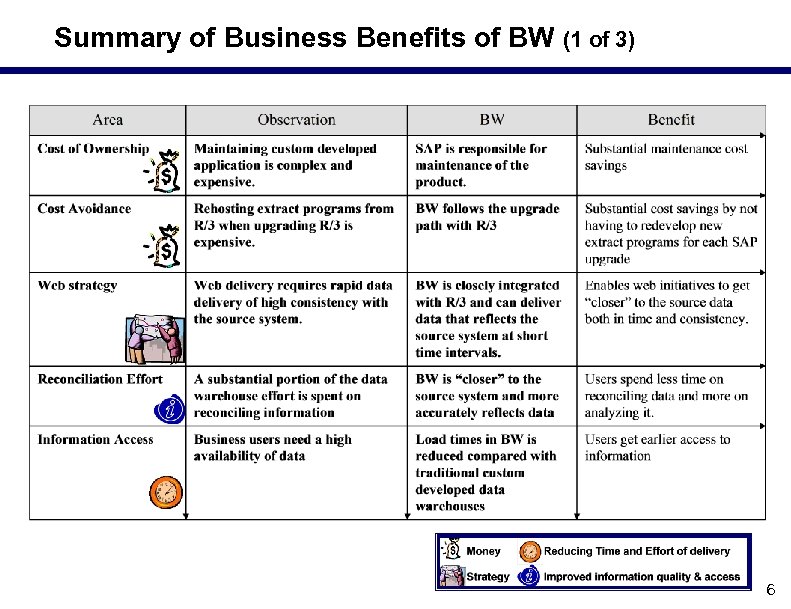 Summary of Business Benefits of BW (1 of 3) 6
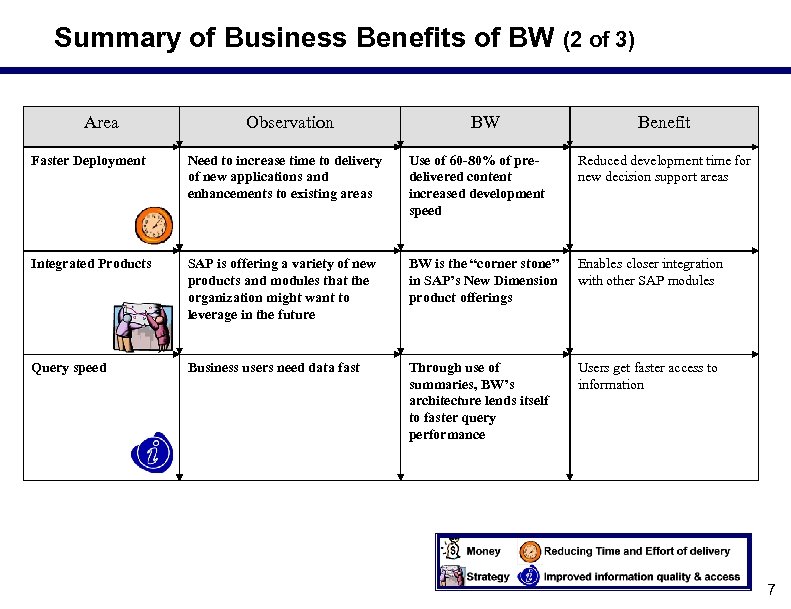 Summary of Business Benefits of BW (2 of 3) Area Observation BW Benefit Faster Deployment Need to increase time to delivery of new applications and enhancements to existing areas Use of 60 -80% of predelivered content increased development speed Reduced development time for new decision support areas Integrated Products SAP is offering a variety of new products and modules that the organization might want to leverage in the future BW is the “corner stone” in SAP’s New Dimension product offerings Enables closer integration with other SAP modules Query speed Business users need data fast Through use of summaries, BW’s architecture lends itself to faster query performance Users get faster access to information 7
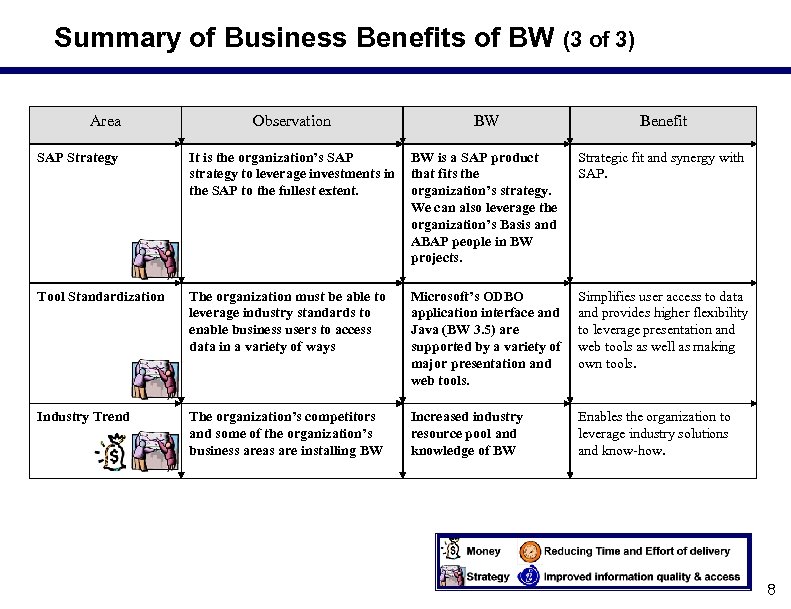 Summary of Business Benefits of BW (3 of 3) Area Observation BW Benefit SAP Strategy It is the organization’s SAP strategy to leverage investments in the SAP to the fullest extent. BW is a SAP product that fits the organization’s strategy. We can also leverage the organization’s Basis and ABAP people in BW projects. Strategic fit and synergy with SAP. Tool Standardization The organization must be able to leverage industry standards to enable business users to access data in a variety of ways Microsoft’s ODBO application interface and Java (BW 3. 5) are supported by a variety of major presentation and web tools. Simplifies user access to data and provides higher flexibility to leverage presentation and web tools as well as making own tools. Industry Trend The organization’s competitors and some of the organization’s business areas are installing BW Increased industry resource pool and knowledge of BW Enables the organization to leverage industry solutions and know-how. 8
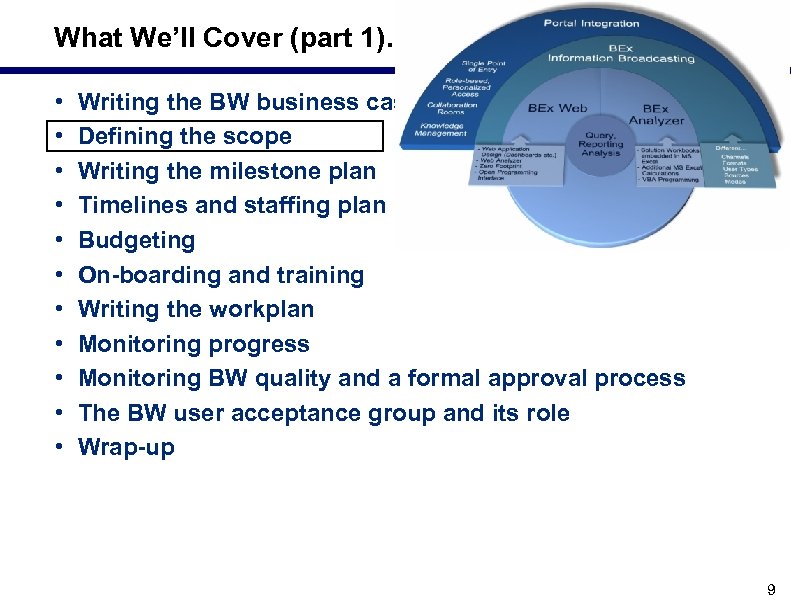 What We’ll Cover (part 1)… • • • Writing the BW business case Defining the scope Writing the milestone plan Timelines and staffing plan Budgeting On-boarding and training Writing the workplan Monitoring progress Monitoring BW quality and a formal approval process The BW user acceptance group and its role Wrap-up 9
 Defining the Scope • First determine what the business drivers were and make sure you meet these objectives. • Define the scope in terms of what is included, as well as what is not included. • Make sure you obtain approval of the scope before you progress any further. All your work from now on will be driven based on what is agreed to at this stage. • As part of the written scope agreement, make sure you implement a formal change request process. This typically includes a benefit-cost estimate for each change request and a formal approval process. Change management is done to manage scope, timelines and competing business requirements. 10
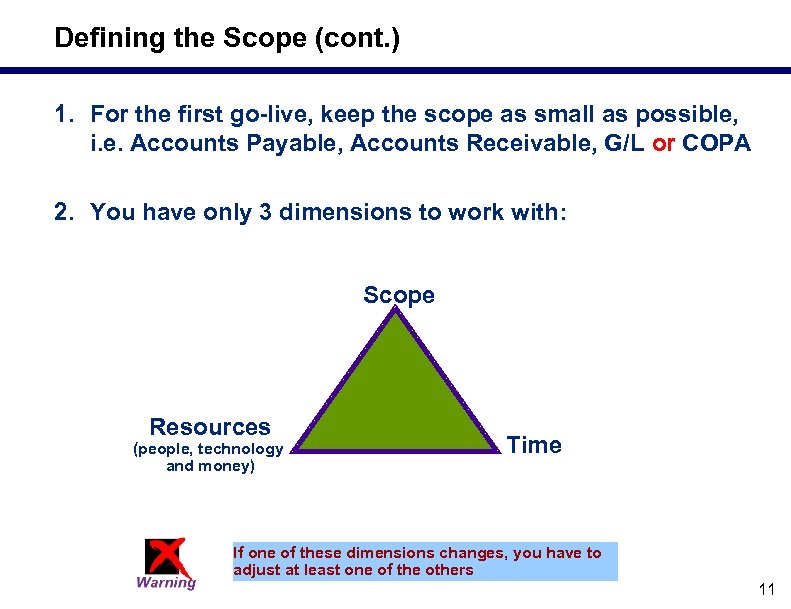 Defining the Scope (cont. ) 1. For the first go-live, keep the scope as small as possible, i. e. Accounts Payable, Accounts Receivable, G/L or COPA 2. You have only 3 dimensions to work with: Scope Resources (people, technology and money) Time If one of these dimensions changes, you have to adjust at least one of the others 11
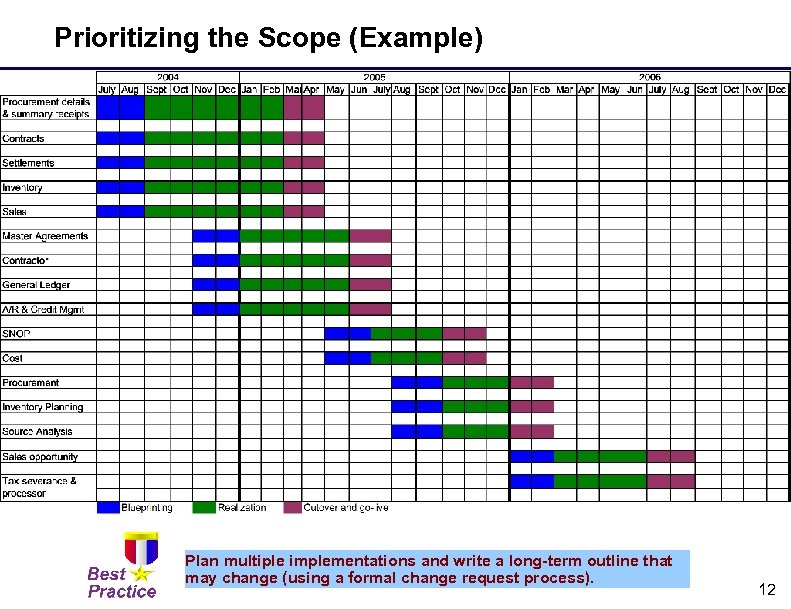 Prioritizing the Scope (Example) Plan multiple implementations and write a long-term outline that may change (using a formal change request process). 12
 What We’ll Cover (part 1)… • • • Writing the BW business case Defining the scope Writing the milestone plan Timelines and staffing plan Budgeting On-boarding and training Writing the workplan Monitoring progress Monitoring BW quality and a formal approval process The BW user acceptance group and its role Wrap-up 13
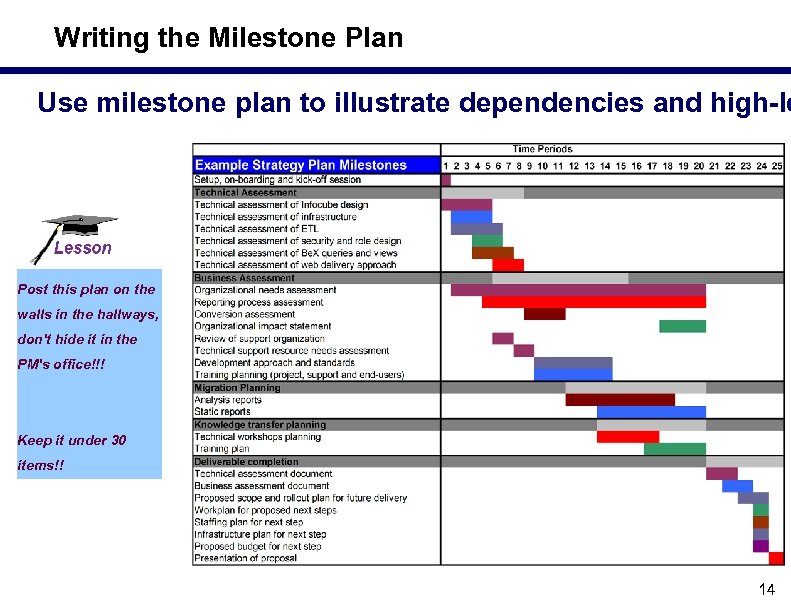 Writing the Milestone Plan Use milestone plan to illustrate dependencies and high-le Post this plan on the walls in the hallways, don't hide it in the PM's office!!! Keep it under 30 items!! 14
 What We’ll Cover (part 1)… • • • Writing the BW business case Defining the scope Writing the milestone plan Timelines and staffing plan Budgeting On-boarding and training Writing the workplan Monitoring progress Monitoring BW quality and a formal approval process The BW user acceptance group and its role Wrap-up 15
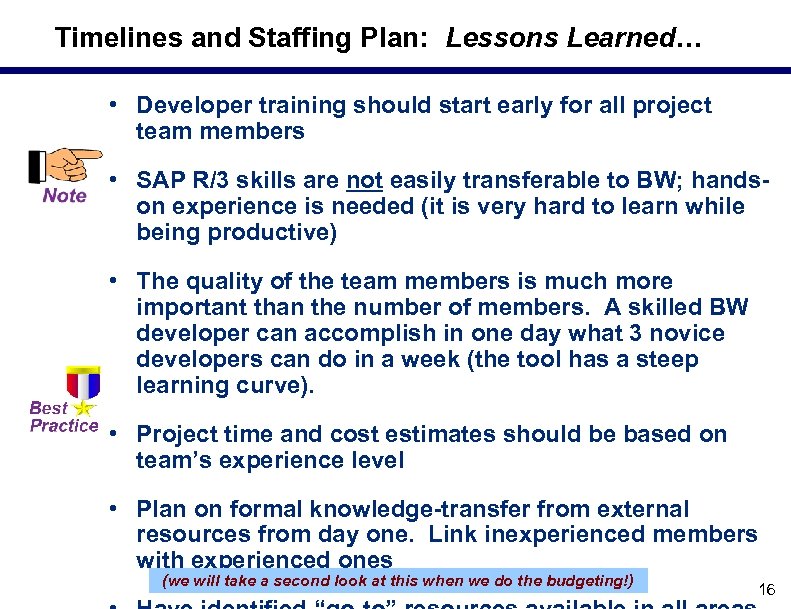 Timelines and Staffing Plan: Lessons Learned… • Developer training should start early for all project team members • SAP R/3 skills are not easily transferable to BW; handson experience is needed (it is very hard to learn while being productive) • The quality of the team members is much more important than the number of members. A skilled BW developer can accomplish in one day what 3 novice developers can do in a week (the tool has a steep learning curve). • Project time and cost estimates should be based on team’s experience level • Plan on formal knowledge-transfer from external resources from day one. Link inexperienced members with experienced ones (we will take a second look at this when we do the budgeting!) 16
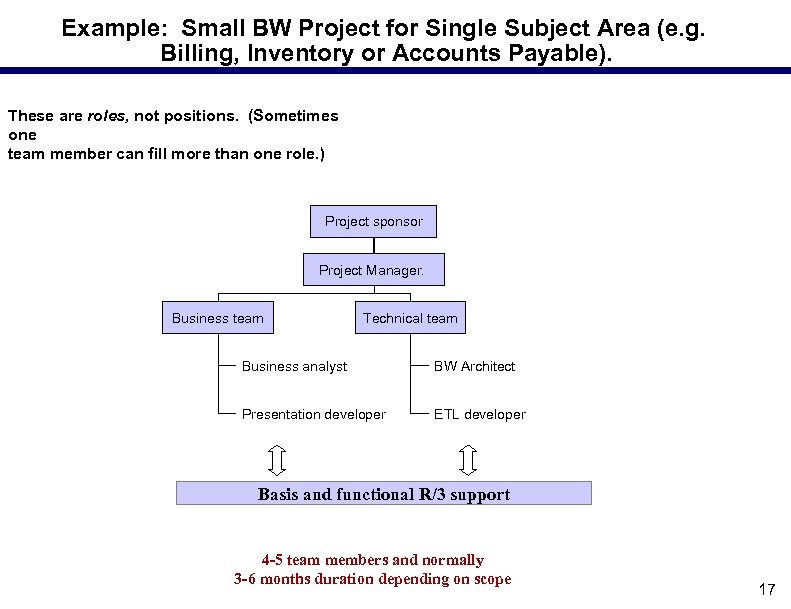 Example: Small BW Project for Single Subject Area (e. g. Billing, Inventory or Accounts Payable). These are roles, not positions. (Sometimes one team member can fill more than one role. ) Project sponsor Project Manager. Business team Technical team Business analyst BW Architect Presentation developer ETL developer Basis and functional R/3 support 4 -5 team members and normally 3 -6 months duration depending on scope 17
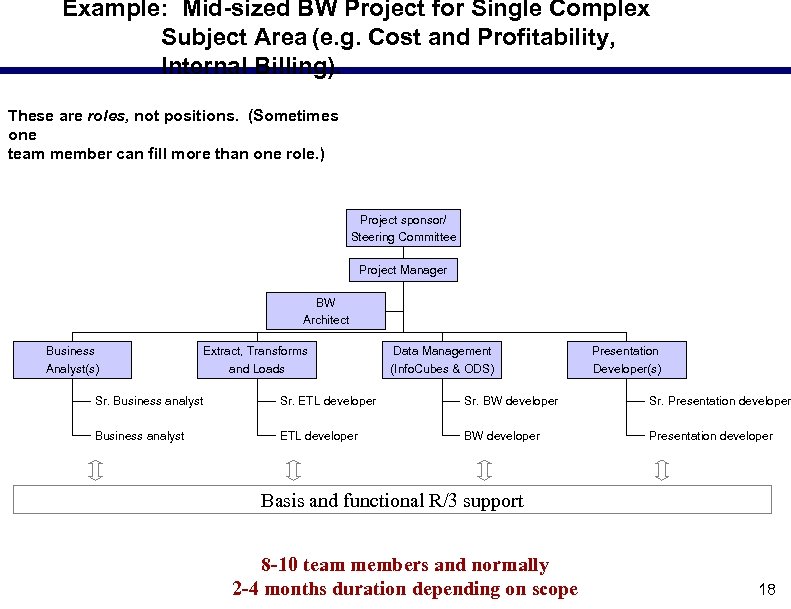 Example: Mid-sized BW Project for Single Complex Subject Area (e. g. Cost and Profitability, Internal Billing). These are roles, not positions. (Sometimes one team member can fill more than one role. ) Project sponsor/ Steering Committee Project Manager BW Architect Business Analyst(s) Extract, Transforms and Loads Data Management (Info. Cubes & ODS) Presentation Developer(s) Sr. Business analyst Sr. ETL developer Sr. BW developer Sr. Presentation developer Business analyst ETL developer BW developer Presentation developer Basis and functional R/3 support 8 -10 team members and normally 2 -4 months duration depending on scope 18
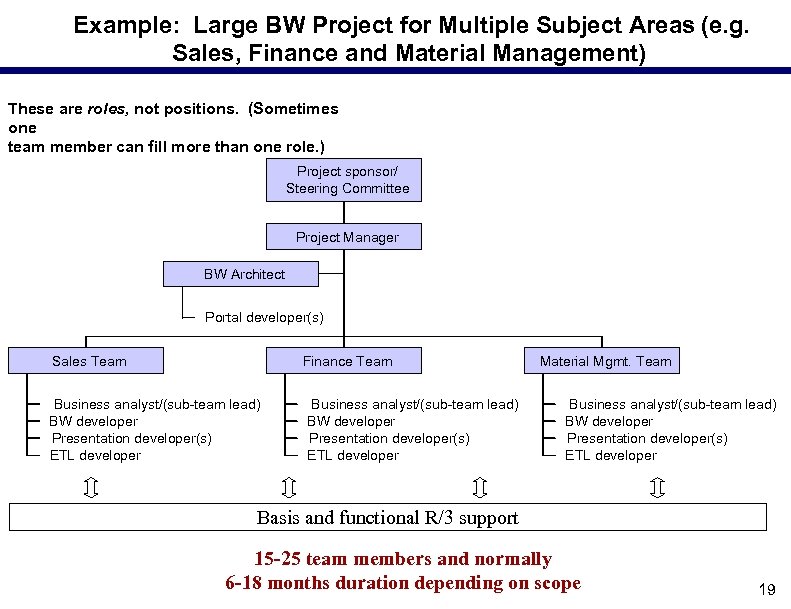 Example: Large BW Project for Multiple Subject Areas (e. g. Sales, Finance and Material Management) These are roles, not positions. (Sometimes one team member can fill more than one role. ) Project sponsor/ Steering Committee Project Manager BW Architect Portal developer(s) Sales Team Finance Team Business analyst/(sub-team lead) BW developer Presentation developer(s) ETL developer Material Mgmt. Team Business analyst/(sub-team lead) BW developer Presentation developer(s) ETL developer Basis and functional R/3 support 15 -25 team members and normally 6 -18 months duration depending on scope 19
 What We’ll Cover (part 1)… • • • Writing the BW business case Defining the scope Writing the milestone plan Timelines and staffing plan Budgeting On-boarding and training Writing the workplan Monitoring progress Monitoring BW quality and a formal approval process The BW user acceptance group and its role Wrap-up 20
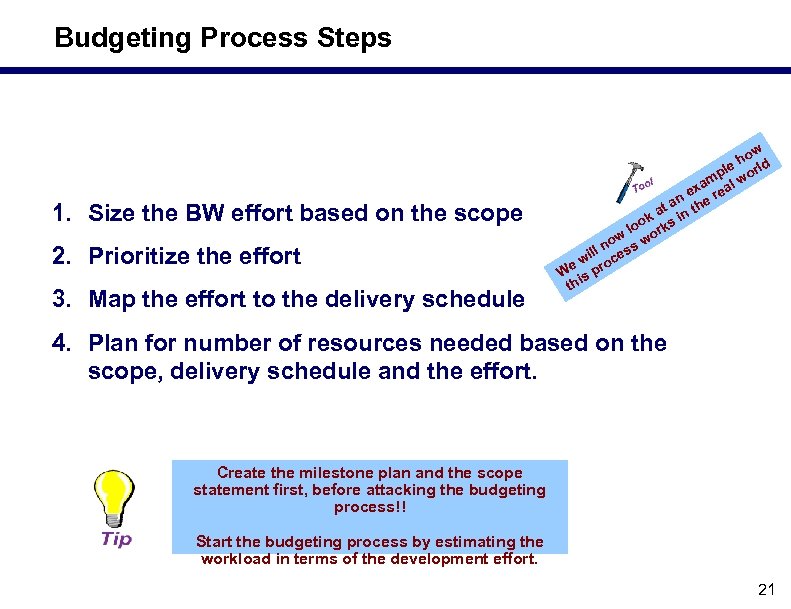 Budgeting Process Steps 1. Size the BW effort based on the scope 2. Prioritize the effort 3. Map the effort to the delivery schedule ow e h rld l mp l wo a ex rea an e at in th k loo orks ow w l n ess il e w proc W is th 4. Plan for number of resources needed based on the scope, delivery schedule and the effort. Create the milestone plan and the scope statement first, before attacking the budgeting process!! Start the budgeting process by estimating the workload in terms of the development effort. 21
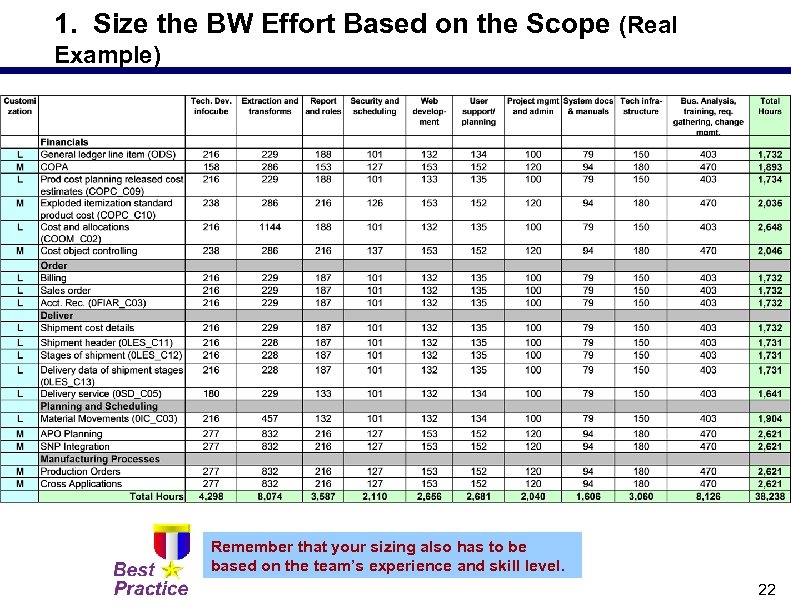 1. Size the BW Effort Based on the Scope (Real Example) Remember that your sizing also has to be based on the team’s experience and skill level. 22
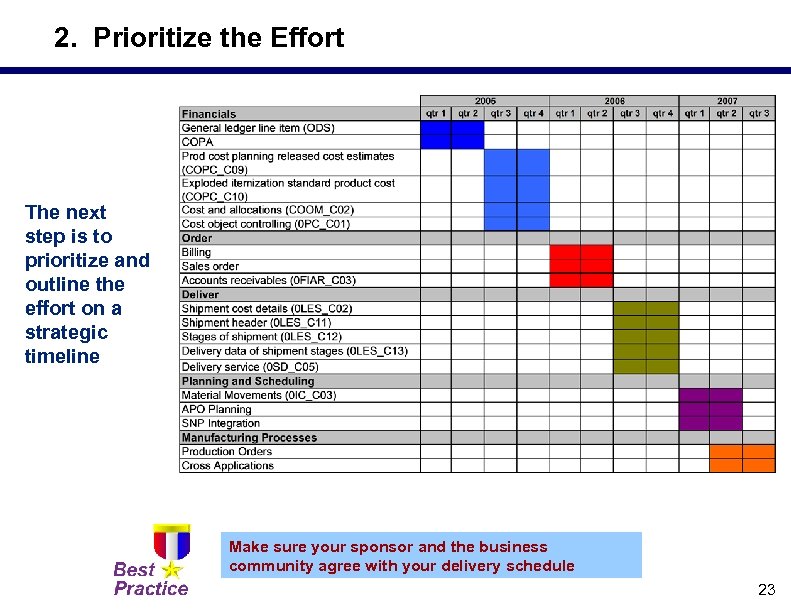 2. Prioritize the Effort The next step is to prioritize and outline the effort on a strategic timeline Make sure your sponsor and the business community agree with your delivery schedule 23
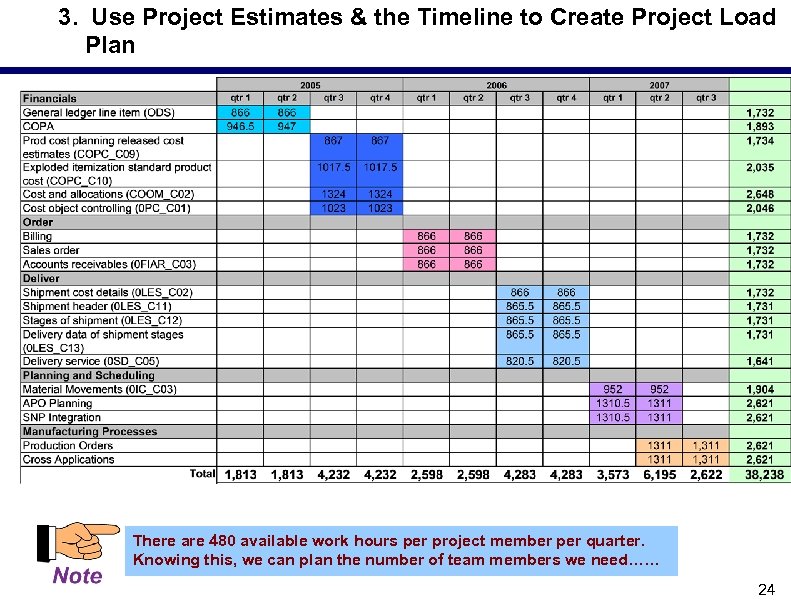 3. Use Project Estimates & the Timeline to Create Project Load Plan There are 480 available work hours per project member per quarter. Knowing this, we can plan the number of team members we need…… 24
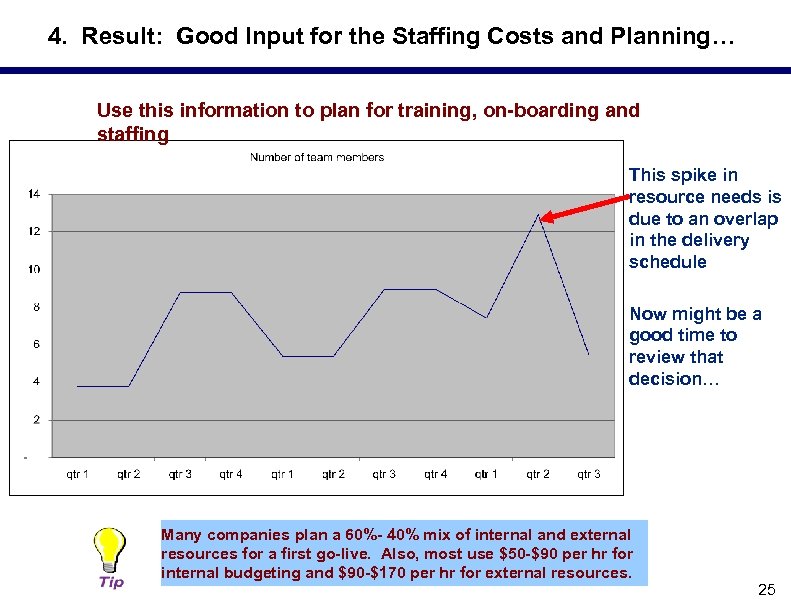 4. Result: Good Input for the Staffing Costs and Planning… Use this information to plan for training, on-boarding and staffing This spike in resource needs is due to an overlap in the delivery schedule Now might be a good time to review that decision… Many companies plan a 60%- 40% mix of internal and external resources for a first go-live. Also, most use $50 -$90 per hr for internal budgeting and $90 -$170 per hr for external resources. 25
 What We’ll Cover (part 1)… • • • Writing the BW business case Defining the scope Writing the milestone plan Timelines and staffing plan Budgeting On-boarding and training Writing the workplan Monitoring progress Monitoring BW quality and a formal approval process The BW user acceptance group and its role Wrap-up 26
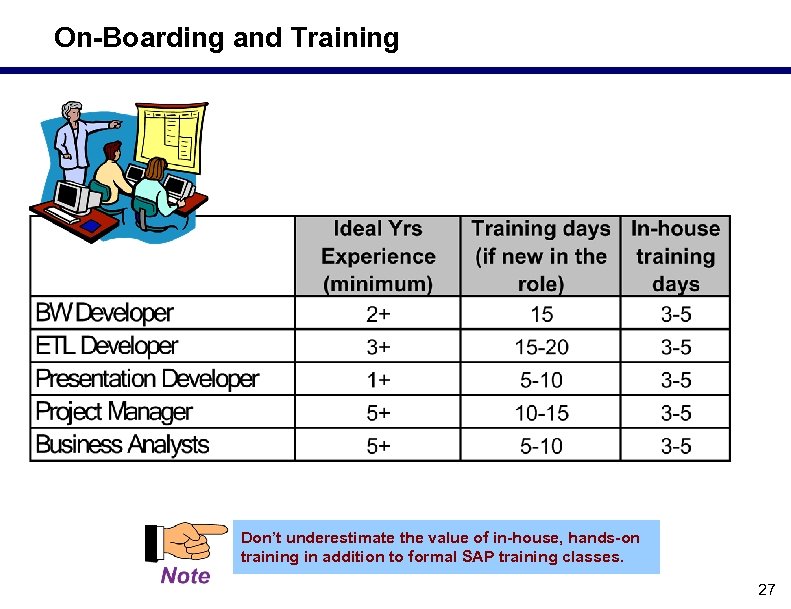 On-Boarding and Training Don’t underestimate the value of in-house, hands-on training in addition to formal SAP training classes. 27
 What We’ll Cover (part 1)… • • • Writing the BW business case Defining the scope Writing the milestone plan Timelines and staffing plan Budgeting On-boarding and training Writing the workplan Monitoring progress Monitoring BW quality and a formal approval process The BW user acceptance group and its role Wrap-up 28
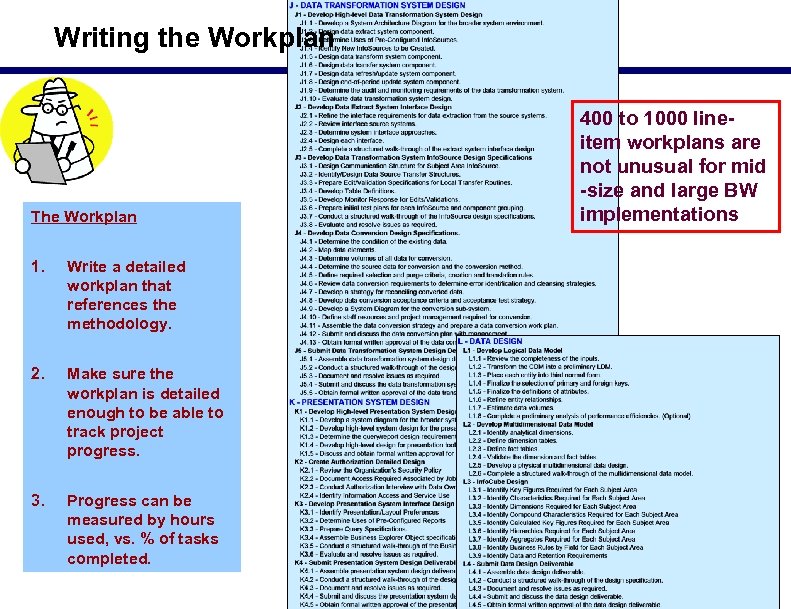 Writing the Workplan The Workplan 1. Write a detailed workplan that references the methodology. 2. Make sure the workplan is detailed enough to be able to track project progress. 3. 400 to 1000 lineitem workplans are not unusual for mid -size and large BW implementations Progress can be measured by hours used, vs. % of tasks completed. 29
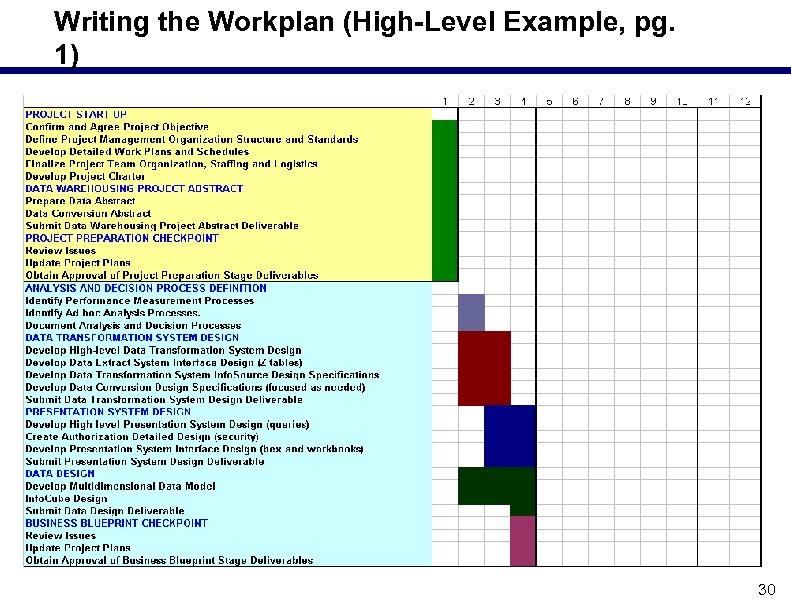 Writing the Workplan (High-Level Example, pg. 1) 30
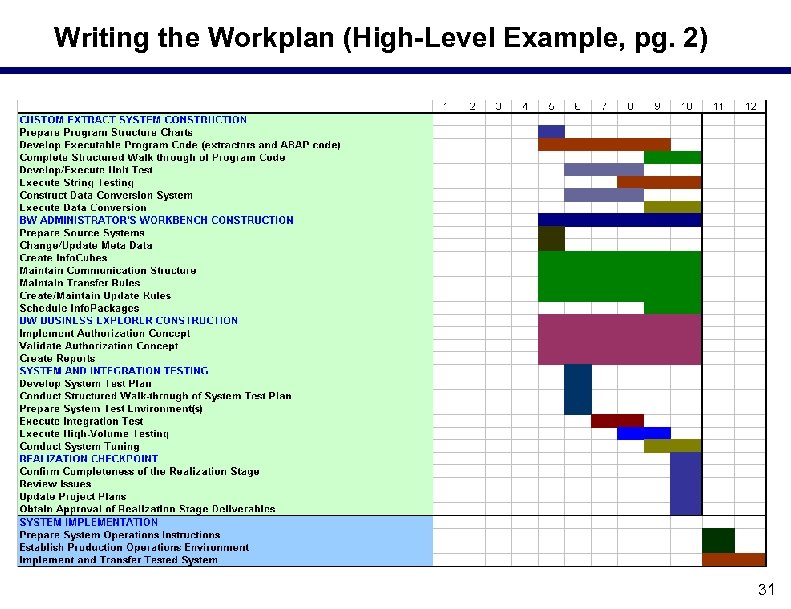 Writing the Workplan (High-Level Example, pg. 2) 31
 What We’ll Cover (part 1)… • • • Writing the BW business case Defining the scope Writing the milestone plan Timelines and staffing plan Budgeting On-boarding and training Writing the workplan Monitoring progress Monitoring BW quality and a formal approval process The BW user acceptance group and its role Wrap-up 32
 Monitoring Progress • • Manage the workplan from a percent complete standpoint on a weekly basis Create weekly status reports with core progress metrics and send to all team members (keep it high-level and tangible) Require monthly status reports from all team members in a fixed format Keep a close eye on the deadlines for the deliverables and make to follow-up personally on late tasks BW is a complex environment that has many dependencies. Late tasks can have significant impacts on the overall project. 33
 What We’ll Cover (part 1)… • • • Writing the BW business case Defining the scope Writing the milestone plan Timelines and staffing plan Budgeting On-boarding and training Writing the workplan Monitoring progress Monitoring BW quality and a formal approval process The BW user acceptance group and its role Wrap-up 34
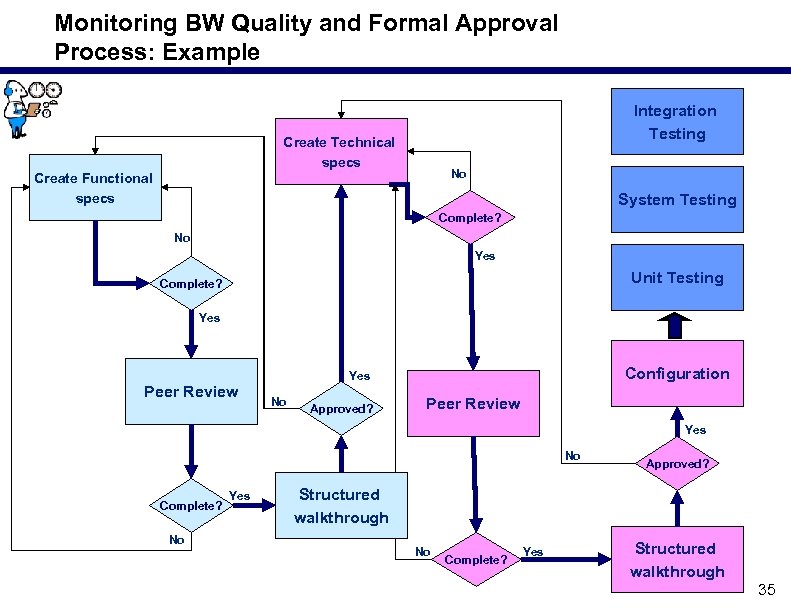 Monitoring BW Quality and Formal Approval Process: Example Integration Testing Create Technical specs No Create Functional specs System Testing Complete? No Yes Unit Testing Complete? Yes Configuration Yes Peer Review No Approved? Peer Review Yes No Complete? No Yes Approved? Structured walkthrough No Complete? Yes Structured walkthrough 35
 What We’ll Cover (part 1)… • • • Writing the BW business case Defining the scope Writing the milestone plan Timelines and staffing plan Budgeting On-boarding and training Writing the workplan Monitoring progress Monitoring BW quality and a formal approval process The BW user acceptance group and its role Wrap-up 36
 The User Acceptance Group and Its Role Create a user acceptance team with a total of 5 -7 members from the various business departments or organizations. • Keep the number odd to assist with votes when decisions are made. With fewer than 5 members it can be hard to get enough members present during a certain meeting time • Make them the focus of the requirements gathering in the early phase and later let this team become the user acceptance team (testing) in the realization phase • Meet with the team at least once a month during realization to refine requirements as you are This approach is hard to execute when also managing scope, but building and have something to show the team • is essential to make sure the system meets the requirements 37
 What We’ll Cover (part 1)… • • • Writing the BW business case Defining the scope Writing the milestone plan Timelines and staffing plan Budgeting On-boarding and training Writing the workplan Monitoring progress Monitoring BW quality and a formal approval process The BW user acceptance group and its role Wrap-up 38
 7 Key Points to Take Home • Write the business case around the areas of greatest benefit to your users. Do not use a “shot-gun” approach but keep it focused. • Define your scope in-terms of what is included and state what is not included. • Establish a formal change control process that is well communicated. • Plan your project based on the hours required for the effort and the project team’s skill level. • Establish milestone dates and map the work hours required to these dates. • Establish a resource on-boarding plan. 39 • Establish a formal process for quality control and approval of
 Resources • Five Core Metrics: The Intelligence Behind Successful Software Management – by Lawrence H. Putnam & Ware Myers • Waltzing With Bears: Managing Risk on Software Projects - by Tom Demarco & Timothy Lister • Mastering the SAP Business Information Warehouse by - Kevin Mc. Donald, Andreas Wilmsmeier, David C. Dixon 40
 END OF PART 1. Next: How do we Deliver What we Promised? How to contact me: bberg@comeritinc. com 41