 Скачать презентацию Amy Kakuk Beth Theriault and Jessica Bourgoin All
c5840a9d1f803160800883308568e7a4.ppt
- Количество слайдов: 47



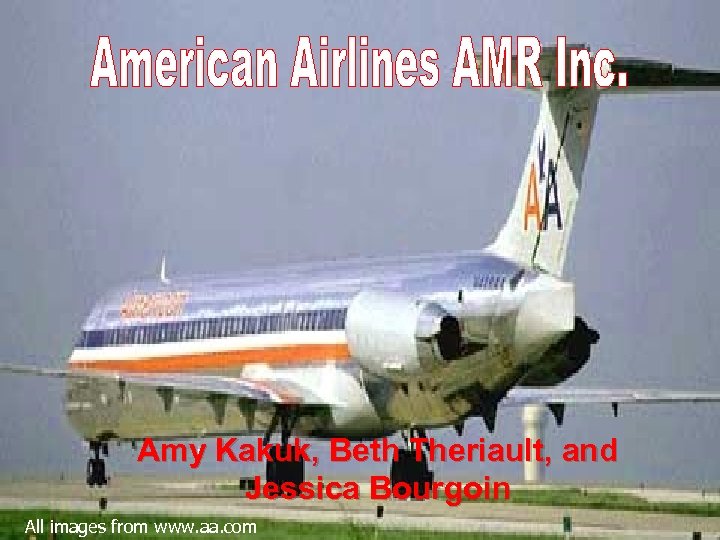
Amy Kakuk, Beth Theriault, and Jessica Bourgoin All images from www. aa. com
Agenda Ø Ø Ø Ø Company History A Little More About Us Our Planes Where We Fly Vision Statement Mission Statement Company Ratios External Analysis Ø Opportunities Ø Threats Ø CPM Ø EFE Ø Internal Analysis Ø Strengths Ø Weaknesses Ø IFE Ø Matrix Analysis Ø SWOT Analysis Ø Space Ø IE matrix Ø Grand Strategy Ø QSPM Ø Recommended Strategies Ø Future Plans Ø AMR in the News
AMR Timeline n n n Started in New York City in 1929 under the name Aviation Corporation. It was founded by Sherman Fairchild. 1930, renamed American Airways after combining 85 small airlines. 1934, airmail was suspended causing difficulty and the cause for new ideas. • Renamed to its current American Airlines and the first plane to pay off itself without the need for postal revenues was built. n n n 1964, AMR introduced the first computerized airline ticket reservation system (SABRE) 1980, new CEO Bob Crandall introduces frequent fliers program. 1982, Purchase of domestic airline. n n n n 1987, Nashville Eagle was renamed American Eagle. 1989, Donald Trump was prevented from purchasing American Airlines and new routes to Japan, Latin America, and London were bought. 1996, 20% of SABRE was sold and a code-sharing agreement was made with British Airways. 1999, One world (alliance of major airlines around the world) was formed because of agreement with British Airways. 2000, AMR sold its shares of Canadian Airlines along with the remaining of SABRE. 2001, AMR bought the assets of the failed TWA for $743 m. 2003, AMR was on the brink of bankruptcy after losing $1. 3 B Text Book: Strategic Management Author: Fred R. David
Location AMR Corporation 4333 Amon Carter Boulevard Fort Worth, TX 76155 Phone: 1 -817 -963 -1234 Fax: 1 -817 -9641 Sector Name: Transportation Industry Name: Airline Employees: 92, 100 Market Cap (Mil) $ : 1, 724. 425 Complete Financials: Dec 2004 Updated: 03/31/2005 www. AA. com
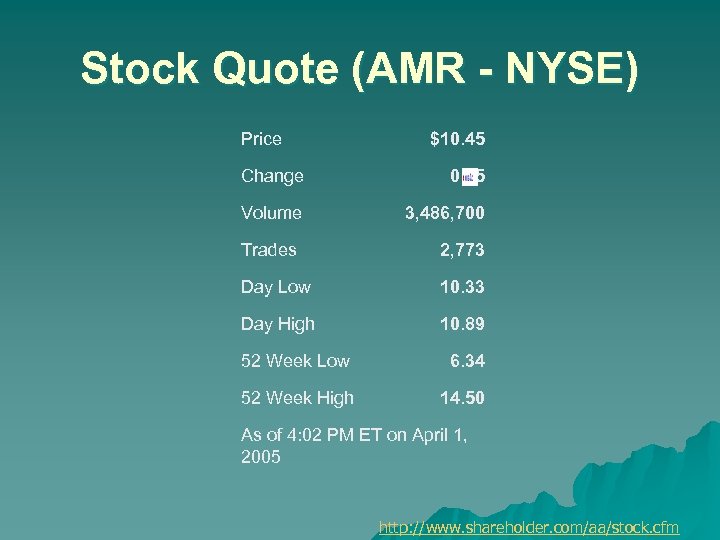
Stock Quote (AMR - NYSE) Price $10. 45 Change 0. 25 Volume 3, 486, 700 Trades 2, 773 Day Low 10. 33 Day High 10. 89 52 Week Low 6. 34 52 Week High 14. 50 As of 4: 02 PM ET on April 1, 2005 http: //www. shareholder. com/aa/stock. cfm
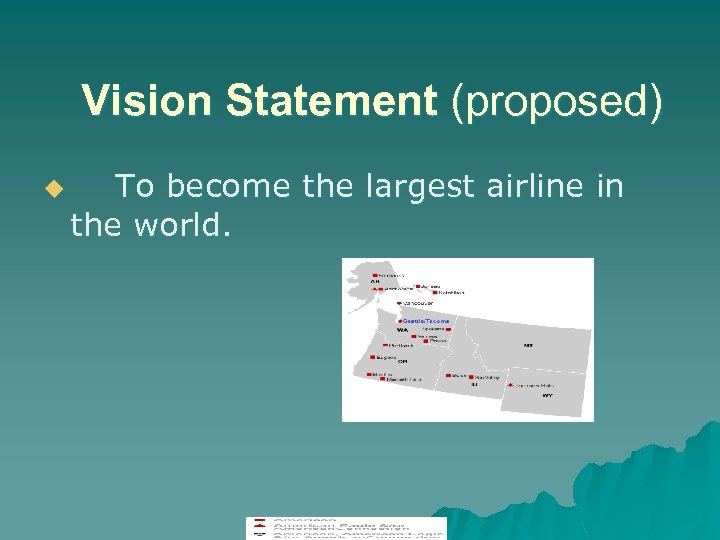
Vision Statement (proposed) u To become the largest airline in the world.
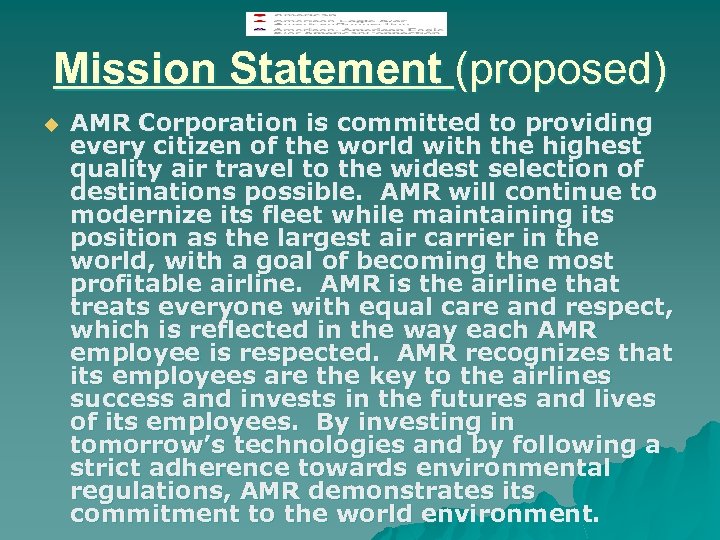
Mission Statement (proposed) u AMR Corporation is committed to providing every citizen of the world with the highest quality air travel to the widest selection of destinations possible. AMR will continue to modernize its fleet while maintaining its position as the largest air carrier in the world, with a goal of becoming the most profitable airline. AMR is the airline that treats everyone with equal care and respect, which is reflected in the way each AMR employee is respected. AMR recognizes that its employees are the key to the airlines success and invests in the futures and lives of its employees. By investing in tomorrow’s technologies and by following a strict adherence towards environmental regulations, AMR demonstrates its commitment to the world environment.
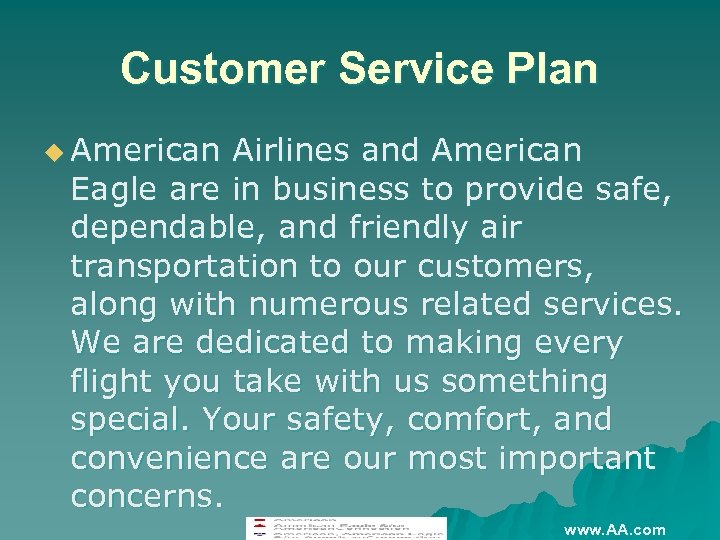
Customer Service Plan u American Airlines and American Eagle are in business to provide safe, dependable, and friendly air transportation to our customers, along with numerous related services. We are dedicated to making every flight you take with us something special. Your safety, comfort, and convenience are our most important concerns. www. AA. com

See Our New Campaign, We Know Why You Fly. www. AA. com
Our Planes… § § § Airbus A 300 -600 Boeing MD-80(S 80) Boeing 737 -800 Boeing 757 Boeing 767 Boeing 777 www. AA. com
Our Planes… § § § ATR 72 - Super ATR Bombardier CRJ-700 ERJ-145 ERJ-140 ERJ-135 SAAB 340 B www. AA. com
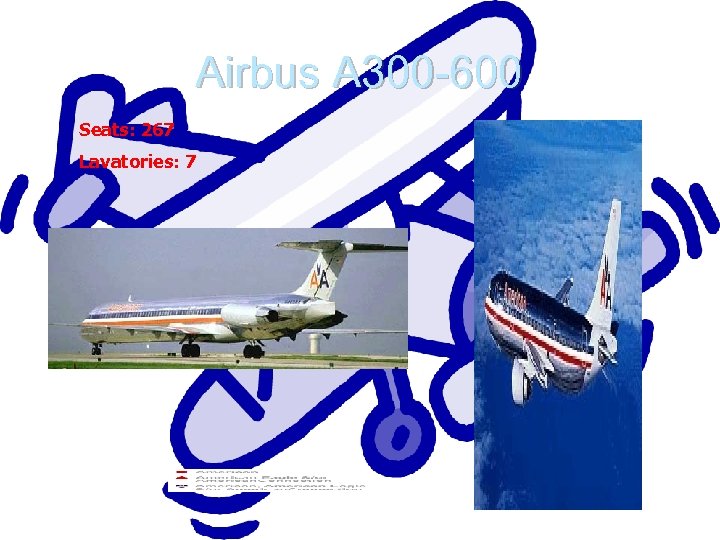
Airbus A 300 -600 Seats: 267 Lavatories: 7 www. AA. com
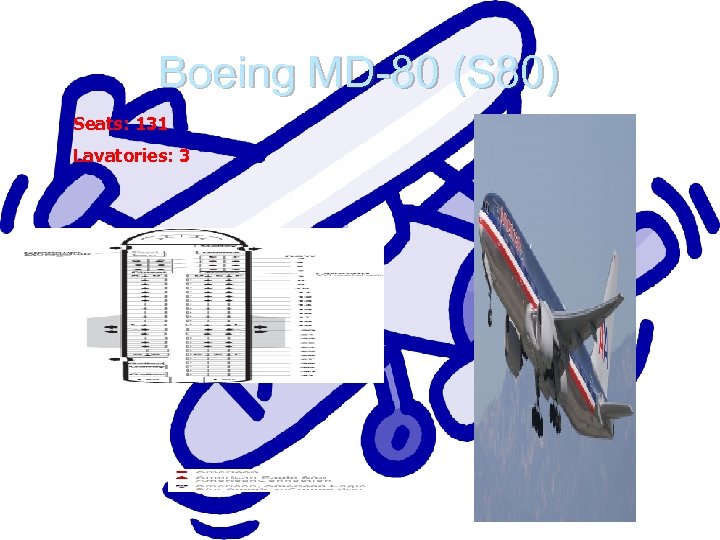
Boeing MD-80 (S 80) Seats: 131 Lavatories: 3 www. AA. com
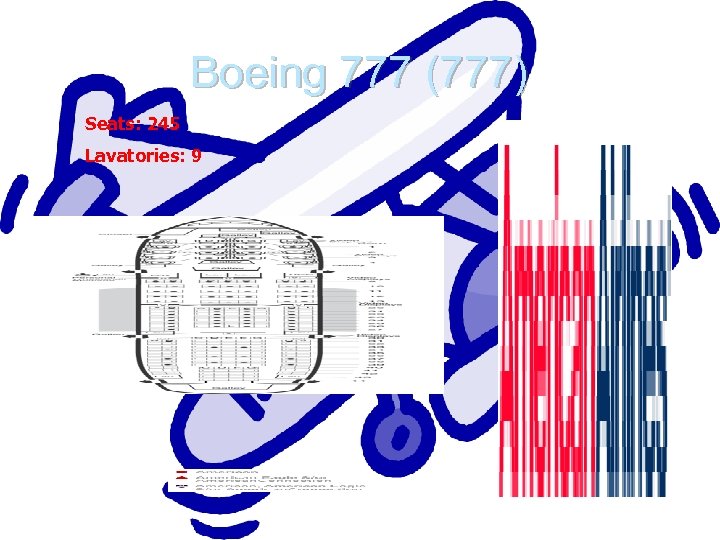
Boeing 777 (777) Seats: 245 Lavatories: 9 www. AA. com

Where we fly…
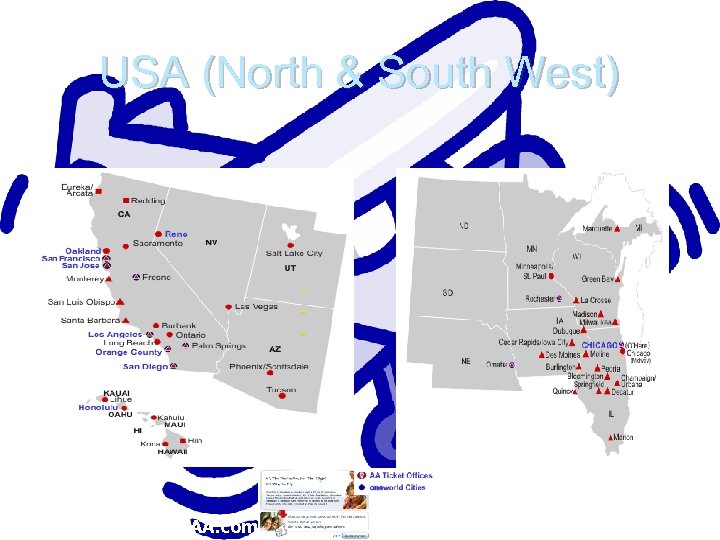
USA (North & South West) All Maps from www. AA. com
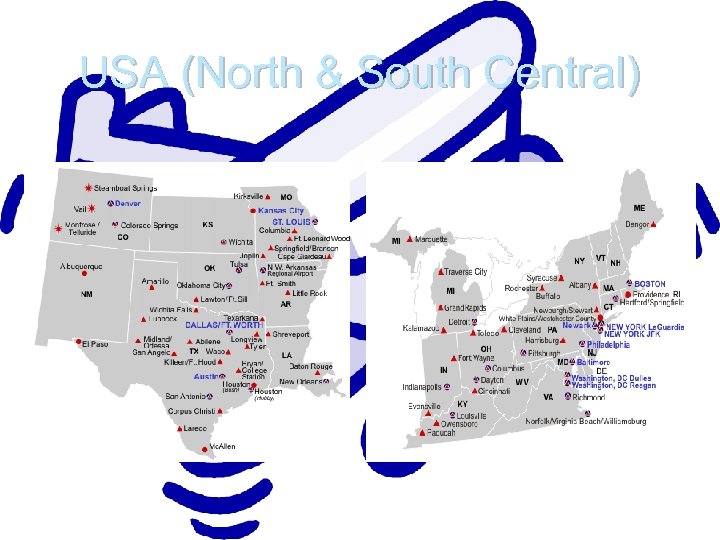
USA (North & South Central)
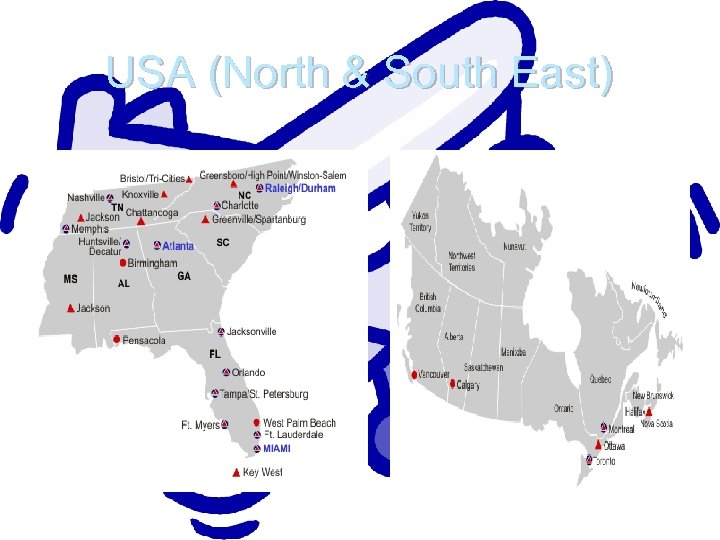
USA (North & South East)
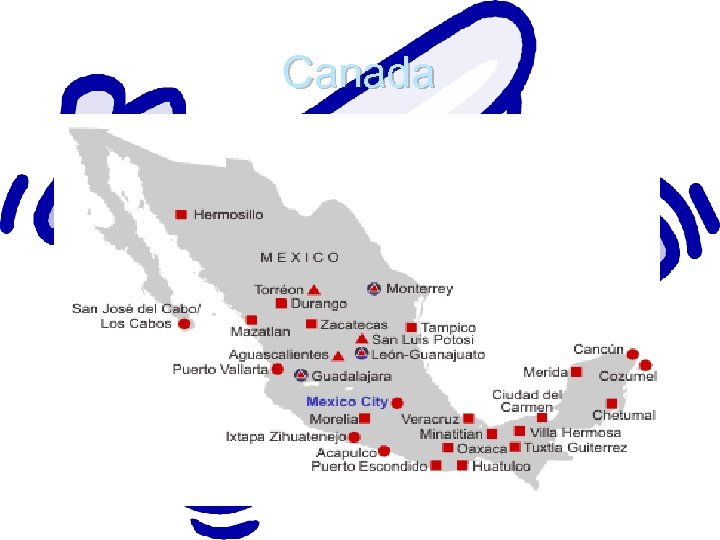
Canada
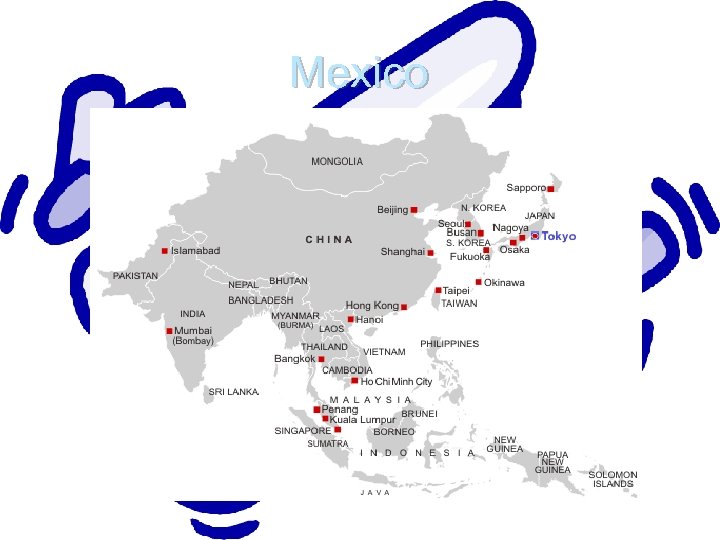
Mexico
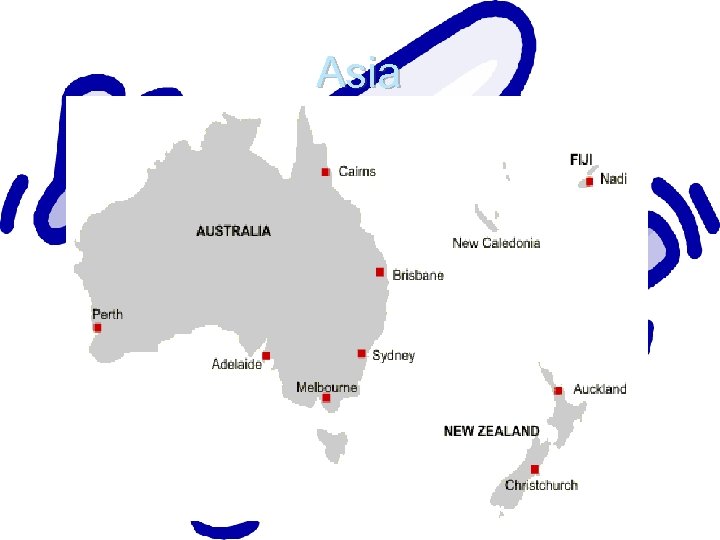
Asia
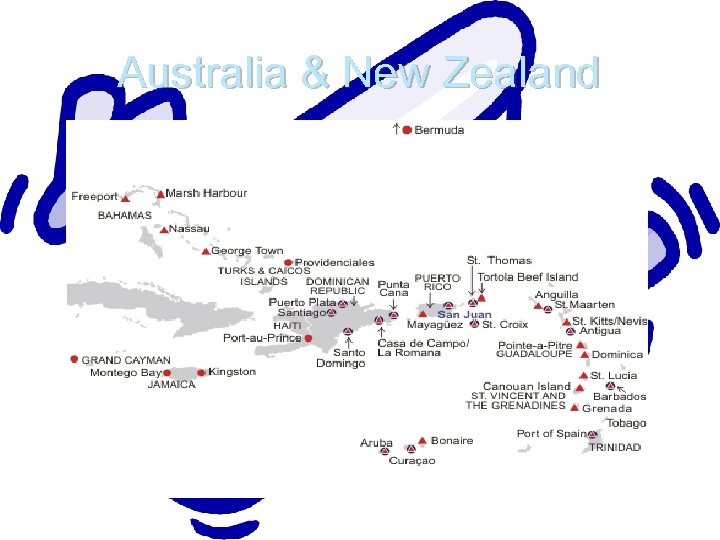
Australia & New Zealand
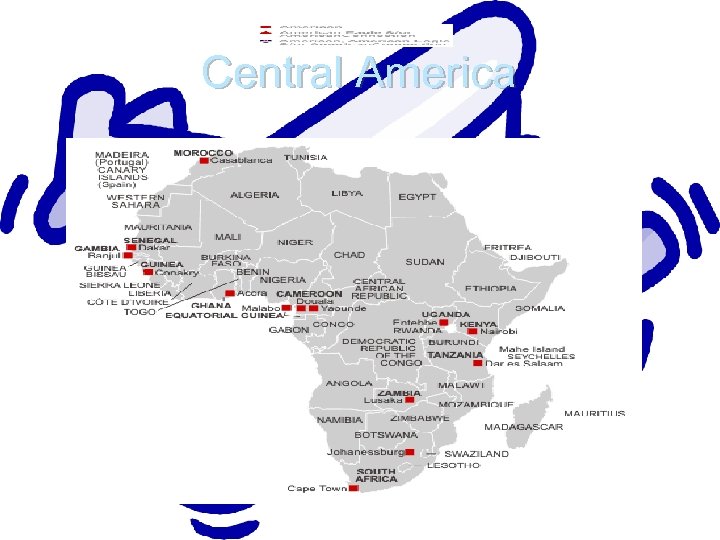
Central America
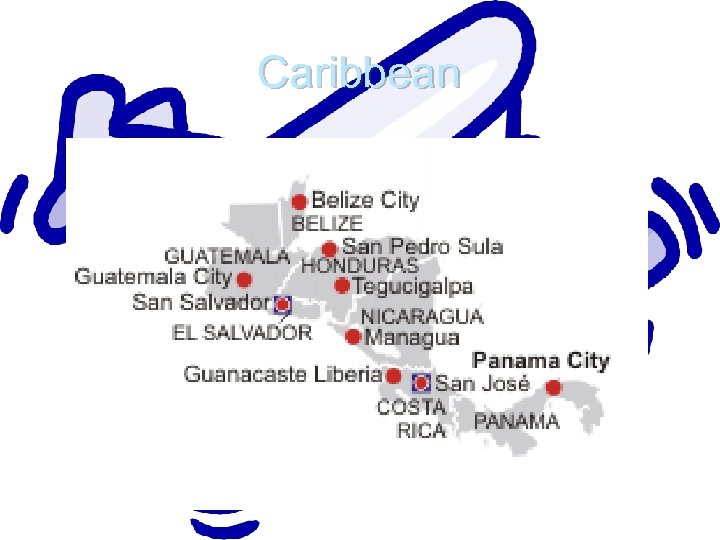
Caribbean
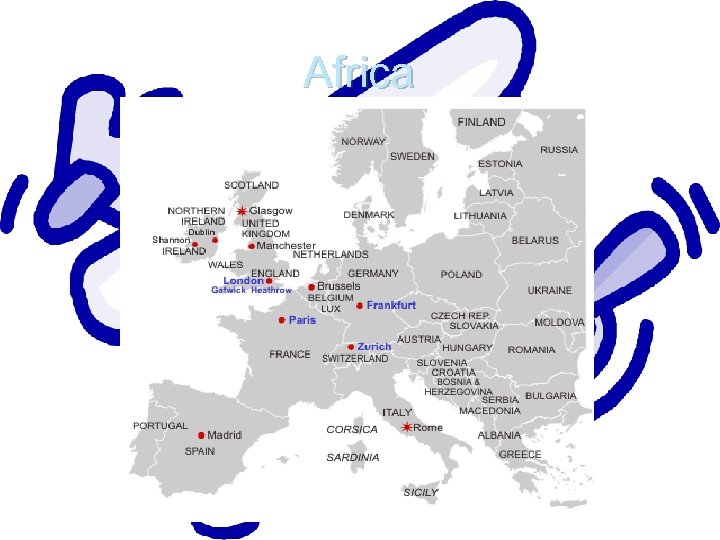
Africa
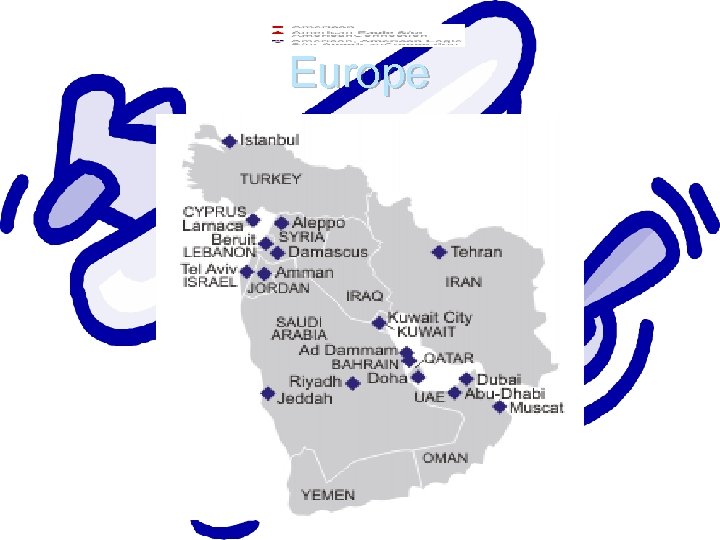
Europe
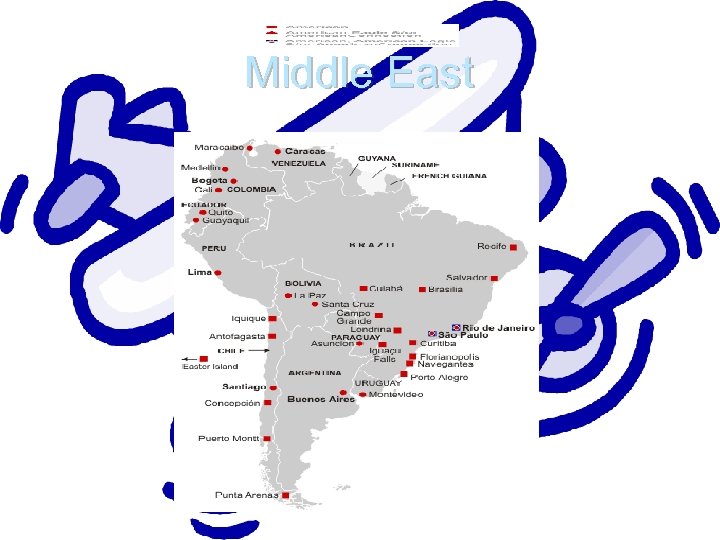
Middle East
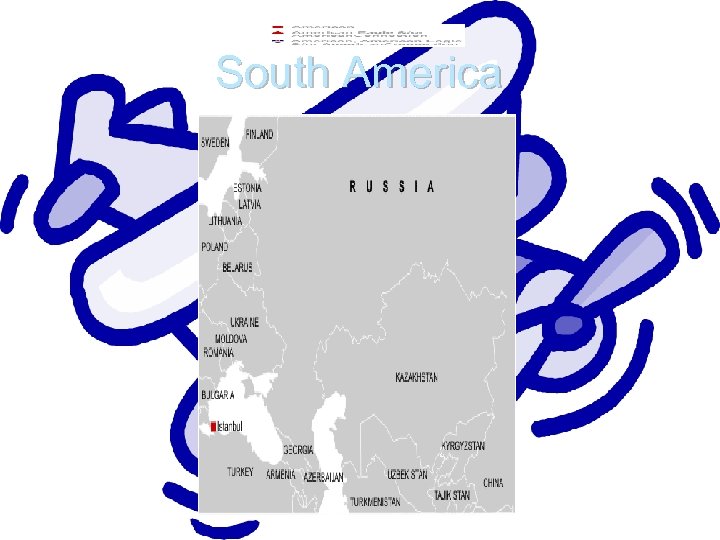
South America

Eurasia
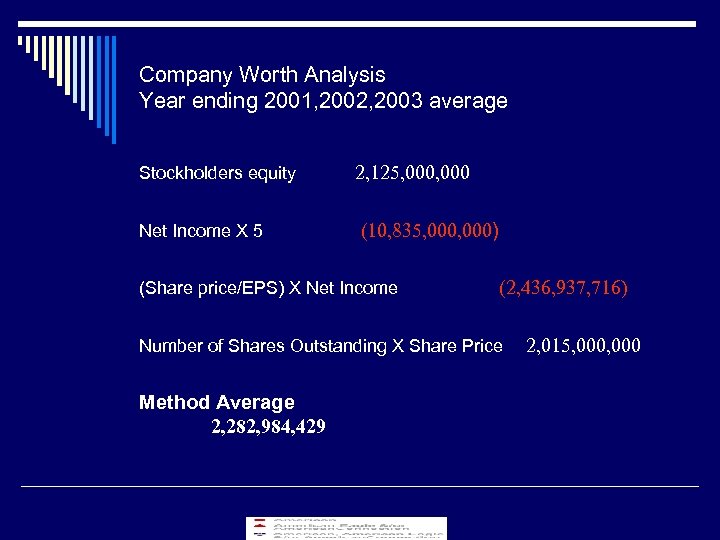
Company Worth Analysis Year ending 2001, 2002, 2003 average Stockholders equity 2, 125, 000 Net Income X 5 (10, 835, 000) (Share price/EPS) X Net Income (2, 436, 937, 716) Number of Shares Outstanding X Share Price 2, 015, 000 Method Average 2, 282, 984, 429
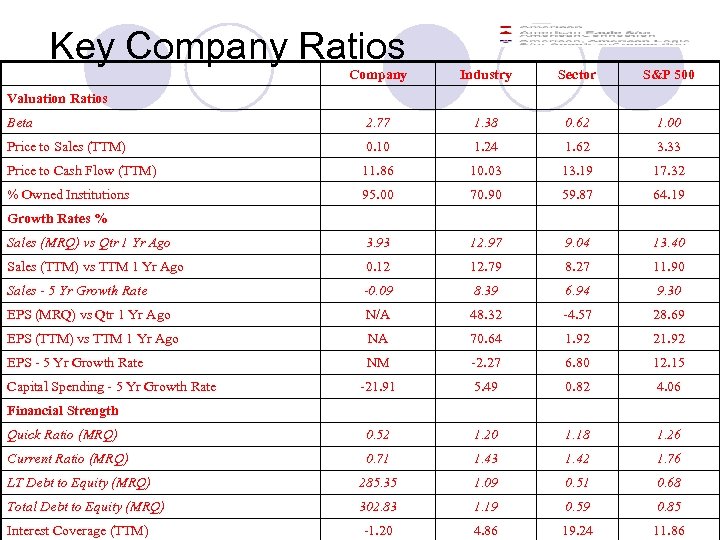
Key Company Ratios Company Industry Sector S&P 500 Beta 2. 77 1. 38 0. 62 1. 00 Price to Sales (TTM) 0. 10 1. 24 1. 62 3. 33 Price to Cash Flow (TTM) 11. 86 10. 03 13. 19 17. 32 % Owned Institutions 95. 00 70. 90 59. 87 64. 19 Sales (MRQ) vs Qtr 1 Yr Ago 3. 93 12. 97 9. 04 13. 40 Sales (TTM) vs TTM 1 Yr Ago 0. 12 12. 79 8. 27 11. 90 Sales - 5 Yr Growth Rate -0. 09 8. 39 6. 94 9. 30 EPS (MRQ) vs Qtr 1 Yr Ago N/A 48. 32 -4. 57 28. 69 EPS (TTM) vs TTM 1 Yr Ago NA 70. 64 1. 92 21. 92 EPS - 5 Yr Growth Rate NM -2. 27 6. 80 12. 15 -21. 91 5. 49 0. 82 4. 06 Quick Ratio (MRQ) 0. 52 1. 20 1. 18 1. 26 Current Ratio (MRQ) 0. 71 1. 43 1. 42 1. 76 LT Debt to Equity (MRQ) 285. 35 1. 09 0. 51 0. 68 Total Debt to Equity (MRQ) 302. 83 1. 19 0. 59 0. 85 -1. 20 4. 86 19. 24 11. 86 Valuation Ratios Growth Rates % Capital Spending - 5 Yr Growth Rate Financial Strength Interest Coverage (TTM)
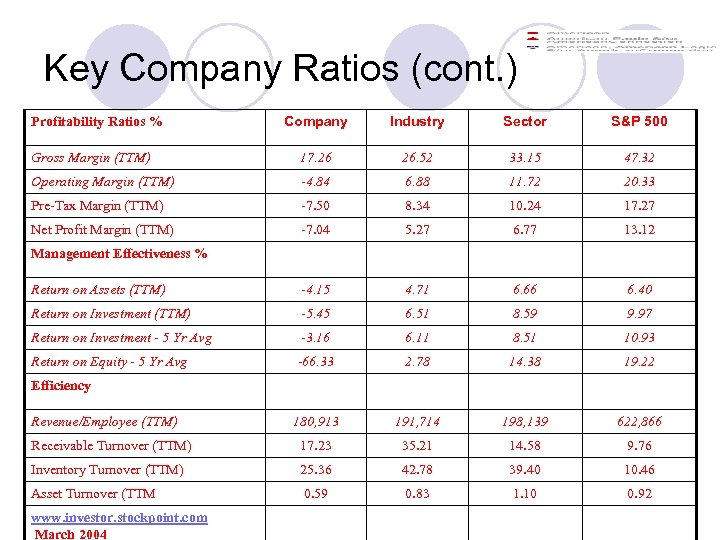
Key Company Ratios (cont. ) Company Industry Sector S&P 500 Gross Margin (TTM) 17. 26 26. 52 33. 15 47. 32 Operating Margin (TTM) -4. 84 6. 88 11. 72 20. 33 Pre-Tax Margin (TTM) -7. 50 8. 34 10. 24 17. 27 Net Profit Margin (TTM) -7. 04 5. 27 6. 77 13. 12 Return on Assets (TTM) -4. 15 4. 71 6. 66 6. 40 Return on Investment (TTM) -5. 45 6. 51 8. 59 9. 97 Return on Investment - 5 Yr Avg -3. 16 6. 11 8. 51 10. 93 Return on Equity - 5 Yr Avg -66. 33 2. 78 14. 38 19. 22 180, 913 191, 714 198, 139 622, 866 Receivable Turnover (TTM) 17. 23 35. 21 14. 58 9. 76 Inventory Turnover (TTM) 25. 36 42. 78 39. 40 10. 46 Asset Turnover (TTM 0. 59 0. 83 1. 10 0. 92 Profitability Ratios % Management Effectiveness % Efficiency Revenue/Employee (TTM) www. investor. stockpoint. com March 2004
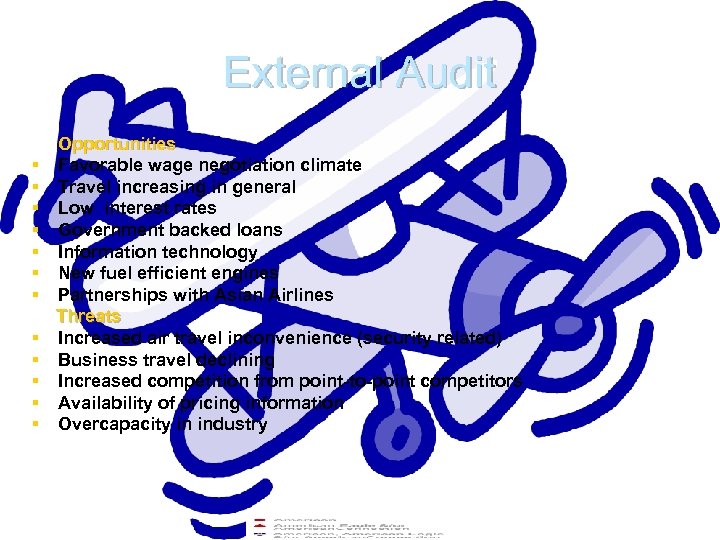
External Audit Opportunities § Favorable wage negotiation climate § Travel increasing in general § Low interest rates § Government backed loans § Information technology § New fuel efficient engines § Partnerships with Asian Airlines Threats § Increased air travel inconvenience (security related) § Business travel declining § Increased competition from point-to-point competitors § Availability of pricing information § Overcapacity in industry
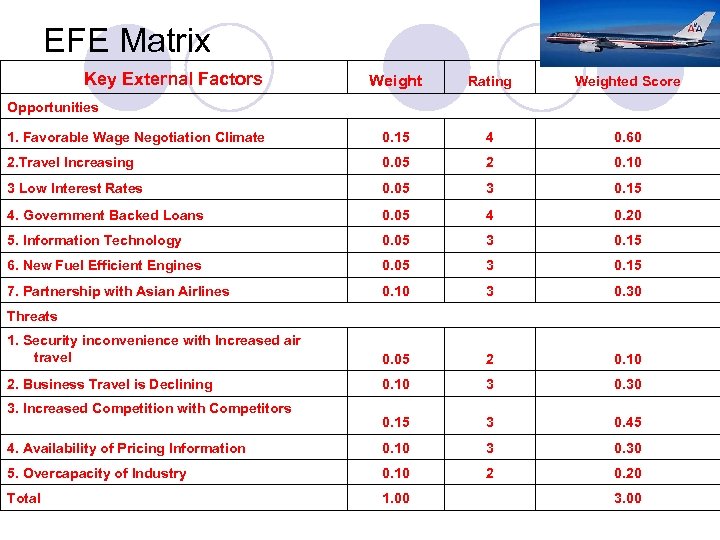
EFE Matrix Key External Factors Weight Rating Weighted Score 1. Favorable Wage Negotiation Climate 0. 15 4 0. 60 2. Travel Increasing 0. 05 2 0. 10 3 Low Interest Rates 0. 05 3 0. 15 4. Government Backed Loans 0. 05 4 0. 20 5. Information Technology 0. 05 3 0. 15 6. New Fuel Efficient Engines 0. 05 3 0. 15 7. Partnership with Asian Airlines 0. 10 3 0. 30 1. Security inconvenience with Increased air travel 0. 05 2 0. 10 2. Business Travel is Declining 0. 10 3 0. 30 0. 15 3 0. 45 4. Availability of Pricing Information 0. 10 3 0. 30 5. Overcapacity of Industry 0. 10 2 0. 20 Total 1. 00 3. 00 Opportunities Threats 3. Increased Competition with Competitors
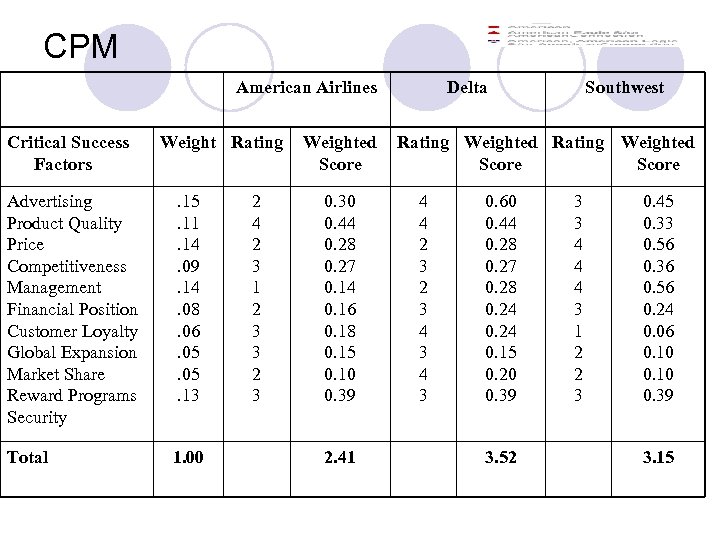
CPM American Airlines Critical Success Factors Weight Rating Advertising Product Quality Price Competitiveness Management Financial Position Customer Loyalty Global Expansion Market Share Reward Programs Security . 15. 11. 14. 09. 14. 08. 06. 05. 13 Total 1. 00 2 4 2 3 1 2 3 3 2 3 Weighted Score 0. 30 0. 44 0. 28 0. 27 0. 14 0. 16 0. 18 0. 15 0. 10 0. 39 2. 41 Delta Southwest Rating Weighted Score 4 4 2 3 4 3 0. 60 0. 44 0. 28 0. 27 0. 28 0. 24 0. 15 0. 20 0. 39 3. 52 3 3 4 4 4 3 1 2 2 3 0. 45 0. 33 0. 56 0. 36 0. 56 0. 24 0. 06 0. 10 0. 39 3. 15
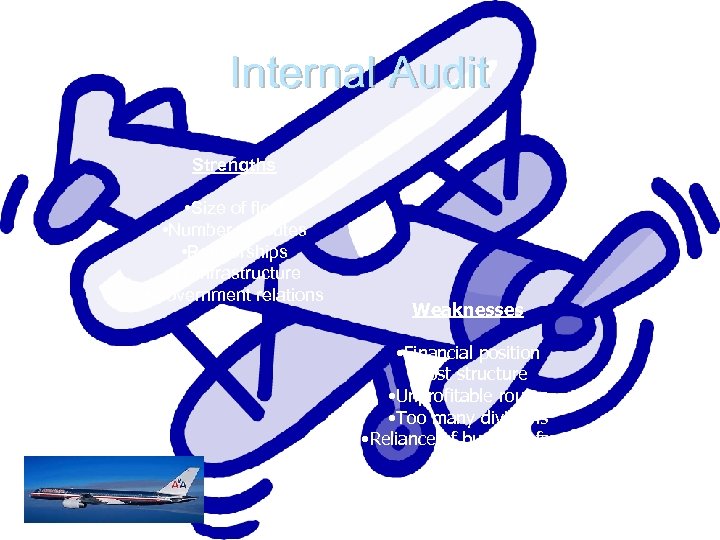
Internal Audit Strengths • Size of fleet • Number of routes • Partnerships • IT infrastructure • Government relations Weaknesses • Financial position • Cost structure • Unprofitable routes • Too many divisions • Reliance of business fares
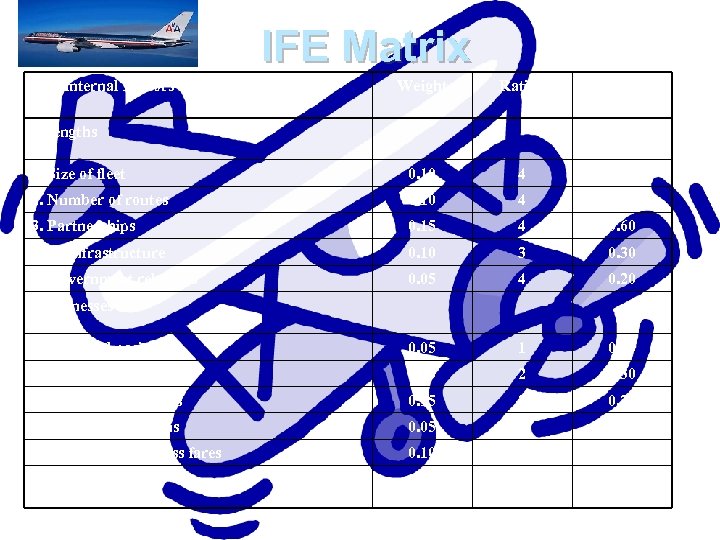
IFE Matrix Key Internal Factors Weight Rating Weighted Score 1. Size of fleet 0. 10 4 0. 40 2. Number of routes 0. 10 4 0. 40 3. Partnerships 0. 15 4 0. 60 4. IT infrastructure 0. 10 3 0. 30 5. Government relations 0. 05 4 0. 20 1. Financial position 0. 05 1 0. 05 2. Cost structure 0. 15 2 0. 30 3. Unprofitable routes 0. 15 2 0. 30 4. Too many divisions 0. 05 1 0. 05 5. Reliance of business fares 0. 10 2 0. 20 TOTAL 1. 00 Strengths Weaknesses 2. 80
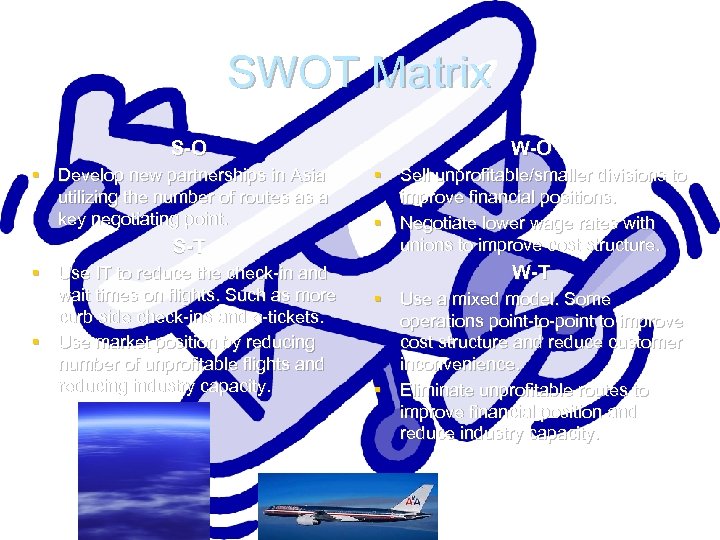
SWOT Matrix S-O § Develop new partnerships in Asia utilizing the number of routes as a key negotiating point. S-T § Use IT to reduce the check-in and wait times on flights. Such as more curb side check-ins and e-tickets. § Use market position by reducing number of unprofitable flights and reducing industry capacity. W-O § Sell unprofitable/smaller divisions to improve financial positions. § Negotiate lower wage rates with unions to improve cost structure. W-T § Use a mixed model. Some operations point-to-point to improve cost structure and reduce customer inconvenience. § Eliminate unprofitable routes to improve financial position and reduce industry capacity.
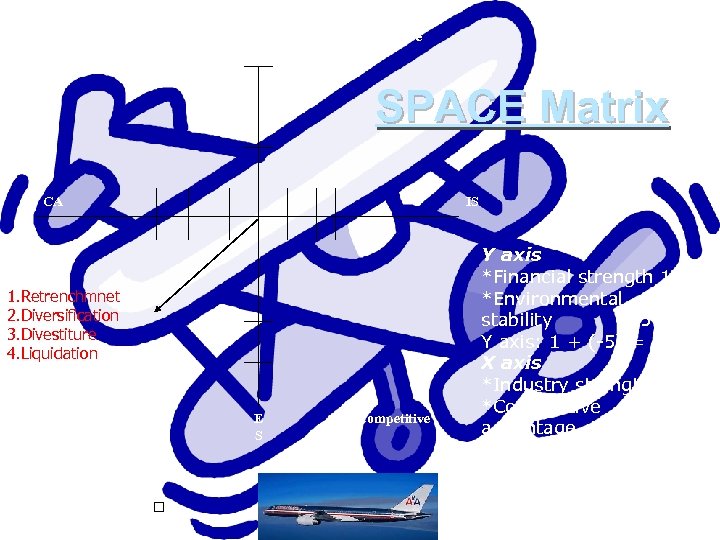
Conservative F S Aggressive SPACE Matrix CA IS 1. Retrenchmnet 2. Diversification 3. Divestiture 4. Liquidation Defensive E S Competitive Y axis *Financial strength 1 *Environmental stability -5 Y axis: 1 + (-5) = -3 X axis *Industry strength 2 *Competitive advantage -5 X axis: 2 + (-5) = -3
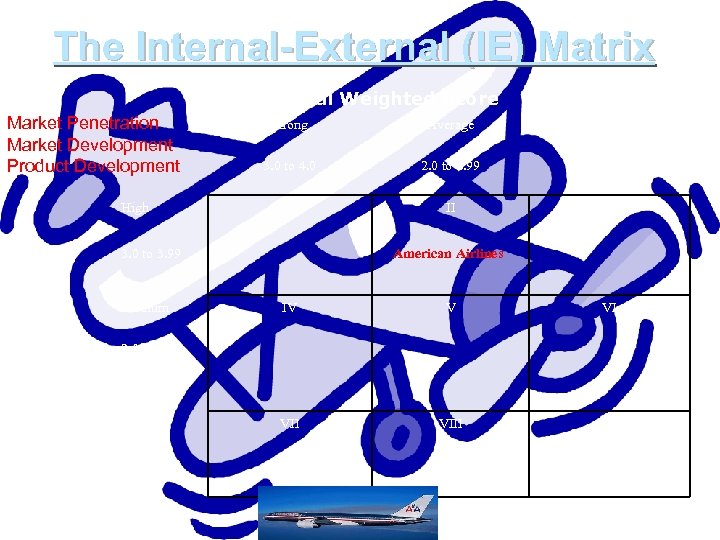
The Internal-External (IE) Matrix The IFE Total Weighted Score Market Penetration Market Development Product Development High Strong Average Weak 3. 0 to 4. 0 2. 0 to 2. 99 1. 0 to 1. 99 I II III 3. 0 to 3. 99 Medium The EFE Total Weighted Score American Airlines IV V VI VIII IX 2. 0 to 2. 99 Low 1. 0 to 1. 99
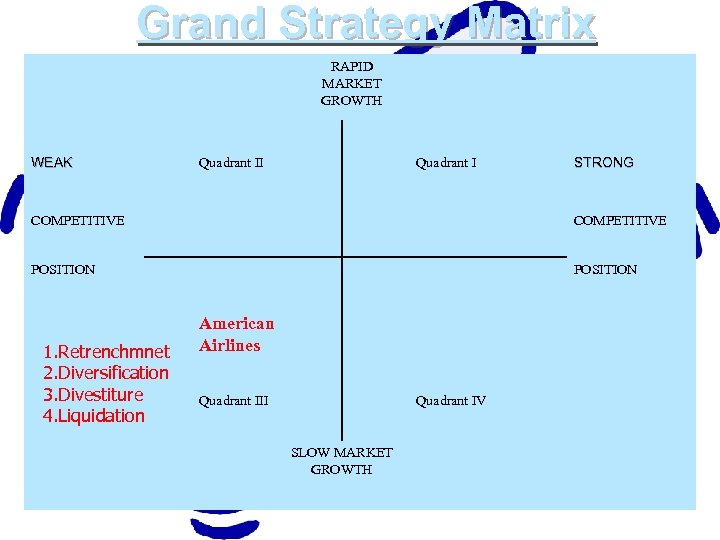
Grand Strategy Matrix RAPID MARKET GROWTH WEAK Quadrant II Quadrant I STRONG COMPETITIVE POSITION 1. Retrenchmnet 2. Diversification 3. Divestiture 4. Liquidation American Airlines Quadrant III Quadrant IV SLOW MARKET GROWTH
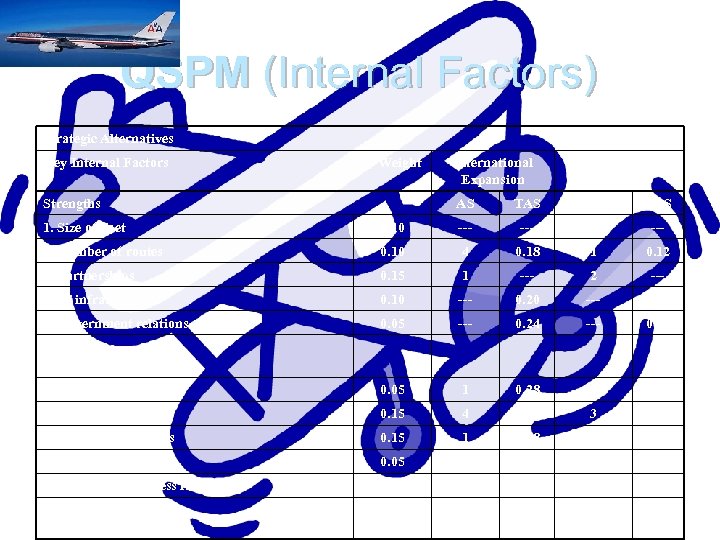
QSPM (Internal Factors) Strategic Alternatives Key Internal Factors Weight Domestic Expansion AS Strengths International Expansion TAS AS TAS 1. Size of fleet 0. 10 --- --- 2. Number of routes 0. 10 4 0. 18 1 0. 12 3. Partnerships 0. 15 1 --- 2 --- 4. IT infrastructure 0. 10 --- 0. 20 5. Government relations 0. 05 --- 0. 24 --- 0. 18 1. Financial position 0. 05 1 0. 28 3 0. 07 2. Cost structure 0. 15 4 0. 12 3 0. 18 3. Unprofitable routes 0. 15 1 0. 08 4 0. 12 4. Too many divisions 0. 05 --- --- 5. Reliance of business fares 0. 10 --- --- SUBTOTAL 1. 00 Weaknesses 1. 35 1. 60
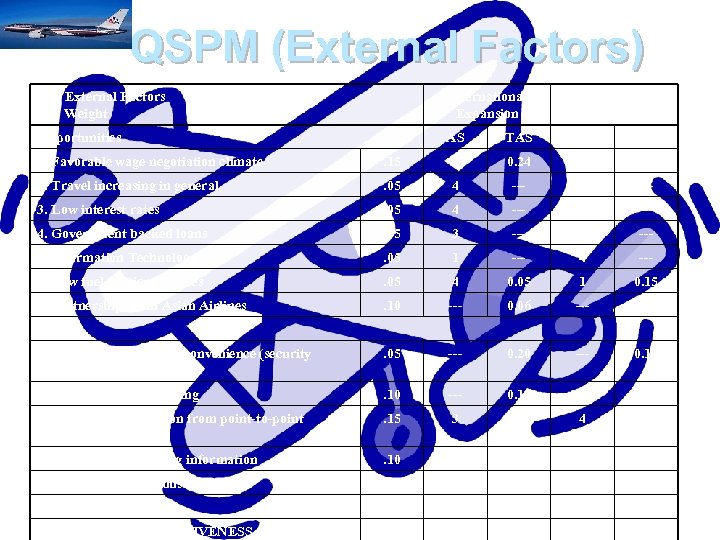
QSPM (External Factors) Key External Factors Weight International Expansion Domestic Expansion Opportunities AS TAS 1. Favorable wage negotiation climate . 15 --- 0. 24 2. Travel increasing in general . 05 4 --- 1 --- 3. Low interest rates . 05 4 --- 1 --- 4. Government backed loans . 05 3 --- 1 --- 5. Information Technology . 05 1 --- 4 --- 6. New fuel efficient engines . 05 4 0. 05 1 0. 15 7. Partnerships with Asian Airlines . 10 --- 0. 06 --- 0. 03 1. Increased air travel inconvenience (security related) . 05 --- 0. 20 --- 0. 15 2. Business travel declining . 10 --- 0. 16 --- 0. 08 3. Increased competition from point-to-point competitors . 15 3 0. 08 4. Availability of pricing information . 10 3 --- 5. Overcapacity in industry . 10 1 --- 4 --- SUBTOTAL 1. 00 Threats SUM TOTAL ATTRACTIVENESS SCORE 1. 65 1. 70 3. 00 3. 30
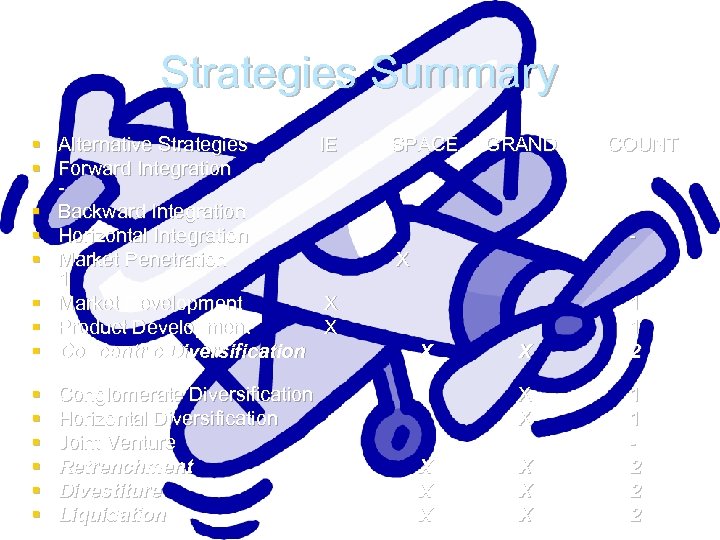
Strategies Summary § Alternative Strategies IE SPACE GRAND COUNT § Forward Integration § Backward Integration § Horizontal Integration § Market Penetration X 1 § Market Development X 1 § Product Development X 1 § Concentric Diversification X X 2 § Conglomerate Diversification X 1 § Horizontal Diversification X 1 § Joint Venture - § Retrenchment X X 2 § Divestiture X X 2 § Liquidation X X 2
? ? Which Strategies? ? § Concentric Diversification which is the addition of new but related product, may be something that AMR would want to look into. They could add something to attract new customers too their company. § Another option they could look into in Retrenchment. This is the regrouping by reducing costs and assets. (This option is already being explored). § AMR may also want to think about Divestiture, selling its American Eagle division. § If these strategies do not work, AMR’s last option is Liquidation. With the financial trouble that AMR has been having, this may be the only way.

Future Plans AMR plans to raise their profitability in the future. This is a much needed event in order for the company to stay in business. In order to boost their profitability, AMR is currently in the process of doing some restructuring. This restructuring includes: – Reducing Number of flights from the Dallas/Fort Worth and the O’Hare Hubs. – In 2003, 27, 000 employees were laid off and more will be needed to keep the company alive. – Retiring older aircrafts that are too expensive to keep running. AMR also needs to start getting rid of some of its least profitable routes, this will simplify their program and eliminate the spending of money to fly on them. Text Book: Strategic Management Author: Fred R. David
News Releases u March 30 | American Airlines Cargo Division Announces Increase in Fuel Surcharge u March 29 | American Airlines to Resume Seasonal Nonstop Service From New York to Rome on April 3 u March 28 | Sizzlin' Summer Travel Deals - Get 'Em While They're Hot u March 28 | New Online Program Lets American Airlines AAdvantage Members Redeem Miles for Hotel Stays and More
Скачать презентацию Amy Kakuk Beth Theriault and Jessica Bourgoin All
c5840a9d1f803160800883308568e7a4.ppt