


 Скачать презентацию Amsterdam July 2017 ANI Training DAY 1
a88cd49055178e42dccc3718bb8021c4.ppt
- Количество слайдов: 36
 Amsterdam, July 2017 ANI Training
 DAY 1 Welcome!
 Introduction • • Who are we? Learning outcomes Programme Code of conduct Your objective for this course Let’s get to know each other Your pre-course assignments
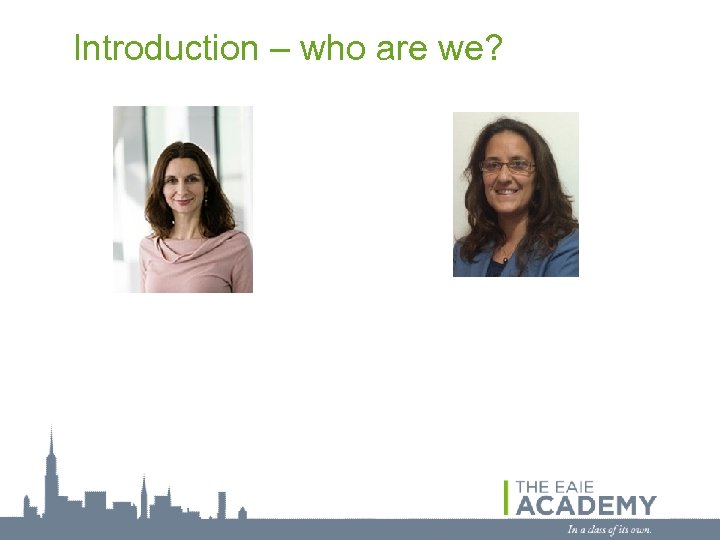 Introduction – who are we?
 Programme
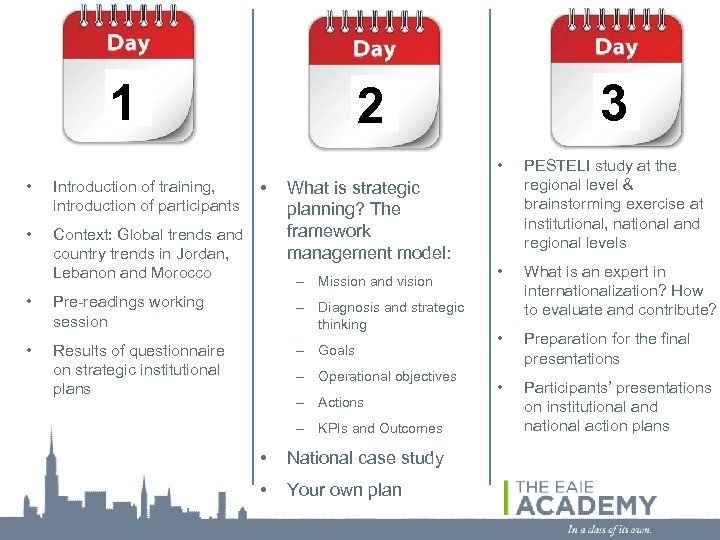 1 3 2 • • Introduction of training, introduction of participants • Context: Global trends and country trends in Jordan, Lebanon and Morocco • What is strategic planning? The framework management model: – Mission and vision • Pre-readings working session – Diagnosis and strategic thinking • Results of questionnaire on strategic institutional plans – Goals – Operational objectives – Actions – KPIs and Outcomes • National case study • Your own plan PESTELI study at the regional level & brainstorming exercise at institutional, national and regional levels • What is an expert in internationalization? How to evaluate and contribute? • Preparation for the final presentations • Participants’ presentations on institutional and national action plans
 Detailed Programme for today
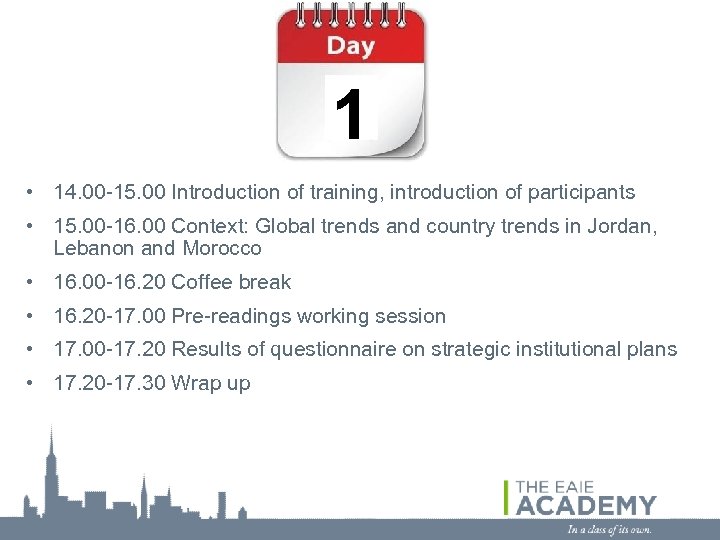 1 • 14. 00 -15. 00 Introduction of training, introduction of participants • 15. 00 -16. 00 Context: Global trends and country trends in Jordan, Lebanon and Morocco • 16. 00 -16. 20 Coffee break • 16. 20 -17. 00 Pre-readings working session • 17. 00 -17. 20 Results of questionnaire on strategic institutional plans • 17. 20 -17. 30 Wrap up
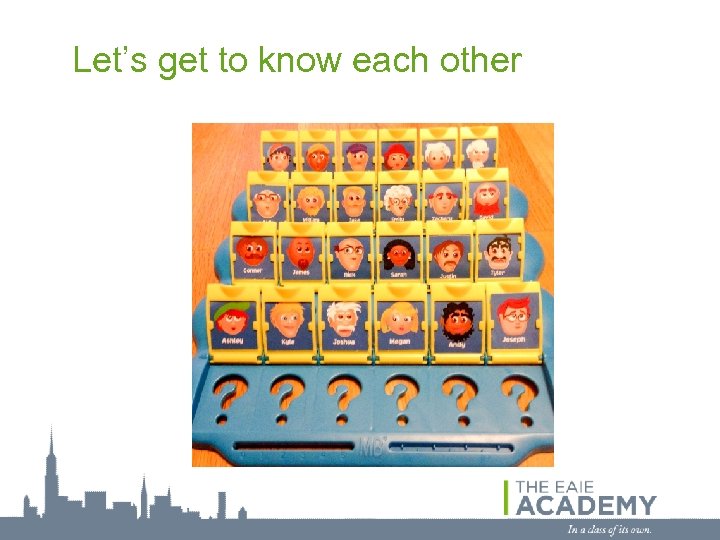 Let’s get to know each other
 Introduction – Learning outcomes At the end of the course you will have the skills to: • Identify the global trends having an influence in internationalization at institutional, regional and national level • Will have the knowledge on internationalization strategic planning and tools for effective implementation • Will be able to become part of a network of higher education experts in internationalization
 What to expect? • You can expect to know about the challenges and trends in internationalisation both globally and per partner country • You can expect to go through the different steps of the strategic planning process • You can expect to learn from peers and that largely depends on you! • And hopefully you can expect to have fun, while learning!
 What NOT to expect? • You will not have your strategic internationalisation plan at the end of this course • The network will start here but will not be created here (we are planting the seed here ) • Strategy is not a smooth process and change management is not problem-free
 Some of what you expect • • • Les compétences nécessaires pour devenir expert en internationalisation Strategic management of internationalisation. Améliorer l'enseignement et les services au sein de l'établissement Define a strategic plan that allows us to enforce organisational changes How to structure a new born IRO? Obstacles that might be triggered when academic agenda and organisational structure of the institution is required to be re-shaped as a result of integrating internationalization objectives to strategic planning. • What skills an internationalization expert should have and how these skills can be utilized to put HEIs in developing countries in the international orbit. • Je souhaiterais maîtriser les spécificités du processus d'internationalisation d'une université, sa gestion et ses outils de mise en place et sa réussite.
 Introduction – Code of conduct • Be respectful. Respect everyone’s opinion and try not to interrupt. • What is worked within the group, stays within the group (we don’t mention other universities by name outside… ) • We let everyone participate in equal timings (one does not monopolize the word) • Using phones or email outside of course hours. • Be open, participative and sports!
 Introduction – Your objective for this course
 What are the current trends in HE?
 Global trends in International Higher Education
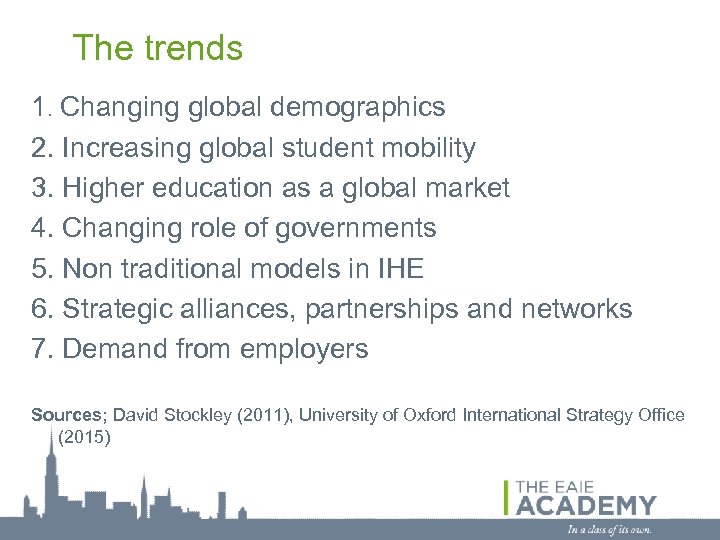 The trends 1. Changing global demographics 2. Increasing global student mobility 3. Higher education as a global market 4. Changing role of governments 5. Non traditional models in IHE 6. Strategic alliances, partnerships and networks 7. Demand from employers Sources; David Stockley (2011), University of Oxford International Strategy Office (2015)
 1. Changing global demographics Is the population in your country getting younger or older?
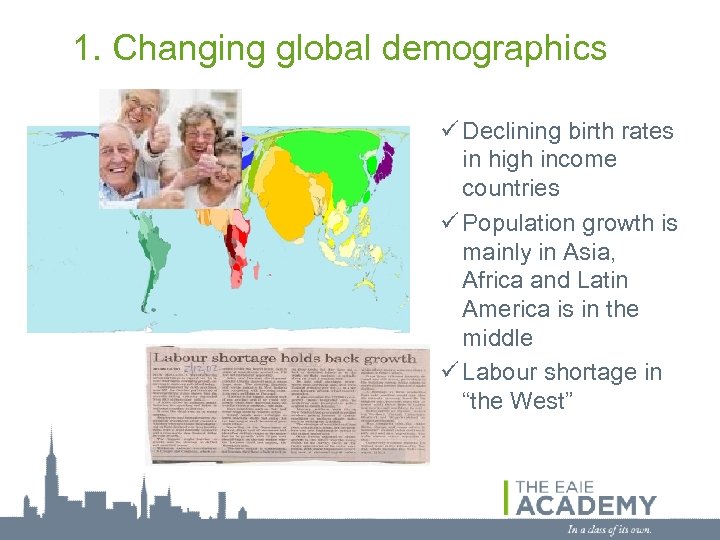 1. Changing global demographics ü Declining birth rates in high income countries ü Population growth is mainly in Asia, Africa and Latin America is in the middle ü Labour shortage in “the West”
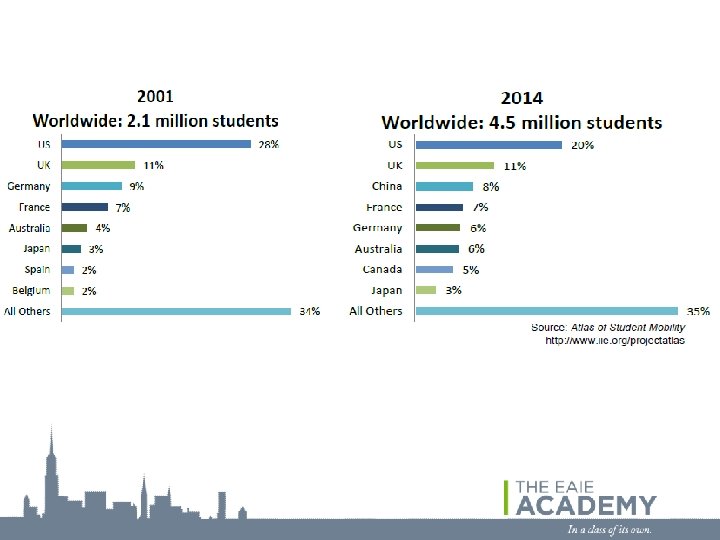
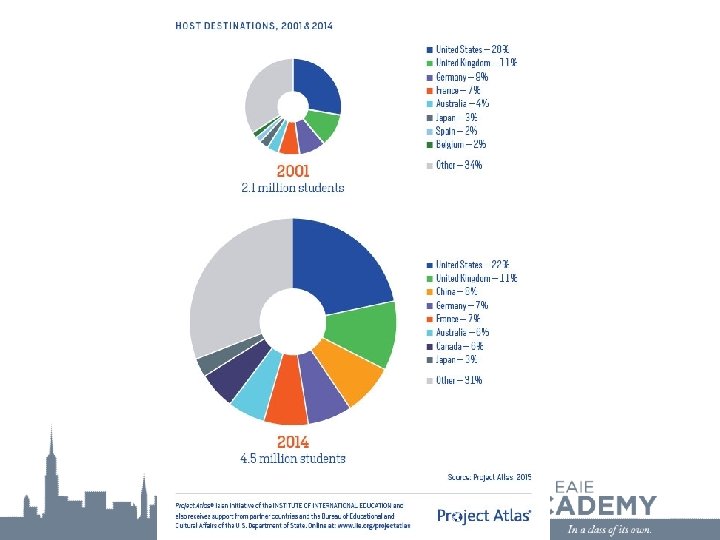
 How many international students are there worldwide?
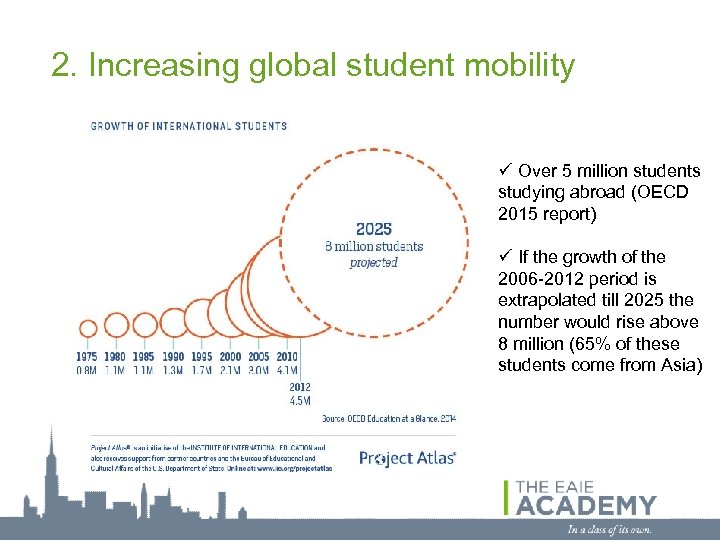 2. Increasing global student mobility ü Over 5 million students studying abroad (OECD 2015 report) ü If the growth of the 2006 -2012 period is extrapolated till 2025 the number would rise above 8 million (65% of these students come from Asia)
 Where do they go?
 Do you think there is balance in outbound and inbound exchange? Ø For your country? Ø For North America? Ø For Latin America? Ø For Asia?
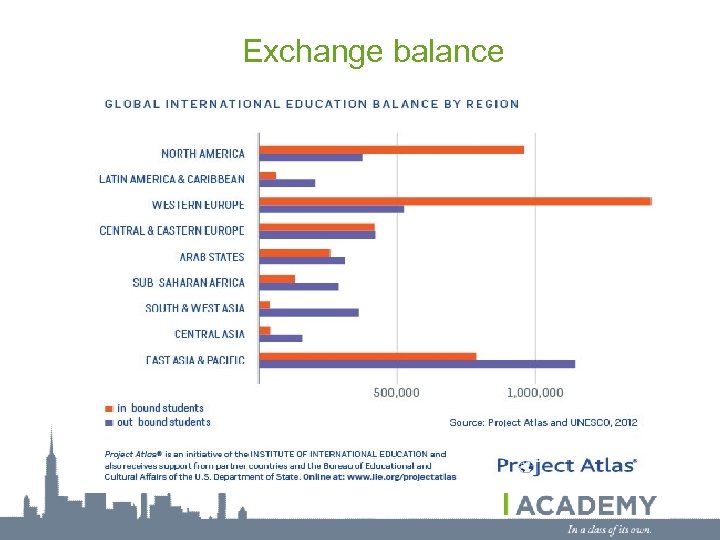 Exchange balance
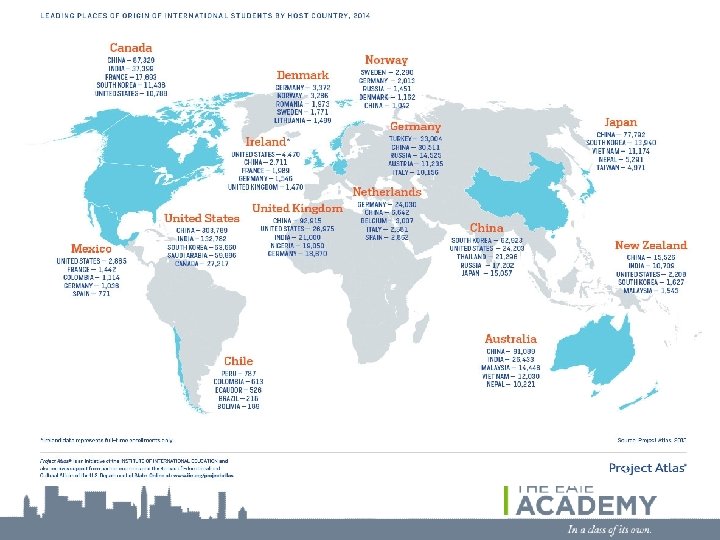
 Leading places of origin per host country ü ü ü In USA? In Australia? In Canada? In the UK? In New Zealand? In Japan? ü In China?
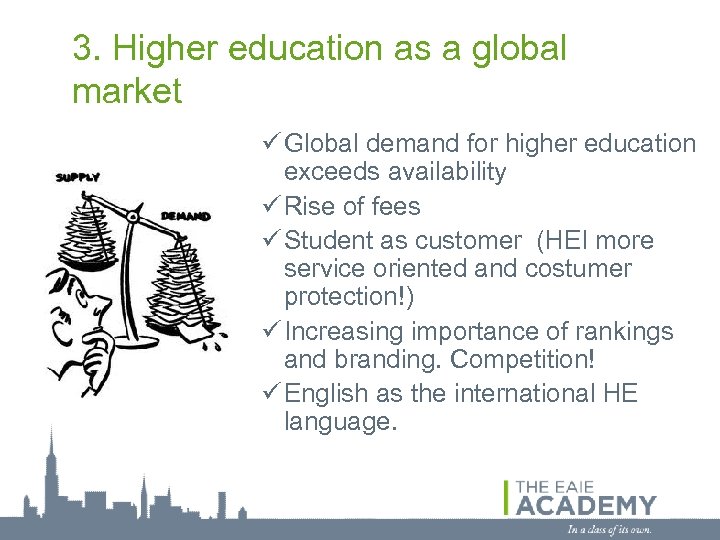 3. Higher education as a global market ü Global demand for higher education exceeds availability ü Rise of fees ü Student as customer (HEI more service oriented and costumer protection!) ü Increasing importance of rankings and branding. Competition! ü English as the international HE language.
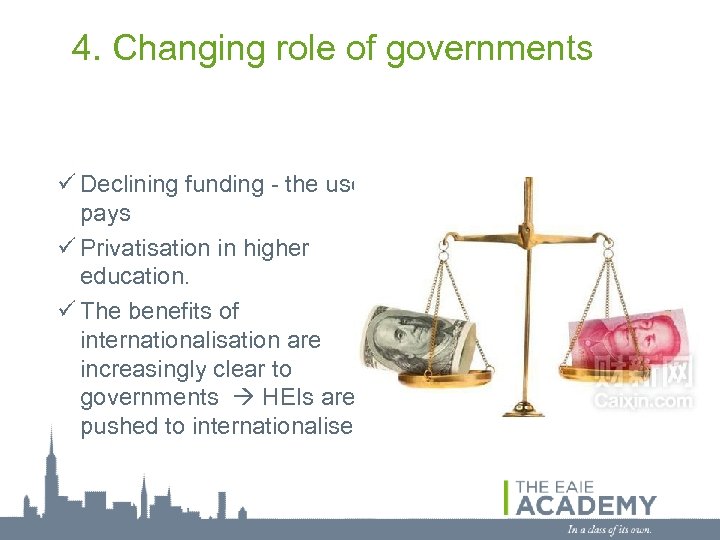 4. Changing role of governments ü Declining funding - the user pays ü Privatisation in higher education. ü The benefits of internationalisation are increasingly clear to governments HEIs are pushed to internationalise
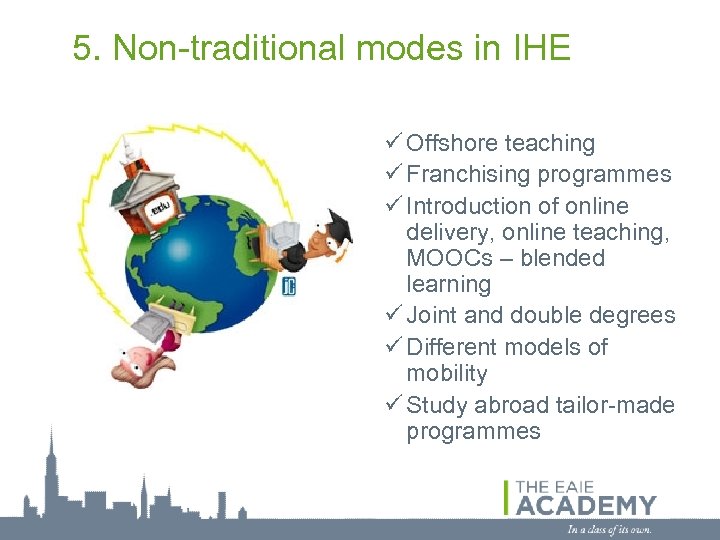 5. Non-traditional modes in IHE ü Offshore teaching ü Franchising programmes ü Introduction of online delivery, online teaching, MOOCs – blended learning ü Joint and double degrees ü Different models of mobility ü Study abroad tailor-made programmes
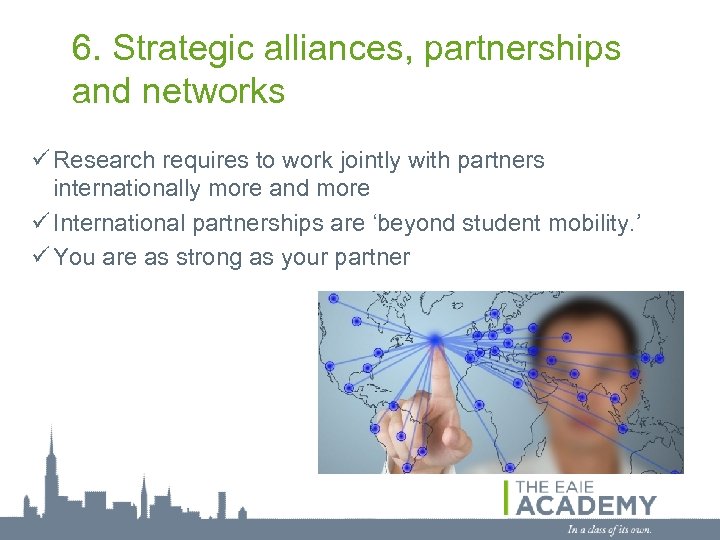 6. Strategic alliances, partnerships and networks ü Research requires to work jointly with partners internationally more and more ü International partnerships are ‘beyond student mobility. ’ ü You are as strong as your partner
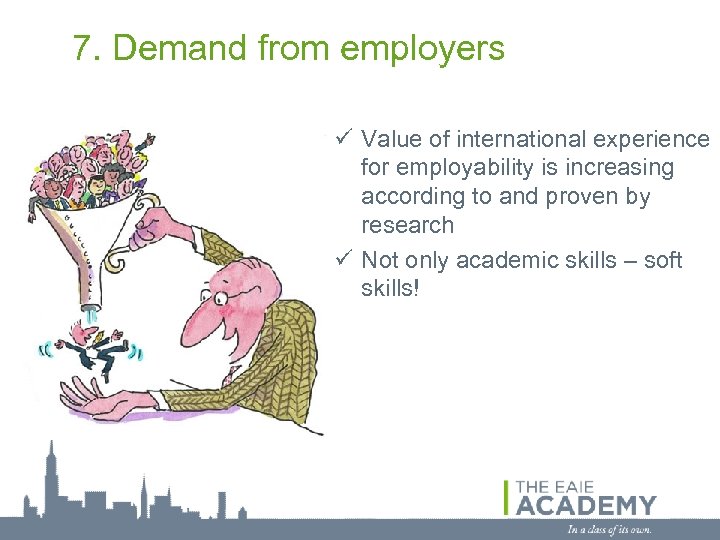 7. Demand from employers ü Value of international experience for employability is increasing according to and proven by research ü Not only academic skills – soft skills!