


 Скачать презентацию Amplification Mechanisms in Liquidity Crises Arvind Krishnamurthy Northwestern
b9ea6fd6af413d313860d1b05a51df6a.ppt
- Количество слайдов: 22
 Amplification Mechanisms in Liquidity Crises Arvind Krishnamurthy Northwestern University 1
 Amplification • Losses on Subprime Mortgages (Fall 07 est. ) – At most $500 bn • Decline in world stock market (Sep 08 to Oct 08) – Close to $26, 000 bn • Expected output losses (IMF forecast) – $4, 700 bn 2
 Amplification Mechanisms • I am going to describe two financial mechanisms that have played an important role in the crisis 1. Balance sheet amplification 2. Uncertainty amplification • I omit … – Subprime was the trigger for a real estate bubble bursting – Aggregate demand effects 3
 Liquidity model • Investors (continuum) A and B own one unit of an asset at date s • Intermediary (bank/market-maker/trading desk) provides price support at date t>s: – Promises to provide liquidity to sellers at P=1 – But, Bank has only 2 > L > 1 units of liquidity • Investors may receive shocks that require them to liquidate: – φA , φB 4
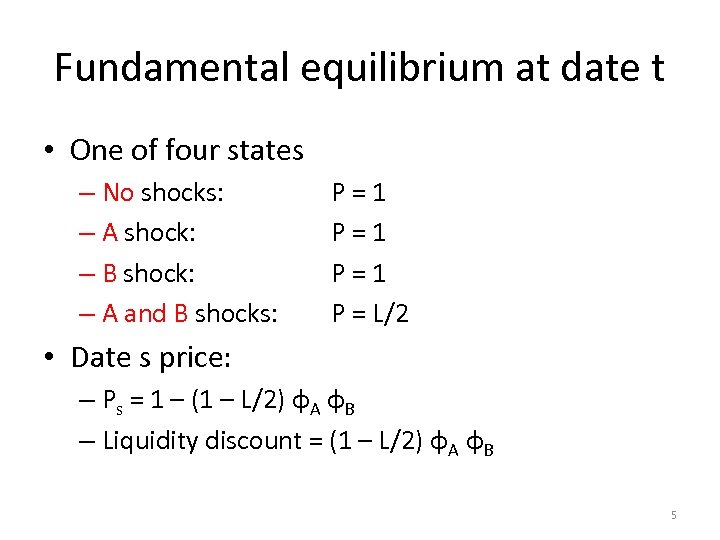 Fundamental equilibrium at date t • One of four states – No shocks: – A shock: – B shock: – A and B shocks: P=1 P=1 P = L/2 • Date s price: – Ps = 1 – (1 – L/2) φA φB – Liquidity discount = (1 – L/2) φA φB 5
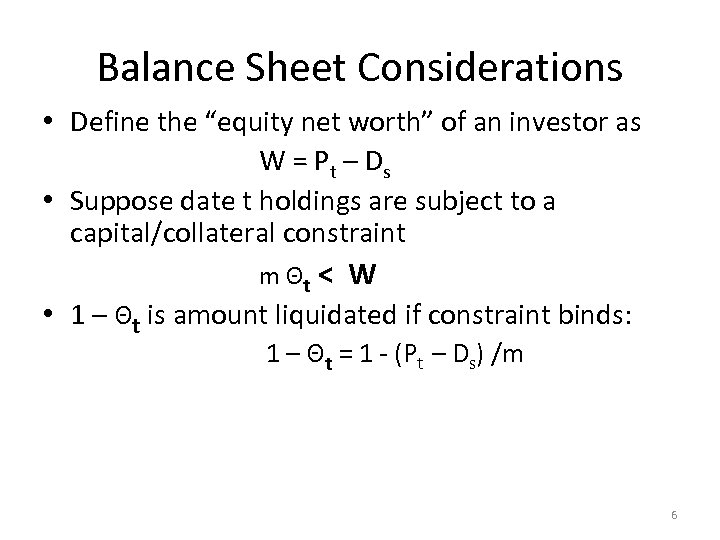 Balance Sheet Considerations • Define the “equity net worth” of an investor as W = P t – Ds • Suppose date t holdings are subject to a capital/collateral constraint m Θt < W • 1 – Θt is amount liquidated if constraint binds: 1 – Θt = 1 - (Pt – Ds) /m 6
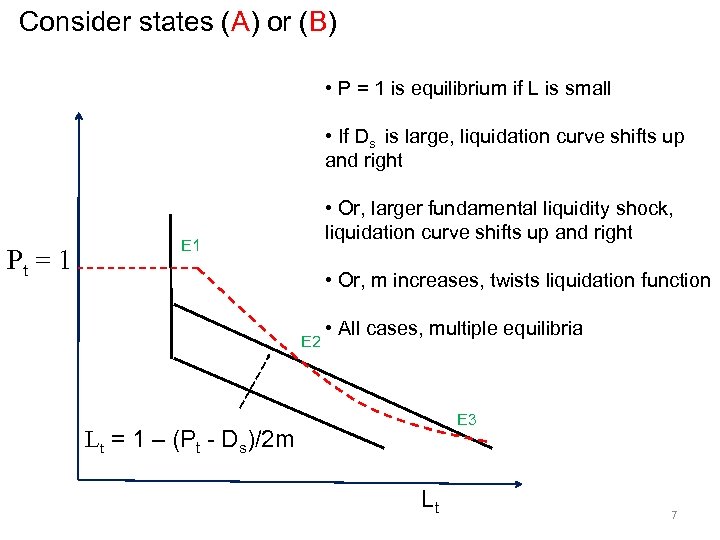 Consider states (A) or (B) • P = 1 is equilibrium if L is small • If Ds is large, liquidation curve shifts up and right Pt = 1 • Or, larger fundamental liquidity shock, liquidation curve shifts up and right E 1 • Or, m increases, twists liquidation function E 2 • All cases, multiple equilibria E 3 Lt = 1 – (Pt - Ds)/2 m Lt 7
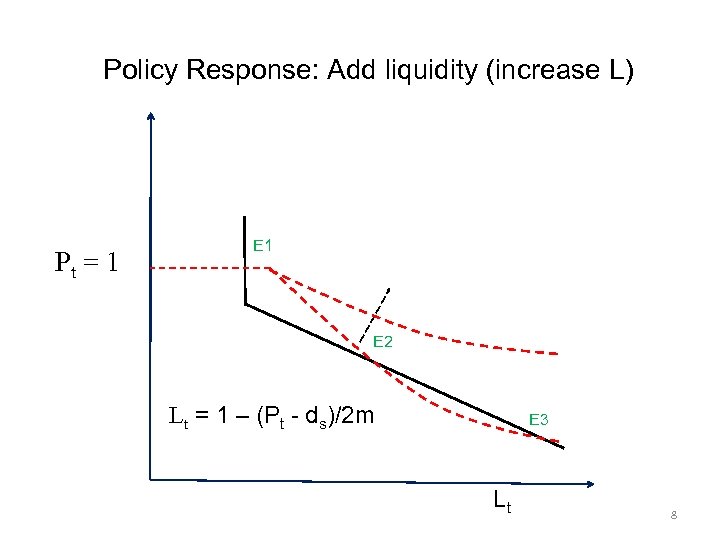 Policy Response: Add liquidity (increase L) Pt = 1 E 2 Lt = 1 – (Pt - ds)/2 m E 3 Lt 8
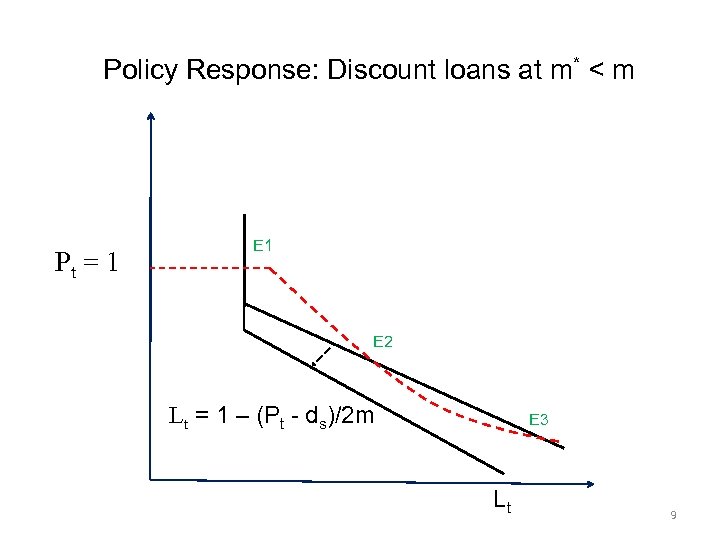 Policy Response: Discount loans at m* < m Pt = 1 E 2 Lt = 1 – (Pt - ds)/2 m E 3 Lt 9
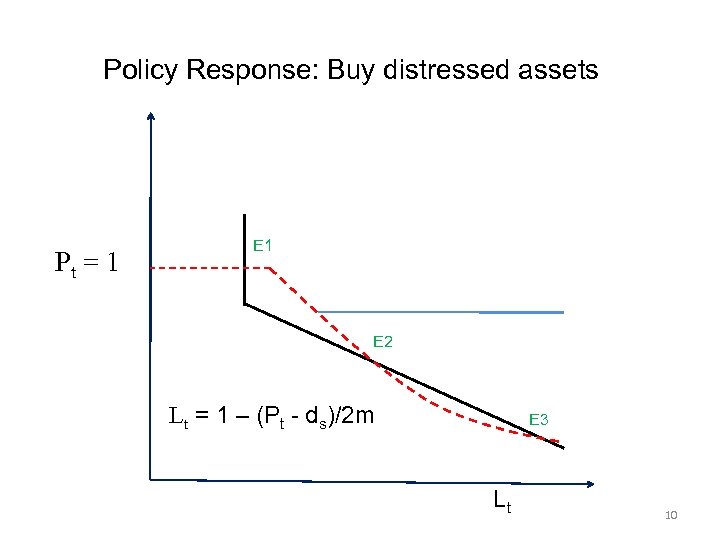 Policy Response: Buy distressed assets Pt = 1 E 2 Lt = 1 – (Pt - ds)/2 m E 3 Lt 10
 Crisis Policy 1. 2. 3. 4. Liquidity injection Buying troubled assets Discount lending Equity injections … 11
 Ex-ante Policy • If we push the model further (I wont here), there is another policy that pops up: – Ex-post externalities that agents don’t internalize ex-ante • Over-leveraging in the financial sector • Ex-ante leverage limitation. 12
 Recap • So far, liquidation model • Next, Uncertainty and Crises 13
 Uncertainty • Subprime crisis: – Complex CDO products, splitting cash flows in unfamiliar ways – Substantial uncertainty about where the losses lie – But less uncertainty about the direct aggregate loss (small) • Knightian uncertainty, ambiguity aversion, uncertainty aversion, robustness preferences 14
 Modeling: • Standard expected utility – max{c} EP u(c) – P refers to the agent’s subjective probability distribution • Modeling ambiguity/uncertainty/robustness: – max{c} min{Q ϵ Q } EQ u(c) – Q is the set of probability distributions that the agent entertains 15
 Uncertainty in the baseline model • Recall, agents may receive liquidity shocks that makes them sell assets at date t • Shock probabilities are φA , φB • Suppose agents are uncertain about the correlation between their liquidity shocks of A and B. • ρ (A, B) ϵ [0, 1] 16
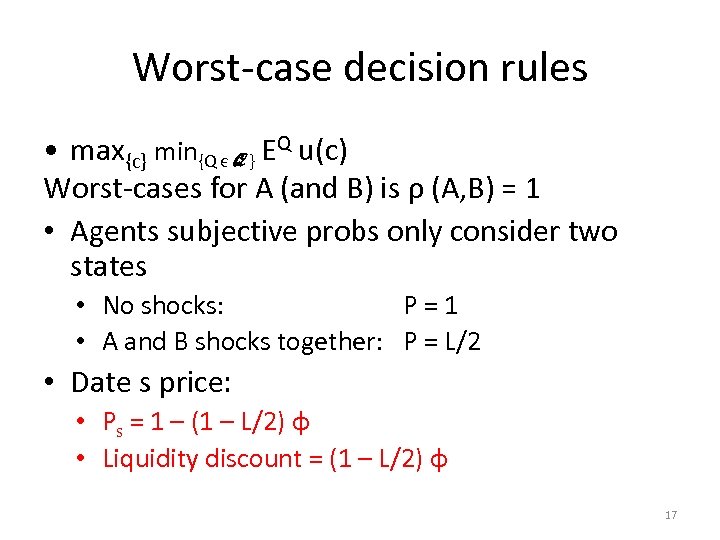 Worst-case decision rules • max{c} min{Q ϵ Q } EQ u(c) Worst-cases for A (and B) is ρ (A, B) = 1 • Agents subjective probs only consider two states • No shocks: P=1 • A and B shocks together: P = L/2 • Date s price: • Ps = 1 – (1 – L/2) φ • Liquidity discount = (1 – L/2) φ 17
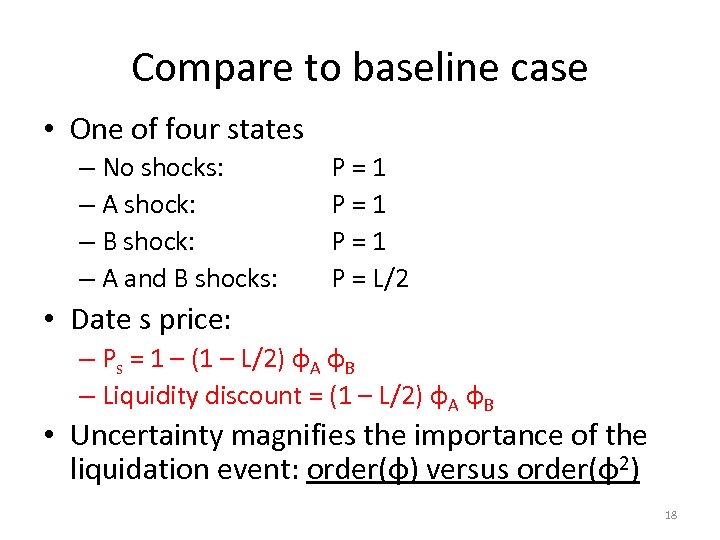 Compare to baseline case • One of four states – No shocks: – A shock: – B shock: – A and B shocks: P=1 P=1 P = L/2 • Date s price: – Ps = 1 – (1 – L/2) φA φB – Liquidity discount = (1 – L/2) φA φB • Uncertainty magnifies the importance of the liquidation event: order(φ) versus order(φ2) 18
 Crisis Policy • LLR policy again • Inject liquidity into bank in the event that both shocks hit. – Liquidity discount = (1 – L/2) φ – Larger effect on agent’s uncertainty, but CB delivers only with probability φA φB 19
 Ex-ante Policy • In liquidity externality model, it was to reduce date s leverage • More generally, this is about incentivizing better ex-ante risk management • But does the central bank really know better? – Especially when it comes to new financial products – History … everyone is blindsided in the same way 20
 Ex-ante Policy • Policing new innovations, these are the trouble spots – Regulations slow new innovations 21
 Summary • Two financial amplification mechanisms – Interactions • Crisis policies are similar • Ex-ante policies are different – Regulate leverage of financial sector – Regulate growth in particular of financial innovation 22