 Скачать презентацию AMOEBA A DISTRIBUTED OPERATING SYSTEM A Case
3305df692f8d84d89bcddf3cc5e4bbea.ppt
- Количество слайдов: 76



AMOEBA – A DISTRIBUTED OPERATING SYSTEM A Case Study by : Y. Vamsi K. Venkatesh Ch. Leela Krishna Y. Durga Prasad S. V. H. R. K. V. Kalyan

Overview of AMOEBA By Kalyan
Introduction • What is amoeba ? • The Amoeba distributed operating system project is a research effort aimed at understanding how to connect computers together in a seemless way.
A Distributed OS • What is a distributed OS ? • In this, users effectively log into the system as a whole, and not to a specific machine. • When a program is run, the system, not the user, decides the best place to run it.
Introduction to Amoeba • Amoeba is an OS that performs all the standard functions of any OS, but it performs them with a collection of machines. • One of the main goals of the Amoeba development team was to design a transparent distributed system that allows users to log into the system as a whole. • When a user logs into an Amoeba system, it seems like a powerful, single-processor, time-sharing system.
Its origin • Amoeba was originally designed and implemented at the Vrije University in Amsterdam (the Netherlands) under the direction of Professor Andrew S. Tanenbaum. • Now, it is being jointly developed there and at the Center for Mathematics and Computer Science, also in Amsterdam. • Four basic design goals were apparent in Amoeba: Distribution, Parallelism, Transparency, and Performance.
It is … • Amoeba is a distributed system that allows several machines connected over a network to operate as a single system. • The machines that make an Amoeba kernel can be spread throughout a building on a Local Area network (LAN). It only provides limited support for Wide Area Network (WAN) connections
The goal • The first goal of the design team was to make Amoeba give its users the illusion of interacting with a single system, even though the system was distributed. • In addition to managing the Amoeba network, an Amoeba system can also act as a router to connect several other networks together. • This is all accomplished with a (newly developed) High Performance network protocol called FLIP (Fast Local Internet Protocol).
Features • Amoeba is also a parallel system. • On an Amoeba system, a single program or command can use multiple processors to increase performance. • Special development tools have been developed for an Amoeba environment that take advantage of the inherent parallelism. • When a user logs into the Amoeba system that they can access the entire system, and are not limited to only operations on their home machine.
Features… • The Amoeba architecture is designed as a collection of micro-kernels. • Amoeba implements a standard distributed client / server model, where user processes and applications (the clients) communicate with servers that perform the kernel operations. • An Amoeba system consists of four principle components: user workstations, pool processors, specialized servers, and gateways.
AMOEBA ARCHITECTURE • The workstations allow the users to gain access to the Amoeba system. • There is typically one workstation per user, and the workstations are all diskless, so they act as intelligent terminals. • Amoeba supports X-windows and UNIX emulation, so X-window terminals are often used to facilitate interaction with UNIX systems.
Pool Processor • The pool processors are unique with Amoeba. • This is a group of CPUs that can be dynamically allocated as needed by the system, and are returned to the pool when processing is complete.
Servers & Communication • At the heart of the Amoeba system are several specialized servers that carry out and synchronize the fundamental operations of the kernel. • The Bullet Server, the Directory Server, the Replication server and the Run server are different servers. • Remote Procedure call and Group communication are two different kinds of communication procedures in amoeba.

OBJECTS IN AMOEBA By Vamsi
OBJECTS • • CONCEPT OF SERVER PROCESSES CONCEPT OF OBJECTS ARE PASSIVE OBJECTS ARE MANAGED BY SERVER PROCESSES
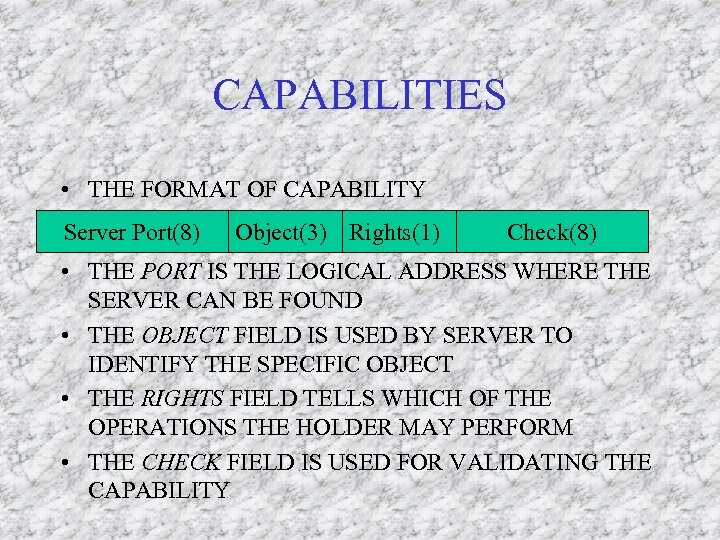
CAPABILITIES • THE FORMAT OF CAPABILITY Server Port(8) Object(3) Rights(1) Check(8) • THE PORT IS THE LOGICAL ADDRESS WHERE THE SERVER CAN BE FOUND • THE OBJECT FIELD IS USED BY SERVER TO IDENTIFY THE SPECIFIC OBJECT • THE RIGHTS FIELD TELLS WHICH OF THE OPERATIONS THE HOLDER MAY PERFORM • THE CHECK FIELD IS USED FOR VALIDATING THE CAPABILITY
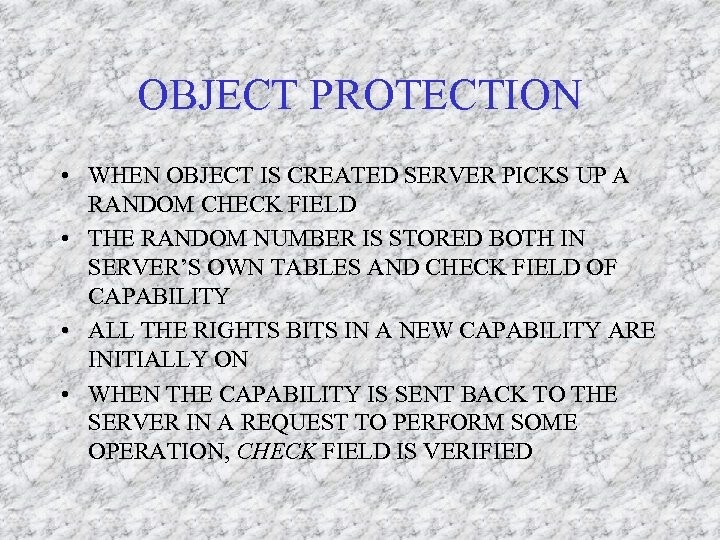
OBJECT PROTECTION • WHEN OBJECT IS CREATED SERVER PICKS UP A RANDOM CHECK FIELD • THE RANDOM NUMBER IS STORED BOTH IN SERVER’S OWN TABLES AND CHECK FIELD OF CAPABILITY • ALL THE RIGHTS BITS IN A NEW CAPABILITY ARE INITIALLY ON • WHEN THE CAPABILITY IS SENT BACK TO THE SERVER IN A REQUEST TO PERFORM SOME OPERATION, CHECK FIELD IS VERIFIED
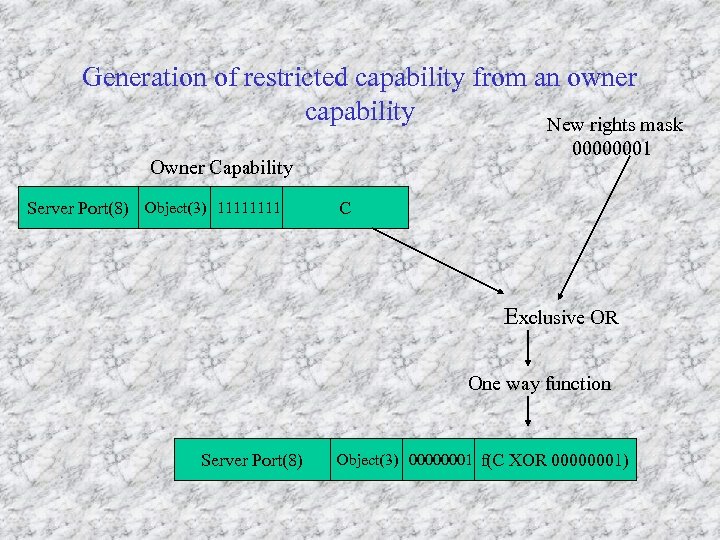
Generation of restricted capability from an owner capability New rights mask 00000001 Owner Capability Server Port(8) Object(3) 1111 C Exclusive OR One way function Server Port(8) Object(3) 00000001 f(C XOR 00000001)

PROCESS MANAGEMENT By Leela Krishna
PROCESS MANAGEMENT IN AMOEBA • • • Processes. Process management. Process descriptor. Library procedures. Threads. Synchronization between threads.
PROCESSES • • • A process is an object in amoeba. Process creation in amoeba is different from unix. In amoeba it is possible to create a new process on a specified processor with the intended memory image starting at the beginning. • In this one aspect a process creation is similar to MS-DOS. • A process can be in two states. 1. Running 2. Stunned
PROCESS MANAGEMENT • Process management is handled at 3 levels in amoeba. 1. The lowest level are the process servers, which are kernel threads running on every machine. 2. We have a set of library procedures that provide a more convenient interface for user programs. 3. Finally, the simplest way to create a new process is to use the run server, which does the most of the work of determining where to run the new process.
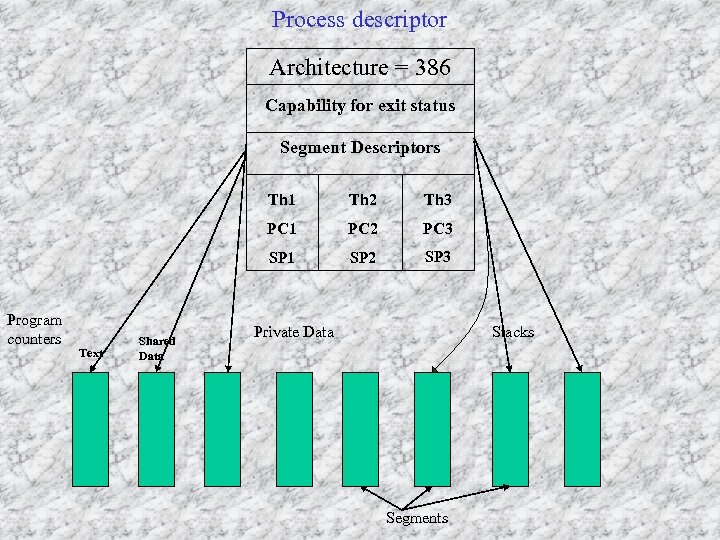
PROCESS DESCRIPTOR • 1. 2. 3. 4. Some of the process management calls use a data structure called process descriptor to provide information about the process to be run. First field, host descriptor tells which CPU architecture the process can run on. Second field contains a capability for communicating the exit status to the owner. Third field memory map contains a descriptor for each segment in process’ address space. Finally the process descriptor also contains a thread descriptor for each thread in the process.
Process descriptor Architecture = 386 Capability for exit status Segment Descriptors Th 1 Text PC 2 PC 3 SP 1 Shared Data Th 3 PC 1 Program counters Th 2 SP 3 Private Data Stacks Segments
LIBRARY PROCEDURES • Low level process interface consists of library procedures. 1. Exec: It’s function is to do RPC with the specified process server asking to run the process. 2. Getload: It returns the information about the CPU speed, current load and the amount of memory free at the moment. 3. Stun: The parent can suspend a process by stunning it.
THREADS • Amoeba supports a simple threads model. • Glocal variables.
SYNCHRONIZATION BETWEEN THREADS • • Three methods are provided for threads to synchronize. Signals. Mutexes. Semaphores.
SYNCHRONIZATION METHODS • Signals are asynchronous interrupts sent from one thread to another thread in the same process. • Mutex is like a binary semaphore. It can be in one of the two states , locked or unlocked. • Semaphores are slower than mutexes but there are times when they are needed.
• All threads are managed by the kernel. The advantage of this design is that when a thread does RPC, the kernel can block the thread and schedule another one in the same process if one is ready. • Thread scheduling is done using priorities, with kernel threads getting higher priority than user threads.

MEM 0 RY MANAGEMENT By Venkatesh
MEMORY MANAGEMENT • Entirely in physical memory. • Segments contiguous in address space. • Segments are objects. • Any process with capability to segment could read/write it (with proper permissions). • Shared memory communications (need not be on same machine. • Main memory file server.
SEGMENTS • A segment is a contigous block of memory that can contain code or data. • Each segment has a capability that permits holder to perform operations on int, such as reading and writing. • A segment is somewhat like an in-core file, with similar properties. • Segments cannot be swapped or paged.
SEGMENTS Cont………. • When a segment is created it is given an initial value. This size may change during the process execution. • The segment may also given initial value either from another segment or from a file. • Processes have several calls available to them for managing segments. • Most important among these is the ability to create, read and write segments. • When a segment is created, the caller gets back a capability for it. • This capability is used for all other calls involving the segment.
SEGMENT Cont…. . • A main memory file server can be constructed using segments because of their read and write properties. • The server creates a segment as large as it can. • This segment will be used as a simulated disk. • The server then formats the segment as a file system, putting in whatever data structures it needs to keep track of the files. • After that, it is open for business, accepting and processing requests from clients.
MEMORY MODEL • Amoeba has an extremely simple memory model. • A process can have any number of segments. • They can be located wherever it wants in the process’s virtual address space. • The virtual address spaces in Amoeba are constructed from segments. • Segments are not swapped or paged, so a process must be entirely memory resident to run. • Although the hardware MMU is used, each segment is stored contiguously in memory. Cont….
• This design was done for three reasons: Performance, Simplicity, Economics. • Having a process entirely in memory all the time makes RPC go faster. • This design has allowed Amoeba to achieve extremely high transfer rates for large RPC’s • Not having paging or swapping makes the system considerably simpler and makes the kernel smaller and more feasible. • Memory is becoming so cheap that within a few years, all Amoeba machines will probably have tens of megabytes of it.
MAPPED SEGMENTS • When a process is started, it must have at least one segment. • Once it is running, a process can create additional segments and map them into its address space at any unused virtual address.
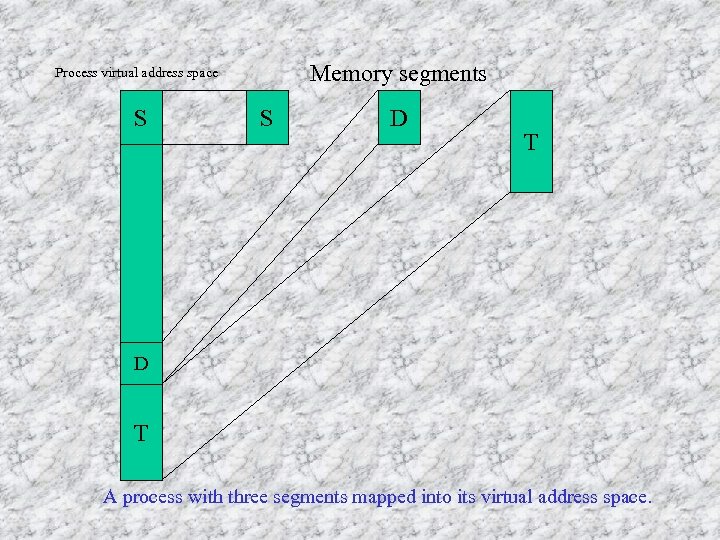
Memory segments Process virtual address space S S D T A process with three segments mapped into its virtual address space.
UNMAPPED SEGMENTS • A process can also unmap segments. • A process can specify a range of virtual addresses and request that the range be unmapped. • When a segment is unmapped a capability is returned, so the segment may still be accessed, or even be remapped.

COMMUNICATIONS IN AMOEBA By Durga Prasad
COMMUNICATION IN AMOEBA • Remote procedure call (RPC) • Group communication
REMOTE PROCEDURE CALL • POINT-TO-POINT COMMUNICATION With client sending a message followed by server sending a reply • REQUEST/REPLY MESSAGE EXCHANGE Each standard server defines a procedural interface that clients can call
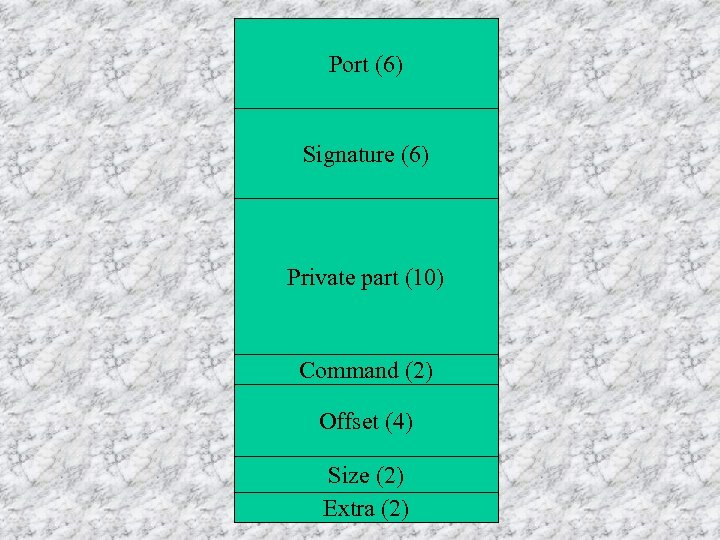
REMOTE PROCEDURE CALL • FINDING SERVER’S ADDRESS Addressing is done by allowing any thread to choose a random 48 -bit number, called a PORT
RPC Primitives • The RPC mechanism makes use of three principal kernel primitives: 1. get_request –indicates server’s willingness to listen to port 2. put_reply - done by a server when it has a reply to send 3. trans - send a message from client to server and wait for reply
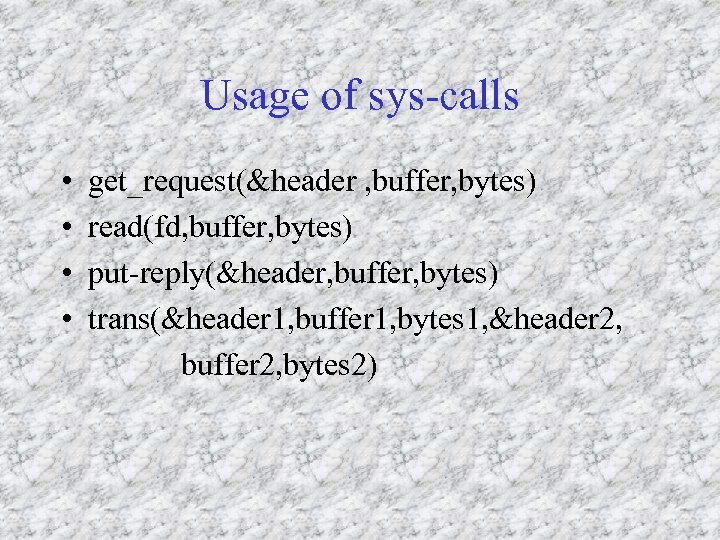
Usage of sys-calls • • get_request(&header , buffer, bytes) read(fd, buffer, bytes) put-reply(&header, buffer, bytes) trans(&header 1, buffer 1, bytes 1, &header 2, buffer 2, bytes 2)
Port (6) Signature (6) Private part (10) Command (2) Offset (4) Size (2) Extra (2)
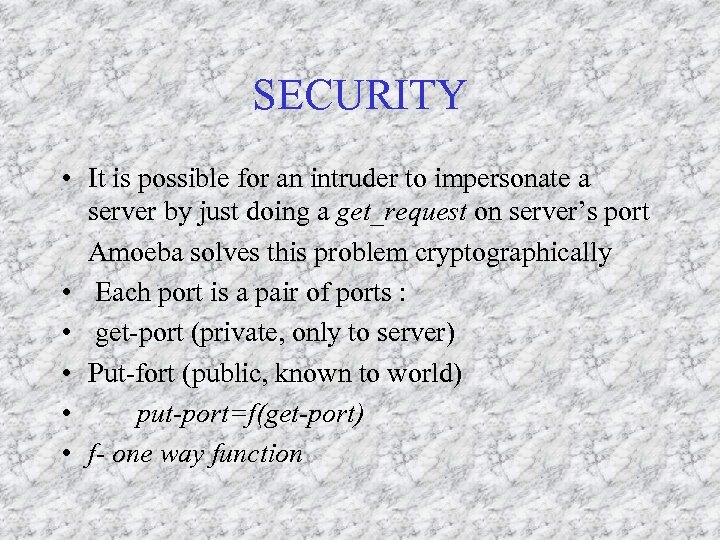
SECURITY • It is possible for an intruder to impersonate a server by just doing a get_request on server’s port Amoeba solves this problem cryptographically • Each port is a pair of ports : • get-port (private, only to server) • Put-fort (public, known to world) • put-port=f(get-port) • f- one way function
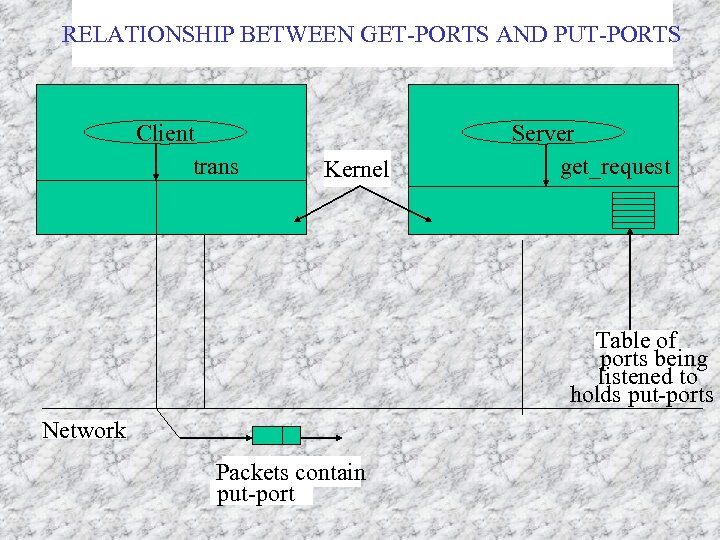
RELATIONSHIP BETWEEN GET-PORTS AND PUT-PORTS Client trans Kernel Server get_request Table of ports being listened to holds put-ports Network Packets contain put-port
Properties of RPC Mechanism • It supports only synchronous type of data • Messages are unbuffered. message is simply discarded if the receiver is not in a ready state to receive it. the sending kernel will time out and retransmit the message. flexibility is provided to specify the maximum retransmissions , after which kernel should give up and report failure
Properties of RPC Mechanism • It supports at-most-once semantics. that is the system guarantees that an RPC will never be carried out more than once, even if the server crashes and is rapidly rebooted. • Stateless servers are used. therefore , each RPC is completely self contained and does not depend on any previous information stored in the server’s memories
GROUP COMMUNICATION • RPC is not the only form of communication supported by amoeba. It also supports group communication. • Amoeba uses the concepts of closed groups. • Procceses can join and leave the group dynamically and can members of multiple group at the same time
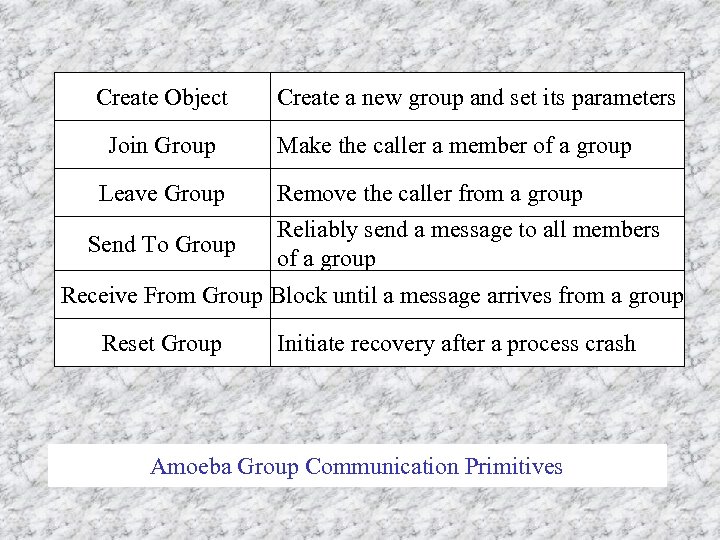
Create Object Join Group Leave Group Send To Group Create a new group and set its parameters Make the caller a member of a group Remove the caller from a group Reliably send a message to all members of a group Receive From Group Block until a message arrives from a group Reset Group Initiate recovery after a process crash Amoeba Group Communication Primitives
Group communication properties Amoeba ensures ordered delivery of messages. A sequencer process is used for properly sequencing the messages received by a group. It is chosen by using an Election Algorithm.
PROPERTIES OF GROUP COMMUNICATION • Amoeba ensures reliable delivery of messages. • The basic mechanisms used to ensure reliable message delivery are timed out based re-transmissions. • Use of any message identifiers to detect duplicate messages.
Properties of group communication mechanism • It ensures ordered delivery of messages. that is if two processes send messages to a group almost simultaneously , the system ensures that all group members will receive the messages in same order
PROPERTIES OF GROUP COMMUNICATION • Amoeba can withstand the loss of an arbitrary collection of k (the degree of resilience) processes. • k is specified by user as a parameter for creating a group. • The larger the value of k , more the redundancy is required and slower the group communication becomes.
THE AMOEBA SERVERS By Kalyan
THE AMOEBA SERVERS • The Amoeba kernel essentially handles communication and some process management, and little else. • The kernel takes care of sending and receiving messages, scheduling processes, and some low-level memory management. Everything else is done by user processes.
Stub Processes… • All standard servers in Amoeba are defined by a set of stub processes. • Stubs precisely define what the server provides and what their parameters are. • The older stubs are written in C whereas newer ones are defined in AIL, Amoeba Interface Language.
Different Servers… • • The standard file system consists of three servers. The Bullet server The Directory server The Replication server
The File Server… • The file server is a user process. • Also called as Bullet Server. • It is a simple file server that maintains immutable files. • It stores files contiguously on disk and in cache. • Supported operations: create file, read file, delete file
The Bullet Server… • When creating a file, the entire file data is provided and the file's capability is returned. • To modify this file, the client sends back the capability through a RPC. • A part of the file can also be read by sending offset and a byte count. • Thus, aims at the convenience of the client.
Types of files • • • The two kinds of files are : Committed Uncommitted files can be changed whereas committed ones are permanent. Only committed files can be read.
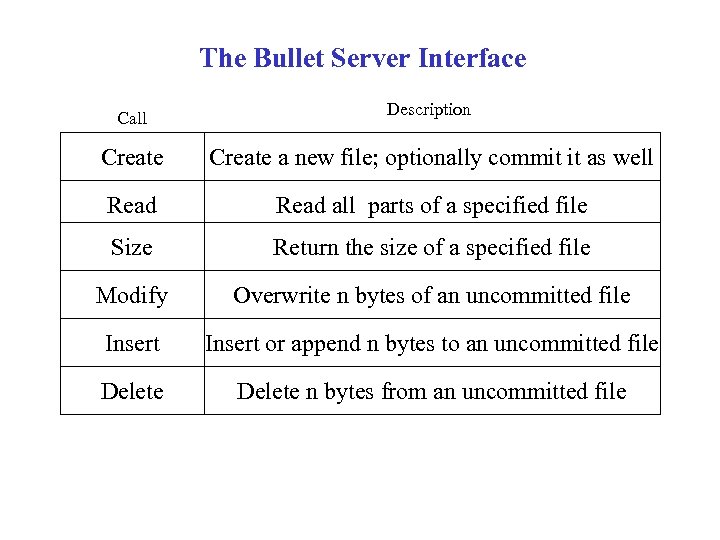
The Bullet Server Interface Call Description Create a new file; optionally commit it as well Read all parts of a specified file Size Return the size of a specified file Modify Overwrite n bytes of an uncommitted file Insert or append n bytes to an uncommitted file Delete n bytes from an uncommitted file
Timeouts • If a file is created and its capability is lost, the file can never be accessed. • An uncommitted file will be deleted if it is not accessed for 10 minutes. • Age and touch operations… • Age operation runs through the server and goes on decrementing MAX_LIFETIME and deletes when it becomes 0. • Every file is touched once in an hour and is deleted if it is not accessed for 24 hours. • This mechanism removes lost files. • Fragmentation problem.
The Directory Server • The Directory server allows one to use names, by providing mapping from user names onto capabilities. • Directories are also objects protected by capabilities. • Entries in the directory may be of different varieties. • A directory may return a capability to another directory.
The Directory Server… • The directory usually has five entries – ASCII string, Capability set, Owner, Group and Others. • The rights, as in UNIX, are specified for three different user groups. The directory actually creates a new capability with the specified rights and returns that to the user. • There is no concept of a single, global root directory. • Directories like bin, dev, etc, public (cap, share, pool). .
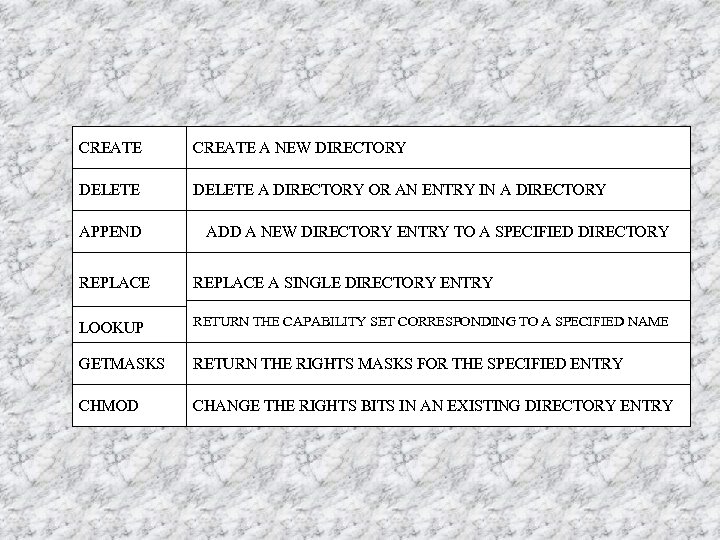
CREATE A NEW DIRECTORY DELETE A DIRECTORY OR AN ENTRY IN A DIRECTORY APPEND ADD A NEW DIRECTORY ENTRY TO A SPECIFIED DIRECTORY REPLACE A SINGLE DIRECTORY ENTRY LOOKUP RETURN THE CAPABILITY SET CORRESPONDING TO A SPECIFIED NAME GETMASKS RETURN THE RIGHTS MASKS FOR THE SPECIFIED ENTRY CHMOD CHANGE THE RIGHTS BITS IN AN EXISTING DIRECTORY ENTRY
The Replication Server • Objects managed by directory server can be replicated automatically by the replication server. • Lazy replication • Initially one copy of object is created and later replication server is invoked to produce identical replicas. • It sends age messages.
Other Servers • Some other servers are – The Run Server, The Boot Server and The TCP/IP server. . • A run server manages one or more processor pool. A processor pool is represented by a pooldir. • The boot server checks whether all other servers are running smoothly or not. • Communication with x-server is also possible.
Wide Area Amoeba • Amoeba was designed with the idea that a collection of machines on a LAN would be able to communicate over a wide-area network with a similar collection of remote machines. • The primary goal of the wide area-networking in Amoeba has been to achieve transparency without sacrificing performance. • Broadcast over WAN is both cost ineffective and for some services (e. g. , print server) of no use over a WAN. These problems are solved by introducing the concept of publishing.
Conclusion • On the whole, the idea of an object-based system has worked well. • In future, Amoeba will support 256 -bit capabilities and will have a room for a location hint which can be exploited by SWAN servers for locating objects in the WAN. • RPC communication is excellent. The only problem being lack of group communication support. • An improvement that developers of Amoeba will be making in Amoeba's memory and process management is to allow for preemption of threads, which now use the run-to-completion scheduling semantics.
Conclusion… • The design of the file server and directory server has been very successful. The separation of the file server and directory server is an important aspect of this design. • Internetworking has been handled in a very innovative manner with good results. • Amoeba has also been used for parallel computing, although designed for distributed computing • The processor pool has been used to achieve large speed ups on a single problem. To program these parallel applications, a new language Orca has been under development.
Present Status • Currently, amoeba is being used for several practical situations from a development environment , for parallel computing, to industrial applications. • The RIT Computer Science House is implementing amoeba. Details can be got about it from www. csh. rit. edu • Amoeba runs on Sun SPARC stations, Sun 3/60, and 3/50 workstations, Intel 86/486/Pentium Pro, and 68030 VMEbus boards. • More information about the present status can be got at : www. am. cs. vu. nl
References • Modern Operating Systems – By Andrew S. Tanenbaum • Amoeba: An Overview of a Distributed Operating System. By Eric W. Lund - March 29, 1998 Rochester Institute of Technology - ICSA 750 • ftp: //ftp. cs. vu. nl/pub/amoeba/Intro. ps. Z • ftp: //ftp. cs. vu. nl/pub/papers/amoeba/spe 89. ps. Z • ftp: //ftp. cs. vu. nl/pub/papers/amoeba/comcom 91. ps. Z • ftp: //ftp. cs. vu. nl/pub/papers/amoeba/dse 93. ps. Z

End of Presentation
Скачать презентацию AMOEBA A DISTRIBUTED OPERATING SYSTEM A Case
3305df692f8d84d89bcddf3cc5e4bbea.ppt