 Скачать презентацию Amino Acid Analyser 2000 6 17 석사 3기
02f999d141a6ec204f5a13f5fd5dacd0.ppt
- Количество слайдов: 29



Amino Acid Analyser 2000. 6. 17 석사 3기 박주영 Amino Acid Analyser Products Ion exchange chromatography Application An example of application
Amino Acid Analyser l AMINO ACID ANALYSER (AAA) – Amino Acid Analyser is a specifically configured system optimised for the analysis of free amino acids. l PRINCIPLE – The system utilises ion-exchange chromatography incorporating post column reaction with ninhydrin and subsequent detection in the visible region spectrum.
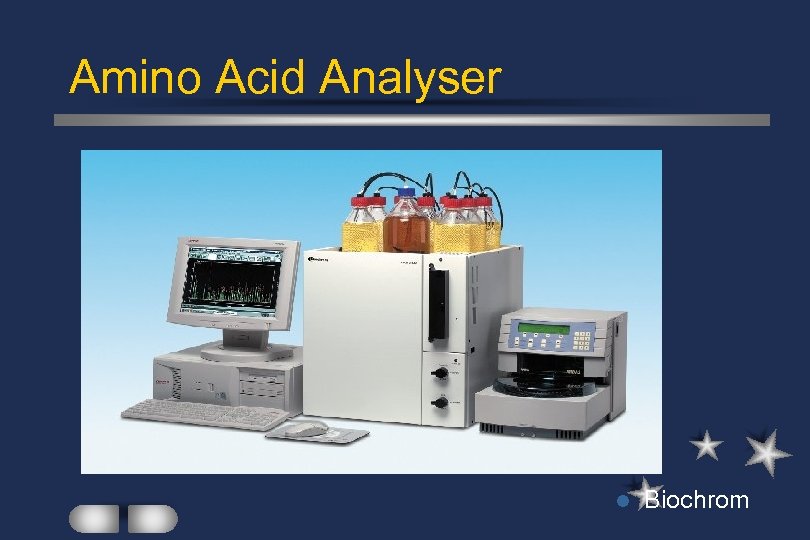
Amino Acid Analyser l Biochrom
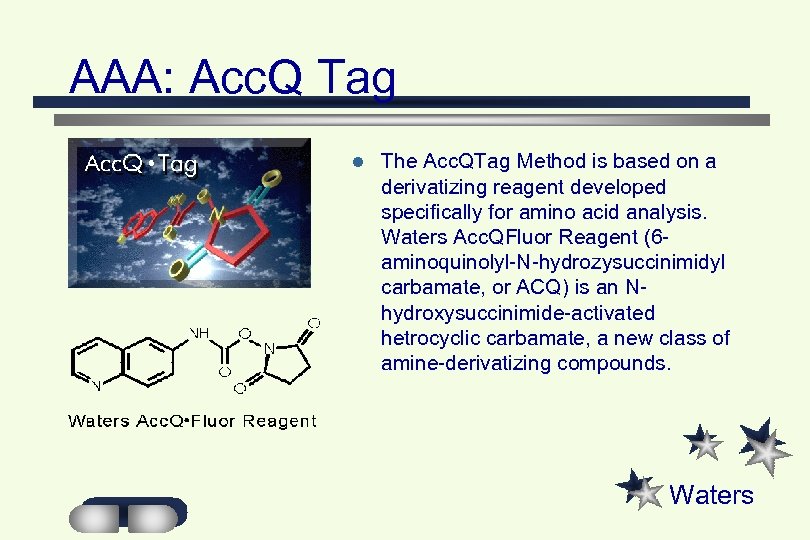
AAA: Acc. Q Tag l The Acc. QTag Method is based on a derivatizing reagent developed specifically for amino acid analysis. Waters Acc. QFluor Reagent (6 aminoquinolyl-N-hydrozysuccinimidyl carbamate, or ACQ) is an Nhydroxysuccinimide-activated hetrocyclic carbamate, a new class of amine-derivatizing compounds. Waters
Chromatography Open Column Chromatography l Thin Layer Chromatography l Liquid Chromatography – Ion exchange chromatography l l Amino l acid analyer High Performance Liquid Chromatography
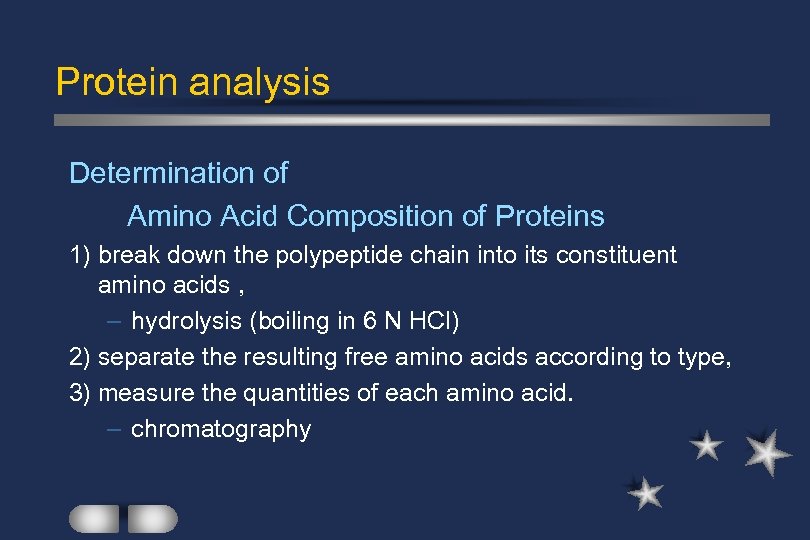
Protein analysis Determination of Amino Acid Composition of Proteins 1) break down the polypeptide chain into its constituent amino acids , – hydrolysis (boiling in 6 N HCl) 2) separate the resulting free amino acids according to type, 3) measure the quantities of each amino acid. – chromatography
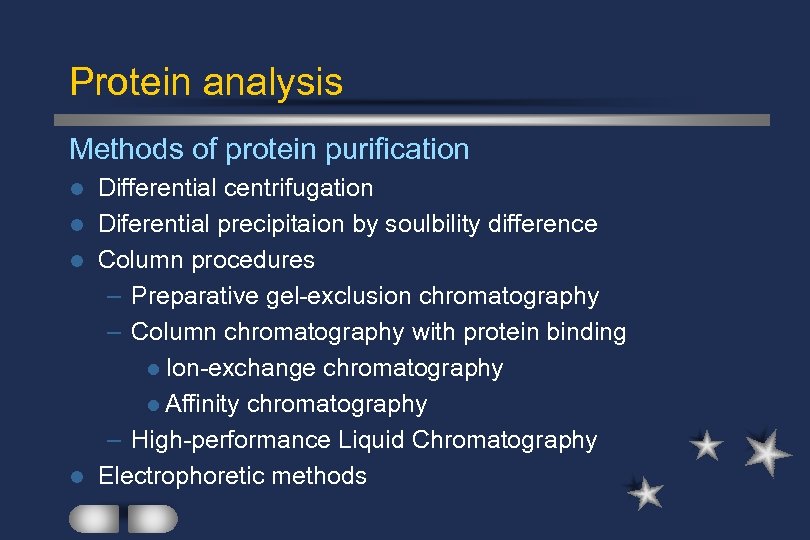
Protein analysis Methods of protein purification Differential centrifugation l Diferential precipitaion by soulbility difference l Column procedures – Preparative gel-exclusion chromatography – Column chromatography with protein binding l Ion-exchange chromatography l Affinity chromatography – High-performance Liquid Chromatography l Electrophoretic methods l
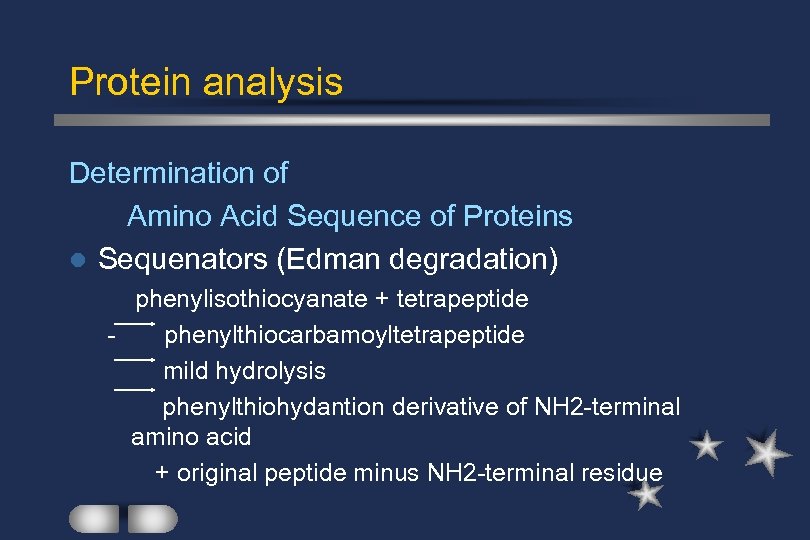
Protein analysis Determination of Amino Acid Sequence of Proteins l Sequenators (Edman degradation) phenylisothiocyanate + tetrapeptide phenylthiocarbamoyltetrapeptide mild hydrolysis phenylthiohydantion derivative of NH 2 -terminal amino acid + original peptide minus NH 2 -terminal residue
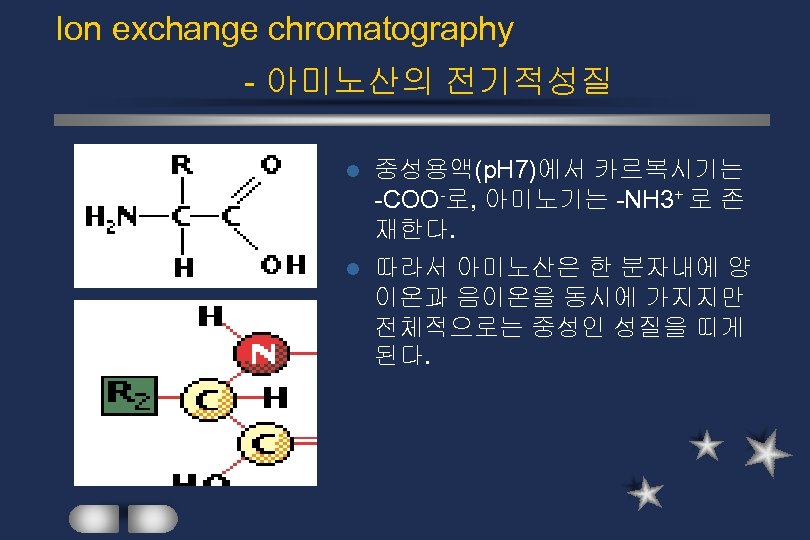
Ion exchange chromatography - 아미노산의 전기적성질 중성용액(p. H 7)에서 카르복시기는 -COO-로, 아미노기는 -NH 3+ 로 존 재한다. l 따라서 아미노산은 한 분자내에 양 이온과 음이온을 동시에 가지지만 전체적으로는 중성인 성질을 띠게 된다. l
이온교환크로마토그래피 l 아미노산이나 다른 용질의 분리에는 종종 이온교환 크로마 토그래피를 이용하는데, 이때 대상분자는 전하를 띤 고체 지지체의 다른 이온과 교환되었다가 다시 떨어져나온다. l 전형적인 과정에서는 액체상에 녹아있는 용질을 다공성 고 체상이 채워진 관을 통과시킨다. l 액체상으로는 물이 보통 쓰이며, 고체상은 하전된 작용기 를 가진 합성수지 입자로 된 층이다.
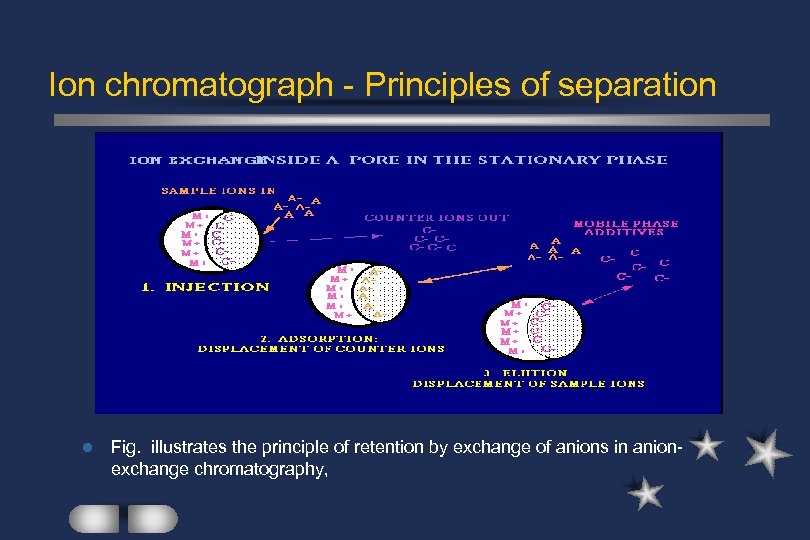
Ion chromatograph - Principles of separation l Fig. illustrates the principle of retention by exchange of anions in anionexchange chromatography,
Ion exchange chromatography의 구성 l Instrumentation – pump – injector – detector – data station l Chemistry components – stationary phase – mobile phase
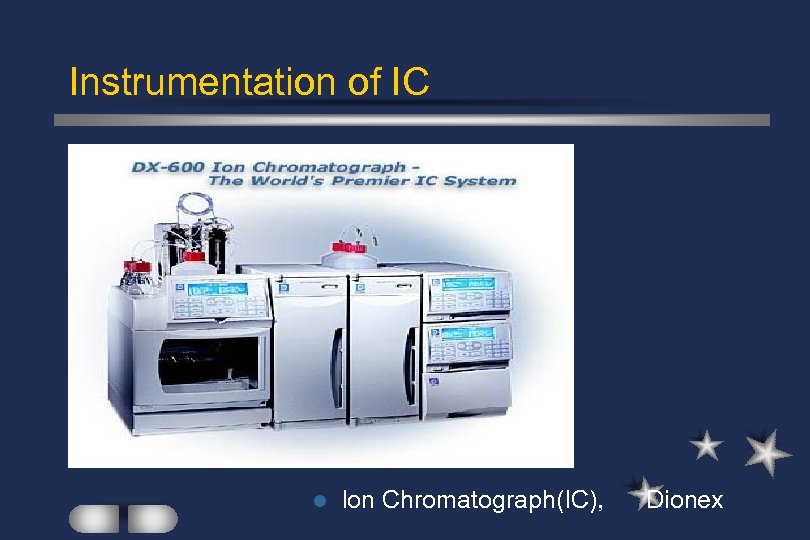
Instrumentation of IC l Ion Chromatograph(IC), Dionex
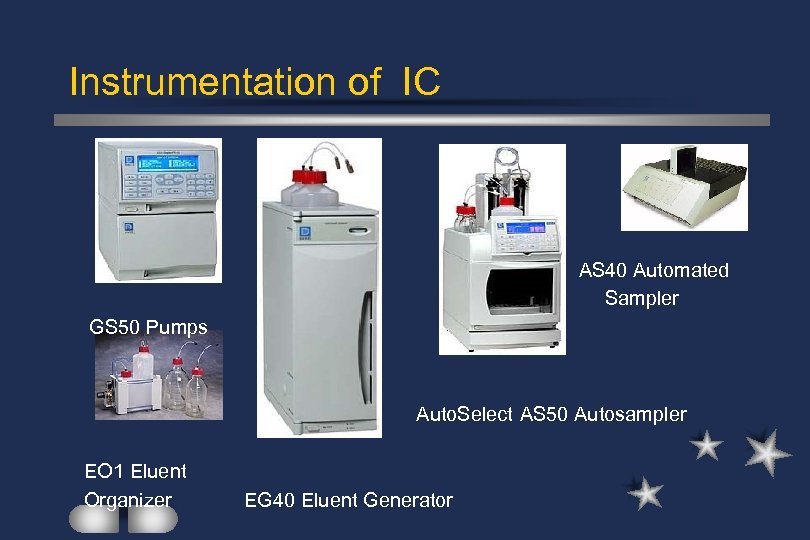
Instrumentation of IC AS 40 Automated Sampler GS 50 Pumps Auto. Select AS 50 Autosampler EO 1 Eluent Organizer EG 40 Eluent Generator
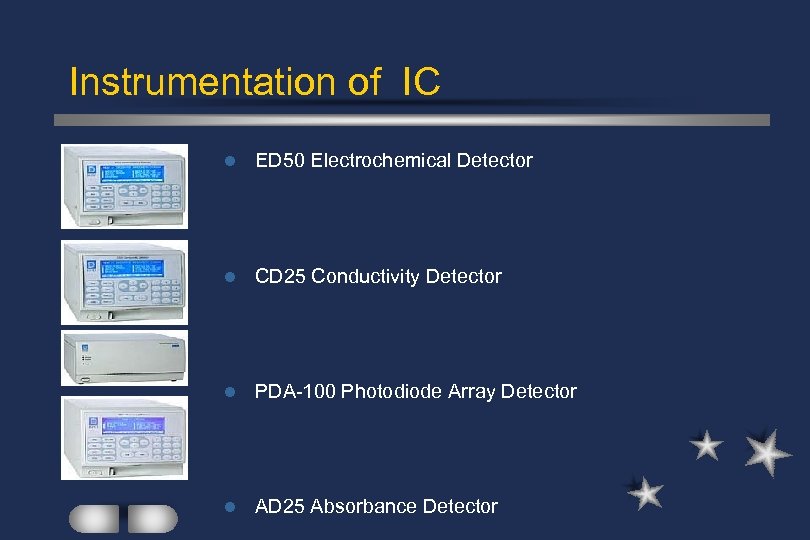
Instrumentation of IC l ED 50 Electrochemical Detector l CD 25 Conductivity Detector l PDA-100 Photodiode Array Detector l AD 25 Absorbance Detector
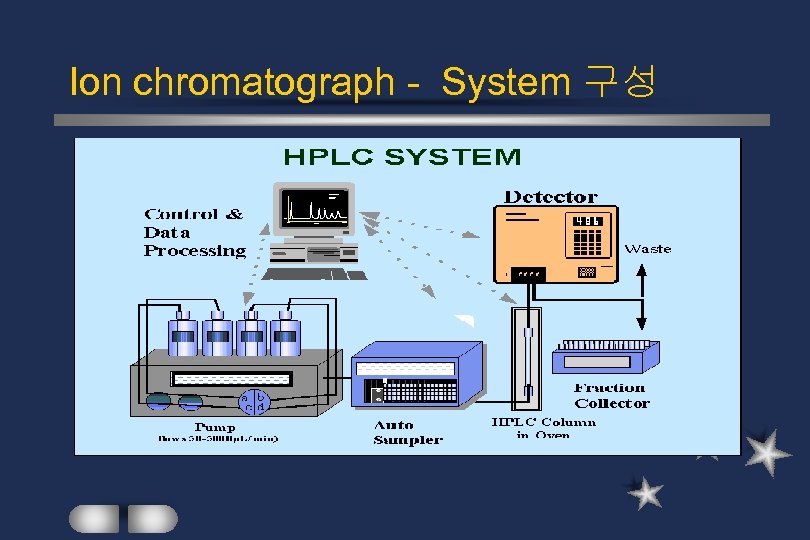
Ion chromatograph - System 구성
Stationary phases of IC l 양전하를 가진 수지를 음이온교환체(anion exchanger), 음 전하를 가진 고체 지지체는 양이온교환제(cation exchanger)라 한다 l Ion-exchangers are charaterized both by the nature of the matrix used as a support and the nature of the ionic functional groups on the surface.
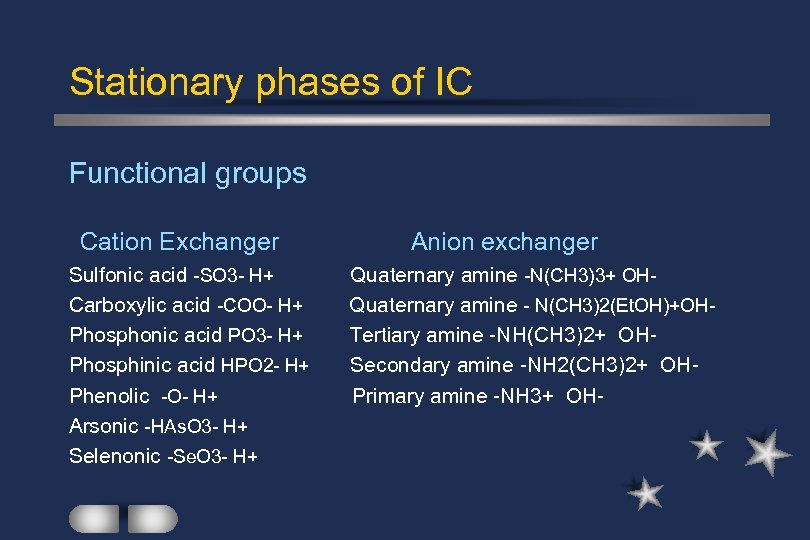
Stationary phases of IC Functional groups Cation Exchanger Sulfonic acid -SO 3 - H+ Carboxylic acid -COO- H+ Phosphonic acid PO 3 - H+ Phosphinic acid HPO 2 - H+ Phenolic -O- H+ Arsonic -HAs. O 3 - H+ Selenonic -Se. O 3 - H+ Anion exchanger Quaternary amine -N(CH 3)3+ OHQuaternary amine - N(CH 3)2(Et. OH)+OHTertiary amine -NH(CH 3)2+ OHSecondary amine -NH 2(CH 3)2+ OHPrimary amine -NH 3+ OH-
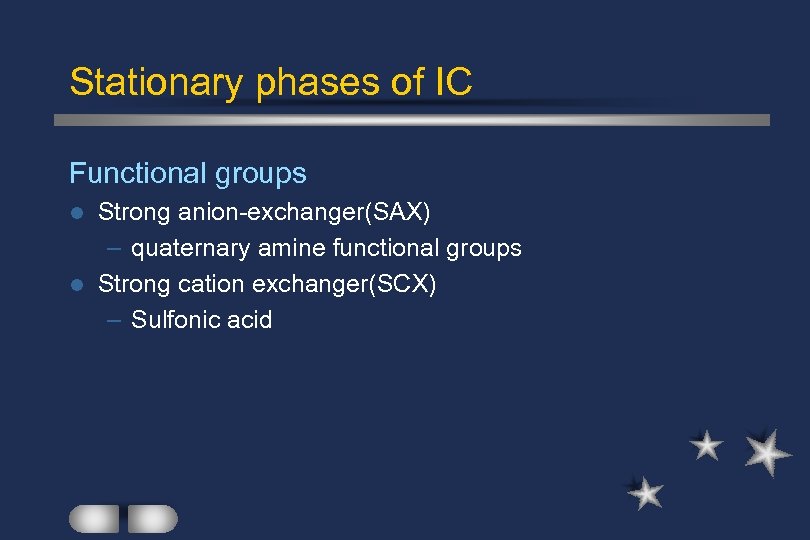
Stationary phases of IC Functional groups Strong anion-exchanger(SAX) – quaternary amine functional groups l Strong cation exchanger(SCX) – Sulfonic acid l
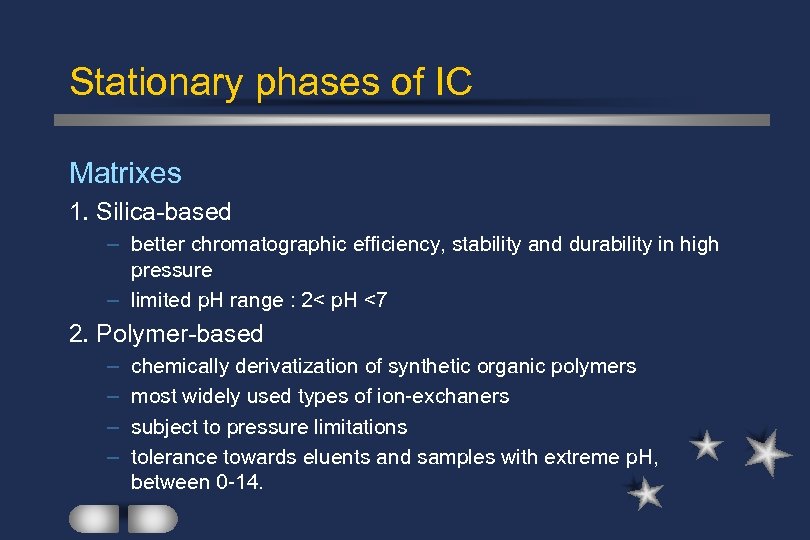
Stationary phases of IC Matrixes 1. Silica-based – better chromatographic efficiency, stability and durability in high pressure – limited p. H range : 2< p. H <7 2. Polymer-based – – chemically derivatization of synthetic organic polymers most widely used types of ion-exchaners subject to pressure limitations tolerance towards eluents and samples with extreme p. H, between 0 -14.
Stationary phase for AAA l 양이온 교환매질 – 강산성, 폴리스티렌 수지(도웩스-50) – 약산성, 카르복시메틸렐룰로오스(CMC) – 약산성, 킬레이트화, 폴리스티렌수지(켈렉스-100) l 음이온 교환매질 – 강염기성, 폴리스티렌 수지(도웩스-1) – 약염기성, 디에틸아미노에틸(DEAE) 셀룰로오스
Mobile phases of IC Properties of Mobile phases – – – – compatibility with the detection mode nature of the competing ion concentration of the competing ion mobiles phase’s p. H buffering capacity of the monile phase ability to complex the ionic sample components organic modifiers
Mobile phases of IC Eluents for Anions l Aromatic carboxylic acids and their salts – mostly widely employed eluent – low conductances – ex) lithium hydroxide l Aliphatic carboxylic acid l Aromatic and aliphatic sulfonic acids l Potassium hydroxide l Polyol-borate complexes l Ethylenediaminetetraacetic acid -EDTA l Inorganic salts such as Cl-, SO 42 - or PO 43 -
Mobile phases of IC Eluents for Cations l Inorganic acids such as nitric acid l Organic bases
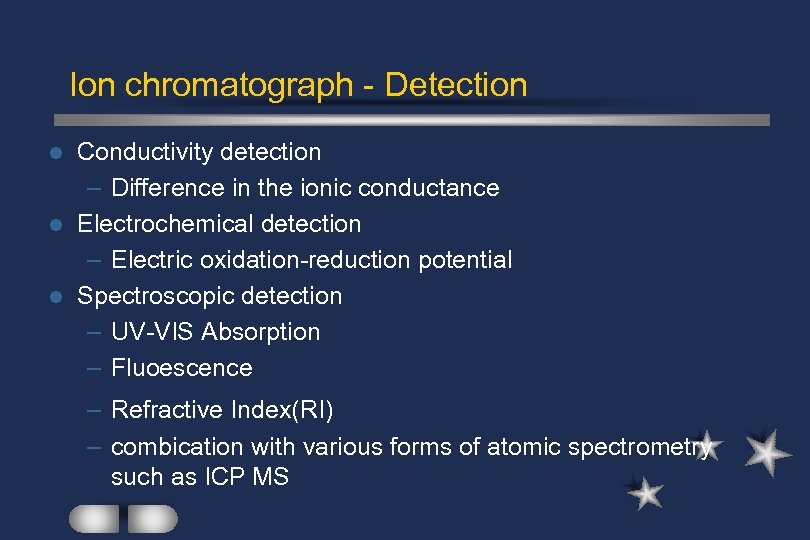
Ion chromatograph - Detection Conductivity detection – Difference in the ionic conductance l Electrochemical detection – Electric oxidation-reduction potential l Spectroscopic detection – UV-VIS Absorption – Fluoescence l – Refractive Index(RI) – combication with various forms of atomic spectrometry such as ICP MS
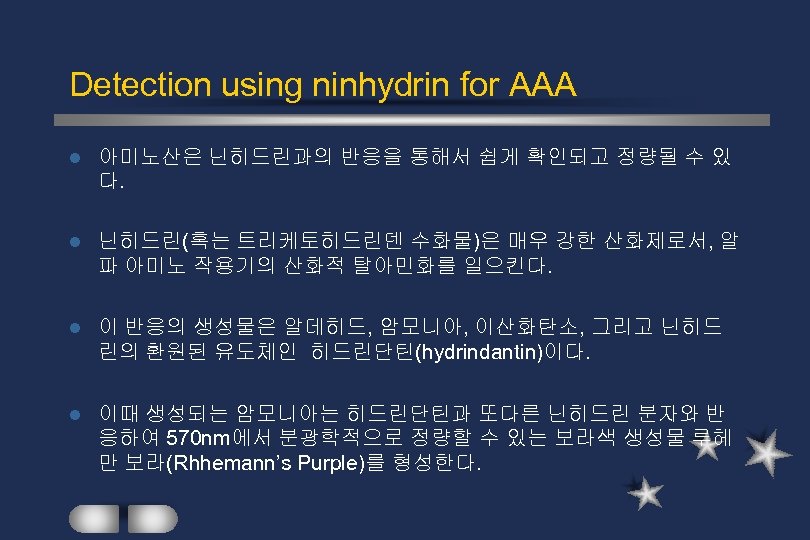
Detection using ninhydrin for AAA l 아미노산은 닌히드린과의 반응을 통해서 쉽게 확인되고 정량될 수 있 다. l 닌히드린(혹는 트리케토히드린덴 수화물)은 매우 강한 산화제로서, 알 파 아미노 작용기의 산화적 탈아민화를 일으킨다. l 이 반응의 생성물은 알데히드, 암모니아, 이산화탄소, 그리고 닌히드 린의 환원된 유도체인 히드린단틴(hydrindantin)이다. l 이때 생성되는 암모니아는 히드린단틴과 또다른 닌히드린 분자와 반 응하여 570 nm에서 분광학적으로 정량할 수 있는 보라색 생성물 루헤 만 보라(Rhhemann’s Purple)를 형성한다.
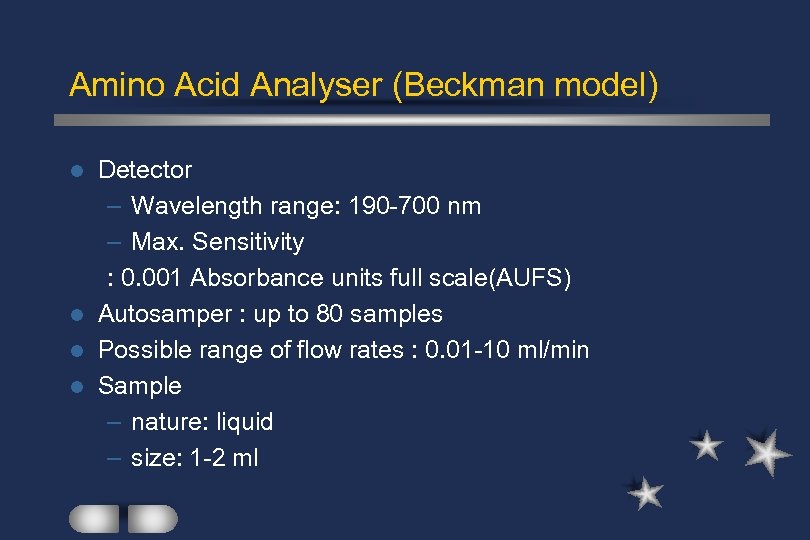
Amino Acid Analyser (Beckman model) Detector – Wavelength range: 190 -700 nm – Max. Sensitivity : 0. 001 Absorbance units full scale(AUFS) l Autosamper : up to 80 samples l Possible range of flow rates : 0. 01 -10 ml/min l Sample – nature: liquid – size: 1 -2 ml l
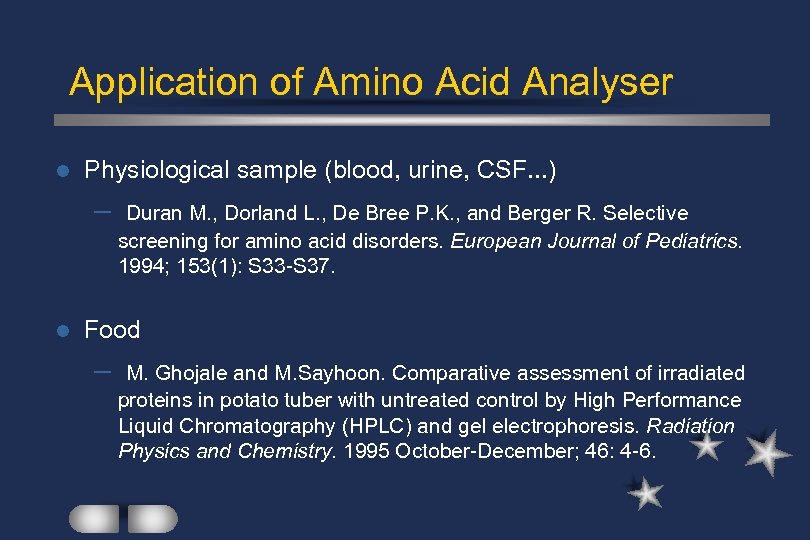
Application of Amino Acid Analyser l Physiological sample (blood, urine, CSF. . . ) – l Duran M. , Dorland L. , De Bree P. K. , and Berger R. Selective screening for amino acid disorders. European Journal of Pediatrics. 1994; 153(1): S 33 -S 37. Food – M. Ghojale and M. Sayhoon. Comparative assessment of irradiated proteins in potato tuber with untreated control by High Performance Liquid Chromatography (HPLC) and gel electrophoresis. Radiation Physics and Chemistry. 1995 October-December; 46: 4 -6.
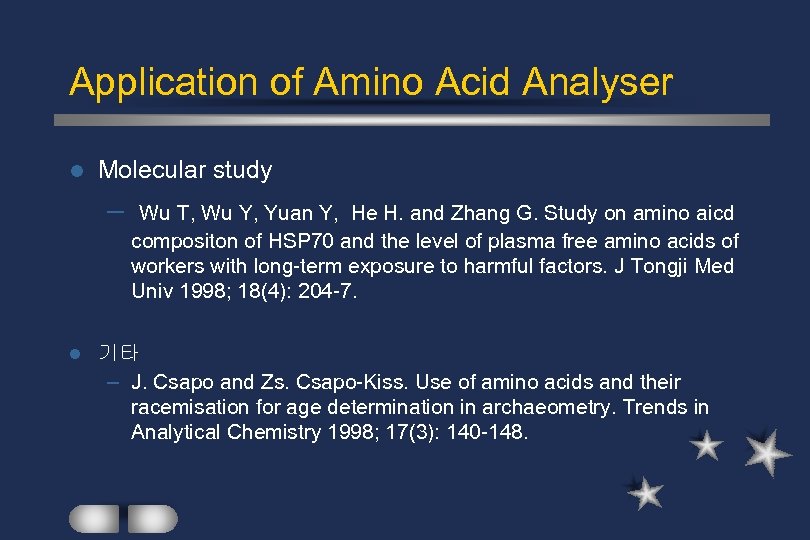
Application of Amino Acid Analyser l Molecular study – l Wu T, Wu Y, Yuan Y, He H. and Zhang G. Study on amino aicd compositon of HSP 70 and the level of plasma free amino acids of workers with long-term exposure to harmful factors. J Tongji Med Univ 1998; 18(4): 204 -7. 기타 – J. Csapo and Zs. Csapo-Kiss. Use of amino acids and their racemisation for age determination in archaeometry. Trends in Analytical Chemistry 1998; 17(3): 140 -148.
Скачать презентацию Amino Acid Analyser 2000 6 17 석사 3기
02f999d141a6ec204f5a13f5fd5dacd0.ppt