


 Скачать презентацию American Literature 1 st Week Puritans
e82dbb33d9ed97c3c0cf1434cf4e5413.ppt
- Количество слайдов: 52
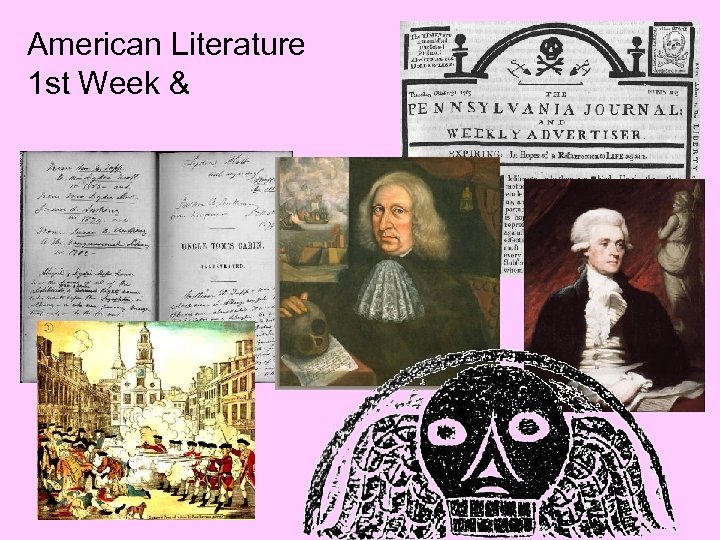 American Literature 1 st Week &
 Puritans 1 -2 • King Henry VIII had split with the Catholic Church because he wanted to divorce his wife and marry other women the Church of England • Some Anglicans wanted to “purify” the Anglican Church of all traces of Roman Catholicism (stained glass, fancy priestly robes…. ) • Puritans (= Saints=Separatists=troublemakers)
 Puritans 2 -2 • Kings James I: either Church of England or jail • After reading Captain Smith’s A Description of New England, the Separatist Pilgrims boarded the Mayflower for New England in 1620. • Of the 102 passengers, half were Saints (to escape hanging). The other half Strangers (to have adventures).
 • THE ENGLISH folk who became Americans during the early years of the seventeenth century kept the language of the relatives and friends whom they left, and with it their share in the literary heritage of the race. They owed much to the influences surrounding them in their new homes, but such skill in writing as they possessed came with them from the other side of the Atlantic.
 The Puritans Believe • • Original Sin The Doctrine of Election Predestination Limited Atonement: Jesus died for the chosen. • Irresistible grace • Perseverance of the “Saints”
 Question • Can we claim that the American sense of responsibility, moral superiority, and nagging guilt come from the Puritan heritage?
 Founders of the American Literature • Before 1700 – John Smith – William Bradford – John Winthrop – Anne Bradstreet – Mary Rolandson – Edward Taylor
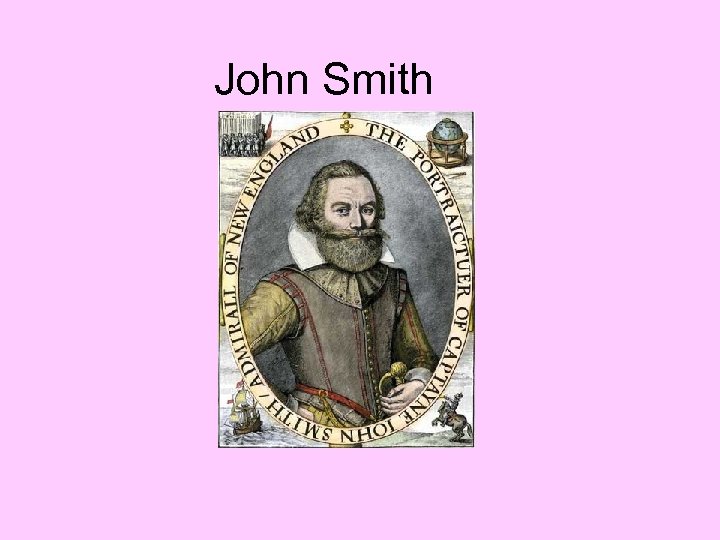 John Smith
 Smith • Among the first settlers in 1606.
 John Smith's Life • (1580– 1631). The story of the life of Captain John Smith, as told by himself, reads more like an adventure novel than like a true autobiography. He was baptized on Jan. 6, 1580, in Willoughby, Lincolnshire, England. • In about 1600 he ran away from home and, traveling through France and at sea, survived some fantastic adventures. • Then he fought in the war against the Turks in Hungary. After being captured and sold into slavery, he escaped to Russia.
 Captain Smith • In 1605 Smith joined an expedition that was preparing to go to America to found the colony of Virginia. During the Virginia voyage he was accused of conspiracy and he faced hanging. He was kept under restraint until after the expedition reached the James River. Then it was discovered that he was one of the councillors appointed by the Virginia Company in England to govern the colony, and the conspiracy charges were dropped. • Soon the incompetence of others forced him to take charge of the Jamestown settlement, and he issued the Jamestown famous order, “He who will not work shall not eat. ” He “He who will not work shall not eat. ” traded with the Indians to supply the colonists with corn.
 Pocahontas • While in Jamestown Smith was captured by hostile Indians and brought before their chief, Powhatan. As a warrior stood ready to club Smith to death, the chief's daughter Pocahontas embraced him and persuaded her father to spare his life. • The truth of Smith's account of his rescue, however, is in doubt.
 Page 52: Pocahontas • Pocahontas, the daughter of Native American Chief Powhatan, helped maintain peace between the Native Americans and English colonists in early America. She was temporarily held captive by the English in 1613, and during this time she and Jamestown colonist John Rolfe fell in love. • Pocahontas converted to Christianity and married Rolfe in 1614. She received a royal welcome from the English upon her trip to London in 1616. While waiting to sail back to America, she became ill with smallpox and died.
 Smith died in London in June 1631 • In 1609 Smith went back to England. In 1614 he charted the coast of southern Canada and the area he named New England. On a return voyage the next year he was captured by pirates, and he returned to England penniless. • He spent much time in writing, and, though his works are not fully reliable, they provide much information about the Jamestown settlement. Smith died in London in June 1631.
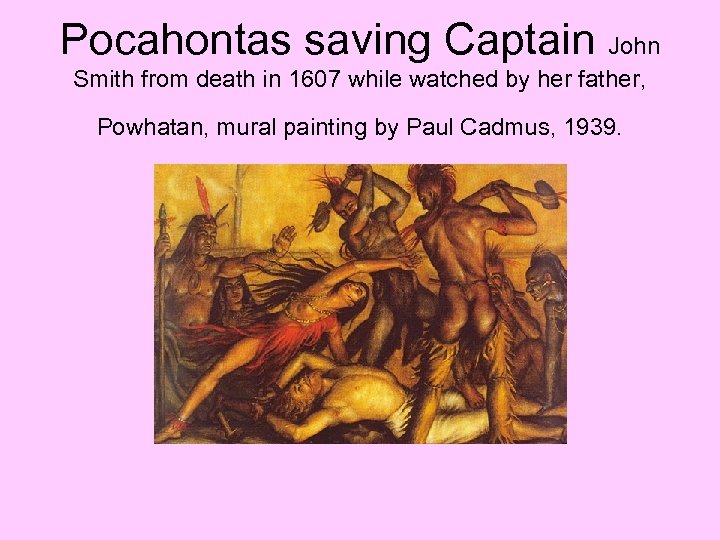 Pocahontas saving Captain John Smith from death in 1607 while watched by her father, Powhatan, mural painting by Paul Cadmus, 1939.
 Smith’s writing style • The European style of writing. It is more elaborate and uses more dependent clauses and phrases to describe than the Puritan Style.
 William Bradford • Bradford was elected governor of Plymouth in the Massachusetts Bay Colony shortly after the Separatists landed in 1620. • The first historian of his colony.
 The Mayflower Compact • A harbinger of the Declaration of Independence. • P. 66
 William Bradford • In 1621 Governor William Bradford of New England proclaimed a day for “thanksgiving” and prayer to celebrate the Pilgrims’ first harvest in America. • United States president Abraham Lincoln, following the precedent of a number of states, designated a national Thanksgiving Day in 1863. • Now Thanksgiving Day falls annually on the fourth Thursday of November.
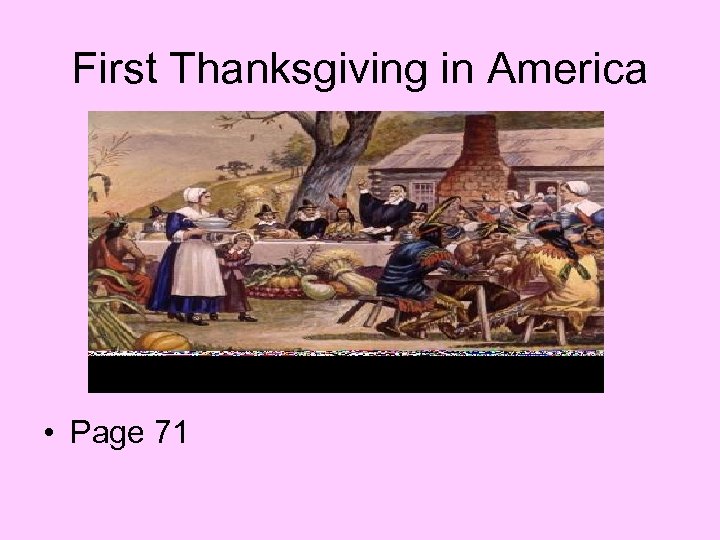 First Thanksgiving in America • Page 71
 An Instance of Bradford’s Puritan Beliefs • P. 58
 What they saw (p. 60) • Being thus passed the vast ocean, and a sea of troubles before in their preparation [. . . ] they had now no friends to welcome them, nor inns to entertain or refresh their weatherbeaten bodies, no houses or much less towns to repair to, to seek for succor. [. . . ] these savages barbarians, when they met with them [. . . ] were readier to fill their sides full of arrows than otherwise. And
 What they saw • For the season it was winter, and they that know the winters of that country know them to be sharp and violent, and subject to cruel and fierce storms, dangerous to travel to known places, much more to search an unknown coast. Besides, what could they see but a hideous and desolate wilderness, full of wild beasts and wild men [. . . ].
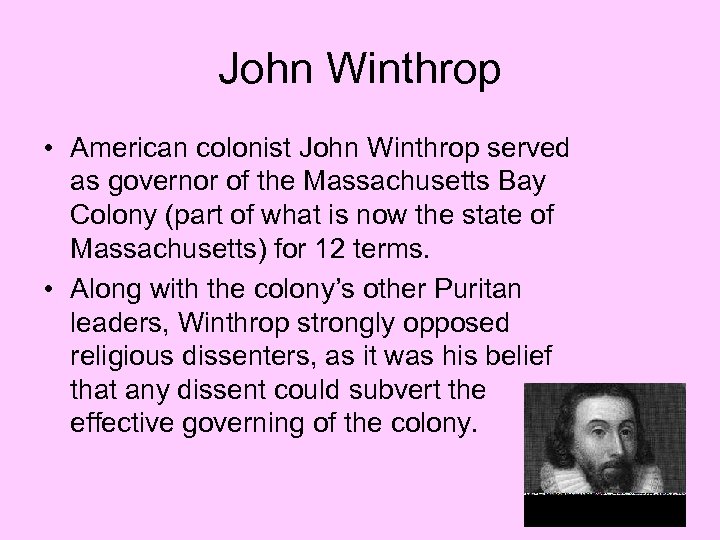 John Winthrop • American colonist John Winthrop served as governor of the Massachusetts Bay Colony (part of what is now the state of Massachusetts) for 12 terms. • Along with the colony’s other Puritan leaders, Winthrop strongly opposed religious dissenters, as it was his belief that any dissent could subvert the effective governing of the colony.
 "A City Upon a Hill" • In 1629 English attorney and Puritan John Winthrop was chosen by the Massachusetts Bay Company, an English trading firm, to govern its colony in New England. Winthrop and 700 Puritan settlers set sail from Yarmouth, England, in March 1630 and landed at what is now Salem, Massachusetts, on June 12. • While bound for New England on board the Arabella, Winthrop delivered a sermon setting forth a moral code and religious goals for the new colony.
 The eyes of all people are upon us. P. 86 • We shall find that the God of Israel is among us, when ten of us shall be able to resist a thousand of our enemies; when he shall make us a praise and a glory, that men shall say of succeeding plantations, 'The Lord make it likely that of New England. ' For we must consider that we shall be as a city upon a hill. The eyes of all people are upon us.
 A Model of Christian Charity • Page 76 -77: Divine Love • Page 84 -85: persons, work, end, means • Well, “A Model of Christian Charity” is important because it expresses the belief that the Puritans were the chosen people of God.
 Anne Bradstreet • Bradstreet was the first poet in America to publish a volume of poetry. The Tenth Muse Lately Sprung Up in America was published in England in 1650. Bradstreet lived in England until 1630. At the age of 18 she arrived in the Massachusetts Bay Colony, where she spent the rest of her life. • Although Bradstreet wrote many poems on familiar British themes and produced skilled imitations of British forms, her most remarkable works responded directly to her experiences in colonial New England. • They reveal her attraction to her new world, even as the discomforts of life in the wilderness sickened her. Her poetry contains a muted declaration of independence from the past and a challenge to authority.
 In which way is Bradstreet’s poetry infused with Puritanism? • P. 108
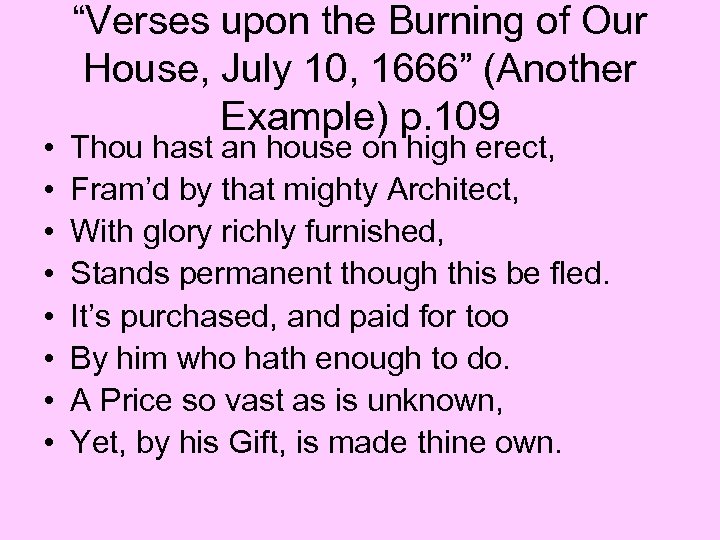 • • “Verses upon the Burning of Our House, July 10, 1666” (Another Example) p. 109 Thou hast an house on high erect, Fram’d by that mighty Architect, With glory richly furnished, Stands permanent though this be fled. It’s purchased, and paid for too By him who hath enough to do. A Price so vast as is unknown, Yet, by his Gift, is made thine own.
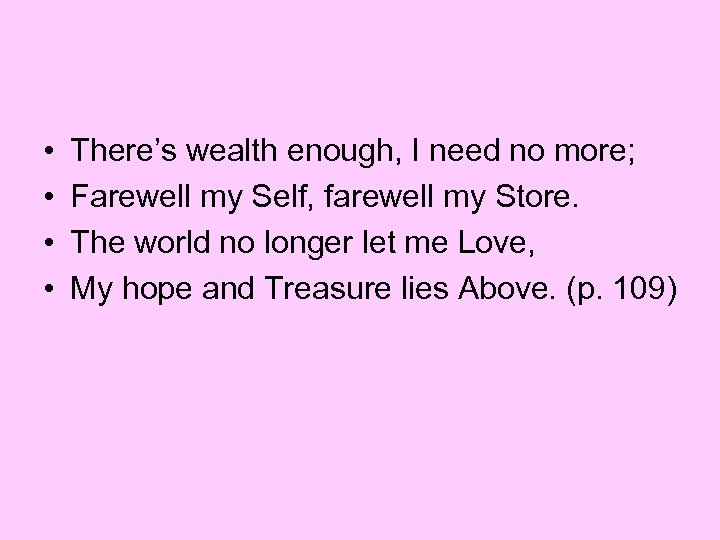 • • There’s wealth enough, I need no more; Farewell my Self, farewell my Store. The world no longer let me Love, My hope and Treasure lies Above. (p. 109)
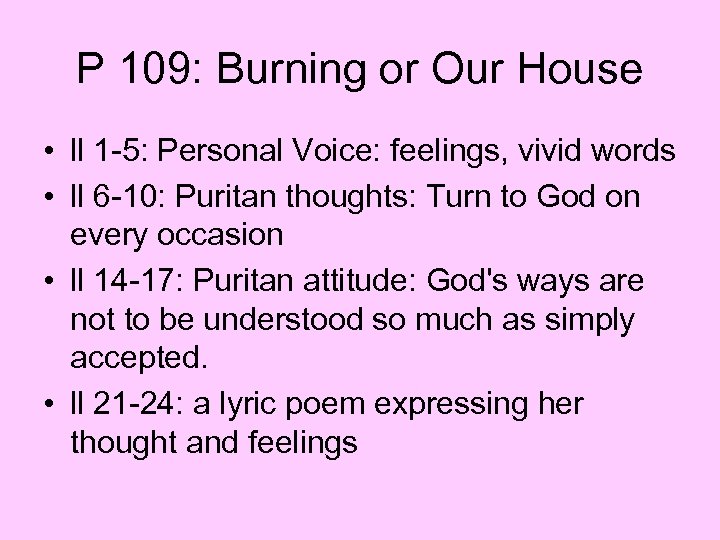 P 109: Burning or Our House • ll 1 -5: Personal Voice: feelings, vivid words • ll 6 -10: Puritan thoughts: Turn to God on every occasion • ll 14 -17: Puritan attitude: God's ways are not to be understood so much as simply accepted. • ll 21 -24: a lyric poem expressing her thought and feelings
 Mary Rolandson • From the clash between the Indians and the British colonists in Massachusetts, there grew a literary genre: the captivity narrative. • Indians ransacked the town of Lancaster in February of 1675. Rolandson relied on her faith in the providence of God to sustain herself during her period of captivity.
 • Rolandson believed that God used the Indians to punish His people for breaking their special covenant as his chosen people. P. 129 -30 • Rolandson believed that the punishment that God had inflicted on the colonists via the Indians was a manifestation of His love. • Well, she was ransomed, and she believed that her eventual redemption affirmed her faith in God’s special relationship with His chosen. p 134
 Question • In 1630, Winthrop spoke to Puritan colonists on the ship Arabella and reminded his fellow colonists: “We are entered into Covenant with Him. ” Rowlandson was captured in 1675. She saw the ransack of the town of Lancaster as God’s punishment of his chosen people. What can we infer from Rowlandson’s story about the change in the Puritan society?
 Edward Taylor • Most of Taylor's poetry is in the metaphysical tradition, and he often used extravagant rhetorical devices. • Taylor's poetry was one of the major literary discoveries of the 20 th century, and since the publication of his work Taylor's reputation has steadily increased. • Many consider him as a great poet.
 Huswifery (p 142) • Make me, O Lord, Thy Spinning Wheel complete. • Thy Holy word my Distaff make for me, • Make mine Affections Thy Swift Flyers neat • And make my Soul thy holy Spool to be. • My conversation make to be Thy Reel • And reel the yarn thereon spun of Thy Wheel
 (skip one stanza) • Then clothe therewith mine Understanding, Will, • Affections, Judgment, conscience, Memory, • My Words, and Actions, that their shine may fill • My ways with glory and Thee glorify. • Then mine apparel shall display before Ye • That I am clothed in Holy robes for glory.
 Huswifery • P. 142 • A conceit: an extended metaphor that compares two startlingly different subjects • What is the conceit in this poem?
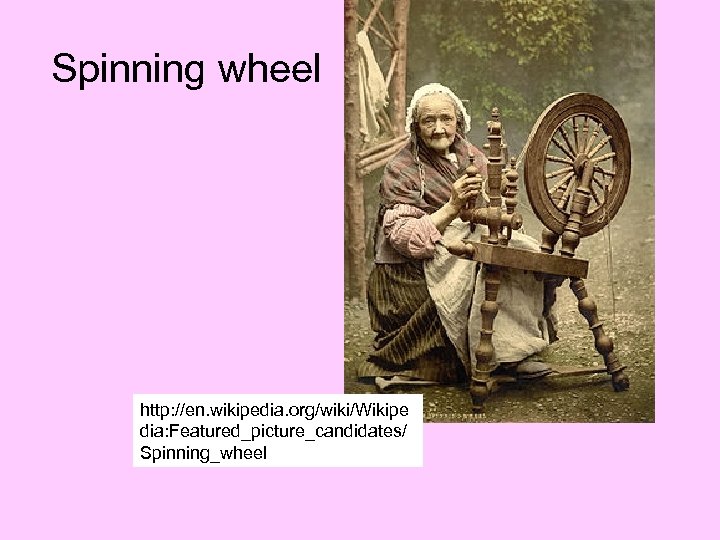 Spinning wheel http: //en. wikipedia. org/wiki/Wikipe dia: Featured_picture_candidates/ Spinning_wheel
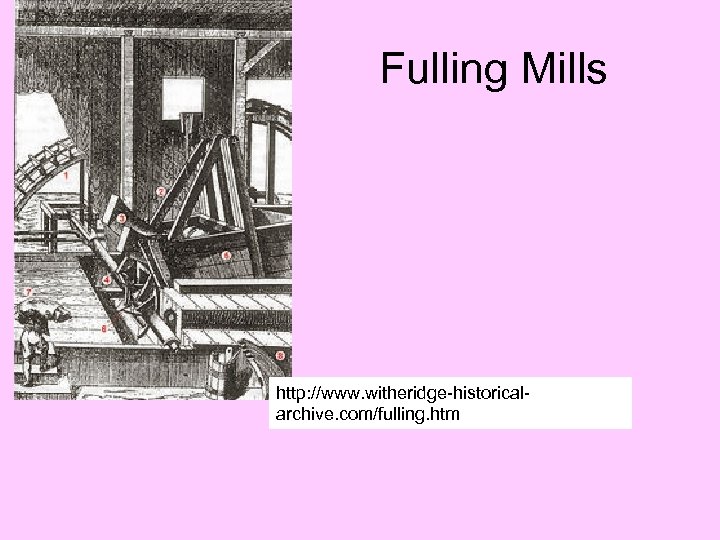 Fulling Mills http: //www. witheridge-historicalarchive. com/fulling. htm
 Question • So what about the Indians? Were they not also the first writers?
 Cotton Mather (1663 -1728) • A Puritan minister, Mather is most famous for being the scribe at the Salem witchcraft trials. • “And we have not with Horror seen the Discovery of such a Witchcraft! An Army of Devils is horribly broke in upon—our English Settlements: and the House of the Good People there are fill’d with the doleful Shrieks of the Children and Servants. ” –Cotton Mather
 The Salem Witchcraft Trials • It all began when some girls conjured some spirits to while away the long winter evening. People were alarmed when the girls began barking like dogs and having fits during Sunday church services. • More than 100 people were tried as witches; 19 people and 2 dogs were put to death.
 Question • In the 1950 s, Senator Mc. Carthy conducted a witch hunt for communists. In the process, he shattered the lives of many innocent and talented people. Has the Puritan era gone?
 Question • Puritans tried to do right in what they saw as an evil world. They left Europe, but the evil society followed them to the New World. What is the problem with those people who are utterly convinced that they know the ultimate truth?
 To The Revolutionary Period • 1700 -1820 – Jonathan Edwards – Benjamin Franklin – Thomas Paine – Thomas Jefferson – and other writers
 Jonathan Edwards & Benjamin Franklin • Transition: Old Puritan beliefs dying. • Edwards and Benjamin both of New England, Puritan background, yet • Edwards’s emphasis: the divine world • Benjamin’s emphasis: this world • Both influenced by Enlightenment thinkers, yet • Edwards: putting rationalism in the service of theology • Benjamin: embracing Enlightenment
 Edwards’s “Sinners in the Hands of an Angry God” • Famous for his frightening images in that sermon. P. 200 • The Great Awakening, p. 154 • Between 1730 and 1745 there swept over the American colonies from Maine to Georgia a religious revival known as the Great Awakening The revival movement, unlike the earlier doctrine of the Puritans, promised the grace of God to all who could experience a desire for it. The series of religious revivals began with Jonathan Edwards.
 An Example (p. 200) • O sinner! Consider the fearful danger you are in: it is a great furnace of wrath, a wide and bottomless pit, full of the fire of wrath, that you are held over in the hand of that God, whose wrath is provoked and incensed as much against you, as against many of the damned in hell. You hang by a slender thread, with the flames of divine wrath flashing about it, and ready every moment to singe it, and burn it asunder [. . . ]
 Terms Puritanism Captivity narrative The Great Awakening
 Question • Compare John Smith's and the Puritans' accounts of life in America. Try to account for the similarities and differences by referring to their personalities, motives, and backgrounds.