


 Скачать презентацию AMERICAN LIGHTING ASSOCIATION CURRENT AND EMERGING ISSUES IN
cffec2b384e6c44260e4ae31781fe858.ppt
- Количество слайдов: 27
 AMERICAN LIGHTING ASSOCIATION CURRENT AND EMERGING ISSUES IN FREIGHT TRANSPORTATION FACING YOUR BUSINESS SEPTEMBER 2011 John M. Cutler, Jr. Mc. Carthy, Sweeney & Harkaway, P. C. 1825 K Street, N. W. , Suite 700 Washington, DC 20006 (202) 775 -5560 jcutler@mshpc. com 1
 OVERVIEW • Companies that manufacture and distribute goods face new challenges in dealing with transportation service providers and intermediaries • Trucking companies, railroads, air carriers, ocean shipping lines, forwarders and brokers also face new challenges • Higher costs and potential reductions in capacity and service quality are likely • As usual, Washington, DC isn’t helping 2
 CARRIER-SHIPPER ISSUES • All carriers – ground, air and water – want to charge more and reduce their own liability exposure • These are givens, but the recession has increased the leverage of many motor, rail, air and water carriers in negotiations • Capacity is tight, demand is rising and carrier costs for fuel, financing, personnel and compliance are rising • It all adds up to increases approaching if not exceeding 10% in many shippers’ transportation budgets 3
 DEALING WITH TRUCKING COMPANIES • TL carriers are exercising more pricing power than LTL • All motor carriers are looking for fuel cost recovery through surcharges • Contract negotiations are more contentious – the ALA model contract can help • Be prepared for more detention charges • Be prepared for resistance to one-way indemnification clauses • Protect against NMFC changes 4
 DEALING WITH TRUCKING COMPANIES (continued) • Good liability coverage is harder to get - Up to $100, 000 per shipment is the best most shippers can expect - Trucking companies are looking to make that coverage the exception rather than the rule - Techniques include alternative coverages, e. g. , lowest released value in NMFC - Waiver of subrogation - Avoid antiquated bills of lading 5
 DEALING WITH TRUCKING COMPANIES • Guard against being dragged into personal injury or wrongful death cases arising out of highway accidents • Your motor carriers need insurance and a Satisfactory safety rating • Your motor carrier must advise you immediately of any changes in safety rating or insurance coverage • Established, financially secure trucking companies tend to be safer and should be preferred • Consider using a service that monitors trucking company safety • Agree in writing that trucking company compliance with safety requirements must supersede customer scheduling instructions 6
 DEALING WITH BROKERS/FORWARDERS • Many companies use them and they can be excellent • Read their contracts carefully – what do they actually agree to do for you? • Do they agree to deliver lower transportation costs? If so, how good are their carriers? • Do they agree to arrange for your goods to move only via safe, experienced, financially sound carriers? 7
 DEALING WITH BROKERS/FORWARDERS (continued) • Do they agree to indemnify you if there is an accident/lawsuit? • What cargo liability coverage will you get? Who pays claims? • Care in negotiating your contract can pay off • Incorporate into your broker contract a requirement for the broker to arrange for the service standards you want from carriers • Use financially responsible brokers to avoid paying freight charges twice 8
 DEALING WITH OCEAN SHIPPING LINES, AIR CARRIERS AND RAILROADS • Negotiating better liability coverage with these carriers is difficult • Domestic and international air cargo coverage • Liability for connecting trucking companies may be governed by ocean or air industry norms • Rail intermodal is growing due to improved service quality 9
 DEALING WITH OCEAN SHIPPING LINES, AIR CARRIERS AND RAILROADS (continued) • Contracting is possible but may not be worthwhile – too many take-it-or-leave-it provisions • Contracting with ocean shipping lines and NVOCCs is subject to Federal Maritime Commission regulations at 46 C. F. R. Part 530 and 531 • Watch out for surcharges and volume commitments • Be prepared for cross-border security requirements • Bills of lading used for trucking may not work for railroads in truck-rail intermodal 10
 GOVERNMENT POLICIES ARE LIKELY TO MAKE THINGS WORSE • Gridlock in Congress makes it difficult to do anything • Deficit and debt concerns make it difficult to increase spending • Programs to promote economic growth cannot get through Congress • Executive branch regulatory agencies are subject to reduced Congressional oversight • Health, safety, environmental and security regulations are growing for the transportation industry 11
 INFRASTRUCTURE • Everyone knows we need to spend more • Fuel taxes not increased since 1993 and are not indexed for inflation • Many bipartisan, expert studies urge higher fuel taxes, possible VMT, and a greater focus on freight • House T&I produced draft Highway Bill that looked like the most comprehensive approach to the problem in history • Funding was the insurmountable problem 12
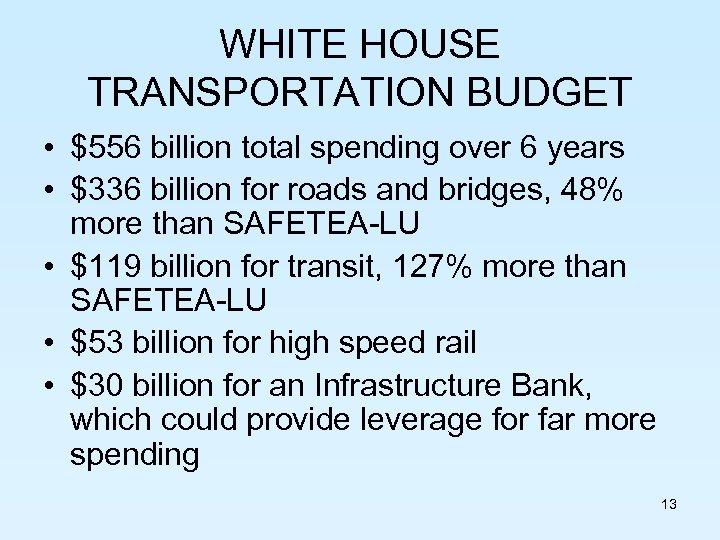 WHITE HOUSE TRANSPORTATION BUDGET • $556 billion total spending over 6 years • $336 billion for roads and bridges, 48% more than SAFETEA-LU • $119 billion for transit, 127% more than SAFETEA-LU • $53 billion for high speed rail • $30 billion for an Infrastructure Bank, which could provide leverage for far more spending 13
 CHAIRMAN MICA’S CURRENT THINKING • Do more with less • Three-pronged approach - Use existing fuel tax revenue (NO TAX INCREASE) - Add unspent stimulus bill money - Stretch funding by making highway projects cheaper and faster • Get next Highway Bill enacted into law by the end of current fiscal year (9/30/11), two years after SAFETEA-LU expired 14
 PROSPECTS FOR SUCCESS • The White House budget sounds good but has little chance of success. The House Bill cuts spending which need to be increased. • ATA President Bill Graves and Senate Finance Committee Chairman Max Baucus predict no new Highway Bill in 2011 or 2012, when Presidential elections will make everything harder • Assuming funding is found, who will provide it? • Assuming funding is found, where will it go? 15
 RAILROADS ARE DOING GREAT • Raising rates and fuel surcharges and making record revenues and profits • Warren Buffett couldn’t be happier with Berkshire Hathaway’s purchase of BNSF • Wall Street loves the railroads • DOT loves railroads, extending record funding and calling for more freight to move by trains, not trucks 16
 AIRLINES • FAA Reauthorization Bill passed by House • Can 2007 FAA Act, which has been extended 21 times, finally be updated? • No Fed. Ex labor provision • Veto threat due to provision overturning NMB ruling facilitating unionization • Next Gen air traffic control system • Shutdown over subsidies to rural airports 17
 CAUSE FOR CONCERN OVER TRUCKING • Fuel Costs • Lack of progress on Highway Bill • Hours of Service, CSA and Driver Shortage • DOT Policy • Truck Size and Weight Limits • Where is the good news for trucking? 18
 HOURS OF SERVICE • Hours of Service rules in effect from 2003 -2011 have worked well • Highway crash rates and fatalities have fallen, including 3% drop in 2010, to lowest levels ever • FMCSA nevertheless wants to reduce daily driving time by 1 hour (plus mandatory ½ hour break or two) • FMCSA also wants to regulate weekend sleep time (the “restart”) that could mean the required 34 hours off is actually as much as 48 hours off • Result could also force drivers coming off restart to drive during morning rush hour 19
 HOURS OF SERVICE (continued) • Trucker and shipper requests for more flexibility for team drivers with sleeper berths were brushed aside • FMCSA support for these changes is skimpy and flawed • Carrier groups, shipper groups, drivers and over 100 members of Congress filed comments opposing HOS rule changes • Proposed rules will exacerbate driver shortage 20
 COMPLIANCE, SAFETY, ACCOUNTABILITY • New FMCSA program to improve trucking company and safety accountability and performance is being implemented • Rulemaking proceeding soon • Safer highways likely to result, as bad apples (drivers and trucking companies) are forced to improve or seek other employment 21
 COMPLIANCE, SAFETY, ACCOUNTABILITY (continued) • Greater complexity; danger of lost business due to misleading appearance of problems • Will not help driver shortage • Danger of exposure to personal injury lawsuits • Contract updates are recommended 22
 DOT POLICIES • For decades, DOT has supported all modes of transportation • Today, DOT favors rail, giving rail projects more funding • DOT needs major freight railroads to cooperate with High Speed Rail program • DOT may also be responding to environmental and congestion concerns 23
 DOT POLICIES (continued) • DOT may also be defining the need for highway spending down, in light of deficit concerns and gridlock • DOT is also very interested in bike trails and “livability” • Bottom line: DOT Secretary La. Hood is calling for shifting freight from trucks to trains 24
 OTHER TRANSPORTATION DEVELOPMENTS • FMCSA proposes to seek expanded authority so it can regulate “shippers, receivers, brokers and forwarders” • FMCSA expresses concern about truck drivers forced to wait to load or unload • FMCSA says it wants to regulate the entire commercial motor vehicle “transportation life-cycle” • Congress is unlikely to go along, but ALA may want to monitor this proposal 25
 OTHER TRANSPORTATION DEVELOPMENTS (continued) • FMCSA wants EOBRs on 500, 000 carriers, subject to penalties of up to $11, 000 • Tentative new deal announced to resolve NAFTA debate over Mexican truckers serving U. S. destinations, ending punitive Mexican tariffs on U. S. Goods • Safety and union concerns and gridlock make progress doubtful. FMCSA plan to provide EOBRs for Mexican trucks doesn’t help. • Congress is considering efforts to increase GVW from 80, 000 lbs. to 97, 000 lbs. HR 763 and HR 801, and S 747. Railroads oppose and want more trucking subject to 80, 000 lb. maximum. 26
 PORT DRAYAGE UNIONIZATION • Efforts continue to require independent truckers in port drayage service to become employees • Port of Long Beach showed that this is not necessary to reduce pollution • Goal is to facilitate efforts by Teamsters to organize drayage companies • ATA is in court fighting Port of Los Angeles on issue 27