


 Скачать презентацию American Government and Politics Today Chapter Two Forging
141cc7de04edd2e46677f07e54f7633b.ppt
- Количество слайдов: 28
 American Government and Politics Today Chapter Two: Forging a New Government: The Constitution
 Learning Outcomes LO 1 Explain how the colonial experience prepared Americans for independence, the restrictions that Britain placed on the colonies, and the American response to those restrictions. LO 2 Describe the significance of the Declaration of Independence and the Articles of Confederation, as well as the weaknesses of the articles. LO 3 Discuss the most important compromises reached at the Constitutional Convention and the basic structure of the resulting government. LO 4 Summarize the arguments in favor of and the arguments against adopting the Constitution, and explain why the Bill of Rights was adopted. LO 5 Describe the process of amending the Constitution and the informal ways in which constitutional interpretation has changed over time. Copyright © 2015 Cengage Learning 2
 The Colonial Background • Jamestown • Representative assembly • Separatists, the Mayflower, and the Compact • The significance of the compact • Pilgrim beliefs Copyright © 2015 Cengage Learning 3
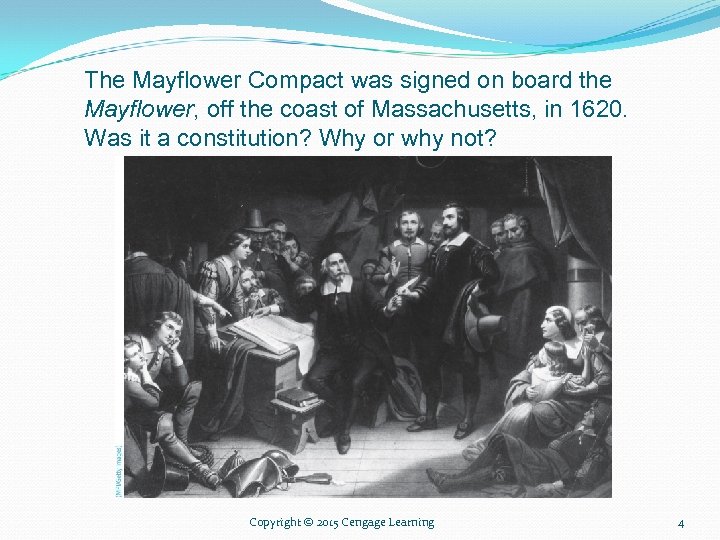 The Mayflower Compact was signed on board the Mayflower, off the coast of Massachusetts, in 1620. Was it a constitution? Why or why not? Copyright © 2015 Cengage Learning 4
 The Colonial Background • More Colonies, More Government • British Restrictions and Colonial Grievances Taxed colonies to pay for war Sugar Act, Stamp Act Boston Tea Party Coercive Acts Copyright © 2015 Cengage Learning 5
 The Colonial Background The First Continental Congress Grievances Troops Boycotts Copyright © 2015 Cengage Learning 6
 The Colonial Background The Second Continental Congress (1775) Common Sense Thomas Paine Called for independence Copyright © 2015 Cengage Learning 7
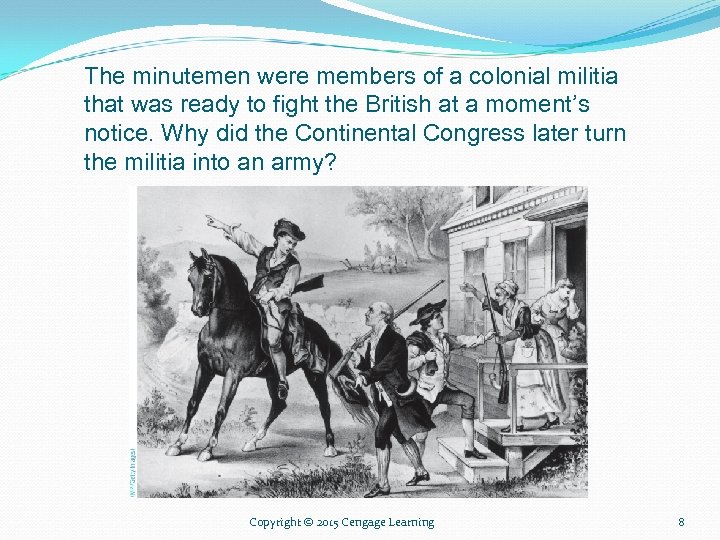 The minutemen were members of a colonial militia that was ready to fight the British at a moment’s notice. Why did the Continental Congress later turn the militia into an army? Copyright © 2015 Cengage Learning 8
 An Independent Confederation The Resolution for Independence Second Continental Congress (1776) Free trade with all nations except Britain State governments Resolution for Independence adopted Copyright © 2015 Cengage Learning 9
 An Independent Confederation July 4, 1776 – The Declaration of Independence Universal truths Natural rights and social contracts Copyright © 2015 Cengage Learning 10
 An Independent Confederation July 4, 1776 – The Declaration of Independence The Significance of the Declaration National identity Legitimacy of U. S. to foreign nations Copyright © 2015 Cengage Learning 11
 An Independent Confederation The Rise of Republicanism Anti-Royalists/Republicans: against strong central government Increase in powerful state legislatures Copyright © 2015 Cengage Learning 12
 An Independent Confederation The Articles of Confederation: Our First Form of Government The Articles establish a government Accomplishments under the Articles Weaknesses of the Articles Shays’ Rebellion and the need to revise the Articles Copyright © 2015 Cengage Learning 13
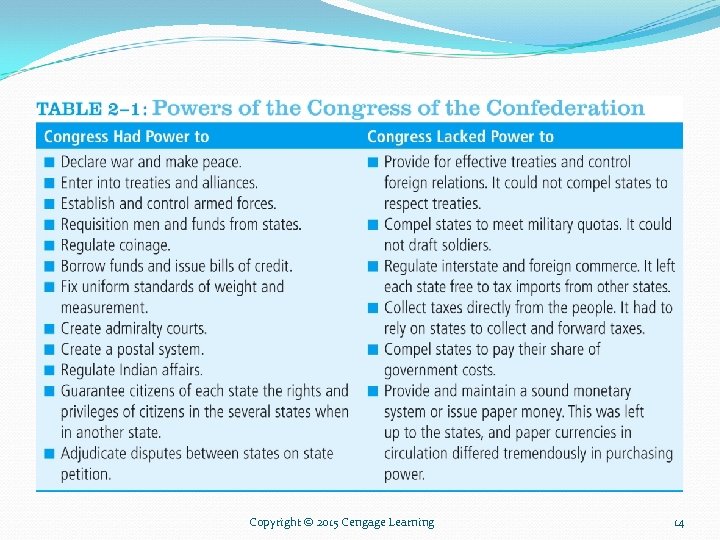 Copyright © 2015 Cengage Learning 14
 The Constitutional Convention Factions among the Delegates Majority: strong central government Disagreed on details Minority: against national authority Copyright © 2015 Cengage Learning 15
 The Constitutional Convention Politicking and Compromises The Virginia Plan The New Jersey Plan The “Great Compromise” House of Representatives based on population Senate: Two members per state Copyright © 2015 Cengage Learning 16
 The Constitutional Convention Politicking and Compromises The Three-Fifths Compromise Other issues No tax on exports Congress regulates commerce Supreme Court and lower courts Copyright © 2015 Cengage Learning 17
 The Constitutional Convention Working Toward Final Agreement The Madisonian Model Separation of powers Checks and balances The executive Copyright © 2015 Cengage Learning 18
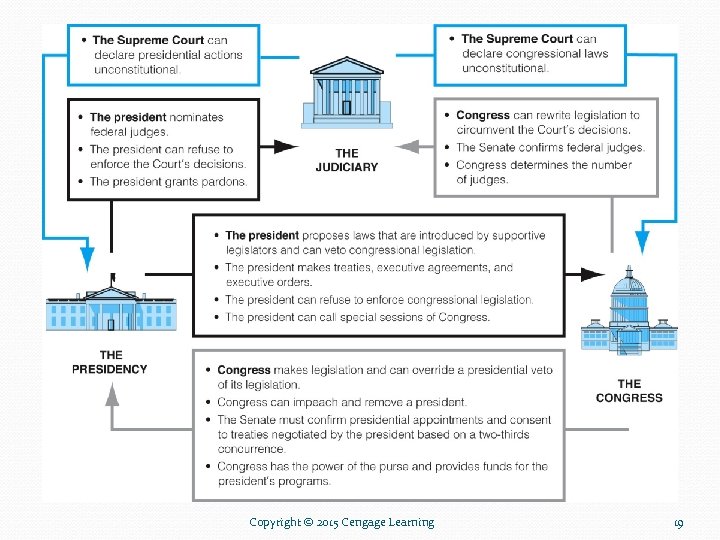 Copyright © 2015 Cengage Learning 19
 The Constitutional Convention The Final Document Popular sovereignty Republican/representative government Limited government via written laws Separation of powers Federal system with room for states’ rights Copyright © 2015 Cengage Learning 20
 The Difficult Road to Ratification The Federalists Push for Ratification The Federalist Papers The Anti-Federalist Response Called for a bill of rights Feared weakened state power Copyright © 2015 Cengage Learning 21
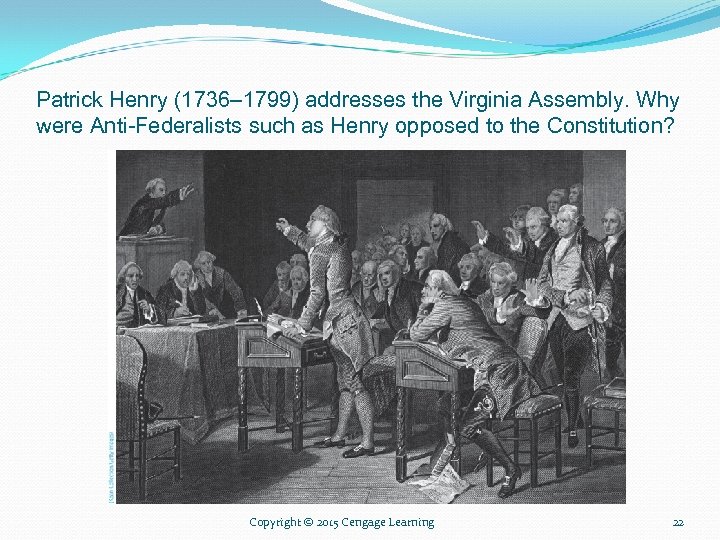 Patrick Henry (1736– 1799) addresses the Virginia Assembly. Why were Anti-Federalists such as Henry opposed to the Constitution? Copyright © 2015 Cengage Learning 22
 The Difficult Road to Ratification The March to the Finish Required nine states to ratify The Bill of Rights Discussed at state ratifying conventions Protected individual liberties at national level Copyright © 2015 Cengage Learning 23
 Altering the Constitution The Formal Amendment Process Proposal Two-thirds of both houses of Congress or Two-thirds of state legislatures ask Congress to call convention (never been used) Ratification Three-fourths of state legislature approval Special convention called in the states with a positive vote by 3/4 of the states (used once) Copyright © 2015 Cengage Learning 24
 The Right to Keep and Bear Arms Click picture to play video Copyright © 2015 Cengage Learning 25
 The Right to Keep and Bear Arms Taking a closer look: 1. What was the original intent of the Second Amendment? Why did the Founding Fathers include this amendment? 2. Has public opinion on private gun ownership significantly changed since this video aired? 3. Should this matter be decided on a state by state or national basis? Copyright © 2015 Cengage Learning 26
 Altering the Constitution Informal Methods of Constitutional Change Congressional legislation Presidential actions Judicial review Interpretation, Custom and Usage Copyright © 2015 Cengage Learning 27
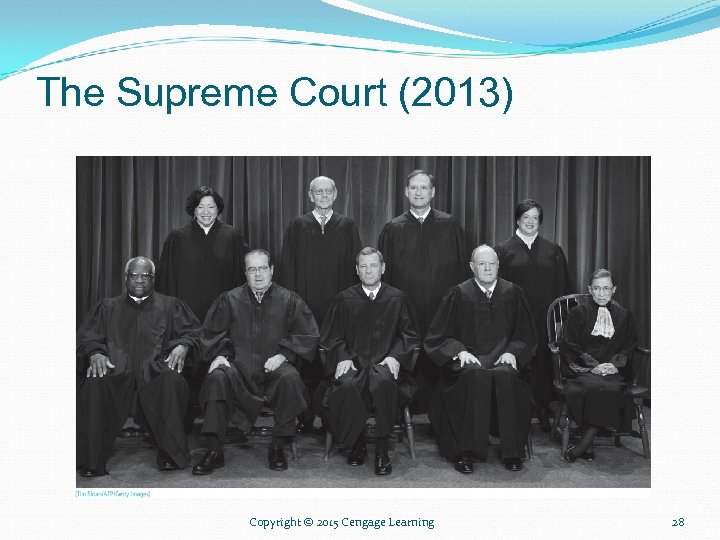 The Supreme Court (2013) Copyright © 2015 Cengage Learning 28