


 Скачать презентацию American Government and Politics Today Chapter 11 The
8f3973bece74be485ceb58e6ffd8dbb2.ppt
- Количество слайдов: 38
 American Government and Politics Today Chapter 11 The Congress
 Why Was the Congress Created? Fear that power in the hands of a single individual would be abused and the people would suffer. l Founders wanted a body that would above abuse of power l Were they successful? l
 Bicameral (two-house) institution. -The House was to be elected by the people and would therefore represent the views of the people. -The members of the Senate were selected by the state legislatures and would be at least one step removed from the people. l
 MEMBERSHIP IN THE HOUSE & SENATE House of Rep. (based on pop. ) -435 members, at least 1 / state, for 2 years -qualifications? -quorum = min. # necessary to do business (218) Ø Senate (2 / state) -100 members, for 6 year term -only 1/3 Sen. runs for re-election every 2 yrs -Qualifications? Ø
 Should there be term limits placed on Congress?
 The Functions of the Congress l l (1) the lawmaking function (2) the representation function • The trustee view of representation: -suggests that the role of a rep is to act in the interest of his/her constituents -entrusted to make decisions that will benefit the district • The (instructed) delegate view of representation: -suggested that the rep should act only on the instruction of his/her constituents -acts as the voice of those who are literally present
 l l (3) Service to constituents (4) The oversight function: Reviewing actions of the Executive Branch (5) The Public-Education Function (6) The Conflict Resolution Function
 “Your” Congress Web Search Ø You are going to conduct a web search to determine who is currently in Congress (we will be basing this on the current Congress, not affected by the recent election)
 The Powers of Congress l Enumerated Powers. (Article I, Section 8 of the Constitution) • Taxing & Spending • Foreign Policy • Reg. Interstate Commerce • Provide for Nation’s Growth • Other Powers -grants copyrights -grants patents
 Non-legislative Powers (1) power to choose the President (2) removal power (3) confirmation power (4) ratification power • The Necessary and Proper Clause. • Allows Congress to make laws that are deemed to be necessary to carry out the expressed powers •
 House-Senate Differences Rules l Debate and filibustering in the Sen. -filibuster : means to “talk a bill to death” -cloture : a time-limit on speeches and debates on a certain bill • Prestige -franking privilege : free mail service l
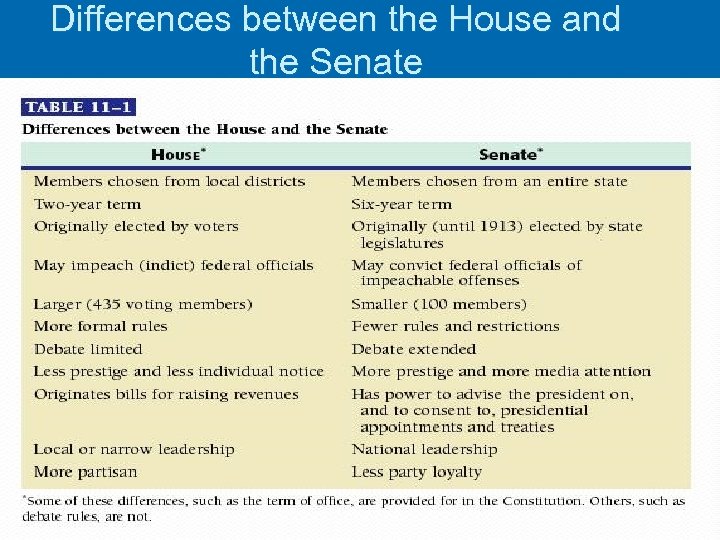 Differences between the House and the Senate
 Who are our Congress people? Differences between common citizens and Congressmen -The members of Congress are older, wealthier, and better educated -There are relatively few women and members of minority groups in Congress. -There a disproportionate number of lawyers in both houses of Congress. -The current congressional salary is $174, 000. l
 Leadership has its’ Advantages Ø Senate Leadership Majority Party Leader - $193, 400 Minority Party Leader - $193, 400 Ø House Leadership Speaker of the House - $223, 500 Majority Leader - $193, 400 Minority Leader - $193, 400
 Congressional Elections l Candidates for Congressional Elections: • Candidates can be self-selected or recruited by the local political party. • Usually the party attempts to select a candidate that has many of the social characteristics of the population in the district.
 l Congressional campaigns and elections • Campaign funding • Effects of Presidential elections • The Power of Incumbency • Being an incumbent is the best advantage in an election – why?
 Congressional Apportionment House seats are apportioned following the census. • Reapportionment—the allocation of seats in the House of Representatives to each state after each census; • Redistricting—The redrawing of the boundaries of the congressional districts within each state -1929 House limited to 435 Problems with redistricting: -gerrymandering – designing a district for a party’s advantage l
 Ø Problems with redistricting: -gerrymandering – designing a district for a party’s advantage
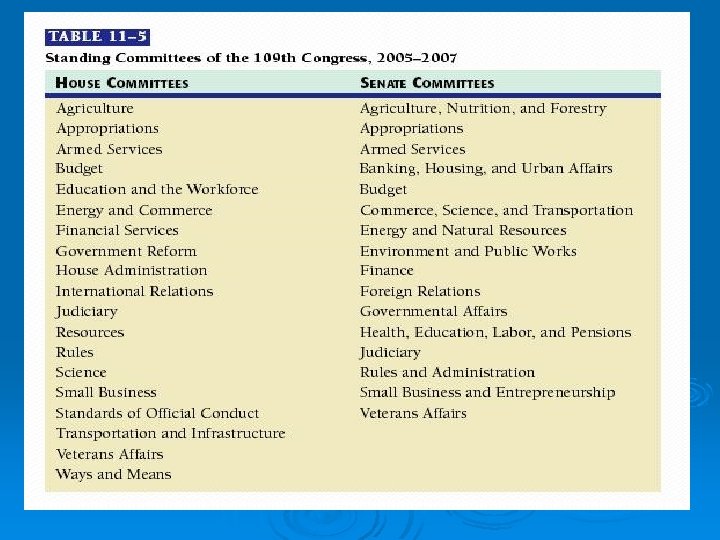
 The Committee Structure l l l Known as “Little Legislatures” The Power of Committees • determine whether a bill will reach the floor and be called for a vote. Types of Congressional committees • Standing Committees ** (p. 352) -permanent committees that considers bills within a certain issue area • Select Committees -temporary committee used for a limited time and a special purpose
 • Joint Committees -made up of both House and Senate members • Conference Committees -to reconcile differences when bills pass the two houses in different forms • House Rules Committee -very powerful -sets debate time and how bills may be amended
 Ø The Selection of Committee Members -appointed by a Steering Committee of their party -majority party members w/ the longest service record -Seniority System
 Formal Leadership l l The majority party controls the legislative process, including the selection of congressional leaders. Any shift in party status will initiate a shift in those who fill the leadership positions.
 l Leadership in the House • The Speaker (powers p. 375) • The Majority Leader • The Minority Leader • Whips
 l Leadership in the Senate • Vice President • President Pro Tempore • Majority Leader
 Congressional Decision-making l l l Party membership is a major determinant of how members vote, but it is not the only factor at work. The Conservative Coalition (1980’s) -an alliance of Rep. & southern Dem. that oppose liberal leg and supports conservative leg. “Crossing over” -ind. that “cross over” to the other party depending on the issue
 How a Bill Becomes a Law (p. 355) l l l For a bill to become law, it must pass through both houses of Congress. All “money bills” or spending measures must originate in the House. Why?
 l House of Representatives • Introduction • Committee Stage • Rules Committee • Floor Action
 Ø The procedure in the Senate is similar, but there are no special rules such as those set by the House Rules committee; the leadership schedules action.
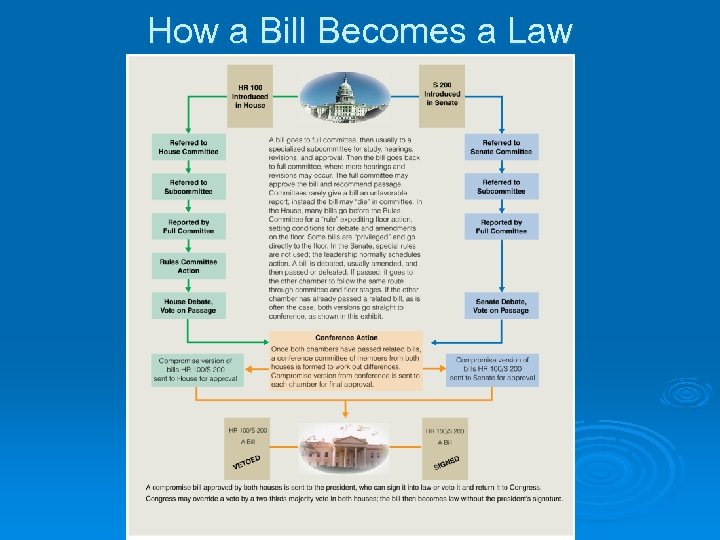 How a Bill Becomes a Law
 l Conference committee • If there are differences between the House version of the bill and the Senate version of the bill • Members of each chamber selected by the leaders will attempt to reach a compromise on the bill. • The House and Senate vote on the bill as reported by the conference committee
 Presidential Action on Proposed Bills l l If the president is in favor of the bill s/he will sign the bill into law. If the president is opposed to the bill s/he will most likely veto the bill and send it back to the chamber that originated the action on the bill with his reasons for the veto.
 l If both houses vote to override the veto by a two-thirds vote, the bill becomes law without the president’s signature.
 l The President may opt to take no action on the bill. -pocket veto – if the president refuses to sign it and Congress adjourns within 10 working days after it has been submitted to the president, it is killed for that session of Congress -if the bill is not sent back to Congress after 10 congressional days, it becomes law without the president’s signature
 How Much Will the Government Spend? l l l Preparing the Budget Suggestions come from the President Congress Faces the Budget • Authorization, a formal declaration by a legislative committee that a certain amount of funding may be available to an agency.
 Some authorizations terminate in a year; others are renewable automatically without further congressional action. Ø Appropriation, the passage, by Congress, of a spending bill specifying the amount of authorized funds that actually will be allocated for an agency’s use. Ø
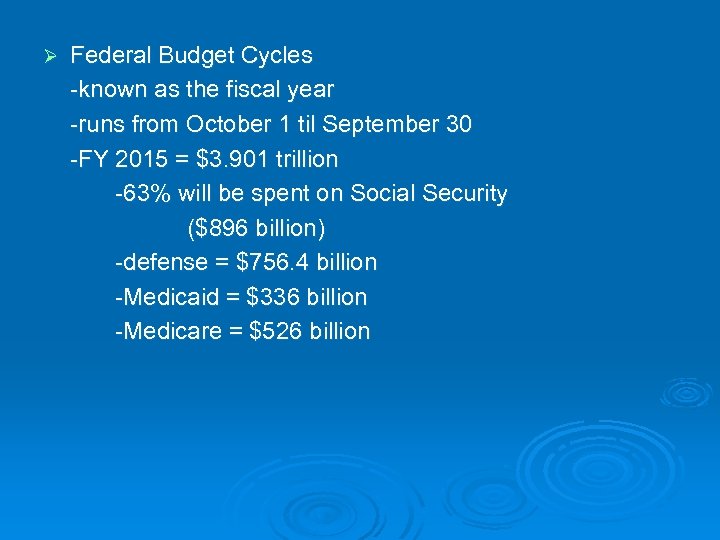 Ø Federal Budget Cycles -known as the fiscal year -runs from October 1 til September 30 -FY 2015 = $3. 901 trillion -63% will be spent on Social Security ($896 billion) -defense = $756. 4 billion -Medicaid = $336 billion -Medicare = $526 billion
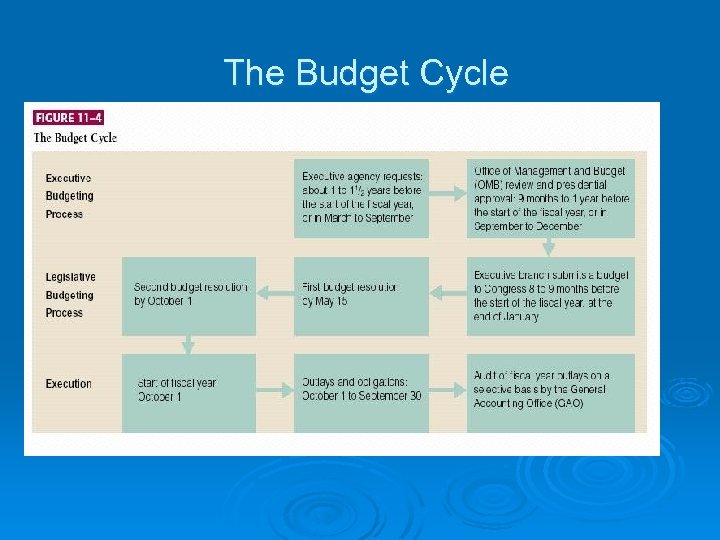 The Budget Cycle