


 Скачать презентацию American Government and Organization PS 1301 -164 Friday
c2c9dff67aa18114cc4e2e5858e474c6.ppt
- Количество слайдов: 20
 American Government and Organization PS 1301 -164 Friday, 19 September
 Plan for the lecture Small change in course outline. We will discuss how congress is organized and then move on to discuss the legislative process.
 Organization of Congress While the Constitution outlined a basic framework for Congress, throughout two centuries the institution has evolved into a complex mix of rules, procedures, and customs. To understand the House and Senate, one must understand what representatives and senators want to accomplish and what obstacles they have to overcome to achieve their goals.
 The Basic Problems of Legislative Organization To exercise the powers conferred on them by the Constitution, the House and Senate had to solve some basic problems: n n How to acquire information How to coordinate action How to resolve conflicts How to get members to work for common as well as personal goals.
 The Need for Information A legislator cannot regulate the stock market or attack environmental pollution without having key information related to these areas. Congress has attempted to solve the problem by utilizing division of labor and specialization as tools. By becoming specialists (or employing them) in policy areas, and by creating a support foundation of information gatherers and interpreters, they can make more informed decisions.
 Coordination Problems Coordination (trying to act in concert) becomes more difficult (and necessary) the greater the group’s workload and the more elaborate its division of labor. As Congress has grown, it has had greater need for traffic management. Congress has used its party leaders to act as the “traffic cops” giving them power to manage the business of legislating and control over the agenda.
 Resolving Conflicts Legislation is not passed until the majorities in both houses agree to its passage. Many of Congress’s rules, customs, and procedures are aimed at resolving or deflecting conflicts so it can get on with the business of legislating. n n Norms of collegiality. Parties are ready made coalitions.
 Collective Action The problem: what members do to pursue individual goals may undermine the reputation of their party or of Congress as a whole. Primary goal for individual members is to get reelected. The committee system, however, gives members individual incentives to work for collectively beneficial ends. How? Seniority rules automate decisions as to who serves on committees, etc. This minimizes the time and effort members might spend competing for these positions.
 Organizing Congress The two most crucial institutional structures created to exercise Congress’s constitutional powers are n n the party system, and the committee system. Without them it would be difficult to overcome the barriers to effective collective action.
 The Importance of Consensus The degree of consensus within a party continues to affect how much authority party members are willing to delegate to party leaders. When there is broad and deep agreement, there is more cohesion among the coalition.
 The Importance of Consensus Over the decades, there has been significant variation in the coordinating ability of parties in Congress. Since the 1950 s there has been a decline and resurgence of congressional partisanship. As they have become more unified, they also become more polarized along ideological lines. Republicans grew more conservative. Democrats became more liberal as their party’s conservative southern members were gradually replaced in Congress by Republicans.
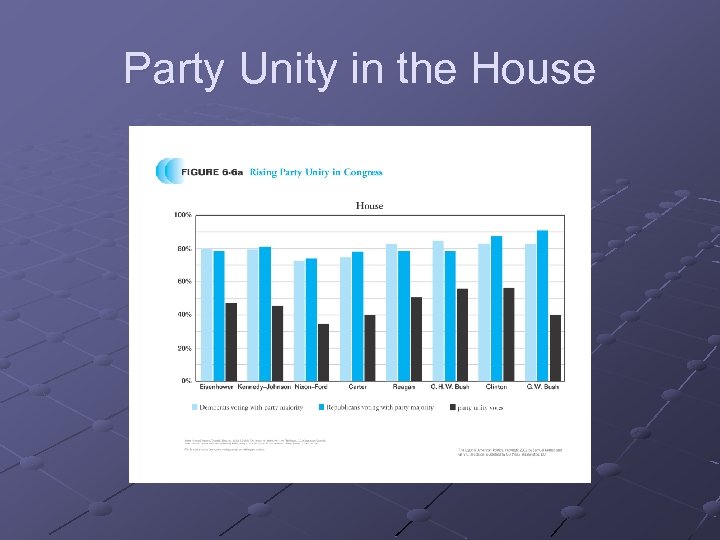 Party Unity in the House
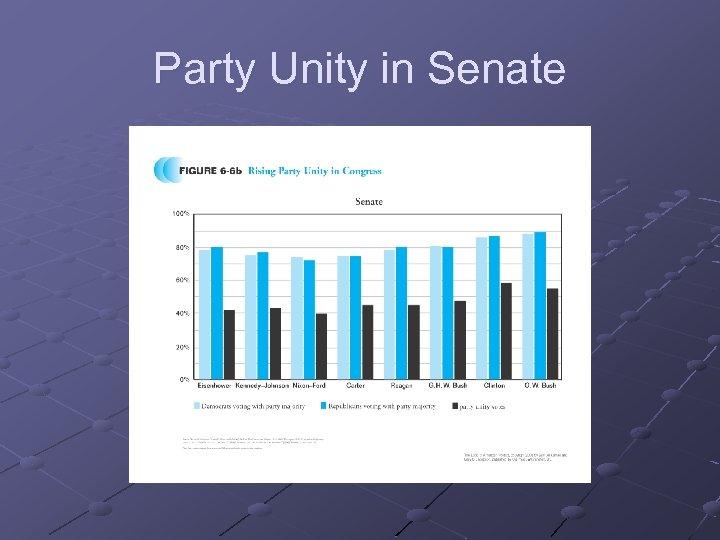 Party Unity in Senate
 Party Leadership Party members give House party leaders resources for inducing members to cooperate when they are tempted to go their own way as free riders. These resources take the form of favors they may grant or withhold (committee assignments, direction of the legislative agenda).
 Party Organization (House) Majority leadership positions n n n Speaker of the House (Dennis Hastert R-IL) Majority Leader (Tom Delay R-TX-22 nd District includes Brazoria, Fort Bend, and Harris Counties) Majority whip (Roy Blunt-R-MO) Whips form communication network connecting leaders to members Minority leadership positions n n Minority Leader (Nancy Pelosi D-CA) Minority Whip (Steny Hoyer D-MD) Link to Leadership offices in House
 Party Organization (Senate) Majority leader (Bill Frist R-TN) Minority leader (Tom Daschle D-SD) Link to Senate leadership
 Party Leadership in the Senators have never delegated as much authority to their leaders as have representatives. The norm of equality (ambassadors from their states to the national government) led them to retain wider freedoms of individual action.
 Committee System Standing Committee (exist from one Congress to the next) Fixed jurisdiction and stable membership =specialization Bills are assigned to committees on the basis of subject matter Committee’s jurisdiction usually parallel those of the major departments or agencies in the executive branch. Each committee is unique Each committee’s hierarchy is based on seniority
 Types of Committees Link to House website
 Committee Power Numerous changes in Congress have negated some of the power of earlier committee chairs. Particular changes in the late 1950 s and mid 1970 s produced a fragmented and decentralized committee system that impeded collective action because coordination was so difficult. When the Republicans took over the House in 1995, they revised the committee rules to ensure that the legislative agenda as outlined in the Contract with America would move swiftly to enactment.