


 Скачать презентацию American Free Enterprise SS 12 Chapter 3 Economics
7ee45cc005494b6796468c2d4b0a4824.ppt
- Количество слайдов: 18
 American Free Enterprise SS 12 Chapter 3 Economics
 Free Enterprise • An economic system characterized by private or corporate ownership of capital goods; investments are based on private decisions rather than gov’t control; and determined in a free market • In other words… an economic system with limited government intervention
 Tradition of Free Enterprise Business Over 18 mil unincorporated business in USA Many started by single entrepreneur or small group of family/friends USA offers a special opportunity for businesses to start-up LAND OF OPPORTUNITY! Constitutional Protections: Guarantees important rights that allow people to participate in business Property Rights Gov’t can’t take your property Taxation Rules Gov’t can only tax according to rules of Const. Right to binding contracts Gov’t cannot change the terms of a legal binding contract
 Basic Principles of Free Enterprise • Profit Motive – Force that encourages people and organizations to improve their material well-being • Open Opportunity – EVERYONE can compete in the market place • Legal Equality – EVERYONE has the same legal rights
 • Private Property Rights – The right and privilege to control possessions as they wish • Free Contract – Freedom to decide what agreements you enter into • Voluntary Exchange – People decide what and when they want to buy and/or sell • Competition – Rivalry among sellers to attract customers with lower costs
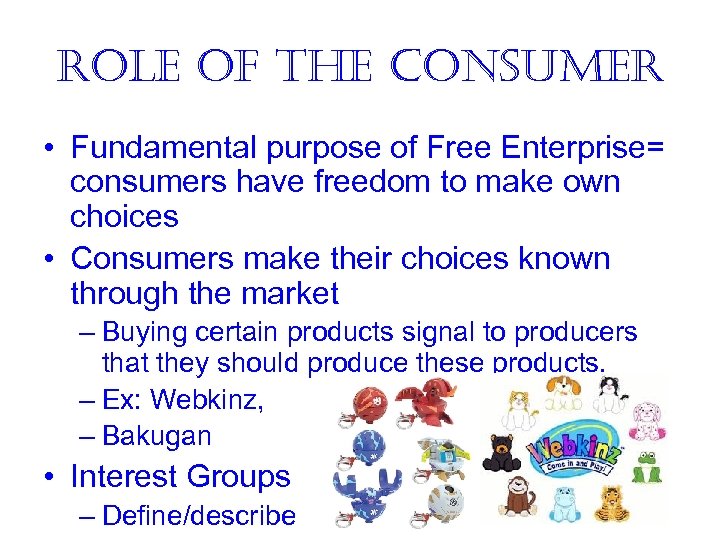 role of the Consumer • Fundamental purpose of Free Enterprise= consumers have freedom to make own choices • Consumers make their choices known through the market – Buying certain products signal to producers that they should produce these products. – Ex: Webkinz, – Bakugan • Interest Groups – Define/describe
 Interest group • A private organization that tries to persuade public officials to act in certain ways that benefit its members
 Role of the Government • Information – Public Disclosure Laws • Protect Health, Safety, and Well-being – Prior to 1960’s= UNREGULATED – 1960’s-Today = Public interest has moved the gov’t to provide consumer protection les p Exam FDA- 1906 FTC- 1914 FCC- 1934 FAA- 1958 EEOC- 1964 EPA- 1970 OSHA- 1970 CPSC- 1972 NRC- 1974
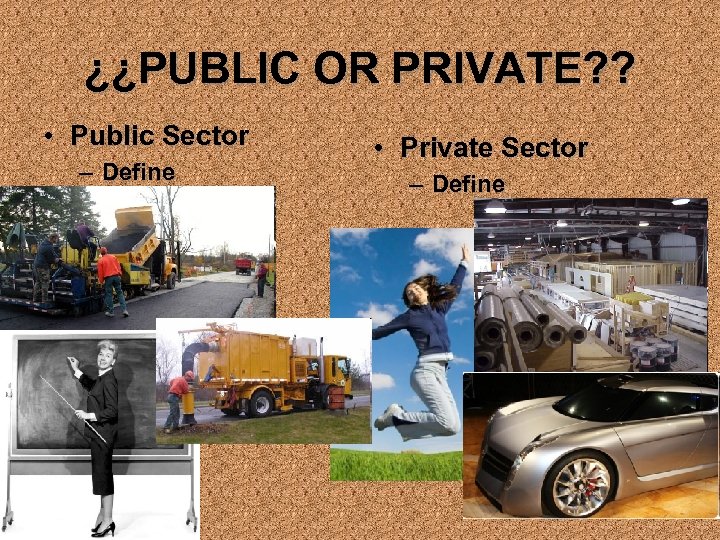 ¿¿PUBLIC OR PRIVATE? ? • Public Sector – Define • Private Sector – Define
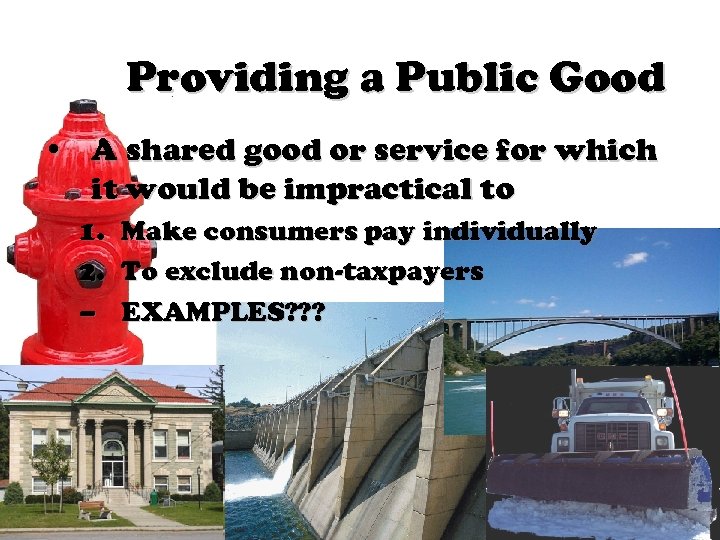 Providing a Public Good • A shared good or service for which it would be impractical to 1. Make consumers pay individually 2. To exclude non-taxpayers – EXAMPLES? ? ?
 Lets Review… • Public goods have two main characteristics – Nonrival –goods that can be consumed by one person without detracting from the consumption opportunities available to others, e. g. sunsets, clean air. – Nonexcludable –goods that, once provided, are available to all, e. g. street lighting, public radio.
 Costs and Benefits • Cost is critical in determining if something gets produced as a Public Good • If the good is produced – The benefit to each individual is less than the cost each individual would pay if it were produced privately – TOTAL BENEFITS to Society are GREATER than the TOTAL COST
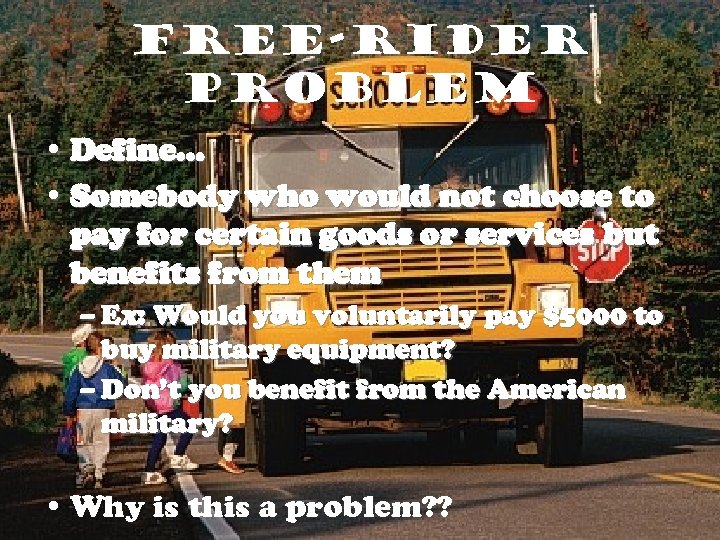 Free-Rider Problem • Define… • Somebody who would not choose to pay for certain goods or services but benefits from them – Ex: Would you voluntarily pay $5000 to buy military equipment? – Don’t you benefit from the American military? • Why is this a problem? ?
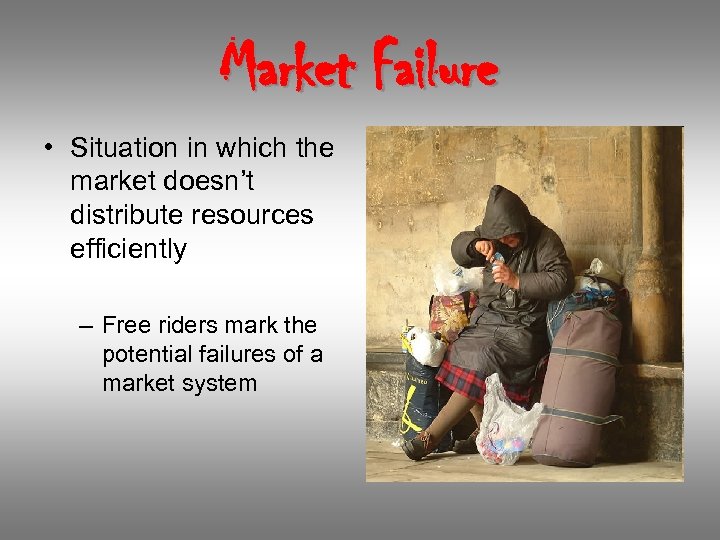 Market Failure • Situation in which the market doesn’t distribute resources efficiently – Free riders mark the potential failures of a market system
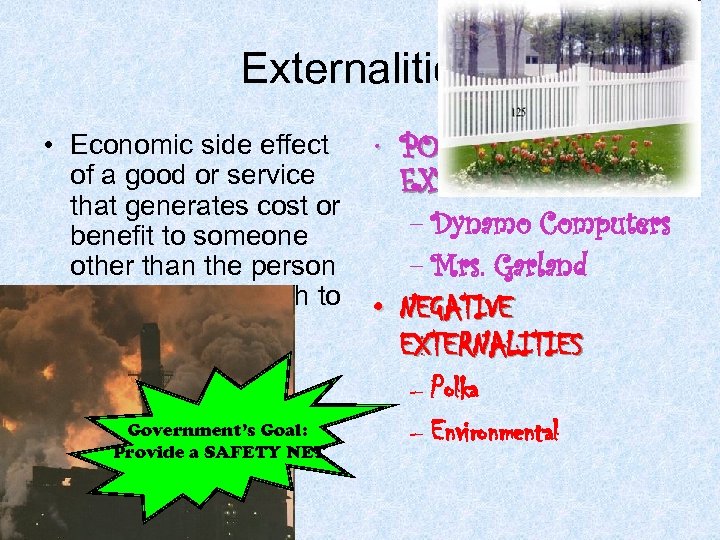 Externalities • Economic side effect of a good or service that generates cost or benefit to someone other than the person deciding how much to consume Government’s Goal: Provide a SAFETY NET • POSITIVE EXTERNALITIES – Dynamo Computers – Mrs. Garland • NEGATIVE EXTERNALITIES – Polka – Environmental
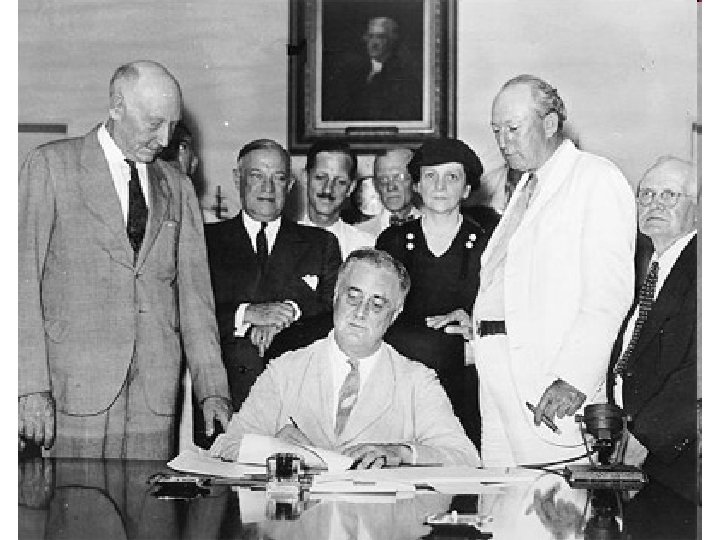
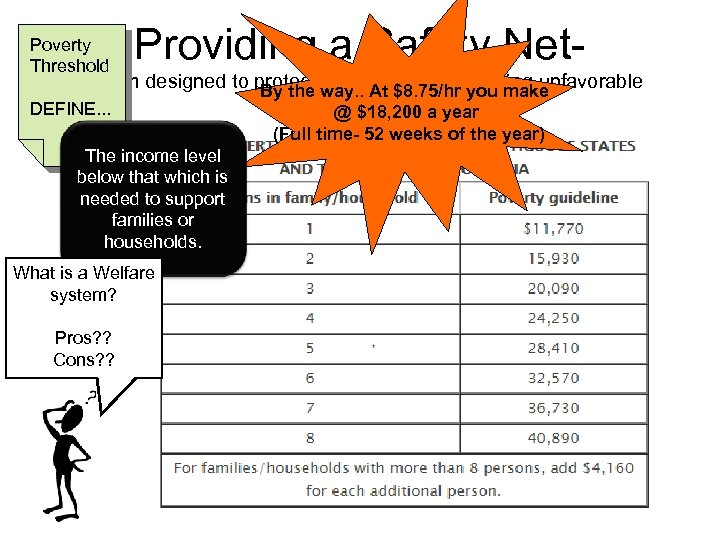 Poverty Threshold Providing a Safety Net- system designed to protect way. . At $8. 75/hr you make By the people experiencing unfavorable economic $18, 200 a year DEFINE. . . @ conditions (Full time- 52 weeks of the year) The income level below that which is needed to support families or households. What is a Welfare system? Pros? ? Cons? ?
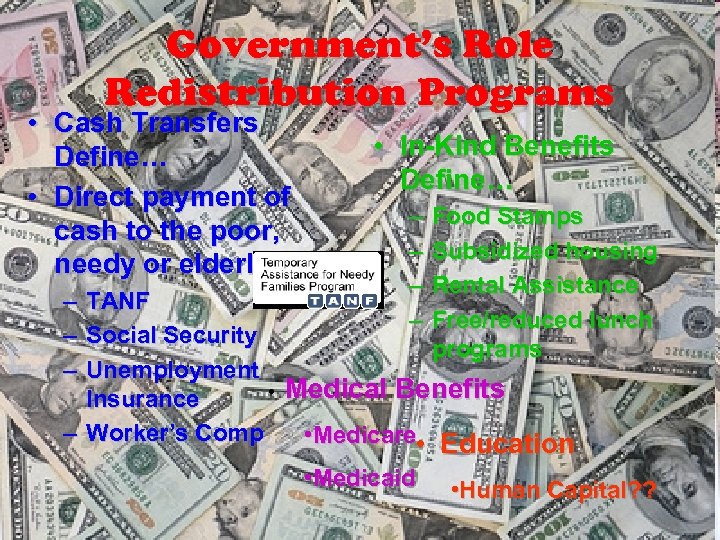 Government’s Role Redistribution Programs • Cash Transfers Define… • Direct payment of cash to the poor, needy or elderly – – – • In-Kind Benefits Define… – – Food Stamps Subsidized housing Rental Assistance Free/reduced lunch programs TANF Social Security Unemployment • Medical Benefits Insurance – Worker’s Comp • Medicare • Education • Medicaid • Human Capital? ?