 Скачать презентацию -American English 마스터 부제목 스타일 편집 1
American vs British.ppt
- Количество слайдов: 11



-American English 마스터 부제목 스타일 편집
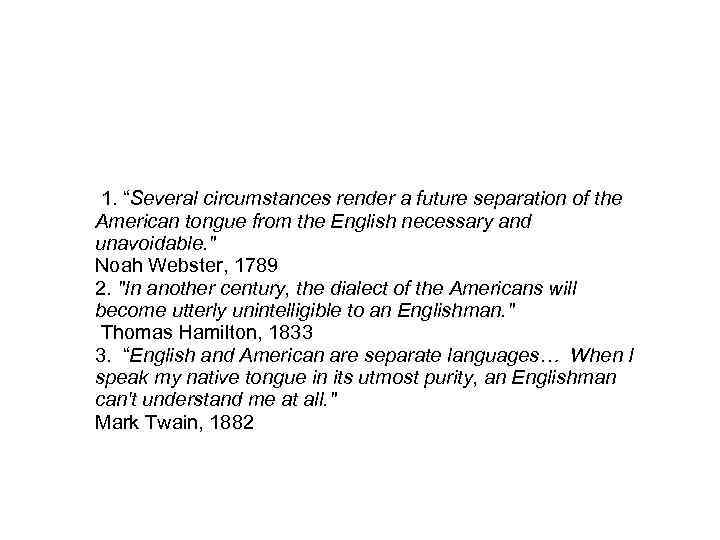
1. “Several circumstances render a future separation of the American tongue from the English necessary and unavoidable. " Noah Webster, 1789 2. "In another century, the dialect of the Americans will become utterly unintelligible to an Englishman. " Thomas Hamilton, 1833 3. “English and American are separate languages… When I speak my native tongue in its utmost purity, an Englishman can't understand me at all. " Mark Twain, 1882
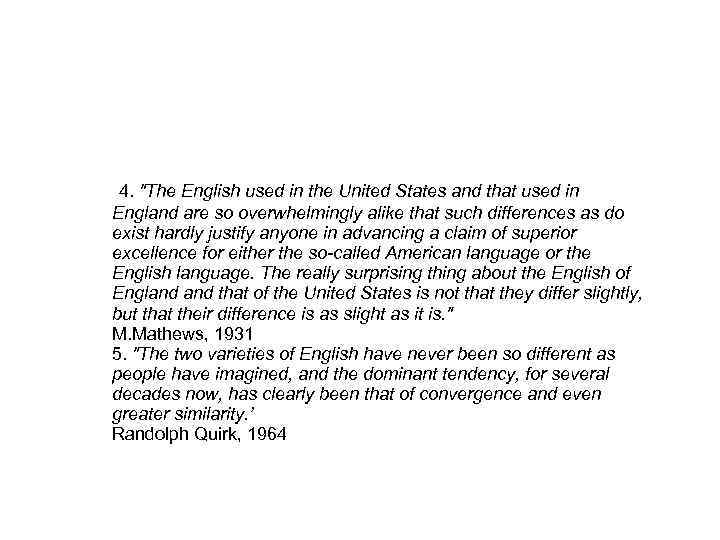
4. "The English used in the United States and that used in England are so overwhelmingly alike that such differences as do exist hardly justify anyone in advancing a claim of superior excellence for either the so-called American language or the English language. The really surprising thing about the English of England that of the United States is not that they differ slightly, but that their difference is as slight as it is. " M. Mathews, 1931 5. "The two varieties of English have never been so different as people have imagined, and the dominant tendency, for several decades now, has clearly been that of convergence and even greater similarity. ’ Randolph Quirk, 1964
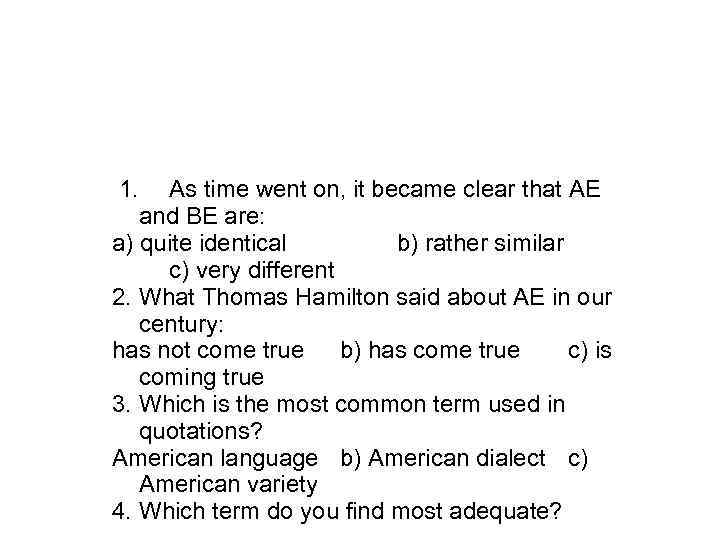
1. As time went on, it became clear that AE and BE are: a) quite identical b) rather similar c) very different 2. What Thomas Hamilton said about AE in our century: has not come true b) has come true c) is coming true 3. Which is the most common term used in quotations? American language b) American dialect c) American variety 4. Which term do you find most adequate?
The English language in America (AE) has been influenced by American Indian languages and by all the ethnic groups that have emigrated to the United States over the years. The term 'americanism' was first used by John Witherspoon, president of Princeton University, in 1781. It designates (a) any word or combination of words which, taken into the English language in the United States, has not gained acceptance in England, or, if accepted, has retained its sense of foreignness; and (b) any word or combination of words which, becoming archaic in England, has continued in good usage in the United States.
The first class is the larger and has the longer history. The earliest settlers in Virginia and New England, confronted by plants and animals that were unfamiliar to them, either borrowed the Indian names or invented names of their own. Examples are afforded by raccoon (енот), opossum (опоссум, сумчатая крыса), squash (кабачок, тыква) among Indian words and by bullfrog (лягушка бык, лягушка вол) and liveoak (дуб виргинский) among inventions.
The archaisms, of course, showed themselves more slowly. They had to go out of use in England before their survival in America was noticeable. But by the beginning of the 18 th century there was already a considerable body of them, and all through that century they increased. The English language in Great Britain (BE), was changing rapidly, but in America it was holding to its old forms. There was very little fresh emigration to the colonies, and their own people seldom visited England. Thus by the end of the century "I guess" was already an Americanism, though it had been in almost universal use in England in Shakespeare's day.
BE accepted the word groups indicating: 1) notions not having any strict definition in BE (e. g. commuter житель пригородного района, который работает в городе, trailer прицеп, know how производственный опыт, технологии, baby sit — присматривать за ребенком за плату); 2) cultural borrowings (e. g. milk shake молочный коктейль, sundae мороженое с фруктовым сиропом); 3) names of American realia (rodeo соревнования ковбоев, sheriff шериф, Secretary of State государственный секретарь, министр иностранных дел, congressman член конгресса (в особенности член палаты представителей), administration управление, правительство, министерство); 4) emotionally coloured equivalents of stylistically neutral words in BE (brainwashing = indoctrination).
AE could more easily than BE form nouns ending with ette ( et) with the diminunative meaning (luncheonette/ dinerette небольшое кафе), or to show gender (such as conductorette). Similarly, AE more extensively uses the suffix wise in the meaning of 'with regard to' or 'in terms of’ (instructionwise, taxwise, pricewise, weatherwise). Also popular among americanisms is the prefix su per (superhighway, superfilm, superweapon), and also the verb suf fix ize. Equally registered tendency of AE is to use the morpholog ical forms of the typegot: gotten.
1. What influences did the English language in America fall under? 2. What is the general definition of americanisms? 3. What most general groups of americanisms are usually distinguished? 4. What is the backward influence of AE on BE?

Thank You!
Скачать презентацию -American English 마스터 부제목 스타일 편집 1
American vs British.ppt