 Скачать презентацию American College of Bankruptcy October 2 2002 The
ab55d0e0017f3fc8c41e7bd2124aaece.ppt
- Количество слайдов: 73



American College of Bankruptcy October 2, 2002 The Implications of Enron Douglas G. Baird Harry Bigelow Distinguished Service Professor of Law Randal C. Picker Paul & Theo Leffmann Professor of Commercial Law The Law School, The University of Chicago Copyright 2002. DGB/RCP 1
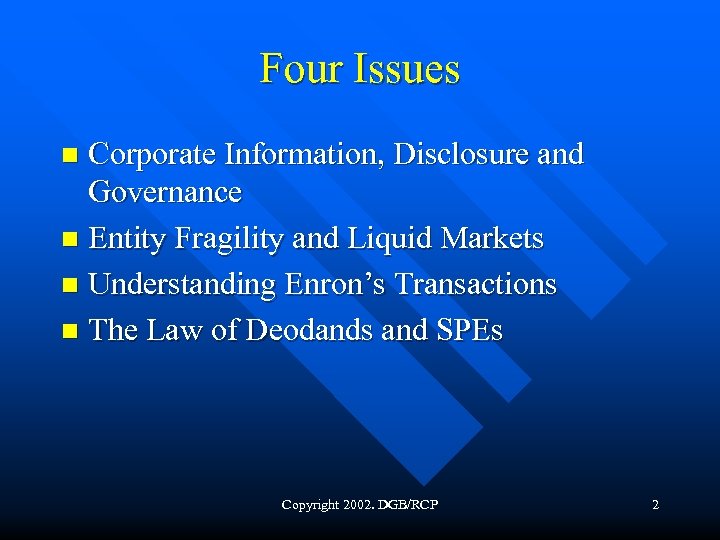
Four Issues Corporate Information, Disclosure and Governance n Entity Fragility and Liquid Markets n Understanding Enron’s Transactions n The Law of Deodands and SPEs n Copyright 2002. DGB/RCP 2
Corporate Information, Disclosure and Governance Copyright 2002. DGB/RCP 3
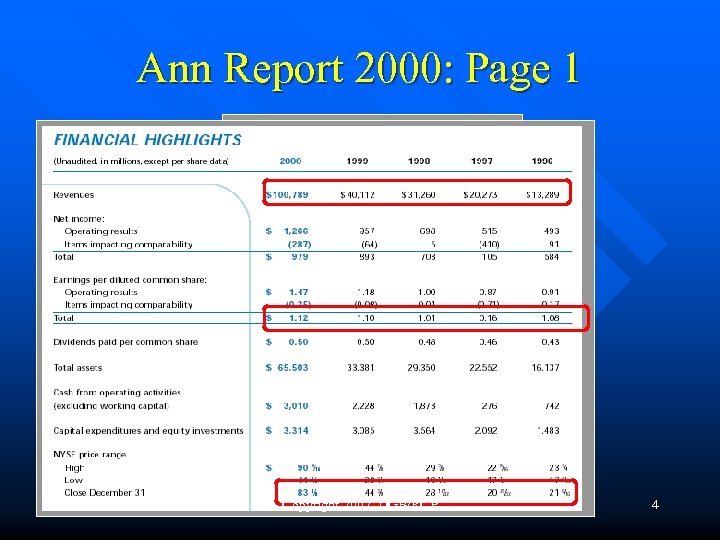
Ann Report 2000: Page 1 Copyright 2002. DGB/RCP 4
Ann Report 2000: Page 2 Enron has built unique and strong businesses that have tremendous opportunities for growth. These businesses — wholesale services, retail energy services, broadband services and transportation services — can be significantly expanded within their very large existing markets and extended to new markets with enormous growth potential. At a minimum, we see our market opportunities company-wide tripling over the next five years. Copyright 2002. DGB/RCP 5
Ann Report 2000: Page 2 Enron is laser-focused on earnings per share, and we expect to continue strong earnings performance. We will leverage our extensive business networks, market knowledge and logistical expertise to produce high-value bundled products for an increasing number of global customers. Copyright 2002. DGB/RCP 6
Ann Report 2000: Page 39 Guarantees of liabilities of unconsolidated entities and residual value guarantees have no carrying value and fair values which are not readily determinable (see Note 15). Copyright 2002. DGB/RCP 7
4/17/01: 1 st Quarter Earnings Report “Enron’s wholesale business continues to generate outstanding results. Transaction and volume growth are translating into increased profitability, ” said Jeff Skilling, Enron’s president and CEO. “In addition, our retail energy services and broadband intermediation activities are rapidly accelerating. ” Copyright 2002. DGB/RCP 8
5/15/01: Files 1 Q ‘ 01 10 -Q: Related Deals Discussion n “During the first quarter of 2001, Enron entered into transactions with limited partnerships (the Related Party), whose general partner is a senior officer of Enron. The limited partners of the Related Party are unrelated to Enron. All transactions with the Related Party are approved by Enron’s senior risk officers as well as reviewed annually by the Board of Directors. Management believes that the terms of the transactions with the Related Party were reasonable compared to those which could have been negotiated with unrelated third parties. ” Copyright 2002. DGB/RCP 9
7/12/01: 2 nd Quarter Earnings Report “Enron completed another quarter of exceptional performance. Our wholesale and retail energy businesses continue to dramatically expand business activity and increase profitability. In addition, Enron is distinct in developing a leading role in the European energy markets and in other high potential wholesale markets, ” said Jeff Skilling, Enron president and CEO. Copyright 2002. DGB/RCP 10
8/14/01: Skilling Resigns “I am resigning for personal reasons. I want to thank Ken Lay for his understanding of this purely personal decision, and I want to thank the board and all of my colleagues at Enron, ” said Skilling. “We regret Jeff’s decision to resign, as he has been a big part of our success for over eleven years, ” said Lay. “But, we have the strongest and deepest talent we have ever had in the organization, our business is extremely strong, and our growth prospects have never been better. ” Copyright 2002. DGB/RCP 11
8/14/01: Files 2 Q ‘ 01 10 -Q n “During the second quarter of 2001, Enron did not recognize any material revenues or income from transactions with the limited partnerships discussed below. Additionally, the senior officer, who previously was the general partner of these partnerships, sold all of his financial interests as of July 31, 2001, and no longer has any management responsibilities for these entities. Accordingly, such partnerships are no longer related parties to Enron. ” Copyright 2002. DGB/RCP 12
8/14/01: Files 2 Q ‘ 01 10 -Q n n “All transactions with these partnerships (the Partnerships) have been approved by Enron’s senior risk officers as well as reviewed annually by the Board of Directors. Management believes that the terms of the transactions were reasonable compared to those which could have been negotiated with unrelated third parties. ” “In the first quarter of 2001, Enron entered into transactions with the Partnerships, now unrelated, to hedge certain merchant investments and other assets. ” Copyright 2002. DGB/RCP 13
8/15/01: Watkins Letter to Ken Lay Has Enron become a risky place to work? For those of us who didn’t get rich over the last few years, can we afford to stay? Skilling’s abrupt departure will raise suspicions of accounting improprieties and valuation issues. Enron has been very aggressive in its accounting—most notably the Raptor transactions and the Condor vehicle. The spotlight will be on us, the market just can’t accept that Skilling is leaving his dream Copyright 2002. DGB/RCP 14 job.
8/15/01: Watkins Letter to Ken Lay I am incredibly nervous that we will implode in a wave of accounting scandals. My eight years of Enron work history will be worth nothing on my resume, the business world will consider the past successes as nothing but an elaborate accounting hoax. Skilling is resigning now for “personal reasons” but I would think he wasn’t having fun, looked down the road and knew this stuff was unfixable and would rather abandon ship now than resign in shame in two years. Copyright 2002. DGB/RCP 15
10/16/01: 3 rd Quarter Earnings Report ENRON REPORTS RECURRING THIRD QUARTER EARNINGS OF $0. 43 PER DILUTED SHARE; REPORTS NONRECURRING CHARGES OF $1. 01 BILLION AFTER-TAX; REAFFIRMS RECURRING EARNINGS ESTIMATES OF $1. 80 FOR 2001 AND $2. 15 FOR 2002; AND EXPANDS FINANCIAL REPORTING Copyright 2002. DGB/RCP 16
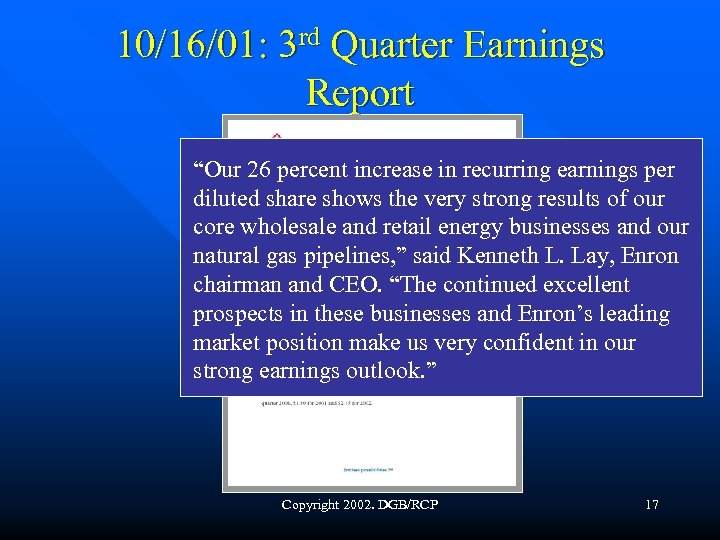
10/16/01: 3 rd Quarter Earnings Report “Our 26 percent increase in recurring earnings per diluted share shows the very strong results of our core wholesale and retail energy businesses and our natural gas pipelines, ” said Kenneth L. Lay, Enron chairman and CEO. “The continued excellent prospects in these businesses and Enron’s leading market position make us very confident in our strong earnings outlook. ” Copyright 2002. DGB/RCP 17
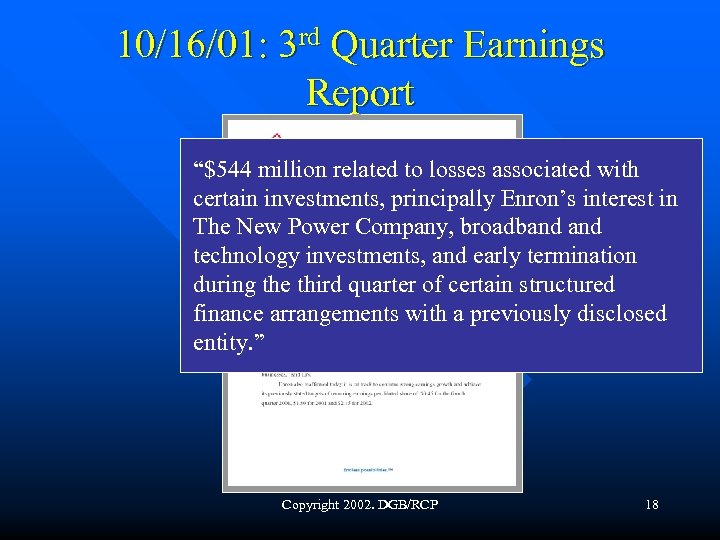
10/16/01: 3 rd Quarter Earnings Report “$544 million related to losses associated with certain investments, principally Enron’s interest in The New Power Company, broadband technology investments, and early termination during the third quarter of certain structured finance arrangements with a previously disclosed entity. ” Copyright 2002. DGB/RCP 18
Timeline 10/24/01: Fastow, Enron CFO, placed on leave n 11/8/01: 8 -K Filing with SEC n – A required restatement of prior period financial statements to reflect the previously disclosed $1. 2 billion reduction to shareholders’ equity, as well as various income statement and balance sheet adjustments required as the result of a determination by Enron and its auditors, based on current information, that certain offbalance sheet entities should have been included in Enron’s consolidated financial statements pursuant to generally accepted Copyright 2002. DGB/RCP 19 accounting principles;
Timeline – the restatement of its financial statements for 1997 through 2000 and the first two quarters of 2001. As a result, financial statements for these periods and the audit reports relating to the year -end financial statements for 1997 through 2000 should not be relied upon; n 11/19/01: Files 3 Q 2001 10 -Q with SEC – Extensive follow-on discussion to 11/8 8 -K regarding LJM transactions Copyright 2002. DGB/RCP 20
12/2/01: Enron Files for Chapter 11 Copyright 2002. DGB/RCP 21
Sarbanes-Oxley P. L. 107 -204, July 30, 2002: Sarbanes-Oxley Act of 2002 Creates new Public Company Accounting Oversight Board, with broad authority to set accounting standards for public companies and their auditors Mandatory lead audit partner rotation after 5 years New requirement for signing officer liability for reported financial information Copyright 2002. DGB/RCP 22
Andy Grove, CEO of Intel, Fortune, 9/16/02 n What's your view of the new regulations coming out of Washington? – Well, one part--attestation of financial reports-is a real pain in the ass. At Intel, we had an 11 hour financial meeting. I sat through it and learned a bunch of things about how we put together a statement. I met a bunch of the people responsible for the actual work; not the comptrollers, whom we normally deal with. It was very useful. Would we have done that without the SEC regulations? No. Should we have done it? Yes. Copyright 2002. DGB/RCP 23
Entity Fragility and Liquid Markets Copyright 2002. DGB/RCP 24
Fragility and Liquidity n “Liquidating” An Entity – “Our most important assets walk out the door each day. ” – Human capital is highly mobile on its own – Physical capital is increasing mobile with liquid asset markets n Entities Are Fragile – Trademarks can depreciate quickly – People can leave, assets can be sold Copyright 2002. DGB/RCP 25
Fragile Enron n Much of what has occupied the first part of Enron’s Chapter 11 has been a sale of assets – Enron’s trading operation and many of its gas pipelines and other businesses have been sold. – Any firm that emerges will have little in common with the firm that was seventh on the list of the Fortune 500 n This is typical of large, modern Chapter 11 s Copyright 2002. DGB/RCP 26
Fragile Andersen n 12/12/01: Berardino testifies in Congress – “If there is one thing you take away from my testimony, I hope it is this: Andersen will not hide from its responsibilities. That’s why I’m here today. The public’s confidence is of paramount importance. If my firm has made errors of judgment, we will acknowledge them. We will make the changes needed to restore confidence. ” n n 1/10/02: AA announces “significant but undetermined number of Enron-related documents were disposed of” 1/15/02: AA fires David Duncan Copyright 2002. DGB/RCP 27
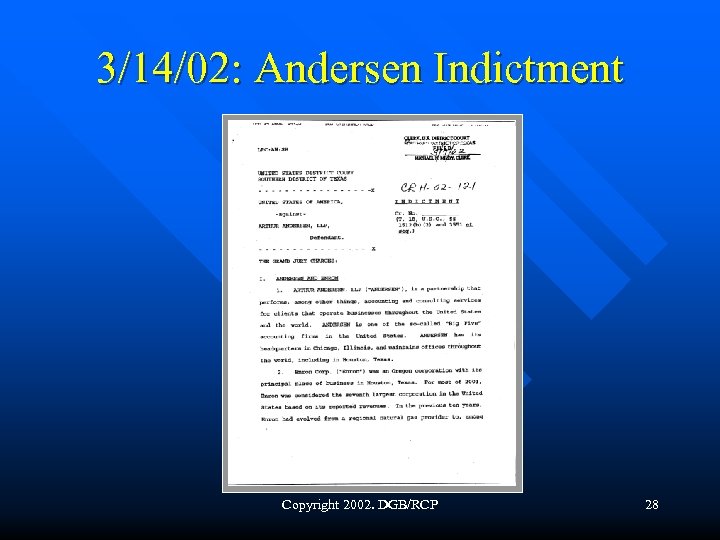
3/14/02: Andersen Indictment Copyright 2002. DGB/RCP 28
Fragile Andersen n Law Can Limit Human Capital Mobility – Status of covenants not to compete – Fears of acquired liability as large chunks of Andersen move to new firms n Trademark Implosion – From valuable brand to The Tonight Show monologue in 60 seconds n Receivables – Collect quickly or vanish Copyright 2002. DGB/RCP 29
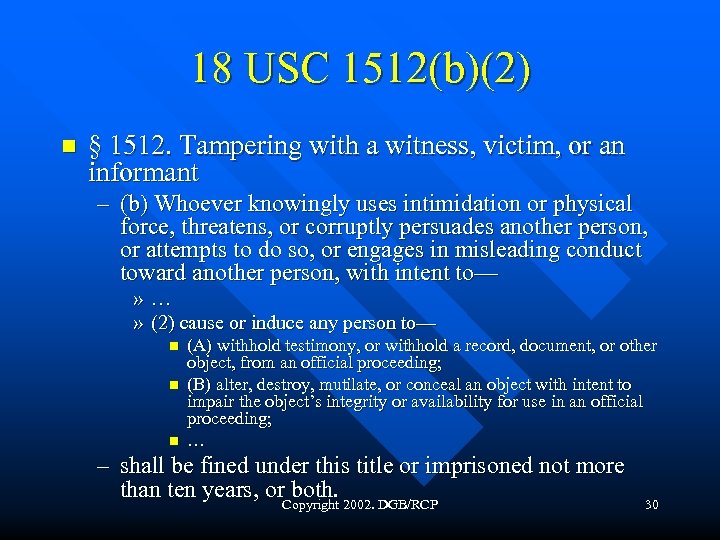
18 USC 1512(b)(2) n § 1512. Tampering with a witness, victim, or an informant – (b) Whoever knowingly uses intimidation or physical force, threatens, or corruptly persuades another person, or attempts to do so, or engages in misleading conduct toward another person, with intent to— » … » (2) cause or induce any person to— n n n (A) withhold testimony, or withhold a record, document, or other object, from an official proceeding; (B) alter, destroy, mutilate, or conceal an object with intent to impair the object’s integrity or availability for use in an official proceeding; … – shall be fined under this title or imprisoned not more than ten years, or both. Copyright 2002. DGB/RCP 30
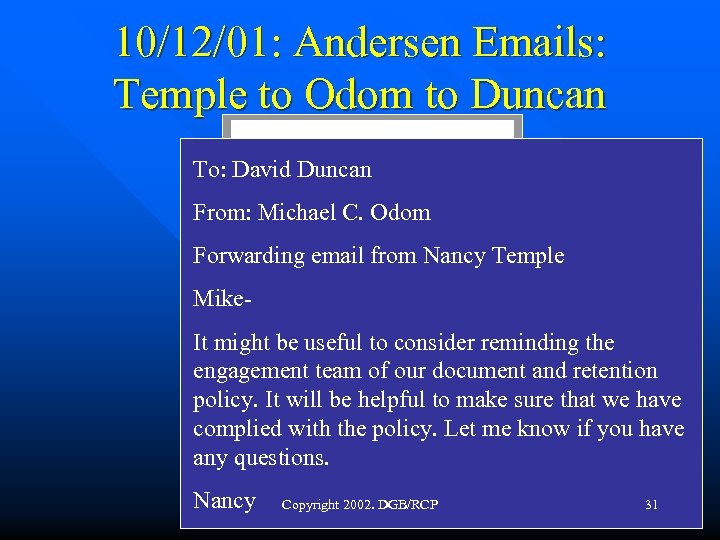
10/12/01: Andersen Emails: Temple to Odom to Duncan To: David Duncan From: Michael C. Odom Forwarding email from Nancy Temple Mike. It might be useful to consider reminding the engagement team of our document and retention policy. It will be helpful to make sure that we have complied with the policy. Let me know if you have any questions. Nancy Copyright 2002. DGB/RCP 31
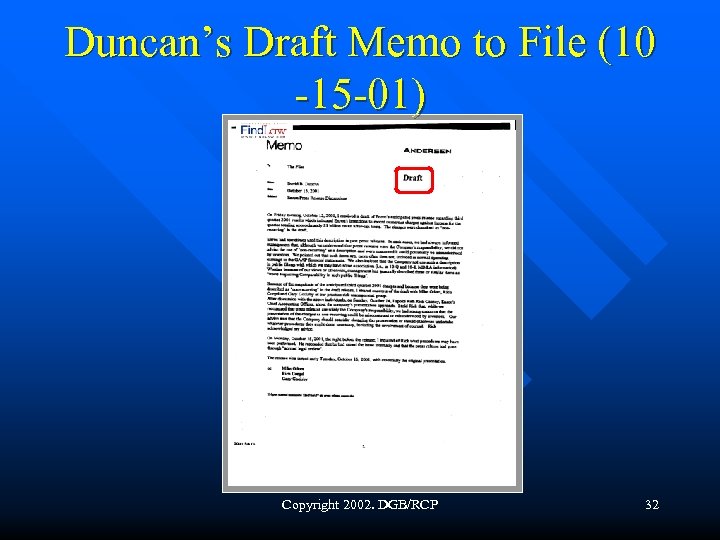
Duncan’s Draft Memo to File (10 -15 -01) Copyright 2002. DGB/RCP 32
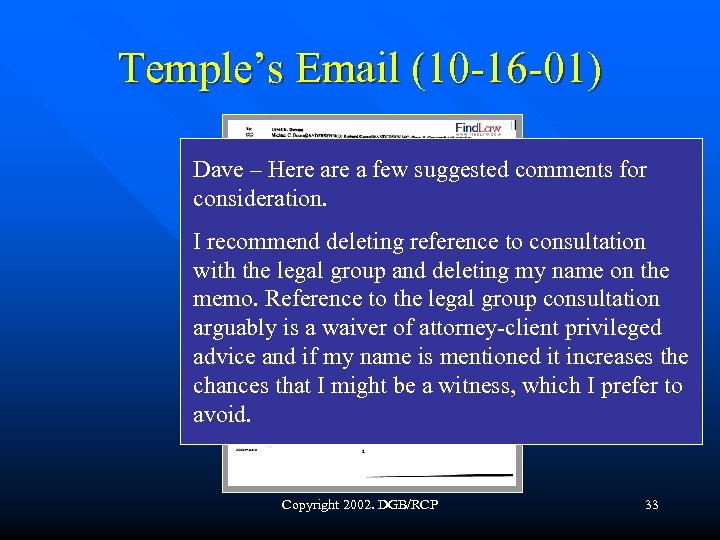
Temple’s Email (10 -16 -01) Dave – Here a few suggested comments for consideration. I recommend deleting reference to consultation with the legal group and deleting my name on the memo. Reference to the legal group consultation arguably is a waiver of attorney-client privileged advice and if my name is mentioned it increases the chances that I might be a witness, which I prefer to avoid. Copyright 2002. DGB/RCP 33
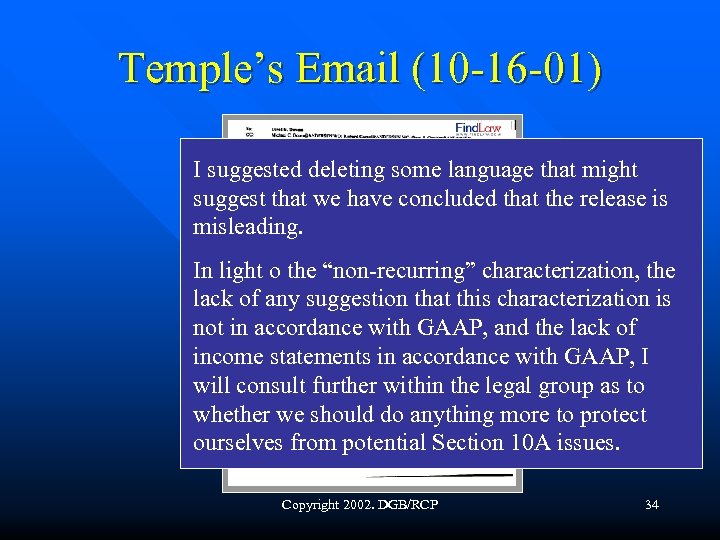
Temple’s Email (10 -16 -01) I suggested deleting some language that might suggest that we have concluded that the release is misleading. In light o the “non-recurring” characterization, the lack of any suggestion that this characterization is not in accordance with GAAP, and the lack of income statements in accordance with GAAP, I will consult further within the legal group as to whether we should do anything more to protect ourselves from potential Section 10 A issues. Copyright 2002. DGB/RCP 34
Understanding Enron’s Transactions Copyright 2002. DGB/RCP 35
Enron’s Place in the Pantheon n Two notable bankruptcies provide a good baseline – Crazy Eddie – Equity Funding n Basic Lessons – Don’t obsess too much about who did and did not engage in fraud – Those who commit frauds are usually judgmentproof – You often can recover from others, even if they knew nothing about the fraud Copyright 2002. DGB/RCP 36
Crazy Eddie n Crazy Eddie’s prices were insane – But he also inflated the stock price, sold stock, and took the cash with him—in suitcases – He went to jail, and the investors were left unpaid – He is now back in business Copyright 2002. DGB/RCP 37
Lessons of Crazy Eddie The litigation was largely over bringing securities and other actions against those (such as accountants) with money n Willie Sutton principle (and its corollary) n – You go to where the money is – But there is usually an inverse corollation between the amount of money and the strength of your cause of action Copyright 2002. DGB/RCP 38
Crazy Eddie and Enron n n In chasing after solvent third parties, nonbankruptcy law is what matters Recently, we’ve narrowed third-party liability – Central Bank of Denver v. First Interstate Bank of Denver, 511 U. S. 164 (1994) – Private plaintiffs cannot bring Rule 10 b-5 actions against those who merely aided and abetted violations of the securities law – But there are lots of other theories that may be sufficient to get past a motion for summary judgment Copyright 2002. DGB/RCP 39
Bankruptcy and Third-Party Liability n When can the bankruptcy trustee bring the cause of action? – If the firm could bring the action outside of bankruptcy, the cause of action is property of the estate under § 541 – The trustee has the power to avoid liens and recover transfers under § 544 and the other avoiding powers n But the trustee cannot bring ordinary damage actions, even if the creditors as a group could Copyright 2002. DGB/RCP 40
The Caplin Principle n n Caplin v. Marine Midland Grace Trust Company, 406 U. S. 416 (1972), sharply limits the trustee’s freedom of movement here Warning! – The case law here about what is “property of the estate” is unreliable and confused – Be cautious about taking appellate opinions at face value – E. g. , they can be reversed by subsequent state court decisions Copyright 2002. DGB/RCP 41
Equity Funding’s Business Plan We are in the 1960 s, and we have learned that bull markets last forever n Investors get the tax benefits of life insurance and the growth potential of a mutual fund n – Investors buy our mutual fund, and we lend them the money (with their shares as collateral) to buy insurance – They pay off the loan with the appreciated mutual fund shares Copyright 2002. DGB/RCP 42
Equity Funding’s Problem The 1960 s bull market ends n Investors start to withdraw their funds and are less inclined to invest in the first place n – How do we maintain our stock price? – We turn to aggressive accounting Copyright 2002. DGB/RCP 43
Aggressive Accounting n Treat as cash received – revenues that will come when an identified person makes the first payment on a policy already issued – revenues that will come if an identified person we have solicited agrees to buy a policy, passes the medical test, etc. – revenues that would come if a fictitious person actually existed, was solicited by us, agreed to buy our policy, passed the medical test, etc. Copyright 2002. DGB/RCP 44
Equity Funding’s Problem Reinsurers expect us to turn over premiums from all living insureds, even if they are fictitious n Fictitous people don’t pay premiums n – Some can die young – But reinsurers get suspicious if too many people die young n Proving fictitious people both lived and died is hard work Copyright 2002. DGB/RCP 45
Equity Funding Lessons Sliding slowly from corner-cutting to outright fraud is commonplace in bankruptcy, especially in small Chapter 11 s n Many of the Equity Funding people who end up engaging in outright fraud (forging medical histories) aren’t even getting paid a lot of money n Copyright 2002. DGB/RCP 46
Equity Funding Lessons Uncovering fraud after the fact is easy, but beforehand it’s hard n WARNING! n – Be alert to departures from past practice – Be aware of slippery slopes – Don’t sign off on transactions you don’t understand Copyright 2002. DGB/RCP 47
What happens in Enron now? Enron is harder than Crazy Eddie, Equity Funding, or World. Com n The complex structure hid the extent of the failure of the business n – Outright fraud and self-dealing is a problem, but the law is easy and recoveries small – What remedies do creditors have against those who help a debtor keep them in the dark? Copyright 2002. DGB/RCP 48
What happens in Enron now? Can the estate recover Enron assets parked in various SPEs and transferred out of SPEs to investors? n The challenge is to filter out what doesn’t matter n – Identify the basic transaction behind the SPEs – Don’t get hung up on whether the transaction complied with GAAP or securities regulations Copyright 2002. DGB/RCP 49
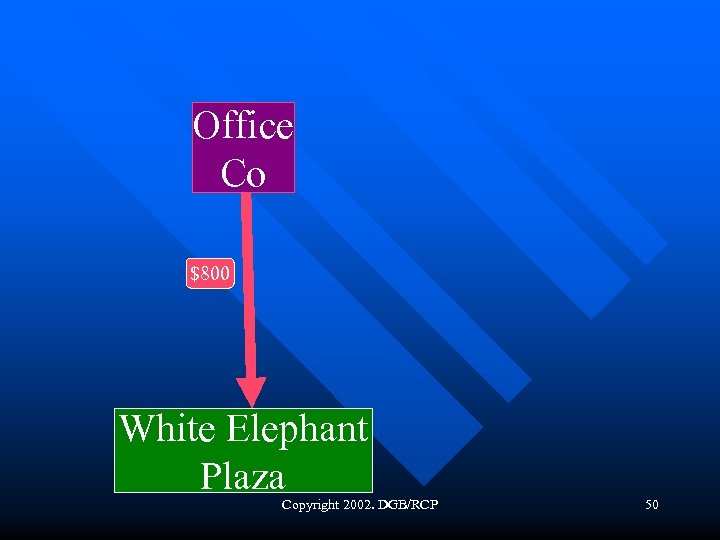
Office Co $800 White Elephant Plaza Copyright 2002. DGB/RCP 50
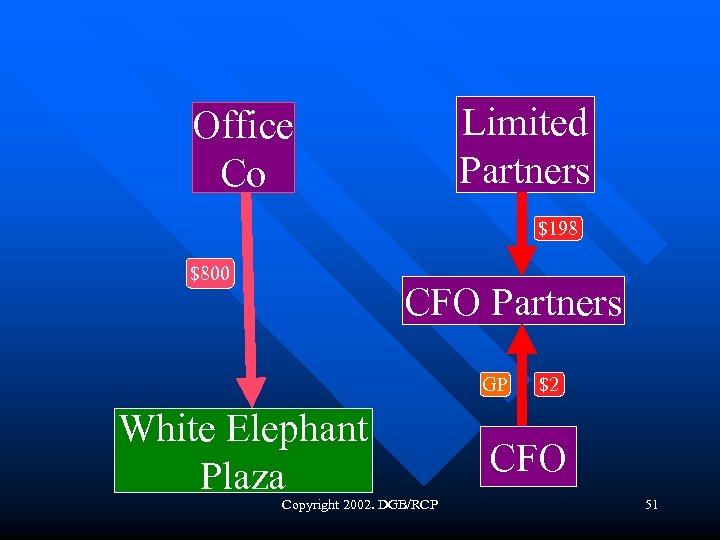
Limited Partners Office Co $198 $800 CFO Partners GP White Elephant Plaza Copyright 2002. DGB/RCP $2 CFO 51
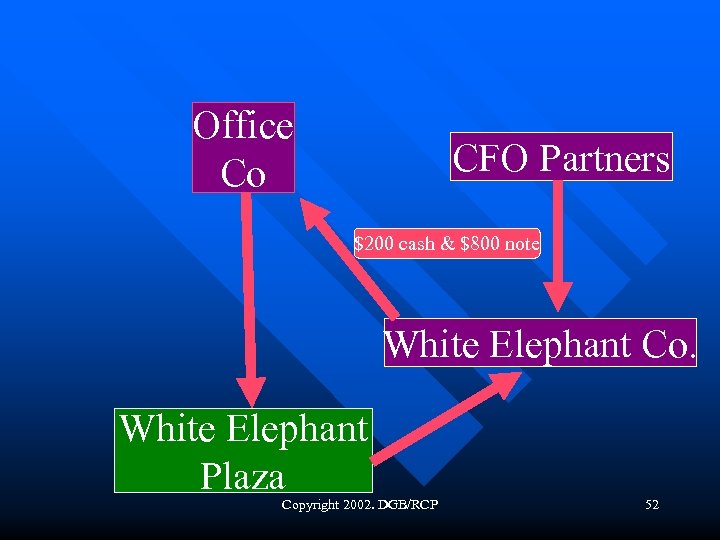
Office Co CFO Partners $200 cash & $800 note White Elephant Co. White Elephant Plaza Copyright 2002. DGB/RCP 52
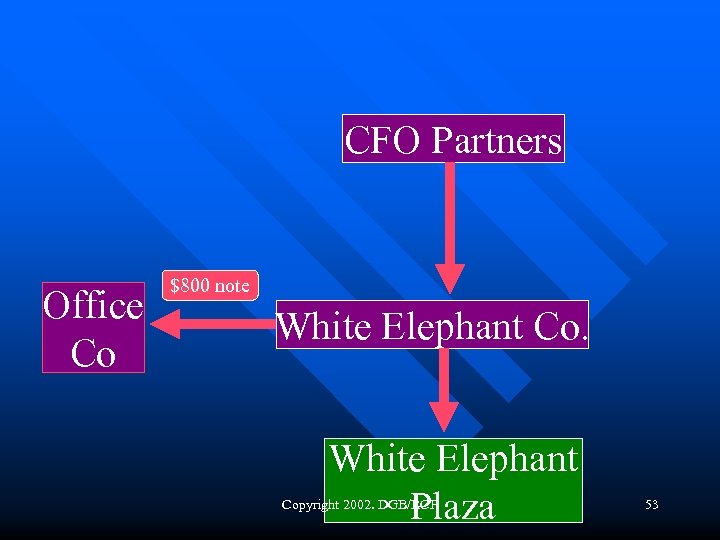
CFO Partners Office Co $800 note White Elephant Co. White Elephant Plaza Copyright 2002. DGB/RCP 53
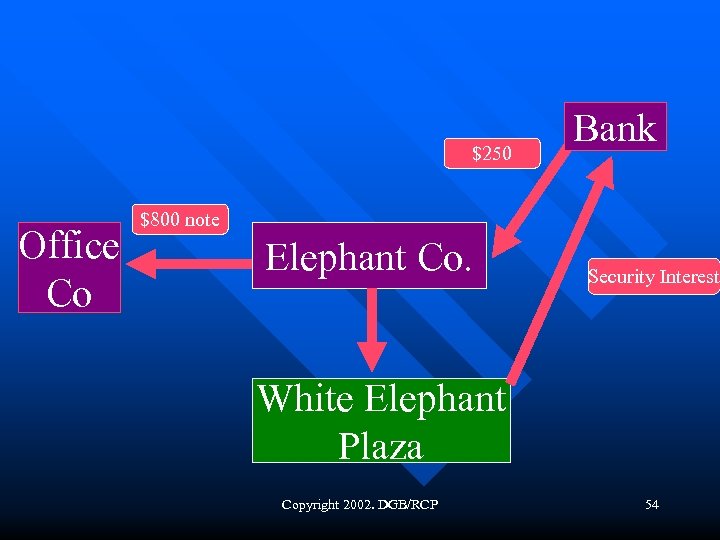
$250 Office Co Bank $800 note Elephant Co. Security Interest White Elephant Plaza Copyright 2002. DGB/RCP 54
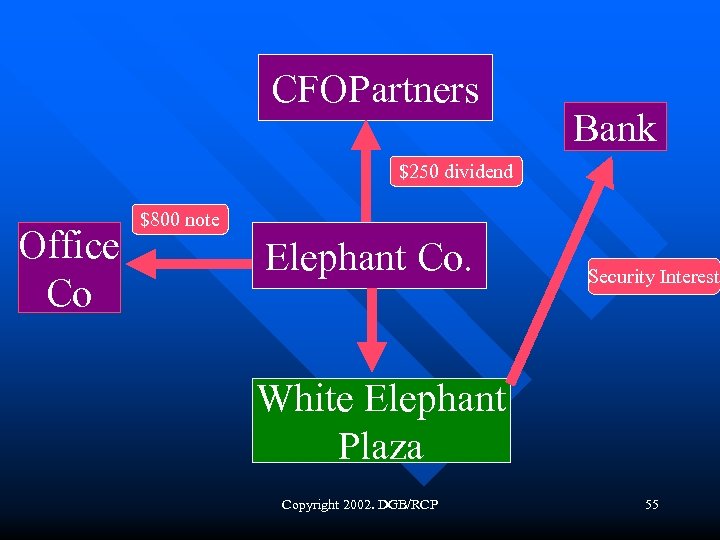
CFOPartners Bank $250 dividend Office Co $800 note Elephant Co. Security Interest White Elephant Plaza Copyright 2002. DGB/RCP 55
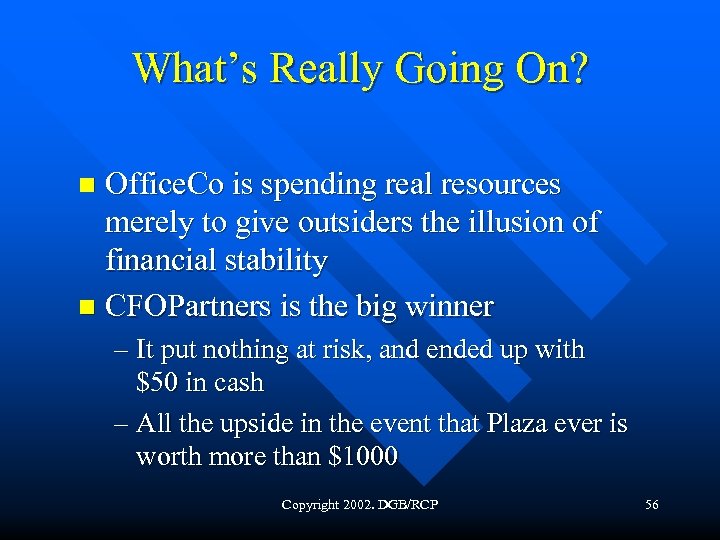
What’s Really Going On? Office. Co is spending real resources merely to give outsiders the illusion of financial stability n CFOPartners is the big winner n – It put nothing at risk, and ended up with $50 in cash – All the upside in the event that Plaza ever is worth more than $1000 Copyright 2002. DGB/RCP 56
White Elephant Plaza and Willie Sutton n Potential Assets – White Elephant Plaza no longer belongs to Office. Co, but it has value – Funds were transferred out of White Elephant to CFOPartners n Possible Recoveries – Bring White Elephant back into the estate, stripped of Bank’s liens and CFOPartners claims – Recover transfers made to CFOPartners Copyright 2002. DGB/RCP 57
Recovering White Elephant Plaza n Potential Theories of Recovery – – – n Veil-piercing and alter ego actions Substantive consolidation Absence of a “true sale” Problems – Each of these theories has serious weaknesses – In any event, they don’t rid us of Bank’s security interest or allow us to recover from CFOPartners Copyright 2002. DGB/RCP 58
Fraudulent Conveyance Recovery from CFOPartners n Step-transaction doctrine applies – Multiple layers of entities irrelevant – Orr v. Kinderhill Corp. , 991 F. 2 d 31 (2 d Cir. 1993) n We may be able to show insolvency and lack of reasonably equivalent value – Dividends of insolvent firm are fraudulent conveyances – Insolvency can be defined broadly. See In re W. R. Grace & Co. , 2002 WL 1767221 (Bankr. D. Del. 2002) Copyright 2002. DGB/RCP 59
Fraudulent Conveyance Recovery from CFOPartners n “Badges of fraud” fraudulent conveyance – – n Proving actual fraud is unnecessary Proving GAAP or violation of securities laws is irrelevant Potential Badges – – Closeness of relationship Retention of control Concealment No business justification Copyright 2002. DGB/RCP 60
Fraudulent Conveyance Recovery from Bank n n If a fraudulent conveyance theory can be made out against CFOPartners, history suggests that Bank is similarly at risk Mere knowledge of the transaction may be enough and giving reasonably equivalent value isn’t a defense – We can recharacterize as a transaction in which Debtor gave Bank a security interest in White Elephant and received nothing in return – Form of the transaction may be a one-way ratchet. See In re W. R. Grace Copyright 2002. DGB/RCP 61
The Law of Deodands and SPEs Copyright 2002. DGB/RCP 62
Exodus 21: 28 n “If a bull gores a man or a woman to death, the bull must be stoned to death, and its meat must not be eaten. But the owner of the bull will not be held responsible. ” Copyright 2002. DGB/RCP 63
Blackstone on Deodand n n “By this is meant whatever personal chattel is the immediate occasion of the death of any reasonable creature: which is forfeited to the king, to be applied to pious uses, and distributed in alms by his high almoner; though formerly destined to a more superstitious purpose. * * * Wherever the thing is in motion, not only that part which immediately gives the wounds (as the wheel which runs over his body, ) but all things which move with it and help to make the wound more dangerous, (as the cart and loading, which increase the pressure of the wheel) are forfeited. ” Blackstone, Book 1, Chap. 8, XVI. Copyright 2002. DGB/RCP 64
HR 833 (July 17, 2001) Sec. 912. Asset-Backed Securitizations. Copyright 2002. DGB/RCP 65
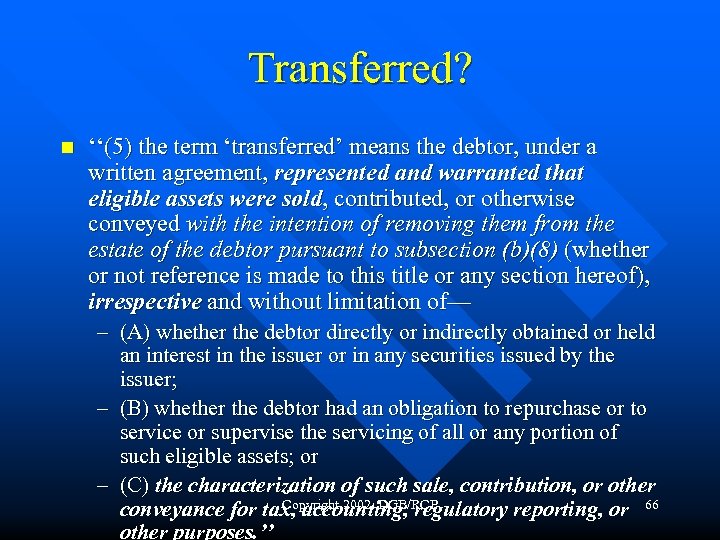
Transferred? n ‘‘(5) the term ‘transferred’ means the debtor, under a written agreement, represented and warranted that eligible assets were sold, contributed, or otherwise conveyed with the intention of removing them from the estate of the debtor pursuant to subsection (b)(8) (whether or not reference is made to this title or any section hereof), irrespective and without limitation of— – (A) whether the debtor directly or indirectly obtained or held an interest in the issuer or in any securities issued by the issuer; – (B) whether the debtor had an obligation to repurchase or to service or supervise the servicing of all or any portion of such eligible assets; or – (C) the characterization of such sale, contribution, or other Copyright 2002. DGB/RCP conveyance for tax, accounting, regulatory reporting, or 66 other purposes. ’’
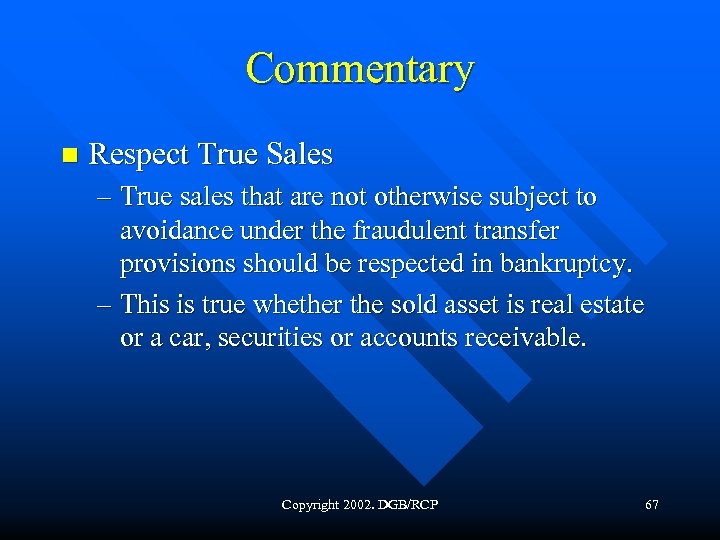
Commentary n Respect True Sales – True sales that are not otherwise subject to avoidance under the fraudulent transfer provisions should be respected in bankruptcy. – This is true whether the sold asset is real estate or a car, securities or accounts receivable. Copyright 2002. DGB/RCP 67
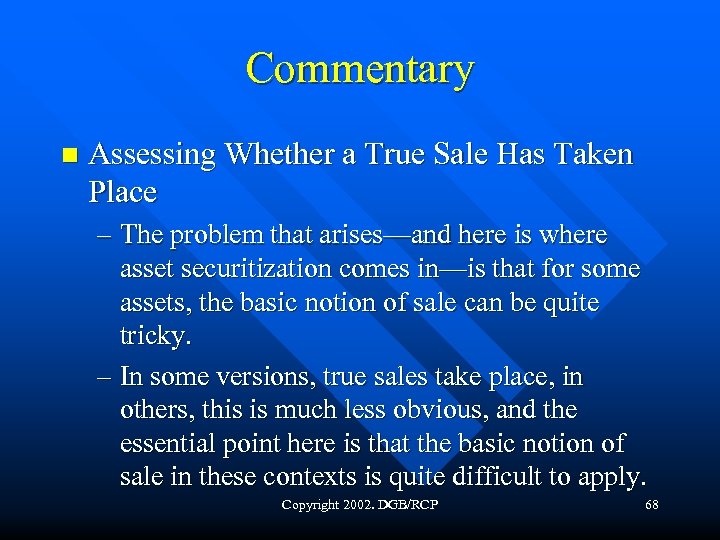
Commentary n Assessing Whether a True Sale Has Taken Place – The problem that arises—and here is where asset securitization comes in—is that for some assets, the basic notion of sale can be quite tricky. – In some versions, true sales take place, in others, this is much less obvious, and the essential point here is that the basic notion of sale in these contexts is quite difficult to apply. Copyright 2002. DGB/RCP 68
Commentary n Managing Uncertainty – How should we deal with that uncertainty, that is, the uncertainty about whether the structure of a particular asset securitization is or is not a true sale? – Current law appropriately leaves these questions to judges, to be resolved under state law, if and when a particular transaction is challenged. Copyright 2002. DGB/RCP 69
HR 333 Conf Rep (7 -26 -02) Sec. 912 Completely gone. Copyright 2002. DGB/RCP 70
S. 2798/H. R. 5221 (7 -25 -02) Employee Abuse Prevention Act of 2002 To protect employees from corporate practices that deprive them of their earnings and retirement savings when a business files for bankruptcy under title 11 Copyright 2002. DGB/RCP 71
Securitization New Sec. 105(e)(1): “Notwithstanding any otherwise applicable provision of law, the court may recharacterize as a secured loan, a sale, lease, or transaction if the material characteristics of the sale, lease, or transaction are substantially similar to the characteristics of a secured loan. ” Copyright 2002. DGB/RCP 72

Copyright 2002. DGB/RCP 73
Скачать презентацию American College of Bankruptcy October 2 2002 The
ab55d0e0017f3fc8c41e7bd2124aaece.ppt