 Скачать презентацию AMERICAN BUSINESS 3 MAJOR TYPES SOLE PROPRIETORSHIP
454131111d9986ebc8872b7b21a8761c.ppt
- Количество слайдов: 99



AMERICAN BUSINESS • 3 MAJOR TYPES –SOLE PROPRIETORSHIP –PARTNERSHIP –CORPORATION
SOLE PROPRIETORSHIPS • A business owned and operated by one person • Advantages – Relatively easy to begin – Claims all of the profits – Your own boss
SOLE PROPRIETORSHIPS • DISADVANTAGES –Unlimited liability – responsible for all of the debts of the company –Responsible for all aspects of the business –Difficult to raise revenue

l Most sole proprietorships earn modest incomes. l Many proprietors run their businesses part-time. Characteristics of Proprietorships
PARTNERSHIPS • 2 or more individuals agree to own and operate a business together • ADVANTAGES – They pool their resources and their business skills – Relatively easy to create
Easy and inexpensive to set up and subject to little government regulation or special taxation. ◦ Ownership interests and management responsibilities are legislated under the Uniform Partnership Act. Advantages to Partnerships
PARTNERSHIPS – Share business responsibilities – Can have some sort of specialization – Share risks • DISADVANTAGES – Relatively difficult to raise revenue – Must share profits
PARTNERSHIPS – Partnership has unlimited liability – Decision making can be difficult
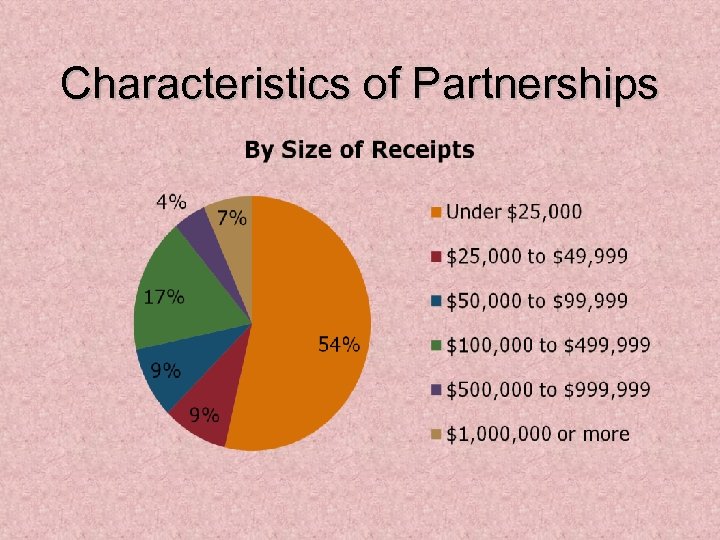
Characteristics of Partnerships
General: One in which the partners share equally in both responsibility and liability. Types of Partnerships
General: One in which the partners share equally in both responsibility and liability. ◦ Examples: lawyers, doctors, accountants, construction companies, family businesses Types of Partnerships
Limited (Silent): only one partner is required to be a general partner. ◦ The limited partner: Does: contribute money Does not do: manage the business or have unlimited personal liability. Types of Partnerships
Types of Partnerships Limited Liability (LLP): all partners are limited partners. ◦ Functions the same as the general except that all partners have limited personal liability in certain situations. Lots of doctors and lawyers are moving to this so that one cannot be held liable for another’s mistakes/bad decisions.
Corporation Sec. 3 Business organization that is treated by law as an individual but is owned by stockholders.
CORPORATIONS • A legal creation that can – Acquire resources – Own assets – Produce and sell products – Incur debts (sell bonds) – Sue and be sued
CORPORATIONS • ***A CORPORATION IS SEPARATE FROM THE STOCKHOLDERS THAT OWN IT
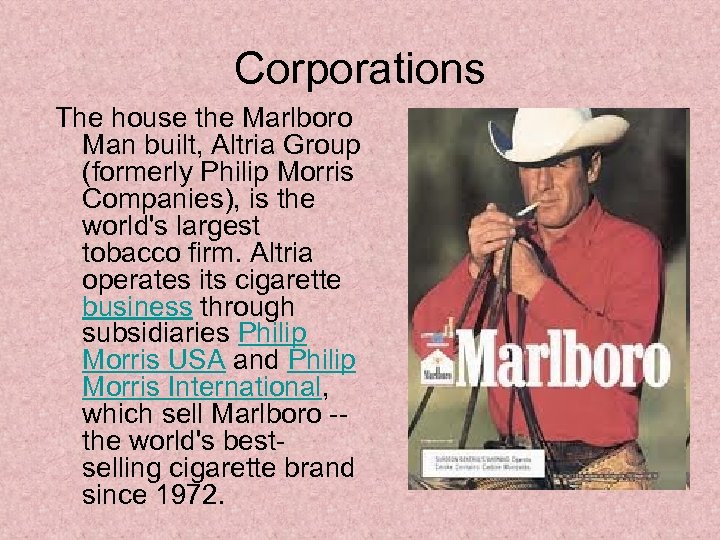
Corporations The house the Marlboro Man built, Altria Group (formerly Philip Morris Companies), is the world's largest tobacco firm. Altria operates its cigarette business through subsidiaries Philip Morris USA and Philip Morris International, which sell Marlboro -the world's bestselling cigarette brand since 1972.
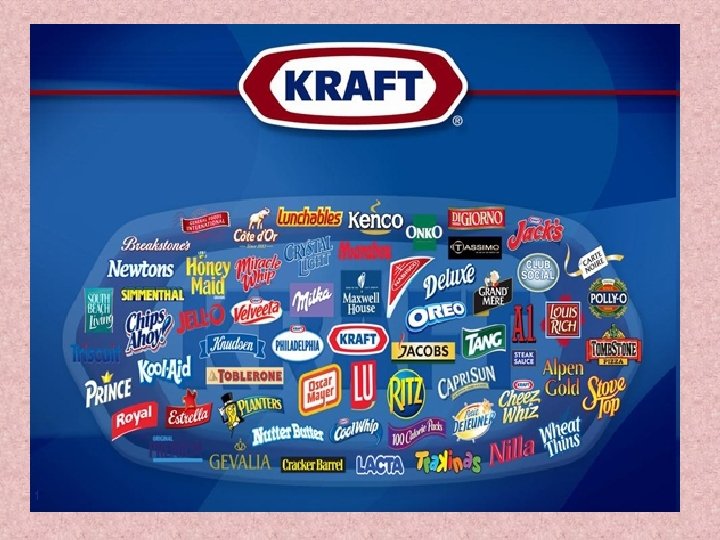
• The company controls about half of the US tobacco market. However, tobacco is only part of its portfolio. • It owns 85% of Kraft Foods, the world's #2 food company (after Nestlé), which makes Jell-O, Kool-Aid, Maxwell House, Oscar Mayer, and Post. • The tobacco giant bought Nabisco in late 2000, folding it into Kraft. Altria owns 33. 9% of SABMiller plc.
CORPORATIONS • ADVANTAGES –Effective at raising revenue • Selling stocks • Issuing bonds
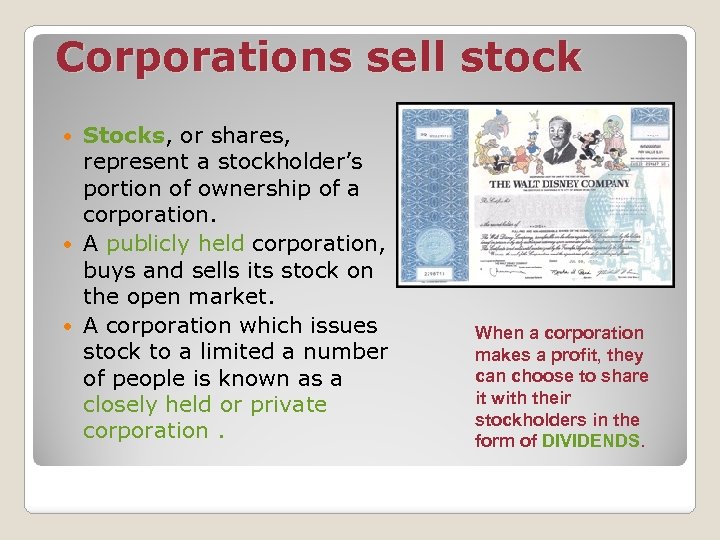
Corporations sell stock Stocks, or shares, represent a stockholder’s portion of ownership of a corporation. A publicly held corporation, buys and sells its stock on the open market. A corporation which issues stock to a limited a number of people is known as a closely held or private corporation. When a corporation makes a profit, they can choose to share it with their stockholders in the form of DIVIDENDS.
STOCKS • Part ownership in a corporation • Stock owners vote for the corporate officers (those who run the corporation) • Vote is in proportion to percentage of stocks owned • Stock owners get a share of the corporate profits (dividends)
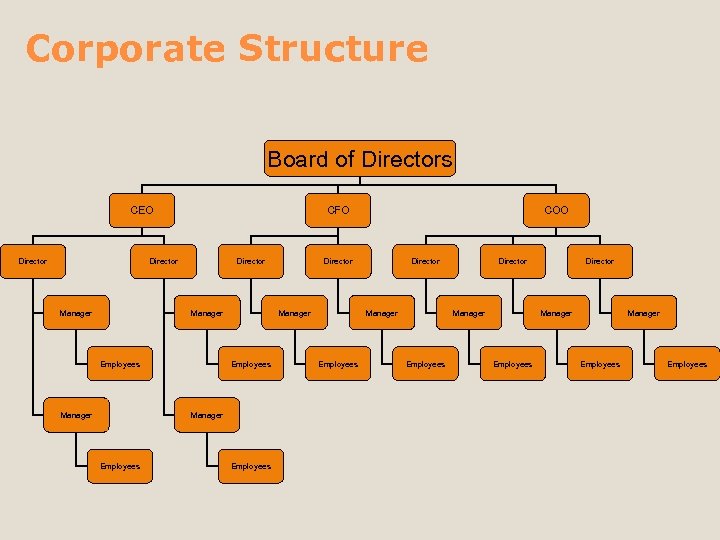
Corporate Structure Board of Directors CEO Director CFO Director Manager Employees Director Manager Employees COO Director Manager Employees Employees
Stockholders have limited liability Stocks can be sold Advantages for Stockholders
Henry Ford Growth potential (can get more capital by selling stock) Long life potential Died in 1943 but the Ford Motor Company lives on. Advantages for Businesses
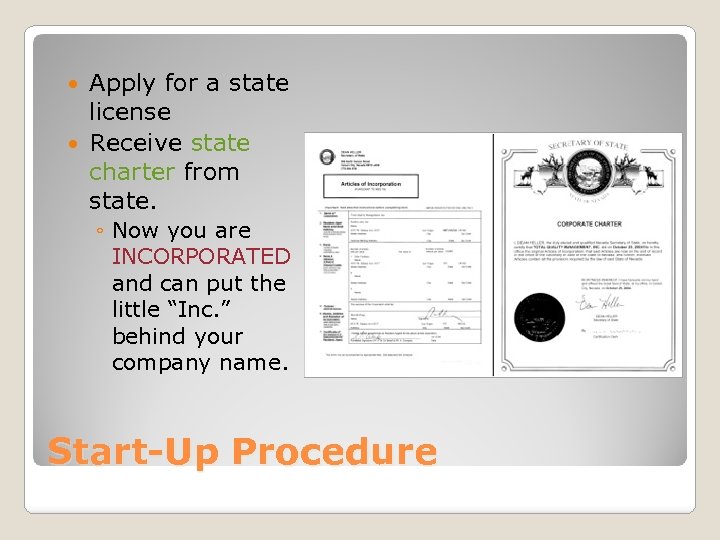
Apply for a state license Receive state charter from state. ◦ Now you are INCORPORATED and can put the little “Inc. ” behind your company name. Start-Up Procedure
Corporate Income Tax: Corporations must pay tax on their income. Stockholders pay taxes on their dividends and capital gains. Taxation
History of the Dow • http: //stockcharts. com/charts/historical/djia 1900. html
BONDS • If you purchase a corporate bond, you are lending money to the corporation • The corporation promises to pay the value of that bond plus interest • Stocks and bonds are also known as SECURITIES
The Dow Jones Industrial Average • The Dow • A single measurement of 30 top U. S. companies • Indication of how the stocks of these companies are doing • ****Serves as a barometer of the health of U. S. stocks in general
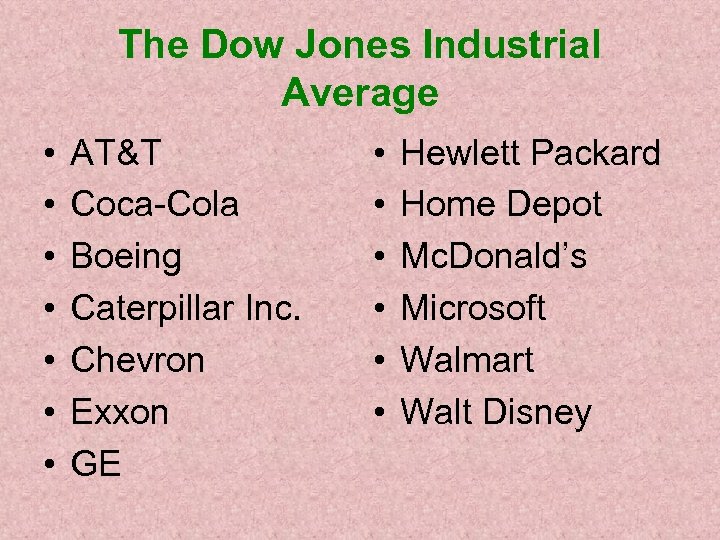
The Dow Jones Industrial Average • • AT&T Coca-Cola Boeing Caterpillar Inc. Chevron Exxon GE • • • Hewlett Packard Home Depot Mc. Donald’s Microsoft Walmart Walt Disney
CORPORATIONS • LIMITED LIABILITY – Stockholders only risk what they have invested – The corporation can be sued but the stockholders cannot • Can mass produce product and specialize human resources • Tend to have a longer life than partnerships and proprietorships
CORPORATIONS • DISADVANTAGES – Some red tape and expense to get a corporate charter – Double taxation • Corporate profits are taxed • Dividend income is taxed
CORPORATIONS • Separation of ownership and management –Can lead to conflicting views on the running of the corporation
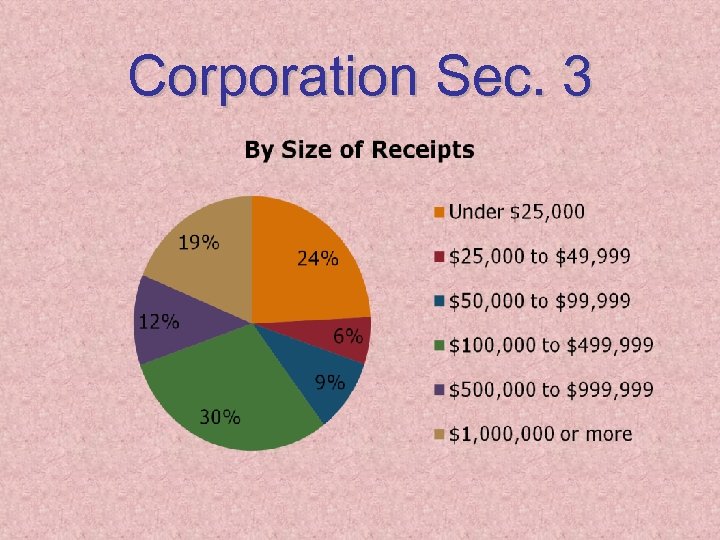
Corporation Sec. 3
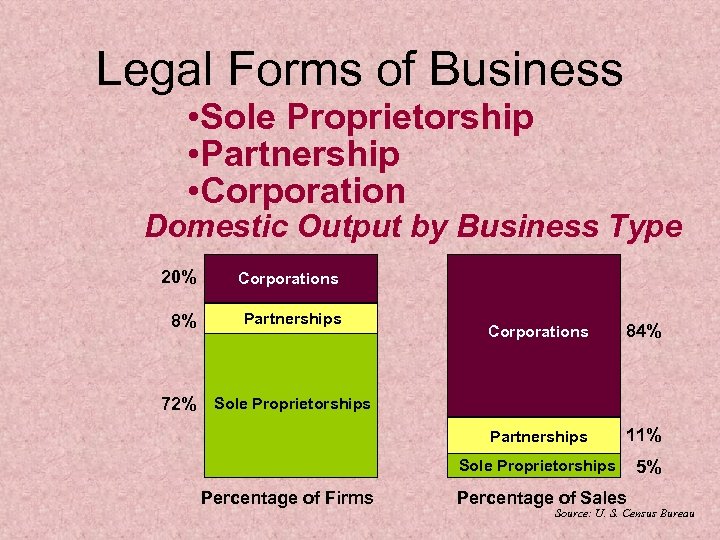
Legal Forms of Business • Sole Proprietorship • Partnership • Corporation Domestic Output by Business Type 20% Corporations 8% Partnerships Corporations 84% Partnerships 11% 72% Sole Proprietorships Percentage of Firms Percentage of Sales 5% Source: U. S. Census Bureau
FORTUNE 500 • Annual listing of the top corporations in America in terms of sales • What companies do you think were on the 2010 list? http: //money. cnn. com/magazines/fortune 500/2009/full_list/
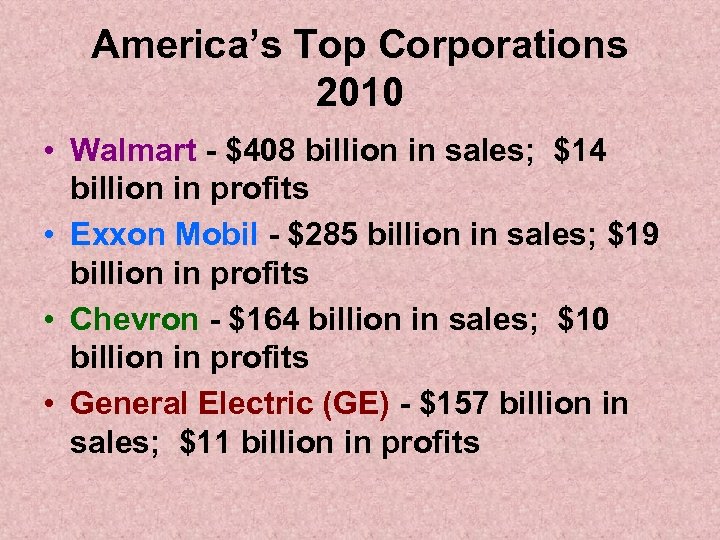
America’s Top Corporations 2010 • Walmart - $408 billion in sales; $14 billion in profits • Exxon Mobil - $285 billion in sales; $19 billion in profits • Chevron - $164 billion in sales; $10 billion in profits • General Electric (GE) - $157 billion in sales; $11 billion in profits
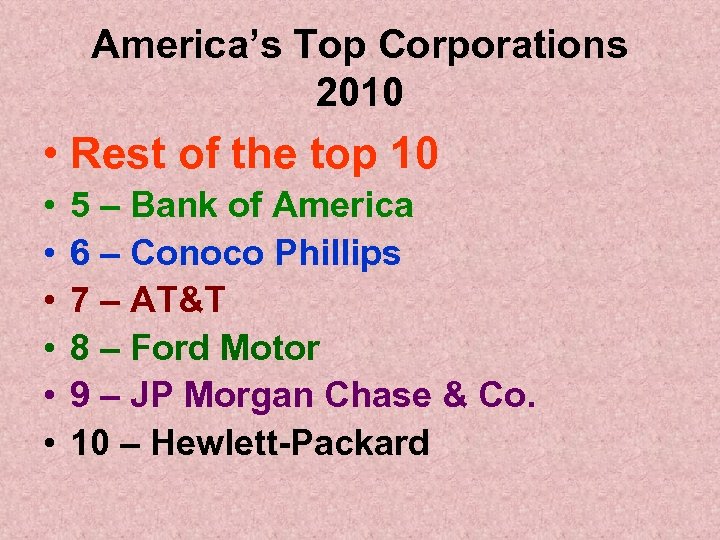
America’s Top Corporations 2010 • Rest of the top 10 • • • 5 – Bank of America 6 – Conoco Phillips 7 – AT&T 8 – Ford Motor 9 – JP Morgan Chase & Co. 10 – Hewlett-Packard
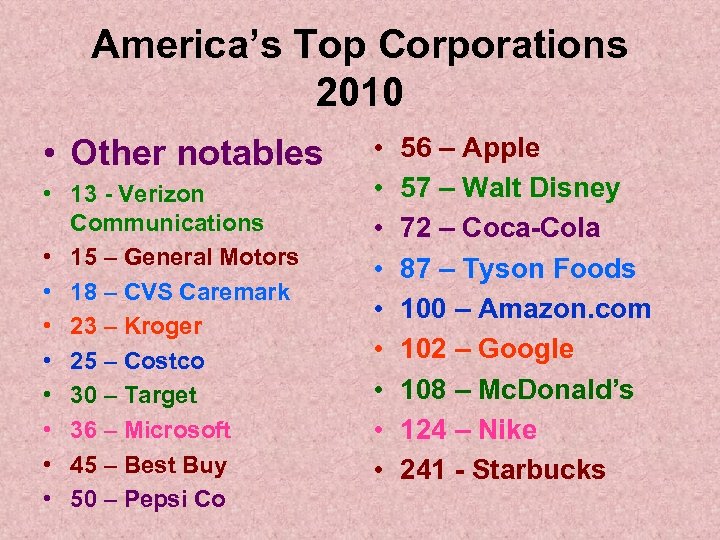
America’s Top Corporations 2010 • Other notables • 13 - Verizon Communications • 15 – General Motors • 18 – CVS Caremark • 23 – Kroger • 25 – Costco • 30 – Target • 36 – Microsoft • 45 – Best Buy • 50 – Pepsi Co • • • 56 – Apple 57 – Walt Disney 72 – Coca-Cola 87 – Tyson Foods 100 – Amazon. com 102 – Google 108 – Mc. Donald’s 124 – Nike 241 - Starbucks
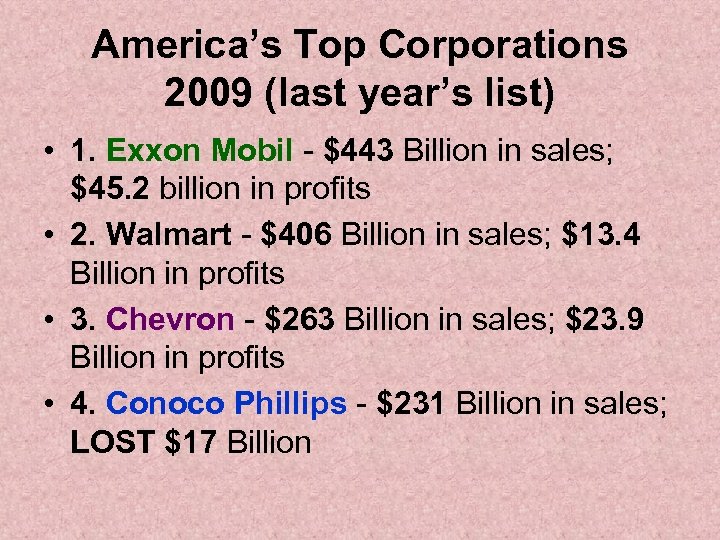
America’s Top Corporations 2009 (last year’s list) • 1. Exxon Mobil - $443 Billion in sales; $45. 2 billion in profits • 2. Walmart - $406 Billion in sales; $13. 4 Billion in profits • 3. Chevron - $263 Billion in sales; $23. 9 Billion in profits • 4. Conoco Phillips - $231 Billion in sales; LOST $17 Billion
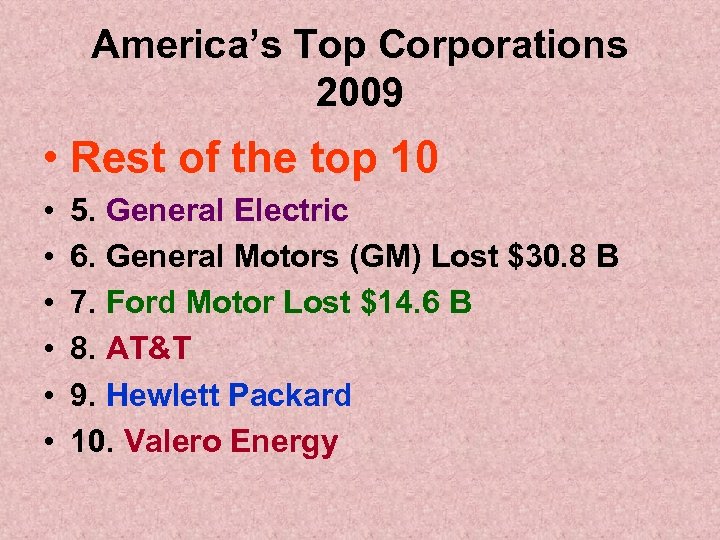
America’s Top Corporations 2009 • Rest of the top 10 • • • 5. General Electric 6. General Motors (GM) Lost $30. 8 B 7. Ford Motor Lost $14. 6 B 8. AT&T 9. Hewlett Packard 10. Valero Energy
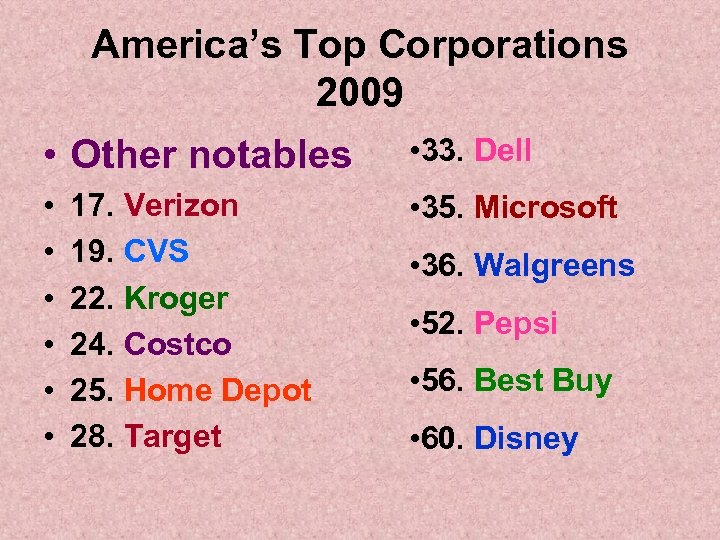
America’s Top Corporations 2009 • Other notables • 33. Dell • • 35. Microsoft 17. Verizon 19. CVS 22. Kroger 24. Costco 25. Home Depot 28. Target • 36. Walgreens • 52. Pepsi • 56. Best Buy • 60. Disney
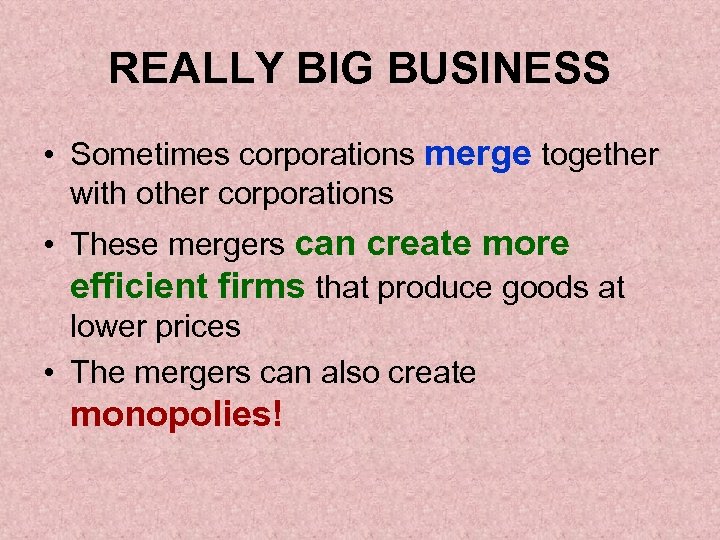
REALLY BIG BUSINESS • Sometimes corporations merge together with other corporations • These mergers can create more efficient firms that produce goods at lower prices • The mergers can also create monopolies!
TYPES OF CORPORATE MERGERS • Horizontal Merger – 2 or more firms competing in the same market – Example – Mc. Donald’s purchases Wendy’s
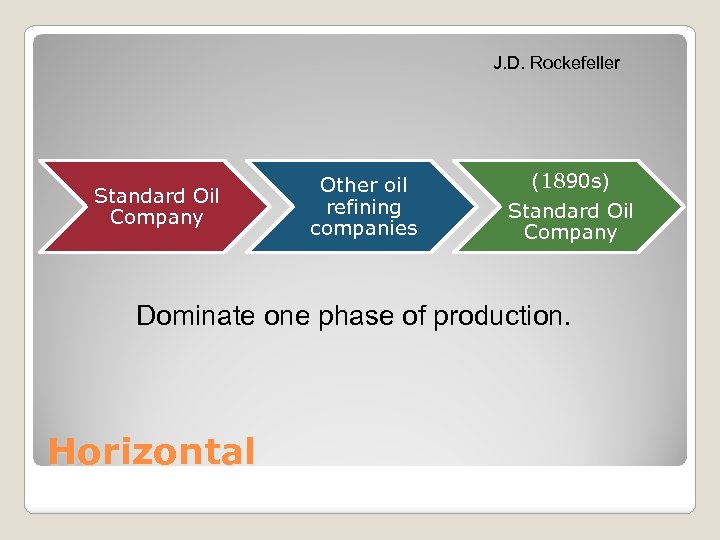
J. D. Rockefeller Standard Oil Company Other oil refining companies (1890 s) Standard Oil Company Dominate one phase of production. Horizontal
This type of merger occurs frequently as a result of larger companies attempting to create more efficient economies of scale. The joining of Daimler-Benz and Chrysler is a popular example of a horizontal merger. Examples: Chase Manhattan/Chemical Bank South Pacific RR/Santa Fe RR Economies of Scale: The Met. Life/Travelers Life cost advantages that an Exxon/Mobile enterprise obtains due to SBC/AT&T expansion. There are factors that cause a producer’s average cost per unit to fall as the scale of output is increased.
Staples, Inc. , a superstore retailer of office supplies, wanted to acquire Office Depot, another giant retailer of office supplies. This action would have left the newly merged Staples in the position as the only large office supply superstore in most places around the country. This creates an unfair advantage for Staples in the market. Market research showed that Staples would have then been able to increase their prices up to 13 percent after the merger. The Federal Trade Commission (FTC) recognized the results this action would have on the market and took steps to block the merger, saving billions of dollars for customers. Mergers Blockages
TYPES OF CORPORATE MERGERS • Vertical Merger – 2 or more firms involved in the production of the same product – Example – Mc. Donald’s buys the trucking company that delivers its meat and buns
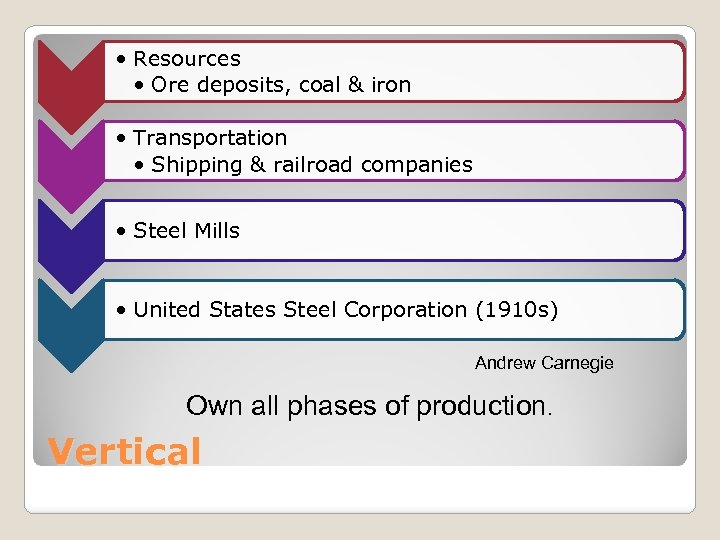
• Resources • Ore deposits, coal & iron • Transportation • Shipping & railroad companies • Steel Mills • United States Steel Corporation (1910 s) Andrew Carnegie Own all phases of production. Vertical
By directly merging with suppliers, a company can decrease reliance and increase profitability. An example of a vertical merger is a car manufacturer purchasing a tire company. Examples: Time Warner-TBS Disney-ABC Disney-Pixar Cleveland Iron/Detroit Steel Brown Shoe/Kinney
TYPES OF CORPORATE MERGERS • Conglomerates – When firms buy other firms that make unrelated products – More than 3 businesses merged – No one business makes a majority of the firm’s profits
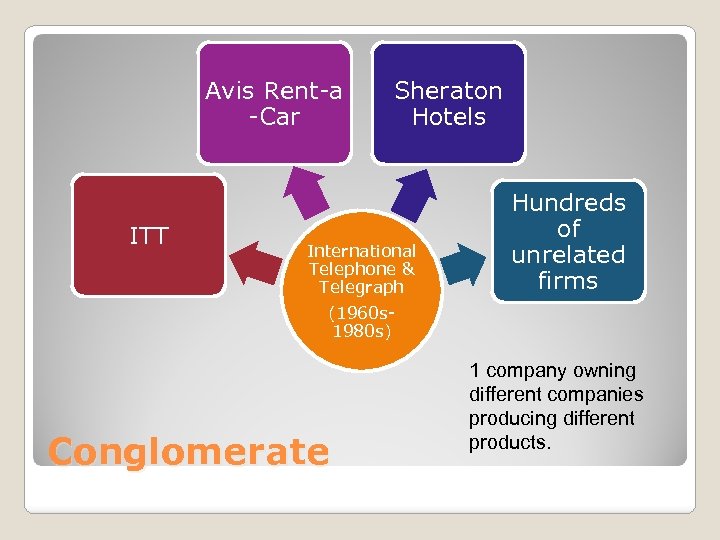
Avis Rent-a -Car ITT Sheraton Hotels International Telephone & Telegraph Hundreds of unrelated firms (1960 s 1980 s) Conglomerate 1 company owning different companies producing different products.
Conglomerates diversify their business risk through profit gained from profit centers in various lines of business. However, some may become so diversified and complicated that they are too difficult to manage efficiently. ◦ Examples: Phillip Morris/Kraft Foods RJ Reynolds/Nabisco Viacom/Blockbuster Pepsi/Taco Bell ITT/Hartford Insurance
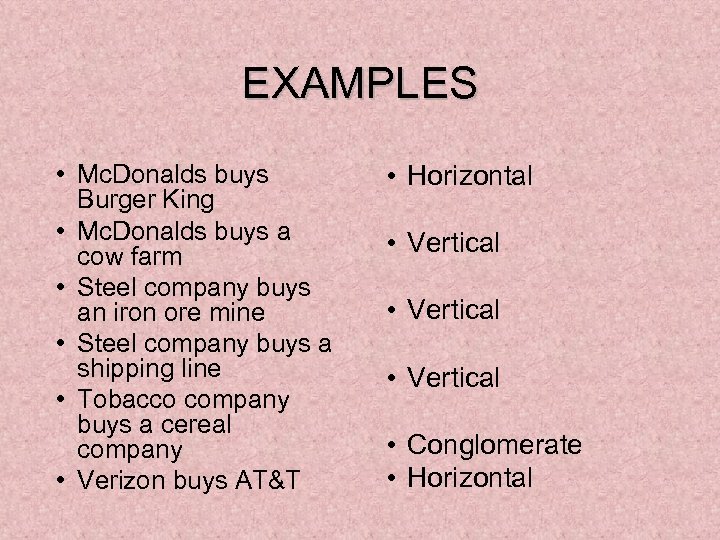
EXAMPLES • Mc. Donalds buys Burger King • Mc. Donalds buys a cow farm • Steel company buys an iron ore mine • Steel company buys a shipping line • Tobacco company buys a cereal company • Verizon buys AT&T • Horizontal • Vertical • Conglomerate • Horizontal
TYPES OF CORPORATE MERGERS • Which of these types of mergers (horizontal, vertical, conglomerate) do you think government regulators have their closest eye on? Why?
THE MULTINATIONAL • Corporations that produce and sell their goods throughout the world • Headquartered in one country with branches in many other countries
THE MULTINATIONAL • They must follow the laws and pay taxes in whatever country they are operating in • 30 years ago, only the U. S. and England had the largest multinationals • Now, the largest multinationals are multinational! Clever, eh? • Toyota, Shell, BP
OTHER TYPES OF BUSINESS ORGANIZATIONS • Franchise – An entrepreneur pays a fee to a “parent company” for the right to sell that company’s product – Usually associated with fast food restaurants but is more broad than that (H&R Block, 7 -Eleven, Ace Hardware, Jiffy Lube)
FRANCHISE ADVANTAGES • Name recognition • Standardized quality • Parent company trains and supports the franchise employees • National advertising • Financial assistance • Buying from large parent company can mean lower prices
FRANCHISE DISADVANTAGES • Must pay a franchise fee and share profits with the parent company • Must strictly follow the parent company guidelines for running the business
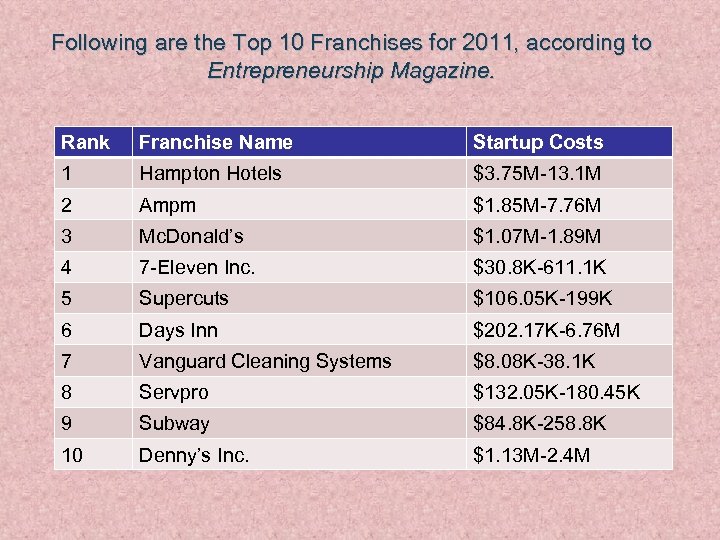
Following are the Top 10 Franchises for 2011, according to Entrepreneurship Magazine. Rank Franchise Name Startup Costs 1 Hampton Hotels $3. 75 M-13. 1 M 2 Ampm $1. 85 M-7. 76 M 3 Mc. Donald’s $1. 07 M-1. 89 M 4 7 -Eleven Inc. $30. 8 K-611. 1 K 5 Supercuts $106. 05 K-199 K 6 Days Inn $202. 17 K-6. 76 M 7 Vanguard Cleaning Systems $8. 08 K-38. 1 K 8 Servpro $132. 05 K-180. 45 K 9 Subway $84. 8 K-258. 8 K 10 Denny’s Inc. $1. 13 M-2. 4 M
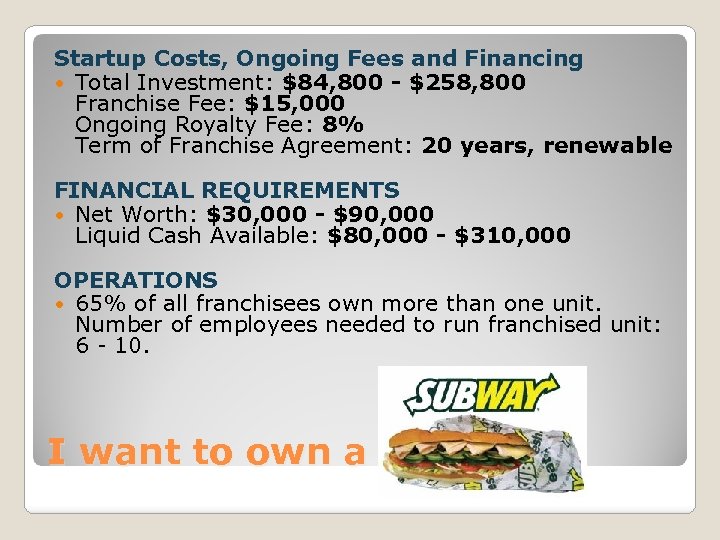
Startup Costs, Ongoing Fees and Financing Total Investment: $84, 800 - $258, 800 Franchise Fee: $15, 000 Ongoing Royalty Fee: 8% Term of Franchise Agreement: 20 years, renewable FINANCIAL REQUIREMENTS Net Worth: $30, 000 - $90, 000 Liquid Cash Available: $80, 000 - $310, 000 OPERATIONS 65% of all franchisees own more than one unit. Number of employees needed to run franchised unit: 6 - 10. I want to own a Subway…
OTHER TYPES OF BUSINESS ORGANIZATIONS • Non-Profit Organizations – an organization that exists for the purpose of benefiting society, NOT for making a profit • Examples – YMCA, American Red Cross, Bill and Melinda Gates Foundation, The Better Business Bureau
OTHER TYPES OF BUSINESS ORGANIZATIONS • Almost all of them provide services instead of goods • They are exempt from income taxes by government
LEVELS OF COMPETITION • Some businesses compete in a market with large numbers of sellers • Some businesses compete in a market with relatively few sellers • Some businesses “compete” in a market with no competition
LEVELS OF COMPETITION • Thus, the MARKET STRUCTURE for an American business depends on their unique competitive situation • There are 4 basic levels of competition – Pure Competition – Monopolistic Competition – Oligopoly – Pure Monopoly
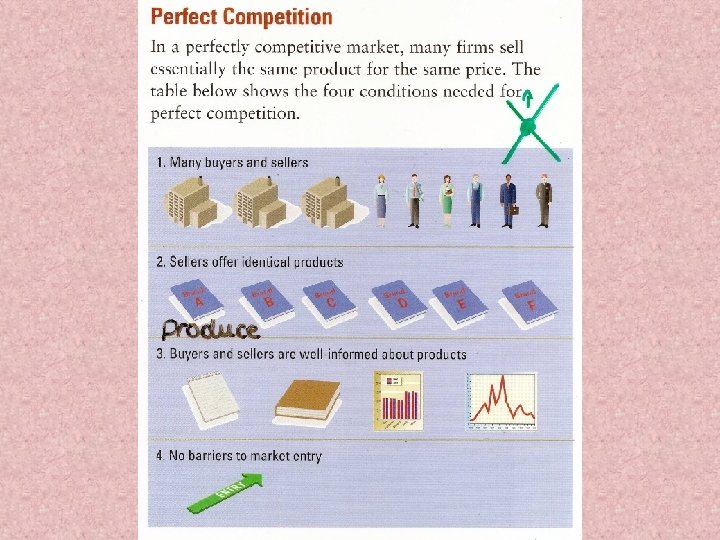
PURE COMPETITION • Sometimes called PERFECT COMPETITION • CHARACTERISTICS – Very large number of independently acting sellers in the market – All the sellers produce the same, homogeneous product; Consumers make no difference between Product A, B, C, D, etc… (No differentiation)
PURE COMPETITION • Sellers make no attempt to differentiate their product from their competitors • Because there are so many sellers, no one business can increase or decrease their output to affect the market price • In other words, businesses do not control the price of their product
PURE COMPETITION • It is very easy to enter and to leave this type of market • In other words, no significant legal, financial or technological obstacles exist • Relatively rare market structure – agricultural goods (farmer’s market)
MONOPOLISTIC COMPETITION • Characteristics – Relatively large numbers of sellers – Sellers try to differentiate their product from others; usually through advertising – Easy entry to and exit from this market
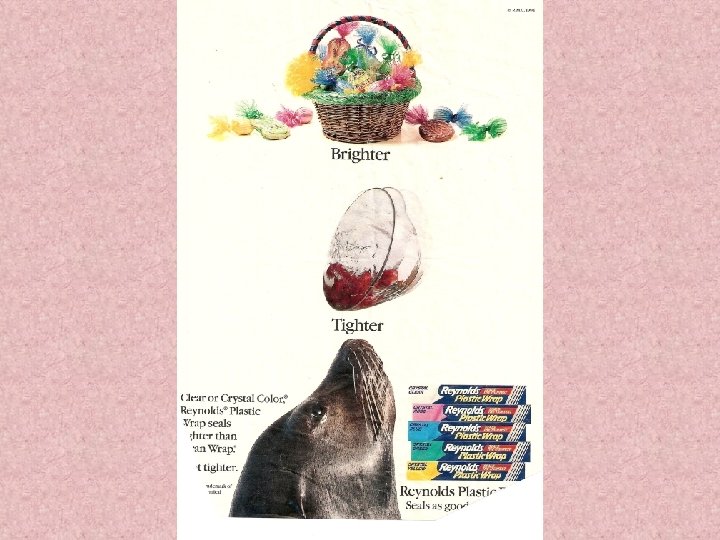
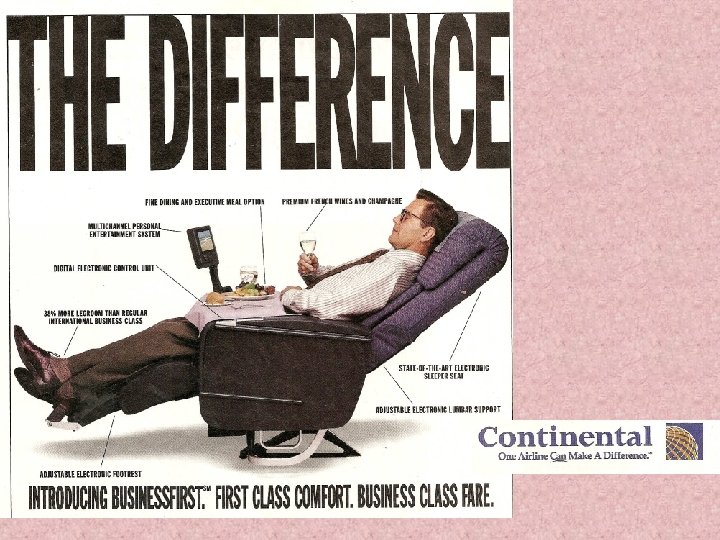
MONOPOLISTIC COMPETITION • The 1 st and 3 rd characteristics (many sellers, easy entry) represent the “competition” part of monopolistic competition • The 2 nd characteristic (differentiation) represents the “monopolistic” part of monopolistic competition • Monopolistically competitive industries are more competitive than monopolistic
MONOPOLISTIC COMPETITION • How do businesses try to differentiate (other than price) their product from competitors? • In other words, what is the NONPRICE COMPETITION that takes place among businesses?
MONOPOLISTIC COMPETITION • Product Quality – businesses try to convince consumers that there is a real difference in the quality of their product • Services Offered – Pizza delivery? Same day furniture delivery? Polite workers?
MONOPOLISTIC COMPETITION • Location, Location and accessibility –Open 24 hours, close to the interstate, Mini. Marts • Advertising and Packaging – companies try to create brand name loyalty; attractive packaging
OLIGOPOLY • A market dominated by a few large producers (they control 75% or more of a market) • Breakfast Cereals – Big Three – Kelloggs, Post, General Mills
OLIGOPOLY • Automobile Industry – Big Six – Ford, GM, Chrysler, Toyota, Honda, Nissan • • Tobacco Motion Pictures Passenger aircraft Sellers try to differentiate their products
OLIGOPOLY • Oligopolies can form when there are significant barriers to entering a market • Why is the automobile industry an oligopoly?
OLIGOPOLY • Oligopolistic companies have greater control over the price of their product than monopolistic competition or pure competition companies
OLIGOPOLY • However, these companies must take into account the reaction of their rivals • 3 oligopolistic practices that are of concern to government regulators – Price Leadership – Collusion – Cartels
OLIGOPOLY • Price Leadership – an influential company takes the lead in announcing price increases that lead the other companies to do the same. – Sometimes the effect is a price war that hurts producers (but helps consumers)
OLIGOPOLY • Collusion – an agreement among the companies to fix prices at a high level in order to maximize profits • Collusion is illegal in the United States
OLIGOPOLY • Cartels – a formal organization of producers that fix output and prices • Illegal in the U. S. • OPEC
Pure Monopoly • Characteristics – Single Seller – the firm IS the industry – Total control over price and output (restrained by the law of demand) – Entry to this market is not possible
Pure Monopoly • Pure monopoly is relatively rare • “Near” Monopolies exist when a single firm controls 75% or more of a market • Intel • Wham-O (frisbees) • Cable TV companies like Comcast • Microsoft operating systems
Types of Monopoly Natural Monopolies ◦ Market that runs most efficiently when one large firm provides all of the output. Example: Public water and sewage Past examples: phone service, electricity • Government issued patents – gives a single firm exclusive rights (20 years) to sell a product – Why? • Incentive to invent and create
Types of Monopoly • Geographic Monopoly – gas station in the middle-ofnowhere Texas

Government Market Intervention Ch. 7, Sec. 4 in Text Workbook p. 40
1. Goal • Keep firms from controlling the price and supply of important G/S.
2. Antitrust Powers • Watch & regulate industry; stop formation of cartels or monopolies; break up existing monopolies
3. Complaints Against Microsoft: • Requiring manufacturers to include Microsoft browser with Microsoft operating system and predatory pricing.
4. Complaints Against AT&T • Using legal monopoly in local service to take control over markets for longdistance phone calls and communications equipment.
5. Guidelines for Mergers • Must prove that merger would lower costs and consumer prices or lead to a better product. • Must be approved by the FTC (Federal Trade Commission. )
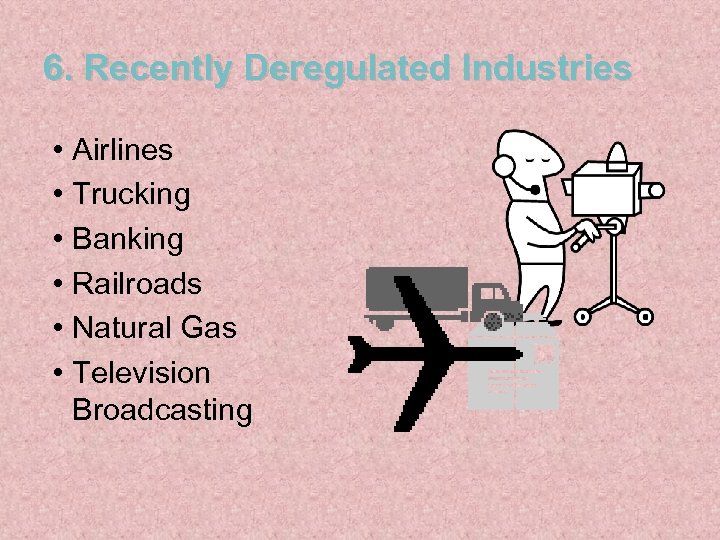
6. Recently Deregulated Industries • Airlines • Trucking • Banking • Railroads • Natural Gas • Television Broadcasting
• • What did economist Paul Krugman suggest was a “simple model for predicting the unemployment rate in the United States over the next few years? ” p. 219 What is the title to Alan Greenspan’s biography? P. 227
Скачать презентацию AMERICAN BUSINESS 3 MAJOR TYPES SOLE PROPRIETORSHIP
454131111d9986ebc8872b7b21a8761c.ppt