 Скачать презентацию AMERICAN BAR ASSOCIATION DRAFTING GUIDE FOR REPORTS WITH
c19d4d3139599dad8a2bc30eff5b52d6.ppt
- Количество слайдов: 10



AMERICAN BAR ASSOCIATION DRAFTING GUIDE FOR REPORTS WITH RECOMMENDATIONS The Committee on Drafting Policies and Procedures House of Delegates August 2007
Dear ABA Colleague, In furtherance of the mission of the American Bar Association to be the national representative of the legal profession, serving its constituents and the public, by promoting justice, professional excellence and respect for the law, the ABA House of Delegates considers Reports with Recommendations that, after adoption by the House, become Association policies. This Guide has been prepared as a resource for anyone drafting a Report with Recommendation, usually referred to as a resolution. It covers the average situation and is intended to help avoid last minute problems for the drafters of the resolutions, the submitting entities and the ABA staff. It is critical that Reports with Recommendations are clearly understnot only by members of the House who will vote on their adoption, but also by all other ABA members, and by those to whom these policies are transmitted. These policies are most often directed to Congress, and state, local and territorial governments, as well as their various agencies and officials, the courts and law schools. Reports with Recommendations that are well-written and clearly expressed, enable the original sponsors to forward their goals with less likelihood that the proposed policies will be misunderstood and/or amended at the request of the Committee on Rules and Calendar or by others during the debate on the floor of the House. If you have an unusual situation, questions, comments, or suggestions for improving this Guide, please contact the Committee on Drafting Policies and Procedures. Sincerely, Donna C. Willard-Jones, Chair Judith S. Kaleta, Vice Chair Hon. Cara Lee Neville Hon. John R. Tunheim
A Drafting Guide for ABA Reports with Recommendations Introduction The ABA House of Delegates formulates policy of the Association at each Midyear and Annual Meeting. The House considers Reports with Recommendations that become Association policies after adoption by the House. A Report with Recommendation may be submitted by a delegate to the House, a section, committee, state or local bar association, affiliated organization or ABA member. It may be considered only if it proposes new policy, a change of policy, or reaffirms existing Association policy that has not been approved within the last 10 years. In addition, a report with Recommendation must meet certain other criteria set forth in the Rules of Procedures of the House of Delegates. This Drafting Guide covers each of those requirements and provides examples and other suggestions. I. RECOMMENDATION A. Recommendation Heading The heading follows a standard format that includes the name of the Association, the sponsor of the Recommendation, and any co-sponsors, and also identifies the document as a report and recommendation to the House of Delegates. 1. Identify the Association. The first line of the Recommendation is always the same and should read, in all capital letters, as follows: AMERICAN BAR ASSOCIATION 2. Sponsoring entity. The second line of the heading should state the name of the entity submitting the Recommendation, in all capital letters. For example: SECTION OF ADMINISTRATIVE LAW AND REGULATORY PRACTICE 3. Co-sponsoring entities. If other entities have agreed to co-sponsor the Recommendation, they should be listed, in all capital letters, following the name of the sponsor.
1. What Position do you want the Association to take? Consider the message you wish to convey and choose the right verb, usually reflecting the action you wish to be taken by the ABA, such as: Should the ABA support or oppose a statute, legislation or policy? Or should it urge or recommend the adoption of legislation? 2. To Whom should the Recommendation be Addressed? i. Federal Legislation. When a Recommendation concerns Federal legislation, the Recommendation should be addressed to Congress. (Do not refer to the United States Congress, the U. S. Congress, or to the Congress of the United States. ) Example: RESOLVED, That the American Bar Association urges Congress… ii. Federal Policy. When a Recommendation concerns Federal policy, the Recommendation should be addressed to the particular agency or official. Example: RESOLVED, That the American Bar Association supports the efforts of the U. S. Trade Representative to encourage the development of transparency disciplines… Example: RESOLVED, That the American Bar Association urges the Attorney General of the United States to issue a memorandum to Freedom of Information Act Officials… Example: RESOLVED, That the American Bar Association urges the U. S. Patent and Trademark Office to amend… iii. Non-Federal Legislation or Policy. When a Recommendation concerns legislative or policy action by States, consider the appropriateness of referring to territorial and local entities as well. Example: RESOLVED, That the American Bar Association urges all federal, state, territorial, and local legislative bodies and governmental agencies to adopt laws and policies…
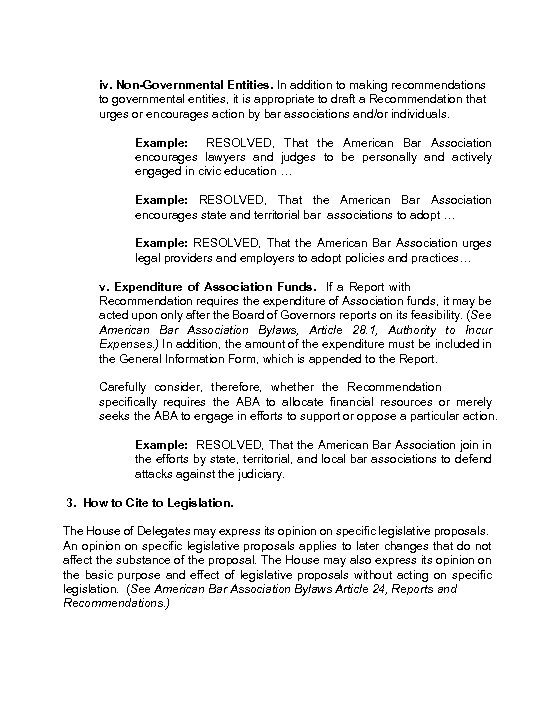
iv. Non-Governmental Entities. In addition to making recommendations to governmental entities, it is appropriate to draft a Recommendation that urges or encourages action by bar associations and/or individuals. Example: RESOLVED, That the American Bar Association encourages lawyers and judges to be personally and actively engaged in civic education … Example: RESOLVED, That the American Bar Association encourages state and territorial bar associations to adopt … Example: RESOLVED, That the American Bar Association urges legal providers and employers to adopt policies and practices… v. Expenditure of Association Funds. If a Report with Recommendation requires the expenditure of Association funds, it may be acted upon only after the Board of Governors reports on its feasibility. (See American Bar Association Bylaws, Article 28. 1, Authority to Incur Expenses. ) In addition, the amount of the expenditure must be included in the General Information Form, which is appended to the Report. Carefully consider, therefore, whether the Recommendation specifically requires the ABA to allocate financial resources or merely seeks the ABA to engage in efforts to support or oppose a particular action. Example: RESOLVED, That the American Bar Association join in the efforts by state, territorial, and local bar associations to defend attacks against the judiciary. 3. How to Cite to Legislation. The House of Delegates may express its opinion on specific legislative proposals. An opinion on specific legislative proposals applies to later changes that do not affect the substance of the proposal. The House may also express its opinion on the basic purpose and effect of legislative proposals without acting on specific legislation. (See American Bar Association Bylaws Article 24, Reports and Recommendations. )
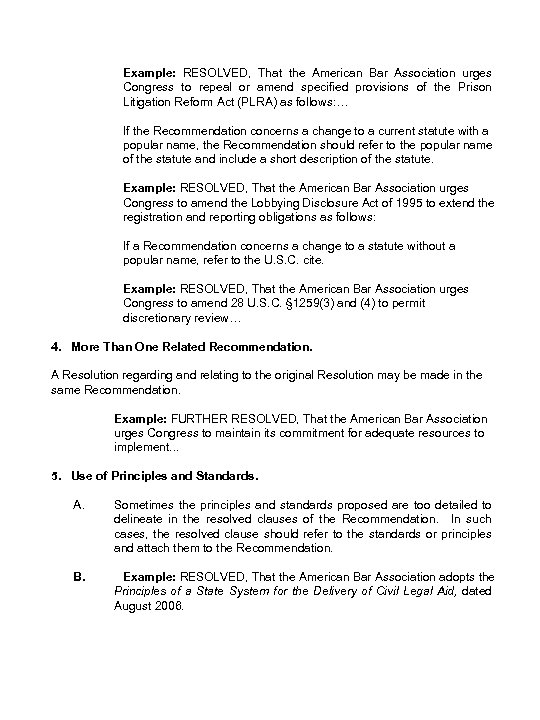
Example: RESOLVED, That the American Bar Association urges Congress to repeal or amend specified provisions of the Prison Litigation Reform Act (PLRA) as follows: … If the Recommendation concerns a change to a current statute with a popular name, the Recommendation should refer to the popular name of the statute and include a short description of the statute. Example: RESOLVED, That the American Bar Association urges Congress to amend the Lobbying Disclosure Act of 1995 to extend the registration and reporting obligations as follows: If a Recommendation concerns a change to a statute without a popular name, refer to the U. S. C. cite. Example: RESOLVED, That the American Bar Association urges Congress to amend 28 U. S. C. § 1259(3) and (4) to permit discretionary review… 4. More Than One Related Recommendation. A Resolution regarding and relating to the original Resolution may be made in the same Recommendation. Example: FURTHER RESOLVED, That the American Bar Association urges Congress to maintain its commitment for adequate resources to implement. . . 5. Use of Principles and Standards. A. Sometimes the principles and standards proposed are too detailed to delineate in the resolved clauses of the Recommendation. In such cases, the resolved clause should refer to the standards or principles and attach them to the Recommendation. B. Example: RESOLVED, That the American Bar Association adopts the Principles of a State System for the Delivery of Civil Legal Aid, dated August 2006.
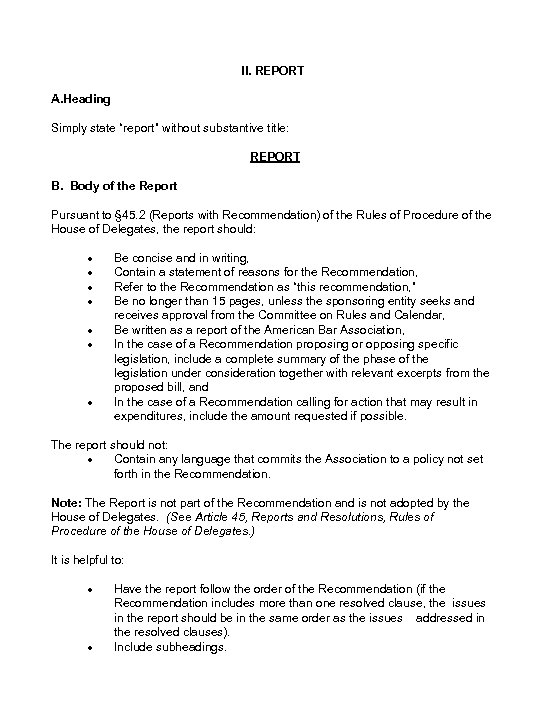
II. REPORT A. Heading Simply state “report” without substantive title: REPORT B. Body of the Report Pursuant to § 45. 2 (Reports with Recommendation) of the Rules of Procedure of the House of Delegates, the report should: · · · · Be concise and in writing, Contain a statement of reasons for the Recommendation, Refer to the Recommendation as “this recommendation, ” Be no longer than 15 pages, unless the sponsoring entity seeks and receives approval from the Committee on Rules and Calendar, Be written as a report of the American Bar Association, In the case of a Recommendation proposing or opposing specific legislation, include a complete summary of the phase of the legislation under consideration together with relevant excerpts from the proposed bill, and In the case of a Recommendation calling for action that may result in expenditures, include the amount requested if possible. The report should not: · Contain any language that commits the Association to a policy not set forth in the Recommendation. Note: The Report is not part of the Recommendation and is not adopted by the House of Delegates. (See Article 45, Reports and Resolutions, Rules of Procedure of the House of Delegates. ) It is helpful to: · · Have the report follow the order of the Recommendation (if the Recommendation includes more than one resolved clause, the issues in the report should be in the same order as the issues addressed in the resolved clauses). Include subheadings.
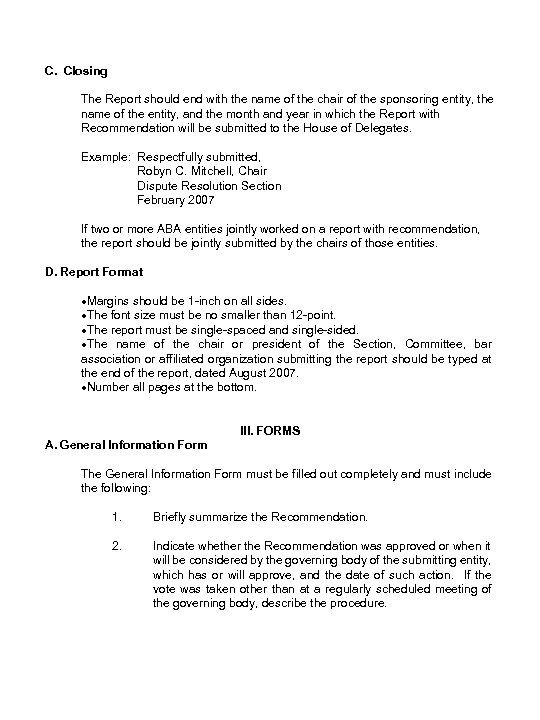
C. Closing The Report should end with the name of the chair of the sponsoring entity, the name of the entity, and the month and year in which the Report with Recommendation will be submitted to the House of Delegates. Example: Respectfully submitted, Robyn C. Mitchell, Chair Dispute Resolution Section February 2007 If two or more ABA entities jointly worked on a report with recommendation, the report should be jointly submitted by the chairs of those entities. D. Report Format ·Margins should be 1 -inch on all sides. ·The font size must be no smaller than 12 -point. ·The report must be single-spaced and single-sided. ·The name of the chair or president of the Section, Committee, bar association or affiliated organization submitting the report should be typed at the end of the report, dated August 2007. ·Number all pages at the bottom. III. FORMS A. General Information Form The General Information Form must be filled out completely and must include the following: 1. Briefly summarize the Recommendation. 2. Indicate whether the Recommendation was approved or when it will be considered by the governing body of the submitting entity, which has or will approve, and the date of such action. If the vote was taken other than at a regularly scheduled meeting of the governing body, describe the procedure.
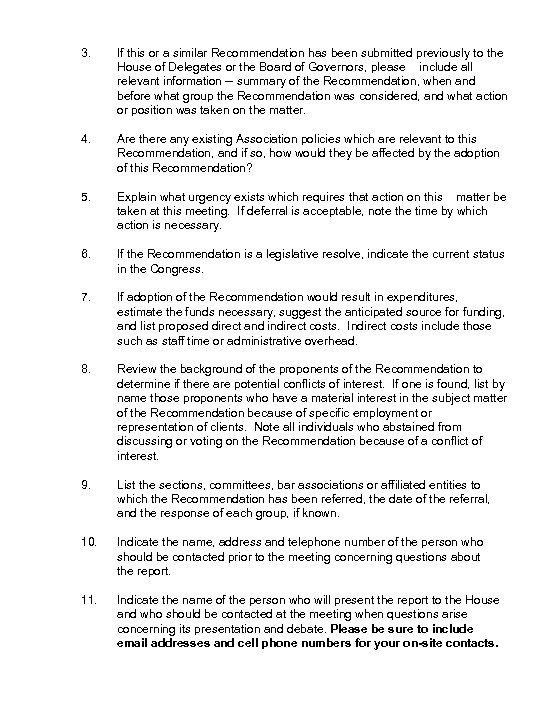
3. If this or a similar Recommendation has been submitted previously to the House of Delegates or the Board of Governors, please include all relevant information -- summary of the Recommendation, when and before what group the Recommendation was considered, and what action or position was taken on the matter. 4. Are there any existing Association policies which are relevant to this Recommendation, and if so, how would they be affected by the adoption of this Recommendation? 5. Explain what urgency exists which requires that action on this matter be taken at this meeting. If deferral is acceptable, note the time by which action is necessary. 6. If the Recommendation is a legislative resolve, indicate the current status in the Congress. 7. If adoption of the Recommendation would result in expenditures, estimate the funds necessary, suggest the anticipated source for funding, and list proposed direct and indirect costs. Indirect costs include those such as staff time or administrative overhead. 8. Review the background of the proponents of the Recommendation to determine if there are potential conflicts of interest. If one is found, list by name those proponents who have a material interest in the subject matter of the Recommendation because of specific employment or representation of clients. Note all individuals who abstained from discussing or voting on the Recommendation because of a conflict of interest. 9. List the sections, committees, bar associations or affiliated entities to which the Recommendation has been referred, the date of the referral, and the response of each group, if known. 10. Indicate the name, address and telephone number of the person who should be contacted prior to the meeting concerning questions about the report. 11. Indicate the name of the person who will present the report to the House and who should be contacted at the meeting when questions arise concerning its presentation and debate. Please be sure to include email addresses and cell phone numbers for your on-site contacts.
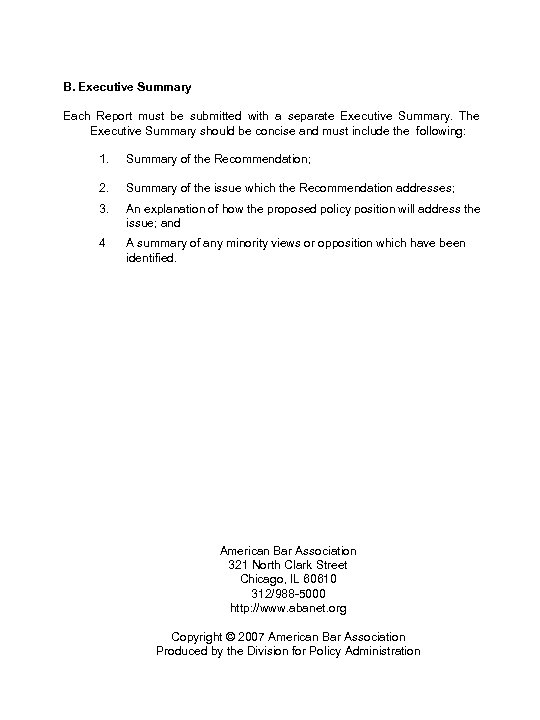
B. Executive Summary Each Report must be submitted with a separate Executive Summary. The Executive Summary should be concise and must include the following: 1. Summary of the Recommendation; 2. Summary of the issue which the Recommendation addresses; 3. An explanation of how the proposed policy position will address the issue; and 4 A summary of any minority views or opposition which have been identified. American Bar Association 321 North Clark Street Chicago, IL 60610 312/988 -5000 http: //www. abanet. org Copyright © 2007 American Bar Association Produced by the Division for Policy Administration
Скачать презентацию AMERICAN BAR ASSOCIATION DRAFTING GUIDE FOR REPORTS WITH
c19d4d3139599dad8a2bc30eff5b52d6.ppt