


 Скачать презентацию American and Israeli Educators Attitudes Towards Inclusion in
1e369781ac5602cbf0dd564b768c78dc.ppt
- Количество слайдов: 18
 American and Israeli Educators' Attitudes Towards Inclusion in the Jewish Early Childhood Classroom תפיסות של מחנכות אמריקאיות וישראליות כלפי הכלה בחינוך היהודי בגיל הרך Shelley Alexander & Sigal Achituv שלי אלכסנדר וסיגל אחיטוב “Not in My Back Yard (NIMBY)” Inter-Cultural Inclusion in Educational Systems and in Society ”לא בחצר האחורית שלי“: הכלה בין-תרבותית במערכות חינוכיות ובחברה אורנים – המכללה האקדמית לחינוך Oranim Academic College of Education 2015 ינואר January 2015
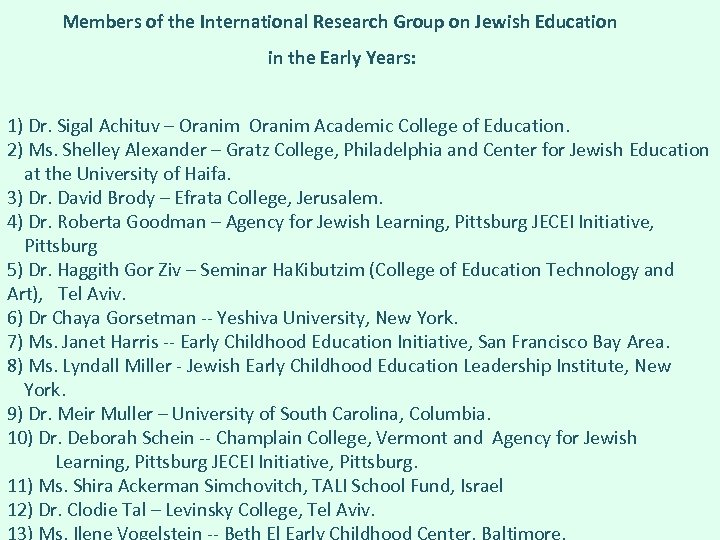 Members of the International Research Group on Jewish Education in the Early Years: 1) Dr. Sigal Achituv – Oranim Academic College of Education. 2) Ms. Shelley Alexander – Gratz College, Philadelphia and Center for Jewish Education at the University of Haifa. 3) Dr. David Brody – Efrata College, Jerusalem. 4) Dr. Roberta Goodman – Agency for Jewish Learning, Pittsburg JECEI Initiative, Pittsburg 5) Dr. Haggith Gor Ziv – Seminar Ha. Kibutzim (College of Education Technology and Art), Tel Aviv. 6) Dr Chaya Gorsetman -- Yeshiva University, New York. 7) Ms. Janet Harris -- Early Childhood Education Initiative, San Francisco Bay Area. 8) Ms. Lyndall Miller - Jewish Early Childhood Education Leadership Institute, New York. 9) Dr. Meir Muller – University of South Carolina, Columbia. 10) Dr. Deborah Schein -- Champlain College, Vermont and Agency for Jewish Learning, Pittsburg JECEI Initiative, Pittsburg. 11) Ms. Shira Ackerman Simchovitch, TALI School Fund, Israel 12) Dr. Clodie Tal – Levinsky College, Tel Aviv. 13) Ms. Ilene Vogelstein -- Beth El Early Childhood Center, Baltimore.
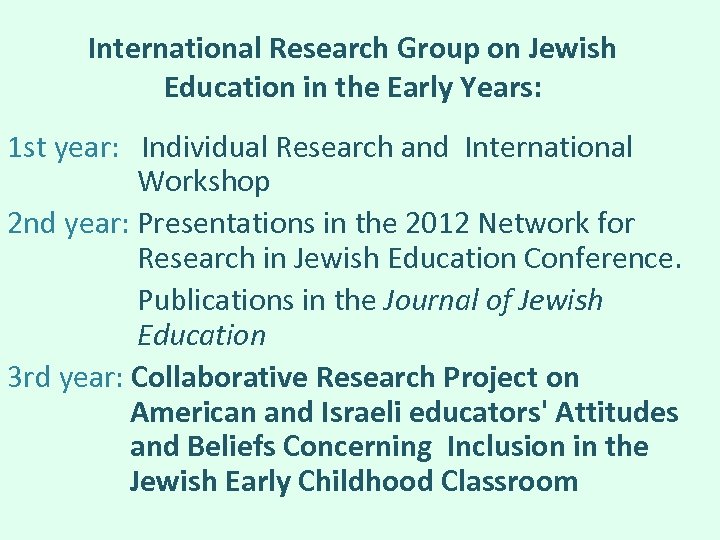 International Research Group on Jewish Education in the Early Years: 1 st year: Individual Research and International Workshop 2 nd year: Presentations in the 2012 Network for Research in Jewish Education Conference. Publications in the Journal of Jewish Education 3 rd year: Collaborative Research Project on American and Israeli educators' Attitudes and Beliefs Concerning Inclusion in the Jewish Early Childhood Classroom
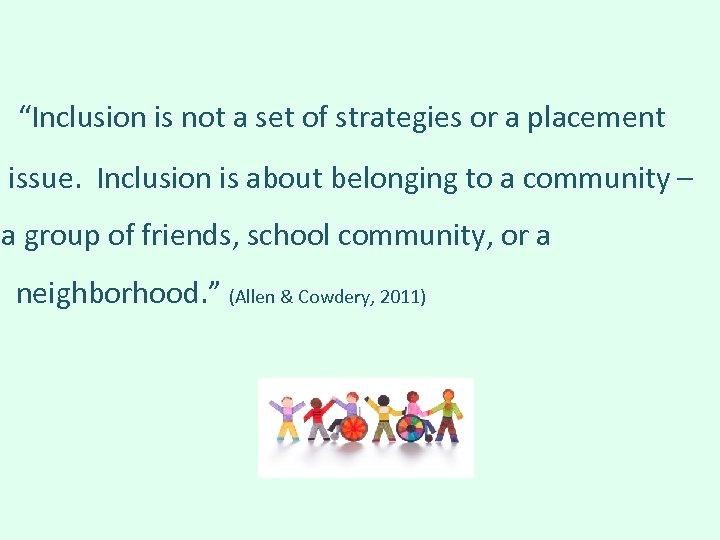 “Inclusion is not a set of strategies or a placement issue. Inclusion is about belonging to a community – a group of friends, school community, or a neighborhood. ” (Allen & Cowdery, 2011)
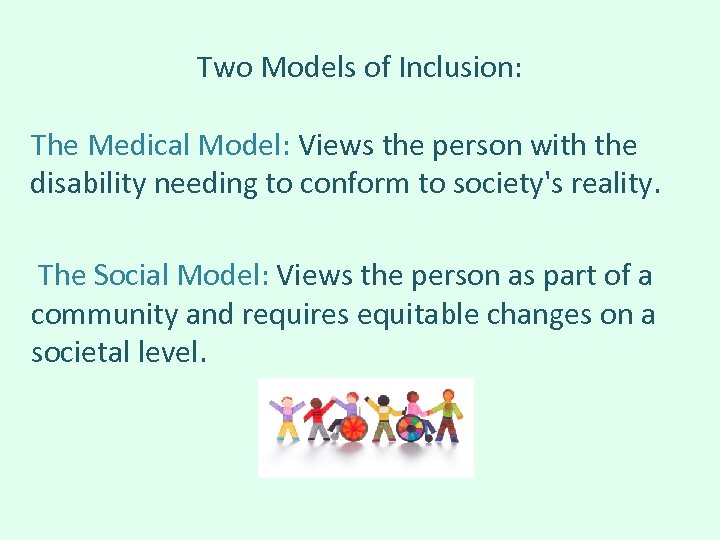 Two Models of Inclusion: The Medical Model: Views the person with the disability needing to conform to society's reality. The Social Model: Views the person as part of a community and requires equitable changes on a societal level.
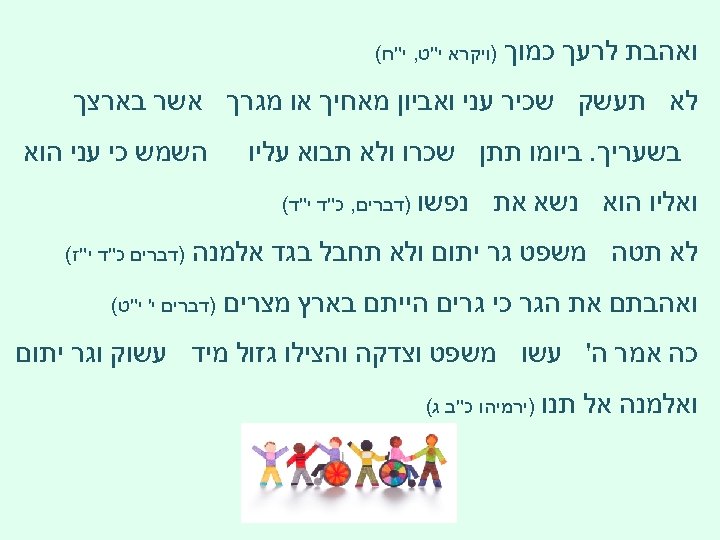 ואהבת לרעך כמוך )ויקרא י"ט, י"ח( לא תעשק שכיר עני ואביון מאחיך או מגרך אשר בארצך בשעריך. ביומו תתן שכרו ולא תבוא עליו ואליו הוא נשא את נפשו השמש כי עני הוא )דברים, כ"ד י"ד( לא תטה משפט גר יתום ולא תחבל בגד אלמנה ואהבתם את הגר כי גרים הייתם בארץ מצרים )דברים כ"ד י"ז( )דברים י' י"ט( כה אמר ה' עשו משפט וצדקה והצילו גזול מיד עשוק וגר יתום ואלמנה אל תנו )ירמיהו כ"ב ג(
 “Teachers seem to endorse inclusive education in general, but do not like to be involved when it concerns their own teaching practice and vary their opinion according to the type of disability”. (Anke, Jan and Alexander, 2011)
 Research Question: What do key educators in Jewish early childhood education in Israel and the United States think concerning inclusion and what, if any, are the problems and/or opportunities concerning inclusion in Israel and the United States that arise in Jewish education?
 Participants 7 American and Israeli Early Childhood Educators: 3 Teachers and Directors from American Learning Community of Jewish Preschools 4 Teachers from 3 Israeli Learning Communities: 2 Groups of Religious Kindergarten Teachers 1 Group of Secular Israeli Kindergarten Teachers.
 Data Themes • Tension Between Ideal and Reality • Lack of Confidence to Carry Out the Task • Need for Support • Limitations on Inclusion or Boundaries of Inclusion • Conflicting Needs of the Child with Disabilities versus the Needs of the Group • Need for Cooperation with Parents as a Requisite for Inclusion
 1) Teacher Attitudes Towards Inclusion "The juggling is even if we see God in children that we can't serve, we have to work with that and struggle with that because we can't serve everybody, and yet we see the beauty of what that person can bring to the world. "
 2) Who Should Be Included? "He really enjoyed music and he had wanted to listen to a CD and he went over to get a teacher's attention and he tapped, tapped on her leg. And there wasn't a response from the teacher. And she said, "I don't know what to do with this. "
 3) Teachers’ Professional Self-Image in the Context of Inclusion • "I think that we need to be supported in a way that an ordinary… with a typically developing class wouldn't be. We need emotional support. We need special ed support… someone throw me a massage my way once in a while and I'll be really happy. “ (An American Educator). • "I am only the kindergarten teacher, I have a supervisor who is the practical decision making authority and I trust her knowledge and her authority. . . this is not my kindergarten. . . I am an employee of the Ministry of Education and I am able to state my opinion but I am not able to make decisions and implement them. “ (An Israeli Educator).
 4) Parent-Teacher Cooperation Relationships and communication with the parents are of great concern to the teachers who believe that cooperation is a necessary condition for inclusion to be effective.
 5) Teachers’ World Views About Inclusion 1. A positive view of the advantages of inclusion 2. A need to balance the needs of the one child with those of the class 3. Inclusion in terms of benefits and deficits for the individual rather than engaging in a discourse of community responsibility and societal obligation for each member of the community
 6) Inclusion and Jewish Values • “It's hard for me to separate between religion and inclusion. These are my values. I’m sure it comes from my religious beliefs. . I’m sure this is the real attitude of Judaism. “ (An Israeli Educator). • “I guess it's something that is really rooted in Jewish values, because our community is religious and I feel this is one of the values we live on. There was no “Shiur” or “Drasha” on this in school, we simply live by them. ” (An Israeli Educator).
 Summary Future Training and Professional Development to Include: 1. knowledge and skills with an orientation towards inclusion of all learners in one classroom 2. strategies to work with parents 3. a vision of the benefits of inclusion for all the stakeholders: the child with disabilities, his/her family and peers, the teachers and the community
 Thank You!