


 Скачать презентацию America Pathways to the Present Chapter 26 The
da3c45b40b2bbdd4273e18494988c30e.ppt
- Количество слайдов: 36
 America: Pathways to the Present Chapter 26 The Cold War (1945– 1960) Section 1 Origins of the Cold War
 Chapter 26, Section 1 Origins of the Cold War • Why was 1945 a critical year in United States foreign relations? • What were the postwar goals of the United States and the Soviet Union? • How did the iron curtain tighten the Soviet Union’s hold over Eastern Europe? • How did the Truman Doctrine complement the policy of containment?
 Chapter 26, Section 1 1945—A Critical Year • Near end of WWII relations betw. Communist Soviet Union and other allies (US & GB) grew tense. • Yalta: February ‘ 45, Roosevelt, Churchill, and Stalin agreed on postwar division of Germany. • April, representatives of 50 countries, including the US, establish the United Nations – organization dedicated to cooperation in solving international problems. • April 12, FDR died unexpectedly – VP Truman takes over. – Far more distrustful of Communism • Anger rises after America’s use of Atomic bombs (developed without the USSR’s knowledge)
 Chapter 26, Section 1 Conflicting Postwar Goals American and Soviet Goals American Goals • Americans fought against dictatorship Soviet Goals • USSR ravaged by war – Europe should experience democracy and economic opportunity • To develop strong capitalist economies – would provide good markets for American products – Soviets want to rebuild Europe in ways that help the USSR recover – Buffer zone against further attacks • To establish satellite nations – countries subject to Soviet domination and sympathetic to Soviet goals – Spread worldwide communism
 Communism spreads through Eastern Europe by silencing opposition in • Albania and Bulgaria: Communists secure control • • Albania; Soviet troops seize Bulgaria. Czechoslovakia: Although it desperately tried to remain democratic, Czechoslovakia became a Soviet satellite nation in 1948. Hungary and Romania: By arresting anti-Communist leaders in Hungary and forcing the appointment of a Communist prime minister in Romania, Communists achieved power in both nations. East Germany: To make sure Germany could not threaten his nation again, Stalin established a totalitarian government, naming the state the German Democratic Republic. Finland Yugoslavia: Both countries maintained their independence from Soviet control – Finland, by signing a treaty of cooperation, and Yugoslavia, by following the leadership of their own dictator.
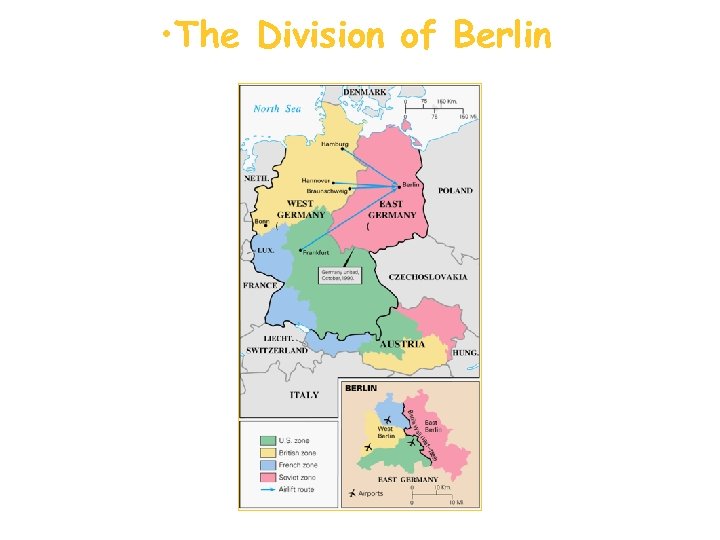 • The Division of Berlin
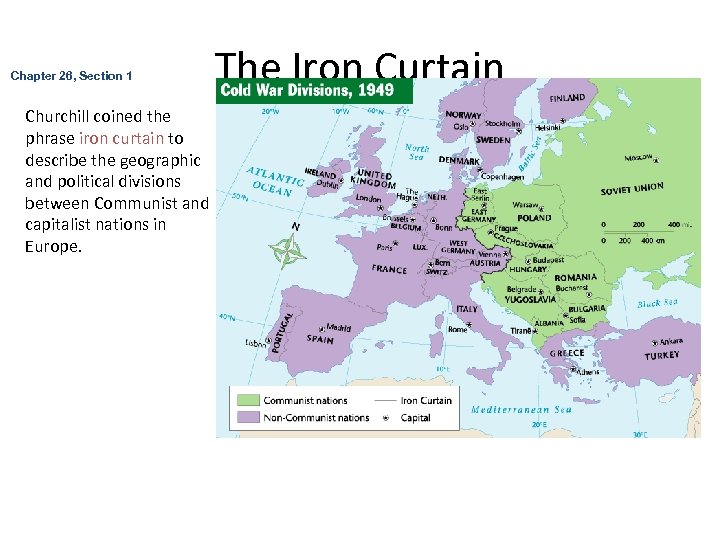 Chapter 26, Section 1 Churchill coined the phrase iron curtain to describe the geographic and political divisions between Communist and capitalist nations in Europe. The Iron Curtain
 Containment and the Truman Doctrine • Competition between the US and the Soviet Union for world influence came to be known as the Cold War. • Containment – US accepted the fact that Eastern Europe was under Communist control – Now trying to prevent Communist governments from forming elsewhere in the world. • The Truman Doctrine – Official policy of containment – the United States would support free people who resist attempted conquest by Communists – first applied in the cases of Greece and Turkey • Gave $400 million in aid to fight against the Communists.
 America: Pathways to the Present Chapter 26 The Cold War (1945– 1960) Section 2 The Cold War Heats Up
 The Cold War Heats Up • New weapons and attempt to acquire them built up fear in US and USSR • Backdrop to the entire conflict • “For now we have entered the atomic age, and war has undergone a technological change which makes it a very different thing from what it used to be. War today between the Soviet empire and the free nations might dig the grave not only of our Stalinist opponents, but of our own society, our world as well as theirs. ” – Harry Truman on M. A. D. • Mutually Assured Destruction
 Chapter 26, Section 2 The Marshall Plan • US didn’t want to repeat mistakes of post-WWI – Goal: help Europe recover and become economically strong. • Create new markets for US goods • Prevent Communists from continuing to gain power in Europe. • Marshall Plan: proposed in ‘ 47 by Sec of State George Marshall – Countries design recovery programs and would receive $ from US. • 17 Western European nations joined plan – Received $13 billion in aid. • US and Europe benefit • Soviets refuse aid, Eastern Europe struggles
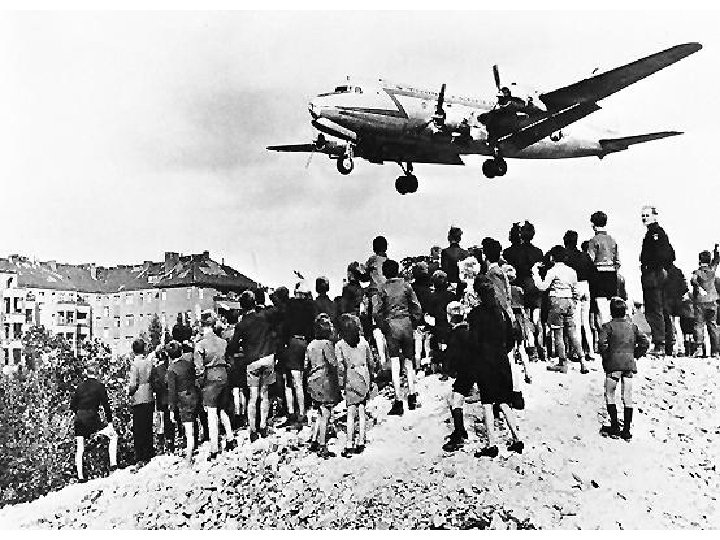
 Chapter 26, Section 2 The Berlin Airlift • 1948: US, GB, France agree to make zones in Germany into single country – West Berlin became part of W. Germany even though located in E. Germany (Communist) – People escape from Iron Curtain into W. Berlin • June ‘ 48, Stalin banned all shipments to West Berlin through East Germany – creates blockade that cuts off supplies to 2. 5 million people • Berlin airlift: US & GB pilots take 200 k flights, deliver thousands of tons of food & supplies by air. • Blockade ends May 1949, – Berlin remained a focal point of Cold War
 Chapter 26, Section 2 • • NATO Soviet vetoes prevented the UN from resolving many postwar problems. Propose “association of democratic, peace loving states” – US looks to become leader in world affairs – Didn’t want to be the only one committed to fighting communism North Atlantic Treaty Organization (NATO) formed in April ’ 49 – US, Canada, 10 Western European nations pledge collective security. • “an armed attack against one or more of them…shall be considered an attack against them all. ” Soviet Union creates Warsaw Pact – military alliance between USSR and satellites.
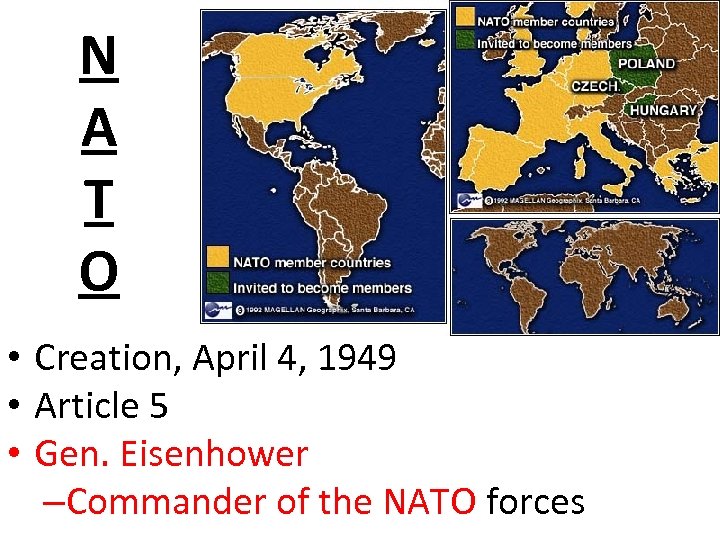 N A T O • Creation, April 4, 1949 • Article 5 • Gen. Eisenhower –Commander of the NATO forces
 • The Arms Race: A “Missile Gap? ” } USSR exploded its first A-bomb in 1949. } Hydrogen Bombs in 1952 } 2 nuclear superpowers!
 Chapter 26, Section 2 Communist Advances • Federal Civil Defense Administration- organizes bomb shelters, air raid drills • China – Civil War betw Communists and Nationalists • Communists: Mao Zedong • Nationalists: Chiang Kai-shek • Nationalists ask US for help – Truman decides that China will fall anyway, refuses to aid • China becomes Communist in 1949. – Truman seen as President who “lost China”
 Chapter 26, Section 2 The Cold War at Home • Communist takeover of Eastern Europe & China fuel fear of its spread – 100 k in U. S. Communist Party; fear some loyal to U. S. S. R. • Truman established federal employee loyalty program in 1947 – checks backgrounds of all federal employees. • House Un-American Activities Committee (HUAC): investigates govt agencies and Hollywood personalities – Accuses that many movies made to influence people toward Communists – Hollywood Ten, refused to answer HUAC’s questions and imprisoned – Studios made a blacklist, naming persons who should not be hired. • Some guilty, most not
 Chapter 26, Section 2 The Cold War at Home • 1952 Mc. Carran-Walter Act reestablished the immigration quota system from 1924. – Limited immigrants from Asia and Southern and Central Europe. – Truman veto's but Congress passes anyway • Spies – Soviet nuclear program built on info stolen from US – Alger Hiss-accused of being Soviet spy, convicted of perjury – Julius and Ethel Rosenberg-executed for espoinage.
 America: Pathways to the Present Chapter 26 The Cold War (1945– 1960) Section 3 The Korean War
 Chapter 26, Section 3 The Korean War • How did Communist expansion in Asia set the stage for the Korean War? • Who fought in the Korean War, and what were three stages of the war? • What were the effects of the Korean War?
 Communist Expansion in Asia Chapter 26, Section 3 The Chinese Civil War • Civil war began in the mid-1920 s and intensified after WWII. • Mao Zedong won support for Communists by redistributing land offering schooling and healthcare. • Chaing Kai-Shek’s Nationalist Party lost support because of harsh treatment of the population, high taxes, and corruption. • When the Communists took power in 1949, the Nationalists fled to Taiwan – Truman blamed for not providing enough aid to fight Communists The Division of Korea • WWII ended with no plan for Korean independence from Japan. • Korea temporarily divided at the thirty-eighth parallel – latitude line at approximately the midpoint of the peninsula. • A pro-American government formed in South Korea, Communist government formed in North Korea.
![• Korean War [1950 -1953] • Kim Il-Sung • Syngman Rhee • “Domino](https://present5.com/presentation/da3c45b40b2bbdd4273e18494988c30e/image-23.jpg "• Korean War [1950 -1953] • Kim Il-Sung • Syngman Rhee • “Domino") • Korean War [1950 -1953] • Kim Il-Sung • Syngman Rhee • “Domino Theory”
• Korean War [1950 -1953] • Kim Il-Sung • Syngman Rhee • “Domino Theory”
 Chapter 26, Section 3 The Korean Conflict • 1950, North Korea invades South, begins Korean War – Wanted to reunite and create 1 (Communist) Korea • South Korea calls on UN to stop invasion; Security Council approves • Gen. Douglas Mac. Arthur put in command of South Korean, U. S. , other forces – UN officially in charge of the “police action” but the US is responsible for 80% of the troops who were sent • North Korea drives south, captures Seoul • UN, South Korean troops forced into small defensive zone • Mac. Arthur attacks North Koreans from 2 sides, pushes into north
 The Korean Conflict • China sends troops to help North Korea • Mac. Arthur calls for war with China; Truman rejects request – Soviet Union, China have mutual assistance pact. Invasion means full fledged war with both • Mac. Arthur continues to push for invasion of China; Truman fires him • Public outraged over hero’s dismissal
 The Korean Conflict: Settling for stalemmate • 1951, Soviet Union suggests cease-fire – Fighting lasts another 2 years • 1953 armistice: Korea still divided; demilitarized zone established • Lack of success, high human, financial costs help elect Eisenhower – 33, 000 + Americans killed, 103, 000 wounded
![• Korean War [1950 -1953]](https://present5.com/presentation/da3c45b40b2bbdd4273e18494988c30e/image-27.jpg "• Korean War [1950 -1953]") • Korean War [1950 -1953]
• Korean War [1950 -1953]
![• The Shifting Map of Korea [1950 -1953]](https://present5.com/presentation/da3c45b40b2bbdd4273e18494988c30e/image-28.jpg "• The Shifting Map of Korea [1950 -1953]") • The Shifting Map of Korea [1950 -1953]
• The Shifting Map of Korea [1950 -1953]
 The Effects of the Korean War Chapter 26, Section 3 Questioning warfare- Why so many casualties for limited results • Integration of the Military — first war where black and white fight together • Increased Power of the Military — A militaryindustrial complex – Defense now made up more than half of US budget – Employs 3 million people by 1960 • Foreign Policy in Asia relations worsen with Communist China
 America: Pathways to the Present Chapter 26 The Cold War (1945– 1960) Section 4 The Continuing Cold War
 Chapter 26, Section 4 The Mc. Carthy Era • 1950 Wisconsin Sen. Joseph Mc. Carthy, up for reelection – Alleges that Communist spies working in US govt. – Claims to have a list of 250 names of Communist-supporting government employees. • Later reduced to 57. • Reelected and named chairman of committee to investigate Communism – Few willing to risk their reputations by speaking out against him. • By ‘ 54, Mc. Carthyism reached US army. • Democrats ask that hearings betw. Mc. Carthy and the army be televised – By mid-June he had lost even his strongest supporters. The Senate formally condemned him for his actions. • Free speech and debate stifled during this era
 The Cold War in the 1950 s Chapter 26, Section 4 United States involvement around the world, 1947– 1956 • Eastern Europe — Afraid of war, US didn’t support uprisings in East Germany, Poland, and Hungary. • Southeast Asia — Korean War ends; Vietnam divided into Communist North and anti-Communist South. • Middle East — US supports Israel, backs groups that restore a pro. American Shah in Iran; the Suez Crisis in Egypt. • Latin America — Organization of American States (OAS) is created; American aid helps anti-Communist leaders gain and retain power.
 Chapter 26, Section 4 The Arms Race • Arms race- Throughout 1950 s, US and USSR struggle to gain weapons superiority. • US Foreign Policy – Deterrence: maintain a military arsenal so strong that no enemy will attack for fear of retaliation – Brinkmanship: bringing US to the “brink” of war without actually entering into war.
 The Arms Race in the Skies Chapter 26, Section 4 • Fear spread when the Soviets developed long-range rockets (intercontinental ballistic missiles, or ICBMs) • 1957 ICBM used to launch the Soviet satellite Sputnik, the first artificial satellite to orbit Earth. • May 1960: Soviet missile shot down an American U-2 spy plane – US thought they were invincible – shattered US confidence – Began a desire to match—and surpass—Soviet weapons technology • Continues for most of the century
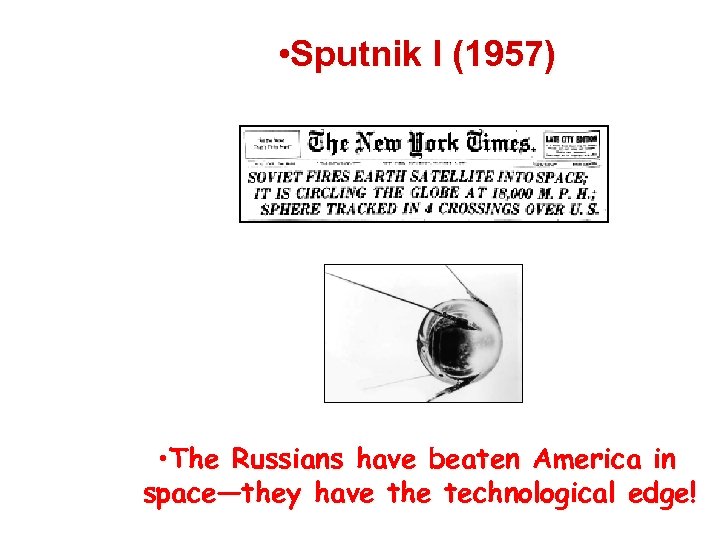 • Sputnik I (1957) • The Russians have beaten America in space—they have the technological edge!
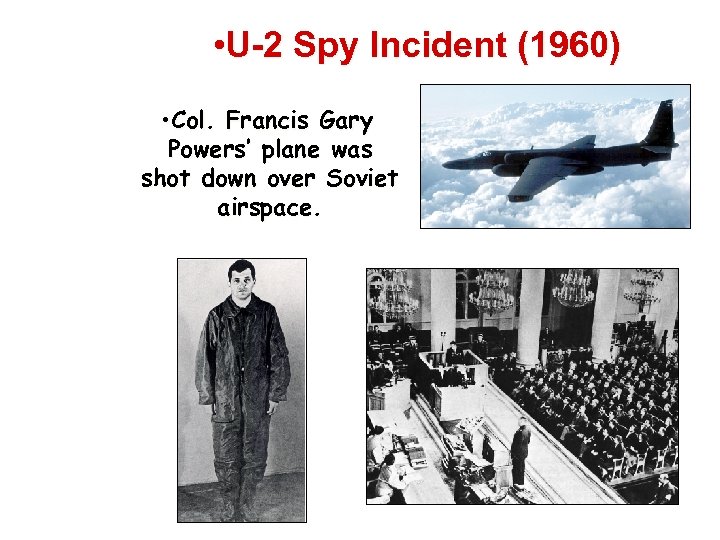 • U-2 Spy Incident (1960) • Col. Francis Gary Powers’ plane was shot down over Soviet airspace.