


 Скачать презентацию America in the 1950 s Relations with
909d99f200c50e1f37c9af9592fbfe3b.ppt
- Количество слайдов: 125
 America in the 1950 s
 Relations with Europe After WWII
 Creating the United Nations • UN General Assembly - every member nation in the world has one vote – power to vote on resolutions and choose the non-permanent members of the Security Council • UN Security Council - 11 members – Five permanent members – Britain, France, China, the Soviet Union, and the United States – five permanent members have veto power – responsible for international peace and security – Can ask members to use military force to uphold a UN resolution
 Yalta Conference • February 1945 • Roosevelt, Churchill, and Stalin met at Yalta (Soviet resort on the Black Sea) • Met to plan the postwar world • Several agreements reached here later caused the Cold War
 Decisions from Yalta • Poland – Soviet Union had driven Germany out of Poland encouraged Communists to set up a government – Two groups claimed to govern Poland – Roosevelt and Churchill argued that the Poles should be free to choose their own government – Stalin stated that every time invaders had entered Russia from the west, they had come through Poland. – Compromise - Roosevelt and Churchill agreed to recognize the Polish government set up by the Soviets. Stalin agreed it would include members of the prewar Polish government, and free elections would be held as soon as possible
 Declaration of a Liberated Europe • At Yalta, the leaders agreed to issue the Declaration of Liberated Europe – Said that the people should be allowed to choose the type of government under which they would live – The people of Europe would be allowed “to create democratic institutions of their own choice” and to create temporary governments that represented “all democratic elements. ” – Agreed to “the earliest possible establishment through free elections of governments responsive to the will of the people. ”
 The Long Telegram • Soviets would not actually allow the free elections • Feb 22, 1946 – George Kennan (diplomat) sent an 8, 000 word telegraph to Truman – Soviets were scared of the West – Wanted to fight capitalism (taught to them by Lenin and Stalin) • Kennan said that the US should adopt a policy of containment of Communism • Communism had political and economical weaknesses and would end itself
 The Marshall Plan • In Western Europe, France, Italy, and Germany were still in terrible shape, so Truman, with the help of Secretary of State George C. Marshall, implemented the Marshall Plan, a miraculous recovery effort that had Western Europe up and prosperous in no time. – This helped in the forming of the European Community (EC). – The plan sent $12. 5 billion over four years to 16 cooperating nations to aid in recovery, and at first, Congress didn’t want to comply, especially when this sum was added to the $2 billion the U. S. was already giving to European relief as part of the United Nations Relief and Rehabilitation Administration (UNRRA). – A Soviet-sponsored coup that toppled the government of Czechoslovakia finally awakened the Congressmen to their senses, and they passed the plan. • Truman also recognized Israel on its birthday, May 14, 1948, despite heavy Arab opposition and despite the fact that those same Arabs controlled the oil supplies in the Middle East.
 The Cold War Continues
 Chinese Revolution • General Douglas Mac. Arthur headed reconstruction in Japan and tried the top Japanese war criminals. He dictated a constitution that was adopted in 1946, and democratized Japan. • However, in China, the communist forces, led by Mao Zedong, defeated the nationalist forces, led by Chiang Kai-shek, who then fled to the island of Formosa (Taiwan) in 1949. – With this defeat, one-quarter of the world population (500, 000 people) plunged under the Communist flag. – Critics of Truman assailed that he did not support the nationalists enough, but Chiang Kai-shek never had the support of the people to begin with. • Then, in September of 1949, Truman announced that the Soviets had exploded their first atomic bomb—three years before experts thought it was possible, thus eliminating the U. S. monopoly on nuclear weapons. – The U. S. exploded the hydrogen bomb in 1952, and the Soviets followed suit a year later; thus began the dangerous arms race of the Cold War.
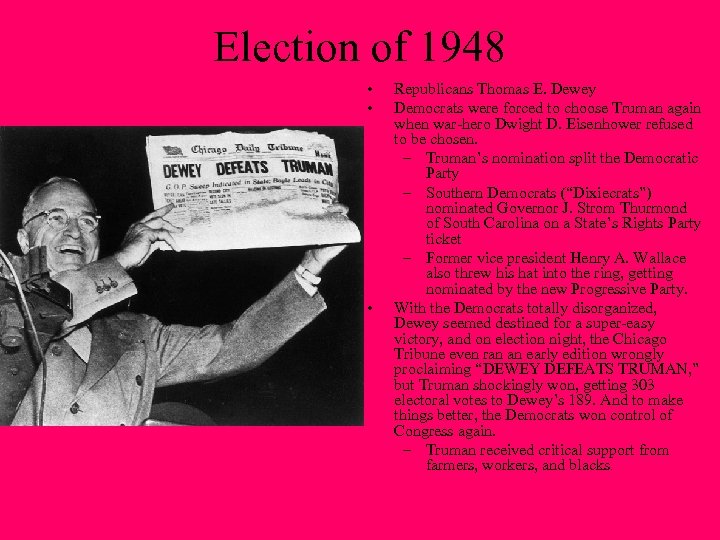 Election of 1948 • • • Republicans Thomas E. Dewey Democrats were forced to choose Truman again when war-hero Dwight D. Eisenhower refused to be chosen. – Truman’s nomination split the Democratic Party – Southern Democrats (“Dixiecrats”) nominated Governor J. Strom Thurmond of South Carolina on a State’s Rights Party ticket – Former vice president Henry A. Wallace also threw his hat into the ring, getting nominated by the new Progressive Party. With the Democrats totally disorganized, Dewey seemed destined for a super-easy victory, and on election night, the Chicago Tribune even ran an early edition wrongly proclaiming “DEWEY DEFEATS TRUMAN, ” but Truman shockingly won, getting 303 electoral votes to Dewey’s 189. And to make things better, the Democrats won control of Congress again. – Truman received critical support from farmers, workers, and blacks.
 The Fair Deal • Truman’s domestic agenda • Raised minimum wage to 75¢ an hour • Increased Social Security benefits by over 75 percent and extended them to 10 million additional people • Passed the National Housing Act of 1949 – Construction of low-income housing and for long-term rent subsidies. • Congress refused to pass other parts of the Fair Deal – National health insurance – Aid for farmers or schools – Truman’s civil rights legislation.
 Truman Doctrine • The United States would provide political, military and economic assistance to all democratic nations under threat from external or internal authoritarian forces. • Effectively reoriented U. S. foreign policy, away from its usual stance of withdrawal from regional conflicts not directly involving the United States, to one of possible intervention in far away conflicts. • END OF ISOLAIONISM as a foreign policy
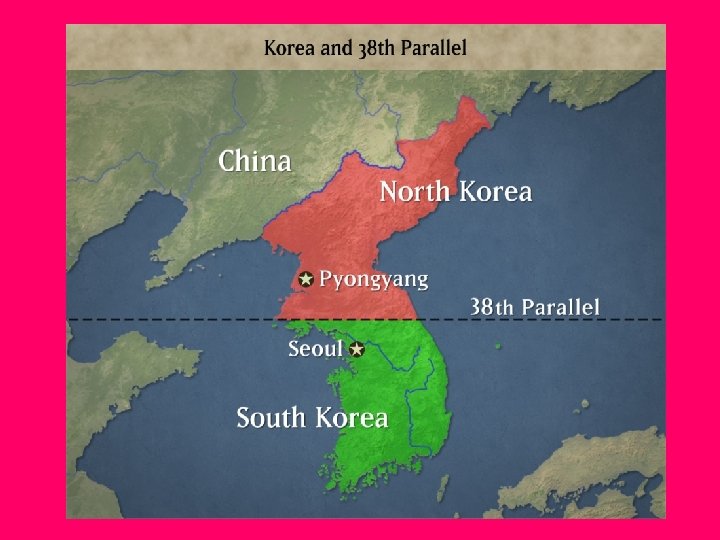
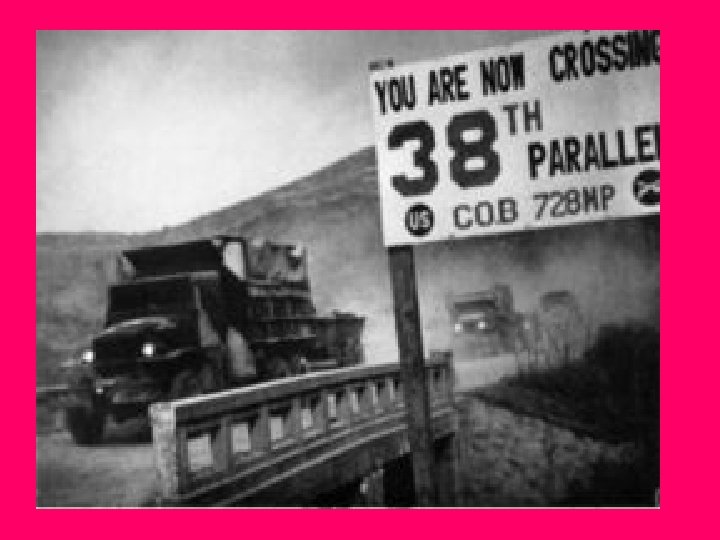
 Korean War (1950 -1953) • After WWII – US and Soviet Union split Korea on the 38 th parallel. Soviet Union helped rebuild North Korea (Communist) and the US helped rebuild South Korea (Democratic). • June 25, 1950 – North Korea invaded South Korea in an effort to unite all of Korea under one Communist government. • US went to aid South Korea and China went to help North Korea. • July 27, 1953 – cease fire called with the border being exactly where it was in the beginning of the war
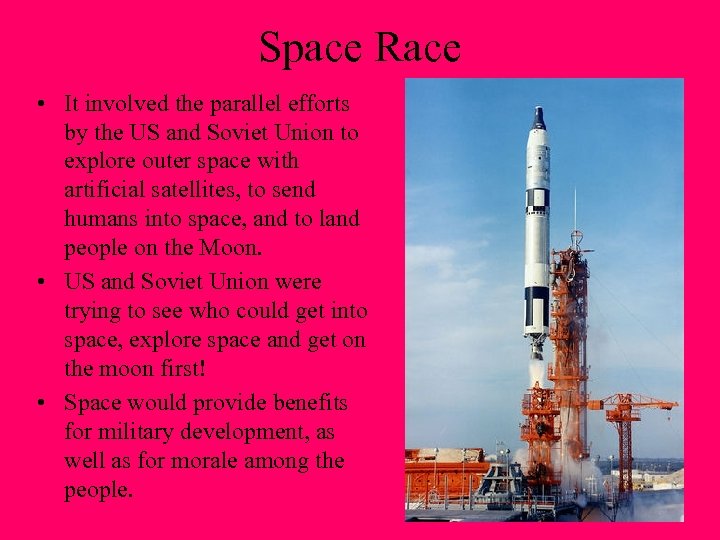 Space Race • It involved the parallel efforts by the US and Soviet Union to explore outer space with artificial satellites, to send humans into space, and to land people on the Moon. • US and Soviet Union were trying to see who could get into space, explore space and get on the moon first! • Space would provide benefits for military development, as well as for morale among the people.
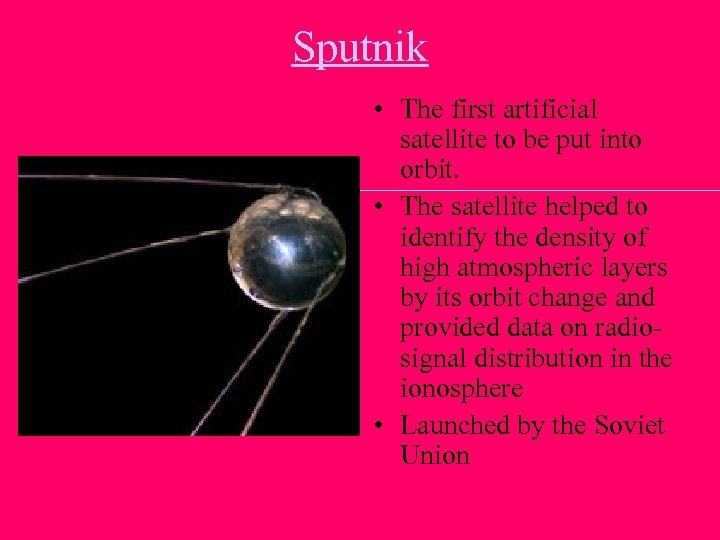 Sputnik • The first artificial satellite to be put into orbit. • The satellite helped to identify the density of high atmospheric layers by its orbit change and provided data on radiosignal distribution in the ionosphere • Launched by the Soviet Union
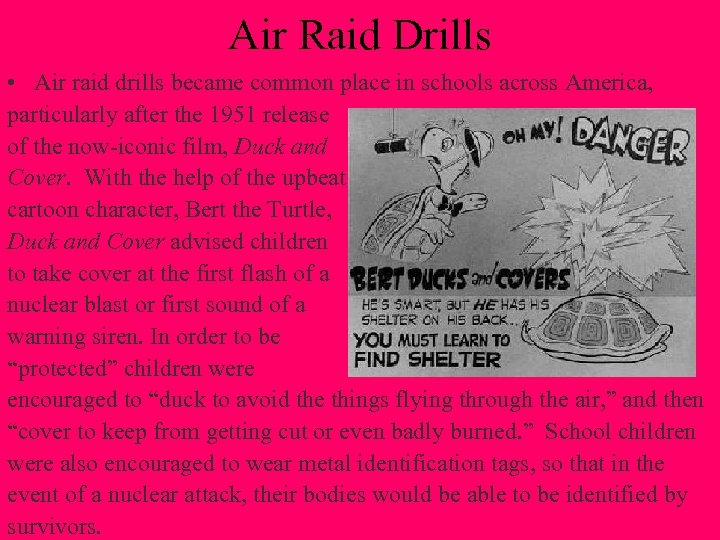 Air Raid Drills • Air raid drills became common place in schools across America, particularly after the 1951 release of the now-iconic film, Duck and Cover. With the help of the upbeat cartoon character, Bert the Turtle, Duck and Cover advised children to take cover at the first flash of a nuclear blast or first sound of a warning siren. In order to be “protected” children were encouraged to “duck to avoid the things flying through the air, ” and then “cover to keep from getting cut or even badly burned. ” School children were also encouraged to wear metal identification tags, so that in the event of a nuclear attack, their bodies would be able to be identified by survivors.
 Arms Race • The US and Soviet Union each tried to build up greater weapons • 1952 – US explodes an H-bomb • 1953 – Soviet Union explodes an H-bomb
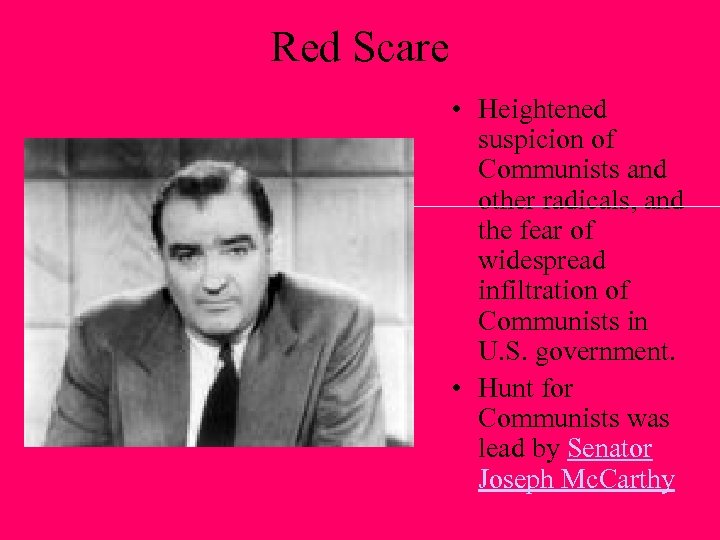 Red Scare • Heightened suspicion of Communists and other radicals, and the fear of widespread infiltration of Communists in U. S. government. • Hunt for Communists was lead by Senator Joseph Mc. Carthy
 Mc. Carthyism • A period of intense anti-Communist suspicion in the United States that lasted roughly from the late 1940 s to the late 1950 s. • Fears spurred aggressive investigations and the red -baiting, blacklisting, jailing and deportation of people suspected of following Communist or other left-wing ideology. • Many people in show business were “blacklisted” as Communists or Communist sympathizers.
 Alger Hiss
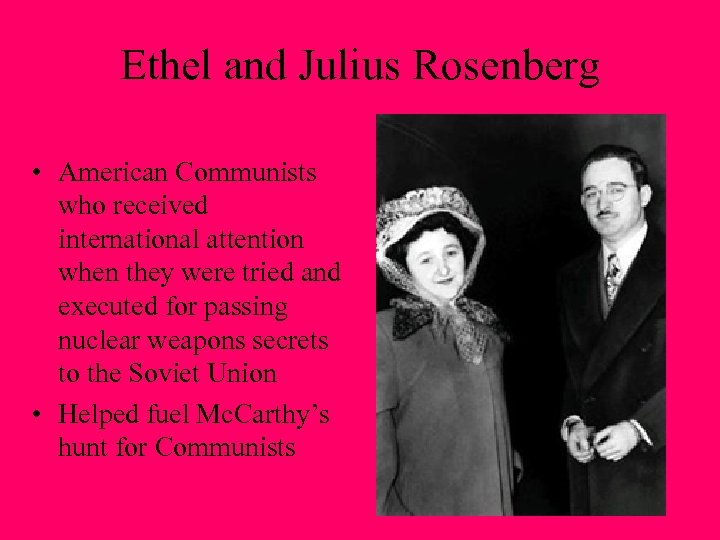 Ethel and Julius Rosenberg • American Communists who received international attention when they were tried and executed for passing nuclear weapons secrets to the Soviet Union • Helped fuel Mc. Carthy’s hunt for Communists
 • March 6, 1951 - David Greenglass stated that his sister, Ethel, typed notes containing US nuclear secrets in the Rosenberg apartment in Sep 1945. He also stated that Julius Rosenberg made a sketch of a cross section of the implosion-type atom bomb (like the one dropped on Nagasaki). • Although the notes typed by Ethel apparently contained little that was relevant to the Soviet atomic bomb project, this was sufficient evidence for the grand jury to indict Ethel and enough for the jury to convict on the conspiracy to commit espionage charge. • The Rosenbergs were convicted on March 29, 1951, and on April 5 were sentenced to death by Judge Irving Kaufman. • At the time, some Americans believed both Rosenbergs were innocent and some believed that the couple got what they deserved. Pope Pius XII appealed to President Dwight D. Eisenhower to spare the couple, but he refused. On February 19, 1953 the Rosenbergs were executed in the electric chair.
 • In 1995, the National Security Agency publicly released documents from the VENONA project, an effort to decrypt intercepted communications between Soviet agents and the NKVD/KGB. A 1944 cable from New York to Moscow clearly indicates that Julius Rosenberg was engaged in espionage for the Soviet Union, though the importance of his effort is not clear • Ethel's involvement is not clear from the VENONA transcripts. A document from November 27, 1944 specifically about Ethel lists her as a "fellow countryman" and claims that she was aware of Julius' work. Ethel was apparently never assigned a code name, which has cast doubt onto her significance and involvement. • In his memoirs, published posthumously in 1990, Nikita Khrushchev praised the pair for their "very significant help in accelerating the production of our atomic bomb. “ • In late 2001, Greenglass recanted and claimed that he had committed perjury when he testified about the typing activity of his sister Ethel. Greenglass said he chose to falsely testify against his sister in order to protect his wife and children.
 Hollywood Blacklist • List of screenwriters, actors, directors, musicians, and other U. S. entertainment professionals who were denied employment in the field because of their political beliefs or associations, real or suspected. • Artists were barred from work on the basis of their alleged membership in or sympathy toward the American Communist Party, involvement in liberal or simply humanitarian political causes that enforcers of the blacklist associated with communism, and/or refusal to assist federal investigations into Communist Party activities; some were blacklisted merely because their names came up at the wrong place and time.
 Eisenhower Republicanism • Eisenhower came into the White House pledging a policy of “dynamic conservatism, ” which stated that he would be liberal with people, but conservative with their money. • Ike decreased government spending by decreasing military spending, trying to transfer control of offshore oil fields to the states, and trying to curb the TVA by setting up a private company to take its place. • Eisenhower Doctrine – promised aid to any country trying to resist Communism
 New Foreign Policy • Secretary of State John Foster Dulles stated that the policy of containment was not enough and that the U. S. was going to push back communism and liberate the peoples under it. This became known as “rollback. ” – Massive Reltaliation was the building up of our forces in the sky to scare the enemys. – Dulles wanted to tone down defense spending by building a fleet of superbombers called Strategic Air Command, which could drop massive nuclear bombs in any retaliation. – SAC could inflict "Massive Retaliation" on the enemy, and also a great bang for the buck. • Ike tried to thaw the Cold War by appealing for peace to new Soviet Premier Nikita Khrushchev at the 1955 Geneva Conference, but the Soviet leader rejected such proposals, along with one for “open skies. ” • However, hypocritically, when the Hungarians revolted against the U. S. S. R. and appealed to the U. S. for help, America did nothing, earning the scorn of bitter freedom fighters.
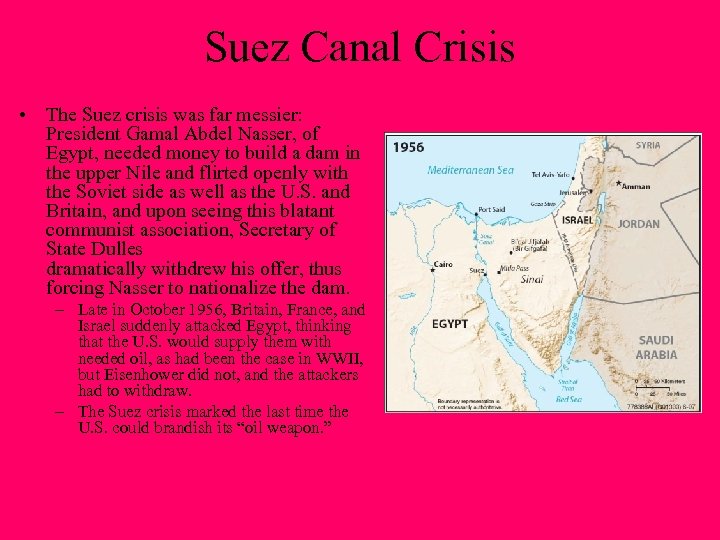 Suez Canal Crisis • The Suez crisis was far messier: President Gamal Abdel Nasser, of Egypt, needed money to build a dam in the upper Nile and flirted openly with the Soviet side as well as the U. S. and Britain, and upon seeing this blatant communist association, Secretary of State Dulles dramatically withdrew his offer, thus forcing Nasser to nationalize the dam. – Late in October 1956, Britain, France, and Israel suddenly attacked Egypt, thinking that the U. S. would supply them with needed oil, as had been the case in WWII, but Eisenhower did not, and the attackers had to withdraw. – The Suez crisis marked the last time the U. S. could brandish its “oil weapon. ”
 U-2 Incident • May 1960 • Soviet Union shot down an American U-2 spy plane in Soviet air space and captured its pilot, Francis Gary Powers • Eisenhower was forced to admit to the Soviets that the CIA had been flying spy missions over the USSR for several years • Powers was convicted on espionage charges and sentenced him to 10 years in prison • After serving less than two years, he was released in exchange for a captured Soviet agent in the firstever U. S. -USSR “spy swap”
 Life in the 1950 s
 Rise of Television • Many early shows were based on radio programs • Westerns – Gunsmoke – Lone Ranger • Game Shows – $64, 000 Question • Variety Shows – Toast of the Town • Spy Shows – I Led Three Lives
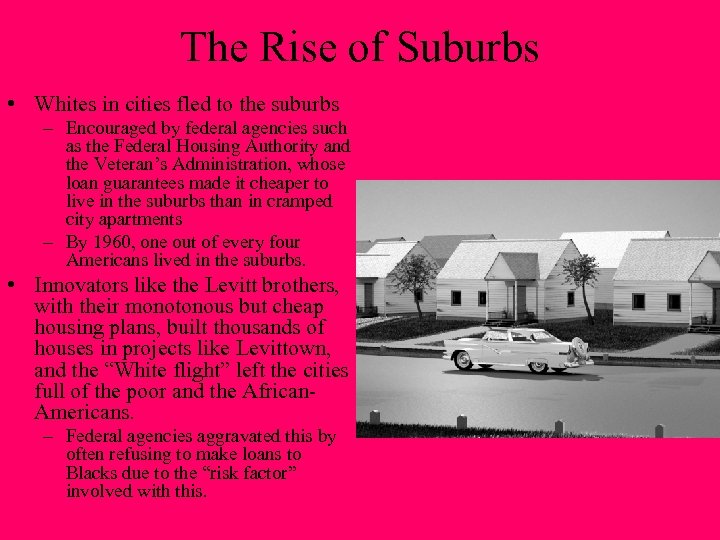 The Rise of Suburbs • Whites in cities fled to the suburbs – Encouraged by federal agencies such as the Federal Housing Authority and the Veteran’s Administration, whose loan guarantees made it cheaper to live in the suburbs than in cramped city apartments – By 1960, one out of every four Americans lived in the suburbs. • Innovators like the Levitt brothers, with their monotonous but cheap housing plans, built thousands of houses in projects like Levittown, and the “White flight” left the cities full of the poor and the African. Americans. – Federal agencies aggravated this by often refusing to make loans to Blacks due to the “risk factor” involved with this.
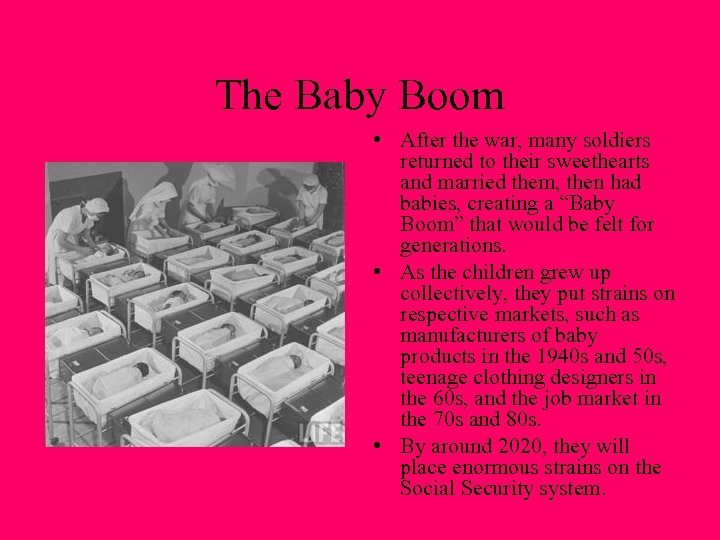 The Baby Boom • After the war, many soldiers returned to their sweethearts and married them, then had babies, creating a “Baby Boom” that would be felt for generations. • As the children grew up collectively, they put strains on respective markets, such as manufacturers of baby products in the 1940 s and 50 s, teenage clothing designers in the 60 s, and the job market in the 70 s and 80 s. • By around 2020, they will place enormous strains on the Social Security system.
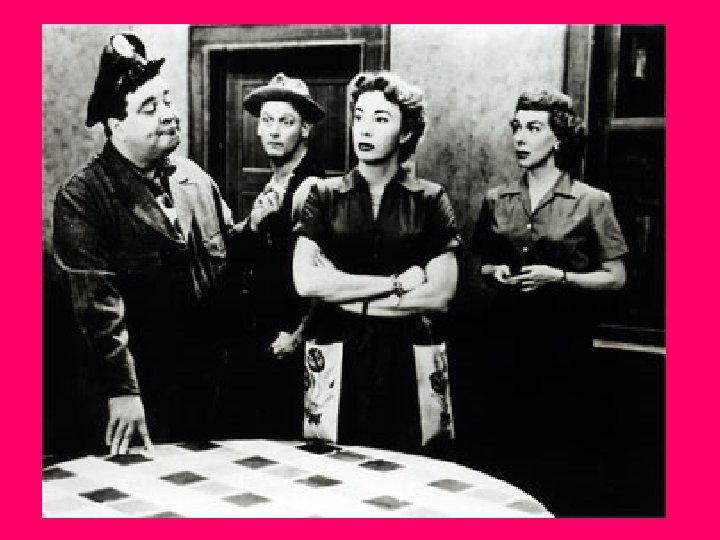
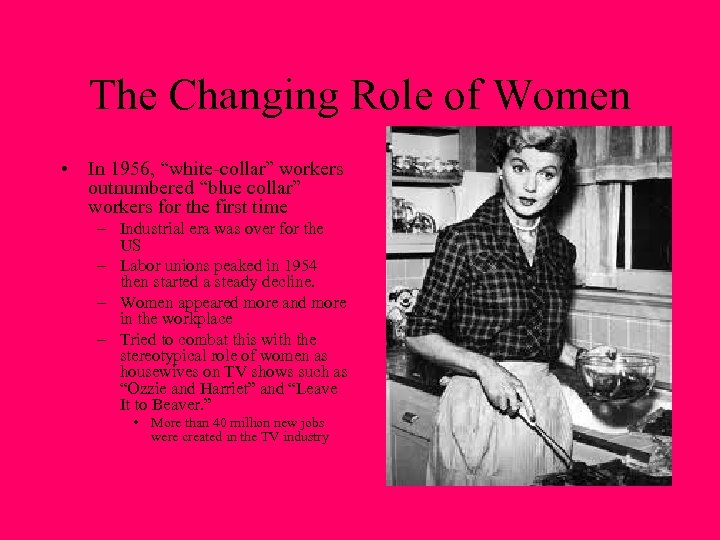 The Changing Role of Women • In 1956, “white-collar” workers outnumbered “blue collar” workers for the first time – Industrial era was over for the US – Labor unions peaked in 1954 then started a steady decline. – Women appeared more and more in the workplace – Tried to combat this with the stereotypical role of women as housewives on TV shows such as “Ozzie and Harriet” and “Leave It to Beaver. ” • More than 40 million new jobs were created in the TV industry
 Entertainers
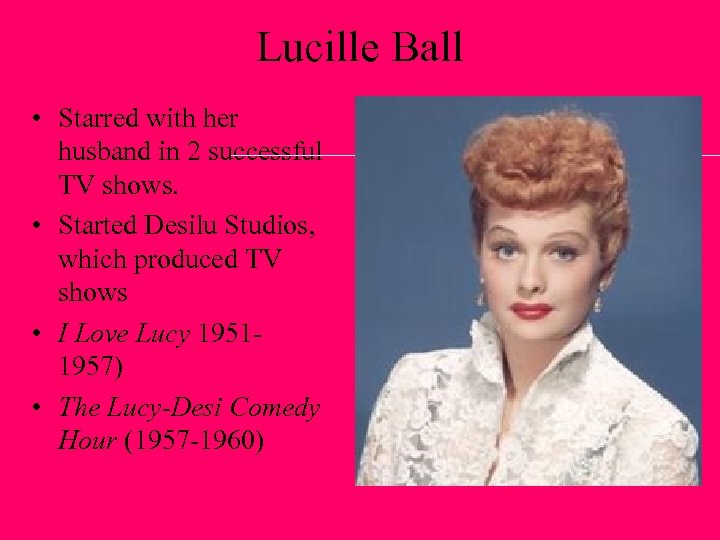 Lucille Ball • Starred with her husband in 2 successful TV shows. • Started Desilu Studios, which produced TV shows • I Love Lucy 19511957) • The Lucy-Desi Comedy Hour (1957 -1960)
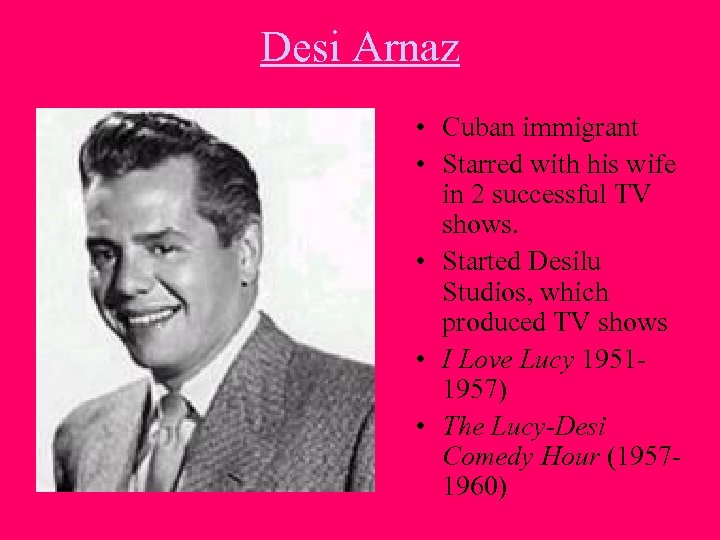 Desi Arnaz • Cuban immigrant • Starred with his wife in 2 successful TV shows. • Started Desilu Studios, which produced TV shows • I Love Lucy 19511957) • The Lucy-Desi Comedy Hour (19571960)
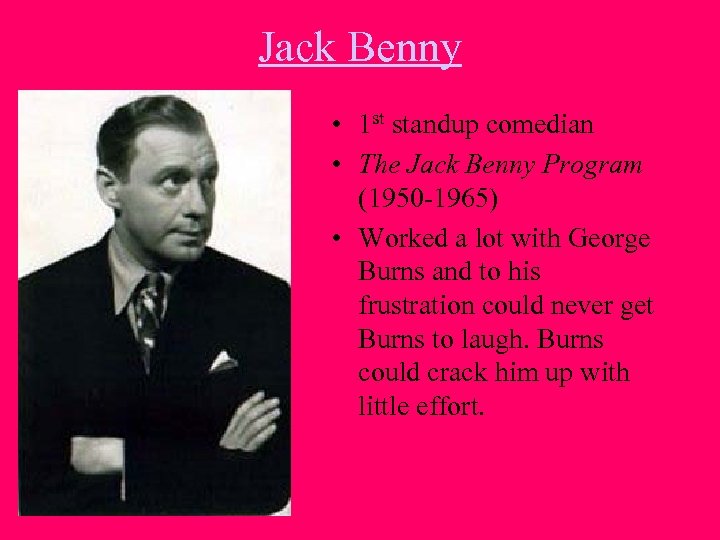 Jack Benny • 1 st standup comedian • The Jack Benny Program (1950 -1965) • Worked a lot with George Burns and to his frustration could never get Burns to laugh. Burns could crack him up with little effort.
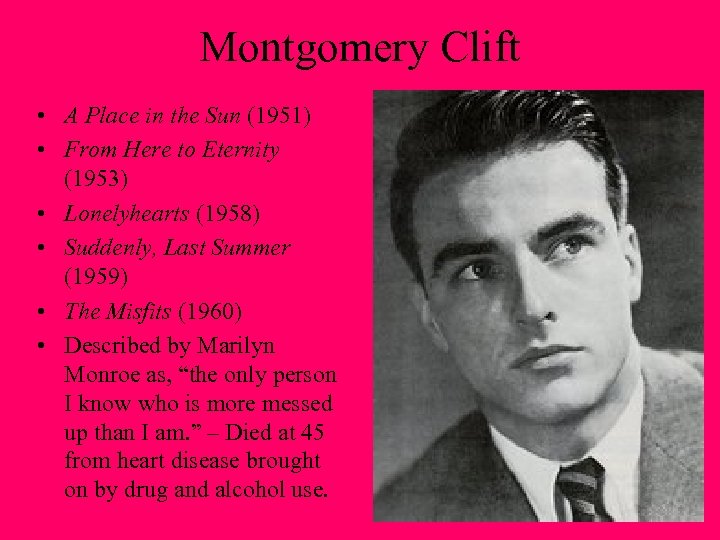 Montgomery Clift • A Place in the Sun (1951) • From Here to Eternity (1953) • Lonelyhearts (1958) • Suddenly, Last Summer (1959) • The Misfits (1960) • Described by Marilyn Monroe as, “the only person I know who is more messed up than I am. ” – Died at 45 from heart disease brought on by drug and alcohol use.
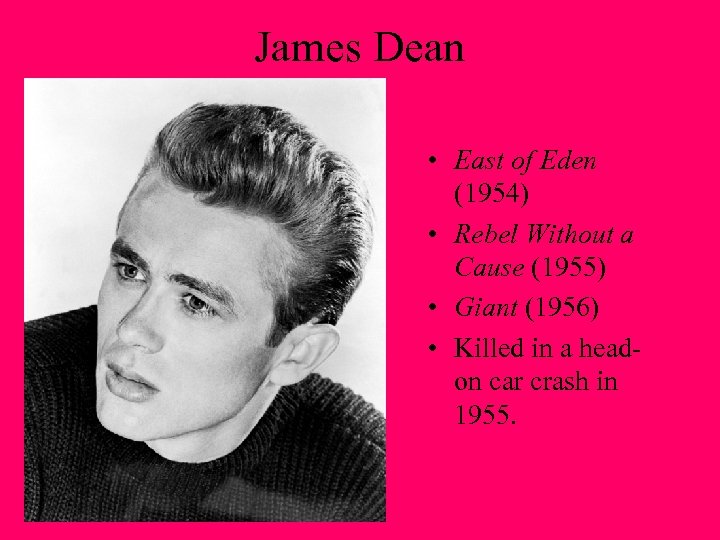 James Dean • East of Eden (1954) • Rebel Without a Cause (1955) • Giant (1956) • Killed in a headon car crash in 1955.
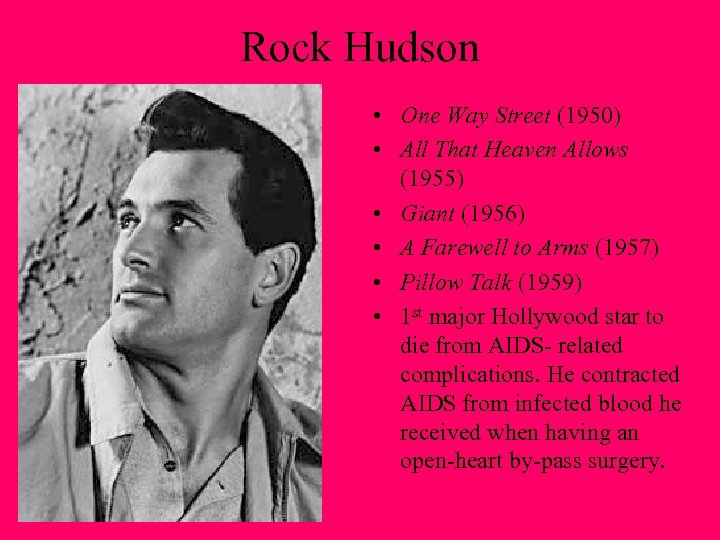 Rock Hudson • One Way Street (1950) • All That Heaven Allows (1955) • Giant (1956) • A Farewell to Arms (1957) • Pillow Talk (1959) • 1 st major Hollywood star to die from AIDS- related complications. He contracted AIDS from infected blood he received when having an open-heart by-pass surgery.
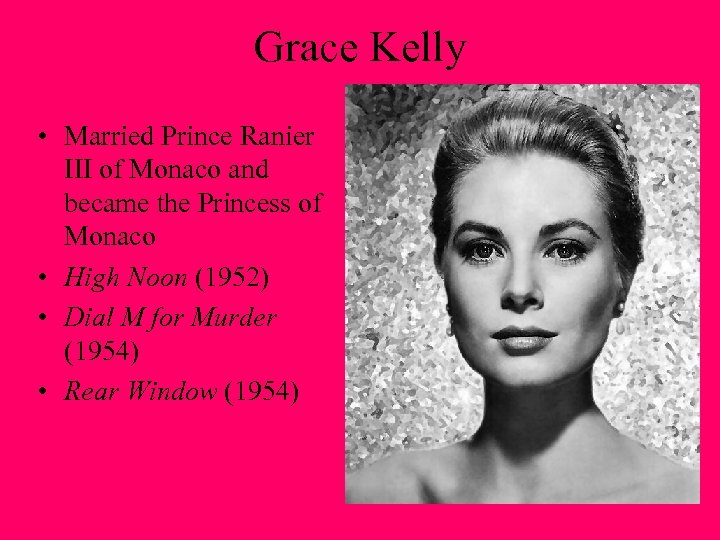 Grace Kelly • Married Prince Ranier III of Monaco and became the Princess of Monaco • High Noon (1952) • Dial M for Murder (1954) • Rear Window (1954)
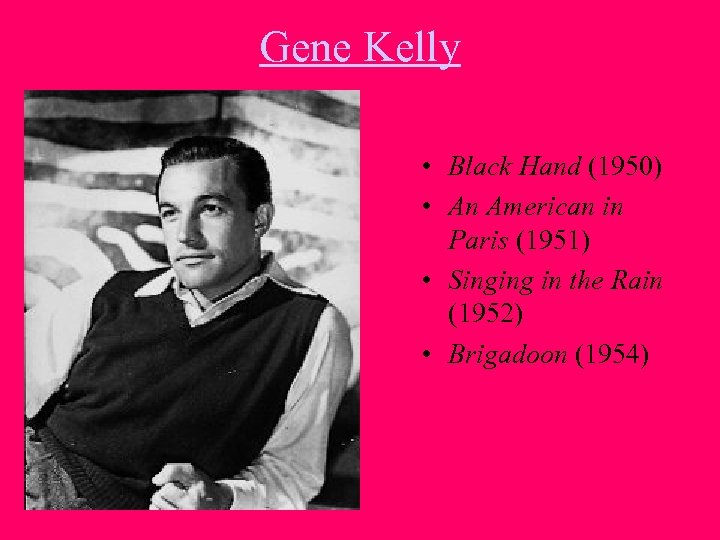 Gene Kelly • Black Hand (1950) • An American in Paris (1951) • Singing in the Rain (1952) • Brigadoon (1954)
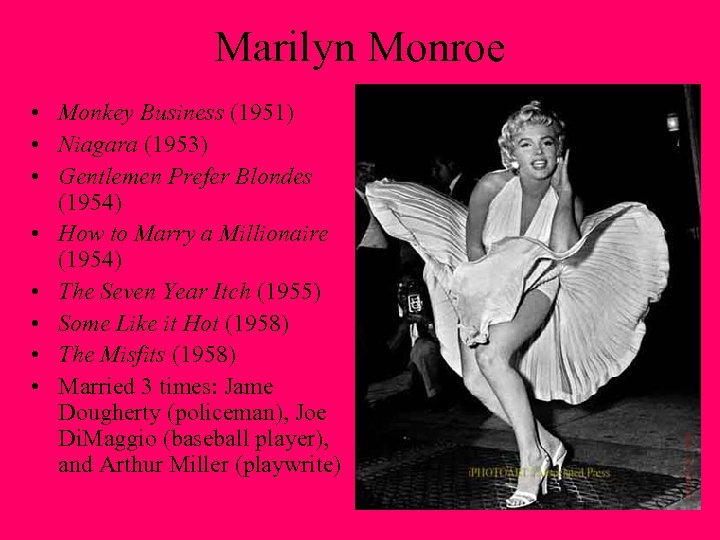 Marilyn Monroe • Monkey Business (1951) • Niagara (1953) • Gentlemen Prefer Blondes (1954) • How to Marry a Millionaire (1954) • The Seven Year Itch (1955) • Some Like it Hot (1958) • The Misfits (1958) • Married 3 times: Jame Dougherty (policeman), Joe Di. Maggio (baseball player), and Arthur Miller (playwrite)
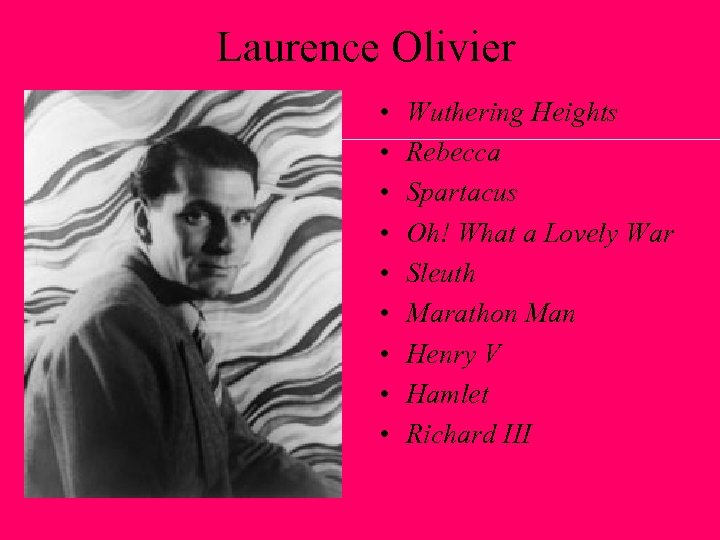 Laurence Olivier • • • Wuthering Heights Rebecca Spartacus Oh! What a Lovely War Sleuth Marathon Man Henry V Hamlet Richard III
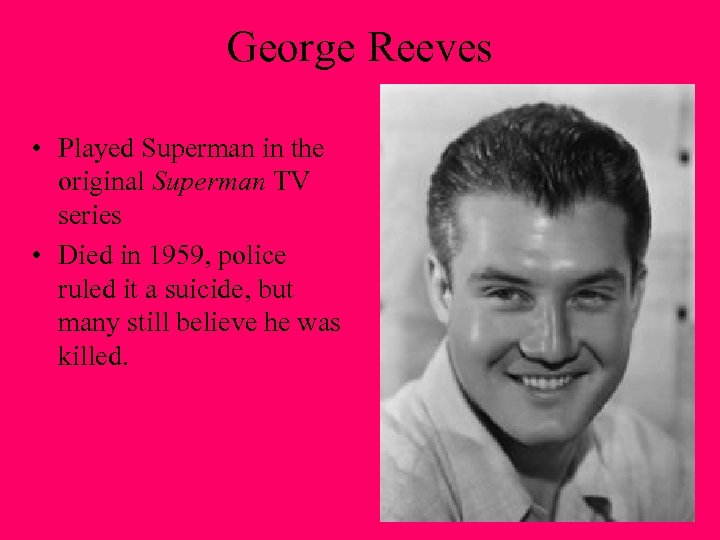 George Reeves • Played Superman in the original Superman TV series • Died in 1959, police ruled it a suicide, but many still believe he was killed.
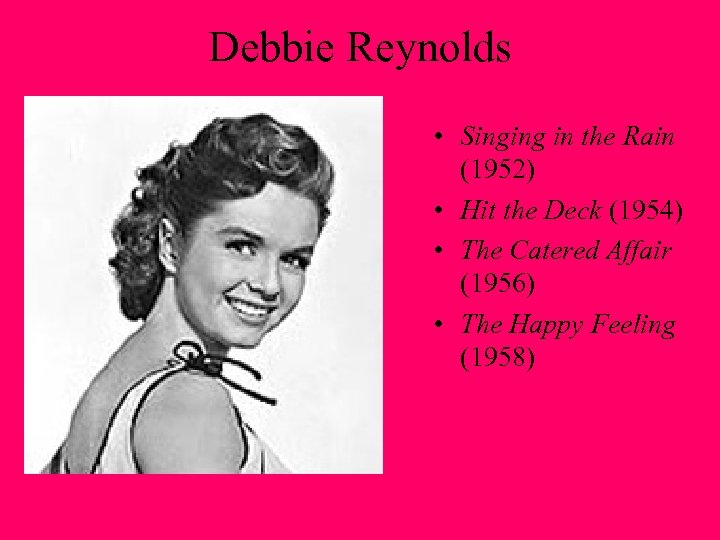 Debbie Reynolds • Singing in the Rain (1952) • Hit the Deck (1954) • The Catered Affair (1956) • The Happy Feeling (1958)
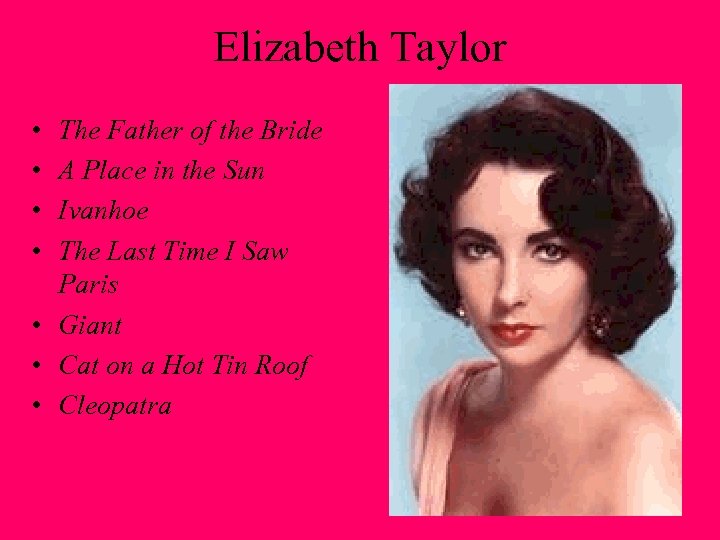 Elizabeth Taylor • • The Father of the Bride A Place in the Sun Ivanhoe The Last Time I Saw Paris • Giant • Cat on a Hot Tin Roof • Cleopatra
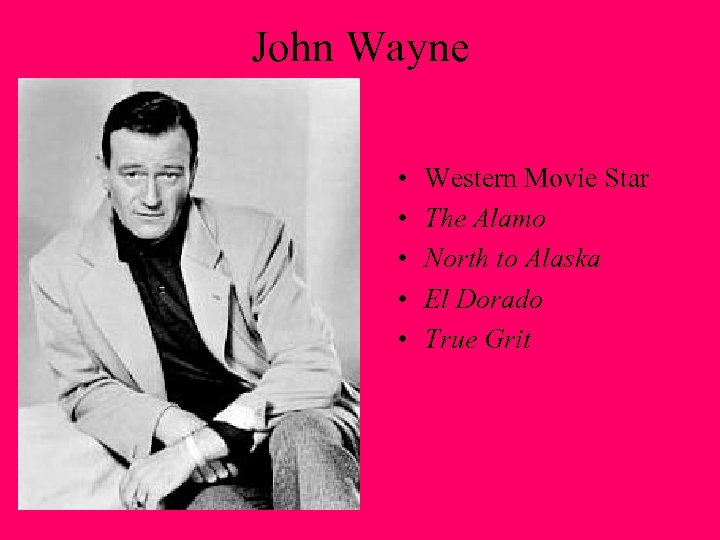 John Wayne • • • Western Movie Star The Alamo North to Alaska El Dorado True Grit
 Music
Music
 Chuck Berry
 Little Richard
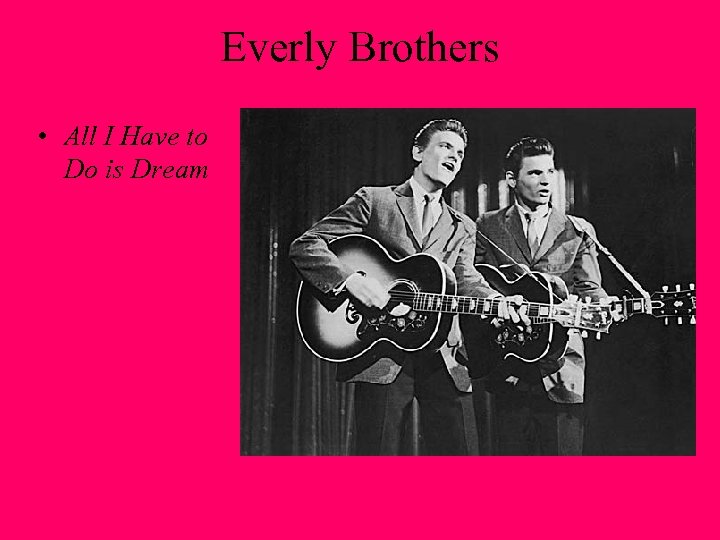 Everly Brothers • All I Have to Do is Dream
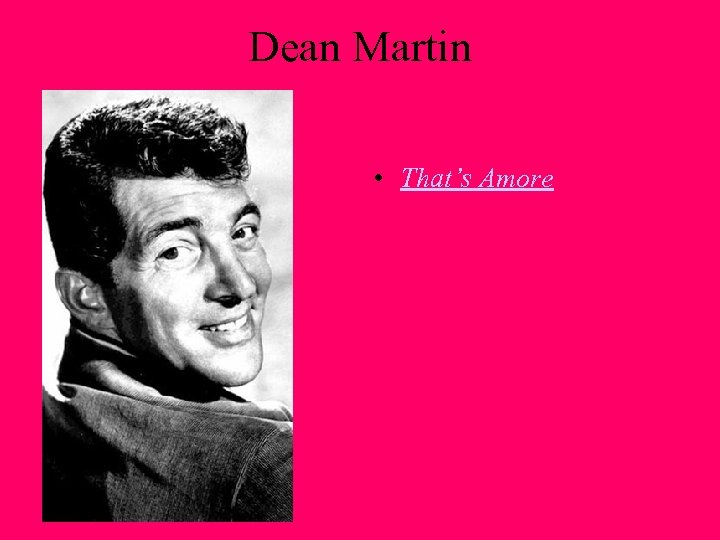 Dean Martin • That’s Amore
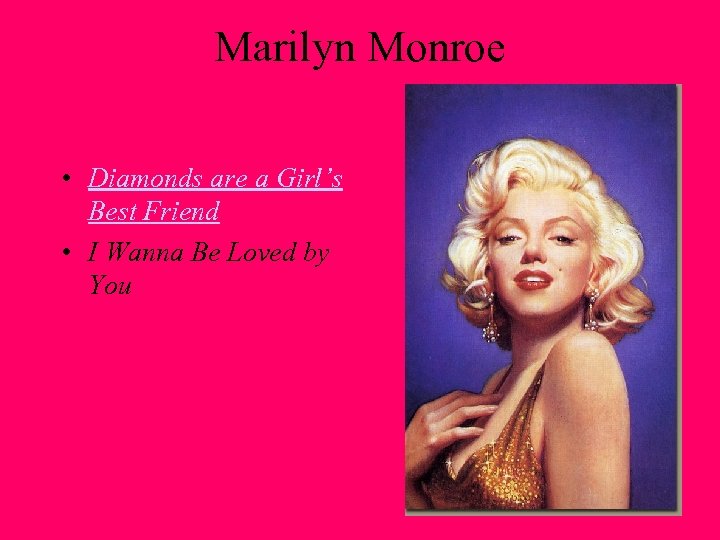 Marilyn Monroe • Diamonds are a Girl’s Best Friend • I Wanna Be Loved by You
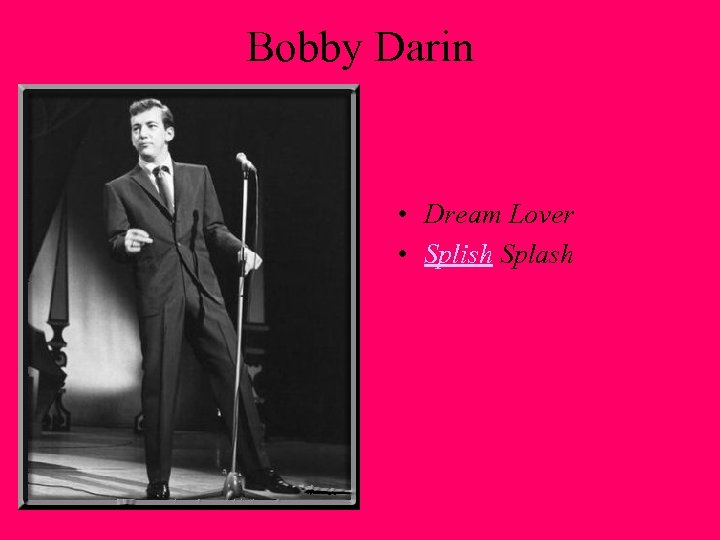 Bobby Darin • Dream Lover • Splish Splash
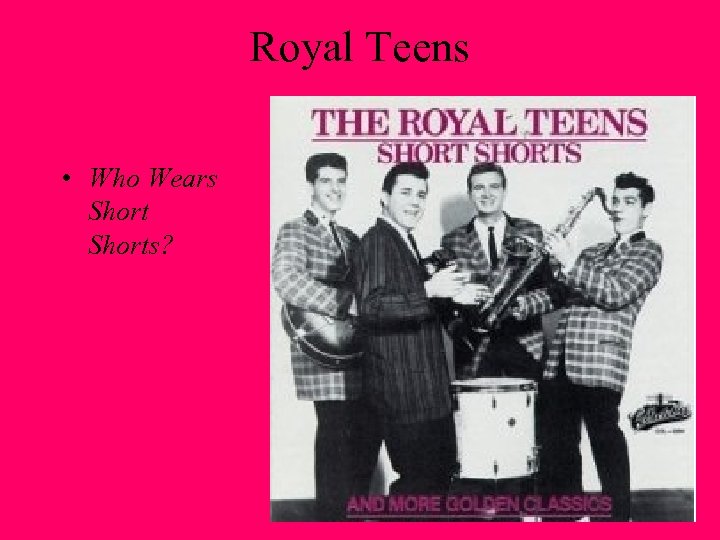 Royal Teens • Who Wears Shorts?
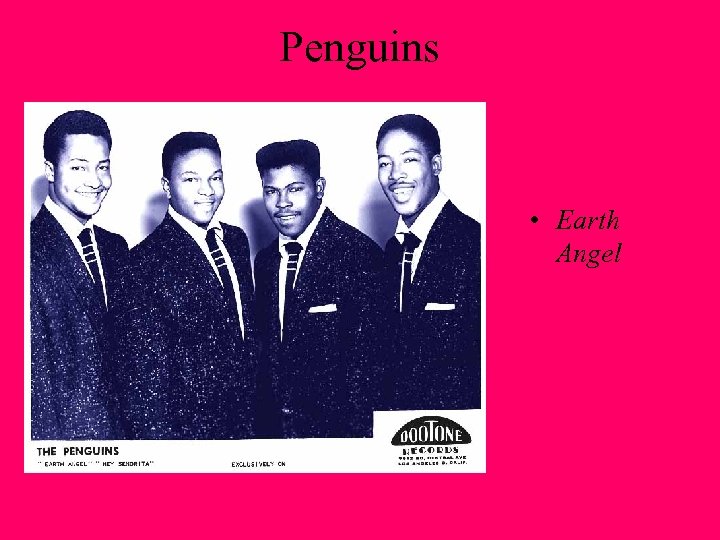 Penguins • Earth Angel
 Nat King Cole
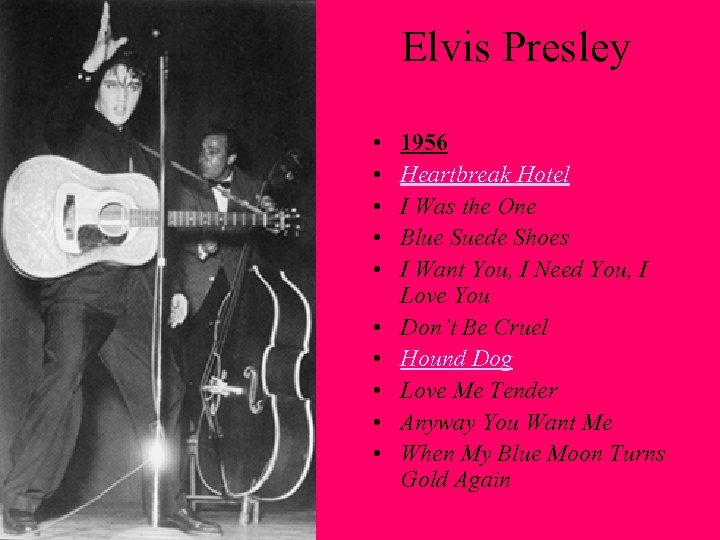 Elvis Presley • • • 1956 Heartbreak Hotel I Was the One Blue Suede Shoes I Want You, I Need You, I Love You Don’t Be Cruel Hound Dog Love Me Tender Anyway You Want Me When My Blue Moon Turns Gold Again
 1950 s Songs • • • 1957 Love Me Too Much All Shook Up Loving You Teddy Bear Jailhouse Rock Treat Me Nice Don’t I Beg of You • 1958 • Wear My Ring Around Your Neck • Doncha’ Think It’s Time • Hard Headed Woman • One Night • I Got Stung • 1959 • A Fool Such As I • I Need Your Love Tonight • A Big Hunk O’ Love • My Wish Came True
 Movies
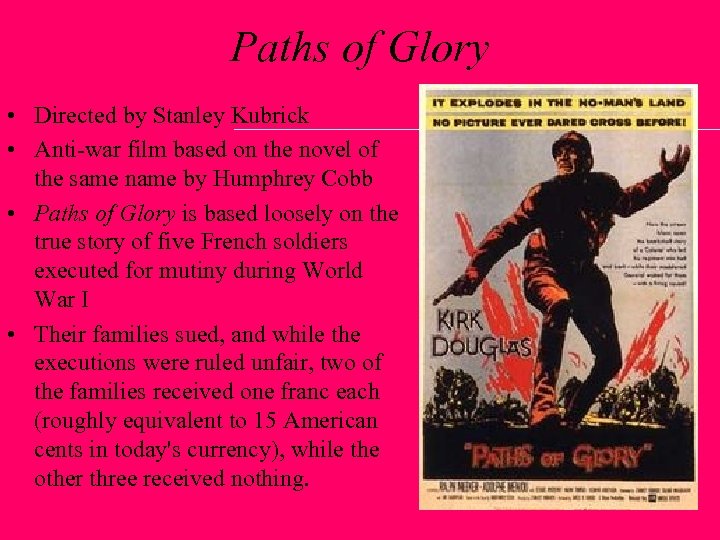 Paths of Glory • Directed by Stanley Kubrick • Anti-war film based on the novel of the same name by Humphrey Cobb • Paths of Glory is based loosely on the true story of five French soldiers executed for mutiny during World War I • Their families sued, and while the executions were ruled unfair, two of the families received one franc each (roughly equivalent to 15 American cents in today's currency), while the other three received nothing.
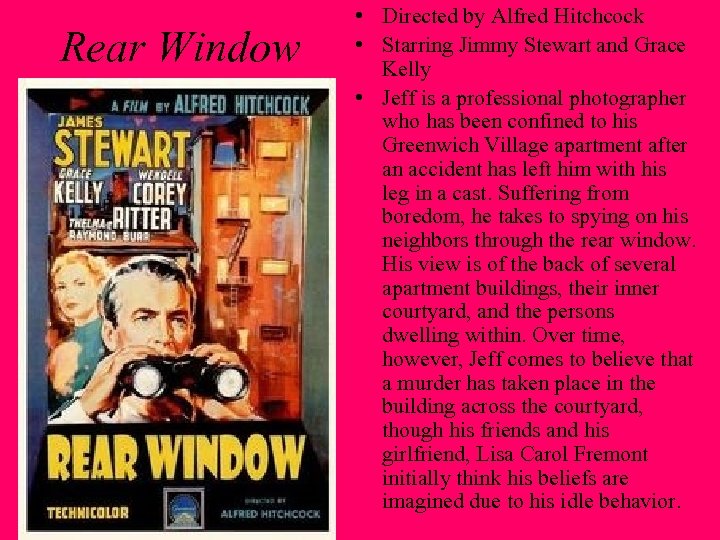 Rear Window • Directed by Alfred Hitchcock • Starring Jimmy Stewart and Grace Kelly • Jeff is a professional photographer who has been confined to his Greenwich Village apartment after an accident has left him with his leg in a cast. Suffering from boredom, he takes to spying on his neighbors through the rear window. His view is of the back of several apartment buildings, their inner courtyard, and the persons dwelling within. Over time, however, Jeff comes to believe that a murder has taken place in the building across the courtyard, though his friends and his girlfriend, Lisa Carol Fremont initially think his beliefs are imagined due to his idle behavior.
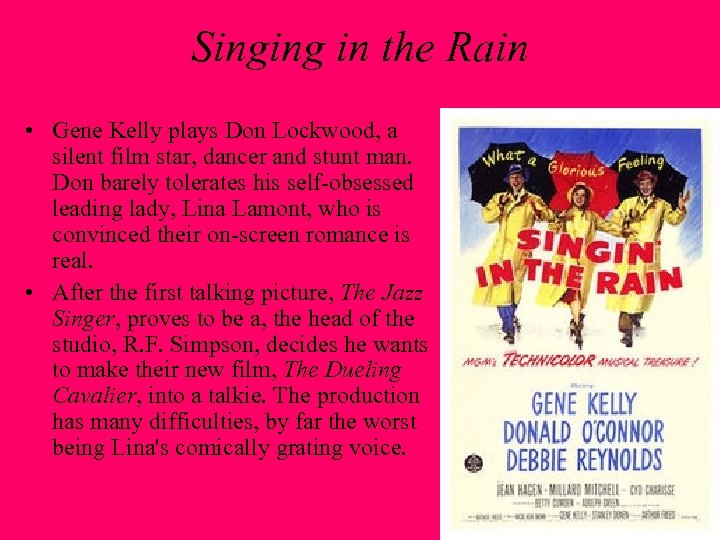 Singing in the Rain • Gene Kelly plays Don Lockwood, a silent film star, dancer and stunt man. Don barely tolerates his self-obsessed leading lady, Lina Lamont, who is convinced their on-screen romance is real. • After the first talking picture, The Jazz Singer, proves to be a, the head of the studio, R. F. Simpson, decides he wants to make their new film, The Dueling Cavalier, into a talkie. The production has many difficulties, by far the worst being Lina's comically grating voice.
 • After a disastrous test screening, Don's best friend, Cosmo Brown, comes up with the idea to overdub Lina's voice and they convince R. F. to turn The Dueling Cavalier into The Dancing Cavalier, a musical comedy. • Meanwhile, Don falls in love with aspiring actress Kathy Selden who is providing the voice for Lina. • When Lina finds out, she is furious and does everything possible to sabotage the romance. She demands that Kathy continue to provide her voice in all future films, but remain uncredited. An irate, but desperate R. F. is forced to agree; Kathy has no choice because she is under contract.
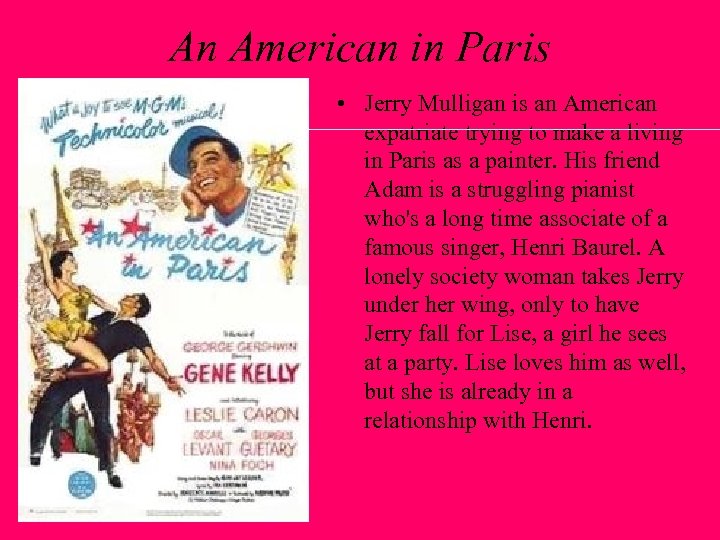 An American in Paris • Jerry Mulligan is an American expatriate trying to make a living in Paris as a painter. His friend Adam is a struggling pianist who's a long time associate of a famous singer, Henri Baurel. A lonely society woman takes Jerry under her wing, only to have Jerry fall for Lise, a girl he sees at a party. Lise loves him as well, but she is already in a relationship with Henri.
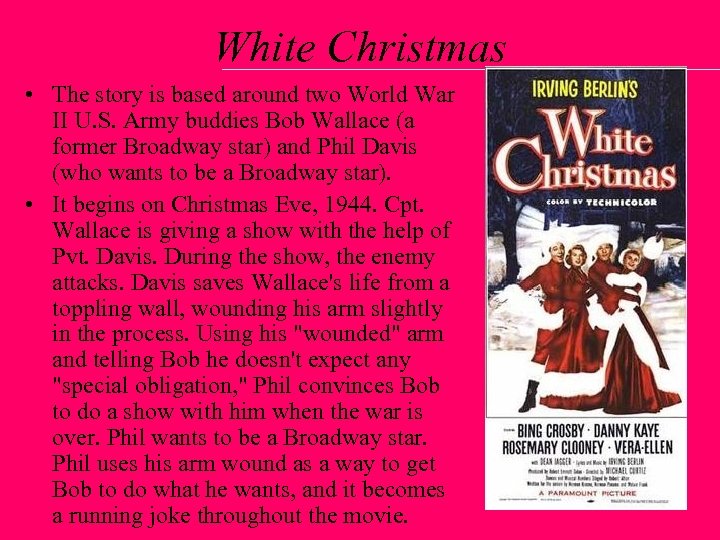 White Christmas • The story is based around two World War II U. S. Army buddies Bob Wallace (a former Broadway star) and Phil Davis (who wants to be a Broadway star). • It begins on Christmas Eve, 1944. Cpt. Wallace is giving a show with the help of Pvt. Davis. During the show, the enemy attacks. Davis saves Wallace's life from a toppling wall, wounding his arm slightly in the process. Using his "wounded" arm and telling Bob he doesn't expect any "special obligation, " Phil convinces Bob to do a show with him when the war is over. Phil wants to be a Broadway star. Phil uses his arm wound as a way to get Bob to do what he wants, and it becomes a running joke throughout the movie.
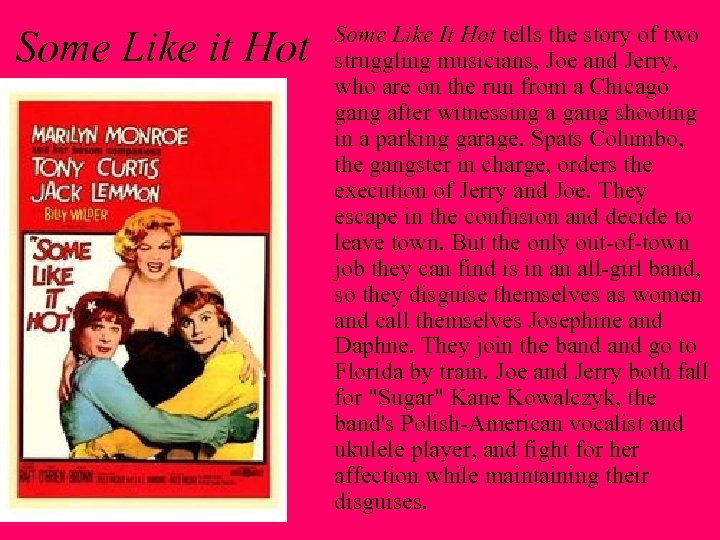 Some Like it Hot Some Like It Hot tells the story of two struggling musicians, Joe and Jerry, who are on the run from a Chicago gang after witnessing a gang shooting in a parking garage. Spats Columbo, the gangster in charge, orders the execution of Jerry and Joe. They escape in the confusion and decide to leave town. But the only out-of-town job they can find is in an all-girl band, so they disguise themselves as women and call themselves Josephine and Daphne. They join the band go to Florida by train. Joe and Jerry both fall for "Sugar" Kane Kowalczyk, the band's Polish-American vocalist and ukulele player, and fight for her affection while maintaining their disguises.
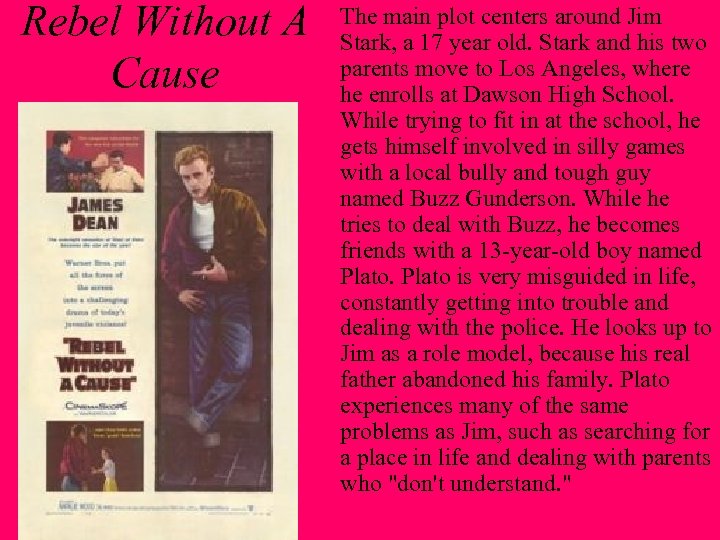 Rebel Without A Cause The main plot centers around Jim Stark, a 17 year old. Stark and his two parents move to Los Angeles, where he enrolls at Dawson High School. While trying to fit in at the school, he gets himself involved in silly games with a local bully and tough guy named Buzz Gunderson. While he tries to deal with Buzz, he becomes friends with a 13 -year-old boy named Plato is very misguided in life, constantly getting into trouble and dealing with the police. He looks up to Jim as a role model, because his real father abandoned his family. Plato experiences many of the same problems as Jim, such as searching for a place in life and dealing with parents who "don't understand. "
 Literature
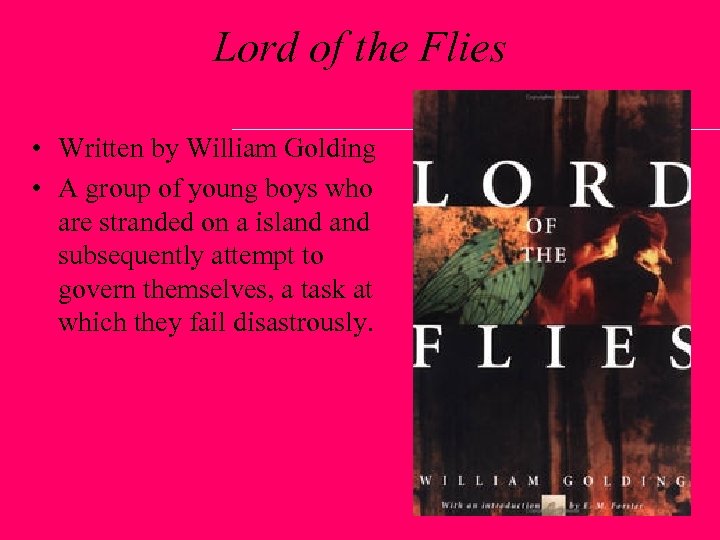 Lord of the Flies • Written by William Golding • A group of young boys who are stranded on a island subsequently attempt to govern themselves, a task at which they fail disastrously.
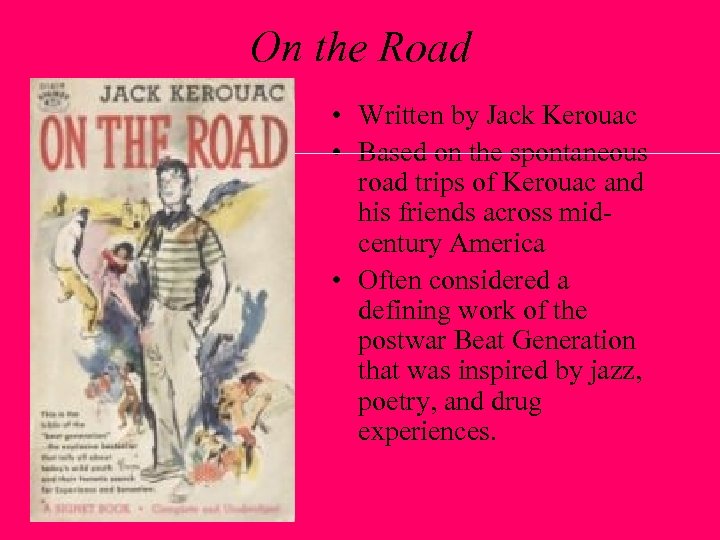 On the Road • Written by Jack Kerouac • Based on the spontaneous road trips of Kerouac and his friends across midcentury America • Often considered a defining work of the postwar Beat Generation that was inspired by jazz, poetry, and drug experiences.
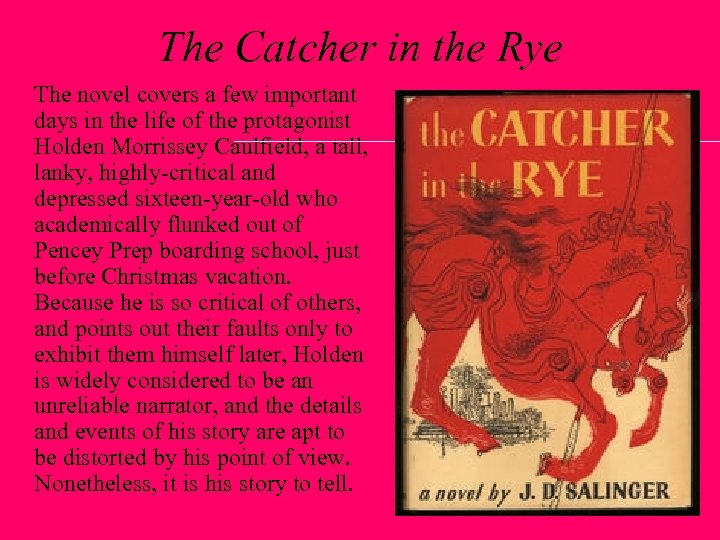 The Catcher in the Rye The novel covers a few important days in the life of the protagonist Holden Morrissey Caulfield, a tall, lanky, highly-critical and depressed sixteen-year-old who academically flunked out of Pencey Prep boarding school, just before Christmas vacation. Because he is so critical of others, and points out their faults only to exhibit them himself later, Holden is widely considered to be an unreliable narrator, and the details and events of his story are apt to be distorted by his point of view. Nonetheless, it is his story to tell.
 The Lord of the Rings Written by J. R. R. Tolkien The story concerns peoples such as Hobbits, Elves, Men, Dwarves, Wizards, and Orcs and centres on the Ring of Power made by the Dark Lord Sauron. Starting from quiet beginnings in The Shire, the story ranges across Middle-earth and follows the courses of the War of the Ring.
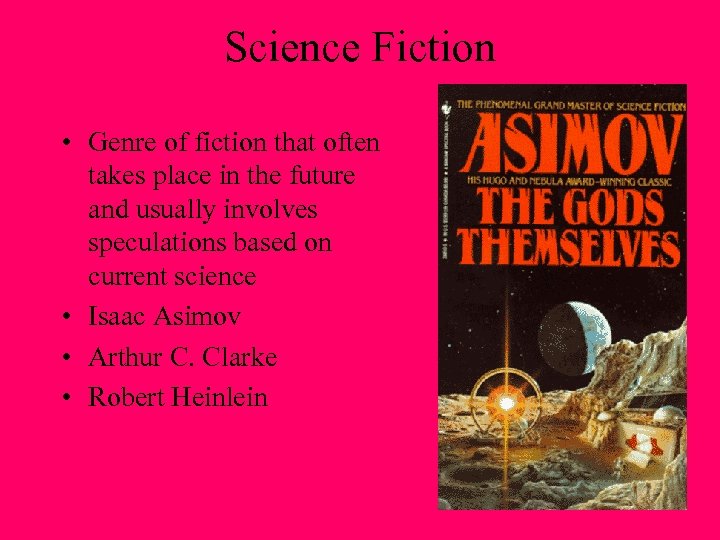 Science Fiction • Genre of fiction that often takes place in the future and usually involves speculations based on current science • Isaac Asimov • Arthur C. Clarke • Robert Heinlein
 A Raisin in the Sun
 I Was a Communist for the FBI
 The New Yorker
 Saturday Evening Post
 The Organization Man
 Tomorrow!
 Walk East on Beacon
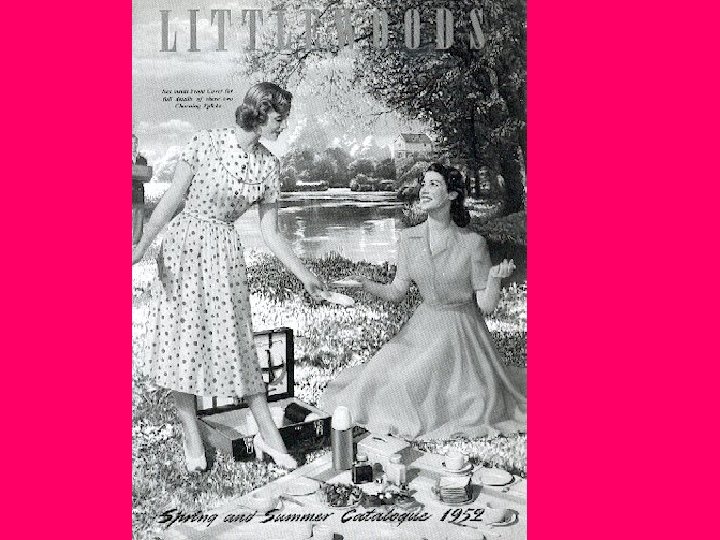
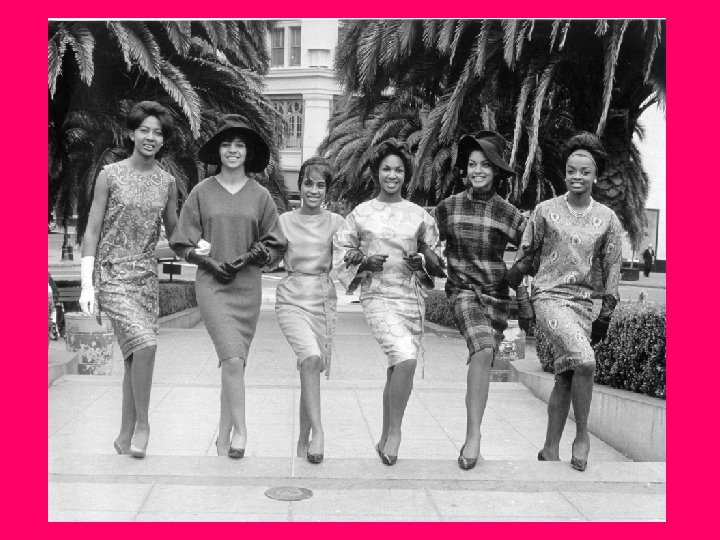
 Dress
Dress


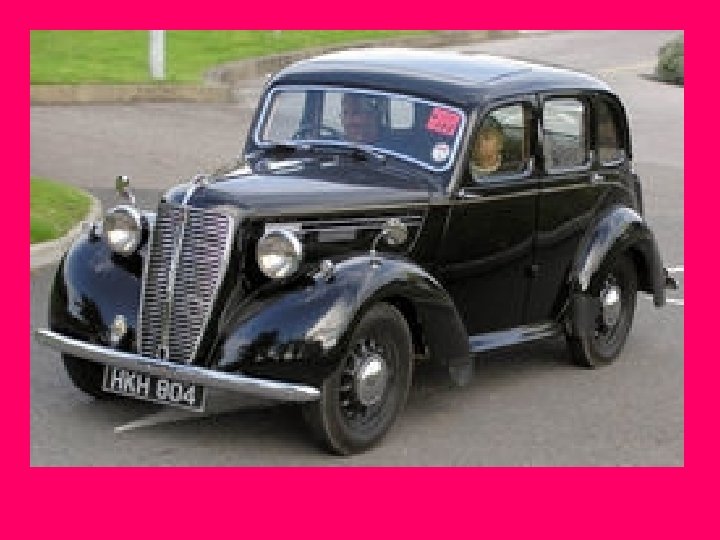
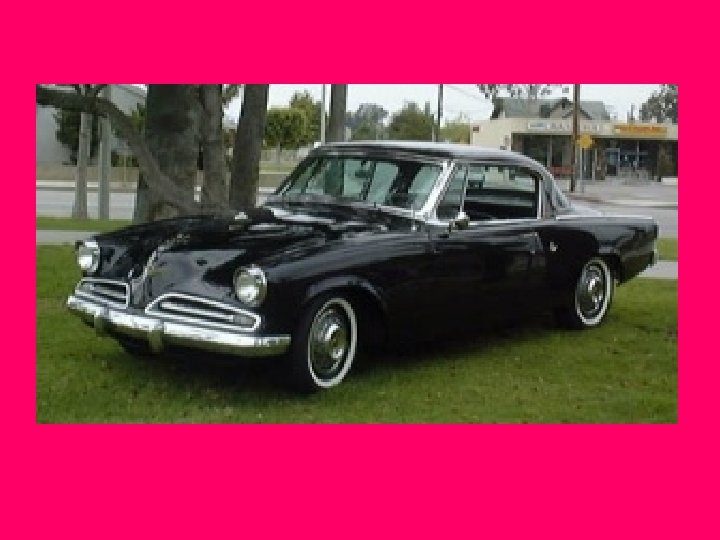
 Automobiles
 1957 Chevy
 1957 Chevy Bel. Air
 1957 Chevy Truck
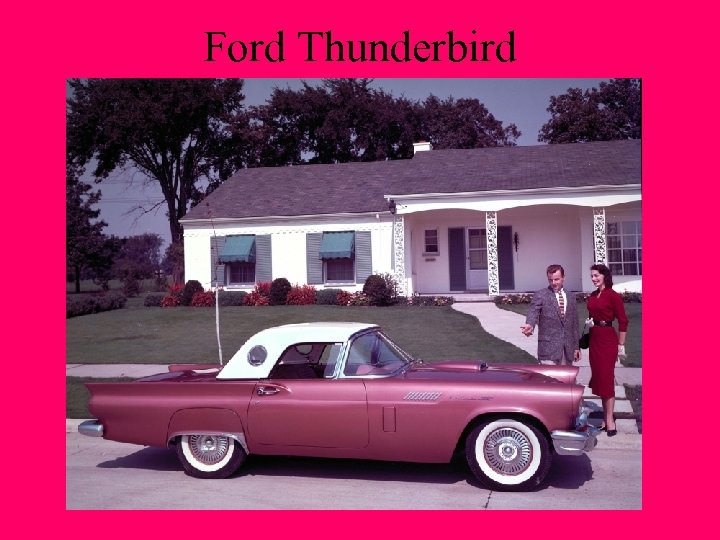 Ford Thunderbird
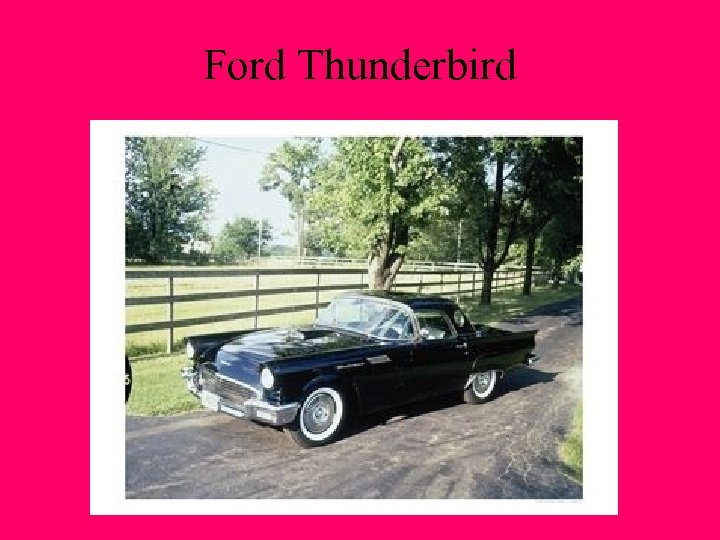 Ford Thunderbird
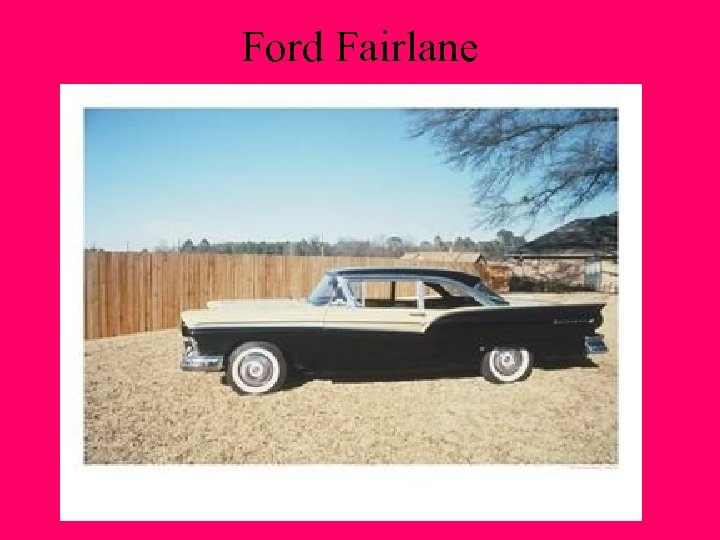 Ford Fairlane
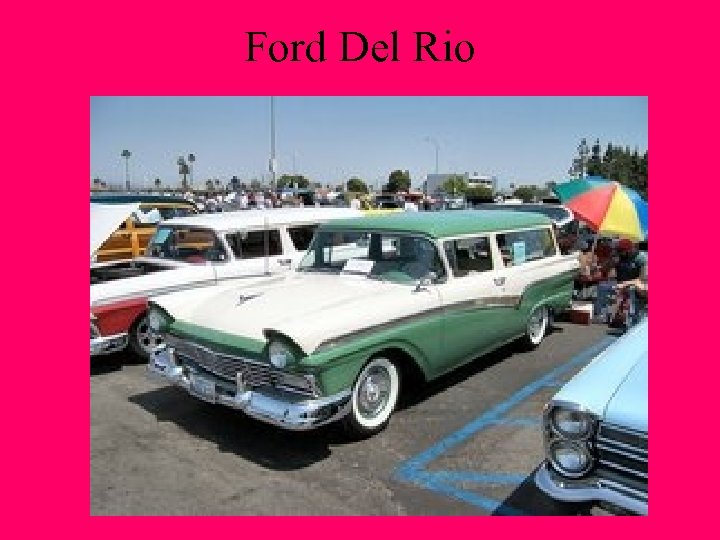 Ford Del Rio
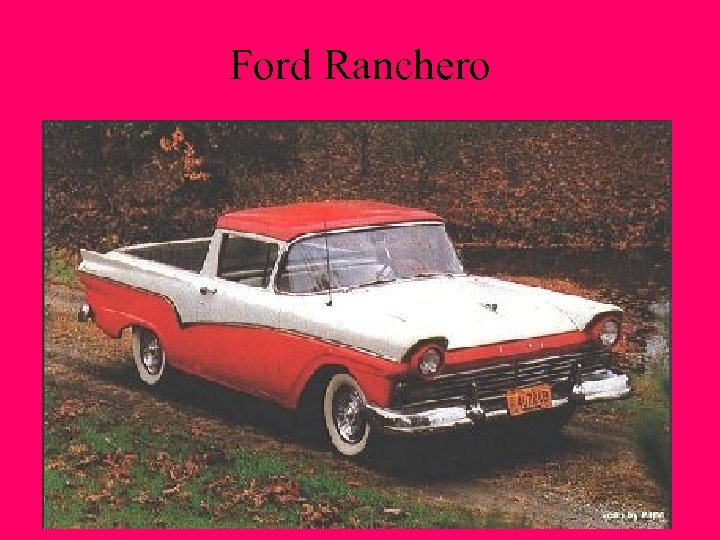 Ford Ranchero
 Porsche Speedster
 Porsche Coupe
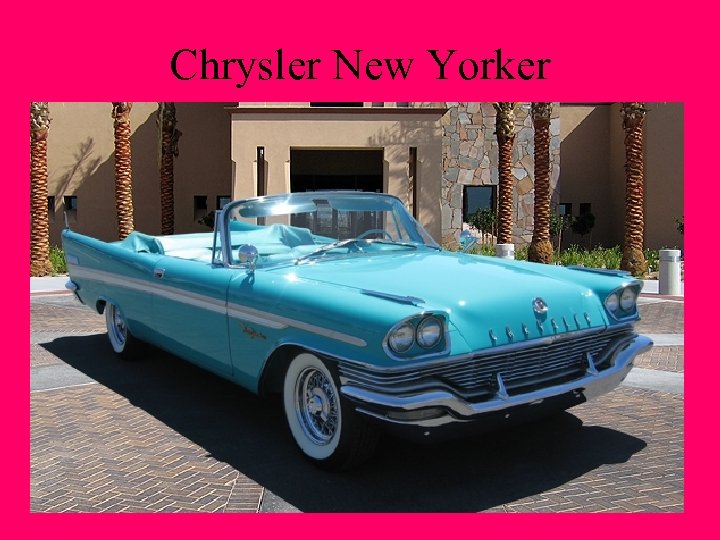 Chrysler New Yorker
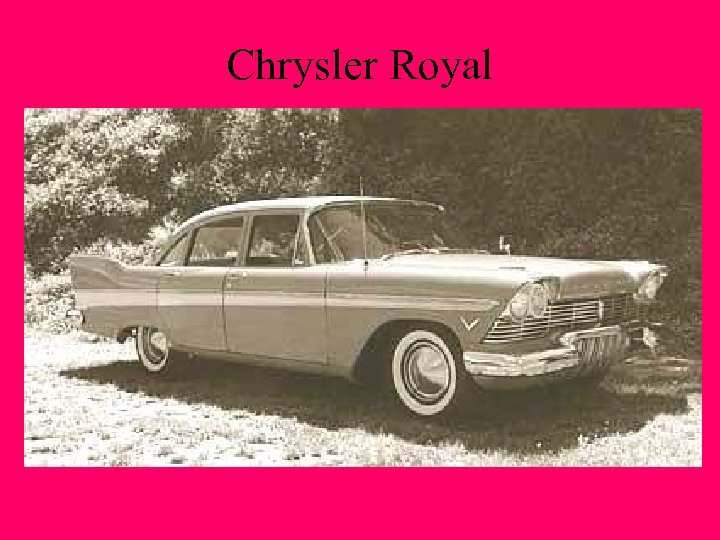 Chrysler Royal
 1950 s Slang
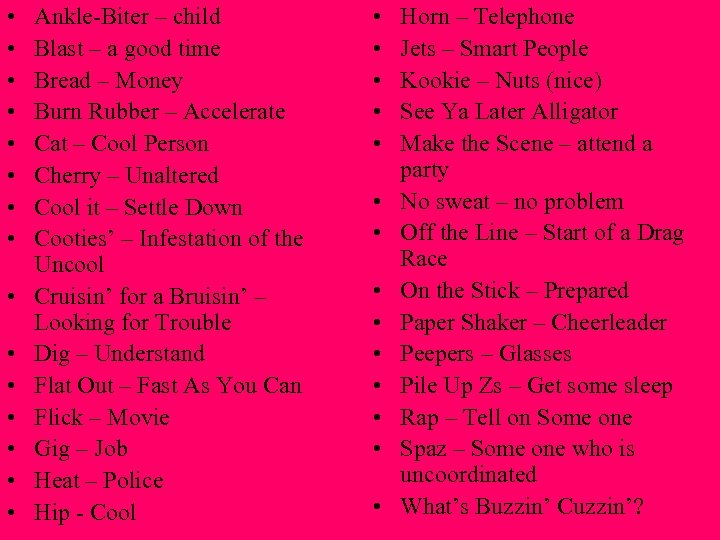 • • • • Ankle-Biter – child Blast – a good time Bread – Money Burn Rubber – Accelerate Cat – Cool Person Cherry – Unaltered Cool it – Settle Down Cooties’ – Infestation of the Uncool Cruisin’ for a Bruisin’ – Looking for Trouble Dig – Understand Flat Out – Fast As You Can Flick – Movie Gig – Job Heat – Police Hip - Cool • • • • Horn – Telephone Jets – Smart People Kookie – Nuts (nice) See Ya Later Alligator Make the Scene – attend a party No sweat – no problem Off the Line – Start of a Drag Race On the Stick – Prepared Paper Shaker – Cheerleader Peepers – Glasses Pile Up Zs – Get some sleep Rap – Tell on Some one Spaz – Some one who is uncoordinated What’s Buzzin’ Cuzzin’?
 Technology
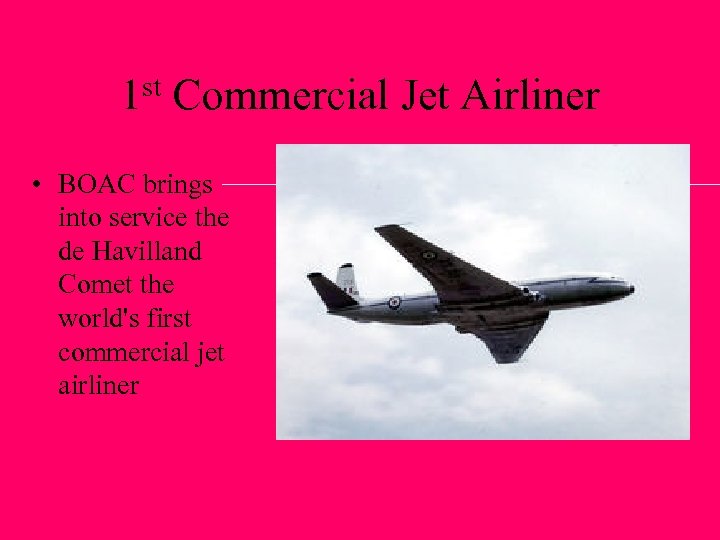 st Commercial Jet Airliner 1 • BOAC brings into service the de Havilland Comet the world's first commercial jet airliner
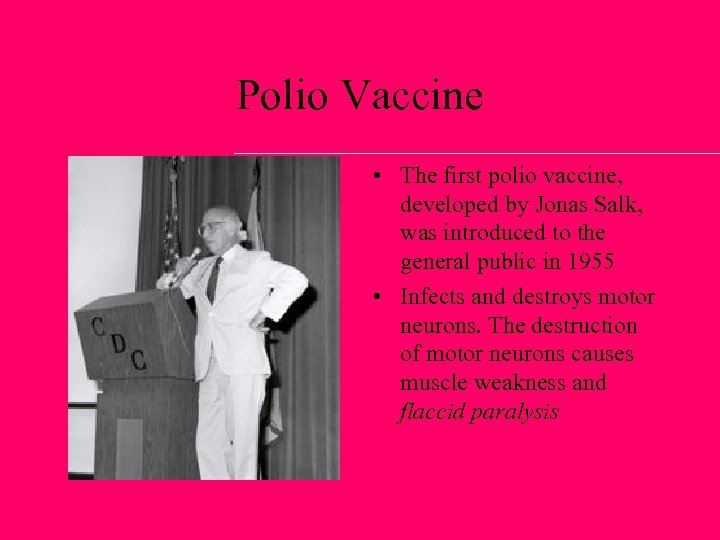 Polio Vaccine • The first polio vaccine, developed by Jonas Salk, was introduced to the general public in 1955 • Infects and destroys motor neurons. The destruction of motor neurons causes muscle weakness and flaccid paralysis
 Oral Polio Vaccine • Created by Albert Sabin • Containing weakened forms of strains of polio viruses – Salk's was a "killed" vaccine effective in preventing most of the complications of polio, but did not prevent the initial intestinal infection. • Sabin’s vaccine was easier to give than Salk’s and its effects last longer.
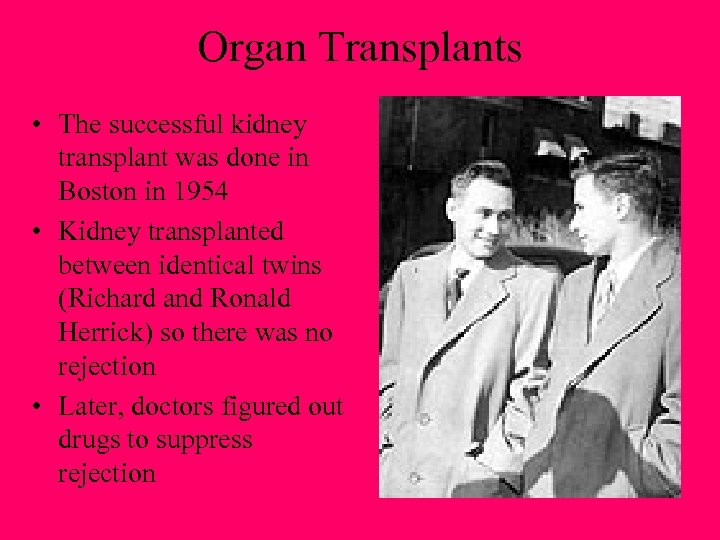 Organ Transplants • The successful kidney transplant was done in Boston in 1954 • Kidney transplanted between identical twins (Richard and Ronald Herrick) so there was no rejection • Later, doctors figured out drugs to suppress rejection
 Sports
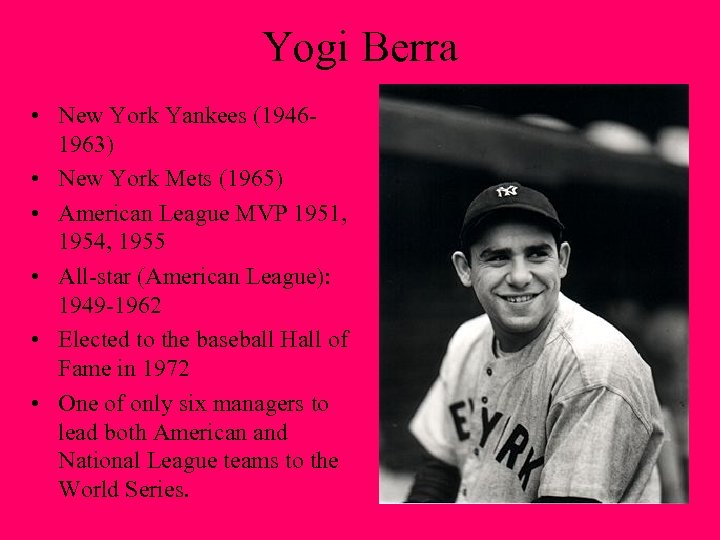 Yogi Berra • New York Yankees (19461963) • New York Mets (1965) • American League MVP 1951, 1954, 1955 • All-star (American League): 1949 -1962 • Elected to the baseball Hall of Fame in 1972 • One of only six managers to lead both American and National League teams to the World Series.
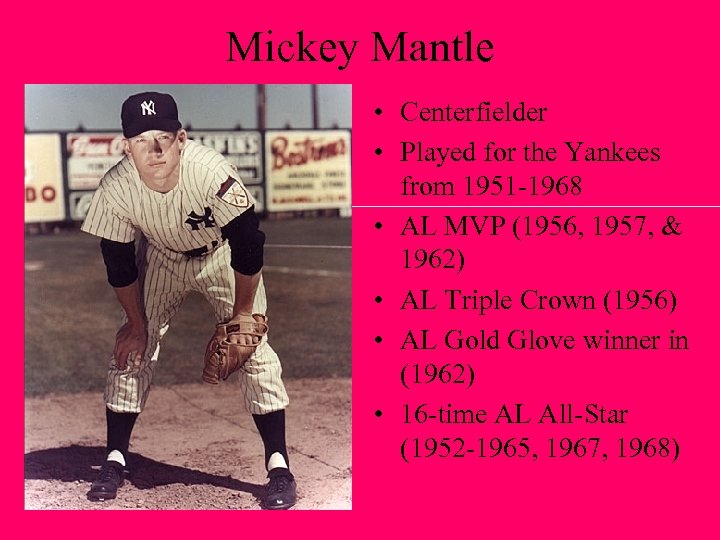 Mickey Mantle • Centerfielder • Played for the Yankees from 1951 -1968 • AL MVP (1956, 1957, & 1962) • AL Triple Crown (1956) • AL Gold Glove winner in (1962) • 16 -time AL All-Star (1952 -1965, 1967, 1968)
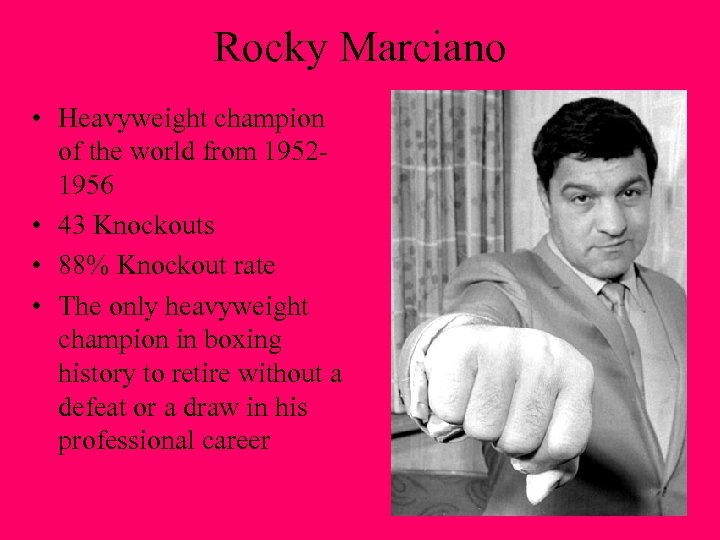 Rocky Marciano • Heavyweight champion of the world from 19521956 • 43 Knockouts • 88% Knockout rate • The only heavyweight champion in boxing history to retire without a defeat or a draw in his professional career
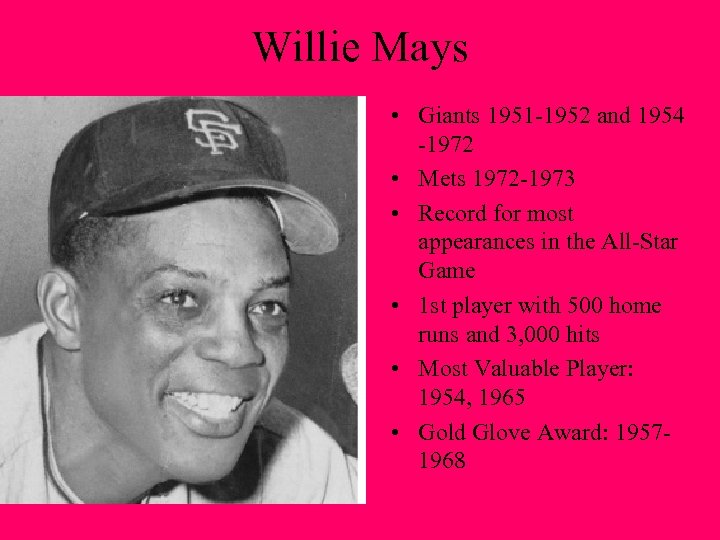 Willie Mays • Giants 1951 -1952 and 1954 -1972 • Mets 1972 -1973 • Record for most appearances in the All-Star Game • 1 st player with 500 home runs and 3, 000 hits • Most Valuable Player: 1954, 1965 • Gold Glove Award: 19571968
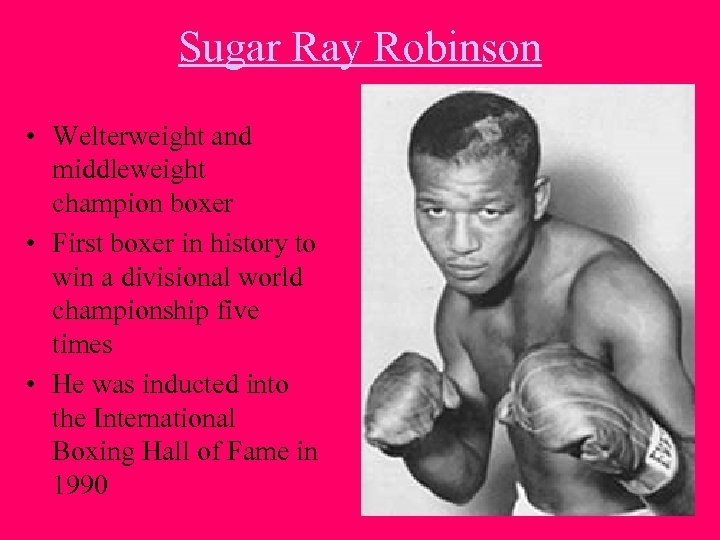 Sugar Ray Robinson • Welterweight and middleweight champion boxer • First boxer in history to win a divisional world championship five times • He was inducted into the International Boxing Hall of Fame in 1990
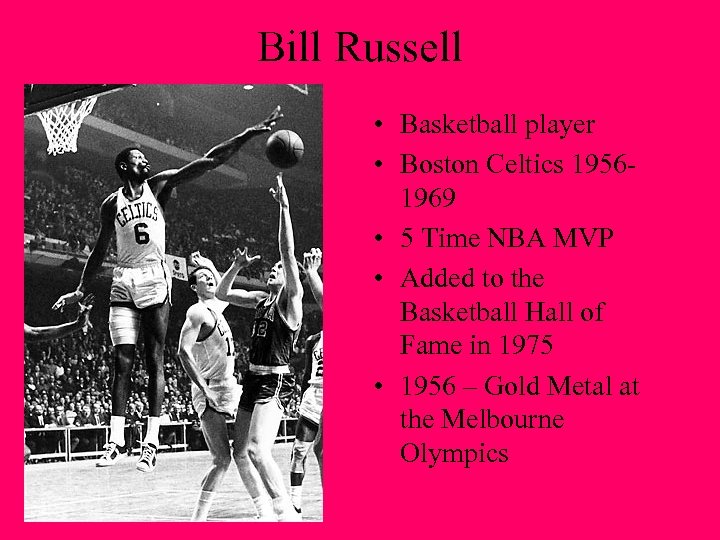 Bill Russell • Basketball player • Boston Celtics 19561969 • 5 Time NBA MVP • Added to the Basketball Hall of Fame in 1975 • 1956 – Gold Metal at the Melbourne Olympics