 Скачать презентацию America Claims an Empire Global competition prompts the
6465802b71f3a580c7f48982b128701d.ppt
- Количество слайдов: 59



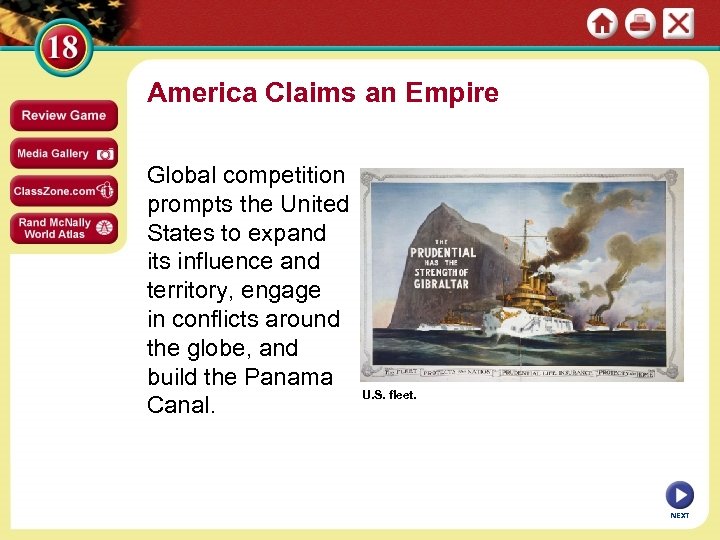
America Claims an Empire Global competition prompts the United States to expand its influence and territory, engage in conflicts around the globe, and build the Panama Canal. U. S. fleet. NEXT
America Claims an Empire SECTION 1 Imperialism and America SECTION 2 The Spanish-American War SECTION 3 Acquiring New Lands SECTION 4 America as a World Power NEXT
Section 1 Imperialism and America Beginning in 1867 and continuing through the century, global competition causes the United States to expand. NEXT
• Journal opinion review: How would you spend our tax money? : Does the U. S. A. really need to have an expensive military which is spread out in bases around the world, costing taxpayers billions of dollars ($683. 7 billion in 2010!) each year, to operate the world’s largest Navy and most technologically advanced Army, Air Force and Marines OR should we cut it back and just have US forces stay in US territory to protect our borders and use a lot of that money for other uses here?
• Advanced Organizer: With your groups of 2 to 3 brainstorm and list or web as many places as you can think of that are NOT directly physically connected to the 48 states of the continental United States of America but that are controlled by the U. S. A. (think of islands, separated states off shore bases, any other places considered under US control etc. )
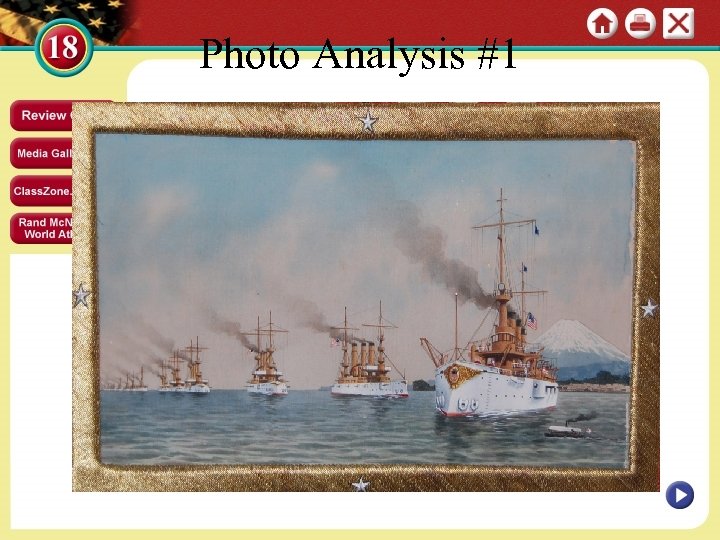
Photo Analysis #1
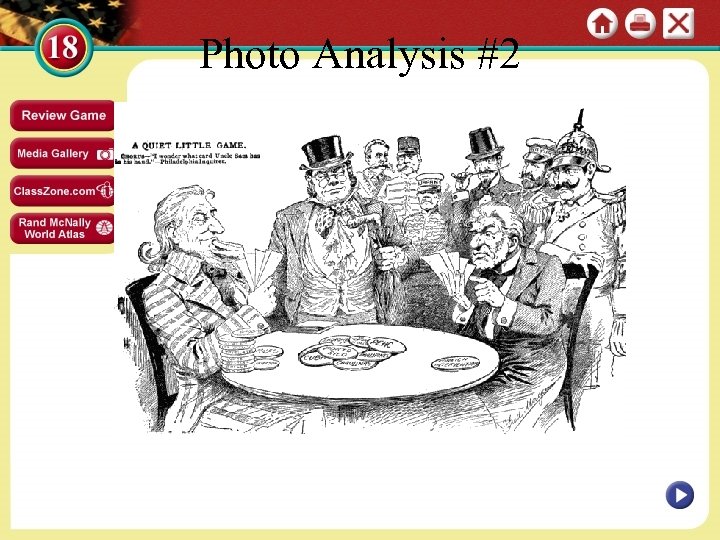
Photo Analysis #2
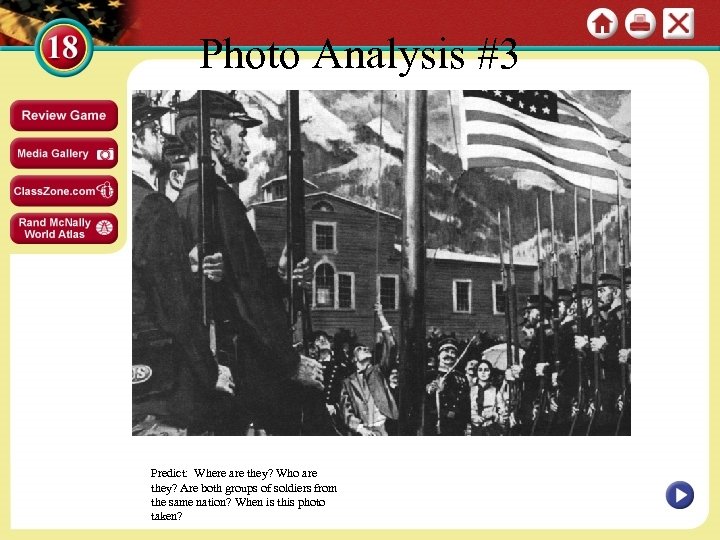
Photo Analysis #3 Predict: Where are they? Who are they? Are both groups of soldiers from the same nation? When is this photo taken?
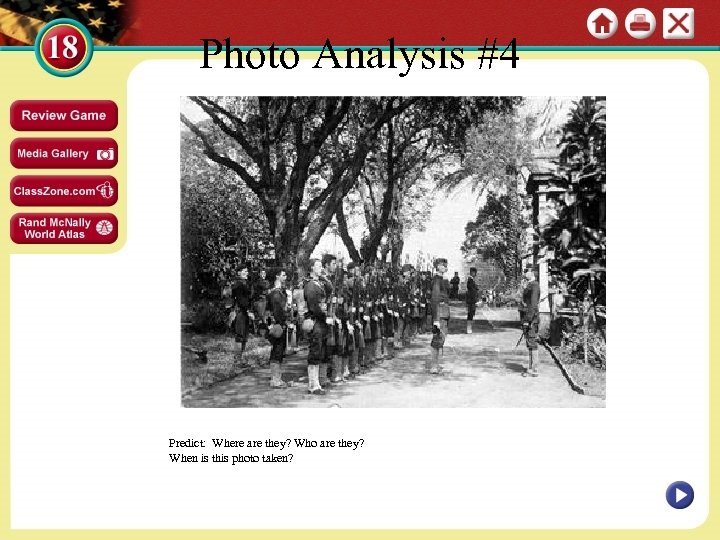
Photo Analysis #4 Predict: Where are they? Who are they? When is this photo taken?
SECTION 1 Imperialism and American Expansionism 1. Global Competition • Imperialism—policy of extending control over weaker nations • In 1800 s, Europeans divide up most of Africa, compete for China • Japan joins race for China; U. S. decides to expand overseas Map 2. Desire for Military Strength • Admiral Alfred T. Mahan urges U. S. to build up navy to compete • U. S. builds modern battleships, becomes third largest naval power Continued. . . NEXT
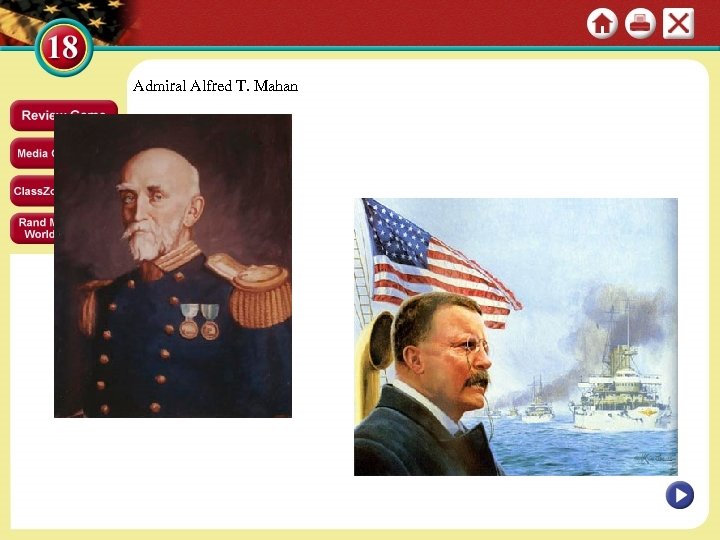
Admiral Alfred T. Mahan
SECTION 1 continued American Expansionism 3. Thirst for New Markets • U. S. farms, factories produce more than Americans can consume • U. S. needs raw materials, new markets for goods • Foreign trade: solution to overproduction, unemployment, depression 4. Belief in Cultural Superiority • Some combine Social Darwinism, belief in superiority of Anglo-Saxons • Argue U. S. has duty to Christianize, civilize “inferior peoples” NEXT
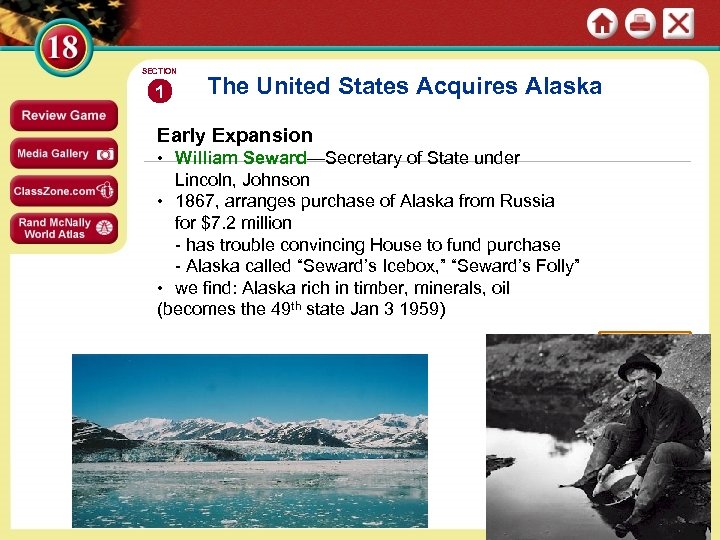
SECTION 1 The United States Acquires Alaska Early Expansion • William Seward—Secretary of State under Lincoln, Johnson • 1867, arranges purchase of Alaska from Russia for $7. 2 million - has trouble convincing House to fund purchase - Alaska called “Seward’s Icebox, ” “Seward’s Folly” • we find: Alaska rich in timber, minerals, oil (becomes the 49 th state Jan 3 1959) Image NEXT
SECTION 1 The United States Takes Hawaii The Cry for Annexation • 1790 s, U. S. merchants stop in Hawaii on way to China, India • 1820 s, Yankee missionaries found schools, churches on islands • Mid-1800 s, American-owned sugar plantations 75% of islands’ wealth • 1887, U. S. pressures Hawaii to allow naval base at Pearl Harbor - becomes refueling station • 1890 Mc. Kinley Tariff eliminates duty-free status of Hawaiian sugar • Planters call for U. S. to annex islands so will not have to pay duty Continued. . . NEXT
SECTION 1 continued The United States Takes Hawaii The End of a Monarchy • 1887, businessmen force King Kalakaua to limit vote to landowners • Queen Liliuokalani tries to remove landowning requirement • With help of marines, business groups overthrow queen Jan 17, 1893… Image Set up government headed by Sanford B. Dole • President Cleveland - recognizes Republic of Hawaii • Under President Mc. Kinley, Congress proclaims Hawaii U. S. territory (by Aug 21, 1959 becomes a state!) NEXT
Video review Clips: Hawaii and Alaska… Watch, then collaborate and create a web of all details your group can recall from each video review clip. Try to recall facts, people and key visual details…. . Get at least 6 for each ! Push yourselves and go for genius level of 15 plus!!! Alaska VRC play 4 minutes 30 secs. . http: //www. youtube. com/watch? v=lh. CZ 8 Pq. U_ 20 http: //www. youtube. com/watch? v=Xpsm. UCtsd 2 o&playnext=1&list=PL 3 D 12 EB 870 C 0967 A 0 &feature=results_video
Review/Summarization: Now in your groups of 2 to 3, Appoint a scribe and question creators and create and write down 5 key questions (with answers) from Section 1 your group feels a teacher will definitely ask on a quiz/test.
My Top 5: How many does your group have? 1. What is IMPERIALISM? 2. Name 2 of the 4 causes for American Expansion: 3. Who helped us BUY ALASKA? 4. What group of Americans wanted Hawaii to join the USA? 5. Who was the LAST Queen of Hawaii?
Section 2 The Spanish-American War In 1898, the United States goes to war to help Cuba win its independence from Spain. NEXT
Pre Question Group Survey: • Should the USA ever spend its money and American lives in order to fight for another nation? Why or why not? • Survey your group on how many think they are times to do this and how many are against ever doing this:
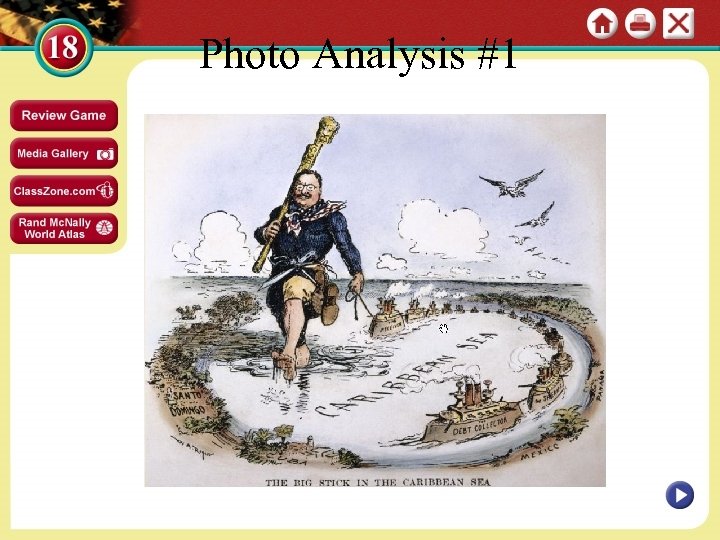
Photo Analysis #1
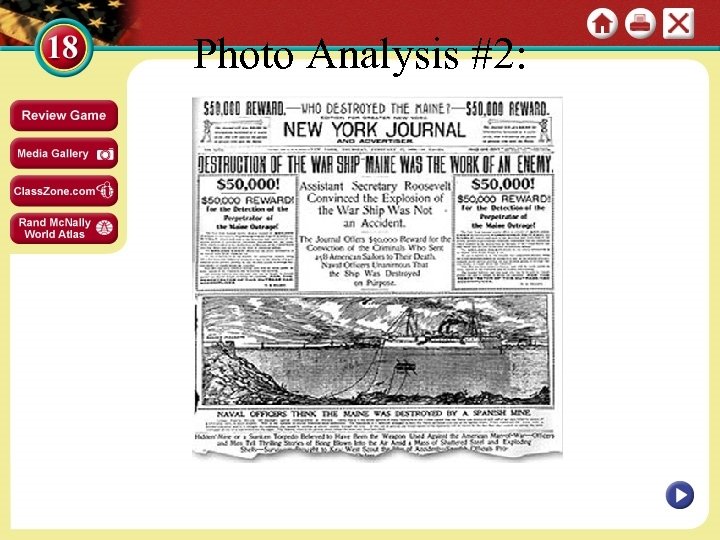
Photo Analysis #2:
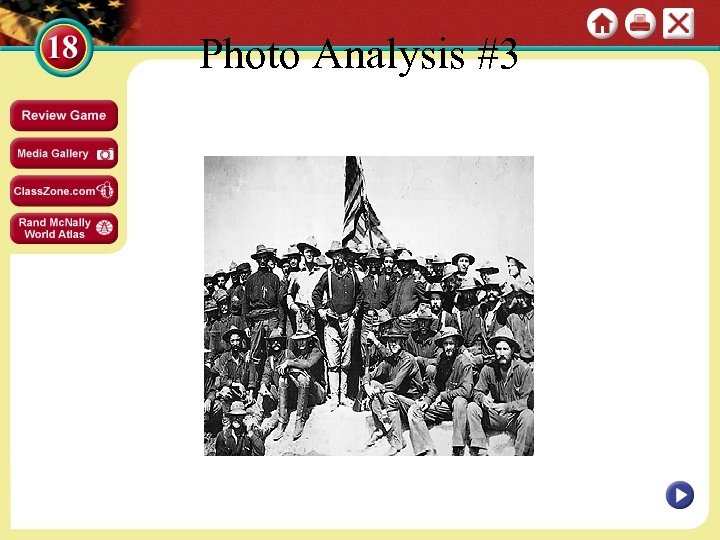
Photo Analysis #3
SECTION 2 The Spanish-American War Cubans Rebel Against Spain American Interest in Cuba • U. S. long interested in Cuba; wants to buy Cuba from Spain • During 1868– 1878 war for independence, American sympathies with Cuba • U. S. investment in sugar cane The Second War for Independence • José Martí—poet, journalist—launches second revolution in 1895 • Guerrilla campaign destroys American-owned sugar mills, plantations • U. S. public opinion split: - business wants to support Spain - others favor Cuban cause NEXT
SECTION 2 War Fever Escalates Spain Takes Action • 1896, General Valeriano Weyler sent to Cuba to restore order • Puts about 300, 000 Cubans in concentration camps Headline Wars • Newspapers exploit Weyler’s actions in circulation war • Yellow journalism—sensational writing used to lure, enrage readers Image Continued. . . NEXT
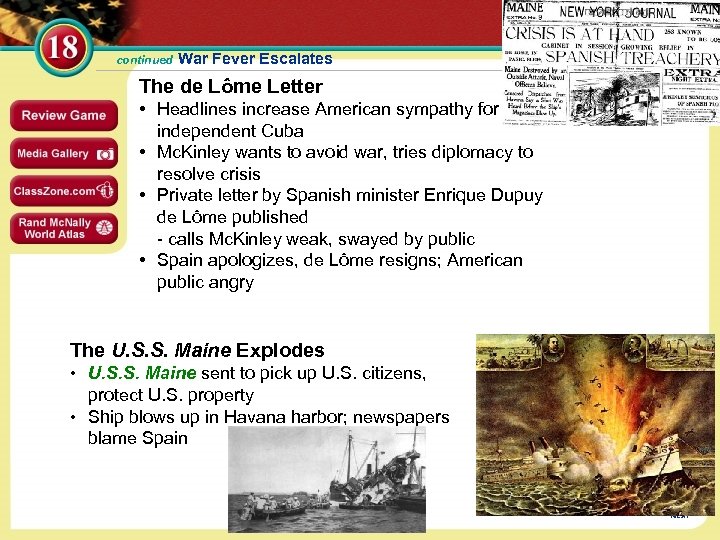
continued War Fever Escalates The de Lôme Letter • Headlines increase American sympathy for independent Cuba • Mc. Kinley wants to avoid war, tries diplomacy to resolve crisis • Private letter by Spanish minister Enrique Dupuy de Lôme published - calls Mc. Kinley weak, swayed by public • Spain apologizes, de Lôme resigns; American public angry The U. S. S. Maine Explodes • U. S. S. Maine sent to pick up U. S. citizens, protect U. S. property • Ship blows up in Havana harbor; newspapers blame Spain NEXT
SECTION 2 War with Spain Erupts The U. S. Declares War • Spain agrees to most U. S. demands, public opinion still favors war • U. S. declares war April 1898 The War in the Philippines • First battle with Spain occurs in Spanish colony of the Philippines • Commodore George Dewey destroys Spanish fleet in Manila harbor • Filipinos, led by Emilio Aguinaldo, support Dewey • August 1898, Spanish troops in Manila surrender to U. S. Continued. . . NEXT
SECTION 2 continued War with Spain Erupts The War in the Caribbean • U. S. blockades Cuba; Spanish fleet in Santiago de Cuba harbor • Unlike navy, U. S. army has small professional force, many volunteers - volunteers ill-prepared, ill-supplied Rough Riders • Rough Riders—Leonard Wood, Theodore Roosevelt lead volunteer cavalry • Roosevelt declared hero of attack on strategic San Juan Hill • Spanish fleet tries to escape blockade, is destroyed in naval battle • U. S. troops invade Puerto Rico soon after Map Continued. . . NEXT
SECTION 2 continued War with Spain Erupts Treaty of Paris • Spain, U. S. sign armistice August 1898; meet in Paris to make treaty • Spain frees Cuba; hands Guam, Puerto Rico to U. S. ; sells Philippines Debate over the Treaty • Treaty of Paris touches off great debate over imperialism • Mc. Kinley tries to justify annexation of Philippines on moral grounds • Opponents give political, moral, economic arguments against NEXT
Video REVIEW Activity: Memory recall: In groups of 2 to 3, Create a group list or WEB of as many details of the Spanish American War causes, players, events and details as possible! 10 minimum go beyond it! THEN appoint one group as the illustrator to create a visual depiction of some event your group found interesting or of key importance to the section…. . http: //www. youtube. com/watch? v=IU 5 l 4 y. QCp MM
Section 3 Acquiring New Lands In the early 1900 s, the United States engages in conflicts in Puerto Rico, Cuba, and the Philippines. NEXT
Journal question: • If you could pick any 5 things that you feel represent the USA in the 2000 s to put into a Time capsule which would be opened in 100 years what 5 items would you choose? What does each item represent about American culture, values, or style etc:
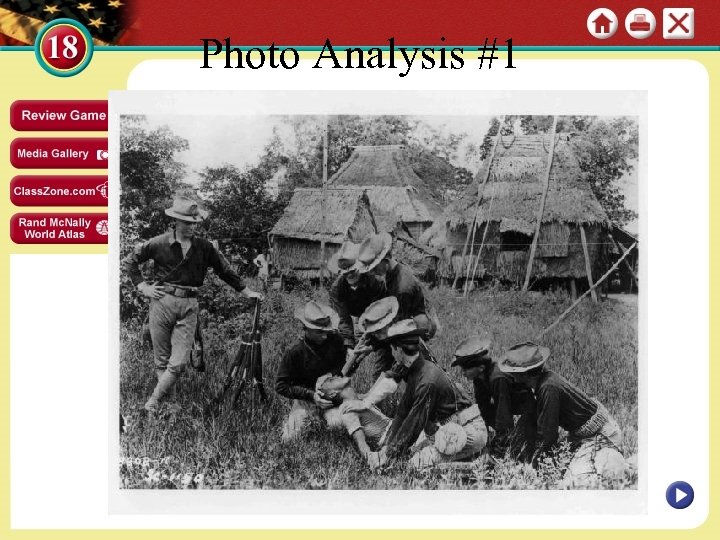
Photo Analysis #1
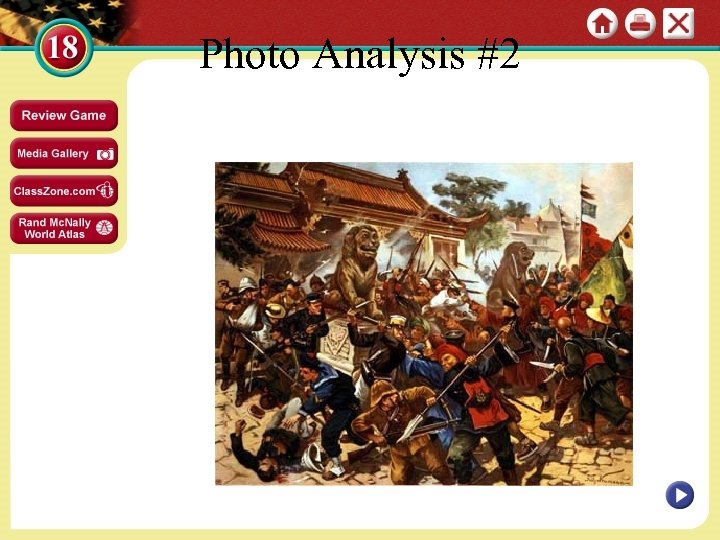
Photo Analysis #2
Survey Question: • In your groups of 2 to 3, appoint a spokesperson, collaborate and decide if any of your group would want to join the military, knowing you could be called to fight in foreign lands and potentially lose your life or be seriously injured fighting in places our politicians decide are worth fighting for:
SECTION 3 Acquiring New Lands Ruling Puerto Rico Military Rule • During Spanish-American War, General Nelson A. Miles occupies island • Puerto Rico under military control • People split on independence, statehood, self-government under U. S. Return to Civil Government • PR strategic as post in Caribbean, for protection of future canal • 1900, Foraker Act sets up civil government - president appoints governor, upper house • 1917, Puerto Ricans made U. S. citizens; elect both houses NEXT
SECTION 3 Cuba and the United States American Soldiers • U. S. recognizes Cuban independence from Spain • Teller Amendment says U. S. has no intention of taking over Cuba • After war U. S. occupies Cuba; has same officials in office as Spain - Cuban protestors imprisoned or exiled • American military government helps rebuild the country Continued. . . NEXT
SECTION 3 continued Cuba and the United States Platt Amendment • U. S. makes Cuba add Platt Amendment to its 1901 constitution • Platt Amendment does not allow Cuba to go into debt; also stipulates - no treaties that let foreign power control land - U. S. has right to intervene - U. S. can buy, lease land for navy • Protectorate—country whose affairs partly controlled by stronger one Continued. . . NEXT
SECTION 3 continued Cuba and the United States Protecting American Business Interests • U. S. wants strong political presence to protect American businesses • Some object to colonial entanglements, do not think colonies needed • U. S. state department continues to push for control of Latin America NEXT
SECTION 3 Filipinos Rebel Philippine-American War • Filipinos outraged at Treaty of Paris call for annexation • 1899, Emilio Aguinaldo leads fight for independence against U. S. • U. S. forces Filipinos to live in designated zones in poor conditions - white U. S. soldiers see Filipinos as inferior - black troops troubled at spreading prejudice • 20, 000 Filipinos die in fight for independence Image Aftermath of the War • U. S. president appoints governor who appoints upper house - people elect lower house • July 4, 1946, Philippines become independent NEXT
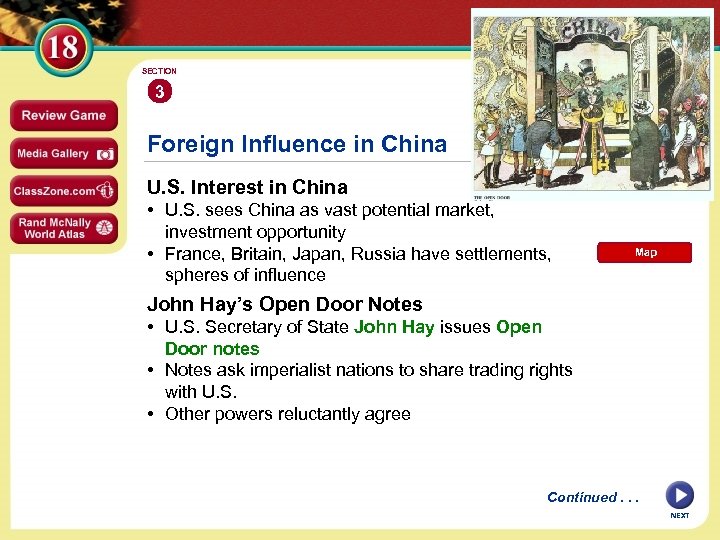
SECTION 3 Foreign Influence in China U. S. Interest in China • U. S. sees China as vast potential market, investment opportunity • France, Britain, Japan, Russia have settlements, spheres of influence Map John Hay’s Open Door Notes • U. S. Secretary of State John Hay issues Open Door notes • Notes ask imperialist nations to share trading rights with U. S. • Other powers reluctantly agree Continued. . . NEXT
SECTION 3 continued Foreign Influence in China The Boxer Rebellion in China • Europeans dominate most large Chinese cities • Chinese form secret societies, including Boxers, to expel foreigners • Boxers kill hundreds of foreigners, Chinese converts to Christianity • U. S. , Britain, France, Germany, Japan put down Boxer Rebellion Protecting American Rights Interactive • Hay issues new Open Door notes saying U. S. will keep trade open • Open Door policy reflects beliefs about U. S. economy: - growth depends on exports - U. S. has right to keep markets open - closing of area threatens U. S. survival NEXT
SECTION 3 The Impact of U. S. Territorial Gains The Anti-Imperialist League • Mc. Kinley’s reelection confirms most Americans favor imperialism • Anti-Imperialist League has prominent people from different fields • For various reasons, agree wrong to rule others without their consent • Mark Twain warns us about dangers of Imperialism in his poem “White Man’s Burden” NEXT
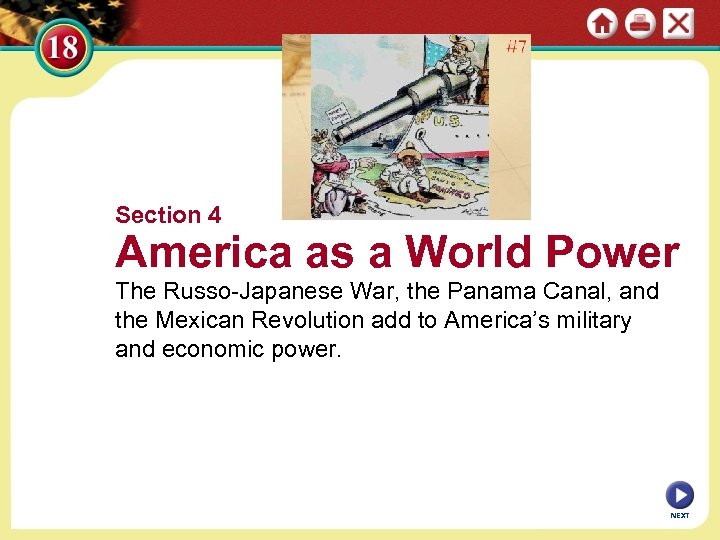
Section 4 America as a World Power The Russo-Japanese War, the Panama Canal, and the Mexican Revolution add to America’s military and economic power. NEXT
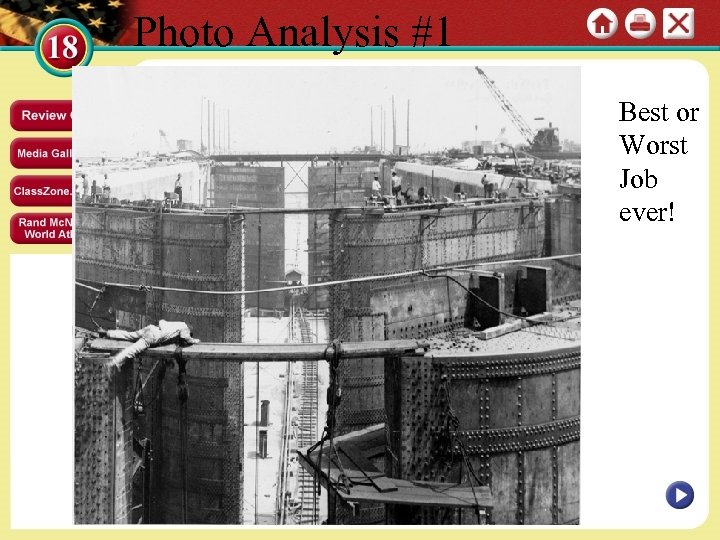
Photo Analysis #1 Best or Worst Job ever!
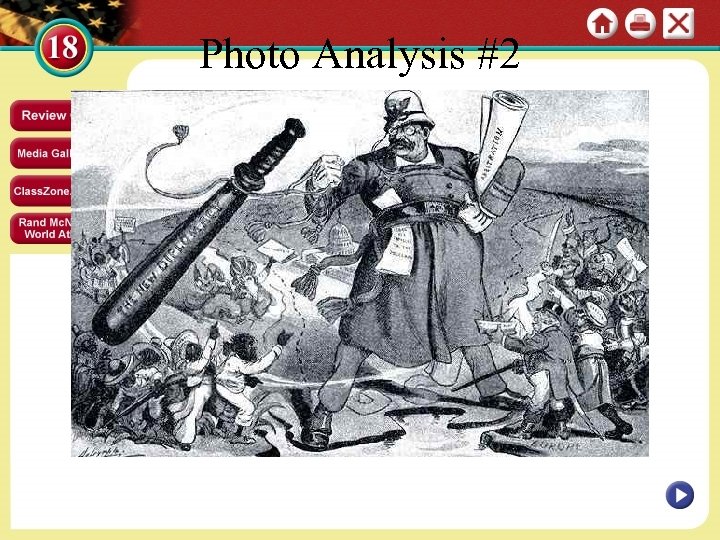
Photo Analysis #2
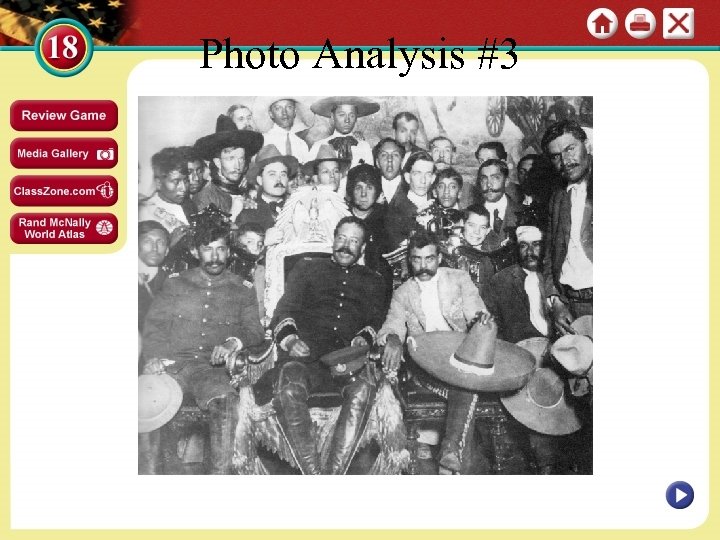
Photo Analysis #3
SECTION 4 America as a World Power Teddy Roosevelt and the World Roosevelt the Peacemaker • Roosevelt does not want Europeans to control world economy, politics • 1904 -1905 Russo-Japanese War • , Japan, Russia dispute control of Korea • Roosevelt negotiates treaty of Portsmouth: - Japan gets Manchuria, Korea - Roosevelt wins Nobel Peace Prize • U. S. , Japan continue diplomatic talks - pledge to respect each other’s possessions Continued. . . NEXT
SECTION 4 continued Teddy Roosevelt and the World Panama Canal 1904 to 1914 • U. S. wants canal to cut travel time of commercial, military ships • U. S. buys French company’s route through Panama • Negotiates with Colombia to build Panama Canal; talks break down • French company agent helps organize Panamanian rebellion - U. S. gives military aid • U. S. , Panama sign treaty; U. S. pays $10 million for Canal Zone Map Continued. . . NEXT
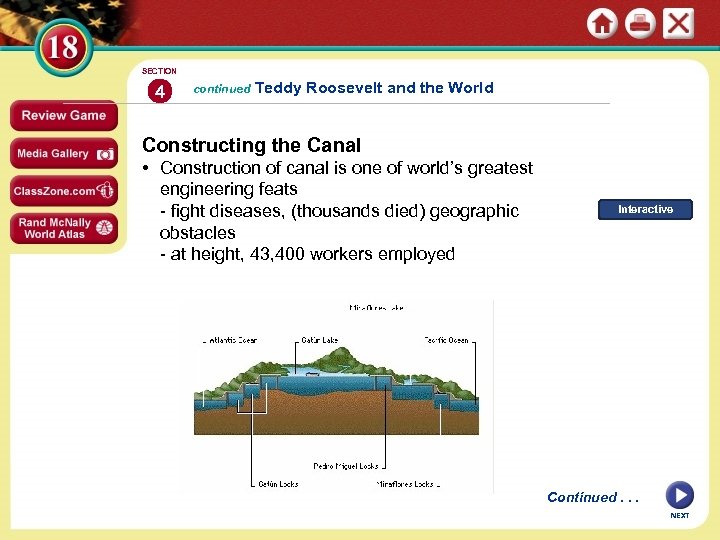
SECTION 4 continued Teddy Roosevelt and the World Constructing the Canal • Construction of canal is one of world’s greatest engineering feats - fight diseases, (thousands died) geographic obstacles - at height, 43, 400 workers employed Interactive Continued. . . NEXT
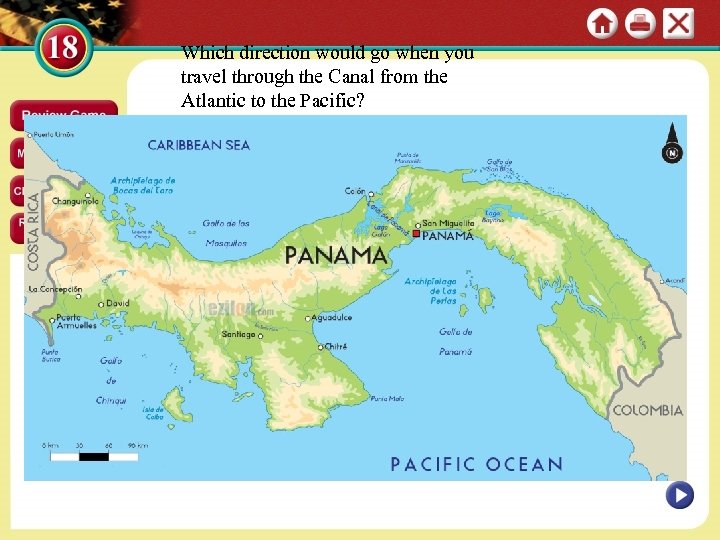
Which direction would go when you travel through the Canal from the Atlantic to the Pacific?
Panama Canal Construction IN Group. S: Appoint a speedy NEAT writer and List as many facts as possible on Panama Canal! https: //www. youtube. com/w atch? v=Tw 5 NMo_u-o. A http: //www. youtube. com/watch? v=ETg. K 3 Bk. Rm 6 A Panama Canal Time Lapse http: //www. youtube. com/watch? v=-vi 19 z 4 LEi 0
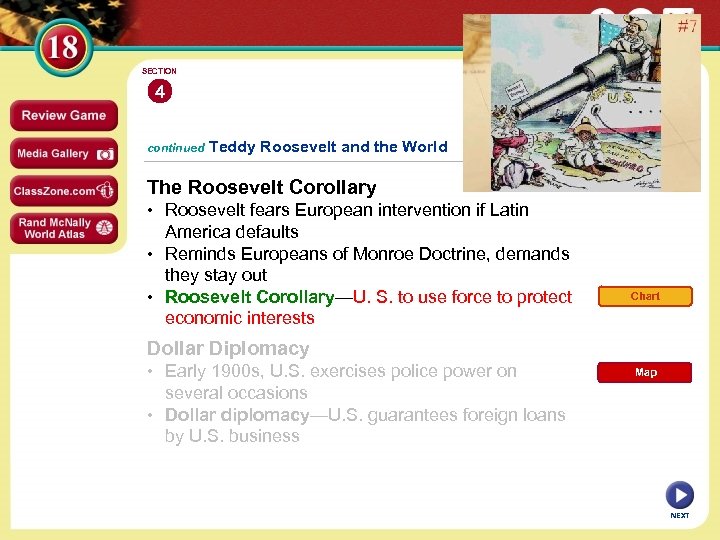
SECTION 4 continued Teddy Roosevelt and the World The Roosevelt Corollary • Roosevelt fears European intervention if Latin America defaults • Reminds Europeans of Monroe Doctrine, demands they stay out • Roosevelt Corollary—U. S. to use force to protect economic interests Chart Dollar Diplomacy • Early 1900 s, U. S. exercises police power on several occasions • Dollar diplomacy—U. S. guarantees foreign loans by U. S. business Map NEXT
SECTION 4 Woodrow Wilson’s Missionary Diplomacy The Mexican Revolution • Missionary diplomacy—U. S. has moral responsibility: - will not recognize regimes that are oppressive, undemocratic • Under dictator Porfirio Díaz, much U. S. investment in Mexico • 1911, peasants, workers led by Francisco Madero overthrow Díaz • General Victoriano Huerta takes over government; Madero is murdered • Wilson refuses to recognize Huerta’s government Continued. . . NEXT
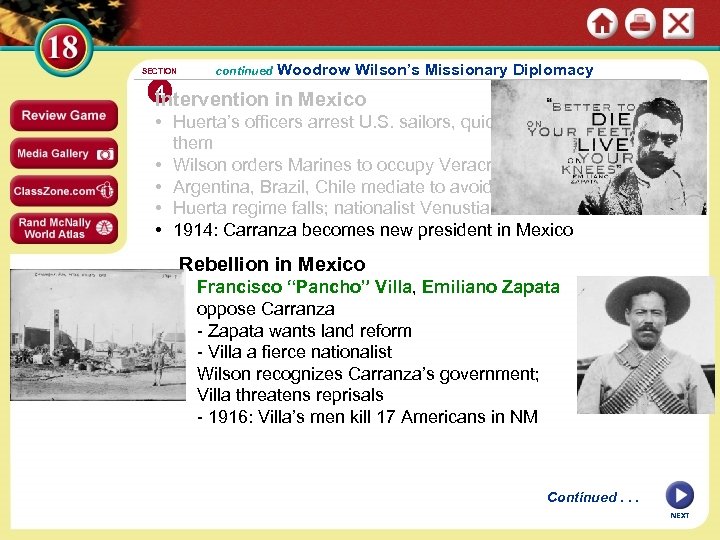
SECTION continued Woodrow Wilson’s Missionary Diplomacy 4 Intervention in Mexico • Huerta’s officers arrest U. S. sailors, quickly release them • Wilson orders Marines to occupy Veracruz • Argentina, Brazil, Chile mediate to avoid war • Huerta regime falls; nationalist Venustiano • 1914: Carranza becomes new president in Mexico Rebellion in Mexico • Francisco “Pancho” Villa, Emiliano Zapata oppose Carranza - Zapata wants land reform - Villa a fierce nationalist • Wilson recognizes Carranza’s government; Villa threatens reprisals - 1916: Villa’s men kill 17 Americans in NM Image Continued. . . NEXT
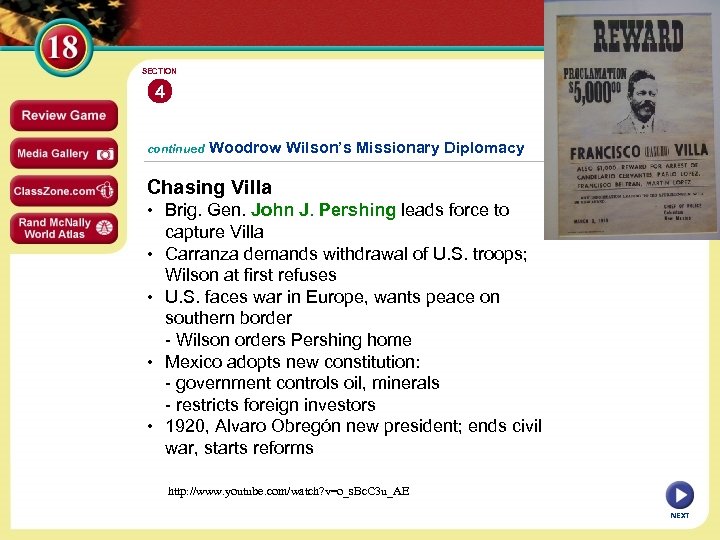
SECTION 4 continued Woodrow Wilson’s Missionary Diplomacy Chasing Villa • Brig. Gen. John J. Pershing leads force to capture Villa • Carranza demands withdrawal of U. S. troops; Wilson at first refuses • U. S. faces war in Europe, wants peace on southern border - Wilson orders Pershing home • Mexico adopts new constitution: - government controls oil, minerals - restricts foreign investors • 1920, Alvaro Obregón new president; ends civil war, starts reforms http: //www. youtube. com/watch? v=o_s. Bc. C 3 u_AE NEXT
Wrapping Up : For a chapter 18 of sections 1, 2 and 4 (we skipped 3 you’re welcome)…. LIST all the people we learned about and 2 details about them Then List all the places we “went to” in our notes… Decide which of the places would be the place you would send Mr Haldeman and tell why…
Wrap Up Activity: Be the Teacher! In Groups of 2 to 3 create 10 questions with answers from this section you feel you DEFINITELY be on review quiz. Read my mind amaze me with your skills…For genius level try to stump your classmates or the teacher with a six extra, really tricky question of DOOOM…….
This is the end of the chapter presentation of lecture notes. Click the HOME or EXIT button.
Скачать презентацию America Claims an Empire Global competition prompts the
6465802b71f3a580c7f48982b128701d.ppt