 Скачать презентацию America at Home and Abroad Late 20 th
f4bc5a4011bb8b635aa9fc81ba524360.ppt
- Количество слайдов: 39



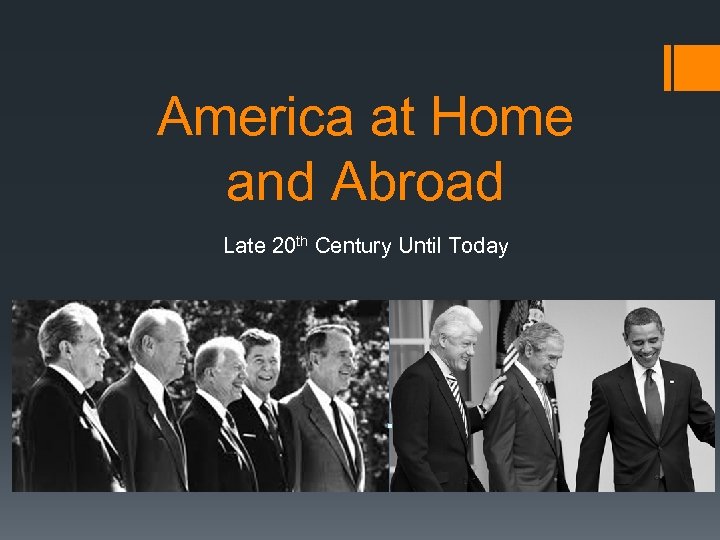
America at Home and Abroad Late 20 th Century Until Today
Migration Within the U. S § Rust Belt§ Unemployment rose sharply in mid-western states due to plant closures during 1970 s recession. § Led to large numbers of people moving out of states such as Illinois, Wisconsin, Indiana, Michigan, Ohio, Pennsylvania, often settling in Sunbelt states. § Sunbelt§ Due to the development of air conditioning, states known for warmer winters have grown steadily in population, especially senior citizens. § These include: California, Arizona, Texas, and Florida § Natural disasters (such as the 1930 s dust bowl) sometimes lead to temporary migrations which often turn out to be permanent. § An early 21 st-Century example of this phenomenon is the impact of Hurricane Katrina in 2005 on the area around New Orleans. § Where did these displaced people move?
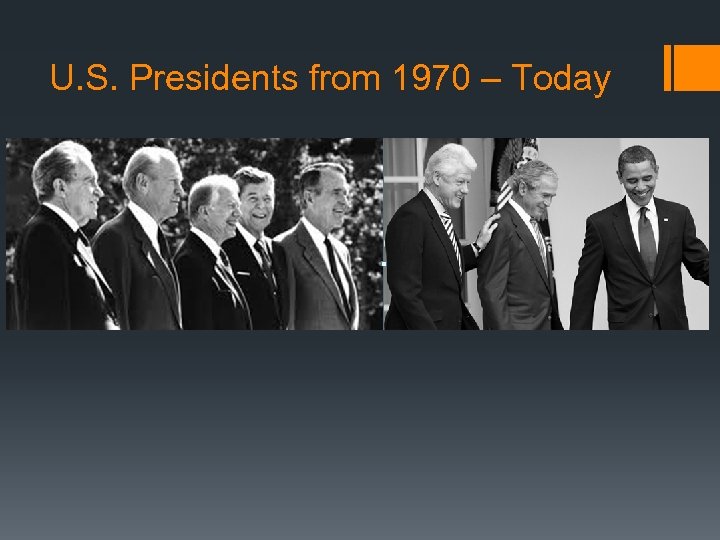
U. S. Presidents from 1970 – Today
How 90 s are you? 1. 2. 3. 4. Were not born in the 90 s. Did not own Beanie Babies or a Furby. Did not listen to Backstreet Boys, NSYNC, or Britney Spears. Did not watch cartoons like Rugrats, Hey Arnold, Rocket Power, Recess, or Doug. 5. Did not watch Home Alone or The Titanic. 6. Did not watch DVDs. 7. Did not play with a Gameboy. 8. Did not use the computer. 9. Did not watch Boy Meets World, Full House, or Saved By the Bell. 10. Did not watch sports such as hockey, football, or baseball. http: //www. youtube. com/watch? v=v. PEw 5 x. PRp. Wg
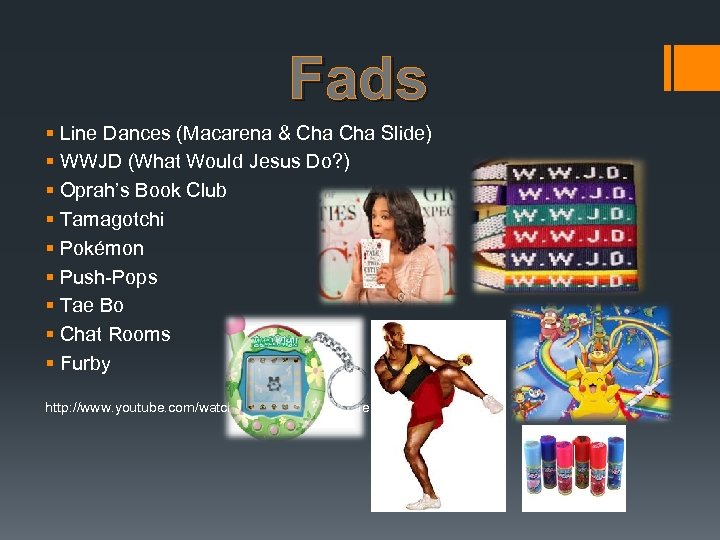
Fads § Line Dances (Macarena & Cha Slide) § WWJD (What Would Jesus Do? ) § Oprah’s Book Club § Tamagotchi § Pokémon § Push-Pops § Tae Bo § Chat Rooms § Furby http: //www. youtube. com/watch? v=8 Cbrb. Yq. U-Wg&feature=related
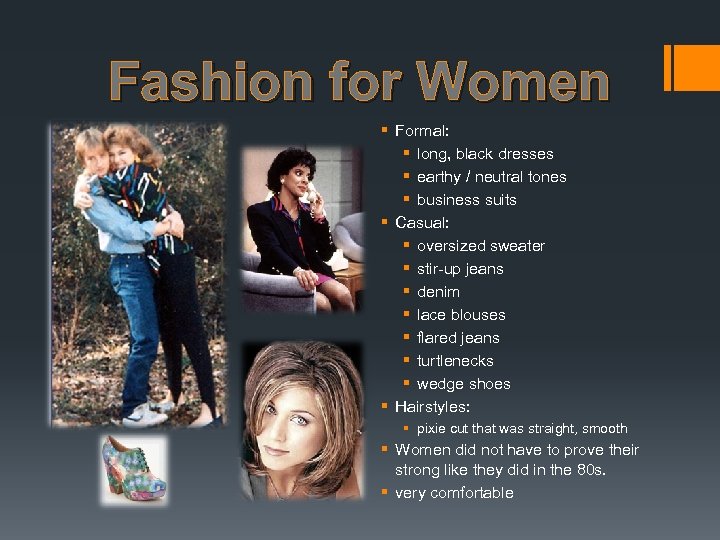
Fashion for Women § Formal: § long, black dresses § earthy / neutral tones § business suits § Casual: § oversized sweater § stir-up jeans § denim § lace blouses § flared jeans § turtlenecks § wedge shoes § Hairstyles: § pixie cut that was straight, smooth § Women did not have to prove their strong like they did in the 80 s. § very comfortable
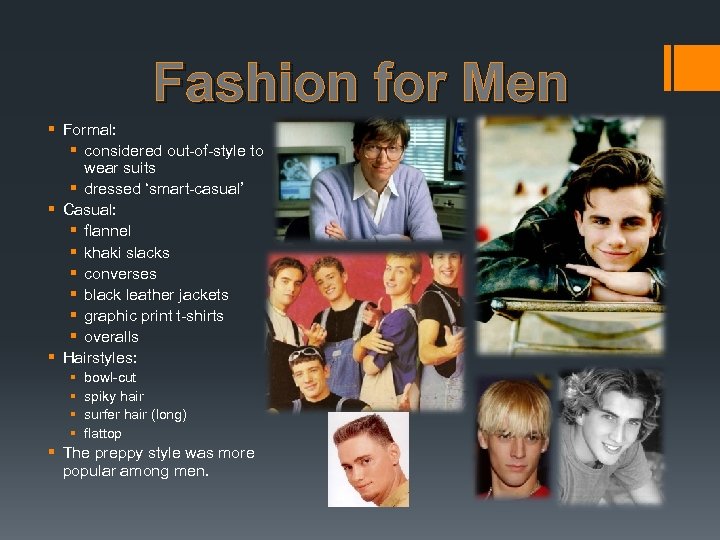
Fashion for Men § Formal: § considered out-of-style to wear suits § dressed ‘smart-casual’ § Casual: § flannel § khaki slacks § converses § black leather jackets § graphic print t-shirts § overalls § Hairstyles: § § bowl-cut spiky hair surfer hair (long) flattop § The preppy style was more popular among men.
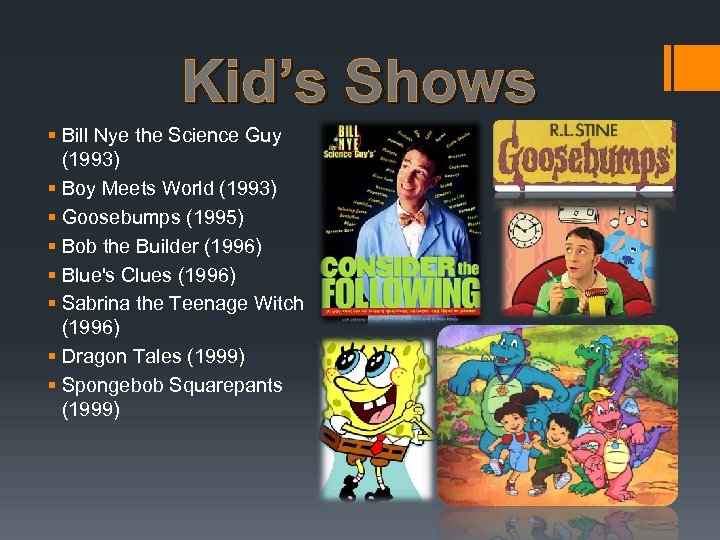
Kid’s Shows § Bill Nye the Science Guy (1993) § Boy Meets World (1993) § Goosebumps (1995) § Bob the Builder (1996) § Blue's Clues (1996) § Sabrina the Teenage Witch (1996) § Dragon Tales (1999) § Spongebob Squarepants (1999)
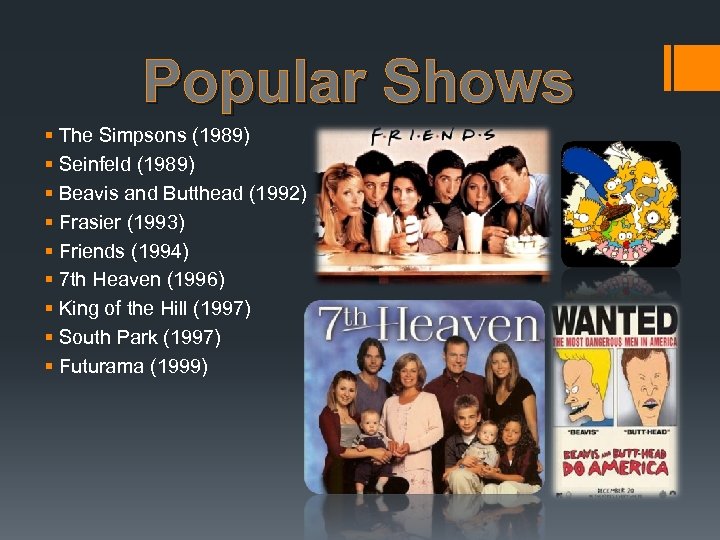
Popular Shows § The Simpsons (1989) § Seinfeld (1989) § Beavis and Butthead (1992) § Frasier (1993) § Friends (1994) § 7 th Heaven (1996) § King of the Hill (1997) § South Park (1997) § Futurama (1999)

New Technology in the New Economy § Invention of cell phones & internet caused big boom in economy and completely changed how businesses worked. § As the quality of information improved, businesses operated more efficiently (E-Mail) § Information technologies allowed for quicker delivery times
Other Inventions & Discoveries § § § § VHS movies changed to DVD disks MP 3’s paved the way for future devices (IPods) GPS Digital Cameras Instant Messaging (AIM, MSN) Hubble Space Telescope (revolutionized astronomy) Extra solar Planets detected Internet businesses (Amazon, EBay, Google, Yahoo, etc. ) PDA’s DVR Home Gaming Consoles with 3 D graphics Game cartridges converted to CDs First Hybrid Car (1997) DNA identification found wide application in Criminal Law
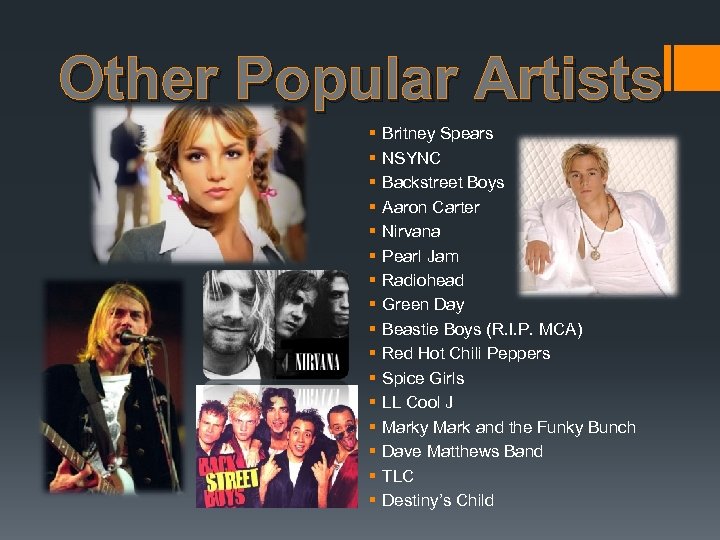
Other Popular Artists § § § § Britney Spears NSYNC Backstreet Boys Aaron Carter Nirvana Pearl Jam Radiohead Green Day Beastie Boys (R. I. P. MCA) Red Hot Chili Peppers Spice Girls LL Cool J Marky Mark and the Funky Bunch Dave Matthews Band TLC Destiny’s Child
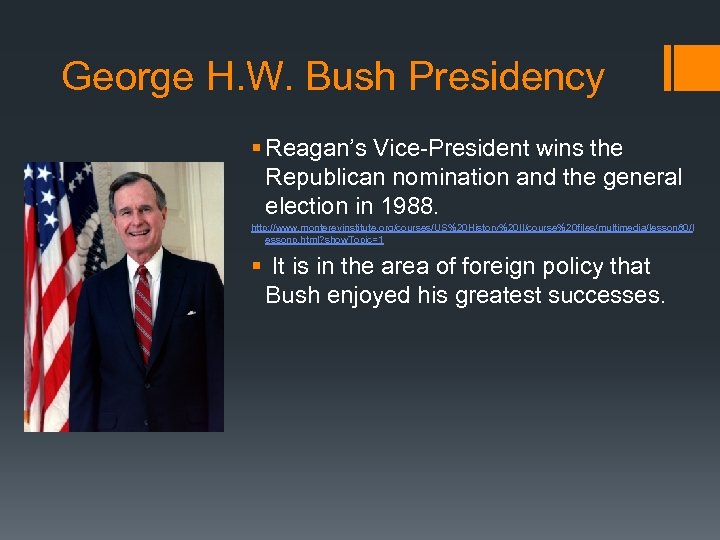
George H. W. Bush Presidency § Reagan’s Vice-President wins the Republican nomination and the general election in 1988. http: //www. montereyinstitute. org/courses/US%20 History%20 II/course%20 files/multimedia/lesson 80/l essonp. html? show. Topic=1 § It is in the area of foreign policy that Bush enjoyed his greatest successes.
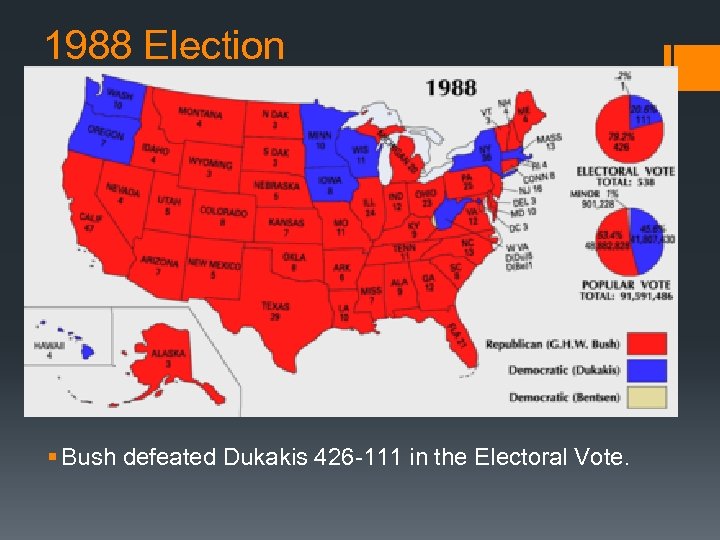
1988 Election § Bush defeated Dukakis 426 -111 in the Electoral Vote.
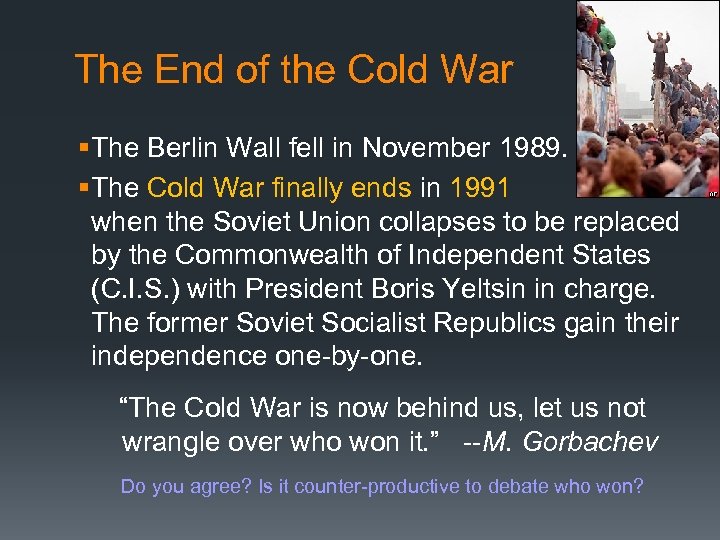
The End of the Cold War § The Berlin Wall fell in November 1989. § The Cold War finally ends in 1991 when the Soviet Union collapses to be replaced by the Commonwealth of Independent States (C. I. S. ) with President Boris Yeltsin in charge. The former Soviet Socialist Republics gain their independence one-by-one. “The Cold War is now behind us, let us not wrangle over who won it. ” --M. Gorbachev Do you agree? Is it counter-productive to debate who won?
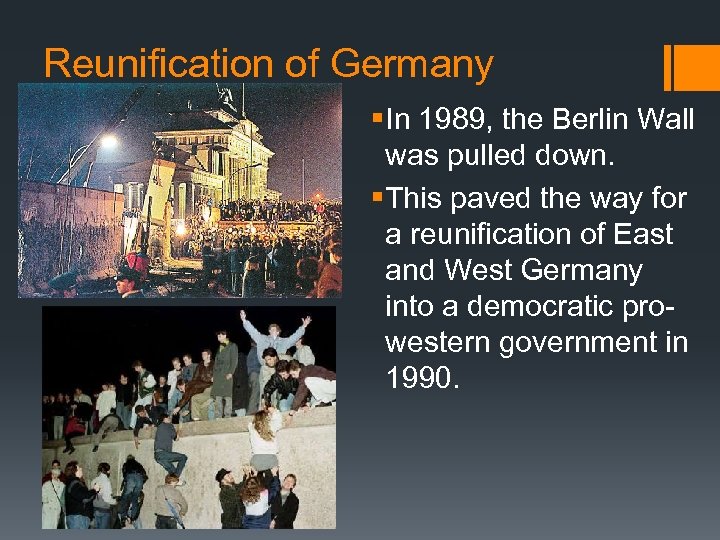
Reunification of Germany §In 1989, the Berlin Wall was pulled down. §This paved the way for a reunification of East and West Germany into a democratic prowestern government in 1990.
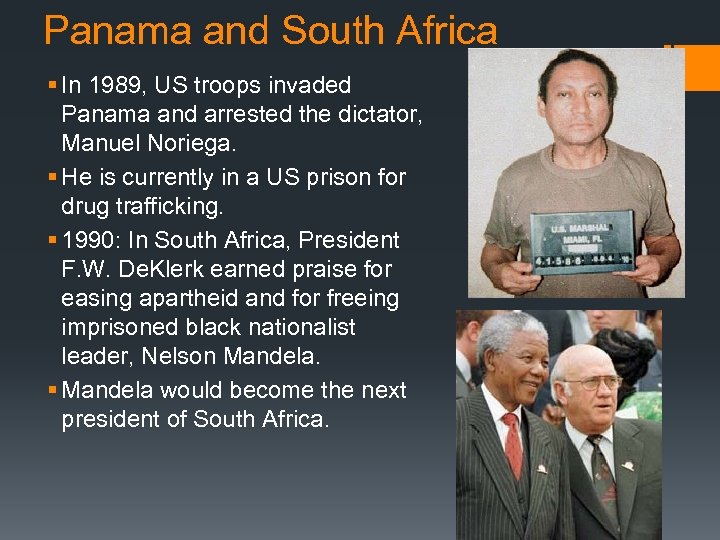
Panama and South Africa § In 1989, US troops invaded Panama and arrested the dictator, Manuel Noriega. § He is currently in a US prison for drug trafficking. § 1990: In South Africa, President F. W. De. Klerk earned praise for easing apartheid and for freeing imprisoned black nationalist leader, Nelson Mandela. § Mandela would become the next president of South Africa.
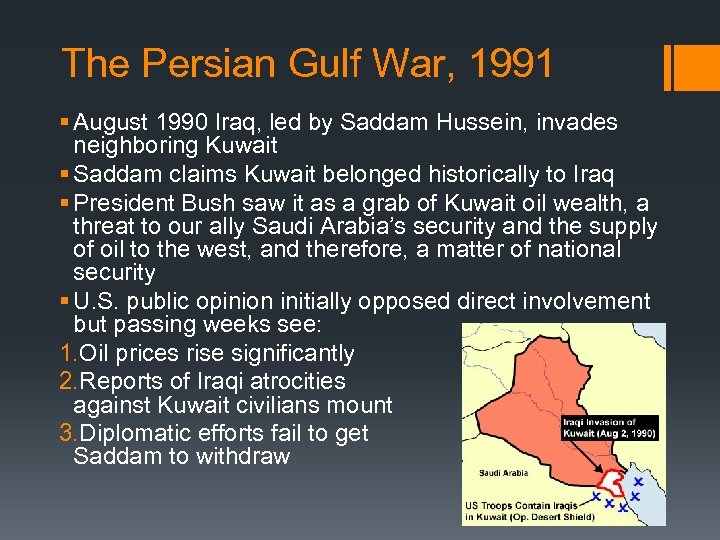
The Persian Gulf War, 1991 § August 1990 Iraq, led by Saddam Hussein, invades neighboring Kuwait § Saddam claims Kuwait belonged historically to Iraq § President Bush saw it as a grab of Kuwait oil wealth, a threat to our ally Saudi Arabia’s security and the supply of oil to the west, and therefore, a matter of national security § U. S. public opinion initially opposed direct involvement but passing weeks see: 1. Oil prices rise significantly 2. Reports of Iraqi atrocities against Kuwait civilians mount 3. Diplomatic efforts fail to get Saddam to withdraw
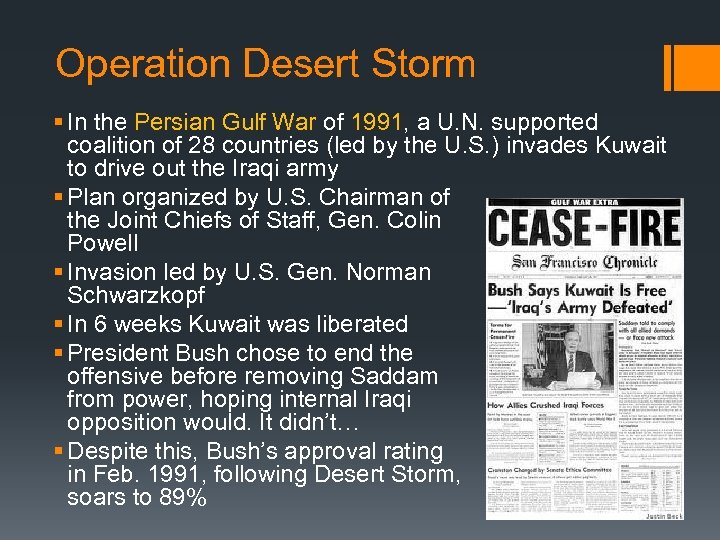
Operation Desert Storm § In the Persian Gulf War of 1991, a U. N. supported coalition of 28 countries (led by the U. S. ) invades Kuwait to drive out the Iraqi army § Plan organized by U. S. Chairman of the Joint Chiefs of Staff, Gen. Colin Powell § Invasion led by U. S. Gen. Norman Schwarzkopf § In 6 weeks Kuwait was liberated § President Bush chose to end the offensive before removing Saddam from power, hoping internal Iraqi opposition would. It didn’t… § Despite this, Bush’s approval rating in Feb. 1991, following Desert Storm, soars to 89%
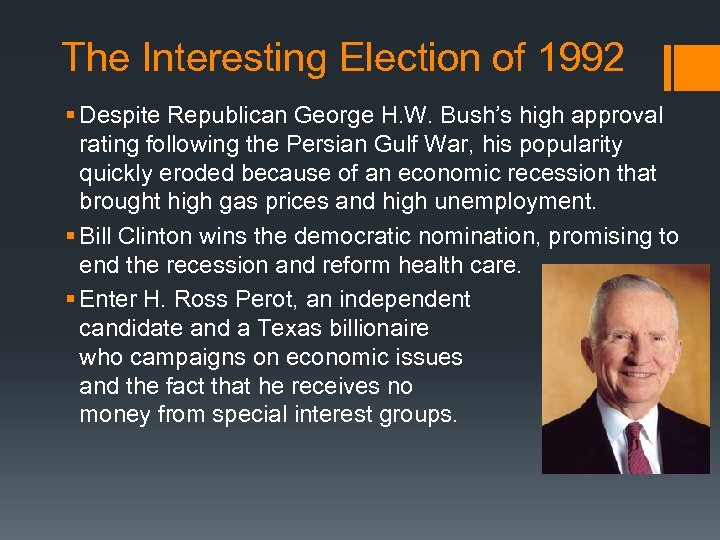
The Interesting Election of 1992 § Despite Republican George H. W. Bush’s high approval rating following the Persian Gulf War, his popularity quickly eroded because of an economic recession that brought high gas prices and high unemployment. § Bill Clinton wins the democratic nomination, promising to end the recession and reform health care. § Enter H. Ross Perot, an independent candidate and a Texas billionaire who campaigns on economic issues and the fact that he receives no money from special interest groups.
And the winner is. . . § Bill Clinton won 370 electoral votes and 43% of the popular vote. § George Bush won 168 electoral votes and 23% of the popular vote. § Ross Perot won no electoral votes, but 19% of the popular vote. Do you see what happened? § The effects of 3 rd party candidates on Presidential elections: § They have never won. § They often serve as “spoilers, ” by taking votes from a major party candidate. In this case, Perot appealed to disgruntled Republicans and Independents. Bush may have won, if Perot had not been in the race. § Also, 3 rd party candidates are able to focus national attention on specific issues, forcing the major party candidates to tackle those issues as well.
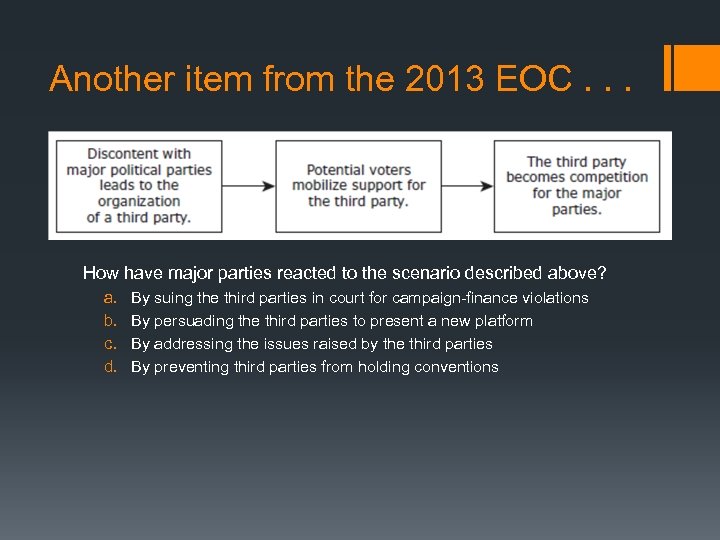
Another item from the 2013 EOC. . . How have major parties reacted to the scenario described above? a. b. c. d. By suing the third parties in court for campaign-finance violations By persuading the third parties to present a new platform By addressing the issues raised by the third parties By preventing third parties from holding conventions
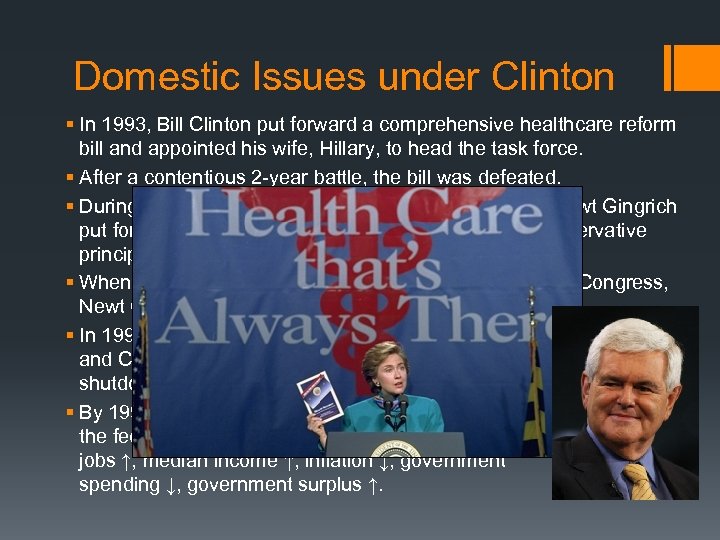
Domestic Issues under Clinton § In 1993, Bill Clinton put forward a comprehensive healthcare reform bill and appointed his wife, Hillary, to head the task force. § After a contentious 2 -year battle, the bill was defeated. § During the 1994 congressional elections, Republican Newt Gingrich put forward the “Contract for America, ” which listed conservative principles outlined by the Heritage Foundation. § When the Republicans won a majority in both houses of Congress, Newt Gingrich became Speaker of the House. § In 1995, after a budget showdown between Gingrich and Clinton, the House Republicans temporarily shutdown the government. § By 1999, the Clinton administration had balanced the federal budget and the economy was growing: jobs ↑, median income ↑, inflation ↓, government spending ↓, government surplus ↑.
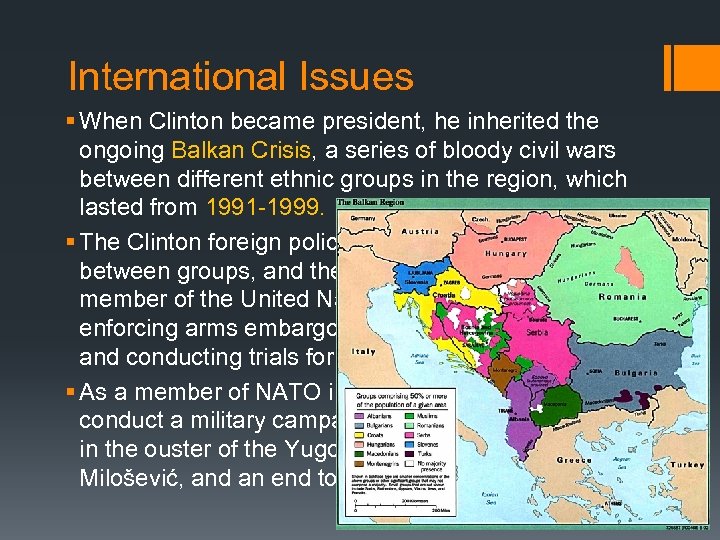
International Issues § When Clinton became president, he inherited the ongoing Balkan Crisis, a series of bloody civil wars between different ethnic groups in the region, which lasted from 1991 -1999. § The Clinton foreign policy team, served to mediate between groups, and the U. S. participated as a member of the United Nations Protection Force, enforcing arms embargos, protecting no-fly zones, and conducting trials for war crimes. § As a member of NATO in 1999, the U. S. helped conduct a military campaign in Kosovo, which ended in the ouster of the Yugoslavian president, Slobodan Milošević, and an end to the civil wars.
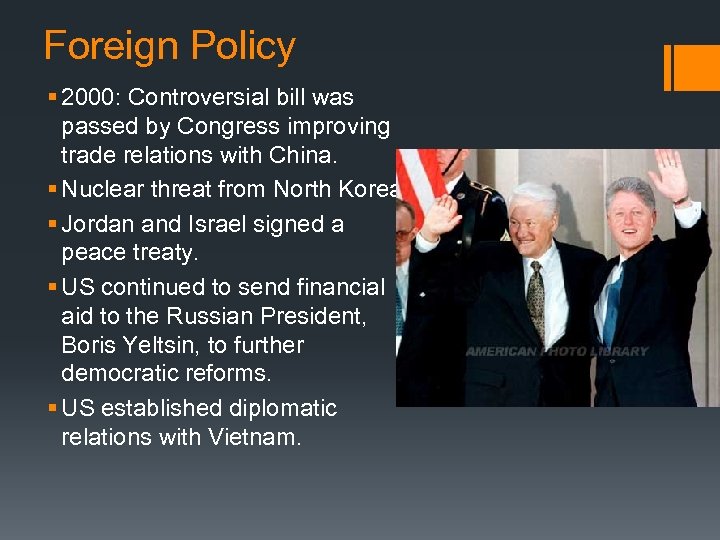
Foreign Policy § 2000: Controversial bill was passed by Congress improving trade relations with China. § Nuclear threat from North Korea. § Jordan and Israel signed a peace treaty. § US continued to send financial aid to the Russian President, Boris Yeltsin, to further democratic reforms. § US established diplomatic relations with Vietnam.
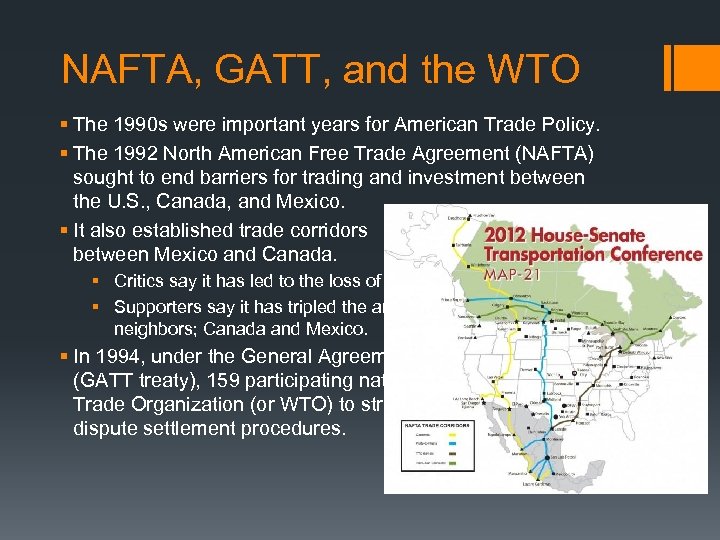
NAFTA, GATT, and the WTO § The 1990 s were important years for American Trade Policy. § The 1992 North American Free Trade Agreement (NAFTA) sought to end barriers for trading and investment between the U. S. , Canada, and Mexico. § It also established trade corridors between Mexico and Canada. § Critics say it has led to the loss of thousands of jobs to Mexico. § Supporters say it has tripled the amount of U. S. trade with its neighbors; Canada and Mexico. § In 1994, under the General Agreement on Tariffs and Trade (GATT treaty), 159 participating nations set up the World Trade Organization (or WTO) to strengthen international dispute settlement procedures.
The Clinton Scandal § In 1998, President Clinton was accused of having an extramarital affair with a White- house intern named Monica Lewinski. § Though he denied it at a hearing while under oath, he was later forced to admit that it was true. § Consequently, the House of Representatives voted to impeach (bring charges against) him for perjury. § In the end, the Senate failed to convict him of the charges, saying that the charges did not constitute “high crimes and misdemeanors” which is the constitutional requirement for impeachment. Clinton was therefore acquitted.
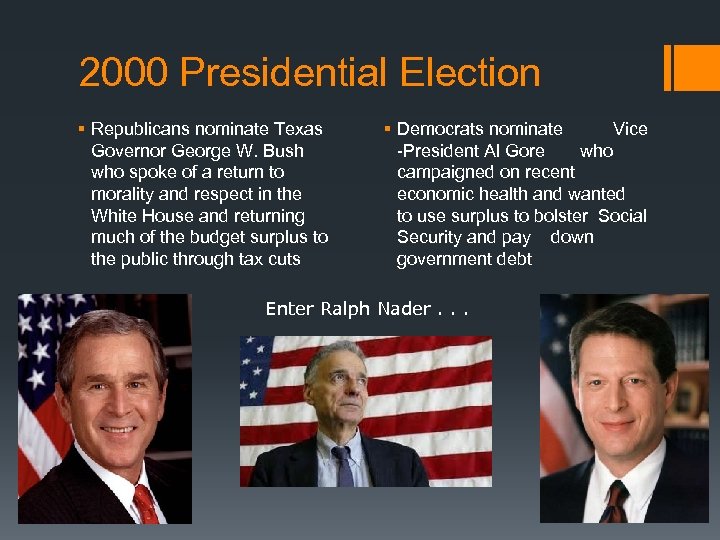
2000 Presidential Election § Republicans nominate Texas Governor George W. Bush who spoke of a return to morality and respect in the White House and returning much of the budget surplus to the public through tax cuts § Democrats nominate Vice -President Al Gore who campaigned on recent economic health and wanted to use surplus to bolster Social Security and pay down government debt Enter Ralph Nader. . .
§ The Green Party nominated liberal consumer advocate Ralph Nader, who likely pulled votes from the liberal conservation-minded Gore
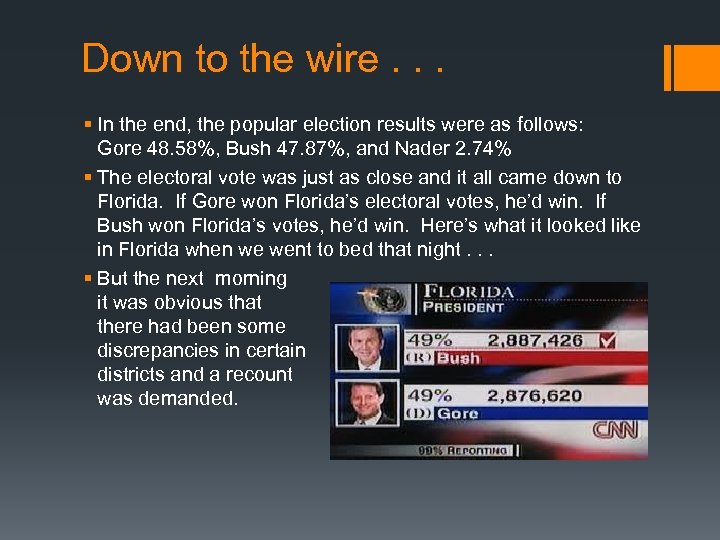
Down to the wire. . . § In the end, the popular election results were as follows: Gore 48. 58%, Bush 47. 87%, and Nader 2. 74% § The electoral vote was just as close and it all came down to Florida. If Gore won Florida’s electoral votes, he’d win. If Bush won Florida’s votes, he’d win. Here’s what it looked like in Florida when we went to bed that night. . . § But the next morning it was obvious that there had been some discrepancies in certain districts and a recount was demanded.
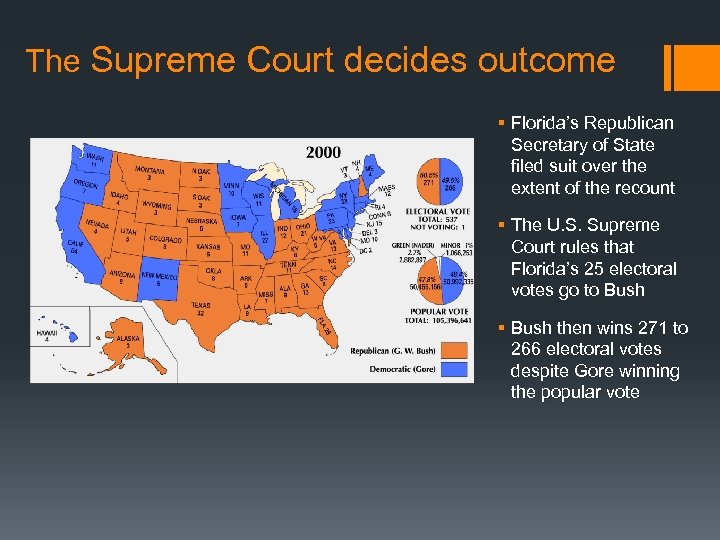
The Supreme Court decides outcome § Florida’s Republican Secretary of State filed suit over the extent of the recount § The U. S. Supreme Court rules that Florida’s 25 electoral votes go to Bush § Bush then wins 271 to 266 electoral votes despite Gore winning the popular vote
George W. Bush Domestic Issues § Bush’s signature piece of domestic legislation is the education reform bill, “No Child Left Behind. ” It provided federal funds to states who raise their standards. § The administration’s response to the levee failure after Hurricane Katrina in 2005 posed great challenges and drew public criticism. § In financial matters, the Bush Administration enacted the biggest tax cut in U. S. history, hoping it will stimulate a slowing economy. § Financial Crisis 2008 -2009: As President Bush’s second term came to an end, the nation’s economy was in a free fall.
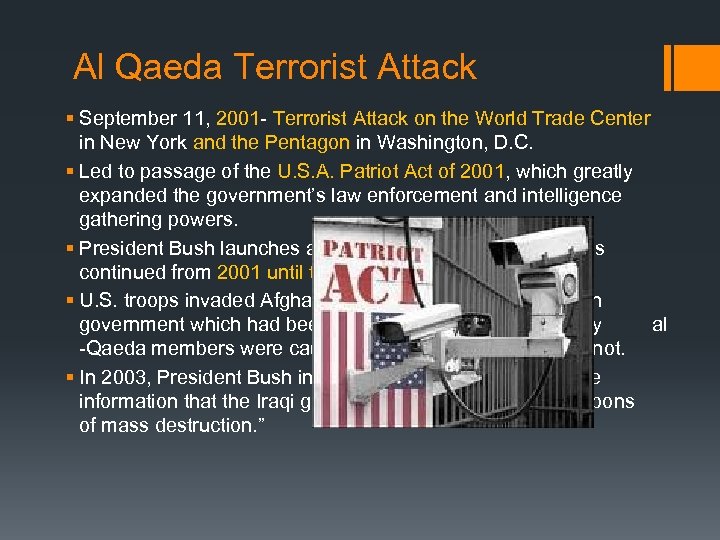
Al Qaeda Terrorist Attack § September 11, 2001 - Terrorist Attack on the World Trade Center in New York and the Pentagon in Washington, D. C. § Led to passage of the U. S. A. Patriot Act of 2001, which greatly expanded the government’s law enforcement and intelligence gathering powers. § President Bush launches a Global War on Terror which has continued from 2001 until today. § U. S. troops invaded Afghanistan and overthrew the Taliban government which had been harboring the terrorists. Many al -Qaeda members were caught but Osama bin Laden was not. § In 2003, President Bush invaded Iraq based on intelligence information that the Iraqi government had developed “weapons of mass destruction. ”
Two items from the 2013 EOC. . . § After the attacks on September 11, 2001, how did U. S. foreign policy change? a. The administration authorized preemptive strikes against nations sponsoring terrorism. b. A program to reduce military bases and personnel in Europe was announced. c. Military aid to Pakistan and Afghanistan was immediately cut off. d. Diplomatic efforts to negotiate peace between Israel and Palestine were abandoned. § Which headline describes an event that resulted from the terrorist attacks on September 11, 2001? a. b. c. d. “Israeli-Palestinian Negotiations Resume” “Debt Crisis Shakes European Union” “Russia Increases Petroleum Exports” “Troops Deployed to Afghanistan”
Domestic Policy § 2002: Congress passed the No Child Left Behind Act bringing more standardized testing to the nation’s public schools. § 2003: Prescription drug bill passed by Congress § Bush repudiated the Kyoto Treaty limiting greenhouse gas emissions that had been negotiated by the Clinton Administration.
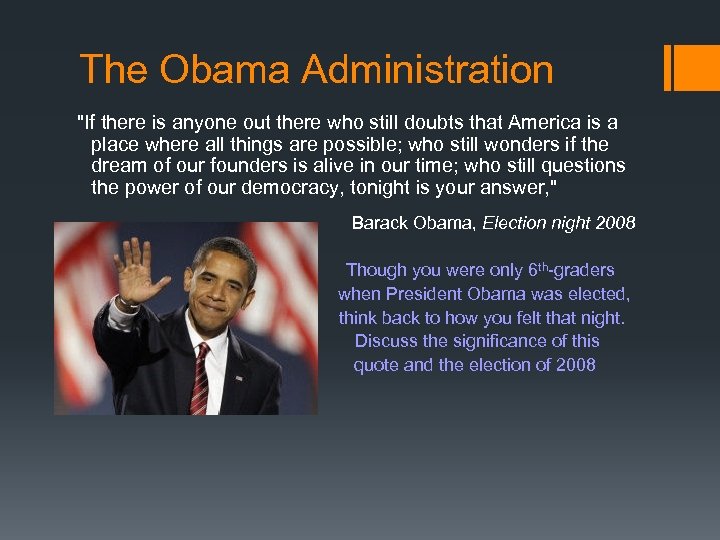
The Obama Administration "If there is anyone out there who still doubts that America is a place where all things are possible; who still wonders if the dream of our founders is alive in our time; who still questions the power of our democracy, tonight is your answer, " Barack Obama, Election night 2008 Though you were only 6 th-graders when President Obama was elected, think back to how you felt that night. Discuss the significance of this quote and the election of 2008
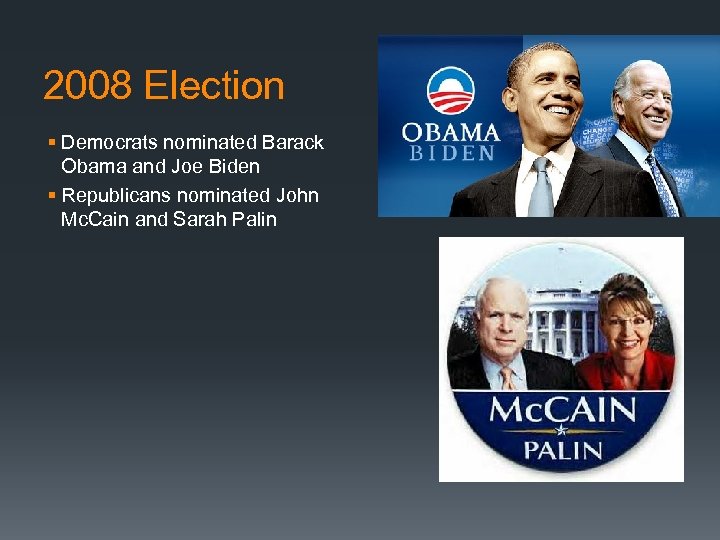
2008 Election § Democrats nominated Barack Obama and Joe Biden § Republicans nominated John Mc. Cain and Sarah Palin
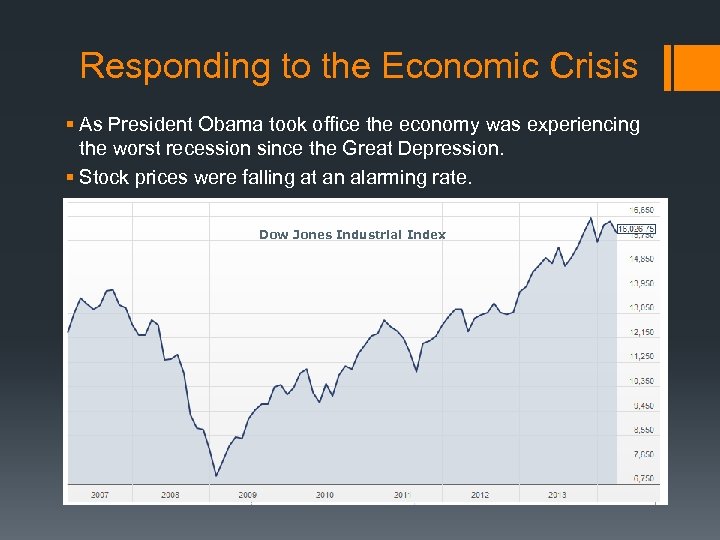
Responding to the Economic Crisis § As President Obama took office the economy was experiencing the worst recession since the Great Depression. § Stock prices were falling at an alarming rate. § American Recovery and Reinvestment Act (ARRA) of 2009 - To respond to the Great Recession, the primary objective for Dow Jones Industrial Index ARRA was to save and create jobs almost immediately. § Secondary objectives were to provide temporary relief programs for those most impacted by the recession and invest in infrastructure, education, health, and renewable energy.
Current Domestic Issues § Comprehensive health care reform has been a goal of many U. S. Presidents since the Progressive Era. § After much debate, the Affordable Care Act was passed and signed by President Obama in March of 2010. § Another major issue that is still under debate is the need for immigration reform. § We have now arrived at the point in our discussion where we are no longer discussing history, but rather the present-day. Congratulations!
Скачать презентацию America at Home and Abroad Late 20 th
f4bc5a4011bb8b635aa9fc81ba524360.ppt