


 Скачать презентацию AMEP Longitudinal Study Employment workplace participation and settlement
7251045f4d9d954fdeca33a64b8f0bda.ppt
- Количество слайдов: 27
 AMEP Longitudinal Study: Employment, workplace participation, and settlement success among recent migrants Charlotte Setijadi, George Major, & Dr Agnes Terraschke Department of Linguistics, Macquarie University 1
 Language training and settlement success • Funded by Department of Immigration and Citizenship • Aims: • Explore language needs of migrants in early settlement: • Language use and needs • How language affects settlement experience • Role of Adult Migrant English Program • → Improve support for migrants 2
 Language training and settlement success: A two phase study • Qualitative, longitudinal, multi-site study • Phase 1: 152 migrants over 1 year • Phase 2: • 60 participants from Phase One (Cohort A) • 85 new participants at AMEP (Cohort B) • Locations: Sydney, Melbourne, Hobart, Adelaide, Launceston, Brisbane, Perth 3
 Language training and settlement success • Data: • • • semi-structured interviews classroom observations teaching and assessment materials out-of-class interactions fieldnotes 4
 This presentation • Report on longitudinal snapshot of Cohort A data from Phase 1 (2009) and Phase 2 (2011) • Focus on migrants’ stories on finding work and their experiences in the workplace: • • General employment trends Patterns of under-, and unemployment Language use at work Workplace socialisation 5
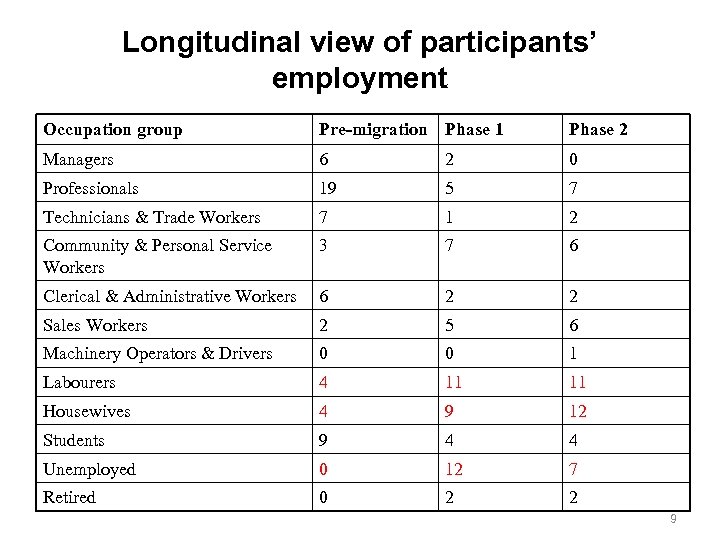
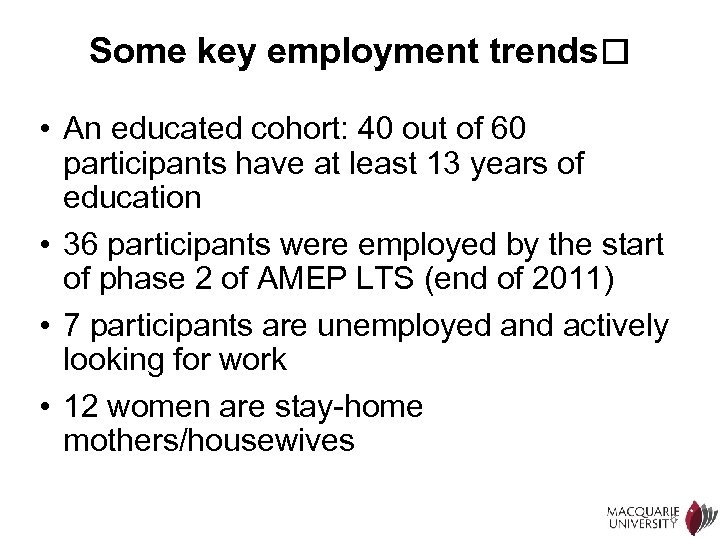 Some key employment trends • An educated cohort: 40 out of 60 participants have at least 13 years of education • 36 participants were employed by the start of phase 2 of AMEP LTS (end of 2011) • 7 participants are unemployed and actively looking for work • 12 women are stay-home mothers/housewives 6
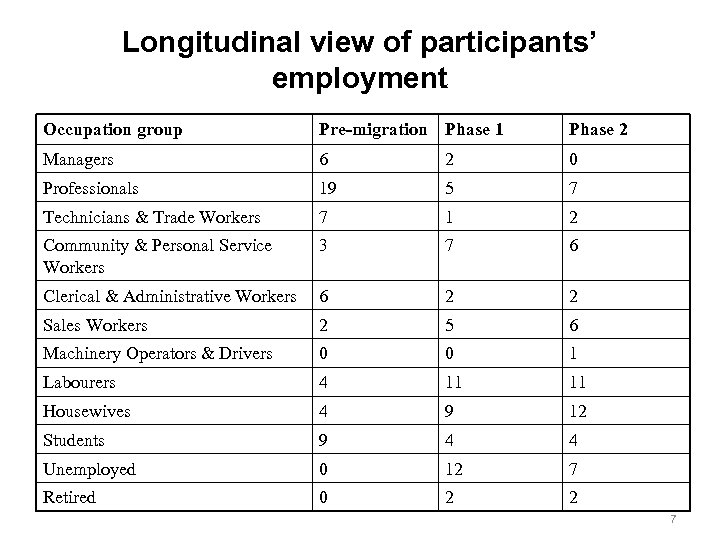 Longitudinal view of participants’ employment Occupation group Pre-migration Phase 1 Phase 2 Managers 6 2 0 Professionals 19 5 7 Technicians & Trade Workers 7 1 2 Community & Personal Service Workers 3 7 6 Clerical & Administrative Workers 6 2 2 Sales Workers 2 5 6 Machinery Operators & Drivers 0 0 1 Labourers 4 11 11 Housewives 4 9 12 Students 9 4 4 Unemployed 0 12 7 Retired 0 2 2 7
 Longitudinal view of participants’ employment Occupation group Pre-migration Phase 1 Phase 2 Managers 6 2 0 Professionals 19 5 7 Technicians & Trade Workers 7 1 2 Community & Personal Service Workers 3 7 6 Clerical & Administrative Workers 6 2 2 Sales Workers 2 5 6 Machinery Operators & Drivers 0 0 1 Labourers 4 11 11 Housewives 4 9 12 Students 9 4 4 Unemployed 0 12 7 Retired 0 2 2 8
 Longitudinal view of participants’ employment Occupation group Pre-migration Phase 1 Phase 2 Managers 6 2 0 Professionals 19 5 7 Technicians & Trade Workers 7 1 2 Community & Personal Service Workers 3 7 6 Clerical & Administrative Workers 6 2 2 Sales Workers 2 5 6 Machinery Operators & Drivers 0 0 1 Labourers 4 11 11 Housewives 4 9 12 Students 9 4 4 Unemployed 0 12 7 Retired 0 2 2 9
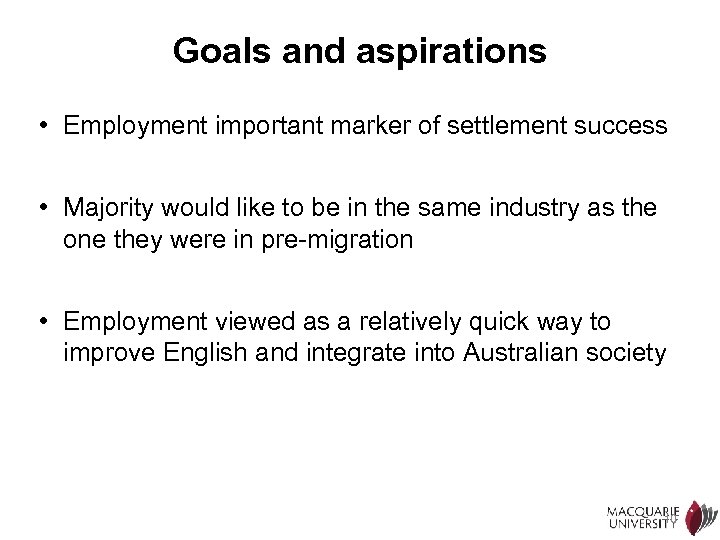 Goals and aspirations • Employment important marker of settlement success • Majority would like to be in the same industry as the one they were in pre-migration • Employment viewed as a relatively quick way to improve English and integrate into Australian society 10
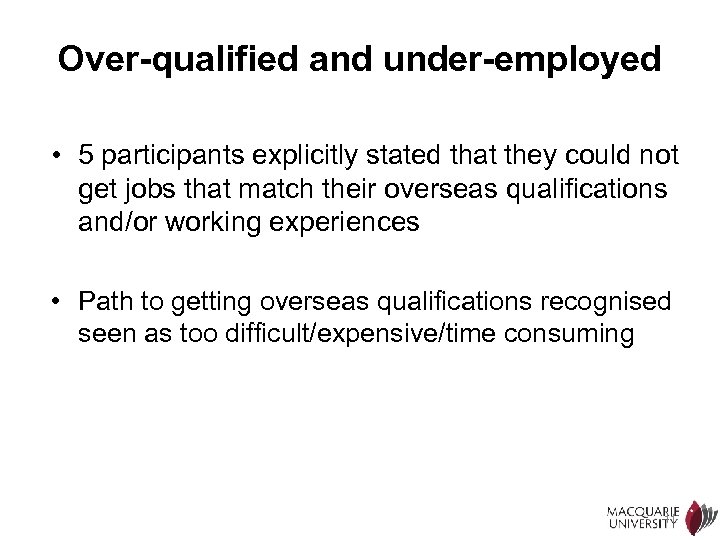 Over-qualified and under-employed • 5 participants explicitly stated that they could not get jobs that match their overseas qualifications and/or working experiences • Path to getting overseas qualifications recognised seen as too difficult/expensive/time consuming 11
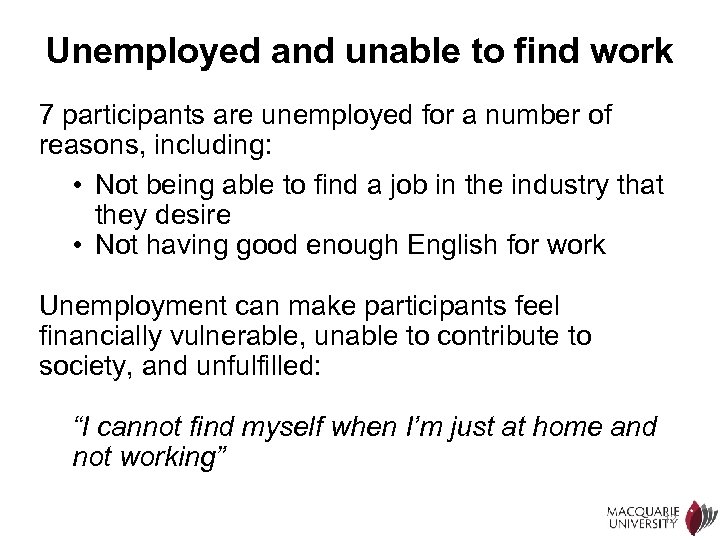 Unemployed and unable to find work 7 participants are unemployed for a number of reasons, including: • Not being able to find a job in the industry that they desire • Not having good enough English for work Unemployment can make participants feel financially vulnerable, unable to contribute to society, and unfulfilled: “I cannot find myself when I’m just at home and not working” 12
 Language at work • Of the participants who were employed at phase 1 (n=32) and phase 2 (n=36): o Three participants work mainly in an L 1 speaking environment 13
 Language at work “I want to find a job in the Aussie shop… Hm because I want change… You know still in Chinese shop I can’t improve myself. I can’t improve my English or that is not for the long time job. So I MUST be change” Lily (Chinese bakery worker) 14
 Language at work • Of the participants who were employed at phase 1 (n=32) and phase 2 (n=36): o Three participants work mainly in an L 1 speaking environment o Four participants work in an English-speaking environment but are able to mainly use their L 1 at work 15
 Language at work “My English is very limited now so, I have to settle with this job” Li Ming (cleaner) Through an interpreter 16
 Language at work • Of the participants who were employed at phase 1 (n=32) and phase 2 (n=36): o Three participants work mainly in an L 1 speaking environment o Four participants work in an English-speaking environment but are able to mainly use their L 1 at work o Most participants speak ONLY English at work 17
 Talking to clients/customers • More participants in phase 2 (69. 44%) interact with customers daily than in phase 1 (43. 75%) • Some have only very minor interactions with customers – either because of the nature of the job or because they are actively discouraged from talking with clients 18
 Talking to clients/customers “One thing might be my English, yeah. Like, um, it might make his shop look unprofessional, because - but, yeah, but still, I think many reason, but it's one of the reason that, I think because the owner doesn't - because I can do everything. If I have money, I can open my own”. Lisa (dog groomer) 19
 Talking to clients/customers • More participants in phase 2 (69. 44%) interact with customers daily than in phase 1 (43. 75%) • Some have only very minor interactions with customers – either because of the nature of the job or because they are actively discouraged from talking with clients • Others describe positive experiences about gaining the confidence to talk with customers 20
 Talking to clients/customers “And now I'm giving them whatever they want and talking to them, ‘How is your day’? ‘Where you come from’? ‘Do you stay in hotel’? ‘How are you doing’? ‘Have you seen Opera House in Sydney’? I start to chat and talk with people”. Kamran (hotel worker) 21
 Workplace socialisation • Establishing relationships with colleagues can be a very important part of the workplace experience • Workplace socialisation was explicitly discussed by 11 participants in phase 1, and 21 participants in phase 2 • 3 participants (all in phase 2) mentioned little or no opportunity for socialisation • 8 participants in phase 1 and 13 in phase 2 describe positive experiences 22
 Workplace socialisation “I like abouts when I got the good friend and we can talk, we can laugh. I'm proud of myself. I'm not a good English but the way I can make a joke to make them all laughing and then the way they're laughing like before start or break time, I feel happy more than them”. Tat (chicken factory worker) 23
 Summary • Finding employment is a crucial milestone for migrants: gateway to Australian society • Restricted access to work due to: • English proficiency • Unrecognised qualifications • Participants often have to adapt their employment aspirations • Some participants have limited opportunities to use English at work and socialise with colleagues 24
 Summary • Majority work in English speaking contexts • By 2011, more participants: • were employed • had direct contact with customers (using English) • Despite facing a range of issues regarding communication in the workplace, many participants report having positive experiences with: a) gaining confidence in talking to customers b) socialising with colleagues 25
 Thanks to all our participants and to the research team: • Ingrid Piller • Pam Mc. Pherson • Lynda Yates • Kerry Taylor-Leech • Donna Butorac • Charlotte Setijadi • John Ehrich • Agnes Terraschke • Laura Ficorilli • Alan Williams • Sun Hee Ok Kim • Vera Williams Tetteh • Loy Lising • Beth Zielinski • George Major 26
 Email: charlotte. setijadi@mq. edu. au georgina. major@mq. edu. au agnes. terraschke@mq. edu. au 27