 Скачать презентацию Ambulatory Care at Macmillan Cancer Centre University College
270825ce41dbef14a33f895ffc77d72e.ppt
- Количество слайдов: 21



Ambulatory Care at Macmillan Cancer Centre, University College London Hospital October 2015 Diana Comerford RGN Ambulatory Care Clinical Lead University College London Hospitals NHS Foundation Trust
What is Ambulatory Care (AC)? l l l An extension of inpatient services Healthcare service without overnight hospital stay Patients receive same treatment administered in inpatient setting Reside at Cotton Rooms (UCLH Hotel), other local hotel, or at home Patients attend AC daily for treatment or assessment, located next to Chemo Day Care service
Brief History l l l l Opened in 2005 with two side rooms and one Band 6 and one Band 7 nurse, treating two patients 2 blocked inpatient beds ESHAP mainly, conservative treatment Local hotel with installed panic alarms Cost pressure until proven safe £ 130 hotel stay vs £ 700 per night hospital stay Consultant buy in Slowly increased capacity with demand
AC at Present l l l l 6 chairs+6 side rooms, 15 -22 patients daily 4 experienced haem/onc nurses 1 potentially blocked inpatient bed All white cell regimes w. exception of 1 st AML cycle, or high risk relapse patients, sarcoma regimes LEAM/BEAM/Melphalan Autograft Low Intensity Allograft Remain in AC if clinically well No capacity at times
AC Operational Management l l l l Open from 0800 -1900 Electronic appointment system (File. Maker Pro) Patients assessed daily by nurses using NCI CTC (2003) scoring system, obs. , bloods, etc. Nurse-Led service Doctor review if required Twice weekly ward round with Consultants Patients/carers have 24 hr access to AC mobile number for advice Panic alarm installed in hotel rooms
AC Operational Management l l Hotel provides breakfast (+fridge, microwave in common area, tea/coffee making facilities, washer/dryer for clothes) Food vouchers One AC bed inpatient for emergencies Aim for all admissions during AC operating hours
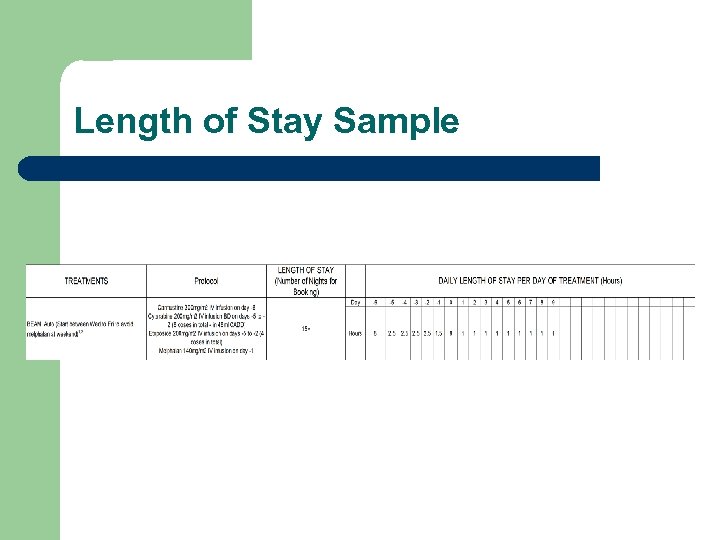
Length of Stay Sample
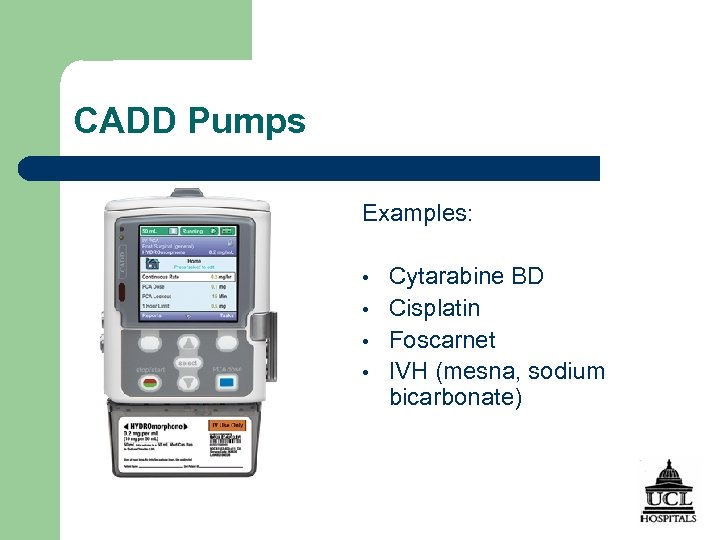
CADD Pumps Examples: • • Cytarabine BD Cisplatin Foscarnet IVH (mesna, sodium bicarbonate)
AC Patient Eligibility Criteria • • 25 years old and above (TYA service available) Patient Consent Patient or Carer must speak English Those with limited mobility must have a carer Mobile phone Thermometer (provided by us) Compliant with care and medications Have an address to be discharged to
AC at Home l Consultant agreement Lives within 60 minute travel time Carer available to drive patient Live near local hospital (30 -45 minutes) l Complexities of AC at Home l l l – – – No parking Missing ward rounds Late night issues with infusion pumps
House Rules l l Must pick up phone at all times Take own medication and temperature Call if unwell, temperature, uncontrolled diarrhoea/nausea/vomiting Show up on time
Why Use AC? l l l Patient freedom and independence Sense of control Earlier discharge compared to inpatients – l l (data available) Privacy Better food choices Valuable family time Financial savings
Safety Considerations l l AC chat and sign Who uses side rooms (allo/infectious patients) Teaching of CADD pumps, spillage kits, CADD record of infusion Who cares for patients out-of-hours? – – 24 hour advice phone Medical notes to ward
Total AC Hospital Transfers n =116 • 13 Out-of-hours transfers to hospital (11%) • More than one factor/patient contributing to transfer • 5 major reasons for admission - febrile neutropenia - anxiety - GI symptoms - stem cell reaction - multiple infusion requirements
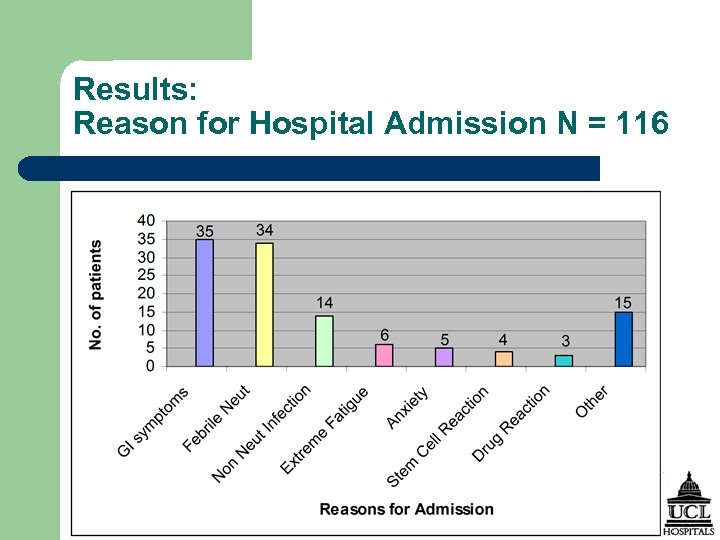
Results: Reason for Hospital Admission N = 116
Staff Experience l l l Continuity of care in an outpatient setting New learning experiences Experienced nurses with inpatient knowledge Training nurses and a small service Skill mix and staffing difficulties
Patient and Carer Questionnaires l l l Empowering experience for patients / carers Allows formation of working partnerships with healthcare professionals Opportunity to become more involved in care ↑ in patient’s general morale Allows for more ‘normality’
What Next? l l l Merging haematology services with Royal Free NHS Trust Increase chair and bed spaces (10+6) Restructuring our diary and nursing team Pushing for chemistry analyser specifically for Cancer Centre Increase AC at home Utilising UCLH at Home
How AC could work for you? l l l AC at home Utilising district nurses Working with a primary care centre

Questions?
Contact details Diana Comerford Ambulatory care cancer services Univeristy College Hospital Macmillan Cancer Centre 2 nd floor, Huntley Street London, WC 1 E 6 AG +44 7946 535 703 diana. comerford@uclh. nhs. uk
Скачать презентацию Ambulatory Care at Macmillan Cancer Centre University College
270825ce41dbef14a33f895ffc77d72e.ppt