 Скачать презентацию Ambient Intelligence through Ontologies Vassileios Tsetsos b tsetsos di
a2f0a4a75f878dce06f99fb0026aed98.ppt
- Количество слайдов: 33



Ambient Intelligence through Ontologies Vassileios Tsetsos b. tsetsos@di. uoa. gr P-comp Research Group http: //p-comp. di. uoa. gr
What is an ontology? n n n A formal, explicit specification of a shared conceptualization. (Studer 1998, original definition by Gruber in 1993) Formal: it is machine-readable Explicit specification: it explicitly defines concepts, relations, attributes and constraints Shared: it is accepted by a group Conceptualization: an abstract model of a phenomenon
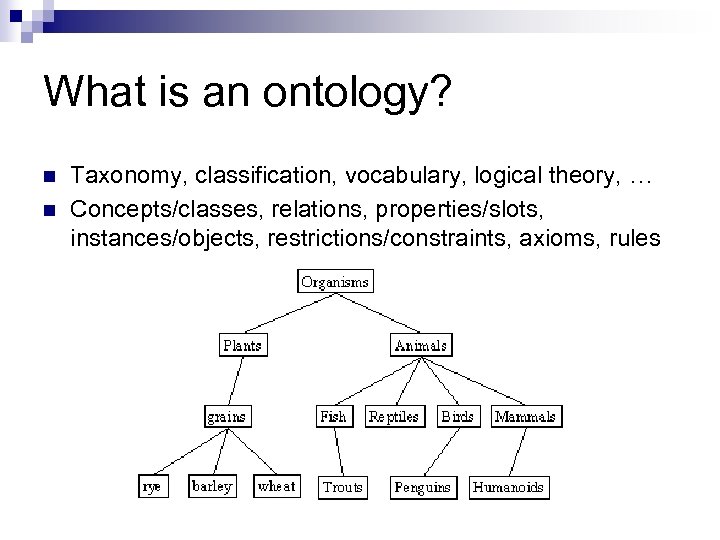
What is an ontology? n n Taxonomy, classification, vocabulary, logical theory, … Concepts/classes, relations, properties/slots, instances/objects, restrictions/constraints, axioms, rules
Heavyweight vs. Lightweight n n They differ in expressiveness, reasoning capabilities, complexity, decidability. Lightweight ¨ n Heavyweight ¨ n n E-R diagrams, UML Description Logics, frames, first order logic There are W 3 C standards for each case (RDF, RDF Schema, OWL) We should choose carefully!
Types of Ontologies (1) n Upper Level Ontologies ¨ Describe very general concepts. ¨ SUO (IEEE Standard Upper Ontology) n KR Ontologies ¨ Representation primitives => Semanticallydescribed grammars of ontology languages. ¨ OKBC, OWL KR, RDF Schema KR
Types of Ontologies (2) n Domain Ontologies ¨ Are specializations of Upper Level Ontologies, reusable in a given domain (e. g. , a generic ontology for smart environments) ¨ Unified Medical Language System (UMLS) n Application Ontologies ¨ They model all the knowledge required for a particular application (e. g. , an ontology for a specific smart classroom)
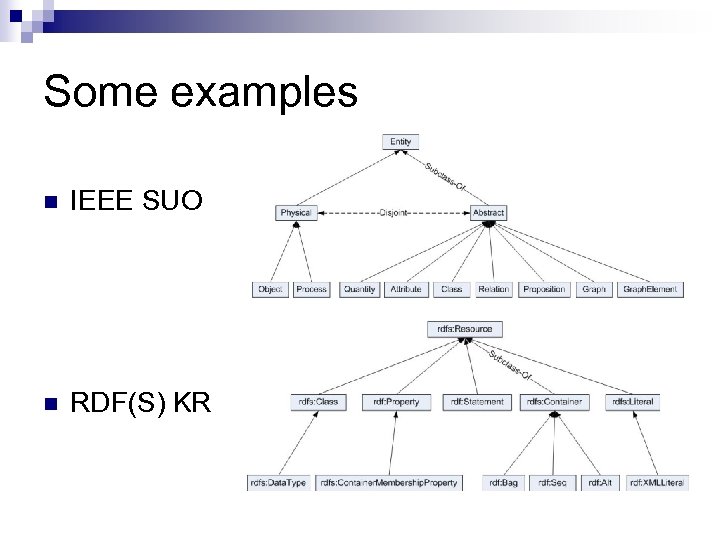
Some examples n IEEE SUO n RDF(S) KR
Many advantages n n Provide formal model descriptions that allow reasoning They support common queries: Queries about the truth of statements (Is there a printer in room I 9? ) ¨ Queries expecting an object to be returned (Where is John? ) ¨ n n n Are quite scalable (especially Semantic Web ones) Provide interoperability as they are agreed by a community (…at least this should be the case!) SW ontology languages are XML-based => XML advantages ¨ have been standardized and are widely used ¨ n …
Pervasive Computing (PC) n Computing paradigm that envisages: ¨ Ubiquitous networking and service access ¨ Intelligence ¨ Intuitive HCI ¨ Context-awareness ¨ Seamless interoperation between heterogeneous agents ¨ Privacy and Security ¨…
Ontology applications in PC n Context modeling & reasoning ¨ Context ontologies (location, time) which define structure and properties of contextual information n Semantic Web Services ¨ Semantic description => automated discovery and matchmaking, composition, invocation, … n n Semantic interoperability between heterogeneous systems (e. g. , agents) through a shared set of concepts Security and trust
Some “PC+Ontologies” projects Co. Br. A n SOUPA n Gaia n Other n
Co. Br. A (1) n e. Biquity Research Group, UMBC ¨ n n http: //ebiquity. umbc. edu A broker-centric agent architecture that aims to reduce the cost and difficulties in building pervasive contextaware systems. In this architecture, a Context Broker is responsible to: Acquire & maintain contexts on the behalf of resource-poor devices & agents ¨ Enable agents to contribute to and access a shared model of contexts ¨ Allow users to use policy to control the access of their personal information ¨
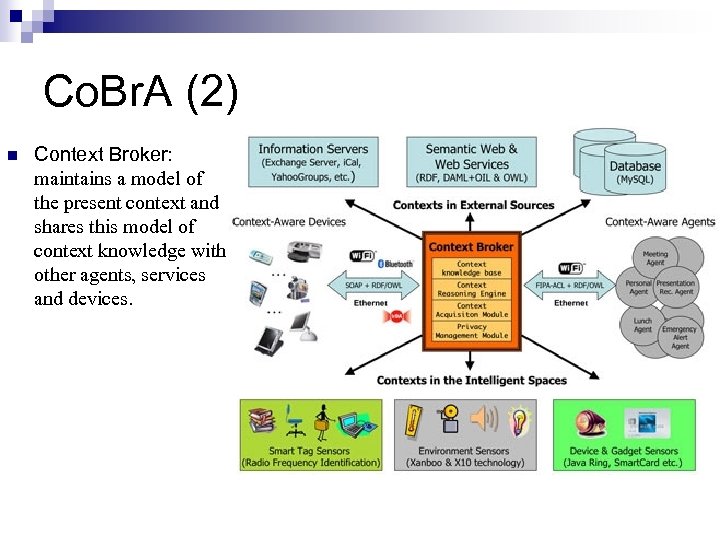
Co. Br. A (2) n Context Broker: maintains a model of the present context and shares this model of context knowledge with other agents, services and devices.
Co. Br. A ontologies A set of ontologies that specialize the SOUPA Ontology. n They model the context and the processes of pervasive environments. n E. g. , Co. Br. A Place n ¨ models different types of “Place” on a university campus
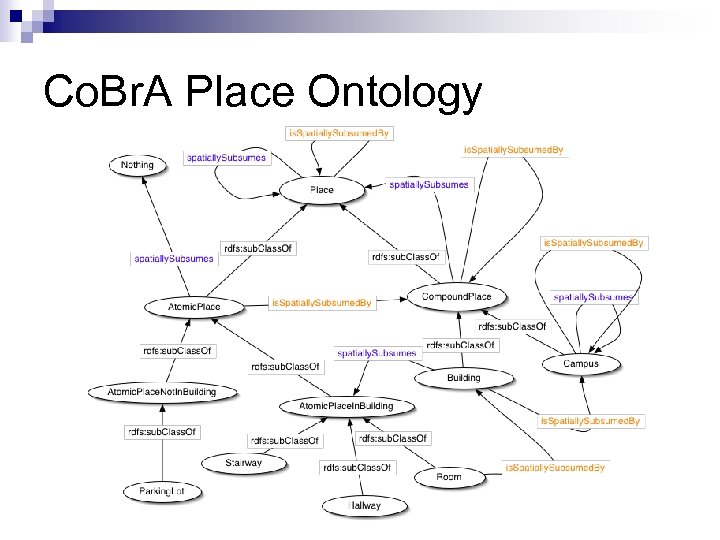
Co. Br. A Place Ontology
SOUPA (1) n Standard Ontology for Ubiquitous and Pervasive Applications (SOUPA) ¨ e. Biquity @ UMBC, http: //pervasive. semanticweb. org ¨ Written in OWL
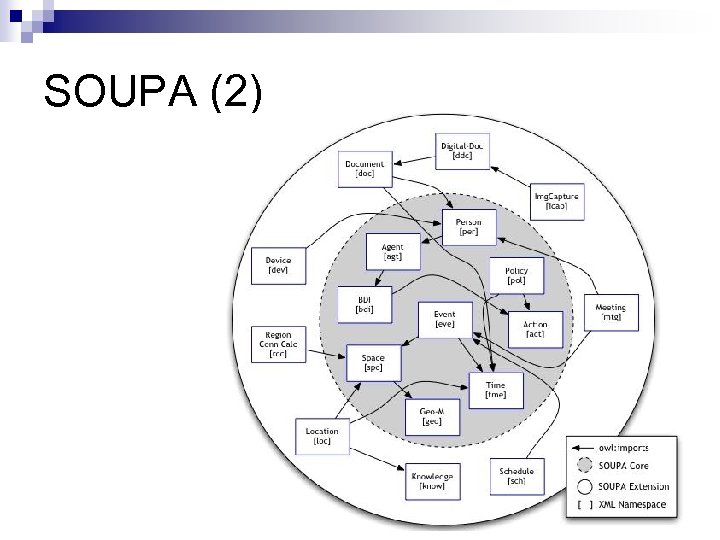
SOUPA (2)
Gaia (1) A PC infrastructure for smart spaces n CORBA-based middleware for the management of Spaces n Ontologies written in DAML+OIL n
Gaia (2) n n Ontology Server: definitions of terms, descriptions of agents and meta-information about context available in a Space Checks ontology consistency and provides maintenance Semantic interoperability is performed through the common adoption of the same ontologies by all agents Ontologies also help the developer to write inference rules or machine learning code in a generic way
Other uses of ontologies in Gaia n Configuration management ¨ ¨ n Semantic discovery with a Fa. CT Server ¨ n Semantic queries involve subsumption and classification of concepts Context modeling ¨ ¨ ¨ n New unknown entities may enter a Space In earlier version: scripts & ad hoc configuration files Context is modeled as predicates e. g. , temperature (room 3, ”-”, 98 F) Ontologies describe the type and values of predicate arguments Context-sensitive behavior ¨ The developers can specify the behavior of the applications under certain contextual conditions through the supported ontologies.
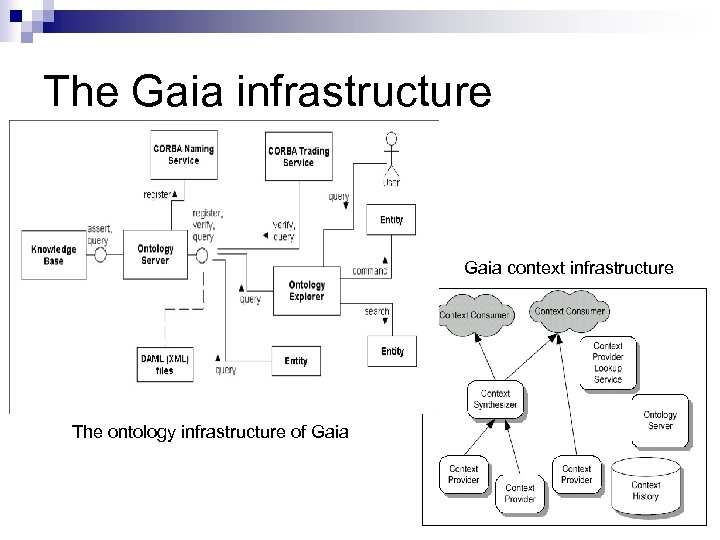
The Gaia infrastructure Gaia context infrastructure The ontology infrastructure of Gaia
CONON: The context ontology n Extensible ontology comprised of: ¨ Upper Level Ontology ¨ Specific Ontology n n n Written in OWL Enables DL reasoning (subsumption, consistency, instance checking, implicit context from explicit context) with OWL-Lite axioms Enables First Order Logic reasoning (inference of higher level context) with user-defined rules
Trust SW entails a Web of Trust n PC requires ad-hoc soft-security models n Ontologies can model semantic networks of trusted entities and allow trust inference n Ontologies are used for the definition of (rule-based) Policy Languages n ¨ Rei, KAo. S
Trust inference n n Directly connected nodes have known trust values Trust for not directly connected nodes can be inferred with several algorithms: ¨ Maximum and minimum capacity paths (~ the range of trust given by neighbors of X to Y) ¨ Maximum and minimum length paths (~ how “far” is Y from X? ) ¨ Weighted average (~ recommended trust value for X to Y). It is a very complex algorithm!!! Why?
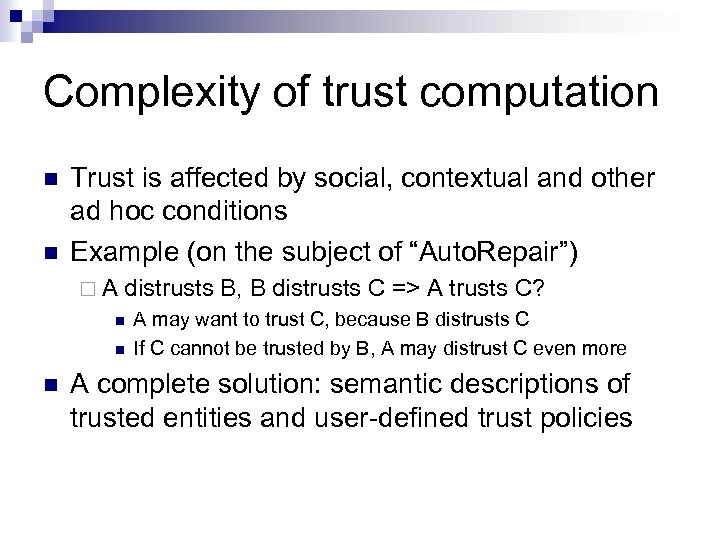
Complexity of trust computation n n Trust is affected by social, contextual and other ad hoc conditions Example (on the subject of “Auto. Repair”) ¨A distrusts B, B distrusts C => A trusts C? n n n A may want to trust C, because B distrusts C If C cannot be trusted by B, A may distrust C even more A complete solution: semantic descriptions of trusted entities and user-defined trust policies
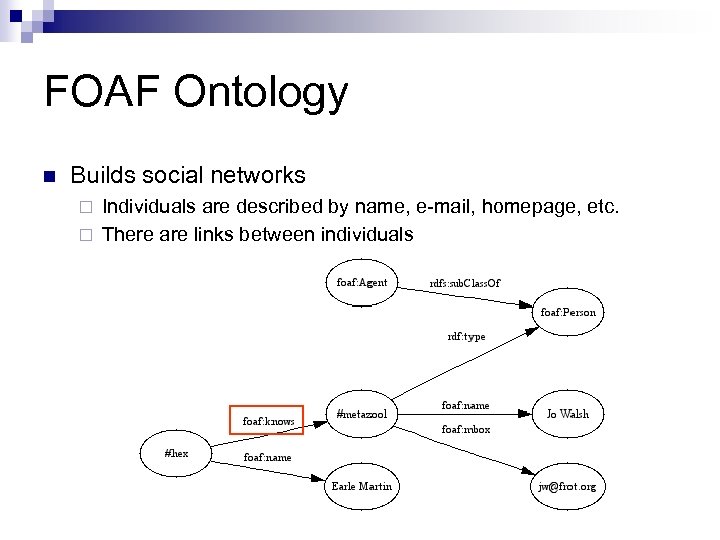
FOAF Ontology n Builds social networks Individuals are described by name, e-mail, homepage, etc. ¨ There are links between individuals ¨
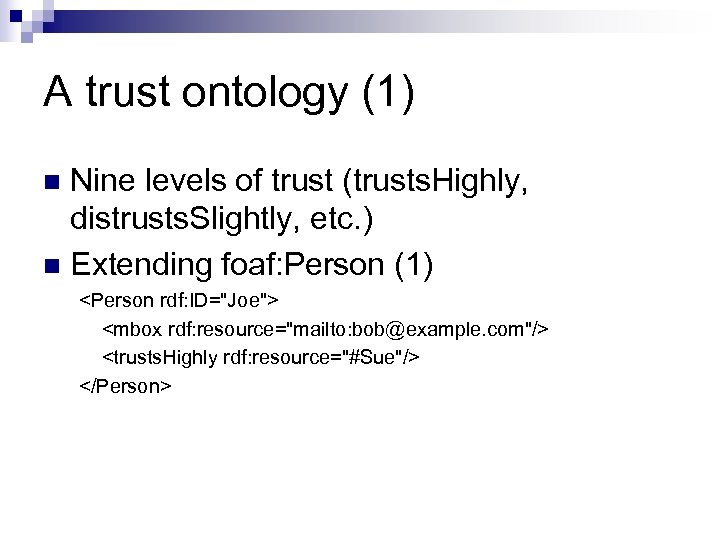
A trust ontology (1) Nine levels of trust (trusts. Highly, distrusts. Slightly, etc. ) n Extending foaf: Person (1) n <Person rdf: ID="Joe"> <mbox rdf: resource="mailto: bob@example. com"/> <trusts. Highly rdf: resource="#Sue"/> </Person>
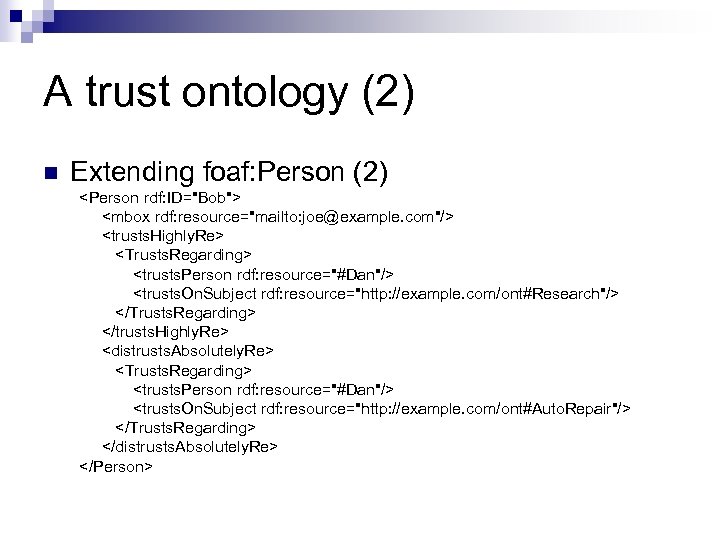
A trust ontology (2) n Extending foaf: Person (2) <Person rdf: ID="Bob"> <mbox rdf: resource="mailto: joe@example. com"/> <trusts. Highly. Re> <Trusts. Regarding> <trusts. Person rdf: resource="#Dan"/> <trusts. On. Subject rdf: resource="http: //example. com/ont#Research"/> </Trusts. Regarding> </trusts. Highly. Re> <distrusts. Absolutely. Re> <Trusts. Regarding> <trusts. Person rdf: resource="#Dan"/> <trusts. On. Subject rdf: resource="http: //example. com/ont#Auto. Repair"/> </Trusts. Regarding> </distrusts. Absolutely. Re> </Person>
Current and future work in P-comp Semantic Web Services n Description Logics n Location modeling n Tools survey and experimentation n Meta-information for sensor data n Ontologies for medical applications n Any ideas? ? ? n
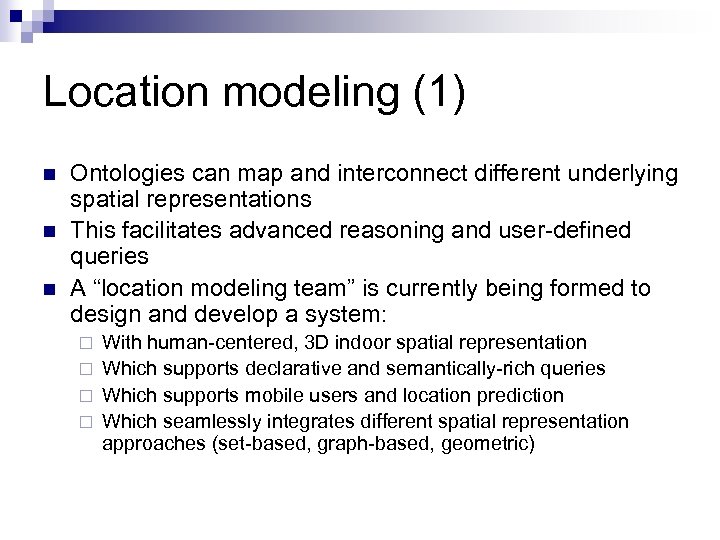
Location modeling (1) n n n Ontologies can map and interconnect different underlying spatial representations This facilitates advanced reasoning and user-defined queries A “location modeling team” is currently being formed to design and develop a system: With human-centered, 3 D indoor spatial representation ¨ Which supports declarative and semantically-rich queries ¨ Which supports mobile users and location prediction ¨ Which seamlessly integrates different spatial representation approaches (set-based, graph-based, geometric) ¨
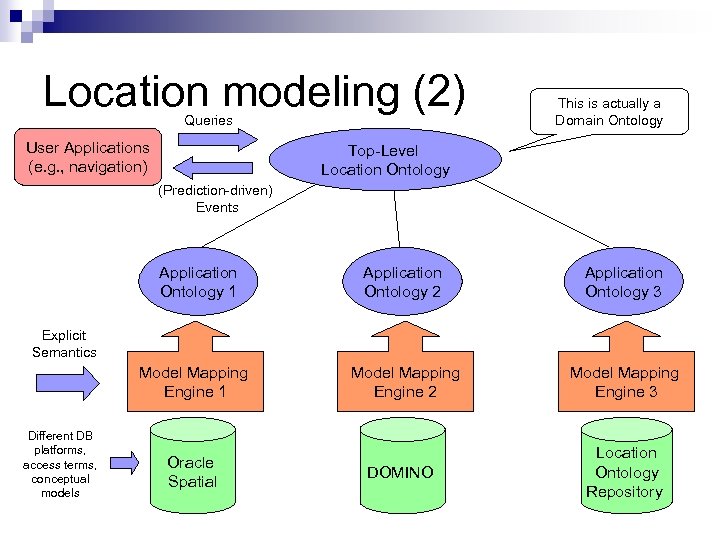
Location modeling (2) Queries User Applications (e. g. , navigation) This is actually a Domain Ontology Top-Level Location Ontology (Prediction-driven) Events Application Ontology 1 Application Ontology 2 Application Ontology 3 Model Mapping Engine 2 Model Mapping Engine 3 Explicit Semantics Model Mapping Engine 1 Different DB platforms, access terms, conceptual models Oracle Spatial DOMINO Location Ontology Repository
Some open research issues n n Can they efficiently model sensor data? Will the introduction of Probability elements improve their effectiveness? If yes, how can this be implemented? Development of user-friendly tools and powerful & efficient reasoners Automated ontology generation/extraction and easy ontology maintenance
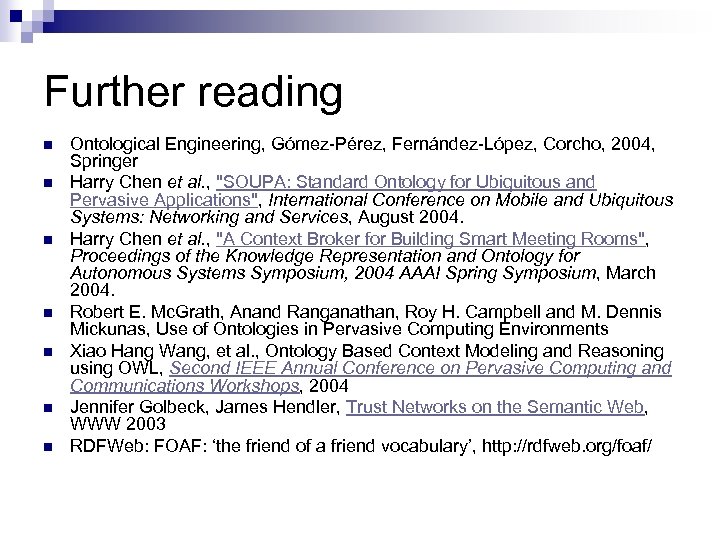
Further reading n n n n Ontological Engineering, Gómez-Pérez, Fernández-López, Corcho, 2004, Springer Harry Chen et al. , "SOUPA: Standard Ontology for Ubiquitous and Pervasive Applications", International Conference on Mobile and Ubiquitous Systems: Networking and Services, August 2004. Harry Chen et al. , "A Context Broker for Building Smart Meeting Rooms", Proceedings of the Knowledge Representation and Ontology for Autonomous Systems Symposium, 2004 AAAI Spring Symposium, March 2004. Robert E. Mc. Grath, Anand Ranganathan, Roy H. Campbell and M. Dennis Mickunas, Use of Ontologies in Pervasive Computing Environments Xiao Hang Wang, et al. , Ontology Based Context Modeling and Reasoning using OWL, Second IEEE Annual Conference on Pervasive Computing and Communications Workshops, 2004 Jennifer Golbeck, James Hendler, Trust Networks on the Semantic Web, WWW 2003 RDFWeb: FOAF: ‘the friend of a friend vocabulary’, http: //rdfweb. org/foaf/
Скачать презентацию Ambient Intelligence through Ontologies Vassileios Tsetsos b tsetsos di
a2f0a4a75f878dce06f99fb0026aed98.ppt