 Скачать презентацию AMBER — A novel non-invasive approach to direct
4141725bc1fe593dad53afa5c84753a3.ppt
- Количество слайдов: 1



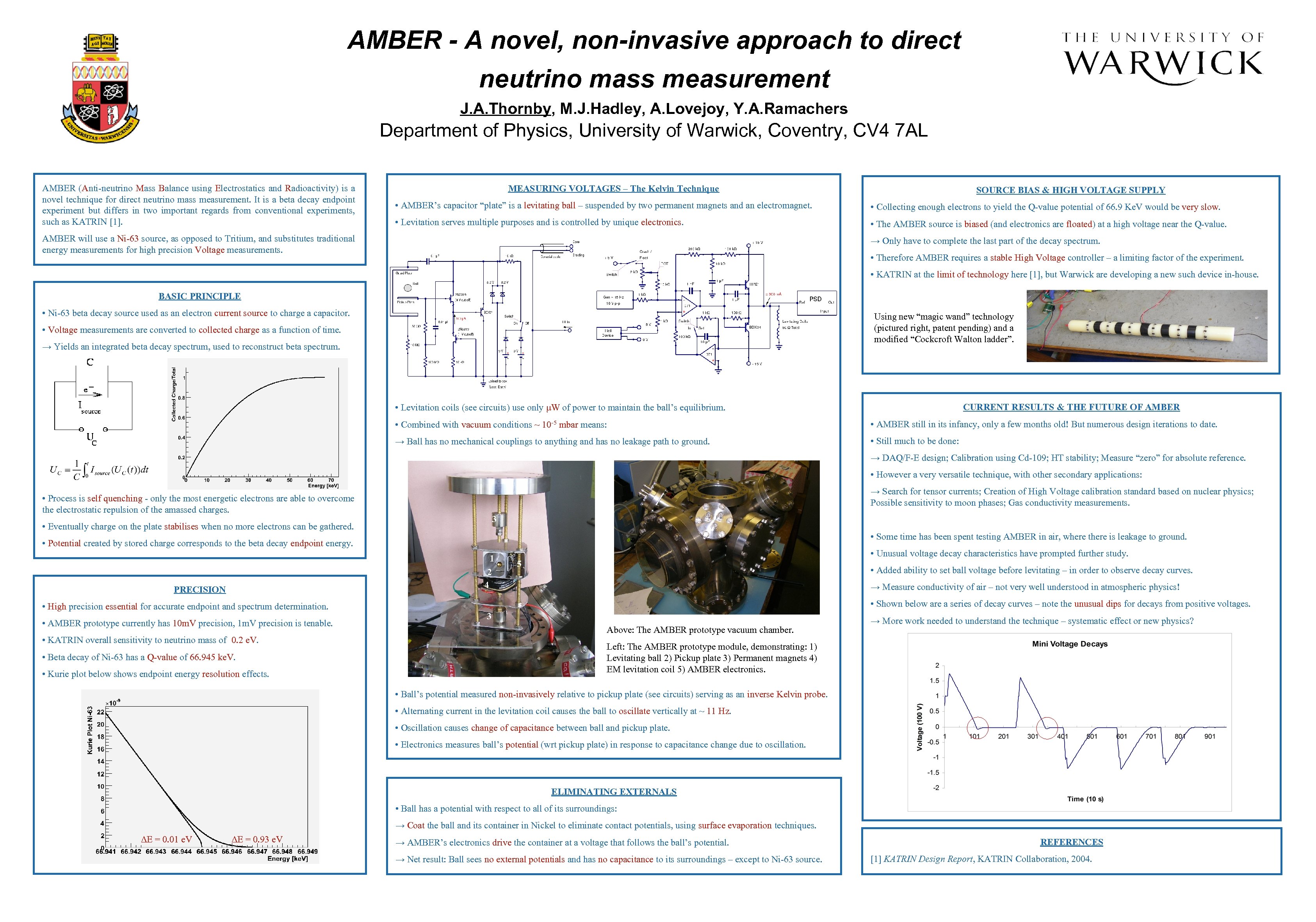
AMBER - A novel, non-invasive approach to direct neutrino mass measurement J. A. Thornby, M. J. Hadley, A. Lovejoy, Y. A. Ramachers Department of Physics, University of Warwick, Coventry, CV 4 7 AL AMBER (Anti-neutrino Mass Balance using Electrostatics and Radioactivity) is a novel technique for direct neutrino mass measurement. It is a beta decay endpoint experiment but differs in two important regards from conventional experiments, such as KATRIN [1]. MEASURING VOLTAGES – The Kelvin Technique SOURCE BIAS & HIGH VOLTAGE SUPPLY • AMBER’s capacitor “plate” is a levitating ball – suspended by two permanent magnets and an electromagnet. • Collecting enough electrons to yield the Q-value potential of 66. 9 Ke. V would be very slow. • Levitation serves multiple purposes and is controlled by unique electronics. • The AMBER source is biased (and electronics are floated) at a high voltage near the Q-value. AMBER will use a Ni-63 source, as opposed to Tritium, and substitutes traditional energy measurements for high precision Voltage measurements. → Only have to complete the last part of the decay spectrum. • Therefore AMBER requires a stable High Voltage controller – a limiting factor of the experiment. • KATRIN at the limit of technology here [1], but Warwick are developing a new such device in-house. BASIC PRINCIPLE • Ni-63 beta decay source used as an electron current source to charge a capacitor. Using new “magic wand” technology (pictured right, patent pending) and a modified “Cockcroft Walton ladder”. • Voltage measurements are converted to collected charge as a function of time. → Yields an integrated beta decay spectrum, used to reconstruct beta spectrum. CURRENT RESULTS & THE FUTURE OF AMBER • Levitation coils (see circuits) use only μW of power to maintain the ball’s equilibrium. • Combined with vacuum conditions ~ 10 -5 mbar means: • AMBER still in its infancy, only a few months old! But numerous design iterations to date. → Ball has no mechanical couplings to anything and has no leakage path to ground. • Still much to be done: → DAQ/F-E design; Calibration using Cd-109; HT stability; Measure “zero” for absolute reference. • However a very versatile technique, with other secondary applications: → Search for tensor currents; Creation of High Voltage calibration standard based on nuclear physics; Possible sensitivity to moon phases; Gas conductivity measurements. • Process is self quenching - only the most energetic electrons are able to overcome the electrostatic repulsion of the amassed charges. 3 • Eventually charge on the plate stabilises when no more electrons can be gathered. • Some time has been spent testing AMBER in air, where there is leakage to ground. • Potential created by stored charge corresponds to the beta decay endpoint energy. 1 2 4 PRECISION • High precision essential for accurate endpoint and spectrum determination. • AMBER prototype currently has 10 m. V precision, 1 m. V precision is tenable. • KATRIN overall sensitivity to neutrino mass of 0. 2 e. V. • Beta decay of Ni-63 has a Q-value of 66. 945 ke. V. • Kurie plot below shows endpoint energy resolution effects. • Unusual voltage decay characteristics have prompted further study. 5 • Added ability to set ball voltage before levitating – in order to observe decay curves. → Measure conductivity of air – not very well understood in atmospheric physics! • Shown below are a series of decay curves – note the unusual dips for decays from positive voltages. 3 Above: The AMBER prototype vacuum chamber. → More work needed to understand the technique – systematic effect or new physics? Left: The AMBER prototype module, demonstrating: 1) Levitating ball 2) Pickup plate 3) Permanent magnets 4) EM levitation coil 5) AMBER electronics. • Ball’s potential measured non-invasively relative to pickup plate (see circuits) serving as an inverse Kelvin probe. • Alternating current in the levitation coil causes the ball to oscillate vertically at ~ 11 Hz. • Oscillation causes change of capacitance between ball and pickup plate. • Electronics measures ball’s potential (wrt pickup plate) in response to capacitance change due to oscillation. ELIMINATING EXTERNALS • Ball has a potential with respect to all of its surroundings: → Coat the ball and its container in Nickel to eliminate contact potentials, using surface evaporation techniques. ΔE = 0. 01 e. V ΔE = 0. 93 e. V → AMBER’s electronics drive the container at a voltage that follows the ball’s potential. → Net result: Ball sees no external potentials and has no capacitance to its surroundings – except to Ni-63 source. REFERENCES [1] KATRIN Design Report, KATRIN Collaboration, 2004.
Скачать презентацию AMBER — A novel non-invasive approach to direct
4141725bc1fe593dad53afa5c84753a3.ppt