 Скачать презентацию Am I Free to be Me Intended Audience
339e76cbf28e312ccde779a100a1ec86.ppt
- Количество слайдов: 10



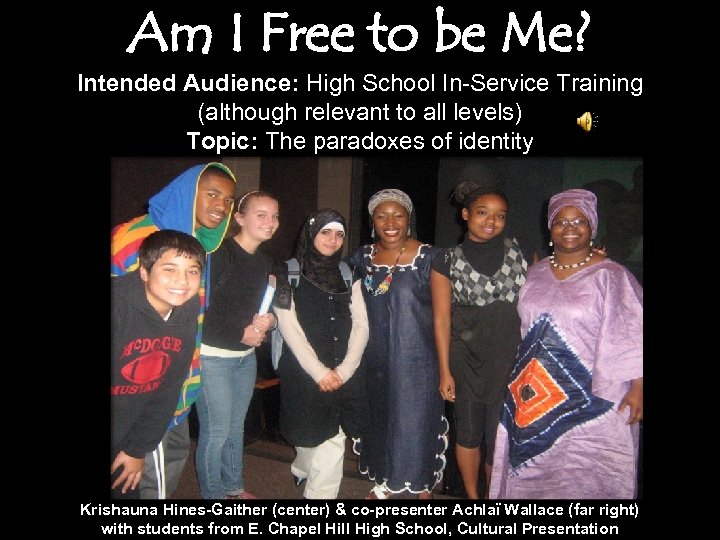
Am I Free to be Me? Intended Audience: High School In-Service Training (although relevant to all levels) Topic: The paradoxes of identity Krishauna Hines-Gaither (center) & co-presenter Achlaï Wallace (far right) with students from E. Chapel Hill High School, Cultural Presentation
“My name is Kunta Kinte. ” Roots Did you know the following celebrities changed their names? Why do you suspect they chose to leave behind these names? Of course, the obvious answer is for artistic reasons. But could there be something more? (below is a list of the actor’s artistic name followed by his/her birth name) Acculturation: the process (or the result) of adopting the cultural traits or social patterns of another group. Cher: Cherilyn Sarkisian La Piere Joan Crawford: Lucille Fay Le. Sueur Nicolas Cage: Nicolas Coppola Robert Blake: Michael James Vijenco Gubitosi Doris Day: Doris von Kappelhoff Tony Danza: Anthony Iadanza http: //www. famousnamechanges. net/ Kirk Douglas: Isidore Demsky Greta Garbo: Greta Lovisa Gustafson Rita Hayworth: Margarita Carmen Dolores Cansino Audrey Hepburn: Edda Van Heemstra Hepburn-Rusten Bruce Lee: Sai Fon Sophia Loren: Sofia Scicolone Charlie Sheen: Carlos Irwin Estevez
Pipher’s explanations • Acculturation/Assimilation: “They found that the best pattern was one in which the family carefully chose what to accept and reject in American culture” (Pipher, 2002, p. 229). • Cultural switching: “They are bicultural, or in many cases, multicultural, and they know when “to wear each culture” (Pipher, 2002, p. 168). • Cultural Brokers: “American friends who may teach them to make intentional decisions about what to accept and what to reject in America” (Pipher, 2002, p. 89). • Schools as therapeutic environments: “Teachers connect the dots between the world of family and of school, the old culture and America, the past and the future” (Pipher, 2002, p. 115).
Expanded definitions • Acculturation: the process (or the result) of adopting the cultural traits or social patterns of another group. • Cultural Broker: a party that arranges transactions. An individual who acts as an intermediary. • Cultural switching: a shift between two cultural interpretive frames in response to cues in the social environment. www. dictionary. com
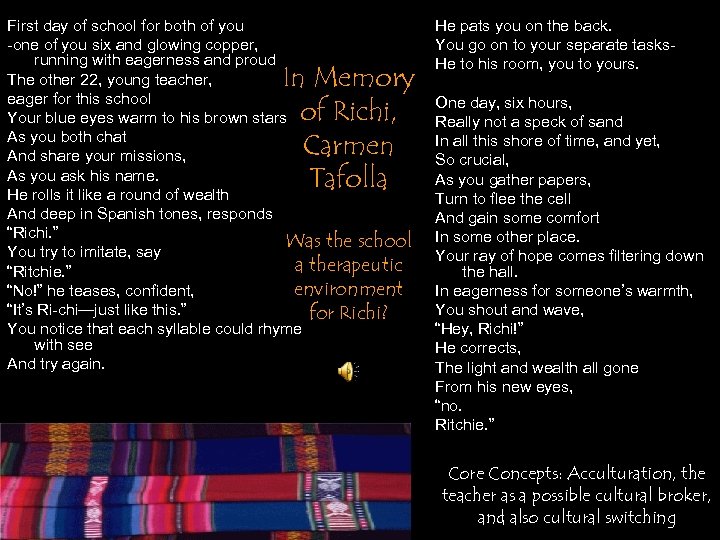
First day of school for both of you -one of you six and glowing copper, running with eagerness and proud The other 22, young teacher, eager for this school Your blue eyes warm to his brown stars As you both chat And share your missions, As you ask his name. He rolls it like a round of wealth And deep in Spanish tones, responds “Richi. ” Was the school You try to imitate, say a therapeutic “Ritchie. ” environment “No!” he teases, confident, “It’s Ri-chi—just like this. ” for Richi? You notice that each syllable could rhyme with see And try again. In Memory of Richi, Carmen Tafolla He pats you on the back. You go on to your separate tasks. He to his room, you to yours. One day, six hours, Really not a speck of sand In all this shore of time, and yet, So crucial, As you gather papers, Turn to flee the cell And gain some comfort In some other place. Your ray of hope comes filtering down the hall. In eagerness for someone’s warmth, You shout and wave, “Hey, Richi!” He corrects, The light and wealth all gone From his new eyes, “no. Ritchie. ” Core Concepts: Acculturation, the teacher as a possible cultural broker, and also cultural switching
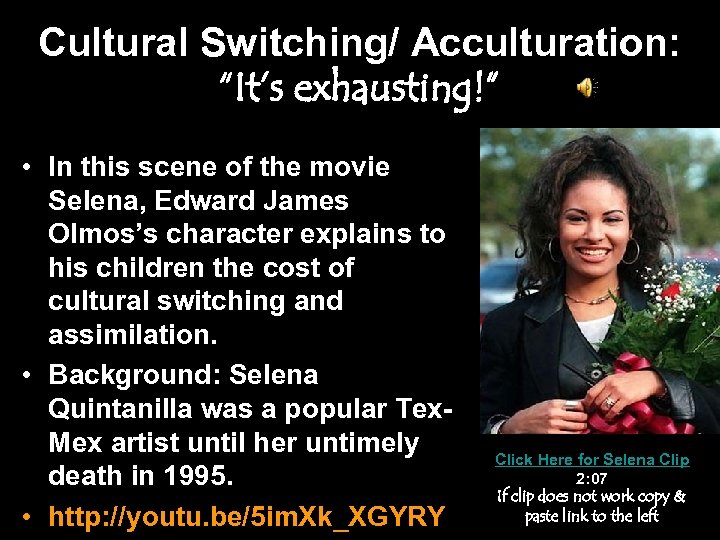
Cultural Switching/ Acculturation: “It’s exhausting!” • In this scene of the movie Selena, Edward James Olmos’s character explains to his children the cost of cultural switching and assimilation. • Background: Selena Quintanilla was a popular Tex. Mex artist until her untimely death in 1995. • http: //youtu. be/5 im. Xk_XGYRY Click Here for Selena Clip 2: 07 If clip does not work copy & paste link to the left
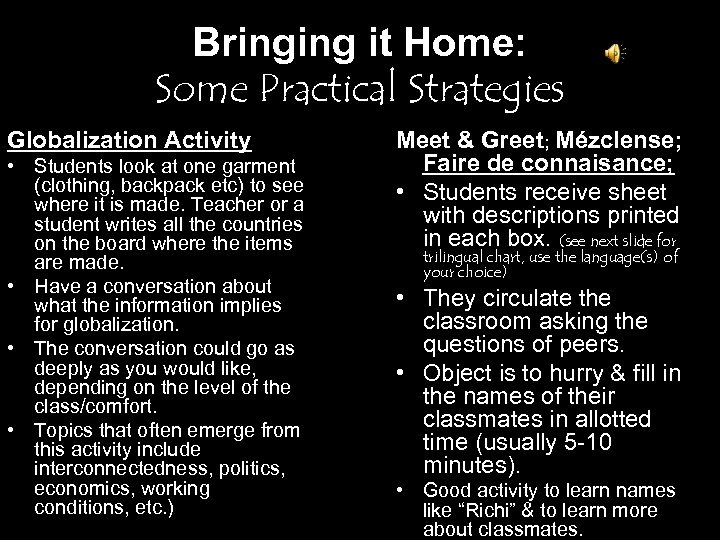
Bringing it Home: Some Practical Strategies Globalization Activity • Students look at one garment (clothing, backpack etc) to see where it is made. Teacher or a student writes all the countries on the board where the items are made. • Have a conversation about what the information implies for globalization. • The conversation could go as deeply as you would like, depending on the level of the class/comfort. • Topics that often emerge from this activity include interconnectedness, politics, economics, working conditions, etc. ) Meet & Greet; Mézclense; Faire de connaisance; • Students receive sheet with descriptions printed in each box. (see next slide for trilingual chart, use the language(s) of your choice) • They circulate the classroom asking the questions of peers. • Object is to hurry & fill in the names of their classmates in allotted time (usually 5 -10 minutes). • Good activity to learn names like “Richi” & to learn more about classmates.
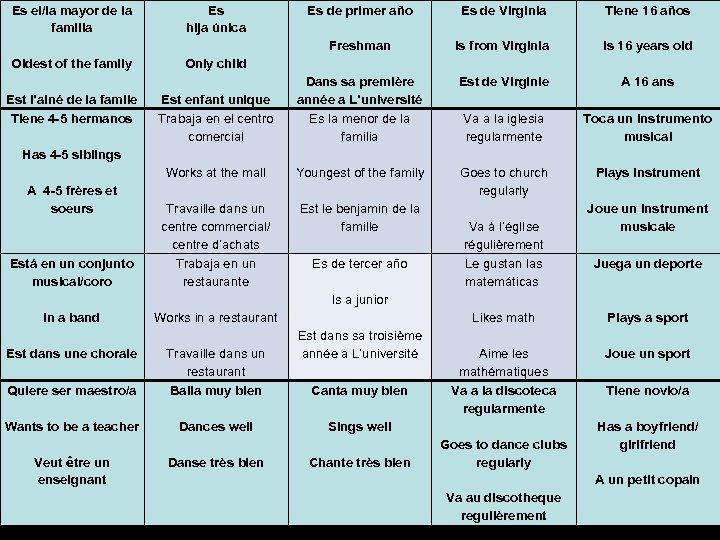
Es el/la mayor de la familia Oldest of the family Est l’ainé de la famile Tiene 4 -5 hermanos Has 4 -5 siblings A 4 -5 frères et soeurs Es hija única Only child Est enfant unique Trabaja en el centro comercial Works at the mall Travaille dans un centre commercial/ centre d’achats Trabaja en un restaurante Works in a restaurant Es de primer año Freshman Dans sa première année a L’université Es la menor de la familia Youngest of the family Est le benjamin de la famille Quiere ser maestro/a Wants to be a teacher Veut être un enseignant Tiene 16 años Is 16 years old A 16 ans Va a la iglesia regularmente Goes to church regularly Toca un instrumento musical Plays instrument Joue un instrument musicale Bringing it Home: Goals and Strategies • “To teach you I must know you. ” Alaskan Proverb (cultural broker) Está en un conjunto Es de tercer año musical/coro • Multivocalism Is a junior In a band Est dans une chorale Es de Virginia Is from Virginia Est de Virginie Travaille dans un restaurant Baila muy bien Dances well Danse très bien Va à l’églìse régulièrement Le gustan las Juega un deporte matemáticas Likes math Plays a sport Est dans sa troisième année a L’université Aime les Joue un sport mathématiques Canta muy bien Va a la discoteca Tiene novio/a regularmente Sings well Has a boyfriend/ Goes to dance clubs girlfriend Chante très bien regularly A un petit copain Va au discotheque regulièrement
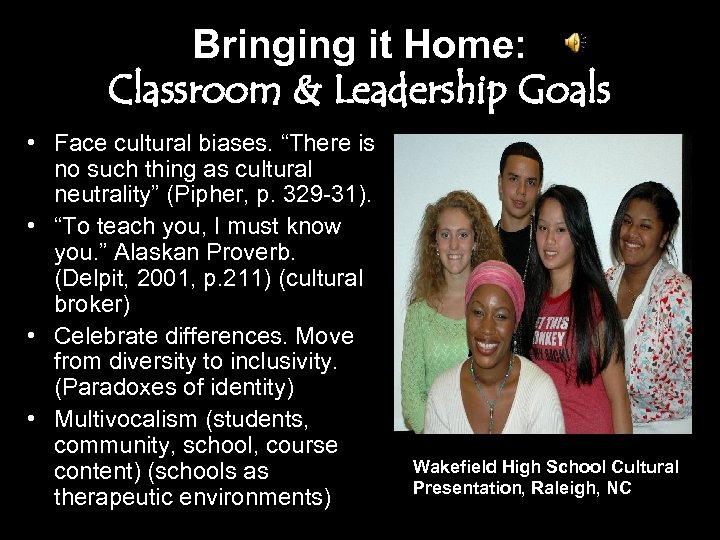
Bringing it Home: Classroom & Leadership Goals • Face cultural biases. “There is no such thing as cultural neutrality” (Pipher, p. 329 -31). • “To teach you, I must know you. ” Alaskan Proverb. (Delpit, 2001, p. 211) (cultural broker) • Celebrate differences. Move from diversity to inclusivity. (Paradoxes of identity) • Multivocalism (students, community, school, course content) (schools as therapeutic environments) Wakefield High School Cultural Presentation, Raleigh, NC
Concluding thoughts & References Delpit, L. (2001). Education in a multicultural society: Our future’s greatest challenge. In J. House (Ed. ), Exploring socio-cultural themes in education: Readings in social foundation, (2 nd ed. ). (pp. 203 -211). Upper Saddle River: Prentice-Hall, Inc. Pipher, M. (2002). The middle of everywhere: Helping refugees enter the American community. Orlando: Harcourt, Inc. Tafolla, C. (2001). Sonnets and Salsa. San Antonio: Wings Press.
Скачать презентацию Am I Free to be Me Intended Audience
339e76cbf28e312ccde779a100a1ec86.ppt