


 Скачать презентацию Alternatives for Economic Growth Employment and Poverty Reduction
50be2afb8e801c5ee12826b733d58c89.ppt
- Количество слайдов: 29
 Alternatives for Economic Growth, Employment, and Poverty Reduction in Paraguay. Macro and Micro simulations Results. José R. Molinas Institute Desarrollo Asuncion, Paraguay www. desarrollo. edu. py International Poverty Center Conference on Employment Brasilia, 11 -12 January, 2005
 PRESENTATION OUTLINE I. Central Problems of the Paraguayan Economy. II. The Searching for Macro Solutions using three types of economy-wide models. III. Micro/Sectoral Policy Implications.
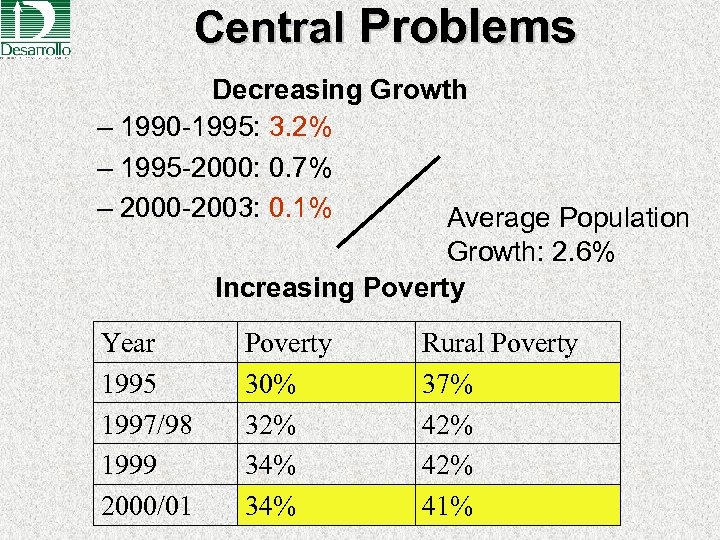 Central Problems Decreasing Growth – 1990 -1995: 3. 2% – 1995 -2000: 0. 7% – 2000 -2003: 0. 1% Average Population Growth: 2. 6% Increasing Poverty Year 1995 1997/98 1999 2000/01 Poverty 30% 32% 34% Rural Poverty 37% 42% 41%
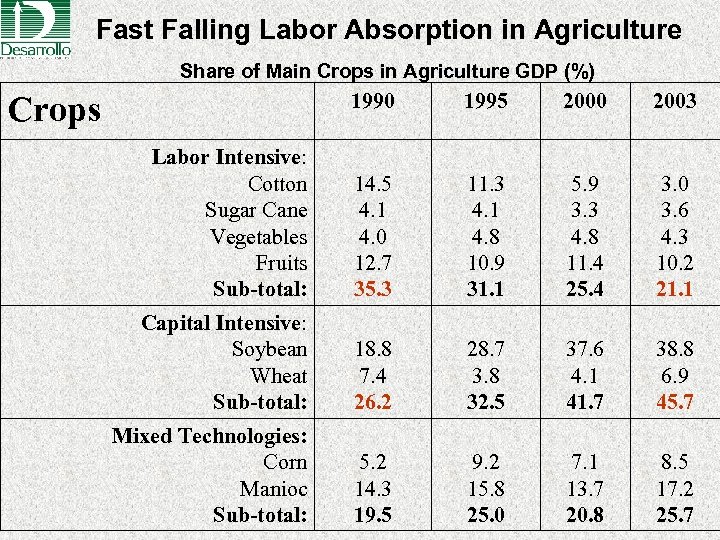 Fast Falling Labor Absorption in Agriculture Share of Main Crops in Agriculture GDP (%) 1990 1995 2000 2003 Labor Intensive: Cotton Sugar Cane Vegetables Fruits Sub-total: 14. 5 4. 1 4. 0 12. 7 35. 3 11. 3 4. 1 4. 8 10. 9 31. 1 5. 9 3. 3 4. 8 11. 4 25. 4 3. 0 3. 6 4. 3 10. 2 21. 1 Capital Intensive: Soybean Wheat Sub-total: 18. 8 7. 4 26. 2 28. 7 3. 8 32. 5 37. 6 4. 1 41. 7 38. 8 6. 9 45. 7 Mixed Technologies: Corn Manioc Sub-total: 5. 2 14. 3 19. 5 9. 2 15. 8 25. 0 7. 1 13. 7 20. 8 8. 5 17. 2 25. 7 Crops
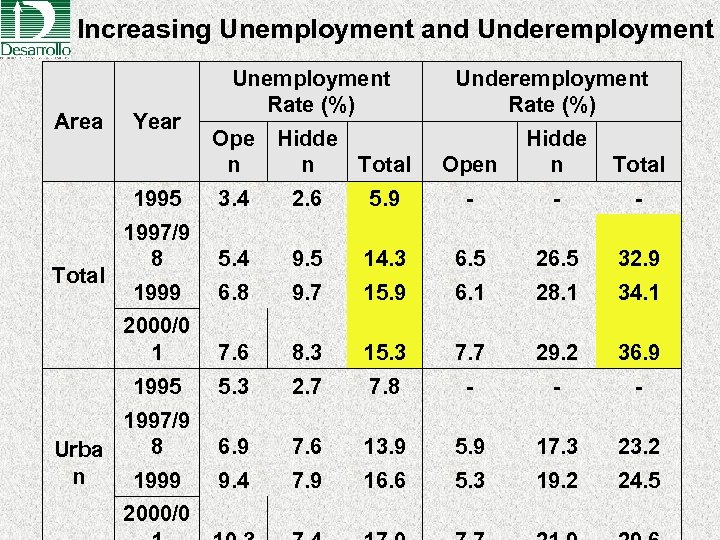 Increasing Unemployment and Underemployment Area Year Unemployment Rate (%) Underemployment Rate (%) Ope Hidde n n Total Open Hidde n Total 1995 2. 6 5. 9 - - - 1997/9 8 5. 4 9. 5 14. 3 6. 5 26. 5 32. 9 1999 6. 8 9. 7 15. 9 6. 1 28. 1 34. 1 2000/0 1 7. 6 8. 3 15. 3 7. 7 29. 2 36. 9 1995 Total 3. 4 5. 3 2. 7 7. 8 - - - 6. 9 7. 6 13. 9 5. 9 17. 3 23. 2 9. 4 7. 9 16. 6 5. 3 19. 2 24. 5 1997/9 8 Urba n 1999 2000/0
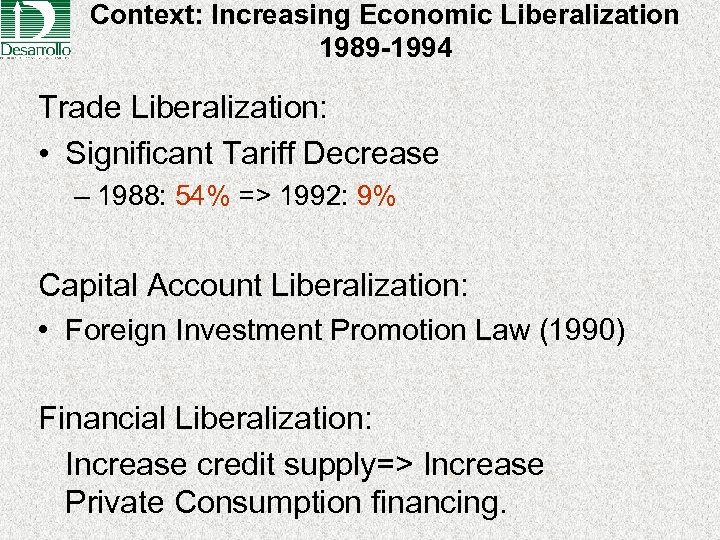 Context: Increasing Economic Liberalization 1989 -1994 Trade Liberalization: • Significant Tariff Decrease – 1988: 54% => 1992: 9% Capital Account Liberalization: • Foreign Investment Promotion Law (1990) Financial Liberalization: Increase credit supply=> Increase Private Consumption financing.
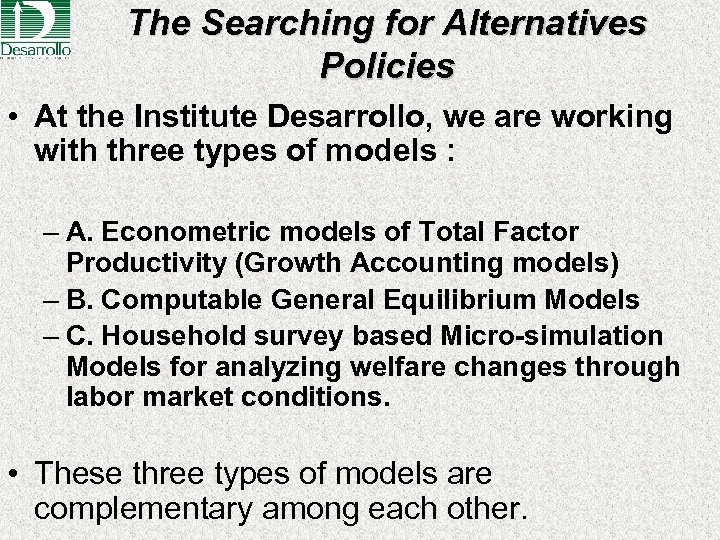 The Searching for Alternatives Policies • At the Institute Desarrollo, we are working with three types of models : – A. Econometric models of Total Factor Productivity (Growth Accounting models) – B. Computable General Equilibrium Models – C. Household survey based Micro-simulation Models for analyzing welfare changes through labor market conditions. • These three types of models are complementary among each other.
 Econometric models of total factor productivity (growth accounting models)
 Selected Results Basic features of the Paraguayan economy in the last 35 years, according to this model: Factor contribution to GDP Growth: • Physical capital contributed in 72% • Land contributed in 11% • Unskilled labor force contributed 10% • Education per worker (human capital) contributed only 0. 3% Technological change contributed in 6. 5% to GDP growth.
 Selected Results Within physical capital, investment on communication is the most socially profitable, following by investment on transport, and machinery respectively. The least profitable in social terms is the investment on buildings. To match a similar impact on GDP growth by an investment of US$ 70 million on communication, we need US$ 182 million investment on transport, US$ 303 million on machinery, and US$ 1, 092 million on buildings.
 Selected Results Technological change positively depends on: (i) FDI/Total Private Investment, (ii) Exports/GDP, and (iii) Industry Valued Added/GDP.
 Aggregate Estimations • In Paraguay, we need four main conditions for achieving an average GDP growth rate greater than 5% over the next 6 years. 1) A gradual increase on investment share of GDP (from a current average of 21% to 26% of GDP), prioritizing investment on communication, transport and machinery, respectively.
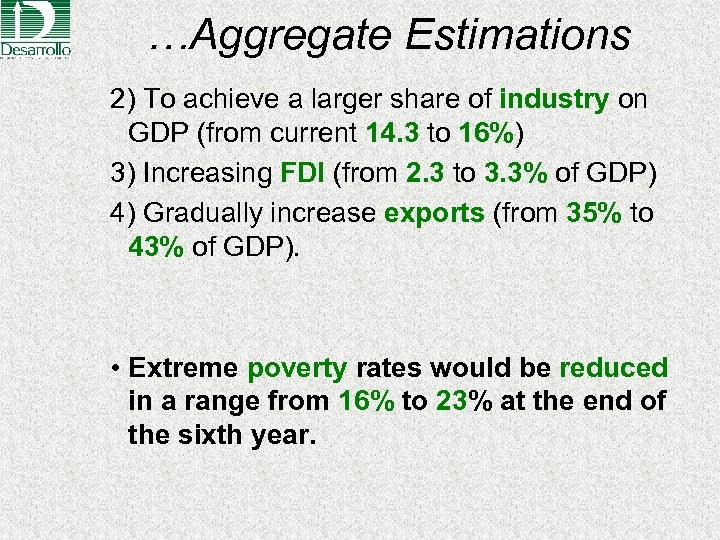 …Aggregate Estimations 2) To achieve a larger share of industry on GDP (from current 14. 3 to 16%) 3) Increasing FDI (from 2. 3 to 3. 3% of GDP) 4) Gradually increase exports (from 35% to 43% of GDP). • Extreme poverty rates would be reduced in a range from 16% to 23% at the end of the sixth year.
 The Computable General Equilibrium Model
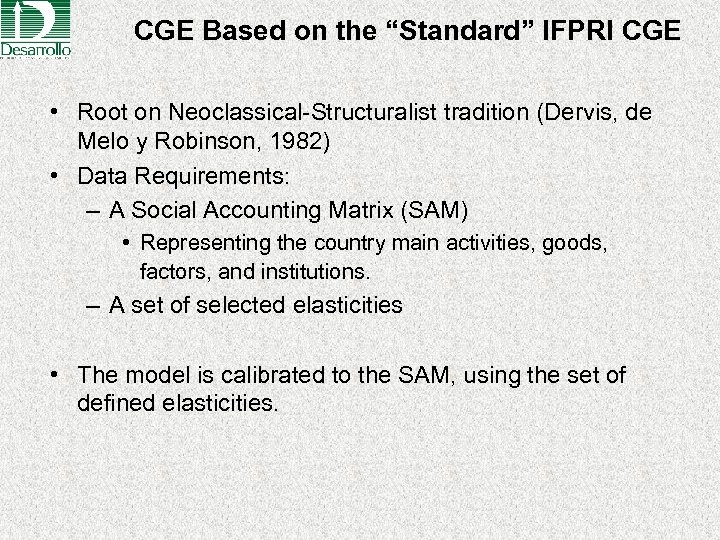 CGE Based on the “Standard” IFPRI CGE • Root on Neoclassical-Structuralist tradition (Dervis, de Melo y Robinson, 1982) • Data Requirements: – A Social Accounting Matrix (SAM) • Representing the country main activities, goods, factors, and institutions. – A set of selected elasticities • The model is calibrated to the SAM, using the set of defined elasticities.
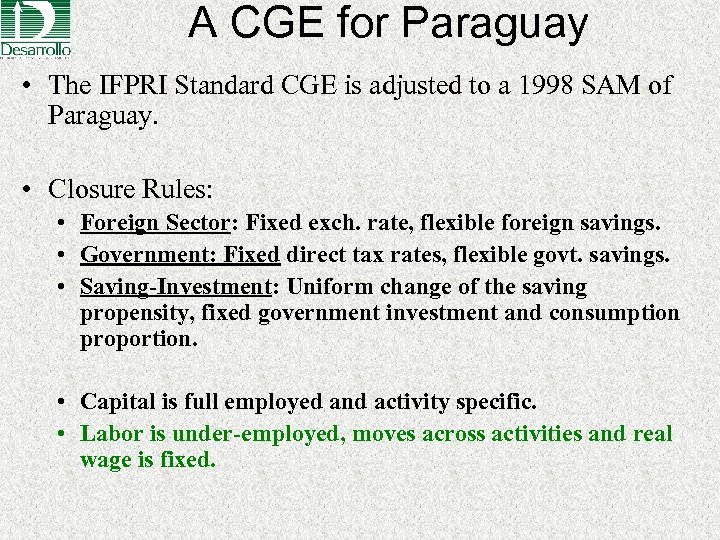 A CGE for Paraguay • The IFPRI Standard CGE is adjusted to a 1998 SAM of Paraguay. • Closure Rules: • Foreign Sector: Fixed exch. rate, flexible foreign savings. • Government: Fixed direct tax rates, flexible govt. savings. • Saving-Investment: Uniform change of the saving propensity, fixed government investment and consumption proportion. • Capital is full employed and activity specific. • Labor is under-employed, moves across activities and real wage is fixed.
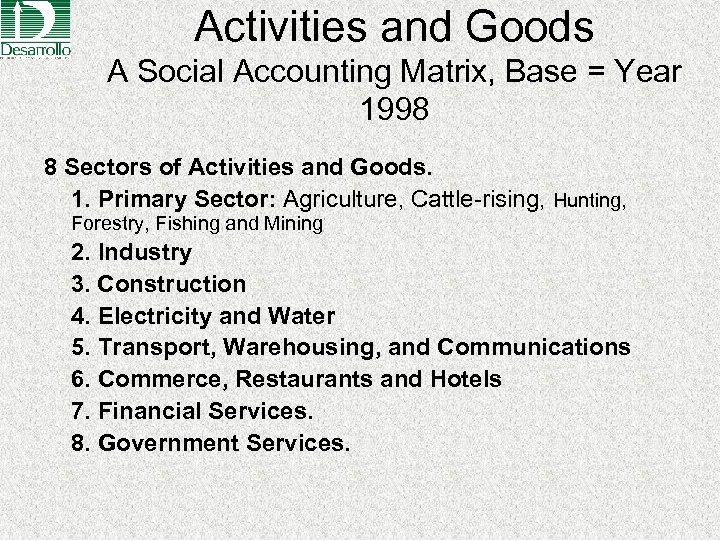 Activities and Goods A Social Accounting Matrix, Base = Year 1998 8 Sectors of Activities and Goods. 1. Primary Sector: Agriculture, Cattle-rising, Hunting, Forestry, Fishing and Mining 2. Industry 3. Construction 4. Electricity and Water 5. Transport, Warehousing, and Communications 6. Commerce, Restaurants and Hotels 7. Financial Services. 8. Government Services.
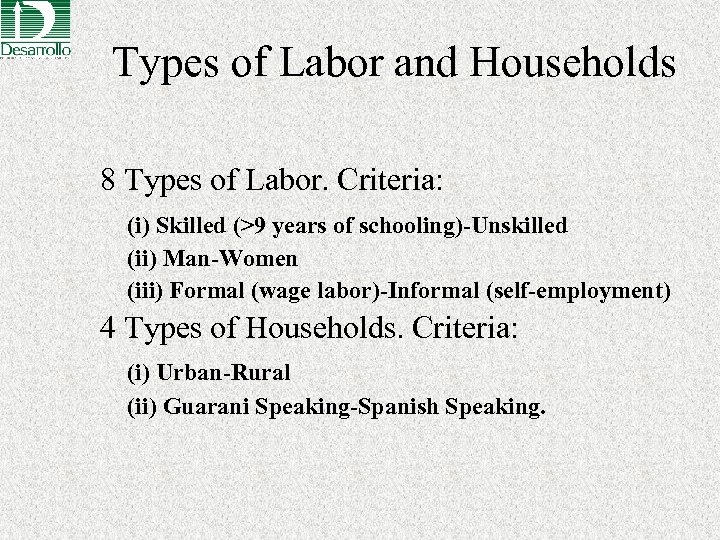 Types of Labor and Households 8 Types of Labor. Criteria: (i) Skilled (>9 years of schooling)-Unskilled (ii) Man-Women (iii) Formal (wage labor)-Informal (self-employment) 4 Types of Households. Criteria: (i) Urban-Rural (ii) Guarani Speaking-Spanish Speaking.
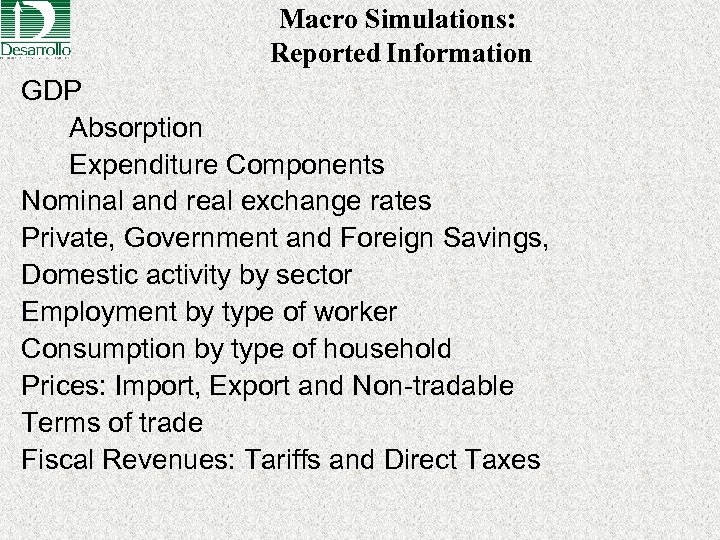 Macro Simulations: Reported Information GDP Absorption Expenditure Components Nominal and real exchange rates Private, Government and Foreign Savings, Domestic activity by sector Employment by type of worker Consumption by type of household Prices: Import, Export and Non-tradable Terms of trade Fiscal Revenues: Tariffs and Direct Taxes
 Household survey based Micro-simulation Models
 Micro-simulations • The micro-simulation exercises use the complete range of income distribution, as stated in the 1997/98 Paraguayan Household Survey (HS). • The HS original database is transformed according to the changes in the labor market structure as defined in the different scenarios simulated with the CGE. • The labor market is defined by the unemployment rates, by the structure of employment by sectors, by types of labor (skilled/unskilled), by earnings, and by the general average of labor income.
 Micro-simulations • The basic problem is to determine what would be the poverty and inequality levels IF the labor market were determined by an unemployment level, an structure of employment by sector, by type of workers different from the one observed in the 1997/98 Household Survey and defined by the CGE simulations results. • The selection of which individuals (HS observations) will change their labor condition in the original database is undertaken by a random process. • A Monte Carlo procedure is applied to generate confidence intervals. • It is reported the average results of 30 runs with different allocations of random numbers.
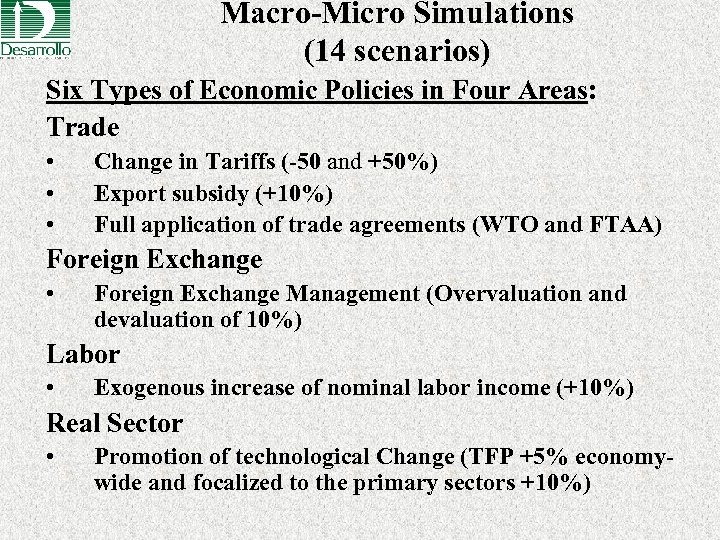 Macro-Micro Simulations (14 scenarios) Six Types of Economic Policies in Four Areas: Trade • • • Change in Tariffs (-50 and +50%) Export subsidy (+10%) Full application of trade agreements (WTO and FTAA) Foreign Exchange • Foreign Exchange Management (Overvaluation and devaluation of 10%) Labor • Exogenous increase of nominal labor income (+10%) Real Sector • Promotion of technological Change (TFP +5% economywide and focalized to the primary sectors +10%)
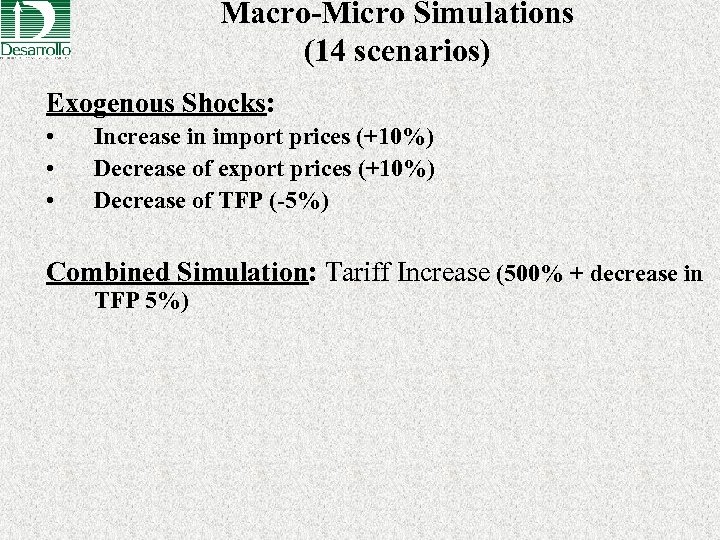 Macro-Micro Simulations (14 scenarios) Exogenous Shocks: • • • Increase in import prices (+10%) Decrease of export prices (+10%) Decrease of TFP (-5%) Combined Simulation: Tariff Increase (500% + decrease in TFP 5%)
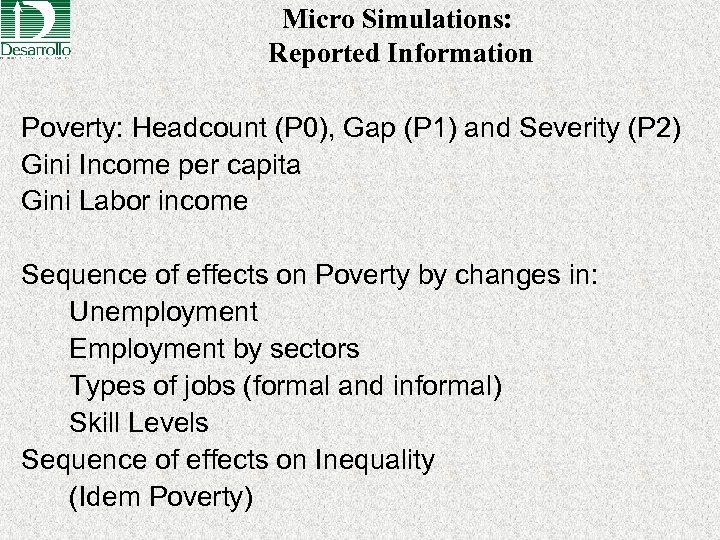 Micro Simulations: Reported Information Poverty: Headcount (P 0), Gap (P 1) and Severity (P 2) Gini Income per capita Gini Labor income Sequence of effects on Poverty by changes in: Unemployment Employment by sectors Types of jobs (formal and informal) Skill Levels Sequence of effects on Inequality (Idem Poverty)
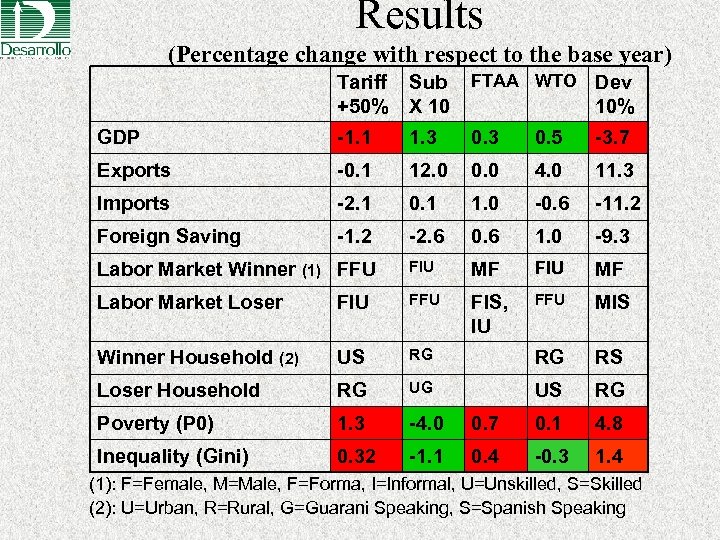 Results (Percentage change with respect to the base year) Tariff +50% Sub X 10 FTAA WTO Dev 10% GDP -1. 1 1. 3 0. 5 -3. 7 Exports -0. 1 12. 0 0. 0 4. 0 11. 3 Imports -2. 1 0. 1 1. 0 -0. 6 -11. 2 Foreign Saving -1. 2 -2. 6 0. 6 1. 0 -9. 3 Labor Market Winner (1) FFU FIU MF Labor Market Loser FIU FFU FIS, IU FFU MIS Winner Household (2) US RG RG RS Loser Household RG UG US RG Poverty (P 0) 1. 3 -4. 0 0. 7 0. 1 4. 8 Inequality (Gini) 0. 32 -1. 1 0. 4 -0. 3 1. 4 (1): F=Female, M=Male, F=Forma, I=Informal, U=Unskilled, S=Skilled (2): U=Urban, R=Rural, G=Guarani Speaking, S=Spanish Speaking
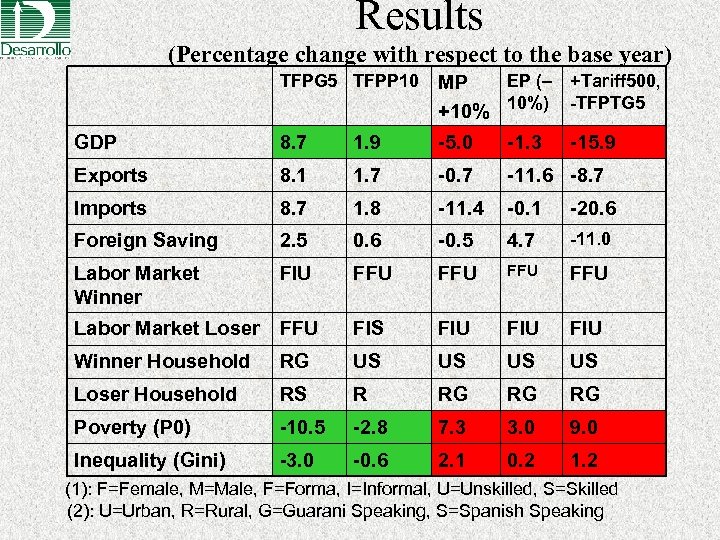 Results (Percentage change with respect to the base year) TFPG 5 TFPP 10 EP (– +Tariff 500, MP +10% 10%) -TFPTG 5 GDP 8. 7 1. 9 -5. 0 -1. 3 Exports 8. 1 1. 7 -0. 7 -11. 6 -8. 7 Imports 8. 7 1. 8 -11. 4 -0. 1 -20. 6 Foreign Saving 2. 5 0. 6 -0. 5 4. 7 -11. 0 Labor Market Winner FIU FFU FFU Labor Market Loser FFU FIS FIU FIU Winner Household RG US US Loser Household RS R RG RG RG Poverty (P 0) -10. 5 -2. 8 7. 3 3. 0 9. 0 Inequality (Gini) -3. 0 -0. 6 2. 1 0. 2 1. 2 -15. 9 (1): F=Female, M=Male, F=Forma, I=Informal, U=Unskilled, S=Skilled (2): U=Urban, R=Rural, G=Guarani Speaking, S=Spanish Speaking
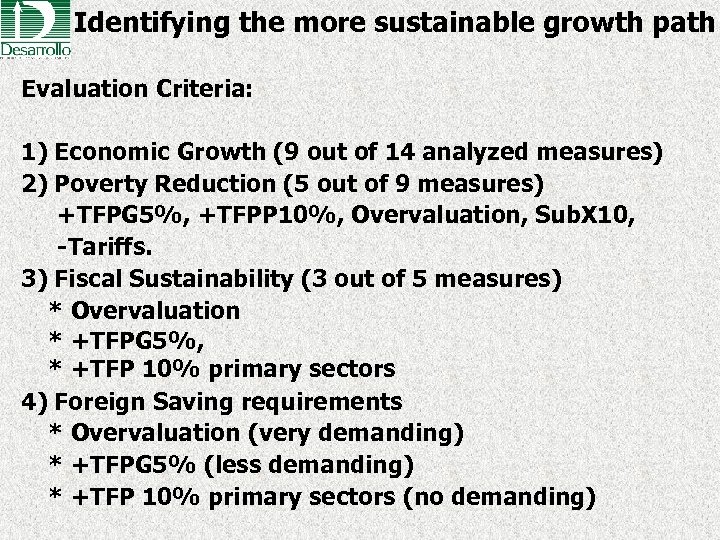 Identifying the more sustainable growth path Evaluation Criteria: 1) Economic Growth (9 out of 14 analyzed measures) 2) Poverty Reduction (5 out of 9 measures) +TFPG 5%, +TFPP 10%, Overvaluation, Sub. X 10, -Tariffs. 3) Fiscal Sustainability (3 out of 5 measures) * Overvaluation * +TFPG 5%, * +TFP 10% primary sectors 4) Foreign Saving requirements * Overvaluation (very demanding) * +TFPG 5% (less demanding) * +TFP 10% primary sectors (no demanding)
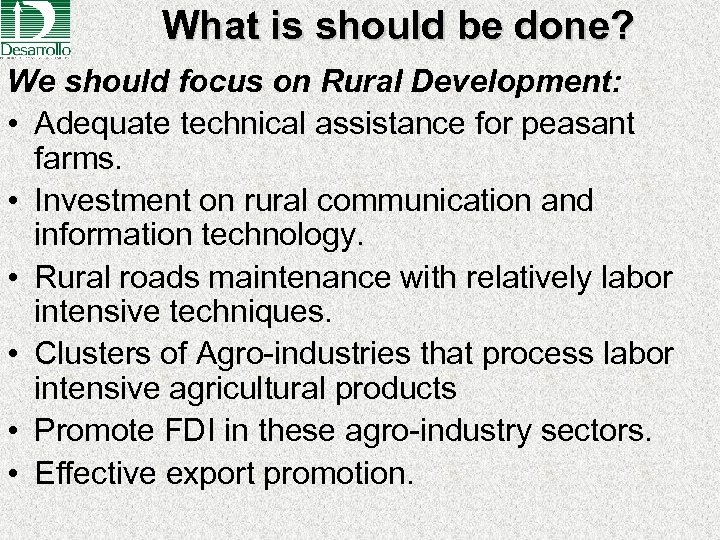 What is should be done? We should focus on Rural Development: • Adequate technical assistance for peasant farms. • Investment on rural communication and information technology. • Rural roads maintenance with relatively labor intensive techniques. • Clusters of Agro-industries that process labor intensive agricultural products • Promote FDI in these agro-industry sectors. • Effective export promotion.